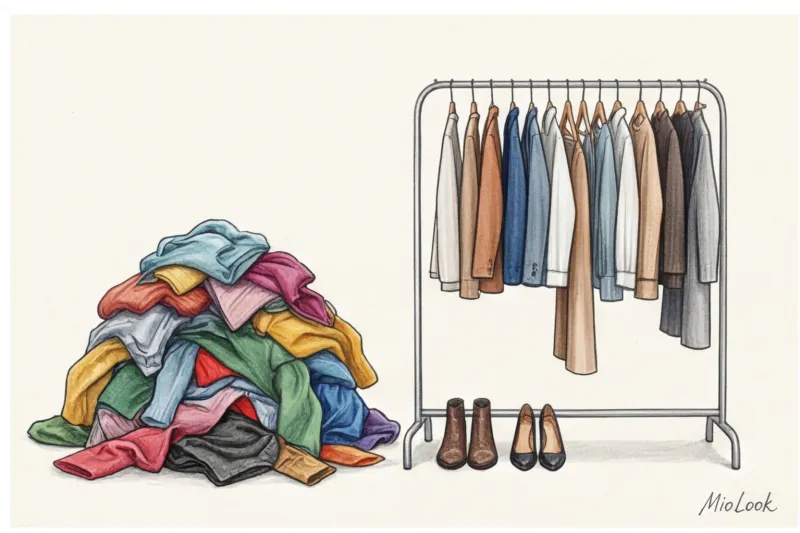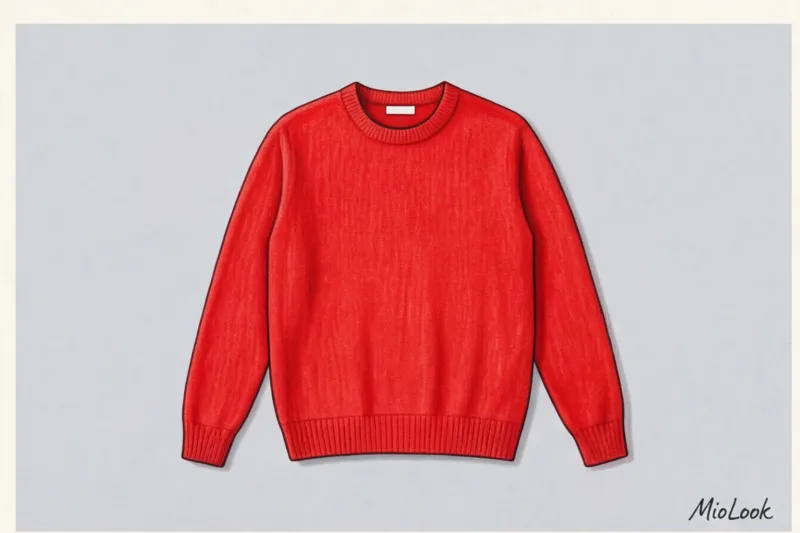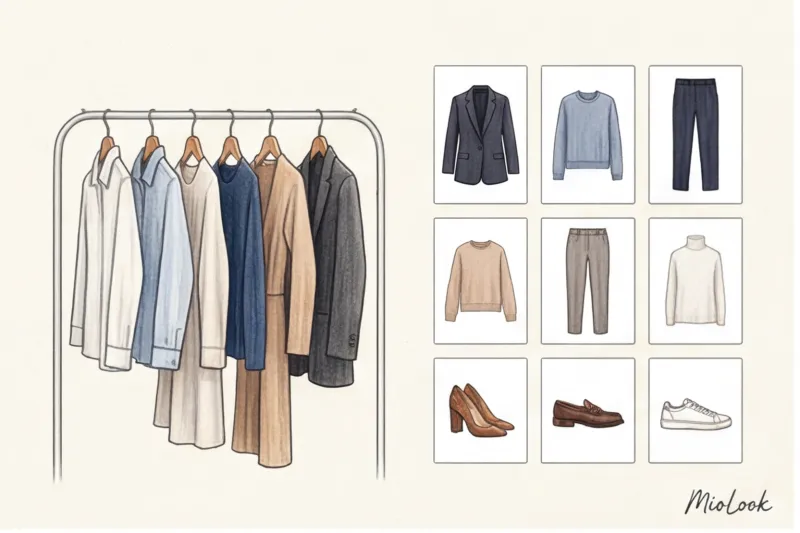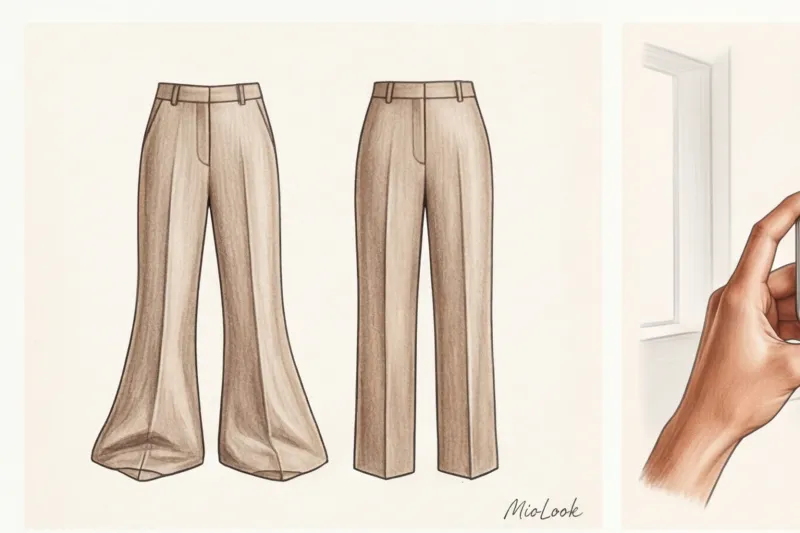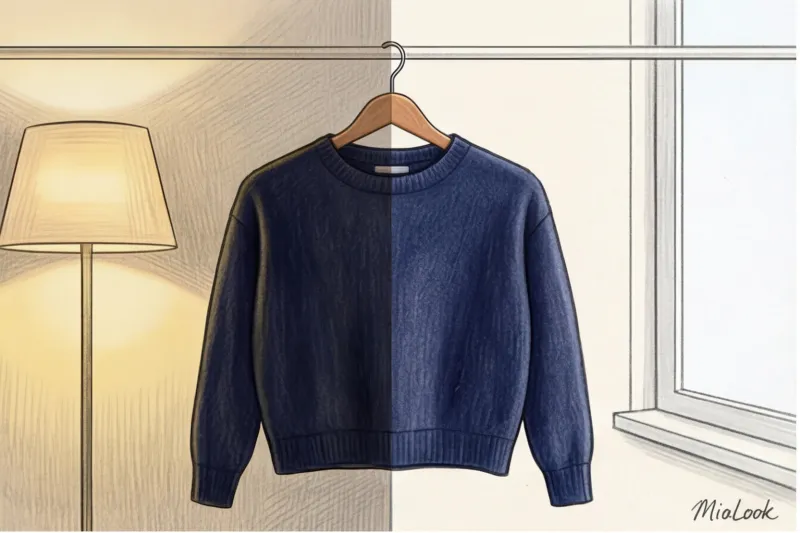
I still remember the evening when one of my clients, in desperation, sent me a screenshot from her smart wardrobe app. "Isabella, why is AI suggesting I wear this gorgeous navy sweater with black trousers and red shoes? This is a disaster!" she wrote. I asked for the original photo of the sweater. And everything fell into place: in the photo, taken that evening under a dim bedroom lamp, the elegant navy shade looked like a dirty black.
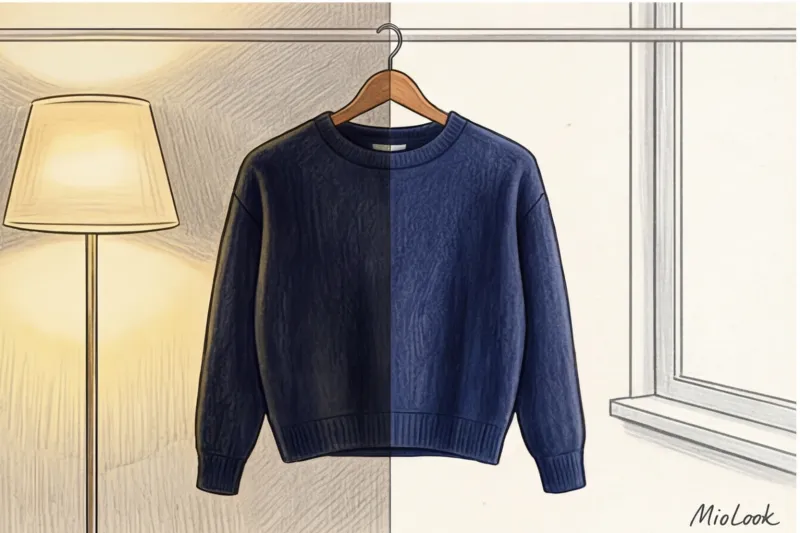
This situation repeats itself time and time again. We invest in high-quality fabrics, hunt for the perfect, complex shades, and then ruin all their magic with one wrong phone shot. If you want your pocket stylist to work flawlessly, you need to know... How to photograph clothes without color distortion We've already covered the basic principles of creating an electronic cabinet in more detail in our The complete guide to photographing clothes for a virtual wardrobe.
Ladies, proper color rendition isn't some street magic trick or the preserve of professional photographers with thousands of euros' worth of equipment. It's the pure physics of light, which we'll put to work today to enhance your impeccable style.
Why does the camera lie? The physics of color and the cruel logic of neural networks.
Let's get back to my client and her €115 COS sweater. Why did the algorithm get it wrong? It's all about principle. Garbage in, garbage out (Garbage in, garbage out). For you, it's your favorite cashmere sweater that makes you feel like a goddess. For a neural network, it's just a set of RGB pixels. If the yellow room light has degraded the blue color and the pixels are considered black (RGB is closer to 15, 15, 15), the AI will collect images for you featuring a "black" item.
How do they work? Computer Vision algorithms and AI work in apps like MioLook They mathematically calculate the dominant hue and search for complementary colors on the color wheel. Moreover, according to WGSN technical reports for 2024, machine vision algorithms require a contrast ratio of at least 30% to correctly distinguish an item from its background. If an item blends into the background or is bathed in yellow light, the neural network simply doesn't understand where the sleeve ends and the shadow begins.
Your smartphone also adds fuel to the fire. Built-in HDR (High Dynamic Range) algorithms attempt to "improve" the photo by artificially brightening shadows and boosting saturation. As a result, the dusty olive turns into a toxic lime green.
Access to MioLook for €0.99 — one-time payment
A smart AI stylist will select the perfect look based on the actual colors in your wardrobe.
Get access — €0.99 onceThe Main Secret: How to Photograph Clothes Without Color Distortion
My personal formula, developed over 12 years of wardrobe analysis, is as follows: Correct lighting + ironed item + neutral background = 100% AI selection accuracy And the main ingredient here is diffused daylight.
Imagine your window as a giant professional softbox. For soft light, it needs to pass through a diffuser. At home, a simple matte white tulle or a light cloud cover outside the window works perfectly. The light should fall on the garment from the front and slightly above. Remember: harsh sidelight creates false volume. It will highlight every microscopic fiber and create harsh shadows, turning smooth viscose into something like crumpled burlap.
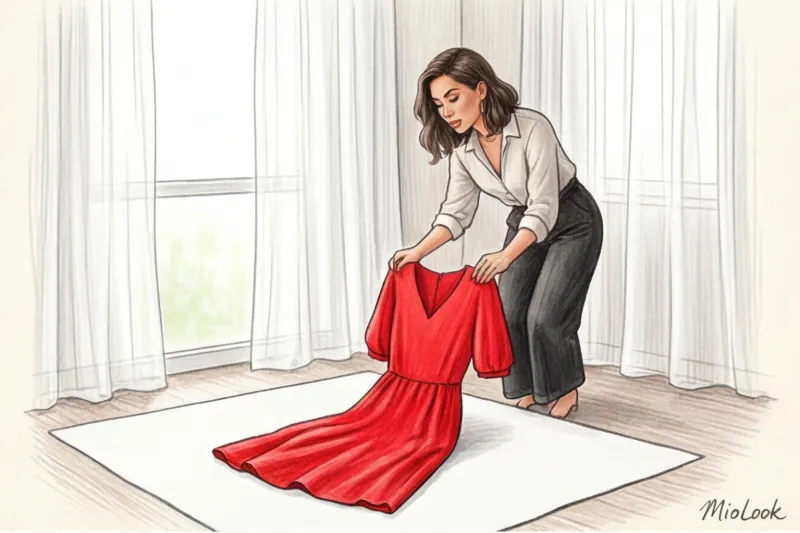
A particular pain point for stylists is the background. Never photograph clothes against a vibrant peach carpet or a yellow sofa! In physics, there's a concept called "color reflection." A bright background will cast its own color reflections onto your clothes, distorting their true color.
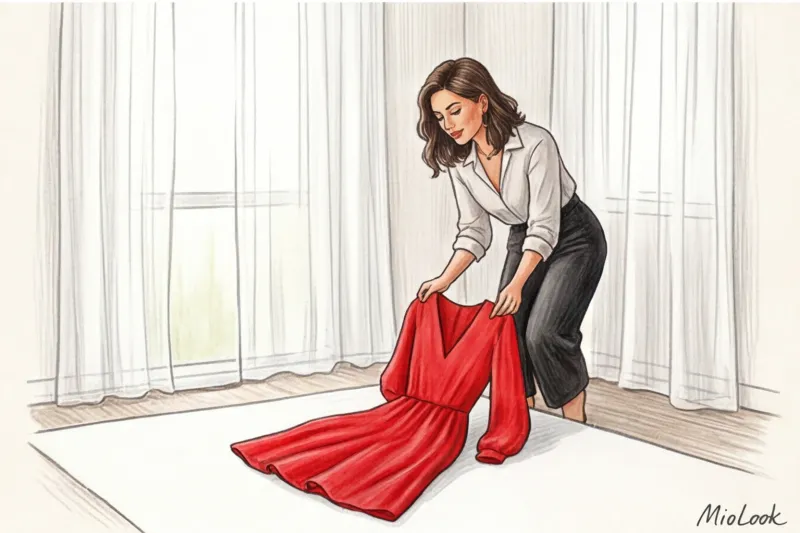
The perfect time and place for a house shoot
Where to look for that perfect light? In your apartment, it's north- or east-facing windows. The optimal time to digitize your wardrobe is between 10:00 AM and 2:00 PM. The light during this period is at its most neutral.
- Don't place the item too close to the glass. Move 1–1.5 meters into the room.
- If there's only a window on one side, the other side of the item will be in deep shadow. Try this: place a plain white sheet of poster board (or a piece of white cardboard) on the shadow side. It will act as a reflector and softly fill the shadows, evening out the lighting.
The Direct Sunlight Mistake: Debunking the Myth
Many people think that a bright, sunlit space (like a balcony on a clear summer day) is a photographer's best friend. As a stylist with a Mediterranean soul, I adore the sun, but for a digital wardrobe, it's your worst enemy.
Direct sunlight burns out the color, creating what's known as "overexposure." The fabric begins to shimmer and appear whitish. Furthermore, the sun creates harsh, pitch-black shadows from every fold. The neural network interprets this black shadow as a decorative seam, an asymmetrical cut, or, even worse, a striped print. The garment's silhouette is irrevocably disrupted.
Your perfect look starts here
Join thousands of users who look flawless every day with MioLook by uploading their items without distortion.
Get access — €0.99 onceArtificial light: salvation in the evening or a style disaster?
I'm a realist. I know most of us only find time to clean out our closets in the evenings, after the kids are in bed and work emails are sent. If you're forced to shoot under artificial light, you need to know two technical terms: CRI and Kelvin.
Color Rendering Index (CRI) Shows how accurately a light source displays real colors compared to reference sunlight. For high-quality clothing photography, you need a lamp with a CRI > 90. Regular, cheap supermarket LEDs have a CRI of around 70—under them, your clothes will look as if they were washed with a gray towel.
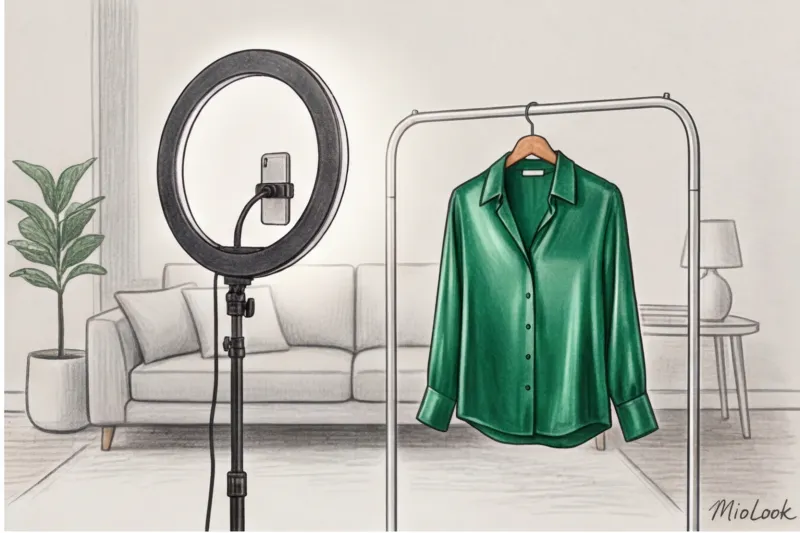
The second parameter is - color temperature According to research by the Lighting Research Center (2023), classic incandescent bulbs with a warm temperature (2700K) distort the blue and green spectrum by up to 40%. A blue shirt will turn greenish, and a purple dress will turn brown. Too cool light (6500K) will turn a luxurious warm beige into a deathly gray. Your ideal is neutral white light in the range 5000–5500K.
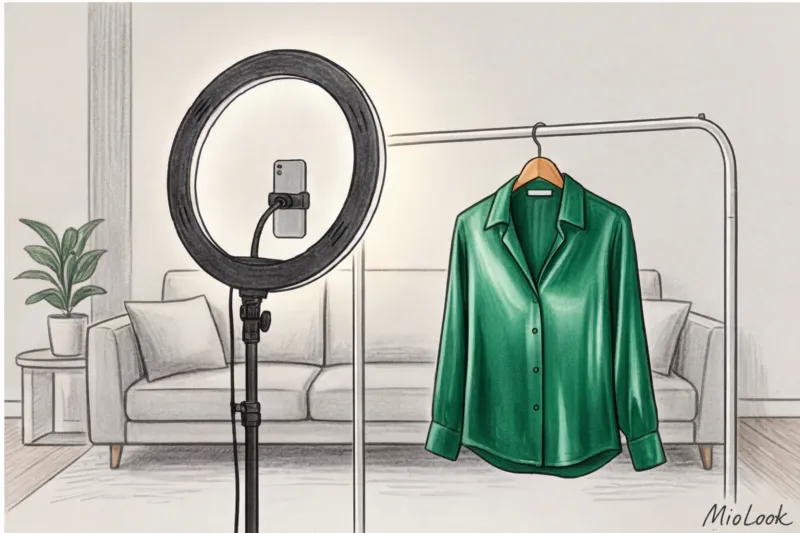
If you're using a ring light for bloggers, never point it directly at the garment! Instead, point the light toward a white wall or ceiling—let the light reflect and fall on the garment in a soft, diffused beam.
Complex fabrics and colors: silk, velvet, Total Black and snow-white
In my experience, the most common cause of hysteria when digitizing a wardrobe is items with a strong texture. I once tried to photograph my emerald silk blouse. The slightest misstep refracted the light so that the AI interpreted it as a swamp-colored garment with white specks.
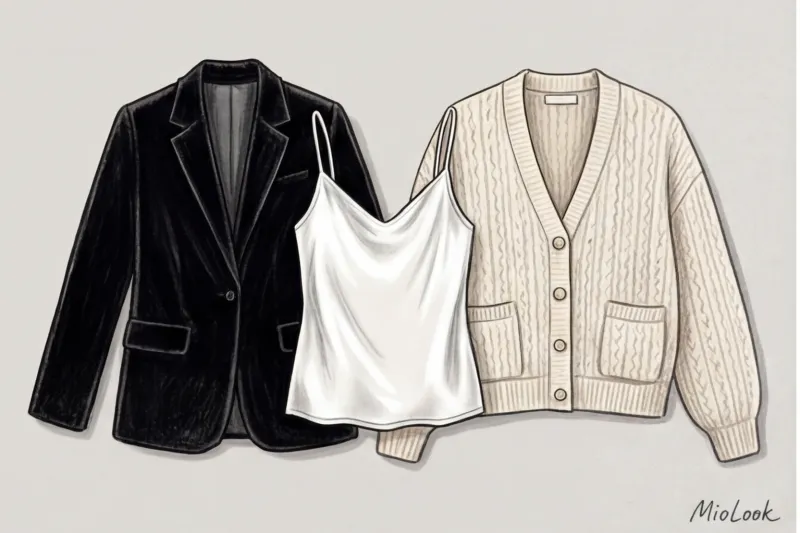
Here are proven solutions for “capricious” textures:
- Silk and satin: Vary the angle of your smartphone. Don't shoot straight down. Tilt the phone 10-15 degrees to remove the glare from the lens, revealing only the pure, deep color of the fabric.
- Total Black (deep black): A black velvet jacket in a photo often merges into a single black hole without lapels or buttons. The secret: slightly underexpose Frame. Tap the jacket area on your smartphone screen and slightly lower the brightness slider (the sun icon). The texture will instantly appear!
- Snow-white things: The biggest mistake is shooting a white shirt on a white sheet. The camera will go crazy trying to find the white balance. Use a light gray, dusty pink, or any pastel background for contrast.
- Volumetric knitting (braids, rib): To highlight the texture of a cozy cardigan, here (and only here!) you can slightly shift the light source to the side. A subtle side shadow will tell the algorithm that it's wearing a thick, voluminous knit, not a thin summer tank top.
Important limitation: To be honest, these tips don't work for 100% of everyone's wardrobe. If you're trying to photograph a dress completely embroidered with sequins or a top with holographic lurex, your smartphone camera will still fail due to unpredictable glare. In such rare cases, it's nearly impossible to accurately capture color without a professional polarizing filter on your lens.
Checklist: The Perfect Digitalization for a Smart Wardrobe
Many women give up on creating a digital wardrobe after the first 10 items because the results look untidy on the screen. To make your virtual shelves look like an expensive boutique display, memorize this short process.
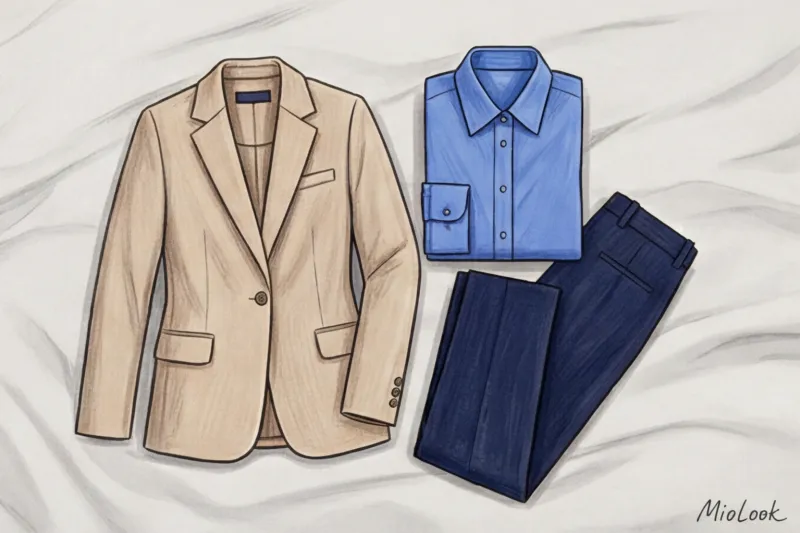
- Iron the item. It sounds boring, but a wrinkled garment ruins the silhouette. The neural network doesn't know that these creases are the result of being stored on a chair for a long time. It'll think it's drapery and choose completely inappropriate "companions" for it. for perfect capsules.
- Use Flat lay. Spread the garment out on the floor or bed so that it follows the shape of your body. Sleeves should not be tucked under the back.
- Hide tags and labels. Carefully fold them inward. Adjust the collar as you would wear it in real life.
- Wipe your camera lens! This is the most trivial, yet most common, mistake. Fingerprints on the camera lens create a cloudy, milky glow that ruins the contrast and microcontrast of the fabric.
- Lock the focus. Before pressing the shutter button, press and hold your finger on the screen in the center of the item until "AE/AF Lock" (auto exposure and auto focus) appears. This will prevent the camera from suddenly changing brightness if your hands shake slightly.
Ready to get started?
Upload your well-photographed items to MioLook and discover hundreds of new combinations.
Get access — €0.99 onceAn investment of time that will change your style forever.
I know what you're thinking: "Isabella, I need to iron, find the right lighting, lay them out... I have 150 items in my closet, it'll take forever!" Yes, the initial digitization of your wardrobe will require several hours of your free time.
But listen: this is one-time investment. You do this once for each item. In return, thanks to the accurately rendered color, MioLook's algorithms will be able to offer you such stunning color combinations and color types (like complex color blocking) that you never even knew existed. You'll be able to tidy up not only your closet, but your style as well generally.
Right now, after reading this article, choose the five most difficult-to-match colors in your closet. Wait for soft morning light, place them against a neutral background, and take a photo according to my rules. You'll see with your own eyes the difference between a "just a photo" and a professional digital copy that will breathe new life into your style.