

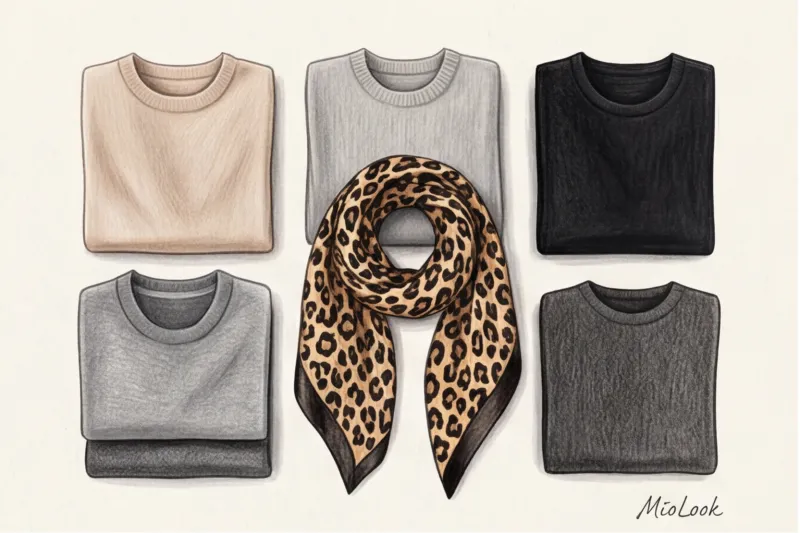
Fashionable prints in clothing: why we're afraid of them and how to start wearing them
Take a look at your closet right now. I bet somewhere in the back of it, hanging forlornly, is an item with a tag that you bought in a sudden burst of inspiration. Chances are, it's not a boring gray turtleneck. Typically, these "wardrobe ghosts" are leopard-print skirts, crazy checkered jackets, or brightly textured leather tops. Integrate fashionable prints in clothing It can be scary to embrace everyday style: we fall in love with them in the window, buy them on impulse, and then on a frosty morning we panic when we think, “What am I going to wear this with?” and end up choosing our usual jeans.
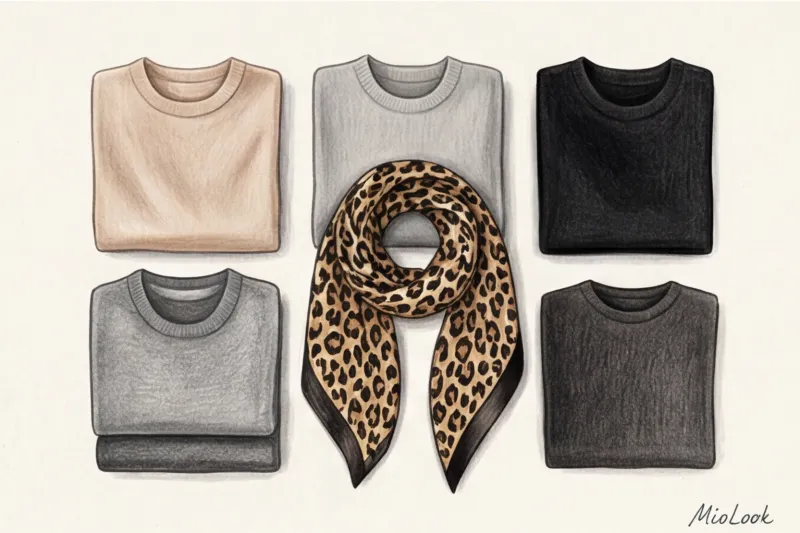
Over the 12 years I've been working as a personal stylist, I've reviewed wardrobes every week. And I almost always find this "graveyard of ambitions"—items priced between €50 and €300 that never see the light of day. Why does this happen? The answer lies in the pure psychology of shopping. Our eyes get tired of everyday monochrome, we crave a sense of celebration, and our brains respond to vibrant patterns with a surge of dopamine. We buy these items not as utilitarian objects, but as a promise of a new, bolder version of ourselves. But for a piece to truly work, it must become functional accent.
A functional accent is a statement piece that fits seamlessly into your current look and doesn't require you to buy five more new items to tone it down.
One of my clients once complained angrily: "Katarzyna, I bought a leopard-print blouse with ruffles, flounces, and puffy sleeves, but I've never worn it. I feel like an actress in a burned-out theater." And this phrase contains the biggest mistake beginners make.
This mistake is to try to combine a complex print with a complex design Ruffles, asymmetry, and peplums combined with aggressive animal prints or large tartans create a total visual disaster. The different stylistic messages (the romanticism of the ruffles and the boldness of the animal print) begin to clash.
This leads to an ironclad rule that I convey at every consultation. Katarzyna's rule: the more active the print or texture, the more laconic the cut of the garment should be. If you want to wear leopard, go with a simple straight silk midi skirt (these are regularly and perfectly cut at Zara or H&M Premium) or a classic straight-cut cardigan without unnecessary details. Smooth women's biker jacket A basic cut will easily balance any lace dress, while a model with an abundance of studs and rivets paired with lace will turn you into a caricature. Clean geometry and minimalist cut save any pattern, even the most eccentric.
The 80/20 Rule for Active Textures and Patterns
The second common problem is a lack of moderation. Introducing a print into a basic wardrobe doesn't tolerate chaos; it requires strict math. If you're just starting to tame complex textures and fashion aesthetics in clothing , use the golden 80/20 rule.
The essence of this formula is simple: the active pattern should make up no more than 20% of the overall area of your outfit. The remaining 80% is composed of subdued base colors and smooth matte textures, which serve as a canvas. For example, a camel-colored coat and black trousers (80%), plus an accent plaid chunky-knit scarf (20%). Or a tailored pantsuit with a snakeskin bag.
Why does the human eye perceive this particular proportion as "stylish"? Research in visual perception shows that our brains need rest. A vibrant print creates visual "noise." If there's too much of this noise (say, a leopard print all-over look), the image disintegrates. The person you're talking to sees a spotted blob, not your face. But basic shades—deep navy, graphite, and classic beige—are excellent at counterbalancing the eccentricity of prints.
To avoid getting your proportions wrong, it's helpful to assess your balance from the outside before leaving the house (or even before shopping at the store). My clients use this for this purpose. smart wardrobe feature in MioLook — you can create a virtual look and literally see if a "noisy" element outweighs your base. Start with small doses: let the print be your calling card, not a camouflage suit.
Leopard Print: From Vulgarity to Quiet Luxury
Have you ever noticed how a woman's expression changes when someone asks her to try on something with an animal print? It's often a mixture of mild panic and outright refusal. When we discuss fashionable clothing prints, leopard print is the one that sparks the most heated debates. A stereotype from the early 2000s, when this pattern was associated exclusively with aggressive, sometimes tasteless presentation, is firmly ingrained in our minds.
Let's debunk this myth once and for all: leopard print isn't vulgar. What makes it vulgar is a specific formula: cheap fabric and a tight fit. When Christian Dior brought this pattern to the catwalk in 1947, it was intended as a symbol of refined elegance. The problem begins when a mass-market manufacturer tries to skimp on materials, turning a sophisticated motif into a garish cheapness.
During shopping trips, I often conduct a visual test with clients. We hold two items with a similar pattern. The first is a fitted top made of thin, shiny polyester for €15. The second is a properly cut bias-cut midi skirt made of heavy, matte viscose or silk, priced between €70 and €120. The difference is dramatic. The sheen of cheap synthetics greatly enhances the "visual noise" of the pattern. A matte texture, on the other hand, absorbs light, and the same spots look elegant and understated.
"One of my regular clients, a corporate lawyer whose wardrobe consisted of fifty shades of dark blue, was terrified of predatory prints. We began the integration with minimalist methods—I picked out classic leopard-print suede loafers for her. Paired with straight black trousers and a crisp white shirt, they became the perfect statement piece, demonstrating her taste without breaking the dress code. Just a month later, she bought herself a silk leopard-print blouse. The secret lay in the right amount of color and the luxurious texture."
So how do you choose that "expensive" leopard that will be an investment, not a mistake? I recommend paying attention to three key parameters:
- Pattern Rating: The spots (so-called rosettes) shouldn't be too small, too close together, or too geometrically regular. In nature, patterns are chaotic, and a high-quality print always imitates this natural carelessness.
- Contrast: Avoid the stark combination of a bright yellow background and jet-black spots. The most refined leopard has a muted, faded base: camel, sand, caramel, or taupe.
- Material: Choose fabrics that hold their shape or flow beautifully. Silk, heavy cotton, and wool are ideal canvases for intricate prints.
Once you've chosen the right piece, it's important to style it wisely. Here are three foolproof color combinations that instantly elevate the animal print to the realm of smart fashion:
- Leopard + grey melange: Gray is inherently achromatic and calm. It phenomenally "cools" the print's temperament, drawing excess attention to itself.
- Leopard + denim: Straight-leg blue or light blue jeans instantly elevate your look to a safe, effortless casual style. They're the perfect way to dress up an everyday look.
- Leopard + burgundy: This is an absolute hit of the H&M Premium and COS fall collections this season. A burgundy cashmere or wool sweater (in the €130–€150 range) paired with leopard-print bottoms looks incredibly classy, creating an aesthetic of "quiet luxury" with character.
What to wear with leopard print in everyday life
The key principle when working with bold textures is contrasting styles. The more complex and sexual the pattern historically, the simpler and more brutal its contemporary surroundings should be. Forget stiletto heels and revealing necklines if you decide to wear animal prints during the day.
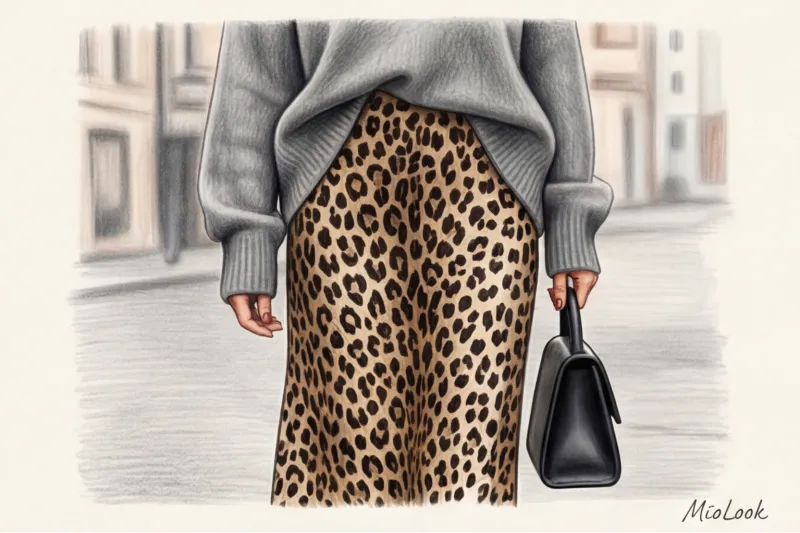
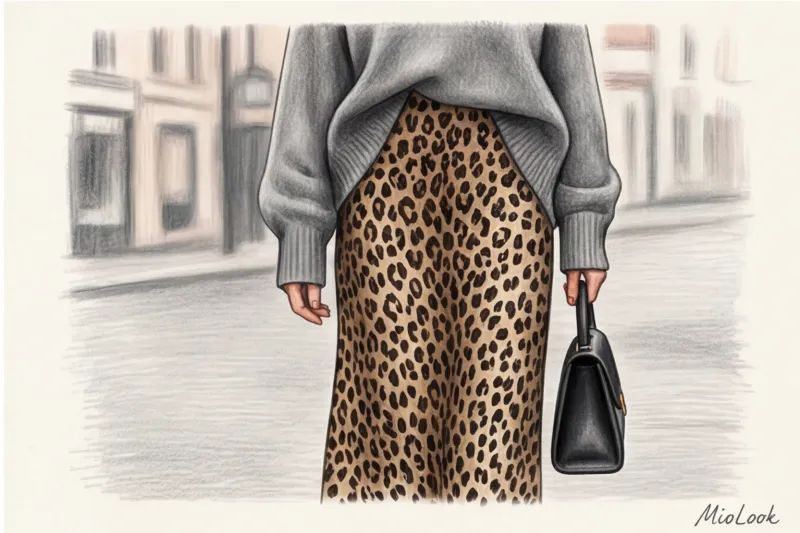
Formula 1: Leopard midi skirt + oversized sweater + chunky boots.
This is a modern uniform for everyday city wear. A matte silk midi skirt (which flows softly but never clings to the hips!) is perfectly balanced by an oversized chunky knit sweater. Chunky boots with chunky soles (like Chelsea boots or combat boots) ground the look completely. This look exudes confidence and ease.
Formula 2: Leopard belt or bag + a strict monochrome pantsuit.
The perfect solution for those not yet ready for large, spotted shapes. A high-quality leather belt with a leopard print (excellent basic options can be found at Massimo Dutti for €40-€50), worn over a voluminous, menswear-inspired jacket, demonstrates that you're a master of trends, but also know your limits. The print works as a subtle accent against a flawless monochrome backdrop.
Liven up your wardrobe with MioLook
Not sure what to wear with your new leopard-print skirt or bright accessory? Upload a photo of your outfit to the MioLook app. Our smart AI stylist will analyze your wardrobe and suggest dozens of stylish and safe combinations for every day.
Cage: How to Avoid Looking Like a Lumberjack or a SchoolgirlAccording to research in the psychology of shape perception, the human brain perceives geometric patterns faster than color. This is why checks are the most powerful, yet most insidious, optical tool in our closet. Among professional tailors and stylists, we use the term "rapport"—the basic, rhythmically repeating fragment of a pattern. And herein lies the main danger: geometry is unforgiving of errors in scale.
The larger the pattern repeat, the more it visually widens the figure. Imagine a tartan with vibrant, contrasting 10 x 10 cm squares: when wearing such trousers over voluminous hips, we literally draw a scale grid on ourselves, emphasizing every curve. On the other hand, too small a pattern repeat creates an unpleasant strobing effect—it's distracting under artificial office lighting. The golden rule I always tell my clients is that the check size should be proportionate to your bone structure. Plus-size women are better off choosing a medium-sized, slightly vertically elongated check with low contrast between the lines.
To manage this print, you first need to distinguish its types. In the modern European database, there are four leading ones:
- Tartan — a classic tartan. A very active pattern that requires absolute neutrality and calm textures around it.
- "Houndstooth" (pied-de-poule) — a graphic broken pattern, historically tied to the aesthetics of thick tweed and bourgeois chic.
- Prince of Wales (Glencheck) — a muted, powdered check with fine intersecting lines. A perfect choice for a business wardrobe.
- Vichy — a small two-tone check, associated with the style of Brigitte Bardot and the carefree aesthetics of the French Riviera.
The main pitfall of plaid is its strong, sometimes overly overt, cultural associations. Wearing a red flannel shirt with blue jeans instantly makes you look like a Canadian lumberjack. Pairing a plaid pleated miniskirt with a fitted blouse? You'll end up looking like a comical schoolgirl. To avoid these clichés, embrace the principle of stylistic paradox. A heavy flannel shirt is best worn open as a lightweight jacket over a sleek silk slip dress. A "schoolgirl" pleated skirt needs to be firmly grounded: pair it with an oversized textured knit men's sweater and chunky Chelsea boots with a tractor sole.
If you're just starting to incorporate fashionable prints into your daily routine, the safest route is smart casual for the office. The Prince of Wales pattern is definitely a favorite here.
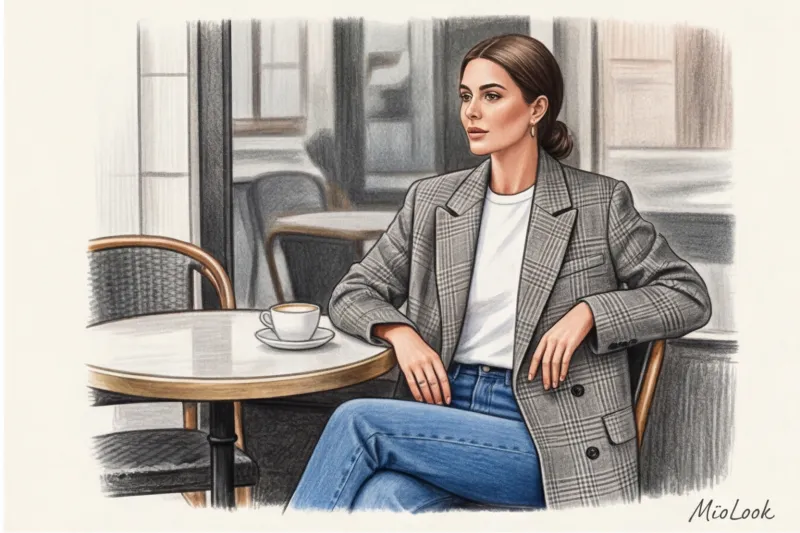
An investment that will earn you every penny is a men's oversized checked jacket with a well-structured, crisp shoulder line. If you're looking for the perfect balance of cut and fabric, consider wool-blend blazers at Massimo Dutti or & Other Stories (a quality basic model will cost around €150-€180). Paired with wide, solid-color, full-length palazzo pants and a basic white T-shirt, this jacket looks expensive and put-together, but not too formal.
By the way, if you already have a statement jacket, but you only wear it with jeans for fear of making a mistake, try digitizing it through MioLook The app's algorithms work brilliantly with geometry and will help you generate dozens of new smart-casual combinations from the items already in your closet, eliminating the need to buy anything else.
Leather clothing: a wardrobe investment or a fleeting trend?
Just ten years ago, leather pants in the office would have sparked whispers around the water cooler. Today, they hang in top managers' capsule wardrobes next to classic white shirts. According to WGSN's 2024 analytical report, leather goods have finally moved beyond the category of "subculture attribute" and become a fully-fledged staple, offering worthy competition to denim.
And here lies an interesting stylistic paradox. If fashionable prints in clothing While leather and leather require careful consideration of the color palette and scale of the pattern, black or chocolate leather works as a versatile yet vibrant neutralizer. It adds complexity not through color, but solely through the reflective texture, making even a completely monochrome look deep and visually rich.
But when we go shopping at European mass markets, a key dilemma always arises: save on eco-leather or splurge on natural materials? Over the years of guiding my clients through shopping, I've developed a simple budgeting rule. Polyurethane (eco-leather) is a safe bet for loose-fitting items that serve as outer layers: voluminous trench coats, shirt jackets, and A-line skirts. At €70-€90, Zara or & Other Stories offer excellent, functional purchases. Eco-leather holds its rigid architectural form perfectly and is completely resistant to rain.
Practical advice from a stylist: The main problem with polyurethane pants is the notorious "greenhouse effect." Clients often come to me complaining that they can't stand wearing mass-market faux leather for more than an hour. If you do decide to buy faux leather pants, always turn them inside out and check the lining. Choose only those with a 100% viscose backing. If the backing is polyester, the item will mercilessly shrink and end up hanging in the closet with the tag still attached.
What's truly worth investing in is genuine leather for trousers and shoes. High-quality straight-leg leather trousers from Massimo Dutti or COS (they'll cost you an average of €150–€250) will fit perfectly over time, breathe, and last for years, fully recouping their cost.
When creating looks, it's important to consider that leather comes in different finishes, and its finish directly dictates the mood of the entire outfit:
- Matte leather — the safest and most prestigious texture. Ideal for everyday basics.
- Patent leather — a high-contrast and demanding material. If you choose a patent leather coat, its cut should be as simple as possible, without unnecessary details, shoulder straps, or complex hardware.
- Vintage wash leather — an absolute hit of recent seasons, inspired by Miu Miu's archival collections. Faux-distressed bombers and jackets add just the right amount of casualness to the look, as if you've inherited something from the '90s.
To make a leather item look truly elegant, always apply the rule of temperature and tactile contrast. The secret to a relaxed aesthetic old money It's not about brand logos, but about a masterful mix of contrasting textures. Never wear rugged leather with another stiff fabric (like thick, starched calico)—you risk creating an overly formal, stand-up silhouette.
Instead, pair leather with distinctly soft, delicate materials: a fluffy mohair sweater, a flowing cashmere turtleneck, or a liquid silk blouse. The smooth, cool surface of leather paired with the fuzzy, warm cashmere creates an optical depth that begs to be explored. This instantly softens the material's aggressiveness, making the outfit cozy and sophisticated.
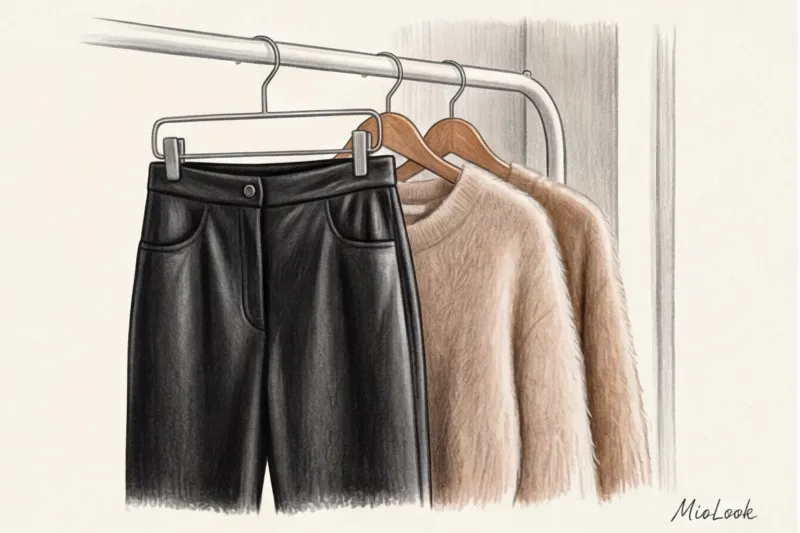
If you're unsure how to balance such complex active textures with your everyday base, try putting together a rough sketch of the look in the app first. MioLook The "smart wardrobe" feature will help you visualize how new leather pants will look with the silk tops and knitwear you already have in your closet, eliminating impulsive and unnecessary purchases.
Access to MioLook for €0.99 — one-time payment
Start creating perfect images with the help of artificial intelligence
Get access — €0.99 onceLace in Everyday Looks: Breaking Stereotypes
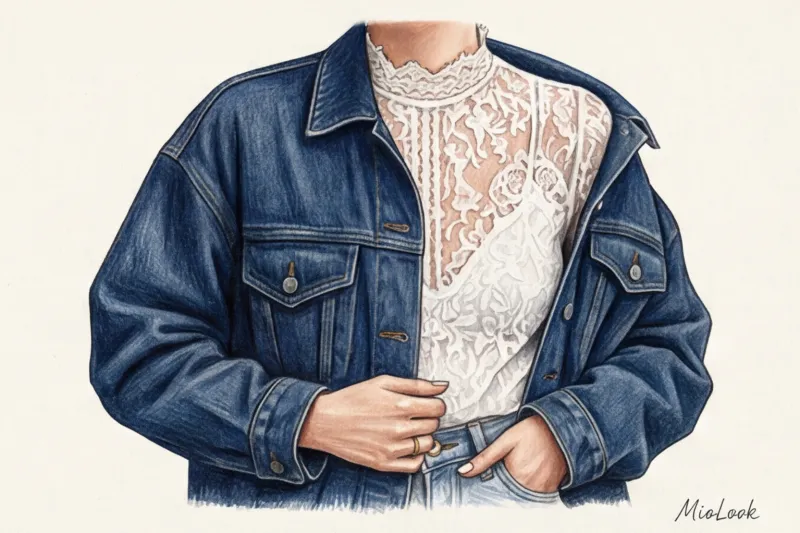
Just last month, while sorting through a client's wardrobe, we discovered a stunning, sophisticated top. She'd been saving it for a vague "special evening." I suggested she wear it right then and there—with her favorite distressed jeans and a casual Saturday brunch. The result exceeded all expectations. Remember this counterintuitive insight: the ideal time for lace is daytime, not evening. In the evening gloom, it looks expected and often banal, but in daylight, with the right styling, it becomes a cutting-edge fashion statement.
Unfortunately, when we're just learning to integrate fashionable prints and complex materials into everyday style, we're guided by old beliefs. The main victim of such stereotypes is the classic "guipure sheath dress." Let's be honest: this style is hopelessly outdated. Its fundamental problem lies in its rigid frame and lack of airiness. A dense synthetic sheath, overlaid with a rigid lace mesh, creates a heavy figure and is guaranteed to add a decade to the wearer's age. Today's fashion demands dynamism and casualness.
A new interpretation of lace is built entirely on a subtle provocation. The focus is on lingerie styles (flowing slips with lace hemlines or bodices), as well as weightless, semi-sheer blouses. In the current collections of brands like Zara and & Other Stories, lace functions not as a solid armor, but as a delicate hint.
My main rule when working with this texture is: "we take the arrogance down a notch." We must strip the lace of its historical pretentiousness and excessive drama.
How does this work in practice? We combine fine weaves with the most rugged, utilitarian, and casual pieces. If you're wearing a sheer blouse, pair it with loose, straight-cut denim and chunky Cossack boots. If you've chosen a silk skirt with a lace trim, layer it over a voluminous hoodie made of thick fleece (to cover your hips) or a vintage, distressed, men's-style biker jacket.
If you are unsure whether your look has enough contrast, take photos of your items and add them to your MioLook The smart wardrobe feature will help you visualize combinations on the screen before you start changing, and will suggest other ways to tone down an overly dressy item.
Mistakes when choosing lace
Textured fabrics don't forgive skimping on production. The main enemy of a modern wardrobe is the cheap shine of synthetics. Natural fibers are always matte; they absorb rather than reflect light. If an item shimmers under the store lights like a plastic bag, leave it on the hanger.
The second sign of low quality is untidy "eyelashes" along the edges of the garment. In the budget segment, these are made of thin elastane, which catches on any fittings, stretches, and turns into untidy fringe after just one machine wash.
How can you distinguish a noble weave from cheap polyester guipure? Look for cotton macramé or crochet. It feels slightly dry, heavy, and holds its shape well thanks to the thickness of the thread. Guipure made from 100% polyester, on the other hand, is slippery and feels unpleasantly scraping against the skin. A high-quality cotton-blend blouse will cost you between €60 and €120. Yes, it's more expensive than basic knitwear, but the accent texture must look impeccable, otherwise, instead of a "quiet luxury" effect, you'll end up with the aesthetics of a provincial prom.
Mix of prints and textures: advanced level for the bold
Every season, research agencies like WGSN publish reports on macro trends, and over the past few years, eclecticism has been breaking all popularity records. This raises the obvious question: can leopard print and plaid, or leather and lace, be worn in real life, off the runway? Yes, absolutely. But only if you know the rules of the game, where clothing functions not as a random assortment of bright spots, but as a carefully calibrated mathematical construct.
The first and most strict rule of combinatorics is single color rule To seamlessly combine different fashionable prints in clothing, you need a common color. The patterns may clash stylistically, but the color scheme must reconcile them. For example, if your classic tartan pants feature a thin caramel thread, a leopard bag or shoes in the same caramel shade will work perfectly. Color will act as the glue that brings the look together.
Next comes in rule of scale Any successful mix always has a dominant element (a large print) and a background element (a smaller print). Imagine this combination: a massive checkered pattern on a double-breasted coat and a silk polka-dot blouse. It looks harmonious because the eye immediately understands which element is dominant. However, if you juxtapose two large patterns of similar proportions, they will start a visual conflict, which will inevitably distort the proportions and add unnecessary volume to the figure.
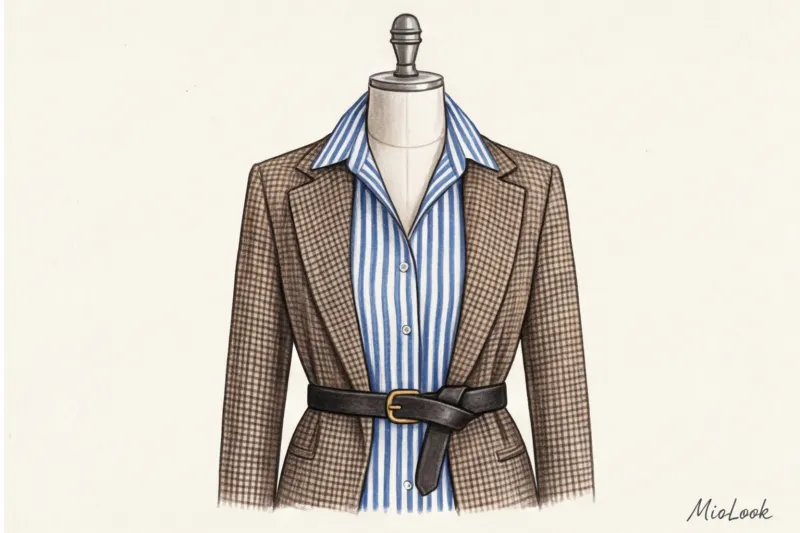
Let's explore a classic street style technique that I consider a benchmark: the combination of a basic striped Breton top and a checked jacket. Why does this combination work so well without looking overdone? Firstly, both patterns have a clear geometric nature, consisting of straight lines—they speak the same language. Secondly, the Breton top, in its modern interpretation, serves as an absolute neutral base. Stripes are so deeply integrated into the DNA of everyday wardrobes that our brains interpret them not as a vibrant pattern, but as a structural solid color. Add the right scale to this: the subtle horizontal rhythm of the Breton top perfectly offsets the wide check pattern of an oversized men's jacket (similar wool-blend models typically cost €150–250 in the mid-range segment).
Your ideal image begins Here
Join thousands of users who look flawless every day with MioLook. Plan your looks and experiment with prints in your smart wardrobe.
Get access — €0.99 onceBut what to do with complex materials? If you want to combine aggressive textures—say, thick matte leather and fine guipure lace—use interval combination This is a visual "buffer" technique in which active elements are separated by calm, plain, basic-cut items.
A stylist's secret: never juxtapose two extremely complex textures head-to-head, unless you want to create a theatrical costume effect. Always leave some visual "air" between them.
For example, instead of wearing a lace lingerie-style top directly under a heavy leather biker jacket, layer a crisp matte cotton T-shirt underneath (quality European brands sell for around €30-€40 for this basic) and layer a lace slip over it. The smooth cotton will act as that perfect neutral, toning down the drama and transforming an evening look into relaxed, urban smart-casual. The layering allows you to wear even the boldest pieces without overpowering the look.
Katarzyna's Checklist: Smart Shopping and Integrating Complex Items
According to statistics from the research agency Mintel (2023), approximately 60% of impulse purchases during seasonal sales end up as dead weight in closets. This is especially true for statement materials and patterns. We walk into a store, see a stunning animal print skirt on the rack with an attractive €30 price tag, and rational thinking switches off. At that moment, we buy not clothes, but an emotion—the hope that this vibrant item will magically transform our routine.
To protect your wallet from embarrassing mistakes and your wardrobe from becoming cluttered with incompatible items, I've developed a rigorous filter. Before taking any unusual new item to the checkout, run it through this checklist. In my experience, hundreds of clients have saved thousands of euros simply by asking themselves three smart questions before paying.
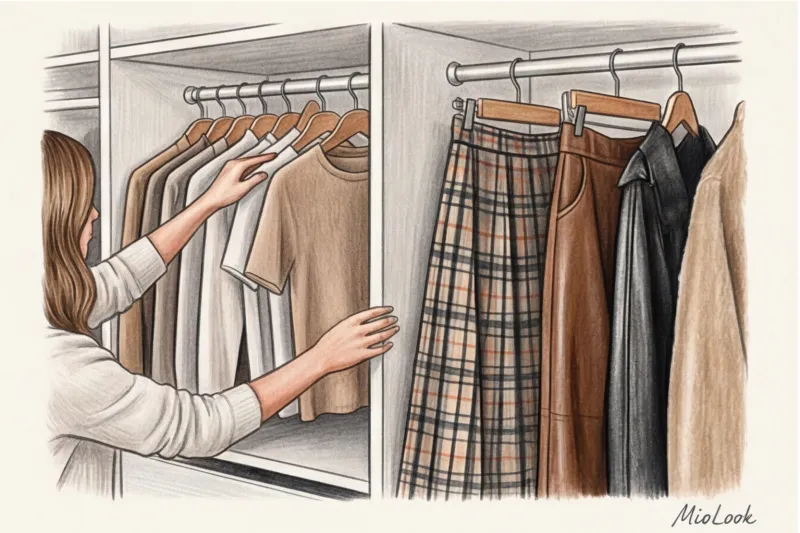
1. Pre-purchase inspection: the "One in Three" rule
The first step is to make sure you have at least three basic, relaxed pieces for your new statement piece. If you're buying leather pants, mentally create three different outfits with them from what's already hanging in your home. For example: a chunky, plain-knit cashmere sweater, a classic oversized white shirt, and a basic T-shirt with a men's blazer. Why three? If only one jumper goes with an active piece, you're not buying a wardrobe staple, but a rigid uniform that you'll get tired of in a couple of weeks. If you have to buy additional, "relaxed" tops specifically for your new purchase, it's a poor investment. To avoid guessing in the dressing room from memory, I recommend digitizing your arsenal through MioLook: One glance at your smartphone screen will show you if your closet has the right backdrop for a potential update.
2. Style assessment: the dictatorship of minimalism
Remember this axiom: if a piece is leather or leopard print, its cut should be simple (no peplums, ruffles, or asymmetry). The louder the texture, the more subtle the design should be. A classic straight midi skirt in leopard print looks elegant and expensive. The same skirt, but with tiered ruffles, draping, and a bias slit, instantly becomes provincial kitsch. When incorporating fashionable prints into clothing, don't try to complicate what's already sufficient. Avoid accent hardware, patch pockets, and complex cuts on active fabrics.
3. Quality assessment: physical tests in the fitting room
Complex fabrics require strict tactile control. For checked suiting fabrics, the wrinkle test is essential: firmly squeeze the edge of the material in your fist for 10 seconds. If a deep, distinct network of creases remains after releasing it, return the garment to the hanger immediately. Otherwise, you'll look unkempt by mid-work. For eco-leather items (especially in the popular mass-market segment priced at €50–€80), the smell and squeak test are critical. Low-quality polyurethane emits a pungent chemical odor that won't go away after washing. And when the legs rub against each other, such leather begins to creak uncomfortably with every step, betraying its cheap manufacturing.
Don't buy statement pieces "just in case" or "to liven up a boring wardrobe." Only buy them when you know exactly what basic pieces you'll wear them with the next morning.
A stylish, functional wardrobe doesn't mean refusing to experiment boldly. It's about taming complex trends so they work for you, highlighting your taste rather than flaunting your spontaneity. Start small: treat yourself to the perfect crocodile-pattern belt or an impeccably tailored tartan jacket. Once you see how one clever detail elevates an entire look, your fear of prints and textures will vanish forever.
Guide Chapters
How to wear corduroy and velvet in everyday looks
Velvet and corduroy aren't just for holidays or '70s retro style. We'll show you how to incorporate these heavy textures into your basic wardrobe and create luxurious looks.
How to Wear a Tweed Jacket: Stylish and Modern
A tweed jacket often gathers dust in the closet for fear of looking too conservative. Learn how the rule of radical contrasts can help you incorporate tweed into a modern wardrobe.
Polka Dot Print: How to Wear It and Avoid Mistakes
Classic polka dots don't suit everyone and can ruin your look irrevocably. We'll explore common styling mistakes and learn how to choose the right print.
Printed Accessories: How to Wear Bags and Scarves
Tired of boring looks? Learn how to add vibrant prints with scarves, bags, and shoes to always look luxurious and stylish.
What to wear with snake print? Alternatives to leopard.
Leopard print often sits in the closet like dead weight. Find out from a stylist why snake, zebra, and cow print are much more versatile patterns.
Floral Prints in Clothing: How to Wear Them and Not Look Older
Floral dresses often gather dust in the closet because they look dull and dated. We discuss with an expert how to choose the perfect pattern and fabric for a stylish look.
How to wear stripes without looking fat: stylist tips
Horizontal lines don't add weight if you understand the laws of optics. Let's figure out how to choose striped clothing for a slimming effect.
How to Wear Sequins Every Day: Stylist Tips
Don't save your dressy pieces for a special occasion. Learn how to easily incorporate glitter, metallics, and sequins into your everyday looks.
How to Wear Sheer Clothing: Stylishly and Without Being Vulgar
Afraid of wearing translucent blouses and dresses? We'll show you how to style sheer fabrics for an elegant and stylish look.
Frequently Asked Questions
What is your color type?
Find out your seasonal color type and choose clothes that highlight your natural beauty.
About the author
Unlock MioLook
for €0.99
Start creating perfect outfits with artificial intelligence
Get access — €0.99 onceRelated Articles
How to wear leopard print shoes without looking vulgar
Afraid of looking vulgar in leopard print? We'll explore the architecture of com...
What to wear with snake print? Alternatives to leopard.
Leopard print often sits in the closet like dead weight. Find out from a stylist...
Print Combinations in Clothing: Capsule Rules
Tired of a wardrobe overflowing with colorful pieces you can't wear with anythin...
Fashionable Prints 2024: How to Wear Runway Trends
Why do runway patterns often translate to real-life looks? We explore this year'...