Why We Buy Unnecessary Items: The Psychology of Sales
Did you know that, according to a large-scale consumer habits study (2023), the average woman spends over €600 annually on clothes she wears exactly once or not at all? This alarming figure is a direct consequence of our behavior during sales seasons. Over 12 years of working as a stylist, I've become convinced: if you want to understand... How to buy correctly on sales , you need to start not by studying fashion trends, but by understanding your own psychology. The problem of overcrowded shelves lies not in your weak will, but in impeccably executed marketing.
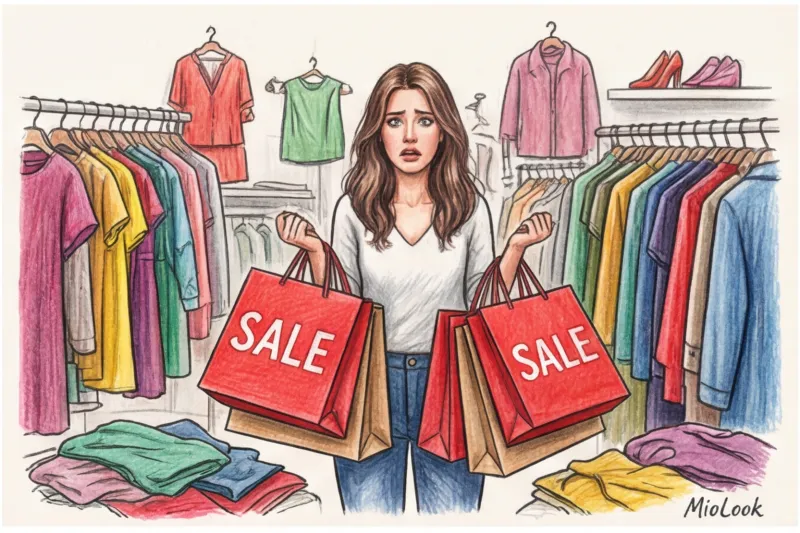
I wasn't born with an innate immunity to red price tags. Early on in my career, I fell into a classic trap. At a Milan outlet, I spotted a luxurious hobo bag from a famous Italian brand with an 80% discount. Originally priced at around €1,200, it was now on sale for just €240. My brain instantly shut down. I bought it without even considering that this garish, acid-orange color was completely out of place in my carefully curated Mediterranean-style wardrobe. Guess how many times I wore it? That's right, none. It's still sitting in my dustbag, a treasured reminder that a discount doesn't make an unnecessary item necessary.
How exactly does the magic of sales work? Neuroscientists have long proven that the sight of a crossed-out number triggers a sharp surge of dopamine—the reward-anticipating hormone—in our brains. At this point, the prefrontal cortex, which is usually responsible for rational thinking and critical analysis, literally goes into hibernation mode. You no longer evaluate the quality of the stitching, the fit, or the fabric composition; your brain evaluates solely size of benefit.
In my consultations, I call this the "Sale Points" effect. It's a dangerous cognitive bias where a clearly unsavory item with a 70% discount suddenly seems incredibly appealing. It's that moment when we indulge a scratchy acrylic sweater or jeans that are mercilessly bunched at the hips: "Well, for 15 €, I'll take them for the dacha!" We buy the emotion of saving money, not the clothes themselves. I discussed in more detail how to build a quality foundation without impulsive spending in my article about budget capsule wardrobe.
Before you can react, retailers are unleashing heavy artillery—fake scarcity. You've probably noticed aggressive countdown timers in online stores: "Promotion ends in 2:15:43." Or those telltale red notices: "Only 1 item left in your size" and pop-ups that say "This item is currently in 14 people's carts." All these tools are designed with one goal in mind—to trigger a powerful FOMO (fog of missing out). We feel like if we don't click the checkout button right now, something irreversible will happen.
According to statistics from major resale platforms, approximately 80% of impulse purchases made in the heat of the moment at sales end up in the bottom of a closet forever. Most often, they are resold a year later, even with the tags still attached.
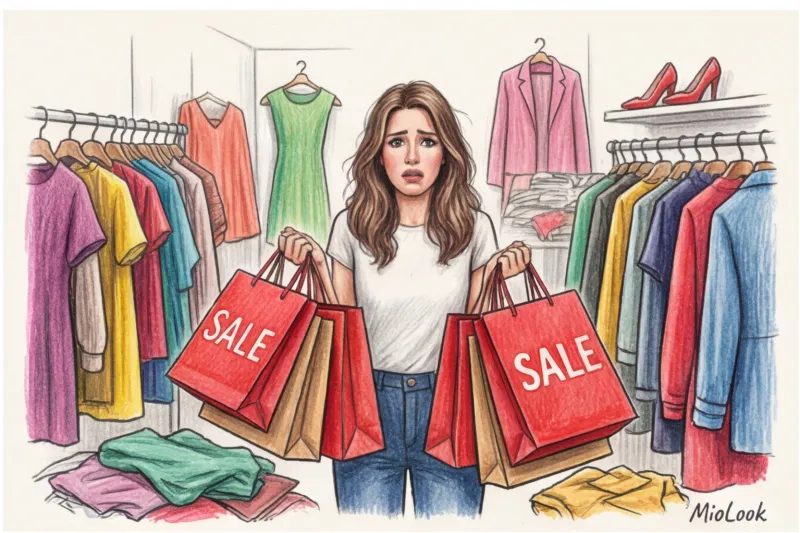
When the dopamine storm subsides, a shopaholic's hangover sets in. You're left alone with bags of clothes and nothing to wear. The only salvation here is an artificial pause. Before giving in to panic over the timer, I always advise my clients to look into MioLook app When you see your entire digitized wardrobe on your smartphone screen, the illusion of necessity dissipates, and cold calculation takes center stage: "What exactly will I wear with that neon bag?" The answer often saves your budget. And if you feel like your shopping is getting out of control, be sure to check out my article on How to stop buying unnecessary clothes.
Preparing for Smart Shopping: What to Do Before the Sale Starts
When clients ask me, How to buy correctly on sales I always start with a concept I call "wardrobe architecture." Your style isn't a chaotic collection of random bricks bought in a fit of rage, but a carefully constructed structure. Before ordering a new sofa (or another jacket from Zara), you measure the room. The same principle applies to clothing. Exactly two weeks before Black Friday or the start of summer sales, I give my clients a strict step-by-step protocol. And here's what it consists of.
Step 1: A ruthless inventory of your own closet
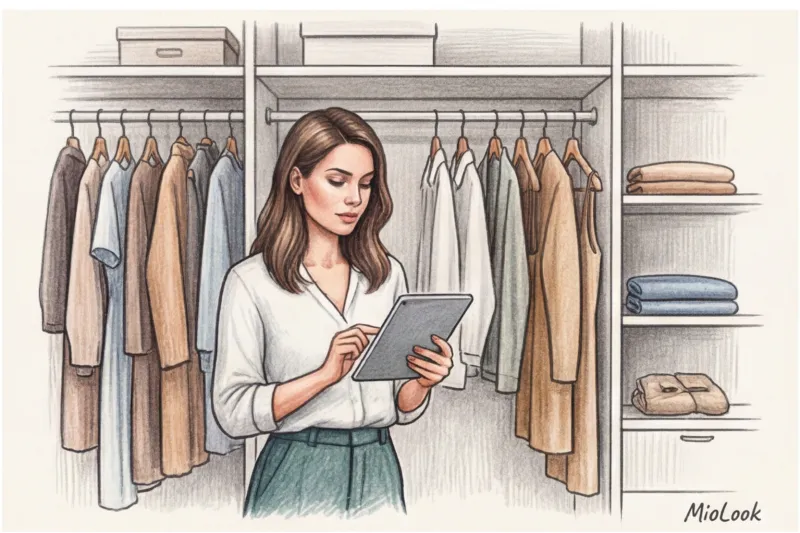
Real smart shopping starts not in the mall, but in your own bedroom. I often see the same scene: a woman buys a basic silk blouse for €150, only to find an identical one, still with the tags, in the back of the shelf. To avoid this, we institute a ruthless inventory control rule.
Take out absolutely everything. If you can't even tell how many white T-shirts you own and what condition they're in, you absolutely mustn't buy new ones. Divide your items into categories, find replacements, put aside items that need repair, and be honest with yourself about which items are no longer relevant.
Step 2: A Hard Wishlist and the Five Look Formula
The worst thing to write on a shopping list before a sale is abstract phrases like "black pants" or "something dressy." Replace that approach with my favorite technique: "What exactly am I missing to complete my 5 favorite looks?".
For example, you love pairing your camel wool trousers with loafers, but you always struggle with choosing a top. So, your list isn't just about "sweater," but "structured navy straight-leg jacket" or "heavy ecru cashmere turtleneck." This elevates your wishlist from abstract desires to a list of missing architectural elements.
A smart wardrobe is always at hand
Try MioLook for free: A smart AI stylist will help you find the perfect look and digitalize your closet before the season's biggest sales.
Get access — €0.99 onceStep 3: Pre-shopping (reconnaissance before the sales start)
The biggest mistake beginners make is trying to guess their size and fit when the discount timer is already ticking and the necessary items are gone from the warehouse. A professional stylist always conducts pre-shopping.
A week before the sales start, head to Massimo Dutti, COS, or any other brand you're interested in. Your goal is to try on items at full price. Feel the fabric, assess how the shoulders fit, and make sure you need a size 38, not a 40. Then, go home and add the desired items in the correct sizes to your online cart. When the prices drop, all you have to do is click "Checkout," and you'll have made the perfect purchase in exactly 30 seconds.
Step 4: Determine your budget and set hard limits
Sales create a dangerous illusion of sudden wealth: "I saved €200, so I can buy those shoes too!" It's a trap. Set a strict shopping budget before you see the first crossed-out price.
How can you avoid spending more than you planned in practice? I recommend physically restricting access to your money. Transfer a designated amount (say, €300) to a separate digital card. If you go to a brick-and-mortar store, withdraw this amount in cash and leave your credit cards at home. If you shop online, unlink your primary card from Apple Pay for a day. This artificial friction instantly sobers your mind and prevents impulsive spending.
How to Shop Smart on Sales: A Stylist's Strategy
Sales aren't the time to buy more than you can easily afford at full price. This is your only chance to legally "hack" the fashion system and gain access to a whole new level of wardrobe. The main secret and the definitive answer to the question, How to buy correctly on sales , sounds incredibly simple: buy quality, not stuff. Use these weeks to purposefully transition from mass-market to mid-up and premium segments.
I once audited the wardrobe of the CFO of a large company. Her closet was literally bursting with fast-fashion items with red tags. Hundreds of compromised tops hung there, losing their shape after the first wash, but bought in a fit of passion. To change this destructive pattern, we introduced style math—a rigorous calculation of Cost Per Wear (CPW). This concept revolutionizes our approach to spending once and for all.
Let's do the math. A €200 cashmere sweater (bought at a deep discount from the original €450) that you'll wear 100 times over three cold seasons will only cost you €2 per wear. Meanwhile, a trendy €20 acrylic jumper that will pill, absorb all odors, and hopelessly stretch out after three washes will cost you almost €7 per wear. The math is ruthless: a truly high-quality item always costs less in the long run. Many brands create discounted lines specifically for sale periods (the so-called "outlet tier"), so focusing on the premium segment also protects against buying items that are just one day old.
Working with dozens of wardrobes in the app MioLook I've come up with the perfect formula for investing. Remember it: Blazer + midi skirt + loafers = a status base Assembling this capsule collection on sale is easier than it seems if you know where to look. Look for a structured wool blazer in the men's departments of premium brands (the patterns there are often more architectural, and the discounts are deeper, as men are less likely to participate in the sale rush). Find a thick silk bias-cut skirt at Scandinavian mid-up brands like COS or Arket, and pick up smooth calfskin loafers at shoe boutiques during the last days of sales, when there are only a few sizes left. This set will work for your personal brand for years to come.
Investment #1: Premium Fabrics and Textures
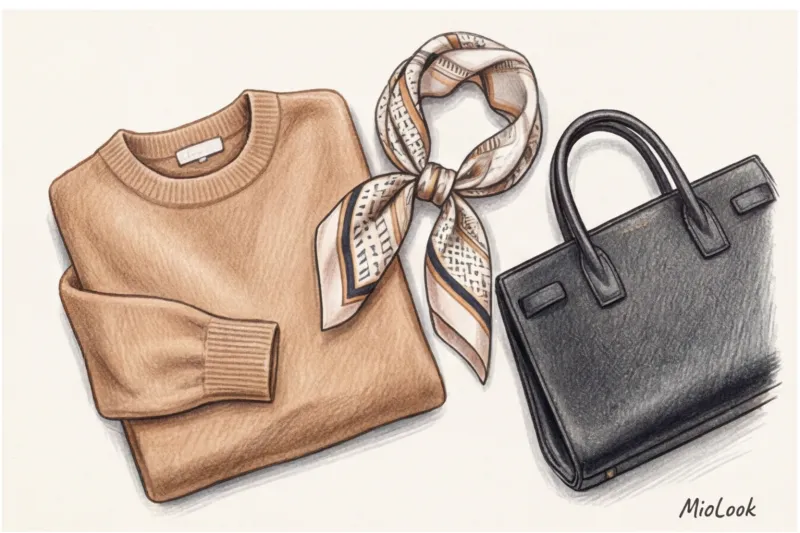
Your hunt during sales should be focused on fine materials. Our radar is tuned exclusively to 100% cashmere, dense silk, structured leather, and high-quality merino wool. No big designer name or discount, even an 80% discount, can justify a clearly inferior composition.
Make it a rule of thumb: first turn the item inside out and carefully read the sewn-in tag, and only then look at the price tag. Blended fabrics should be assessed with extreme caution. If you see "10% alpaca wool, 90% acrylic" on the tag, the manufacturer is simply selling you the illusion of warmth. Synthetics are only acceptable in strict technological proportions: for example, 20–30% elastane or polyamide in suiting wool adds wear resistance and prevents trousers from stretching at the knees. But basic knitwear that fits closely to the body must be natural.
The color palette also plays a critical role in such investments. Have you ever wondered why deep, elegant shades—like classic camel, rich navy, and rich emerald—always look expensive? It's all about the physics of fibers. Natural silk or premium wool absorb pigment and reflect light in a unique way. This creates a multidimensionality and depth of color that's technically impossible to achieve with flat polyester. By investing in these shades on sale, you're getting pieces that will visually enhance even the most casual, everyday look.
Investment #2: Status accessories, shoes, and outerwear
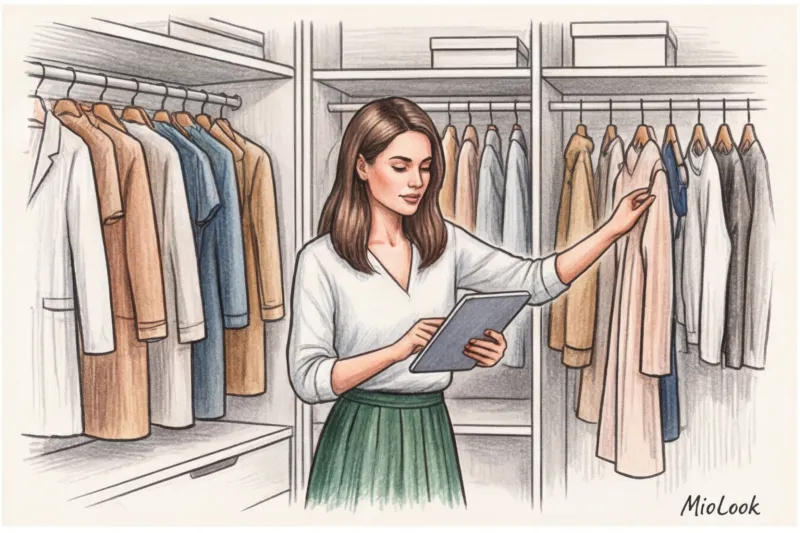
I never tire of telling my clients: shoes and bags are what make an entire look, elevating it to the right level. You can wear the simplest white cotton T-shirt and straight-leg vintage jeans, but if you pair them with an impeccable leather bag that holds its shape perfectly and expensive, trendy shoes, the whole outfit instantly looks like a million bucks. That's why it's worth allocating the lion's share of your retail budget to accessories.
Your sales wishlist should always include three must-haves: basic pumps (ideally made of soft suede or matte leather), structured totes, and quality belts. When choosing a bag, pay attention to the bottom—metal feet will protect the corners from scuffs and extend the life of the accessory for years to come. Look for models with minimalist metal hardware, without flashy logos or monograms. Buy belts only from solid, dense leather, not pressed leather, which will inevitably crack after a month of daily wear. These are wardrobe staples that will never go out of style and won't reveal the year they were purchased.
My favorite and most profitable smart shopping tactic is buying out of season. According to industry reports from European retailers, brands offer the most uncompromising discounts on heavy outerwear in the height of summer to free up valuable warehouse space. Therefore, the best time to buy a luxurious wool coat is hot July. Yes, it's psychologically very difficult to force yourself to pay €300 for a heavy double-breasted coat when the asphalt is melting outside and the temperature is 30°C. But trust me: when in a chilly November the same item in the new collection costs €800, you'll be extremely grateful for this strategic foresight.
Discount Myths: Why Sales Are the Worst Time to Experiment
Open your closet and take a look at the back shelf. I bet that's where what I call the "experimental graveyard" lies. Those neon tops, complex asymmetrical skirts, and extravagant hats, bought in a fit of sudden boldness at sales. For years, fashion magazines have been selling us the idea that sales are the perfect time to reinvent yourself. As a practicing stylist, I say the opposite: this is the most dangerous misconception, one that's quietly eating away at your budget. Finding your unique aesthetic should be done thoughtfully and at full price, not under the hypnotically flashing "70% off" sign.
Let's ruthlessly debunk the biggest fitting room myth: "For 15 euros, you can try on leopard-print leggings." The math here is completely misleading. It seems like you're only risking the cost of two cups of coffee or a quick lunch. But in reality, you're paying for an item that will steal valuable closet space, cause morning frustration ("I have nothing to wear this with again"), and ultimately end up in a landfill. Analysis from the Sustainable Fashion Institute (2024) reveals a disappointing figure: items bought as a spontaneous, cheap experiment are worn, on average, less than twice during their entire lifespan.
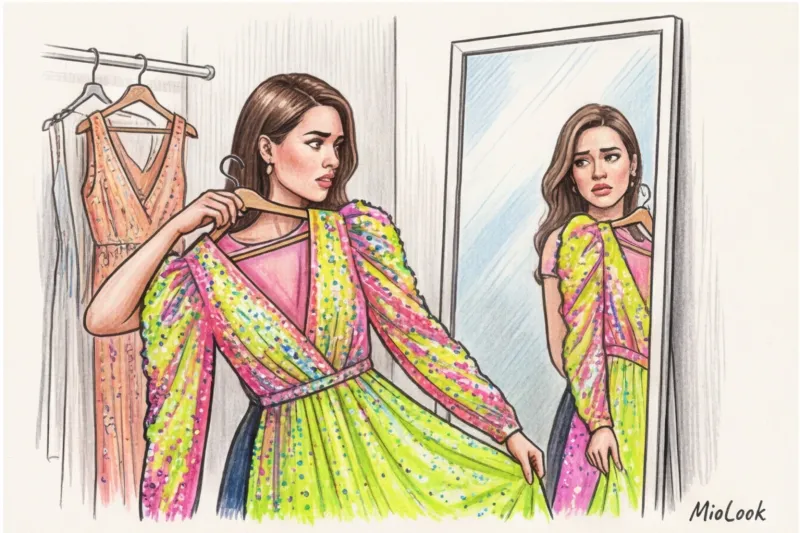
Remember my strict stylist rule: if a piece doesn't fit your established style DNA, you don't need it, even if it's free. Understanding how to shop sales effectively is impossible without a strict entry filter. Let's say your foundation is intellectual elegance: a menswear-inspired blazer + silk midi skirt + leather loafers = instant polish. In that case, a sudden purchase of a rhinestone-embellished corset or acid-colored cargo pants will ruin your entire wardrobe. You'll try to tweak the look, buying new T-shirts and chunky sneakers to go with them... And end up spending three times the stated 15 euros, without feeling confident.
To avoid such breakdowns, I always ask clients to open their doors before shopping. the "smart wardrobe" feature in MioLook When you have a clearly digitized database of your verified items in front of you, it becomes physically difficult to buy something that doesn't match them in either color palette or spirit.
Finally, let's be honest: why do ultra-trendy items even end up on sale? Spoiler alert: the trend is already dying. What blew up the runways of trendsetting brands six months ago and was instantly replicated by mass-market giants like Zara or H&M is hopelessly out of fashion by the time the seasonal sale rolls around. Retailers are getting rid of hot microtrends to free up warehouse space for fresh concepts. By buying a bag with an unimaginable geometric shape or jeans with complex lacing at the end of their popularity, you're investing in an item whose shelf life has already expired. Next season, it will literally scream that it was bought at last year's final clearance sale.
It's a profound misconception to think that a discount changes the essence of a thing. The price has dropped, but the unflattering cut and clashing color remain the same.
Access to MioLook for €0.99 — one-time payment
Start creating perfect images with the help of artificial intelligence
Get access — €0.99 onceOffline vs Online shopping: how not to lose your head in different formats
Have you ever noticed how our heart rate increases differently depending on whether we're scrolling through a favorite brand's app or wading through racks at the mall? Each of these formats harbors its own mental traps, and to understand how to shop effectively during sales, we need to develop two completely different tactics.
Online Hunting: The Magic of Filters and Digital Hygiene
Virtual shopping gives us a huge advantage—the ability to turn off emotions with the help of dry mathematics. The first thing I do on the websites of brands like COS or Arket during sale season is set up strict filters. We immediately, ruthlessly, and without exception, eliminate polyester, acrylic, and cheap polyamide in the "Composition" section. Then we choose the desired color and precisely our size. No "I'll take a large for my medium size, let it be oversized"—a high-quality oversized garment is cut differently than a garment that's simply two sizes too big.
It's important to understand how to use smart algorithms to your advantage. Platforms are programmed to show you stale items in slow-selling, acidic shades. To avoid this trick, always change the sorting from "Recommended" to "Expensive First" or set your own price range (for example, from €80 to €250). This way, you'll immediately see premium lines and high-quality fabrics on which the brand was forced to lower the price.
Retailers often use scarcity patterns: pulsating timers and "15 people have their carts" signs. This is an artificial trigger. If an item is gone, it's simply not yours. Never compete with invisible shoppers.
This is where the protection rule comes into play. basket traps Why is it so important to leave your selected items in your online shopping cart for 24 hours before paying? Because within 24 hours, the dopamine surge subsides, and the rational prefrontal cortex of the brain kicks in. My personal method: I pack my cart in the evening, and in the morning, 40% of the items seem downright unnecessary.
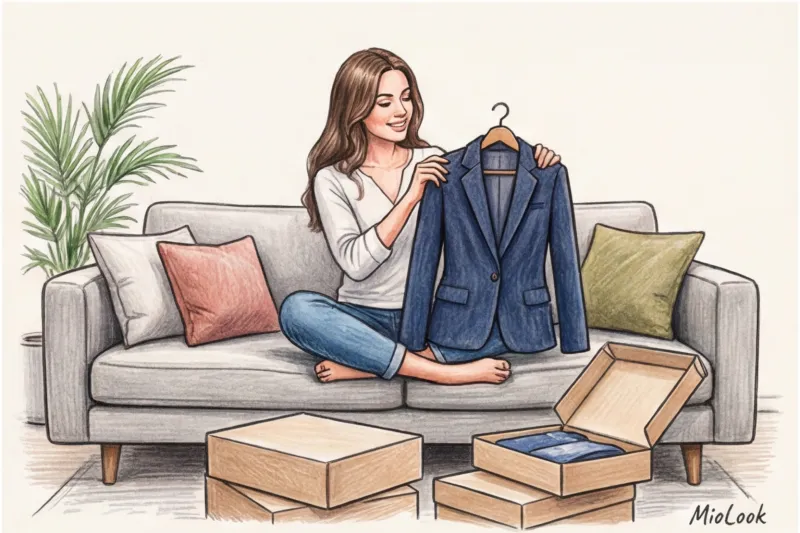
These 24 hours are the perfect time for a technical check. Before any purchase, I open MioLook app I use the virtual try-on feature. Integrating a new item into your digital wardrobe is more sobering than any advice. If a luxurious silk blouse on sale doesn't create at least three perfect looks with the skirts and trousers already in your closet, it's out of the trash for good.
Offline Assault: Protecting Against Sensory Overload
While online we battle algorithms, in the mall our physiology becomes our enemy. Neuromarketing research proves that rhythmic music (around 120 beats per minute), bright spotlights, red price tags, and chaotic shelves during sales artificially induce mild stress in shoppers. This sensory overload causes us to move faster, think less clearly, and grab things simply to achieve the illusion of a successful hunt and leave the noisy store.
How to cope? I always advise clients to come to the store with headphones. Turn on a calming podcast or relaxing jazz—it will instantly reduce anxiety and slow down your movements.
But the most important stage of offline shopping happens in the fitting room. Golden rules for trying on in a store It goes like this: your appearance on shopping day determines the quality of your purchases. Wear the right lingerie—it should be nude, seamless, and smooth. A lacy black bra will ruin the fit of any light-colored item and make you forego a potentially perfect basic shirt.
Wear your most polished basics, like perfectly fitted straight-leg jeans and a neutral top. Trying to layer a tailored architectural jacket over a stretched-out lounge hoodie or a shapeless sweater will never fully capture its potential. You need a clean silhouette to make the right style decisions.
The biggest sales mistakes you'll regret
Do you know where the most conscience-fueled bargains are made? In a cramped fitting room stall under the merciless neon lights, with a crowd of bargain hunters buzzing behind the curtain. In my professional stylist notebook, I have a separate page I jokingly call "The Fitting Room Confessional." It's a veritable list of excuses I regularly hear from my clients as they stand in front of the mirror wearing clothes that objectively don't suit them. And for each of their statements, I have one firm, uncompromising response: "No, we're leaving it here." If you want to understand, How to buy correctly on sales , start by realizing that the most expensive financial mistakes are made precisely during these moments of trading with yourself.
Let's look at which self-deceptions cost us the most.
The illusion of motivation. The biggest and most toxic mistake is buying clothes "one size too small" as motivation to lose weight. Spoiler alert: this only causes stress, not a surge of fitness enthusiasm. Clothes are designed to serve your body here and now, elegantly framing its best features, not to silently reproach you. Every time you open your closet, you'll be met with those tight pants, experiencing a subconscious feeling of guilt. The basic rule of style: a garment should fit a woman, not a woman who should exhaust herself for a piece of fabric, even if it was bought at a €100 discount.
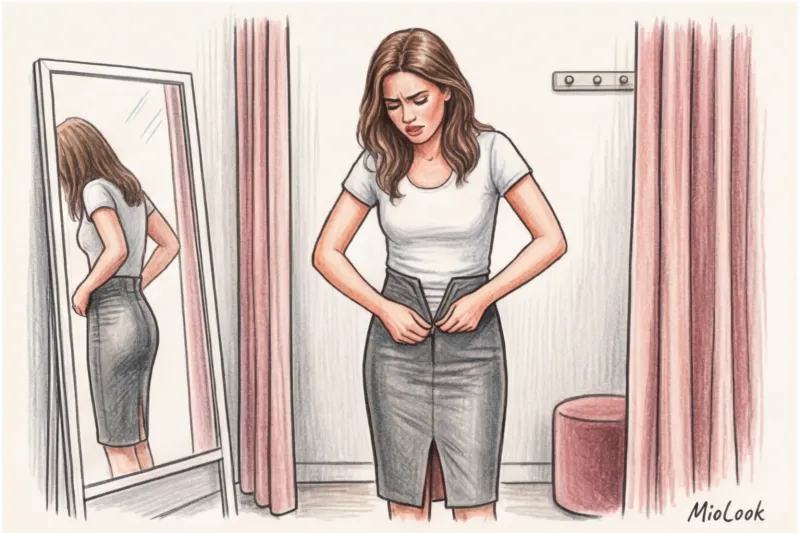
Blind faith in logos and tailors. The next trap is compromises with the landing. The phrase "It's a little tight, but it's Saint Laurent with 80% off!" This should be a signal for you to immediately evacuate the store. A poorly cut armhole or a belt that cuts into your waist won't make you feel any more comfortable just because the logo of a legendary French house is embroidered on the tag. This also includes a dangerous fantasy. "I'll have it tailored later." Let's be completely honest: 9 times out of 10, this item will sit in a bag in the hallway for at least six months. And even if you do make it to a tailor, a high-quality alteration of a jacket or a tailored dress will cost you €40–€80, which will completely destroy the original discount and may irreparably alter the garment's original proportions.
Your ideal image
it begins Here
Join thousands of users who look flawless every day with MioLook.
Get access — €0.99 onceReproduction of clones. The third sin of sales is buying duplicates. Our brains, when stressed and in the throes of shopping, instinctively gravitate toward the safe and familiar. So, you bring home a bag containing a fifth white T-shirt or another pair of blue skinny jeans. Why bother with duplicates of what's already hanging on the hangers? It creates the short-term illusion of a new wardrobe, but in reality, your personal style remains stagnant. A sale is a chance to buy a textured cashmere jumper instead of your usual cotton sweatshirt, not to accumulate an army of identical basics.
Roulette game with final discounts. Finally, there's the complete disregard for return policies. During the liquidation period, brands often hang categorical signs on the rails. Final Sale Remember: items marked with this label cannot be returned or exchanged under any circumstances. This is why they require triple the care. These sections of the mass market and mid-range segments are often used to store manufacturing defects, items with unsuccessful fittings, stretched necklines, and items with broken hardware. Before taking an item with a red price tag to the checkout, turn it inside out. Check every seam, the smooth movement of the zipper, the presence of all buttons, and the symmetry of the cut. A mistake here is irreversible: you either get a great item for a nominal fee, or you're forever tying up your money in a piece of defective fabric. Are you even a little unsure? Leave it at the checkout.
Smart Shopper Checklist: 5 Questions to Ask Before Checkout
According to the study Journal of Consumer Psychology (2024), the most irrational financial decisions are made in the last three minutes before the checkout. This is a window of vulnerability, when our brain desperately searches for logical justifications for an emotional impulse. To finally understand how to buy wisely during sales, I developed a strict filter for the participants of my style intensives. Take a screenshot of this checklist—it's your personal mindfulness framework that you should activate every time you reach for the payment terminal.
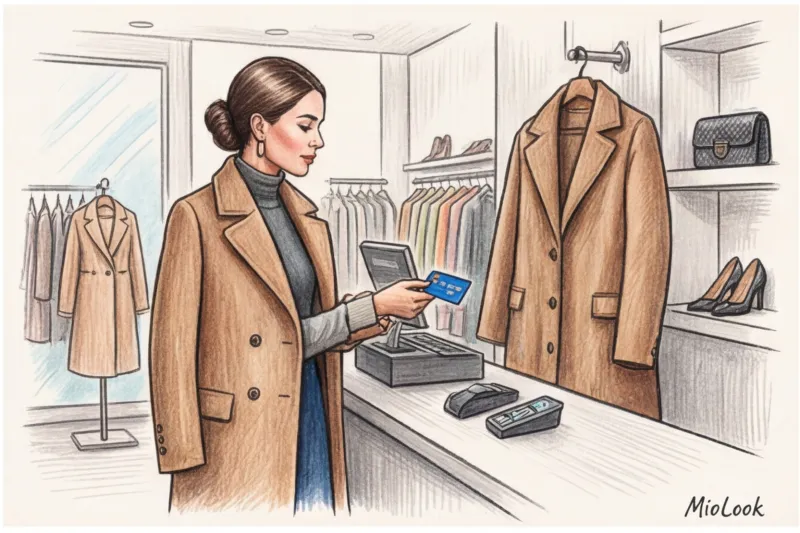
- Question 1: Would I buy this item right now at full price?
Imagine the crossed-out price tag disappearing. My personal test: simply cover the red discount sticker with your finger. The blazer costs not €45, but its original price of €180. Do you still want to take it home? If the answer is no, you're not buying an item of clothing, but the fleeting euphoria of a discount. - Question 2: Can I create at least 3-4 looks with her from what’s already hanging in my closet?
The math of a wardrobe is ruthless: a single item will inevitably trigger a chain of new expenses. Open it right in the store smart wardrobe feature in MioLook and virtually match a potential new item with your favorite jeans, skirts, and shoes. No three sure matches? The item stays on the hanger. - Question 3: Am I comfortable moving, sitting, and raising my arms in it right now (without hoping that it will “break in later”)?
One of my golden rules for fitting is the dynamic test. In loafers, you should briskly walk around the room; in a jacket, you should try to hug yourself; in trousers, you should definitely sit on a pouf and cross your legs. The myth that shoes mysteriously "break in" and a tight jacket armhole "fits" is a source of wealth for orthopedists and tailors every year. If you're uncomfortable right now, it will only get worse tomorrow. - Question 4: Does the fabric and cut match my status and personal brand?
As stylist Allison Bornstein notes in her book Wear It Well (2023), clothing should become a physical embodiment of your personal qualities. Ask yourself: does that flimsy knitwear or uneven seam on the hem enhance your image or detract from it? Status isn't about flashy logos; it's about impeccable fit and refined texture, which don't fade even at a 70% discount. - Question 5: Where exactly will I wear this in the next 14 days?
This is an absolute lifesaver when it comes to shopping for your "fantasy self." If you're buying a sequined top for a yacht party you haven't yet been invited to, or skinny jeans as a summer motivator, that's frozen capital. A good investment should start earning its value within the next two weeks.
I have to be completely honest: this framework has its limitations. It's useless if you're looking for an outfit with a strict dress code for a specific event—for example, a bridesmaid dress or ski gear. In such highly specialized cases, the "3-4 looks" rule becomes irrelevant, and precise fit becomes paramount.
Discounts are a great financial tool, but only for those who can keep a cool head. Your wardrobe isn't a warehouse of random bargains, but a carefully crafted toolkit for achieving your life goals. Now, armed with the right strategy, you can transform any sales season from a chaotic lottery into a precise, measured process for expanding your personal collection. Happy and mindful hunting!
Guide Chapters
How to Avoid Overspending on Sales: The Psychology of Shopping
Forget the clichéd advice. Learn how a data-driven approach and neuroscience can help you save your budget and stop buying unnecessary items during the crazy sales season.
How to Make a Clothes Shopping List: Wardrobe Analysis
Spontaneous shopping during sales can ruin even the most carefully planned style. We'll tell you how to clean out your closet and buy only what you truly need.
Capsule Wardrobe on Sale: Build Smart
Are discounts driving you crazy and making you buy things you don't need? We'll tell you how to avoid these psychological traps and build a stylish wardrobe on a budget.
The best life hacks for online clothing shopping at sales
How can you stop buying unnecessary items at sales and finding premium essentials at mass-market prices? A practicing stylist shares the secrets of smart shopping.
How to check a discount for authenticity: marketers' secrets
Red price tags defy logic and make us buy unnecessary things. We'll explore the real mechanics of brand deception and learn to shop smarter.