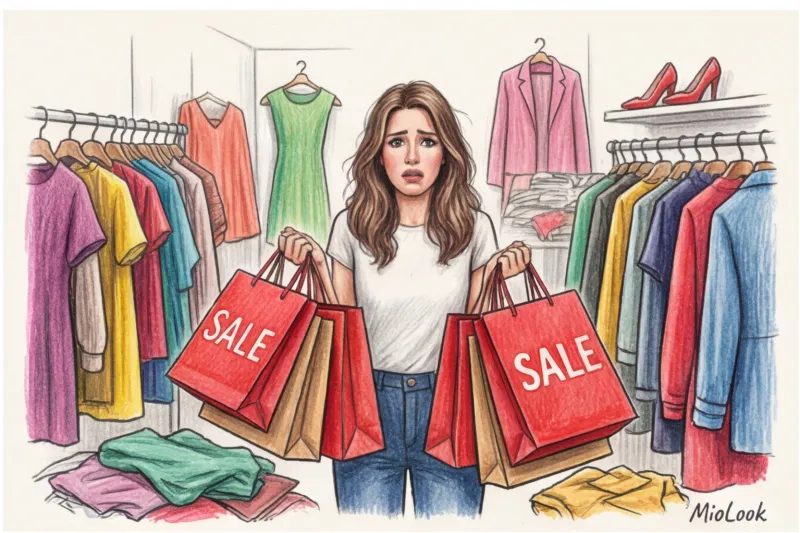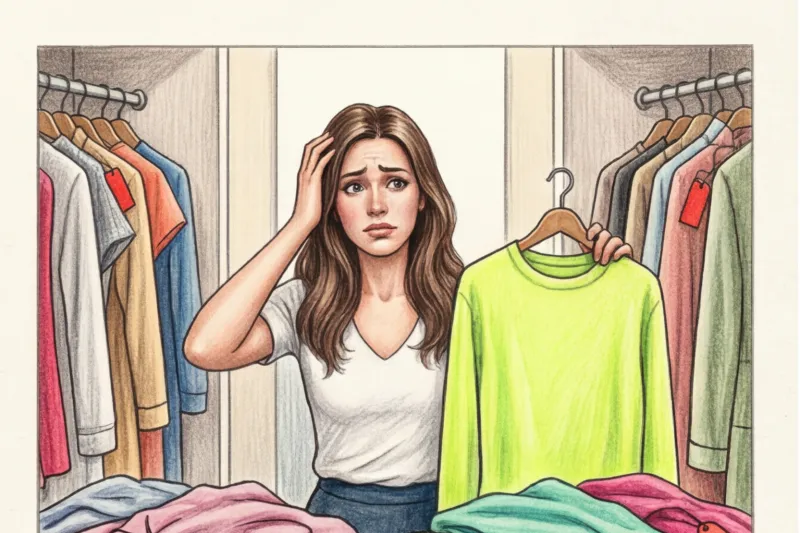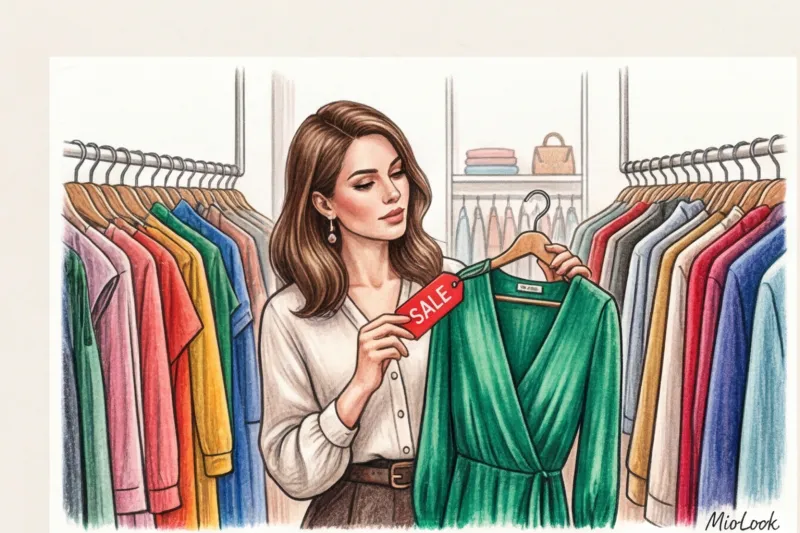
For a long time, an acid-orange hobo bag sat in the back of my closet. I bought it in Milan seven years ago. Original price: €1,200; with 80% off, it was €240. It was a fantastic, mind-blowing bargain. Do you know how many times I went out with it? Exactly zero. It didn't match any of my coats, clashed with my shoes, and generally clashed with my minimalist style. That bag became my most treasured "dust collector" and a great lesson.

Were you wondering? How to avoid overspending on sales , when red banners flash everywhere and timers count down to the end of a promotion? Traditional advice like "leave your credit card at home" or "write a list" no longer works. Retail has become too smart. In our The Complete Guide: Smart Shopping: How to Shop Smart on Sales We've already covered the basic rules for preparing for the discount season. Today, I'd like to go deeper.
Let's apply a product- and data-driven approach to your closet. We'll use metrics, neuroscience, and digitalization to reprogram your dopamine addiction to discounts into a systematic approach to personal style.
The Red Price Tag Trap: How to Avoid Overspending on Sales
Willpower is powerless in a shopping mall. This isn't a metaphor, it's physiological. When we see a crossed-out price tag, a powerful dopamine loop is triggered in our brain. Consumer neuroscience proves that the sight of a significant discount literally "switches off" the prefrontal cortex, the brain's logical and rational thinking.
We put on invisible "Sale glasses." At that moment, our brains begin to evaluate not the quality of the crooked seams on a dress or the composition of the fabric, but solely the size of the potential profit. We're not buying a thing. We're buying a victory over the system.
"People rarely think in absolute terms. We need something to base our prices on. The crossed-out high price serves as that anchor that makes any subsequent figure seem reasonable," explains Dan Ariely, a behavioral economics professor, in his research on the scarcity effect.
That's why my Milanese hobo bag seemed so essential. Compared to €1,200, €240 seemed like a godsend. My brain simply blocked out the question: "Emily, what will you wear with acid orange?"
Access to MioLook for €0.99 — one-time payment
A smart AI stylist will select the perfect look based on your real wardrobe.
Get access — €0.99 onceThe biggest mistake newbies make: why you shouldn't buy essentials on sale
Now I'm going to say something that contradicts 99% of the articles in glossy magazines. Buying basic items on sale is a huge mistake.
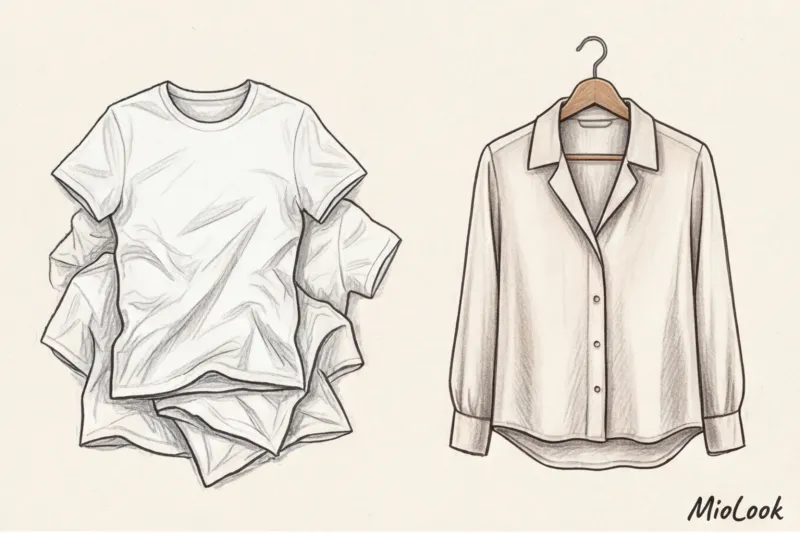
The myth goes that sales are the best time to refresh your collection of white T-shirts, simple jeans, and cotton turtlenecks. In practice, things are different. Over 12 years of working as a stylist, I've noticed a pattern: the basics that survive 70% off at mass-market stores (like Zara or H&M) are often defective, poorly cut, or downright cheaply made.
Brands know that a good basic white T-shirt made of heavy cotton (180 g/m² and above) will sell even without a discount. The stuff hanging on the Sale racks with a red "9 €" sticker is thin, see-through knitwear that will lose its shape after the first wash.
Instead of buying up consumables, use the "sniper strategy." Sales are a unique window of opportunity to invest in complex, expensive textures. Hunt for 100% cashmere, dense silk, structured leather, and premium brands (like COS or Massimo Dutti), which are usually beyond your budget.
The False Economy Effect in Wardrobe
Our brains deceive us with the volume of bags. Leaving the store with five €10 T-shirts seems like a better deal than buying one perfect silk blouse for €50. But those five polyester and thin cotton T-shirts will start to pill within a month.
So, you paid €50 for the illusion of a refreshed wardrobe. Read more about how to budget wisely for essentials in this article. Budget Capsule Wardrobe: Smart Shopping Guidelines.
Style Math: Applying the Cost Per Wear (CPW) Formula

If you want to stop buying everything and anything once and for all, start tracking your wardrobe. Introduce Cost Per Wear (CPW)—the price per wear—into your life.
The formula is simple: Item Cost / Number of Outputs = CPW.
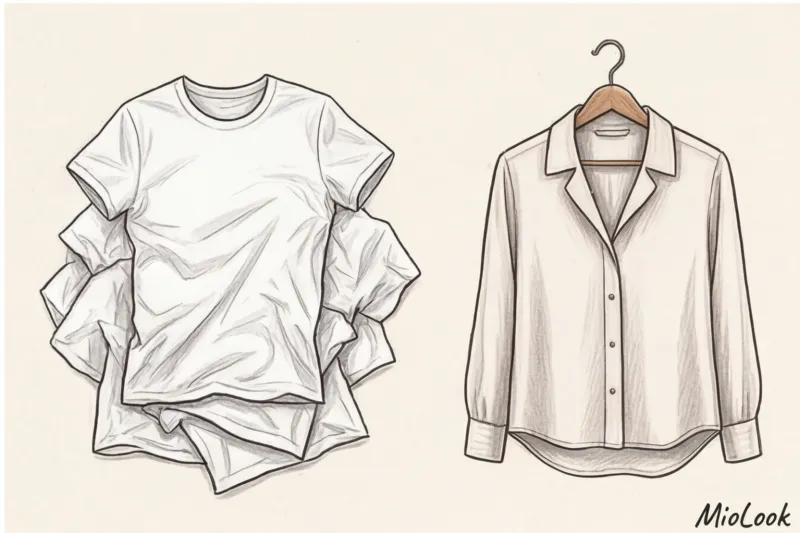
Let's do the math. You bought a trendy sequin dress on sale for €30. You wore it once to a corporate event. Your cost per outing is €30.
Now let's take a classic wool jacket for €300. You wear it to the office, throw it over a slip dress on dates, and take it on business trips. You wear it at least 50 times a year. Your cost per outing is €6. The €300 jacket turns out to be five times cheaper than the €30 dress.
According to a 2023 WGSN analytical report, the average woman spends over €600 per year on clothes she wears once or never. Tracking your belongings is more sobering than any personal finance coach. If you want to delve deeper into this math, I recommend this article. Cost Per Wear: How to Calculate the Cost to Wear an Item.
Your perfect look starts here
Join thousands of users who look flawless every day with MioLook. Digitize your closet now.
Get access — €0.99 onceMarketers' Games: How to Recognize In-Store Manipulation
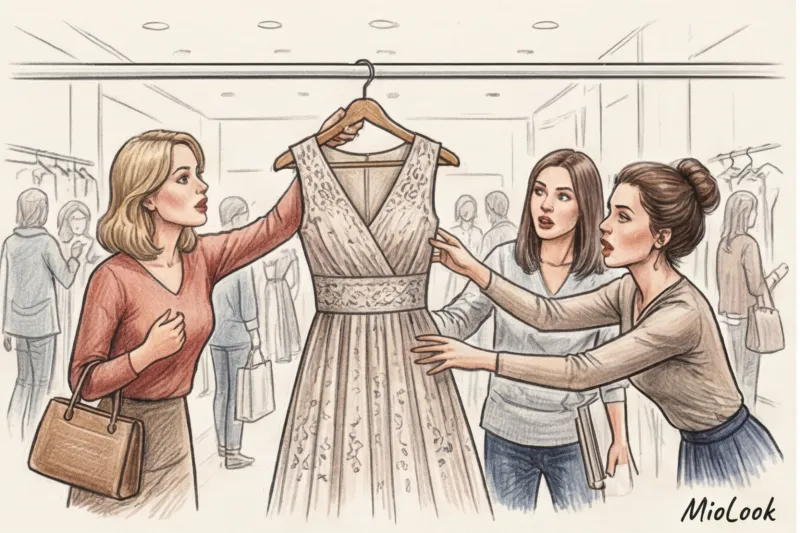
To win the game called Sale, you need to know the rules of the stores. Here are three main manipulations that force you to bring to the checkout what you don't need:
- Artificial shortage. The sign "15 people have this in their cart" or the salesperson's phrase "Last size left" hits home with our primal hoarding instincts. Fear of missing out (FOMO) compels us to grab an item, even if it doesn't fit perfectly.
- Reorganization of the hall. Have you ever noticed how the discount racks are always located in the farthest corner of the store? To reach the coveted red price tags, you'll have to navigate through the new collection without any discounts. By the time you reach the Sale section, your eyes will already be saturated with the high prices, and any discount will seem like manna from heaven.
- “Loss Leader” tactic (bait product). The store displays a huge banner reading "Cashmere Sweaters for €29." It's a decoy, sold at cost or even below. The goal is to lure you in. While you're heading to the checkout with your sweater, you grab a scarf for €40 and jeans for €60 at full price. The store is in the black.
Digital Wardrobe vs. Emotions: Technology Protecting the Budget
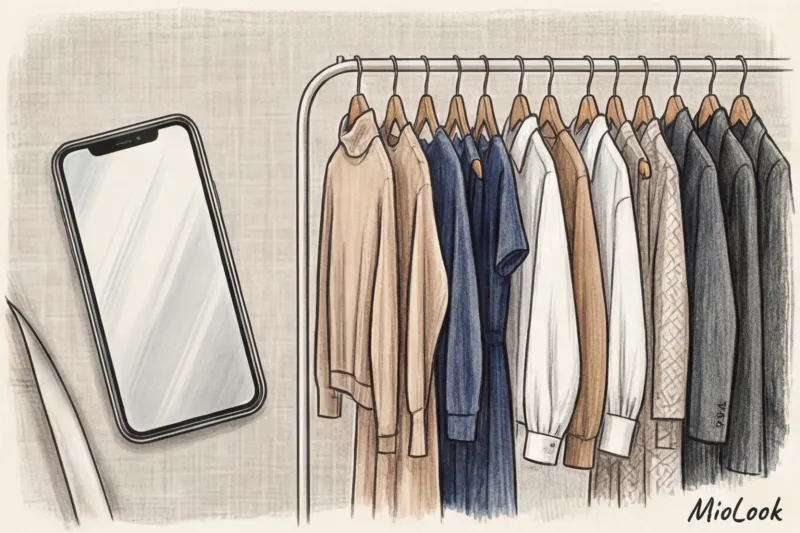
I recently went through my client Anna, a top manager at an IT company, and her wardrobe. We analyzed her Black Friday purchases over the past three years. The results shocked us both: 85% of the items in her closet with the tags still attached were impulse buys at sales.
How did we cure this? By digitizing. Visualizing your current closet on your smartphone is the best cure for impulse buying.
When you're standing in the fitting room with another pair of black trousers (because "well, they're basic and only €15"), you open MioLook is an app for mindful shopping and wardrobe management. The algorithm mercilessly tells you: you already have five pairs of black trousers. The purchase is cancelled.
Virtual fitting as a filter
My favorite rule for working with MioLook application — This is the "Rule of Three Looks" right in the fitting room. Before you go to the checkout, you take a photo of the item or upload a screenshot from the online store. The AI assistant visualizes the new item in combination with yours. current clothes.
If the AI can't create at least three functional looks based on what's already hanging in your closet, the item stays in the store.
Ready to get started?
Try the MioLook plan for free—no commitments required. Upload your items and see how they pair with new arrivals in the store.
Get access — €0.99 onceStylist Checklist: 5 Tough Questions to Ask Before Payment
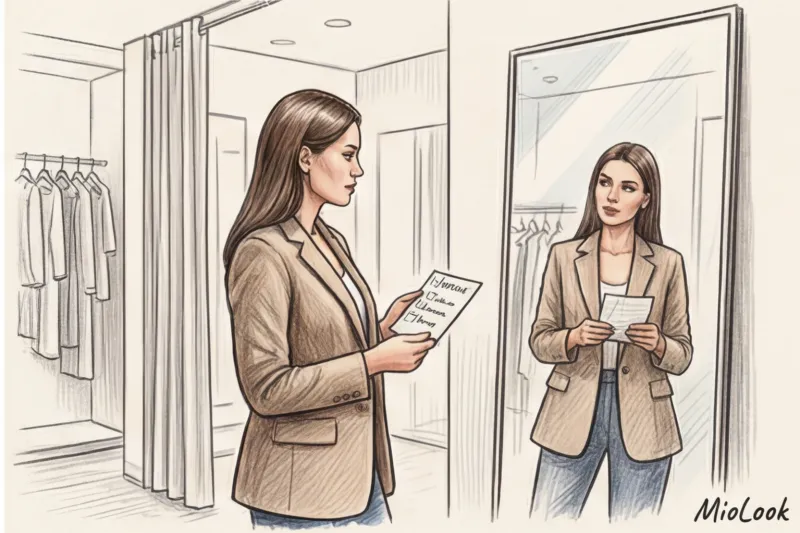
Take a screenshot of this block. It's your personal stylist-supervisor, and you should activate it every time you reach for Apple Pay or your credit card at the checkout.
- Would I buy this at full price tomorrow? If the answer is "no", then you are buying a discount, not the item.
- What three specific items in my closet does this go with? Name them right now. "With some blue jeans" is not acceptable. Specifics are needed: "With straight-leg Levi's jeans, white Veja sneakers, and a beige trench coat."
- Where exactly will I wear this in the next 14 days? Things bought “for weight loss,” “for a future trip to Paris,” or “for a hypothetical corporate event” end up sitting in the closet as dead weight.
- Does this item require the purchase of an "accompaniment"? If you need to buy special invisible underwear for €50, seamless tights for €20 and new shoes for €80 to go with a €40 backless dress, it’s a bad investment.
- Does this item solve my style problem or create a new one? Already have five sweaters but don't have a warm, basic skirt? Another sweater on sale won't solve the problem.
I'll be honest: this checklist It doesn't work If you're looking for a wedding dress or a unique vintage dress for a special occasion, consider this. In these rare cases, emotion and art reign supreme. But for everyday and work wardrobes, this is an absolute must-have.
Your smart shopping algorithm for next season

Wardrobe mindfulness isn't about strict self-imposed restrictions or asceticism. It's about choosing what's best for your personal brand and your budget. Transitioning from intuitive shopping to systematic style management takes time, but yields amazing results.
My top tip: create a wish list two months before the sales season starts. Pinpoint specific items, brands, and prices. When the red-price-tag craze hits, you'll act like a professional buyer: pop into a store (or app), check if the item you want from your list is available at a good price, buy it, and go.
Instead of a dozen compromised clothes that will lose their shape after washing, your closet will start to fill with truly luxurious pieces that shape your confident style. And the money you save... well, you can always put it aside for a vacation in Milan. Just this time, no orange bags.