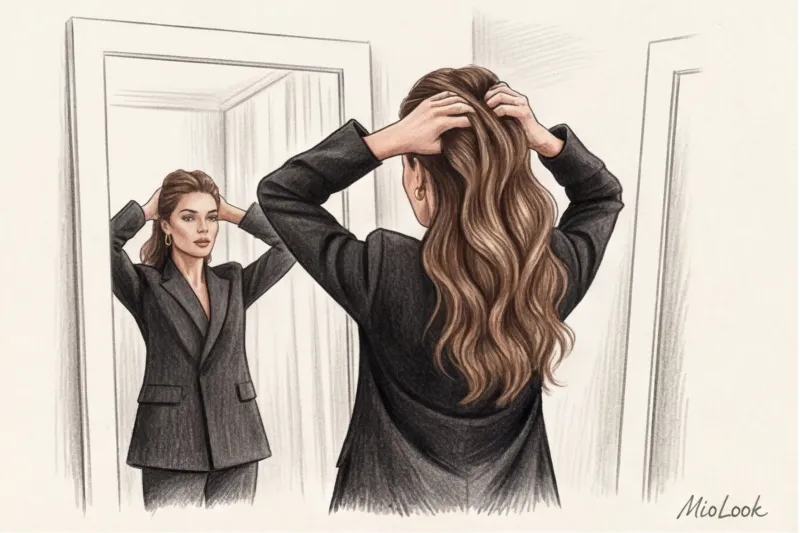
Geometry and Balance: Why a Hairstyle to Match a Dress's Neckline Changes Everything
It's a familiar situation: you buy a stunning dress (say, a silk slip for €250), apply flawless makeup, loosen your freshly styled locks... then look in the mirror and realize it looks heavy and squat. What's wrong? Is the dress unfitting? Nope. Just perfect. hairstyle for a dress neckline — this is not an intuitive choice, but a strict mathematics of proportions.
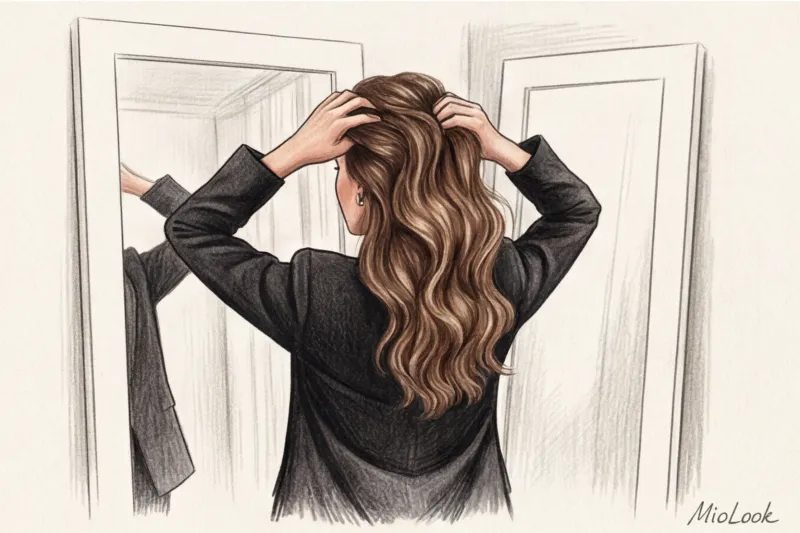
As an image consultant with an artistic background, I always tell my clients: stop thinking of your hair as just "hair." In the grand scheme of your silhouette, it's the final accessory, a massive splash of color and a distinct geometric line. This is the true architecture of your look. The legendary Vidal Sassoon revolutionized hairstyling back in the 1960s, declaring that hairstyles don't exist separately from the bone structure of your face. Today, we go even further in styling: the shape of your hair should be subordinate to the cut of your clothes.
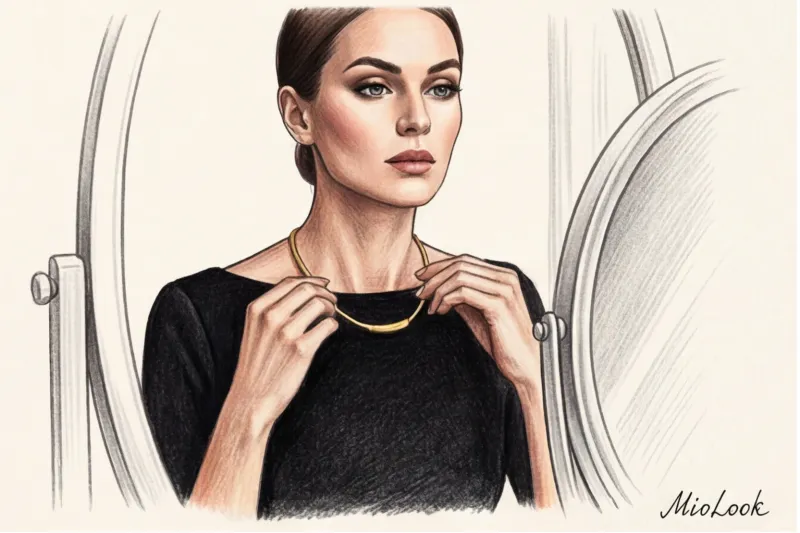
Why is this symbiosis so critical? In styling, there's an ironclad rule of the "portrait zone." Think about it: 80% of the attention of others is focused on the "head-neck-chest" line. This is where people look, this is where we place emphasis, and this zone determines whether you look tall and stately or, conversely, hunched. If the geometry of the collar clashes with the direction of the strands, visual noise is created, which the brain interprets as sloppiness. Incidentally, this is also why it's so important to style your hair correctly. choose jewelry to match the neckline of your dress — all these elements share one small but strategically important area.
And here we come to my favorite tool: the concept of visual weight. The thickness, volume, and texture of hair have their own "weight," which can easily clash with the heaviness of fabric or chest decoration.
"You can't wear a dress with a voluminous frill and leave your hair loose unless you want to look like your head is resting on a pillow of fabric and curls."
I had a classic case: we were preparing a client for an evening out. She was wearing a luxurious velvet dress with a striking stand-up collar and a massive asymmetrical embellishment on the shoulder. She insisted on voluminous Hollywood waves cascading down to her collarbones. The end result? Her neck visually disappeared, and the weight of her upper body doubled. The thick mass of her hair vied with the thick velvet for dominance. As soon as we swept her hair into a sleek French bun, her silhouette instantly elongated, and the embellishment became an elegant accent rather than a burden.
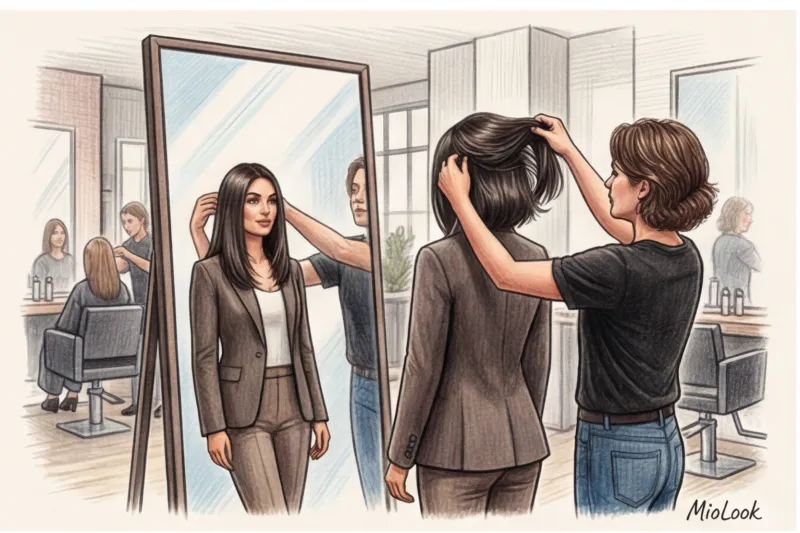
Before you reach for a curling iron or flat iron, I always recommend visualizing this volume balance. If you're unsure, upload photos of your looks to MioLook — a smart algorithm will help you predict in advance how updos, sleek, or textured hair will work with a specific cut, so you don't waste time on styling that you'll have to quickly redo later.
The main rule of the stylist: how the neck and shoulders dictate the choice
Glossy magazines often offer categorical advice like "V-neck = loose hair." As a practicing image consultant, I always tell my clients: forget these stereotypes if you haven't considered your own anatomy. Clothes are just fabric, and your bone structure is the fundamental framework upon which your entire look is built.
Choosing a hairstyle based solely on the cut of the clothes is like buying a picture frame without measuring the canvas itself. Ideal hairstyle for a dress neckline A dress should always function as a link between the geometry of the fabric and the natural proportions of your body. If you ignore the width of your shoulders or the length of your neck, even the most luxurious outfit will make you look disharmonious.
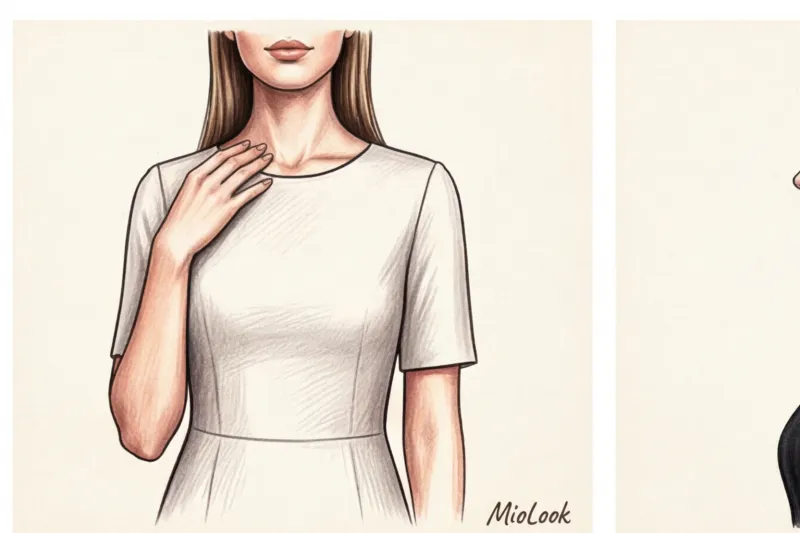
Before making any styling decisions, do a quick analytical test in front of a mirror in good lighting:
- Estimating neck length (four-finger rule): Place your palm (four fingers together) on your neck so that your little finger touches your collarbone. If your index finger rests exactly on the base of your jaw, your neck is of a classic, proportional length. If there's not enough room, your neck is considered short. If there's still some space, your neck is considered long.
- Shoulder width assessment: Stand up straight and mentally draw vertical lines from the outermost points of your shoulders down. If these lines extend well beyond your hips, you have a T-shaped silhouette (an inverted triangle).
The architecture of personal style is uncompromising: the visual volume of the head must always balance the dimensions of the body. Broad shoulders do not forgive overly "small" hairstyles, and a short neck disappears under the weight of thick hair.
I had a case in my practice that illustrates this principle. A client came to me with a request to create a look for an important evening event. She had a fairly short neck, so she bought a stunning dress with a high-neck collar (incidentally, a great model from a niche European brand for €220), which she planned to wear with voluminous Hollywood curls. This would have been a disaster: her neck would have visually "drowned" in the hair and fabric, and her upper body would have looked heavy.
We radically changed our approach. I suggested a dress with a deep V-neckline, and we pulled her hair into a high, textured bun on top. The effect exceeded all expectations: we artificially "stretched" her neck by almost two inches thanks to the open back and the perfect geometry of the neckline, creating a stately, swan-like silhouette.
Short neck: the illusion of elongation
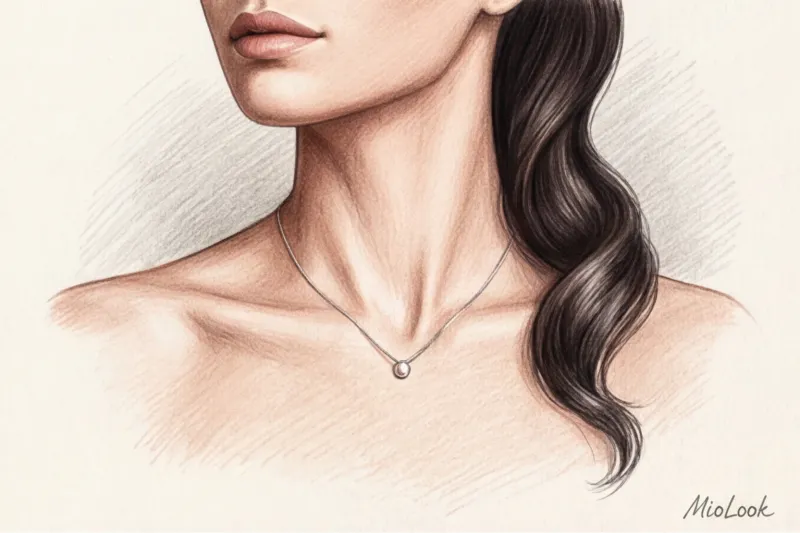
If the previous test showed that you have a compact neck, your main styling tool becomes air rule Its essence is extremely simple: it is necessary to ensure maximum exposure of the collarbones and décolleté.
The more free space (bare skin) left between the hairline and the hem of the dress, the longer the neck appears. That's why high ponytails, elegant buns, and loose buns work flawlessly here.
The main stylistic enemy of a short neck is the classic straight bob that reaches mid-neck or just above the shoulders. Why? Because the sharp horizontal cut creates a harsh line exactly at the widest and shortest point, literally "cutting" the neck in half. If you love short haircuts, choose either a bold pixie that completely reveals the back of the head, or an elongated bob (lob), the ends of which reach below the collarbone, creating a life-saving vertical line.
Access to MioLook for €0.99 — one-time payment
A smart AI stylist will select the perfect look based on your proportions and clothing cuts.
Get access — €0.99 onceBroad shoulders: softening the angles
Women with pronounced shoulders (T-shaped silhouettes) face the exact opposite challenge. Here, the goal is to break up the monolithic horizontal line so the top doesn't appear bulky, especially in dresses with boat necklines or off-the-shoulder silhouettes.
The ideal solution in this case is hair that falls on the shoulders. Haircut technique long layers (Long layers or cascades) work beautifully: the strands create vertical and diagonal lines that cross the horizontal line of the shoulders, visually breaking up their width into narrower segments. This instantly softens sharp angles and adds fluidity to the look.
What should you absolutely avoid if you have broad shoulders? Tight, perfectly slicked-back buns paired with an open neckline. A sleek hairstyle visually reduces the size of your head. By contrast, the shoulders appear even wider and bulkier against a smaller head, creating an undesirable "swimmer" effect. If you still want to pull your hair back, choose voluminous, textured styles with strands loose around your face to smooth the transition from your neck to your shoulders.
Choosing the perfect hairstyle for basic dress necklines
When I studied color and styling at the European Image Academy, our composition teacher liked to repeat, "Harmony is mathematics that we perceive visually." When choosing a hairstyle to match the neckline of a dress, you're literally working with the golden ratio and classical rules of proportion. In style architecture, your primary goal is to skillfully manage negative space (the exposed skin on the neck and décolleté) and positive space (the texture of the fabric and the weight of the hair).
Classic design theory includes the concept of a focal point. The ideal hairstyle for a dress neckline should work in tandem with the outfit so that this focal point is consistently on your face, not wandering somewhere around your collarbone due to clashing volumes and shapes. If your hair clashes with the cut of your outfit, the look falls apart. Let's take a closer look at four basic neckline silhouettes we encounter regularly and see how they can be transformed with a single brush stroke or a change in parting.
V-neck: vertical and slim
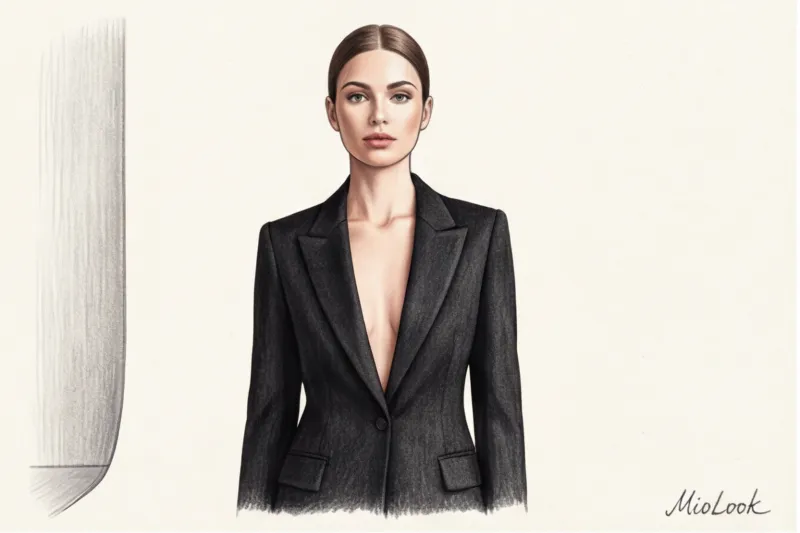
The V-neckline is deservedly considered the most flattering and versatile in fashion history. Its main superpower is the creation of a powerful central vertical line, which visually elongates the neck, narrows the shoulders, and directs the eye directly to the center of the face. But it is precisely this saving vertical line that women most often "kill" with improper styling.
Imagine a realistic scenario: you've purchased a luxurious, deep emerald evening dress with a V-neckline that reaches all the way to your solar plexus (in the €200 to €400 price range, such dresses are often made of gorgeous, flowing silk). You create voluminous, bouncy Hollywood curls and toss them forward over your chest. What happens? The large, vibrant curls obscure the clean, diagonal lines of the dress, creating visual noise. Instead of an elegant vertical line, you get a shapeless volume in the bust area, which visually adds a couple of pounds.
The best look for a deep V-neck is sleek, shiny hair pulled back or a sleek ponytail. If you prefer to wear your hair loose, be sure to tuck the front strands behind your ears. It's vital to leave some air around the neckline.
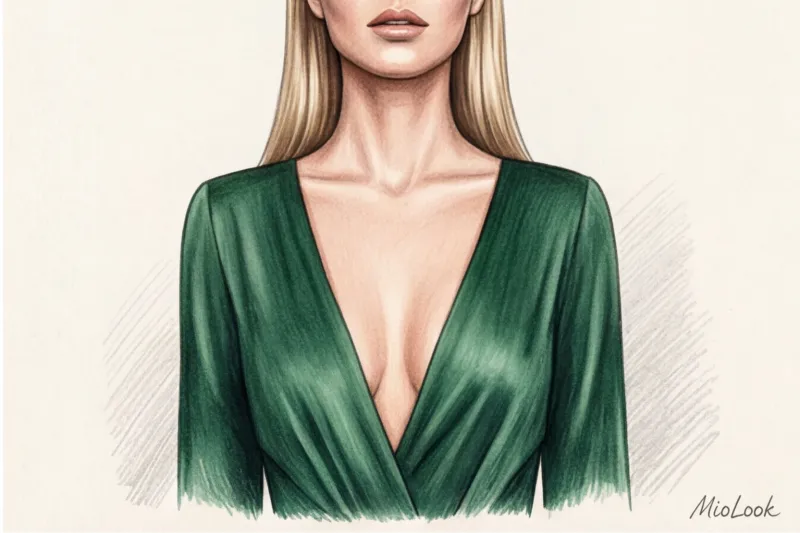
I especially admire the combination of a V-neckline with a bob haircut (chin-length or just below). Pure geometry comes into play here: the tight, even cut of the hair creates the upper horizontal, while the lines of the neckline create the lower triangle. Together, they form a perfect diamond. This shape looks extremely expensive, put-together, and a little French-chic.
Round neckline (U-neck and crew neck): soft lines
Basic T-shirts, cashmere sweaters, and sheath dresses with round necklines harbor a hidden stylistic threat that I call the "balloon effect." According to research on shape perception (specifically, 2022 publications by the Fashion Psychology Institute), the human eye automatically groups similar geometric shapes together, enhancing their scale.
What does this mean for your look? If you have naturally soft, rounded features, you wear a basic crewneck sweater and style your hair in a voluminous, rounded style with a brush, with the ends tucked in. You're essentially tripling the roundness of your head. Your face appears wider and your cheeks appear fuller. The situation is exacerbated if you're wearing a thick cotton sweatshirt or chunky knit (whether it's a €30 high-street item or a premium cashmere sweater for €300)—the thick fabric itself adds volume to your upper body.
A round neckline desperately needs to be offset with sharp angles and visual sharpness. How can this be done?
- Asymmetrical parting: Create a deep side parting. The diagonal line will instantly break up the excessive symmetry and visually elongate the oval of your face.
- Perfectly straight ends: Forget about curling the ends inward with a round brush. Straighten your hair with a flat iron, keeping the ends straight and sharp, creating vertical lines.
- Wet look (wet hair effect): Sleek, gelled hair slicked back creates the illusion of a small, neat head that perfectly balances the wide, rounded neckline.
Have you noticed that many conceptual minimalist brands (like Jil Sander or COS) style their crew neck pieces exclusively on models with sleek hair? This isn't a passing trend; it's a strict architectural necessity.
Are you unsure about choosing a styling option?
Not sure which parting or texture will work best with your new dress? Upload a photo of it to your smart wardrobe, and our AI assistant will help you find a coordinating look.
Try a hairstyle on MioLookBateau: Elegance and exposed collarbones
The boat neckline is a timeless homage to 1950s style and the legendary Hubert de Givenchy, who created iconic looks for Audrey Hepburn. This cut creates a clear horizontal line from shoulder to shoulder, elegantly revealing the collarbone. But this luxurious horizontal line has a side effect: it inexorably broadens the shoulders. That's why the hairstyle here must be meticulously crafted.
The most fatal mistake I regularly see at social events is loose hair over a boat neckline. Long strands mercilessly break the elegant horizontal line, cover the collarbones, and transform the exquisite designer cut into a sloppy, cluttered collar. The dress instantly loses its shape, and the look loses its polish.
There is one uncompromising rule for the boat neck: the neck must be open. Hair should be gathered, not simply pulled back with a tight elastic band, but rather styled into a low, textured chignon. Why a chignon? A high chignon on top, combined with broad, horizontal shoulders, creates a "chandelier" silhouette, which often looks unnatural and comical.
"A low bun at the nape of your neck works like an optical magnet: it draws the other person's gaze down to your neck and collarbones, emphasizing the fragility of the exposed area rather than the width of your shoulders."
To create the perfect chignon: create a low ponytail at the nape of your neck, twist it into a loose braid, and wrap it around an elastic. Be sure to gently pull the hair at the nape of your neck to prevent the shape from looking flat. Use a dry texturizing spray (such as one with sea salt) to keep the bun looking modern and vibrant, not like a ballerina in front of a stern examiner.
Square neckline (Kare): a play on contrasts
The square neckline is experiencing a real renaissance today, driven by the popularity of corsets and the "bridgertoncore" aesthetic. The rigid geometry of the square (right angles, clear lines framing the bust) creates a very strong, uncompromising accent. And here the rule of stylistic contrast comes into play: a rigid cut always requires a soft frame.
If you pair a square-necked dress (especially one made of a dense fabric like taffeta or velvet) with a strict, geometric hairstyle—for example, a perfectly sleek bob with thick bangs or a tight, slicked-back bun—your look will become monumental. You'll look overly massive and severe, as if you've stepped out of a Tudor-era portrait.
To offset the rigidity of the square's right angles, we need dynamism and lightness. The ideal architectural complement would be:
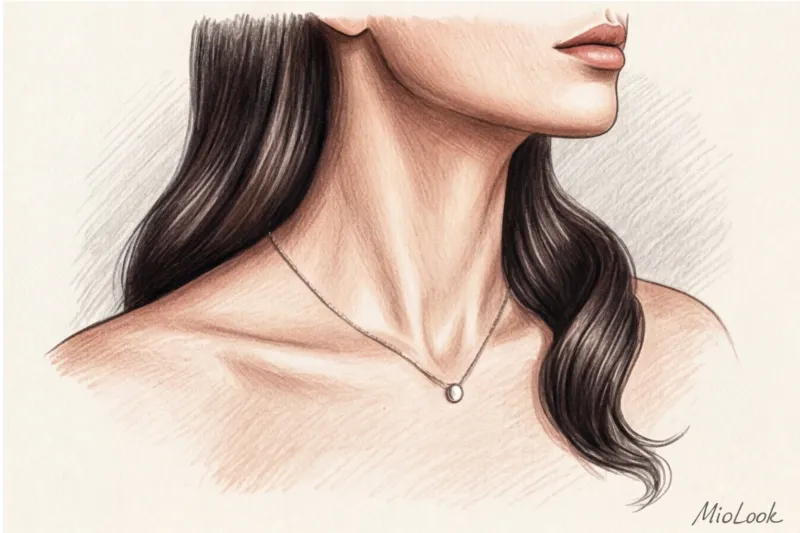
- Beach waves: The broken, slightly careless texture perfectly breaks up the strict lines of the neckline and adds airiness.
- Curtain bangs: The softly parted bangs on the sides round out the sharp angles of the cut and draw attention to the cheekbones and eyes.
- Half-up half-down hair: The top section of hair is pulled back from the face, while the bottom section falls softly down the back, creating the illusion of a flowing waterfall.
One of my clients bought a minimalist square-neck midi dress made of thick cotton (costing around €180) for a summer party. When she tried it on with a sleek ponytail, she looked like a stern algebra teacher. We radically changed our approach: we let her hair down, curled it into soft, barely-there waves with a large iron, and tousled them with our fingers and a drop of texturizing cream. The severity instantly dropped, giving way to relaxed, modern elegance. The dress's rigid square shape became the perfect frame for her lively, bouncy hair.
Complex architecture: asymmetry, stand-up collars and deep necklines
Transitioning from a basic wardrobe to evening or cocktail wear requires a whole new level of stylistic discipline. The main pitfall of complex tailoring is the "overdressed" syndrome. Imagine wearing a designer dress with intricate draping or accent embroidery costing around €600, then adding a complex, layered hairstyle with a tight hold. The result? The look becomes heavy, theatrical, and visually ages you.
According to the laws of composition we apply in professional styling, a look should have only one clear focal point. If your clothing has an unusual geometric shape, your styling should fade into the background, serving solely as an architectural counterweight. Let's explore the most capricious evening silhouettes and find the perfect proportions for them.
Asymmetrical One-Shoulder Neckline: Breaking the Stereotypes
There's a myth circulating among clients and even aspiring stylists: if one shoulder is exposed, the hair must be pulled up or swept to the closed side to "show off the neckline." I strongly disagree with this outdated rule.
Analyzing the successful red carpet appearances of Hollywood stars over the past few years, one can notice a completely different approach. Top stylists use the technique cross-balancing. The paradox is that it is loose hair or light waves thrown over open shoulder, create the most sensual and harmonious picture.
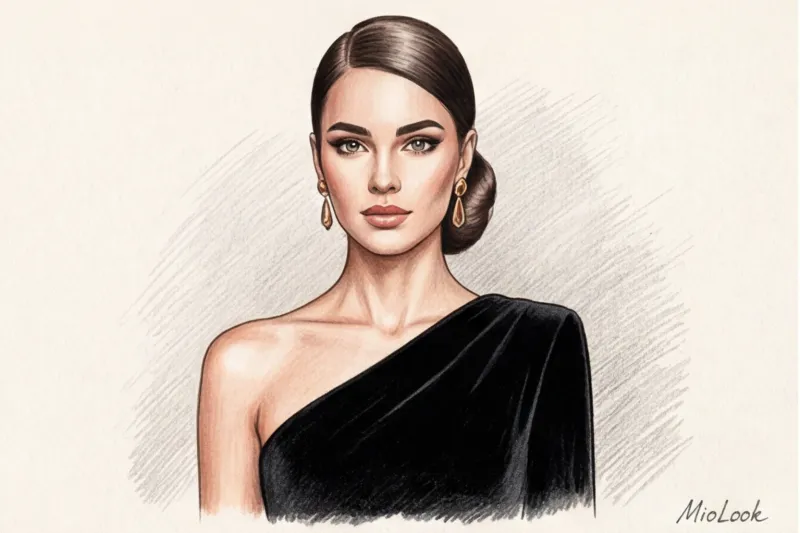
How it works in practice:
- Hair on open shoulder: They fill the empty space, creating an effect of mystery, and at the same time do not clash with the fabric or decor on the closed shoulder.
- Low ponytail on closed side: If there is no voluminous decoration on the shoulder (for example, just a smooth fabric), a strict low ponytail lying on top of the fabric will add a graphic look to the look.
The main no-no here is symmetrical hairstyles. A center parting and hair falling evenly to both sides will ruin the very idea of an asymmetrical cut. Your ideal hairstyle for a one-shoulder dress should definitely support the diagonal flow of the outfit.
Halter and closed neck: the vertical rule
Halternecks (where the straps tie or fasten at the neck) and high stand-up collars are incredibly elegant, but they pose an anatomical hazard. They physically cover the narrowest part of the body—the neck. Leaving your hair loose, especially if it's thick and dark, creates the optical illusion of a head resting directly on your shoulders.
This is where the strict rule of verticality comes into play: we must compensate for the stolen neck length with the height of the hairstyle. What will work best?
- Top knot (high messy bun): It stretches your silhouette upwards, adding a couple of visual centimetres of height to your figure.
- High smooth tail: Ideal for dresses made of dense fabrics (wool, velvet) with a closed neckline, it creates a sporty, taut look.
There's only one exception to this rule: ultra-short haircuts. A classic pixie or a very short French bob (ear-length) are perfect for high-necked hairstyles. They leave the back of the head and the nape of the neck exposed, allowing even a €50 black turtleneck to look like a high-fashion statement.
Access to MioLook for €0.99 — one-time payment
Start creating perfect looks with the help of artificial intelligence. Upload your items and find flawless combinations in seconds.
Get access — €0.99 onceOff-shoulder and bustier: face framing
Strapless or off-the-shoulder dresses create a huge horizontal expanse of exposed skin in the portrait area. On the one hand, this looks very fragile. On the other, if you pull your hair back into a sleek, tight bun, your head can appear disproportionately small against the broad horizontal line of your shoulders and exposed décolletage.
Excessive skin exposure requires careful visual framing. Our goal is to soften the horizontal line of the dress's hem. That's why the classic hairstyle for a bustier dress neckline is a loose or semi-updo:
- Hollywood Waves (Old Hollywood): Styled with a deep side part and tossed to one side, they create a luxurious diagonal that breaks up the broad shoulder line.
- Half-up half-down (malvinka): The top part of the hair is pulled back, revealing the cheekbones and face, and the bottom part falls freely onto the collarbones, covering excess nudity.
A little pro tip: if you're wearing your hair down for an off-shoulder dress, use a texturizing spray to keep your strands slightly casual. Overly sleek, plasticky curls paired with an open neckline can make your look look provincial, while a light, bouncy texture will add just the right amount of expensive casualness.
The influence of fabric and style on styling choices
Imagine the perfect V-neck. Now imagine sewing this dress first from flowing silk, and then from thick, textured Scottish tweed. Would the same hairstyle work? My answer: absolutely not. The architecture of the look is built not only on the geometry of lines but also on the physics of materials. The visual weight of the fabric dictates exactly how your hair should fall.
"Hair is a material in your composition, just like silk or cashmere. If the textures clash, the look falls apart, even if the neckline is flawless."
Last month, I experimented with styling myself to prove the power of texture to a client. The brief was simple: one basic silk slip dress (a minimalist style priced around €120) and two completely different settings. During the day, I wore the dress with a deliberately casual low bun, leaving fluffy, textured strands around my face. The look read as relaxed, urban casual. In the evening, without changing my dress or makeup, I simply straightened my hair to a mirror shine, created a sharp center part, and secured the strands behind my ears with a drop of gel. In 15 minutes, the same dress transformed into a formal black-tie evening gown. The magic happened solely due to the change in hair texture.
Dense fabrics: the rule of smooth contrast
Velvet, thick wool, bouclé, and heavy jacquard have tremendous visual weight. They absorb light and appear monumental. If you wear a velvet dress and add voluminous, '80s-style curls, the look will be heavy, stuffy, and will add years to your age.
The rule of contrast works here: heavy, matte fabric requires structured, smooth styling Think back to the Saint Laurent shows—their signature velvet dresses are always paired with perfectly slicked-back hair or graphic bobs. The sleek, shiny strands reflect the light and add just the right amount of movement and freshness to the heavy fabric.
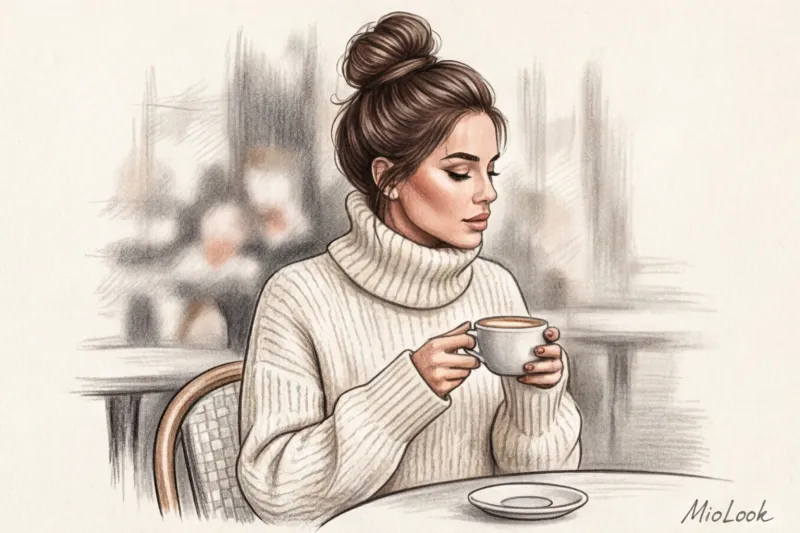
Lightweight fabrics: the law of airiness
Silk, organza, chiffon, and fine viscose are all about movement. If you create a stiff, varnished "shell" hairstyle on a flowing chiffon dress, your head will look like an artificial part, haphazardly attached to your body. The static of the hairstyle will clash violently with the flowing fabric.
In contrast to dense materials, light fabrics require the same moving, airy textures The aesthetic of fashion houses like Chloé is built on precisely this: flowing, translucent blouses and the inevitable lively "beachy" waves, relaxed braids, or curls that are easily blown by the wind.
To avoid having to look in the mirror every time you try to remember the rules for texture compatibility, I recommend digitizing your looks. You can upload photos of your key pieces to MioLook smart wardrobe and create capsule cheat sheets in a couple of clicks: note which particular hairstyle your favorite thick sweater or flowing blouse looks best with.
Checklist: How to Test Your Look Before Going Live
After eight years of training models for photo shoots and working with private clients, I learned one painful lesson: the perfect hairstyle for a dress neckline We don't exist solely in static form. We're not mannequins in a shop window. We laugh, reach for a glass, adjust our bags, and sit down at a table. Therefore, the final stage of your style architecture is a mandatory crash test before you go out. I call it the "four-step rule."
Step 1: Height test for head-neck-body proportions. Step back exactly two meters from a full-length mirror. Your goal is to assess the volumes as a whole. If you're wearing a dress with exaggerated puff sleeves (an architectural trend adored by designers like Alexander McQueen), a sleek hairstyle will create a pinned-up effect. Conversely, voluminous Hollywood curls paired with a tight knit tube dress will visually make your head appear disproportionately massive. The wide, geometric shape of a dress always requires at least a minimal amount of air and volume in your styling.
Step 2: Dynamics and friction test. Turn your head a few times. Are your strands getting caught in the decorations? If your evening dress is embroidered with stiff sequins, glass beads, or has a thick lace collar (even at €300 and up, such textures are tricky), leaving your hair loose will be your biggest mistake. Within an hour, the bottom strands will become an untidy tangle from constant friction, and expensive rhinestones can simply tear out some of your hair. If you feel the slightest resistance from the fabric, immediately gather up the lengths.
Step 3: Honest profile verification. This is the very practical advice I'm asking you to apply right now, standing in front of the mirror. Turn your head strictly sideways to your reflection. From the front, we perceive ourselves as flat, but the side view mercilessly reveals an imbalance. If you're wearing a dress with a full jabot, a large ruffle across the chest, or a statement collar, a sleek, combed-back nape will transform your silhouette into a question mark. You need to add volume at the nape (for example, with a textured bun or a French twist) to balance out the protruding front hem of the dress.
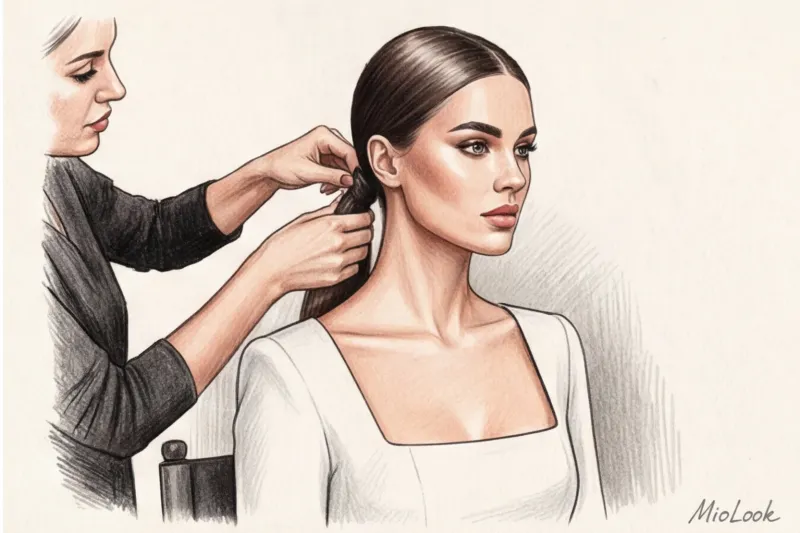
Step 4: Waist-up selfie (small talk test). At any dinner, date, or business event, people see you sitting 90% of the time. Sit back, relax your shoulders, and take a selfie with your chest level. Assess the frame: are your dark locks blending into your black collar, depriving you of any neck? And if you've chosen a deep bustier neckline and pulled your hair back tightly, does the photo create the awkward illusion that you're naked? It is in this portrait framing that the harmonious framing of your face should be visible.
Your ideal image begins Here
Join thousands of users who look flawless every day with MioLook. Digitize your wardrobe and find hairstyles to match your favorite dresses with just one click.
Get access — €0.99 onceConclusion: Your Personal Algorithm for Creating Harmony
Let's face it: most women spend hours searching for the perfect outfit and only five minutes styling their hair before going out, simply tying it into a crimp or hastily straightening it with a flat iron. This is a fatal styling mistake that can ruin even the most polished silhouette. Remember the philosophy of the legendary Vidal Sassoon: he was the first to treat a haircut as an architectural object requiring rigorous calculations.
Transferring this rule to modern styling, I always insist: hair is the same element of cut as sleeves , collar, or hem length. Your hairstyle has real visual weight, texture, and line direction. The perfect hairstyle for a dress's neckline isn't a random choice. If you're wearing a dress with a complex neckline, your hair should either complement the designer's intended silhouette, making it logical, or act as a deliberate contrast, never clashing with it.
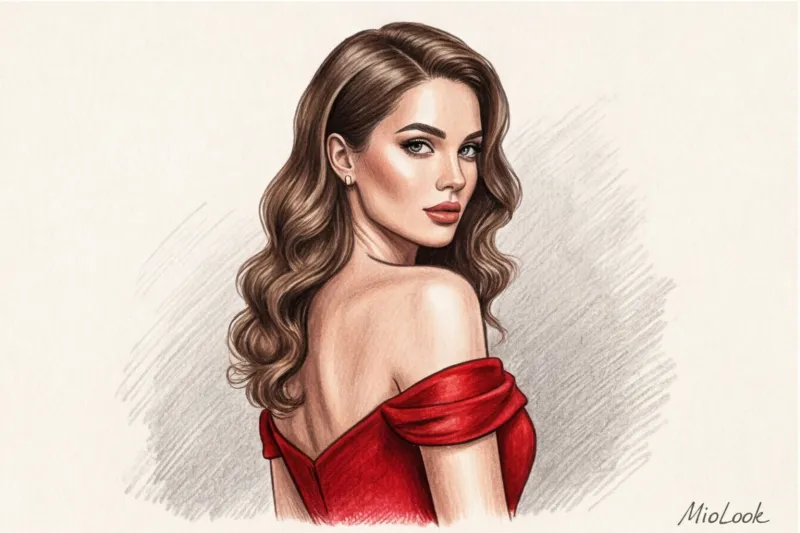
To make sure this theory doesn't just remain empty rhetoric, I suggest you try my signature at-home test, which I give to all new clients. Take out a dress from your closet that you like but somehow feel uncomfortable in (let's say, a classic sheath dress in the mid-price range, say, €70-€90). Put it on and take three honest selfies in the mirror in good daylight:
- Volume test: Let your hair down and throw it forward, covering your collarbones.
- Vertical test: Gather your hair into a tight, sleek bun at the back of your head or a high ponytail, leaving your neck completely exposed.
- Asymmetry test: Flip all your hair to one side (or create a low side ponytail), leaving the other shoulder open.
Then open these three photos side by side. The secret of this method is that the smartphone lens mercilessly removes our emotional attachment to the familiar reflection. Looking at the collage, you'll immediately notice how in the first case, the neck may have visually shortened by a couple of centimeters, in the second, a stately posture has emerged, and in the third, the broad shoulders suddenly appear more fragile and graceful.
But let's be realistic: testing hairstyles with curling irons, pins, and gallons of hairspray before every important event is an unaffordable luxury. We value our time. Over 12 years of practice, I've realized that only professionals with a trained eye can accurately predict the final volume balance in their heads. That's why today we are actively implementing technology in our wardrobe management. I highly recommend using MioLook AI fitting room for intelligent image planning.
The algorithm is simple: you upload a photo of your outfit, and the built-in artificial intelligence allows you to virtually "try on" dozens of hairstyles over your specific dress. This ingenious solution saves you from the classic pre-holiday frustration of spending an hour and a half at the salon getting a complex Hollywood wave, putting on a dress with a lot of embellishment on the chest, and suddenly realizing you look "overdressed" and heavy. A couple of clicks in the app saves time, stress, and the money needed to redo your hairstyle.
Instead of a final parting word, I'll share an observation from behind the scenes of a fashion shoot. I've seen designer dresses costing thousands of euros lose all their luster and become shapeless sacks due to loose hair obscuring the intricate cut of the collar. Conversely, a simple, basic, mass-market outfit for €50 looked like the epitome of couture simply because the graphic cut of the short bob perfectly matched the boat neckline.
Personal style isn't about chasing brands and trends. It's the pure mathematics of proportions, coupled with an understanding of your physical features. Study the architecture of your face and neck, align it with the geometric cut of your favorite pieces, and you'll forget about the problem of "I have nothing to wear." Harmony is already inherent in the right lines—you just need to arrange them correctly.
Guide Chapters
Hoodie Hairstyles: Stylish Oversized Hairstyles
Relaxed oversized styles require precise geometric styling. We'll explore the main mistakes and find the perfect hairstyles for voluminous clothing.
The perfect hairstyle for an American armhole and halter cut
Learn how silhouette design influences styling choices. We'll explore the basic rules for creating harmonious hairstyles for halternecks and halter necklines.
The Best Hairstyle for a Round Neck Dress: Stylist Tips
A round neckline can visually shorten the neck and make the silhouette heavier if styled incorrectly. We'll explain how to properly pair a hairstyle with a classic neckline.
Hairstyles for dresses with puffy sleeves: how to choose
A dress with accent sleeves requires a special geometric styling technique. We'll explore common mistakes and learn how to create the perfect balance in your look.
Hairstyles for a square neckline: geometric rules
A square neckline requires a special styling approach. We'll explore how to balance proportions and highlight the beauty of your neck with the right hairstyle.
The Best Boat Neck Hairstyles: Stylist Tips
A boat neckline requires perfect geometry. Learn how to choose the right hairstyle for a sophisticated look without throwing off your figure's proportions.
Women's hairstyles for a collared shirt: top ideas
A business suit can easily be ruined by improper styling. Learn the rules of portraiture and choose the perfect hairstyle for the office.
The perfect hairstyle for a backless dress
Have you chosen a dress with a striking back cutout? Find out how to style it so you don't hide the key detail and create a flawless look.
The perfect hairstyle for a one-shoulder dress
A one-shoulder dress requires special styling to prevent the silhouette from appearing heavy. We'll explore the rules for harmoniously pairing your hairstyle with an asymmetrical cut.
Hairstyles for Off-the-Shoulder Dresses: A Style Guide
An off-the-shoulder dress requires a special approach to styling to maintain the figure's proportions. Learn the secrets of image consultants for creating a flawless look.
The Perfect Turtleneck Hairstyle: Stylist Tips
A turtleneck is a stylish statement piece that requires the right styling. Learn how to style a turtleneck perfectly.
The Perfect V-Neck Hairstyle: The Best Styles
A deep neckline requires the right geometry. We'll explore the mathematics of silhouette and learn how to choose a hairstyle that will visually elongate your height and accentuate your figure.