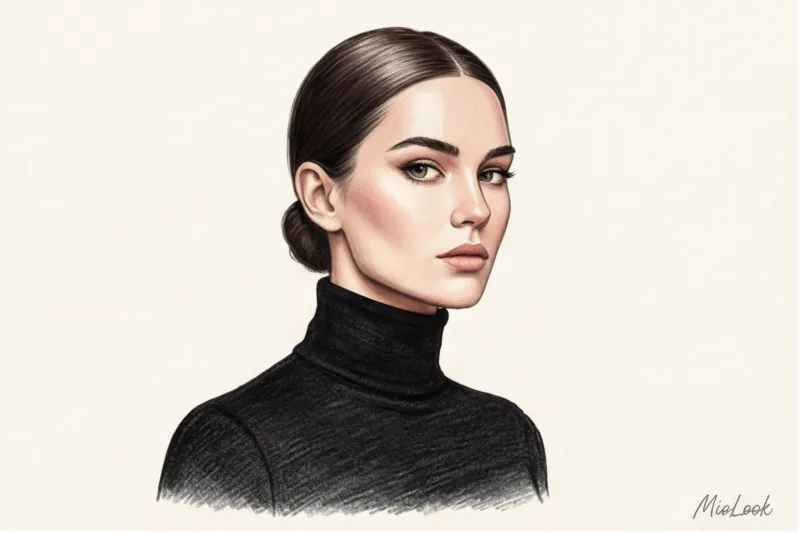
One of my clients, a top manager at a major IT company, once confessed during a wardrobe review: "In a turtleneck, I feel like either Steve Jobs or a strangled caterpillar. There's no middle ground." And she's not alone. Most women perceive turtlenecks solely as functional insulation, completely forgetting that this very item dramatically alters the body's proportions.
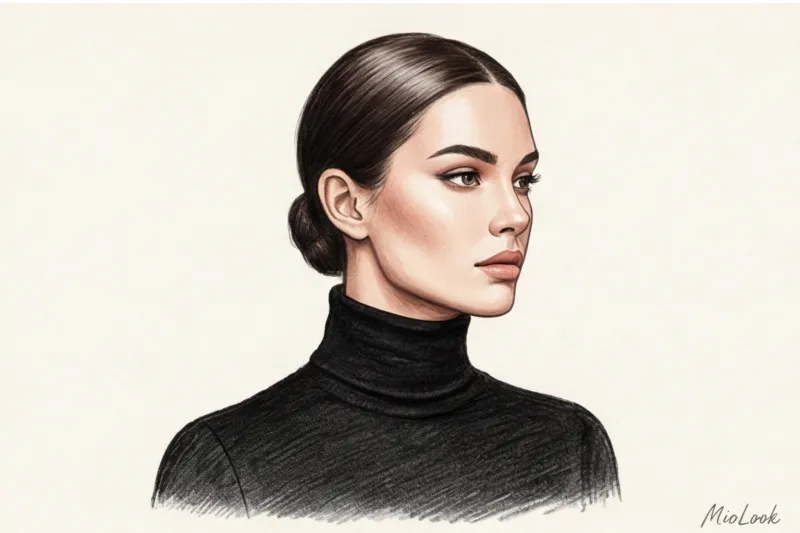
We talked about the architecture of the silhouette in more detail in our The complete guide to the perfect hairstyle for a dress neckline , but a closed neckline requires a completely separate, honest conversation. The fact is, the right hairstyle for a turtleneck depends not on the collar itself, but on the texture of the fabric (fine, flowing silk or coarse alpaca) and your ability to manage static electricity.
Over 12 years of practice, I've come up with a golden rule: a turtleneck is a pedestal. And how the "sculpture" on that pedestal looks depends entirely on how you style it.
Silhouette Architecture: Why a Turtleneck Hairstyle Is Strictly Geometry
When you wear a turtleneck, you literally erase the natural boundary between your torso and head. The skin of your neck, which usually serves as "air" in your look and lightens your silhouette, disappears. You create a monolithic block of color from your chest to your chin.
According to a 2024 study by the analytical agency WGSN, dedicated to the psychology of image perception, 80% of a person's visual attention is focused on the so-called "portrait zone"—from the collarbone to the crown of the head. If there is a volume conflict in this zone (a massive collar and voluminous curls around it), the eye perceives it as excess weight. An improper hairstyle with a closed neckline can visually shorten the neck by 3-5 centimeters and add a non-existent 5 kilograms.
"In styling, there's a strict law of compensation: if you cover your neck with fabric, you must expose its structure with your hair. Otherwise, your head will appear to rest directly on your shoulders." I repeat this golden ratio principle to every client.
Sleek hairstyles: a fail-safe classic for a closed neck
If you're unsure how to style your hair in the morning, a sleek, updo is your safest and most expensive choice. The contrast between the shiny, taut texture of the hair and the matte fabric (be it cotton, cashmere, or viscose) automatically elevates the look to the premium segment.
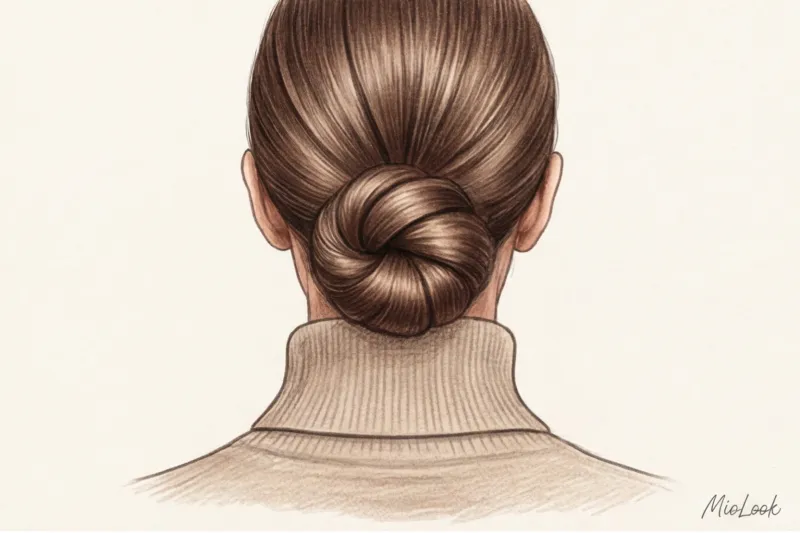
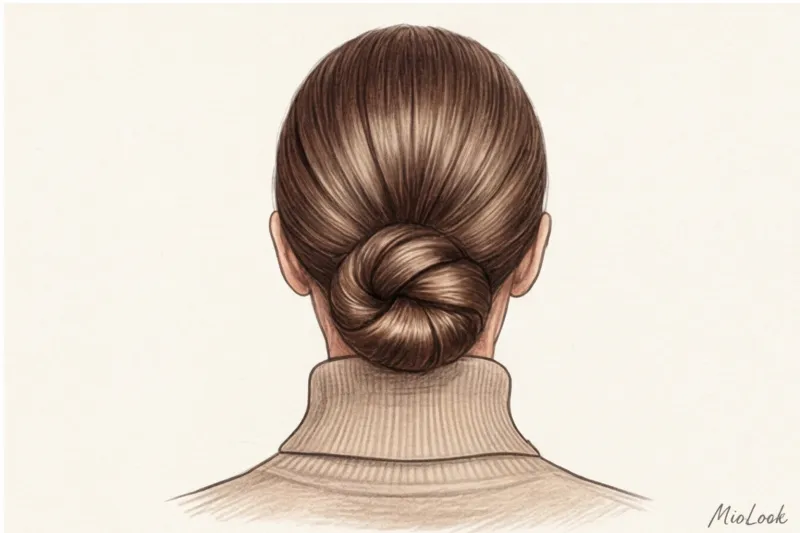
Old Money Low Bun
This is my go-to uniform for those days when I need to look classy without being overdone. It pairs perfectly with thin cashmere turtlenecks (ranging from €100 to €300) and smooth, basic knits.
- Geometry: The beam must be positioned strictly below collar line or exactly on its border, so that they do not push or deform each other.
- Parting: A straight geometric parting will add strict symmetry to the face.
- Trick: Leave a few thin strands of hair loose at the temples if you want to soften angular features.
High ponytail: visual face lift
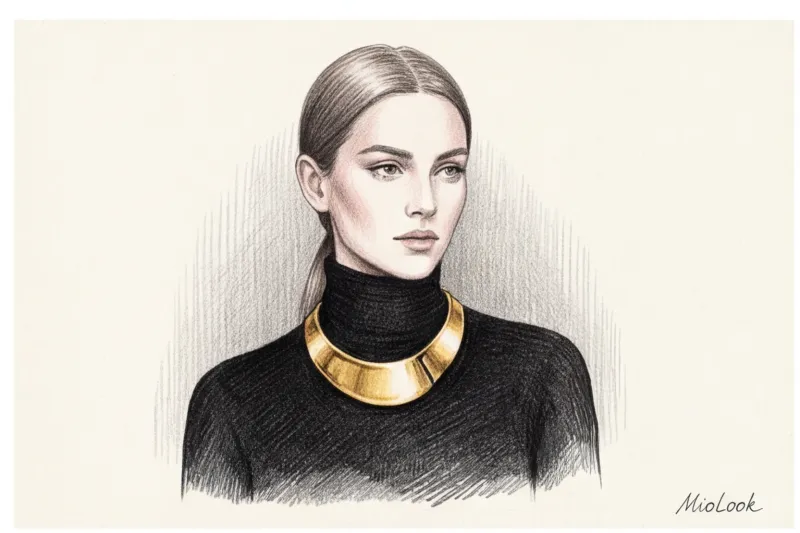
I love this Mediterranean look. When a turtleneck steals length from your neck, a high, tight ponytail brings it back, elongating the entire silhouette vertically. The formula is foolproof: black turtleneck + high, sleek ponytail + statement gold hoop earrings. It exudes confidence.
If you want to experiment with this geometry without risk, try MioLook — a smart AI stylist will help you visualize how a high ponytail will change the proportions of your face when combined with a high neckline.
Your perfect look starts here
Join thousands of users who look flawless every day with MioLook. Our smart algorithm will select a hairstyle to match your wardrobe.
Get access — €0.99 onceMyth busted: how to wear loose hair with a turtleneck
You've probably read articles with the categorical advice: "If you put on a turtleneck, immediately tie your hair back." I hate such dogmas. It's okay to wear your hair loose with a turtleneck, but you have to do it strategically.
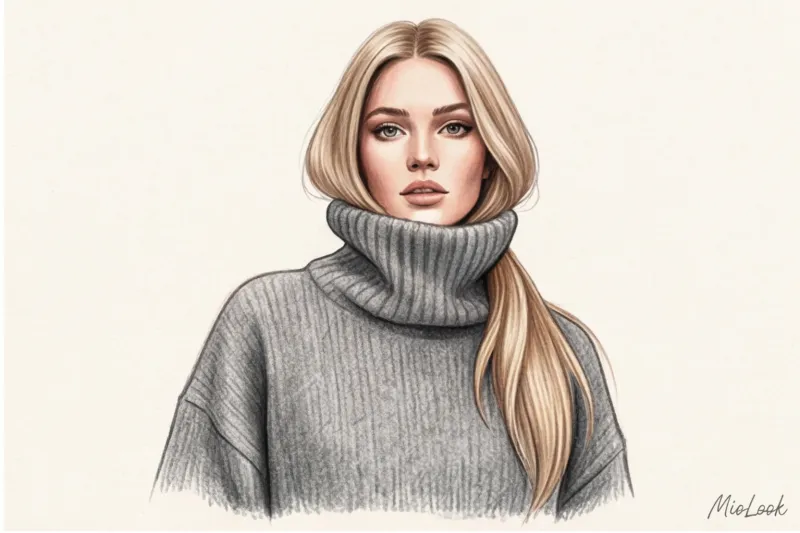
The biggest and most damaging mistake is fluffy, voluminous curls that fall over a thick collar. This instantly makes you look wider in the shoulders.
The "Hair Tuck" (hair in the collar)
This counterintuitive trick is a favorite of stylists at shows from Celine to The Row. The trick involves leaving your hair loose but tucking the ends into your sweater. This creates relaxed volume at the nape and mimics a stylish bob.
When it does NOT work: I have to be honest—this trick is absolutely contraindicated with thin, form-fitting viscose turtlenecks. Hair trapped under the thin fabric will create unsightly lumps on your back. This technique only works with oversized sweaters and thick fabrics.
Sleek strands behind the ears and "glass hair"
If you want to leave your hair loose over the fabric, it should be perfectly straight and shiny. Comb the front strands behind your ears to open up the jawline and restore definition to your face. Use a flat iron and liquid shine sprays to create a "glass hair" effect, which will contrast beautifully with the matte texture of your clothing.
Stylist's secret: the texture of the fabric dictates the styling rules
My client Elena once showed up for a fitting wearing a luxurious chunky knit turtleneck sweater. She had a complex updo with braids and backcombing. She looked as if she was struggling to carry it all. As soon as we unbraided her hair and pulled it into a minimalist low ponytail, the look instantly took on a new dimension.
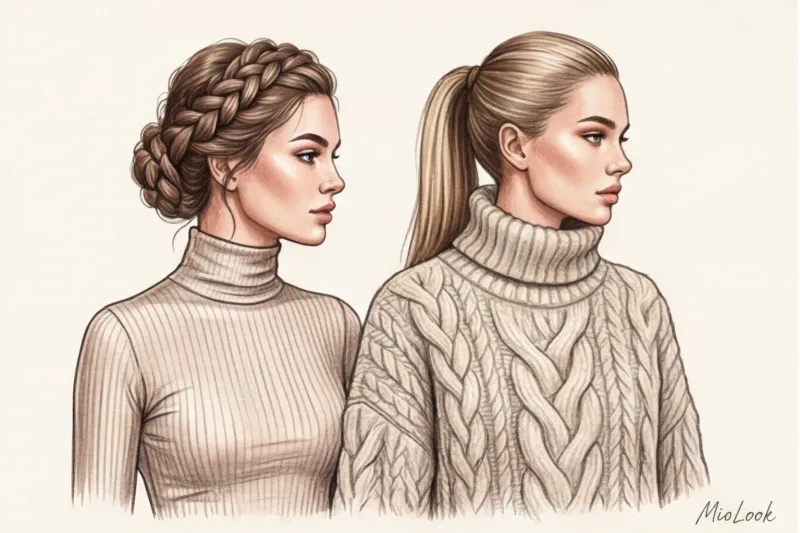
The texture rule that will save your winter wardrobe:
- Thin basic turtleneck (silk, viscose, merino): It can handle architectural, complex, and sleek shapes. Strict buns, braids, clips, and clip-ons are all appropriate here.
- Chunky knit sweater or fluffy angora: Requires radical minimalism on the head. The more active, thicker, and textured the fabric near the face, the simpler the hair should be.
Ready to get started?
Try a free plan—no commitments required. MioLook's AI stylist will help you avoid mistakes when combining complex clothing textures and hairstyles.
Get access — €0.99 onceAnatomy of Style: Adjusting Neck Length and Face Shape
Any garment with a closed neckline is a test of proportions. If you don't know your basic measurements, a turtleneck can be a disadvantage.
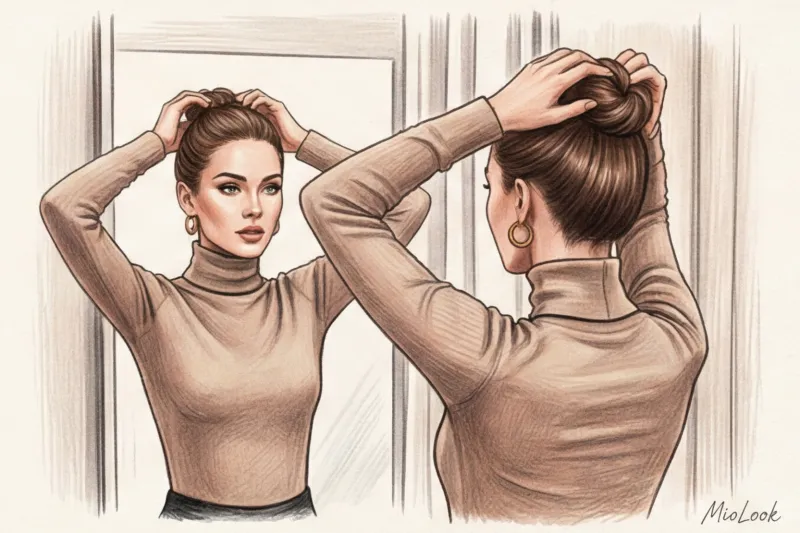
If you have a short neck: A turtleneck is your number one stylistic enemy, unless you offset it with an updo. A top knot and no volume at all on the sides will do the trick. No loose hair at shoulder level!
If you have a round face: A collar visually flattens the oval shape. To restore balance, you need volume at the roots in the crown area (above the forehead). Slightly raised curtain bangs, pulled back from the face, or a light backcombing combined with a pulled-back hairstyle will elongate the face vertically.
By the way, understanding these proportions is critically important not only for styling. We use the same rule when choosing rejuvenating bob — geometry decides everything.
Fighting static: how to save your hair from contact with wool
No style guide is worth it if your hair is standing on end with static electricity 10 minutes after leaving the house. A frizzy, sticky hairstyle ruins even the most carefully crafted look.
As cosmetics chemist Michel Blanc (2023) notes, winter static is a result of physics. The friction of dry hair against a wool or synthetic collar causes electrons to move, leaving the hair with a positive charge, causing them to repel each other. Furthermore, the coarse wool fibers literally cling to the hair cuticle, causing split ends.
Practical solutions I use on set:
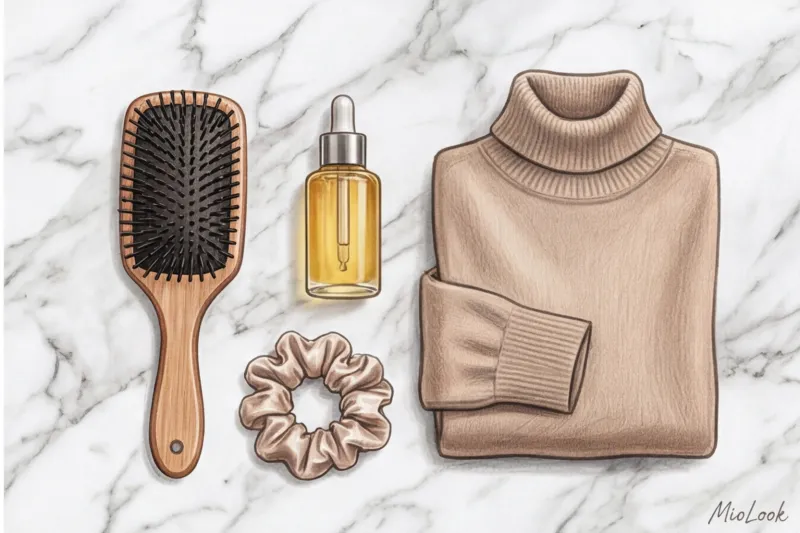
- Antistatic for clothes, not for hair. Lightly spray the inside of your turtleneck (especially if it's made with acrylic or polyester) with anti-static spray. Don't spray it on your hair!
- Silicone drops. Apply a drop of oil or smoothing serum directly to the ends of your hair. This will weigh it down and seal the cuticle, preventing friction from your sweater.
- Silk barrier. If you are wearing a sweater made of coarse lambswool, tie a thin silk scarf around your neck so that it creates an invisible layer between the wool and your hair.
Checklist: The Perfect Turtleneck Hairstyle in 5 Minutes
Save this routine for those mornings when you're standing in front of the mirror and don't know what to do with your hair.
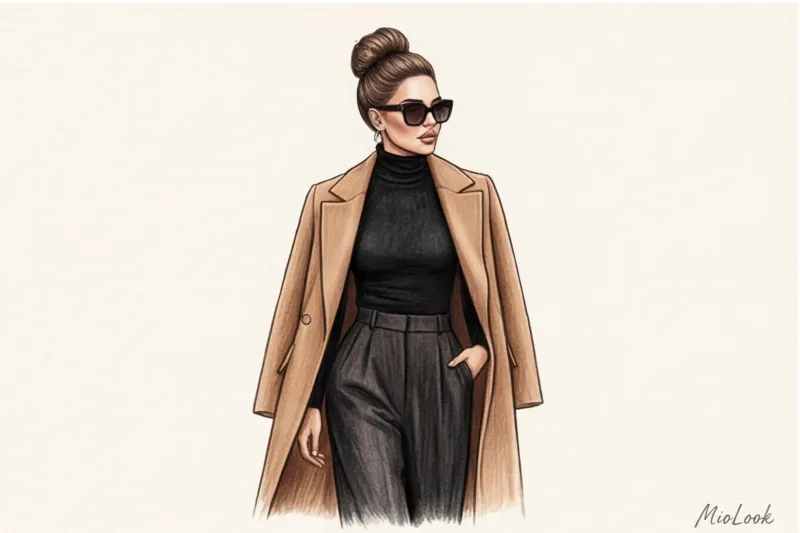
- Step 1: Estimate the collar volume. A thin fabric (like a turtleneck) allows you to play with partings and styling. A thick sweater ensures sleek minimalism.
- Step 2: Choose your hair texture. Create a contrast: matte fabric with glossy hair (use styling cream).
- Step 3: Open up your cheekbones. Keep your hair away from your face. Either pull it into a ponytail or bun, or tuck it tightly behind your ears.
- Step 4: Add an accent. By wearing a turtleneck, you've reduced your cleavage. Draw attention to your face with large earrings (vintage clip-on earrings or sculpted hoops look great).
- Step 5: Block static. A drop of oil on the ends or spray on the inside of the collar.
Managing your wardrobe is much easier when you have a handy tool at hand. You can always create your capsule wardrobe and test combinations in the app. MioLook , so as not to waste your nerves in the morning.
Remember the key: a turtleneck isn't just a sweater; it's a frame for your face. Stop hiding behind loose, shapeless locks. Show off your jawline, add a touch of sleekness, and even the most basic €30 high-street turtleneck will look like a touch of Parisian chic.