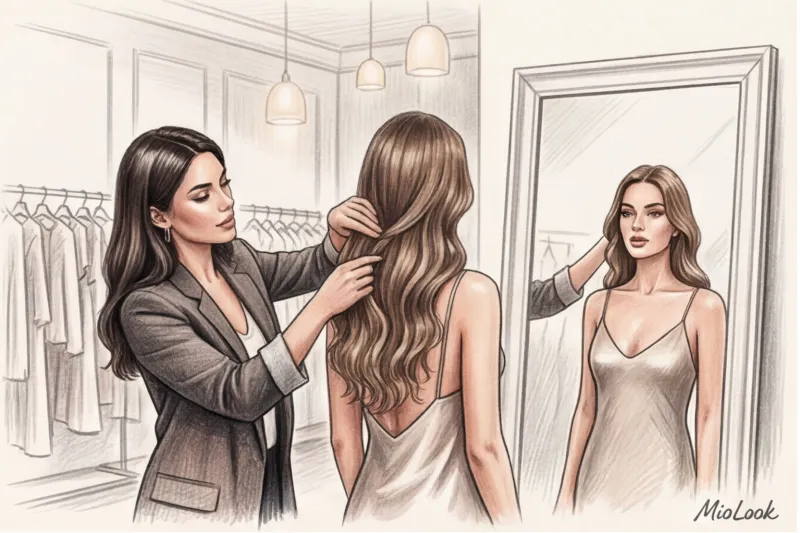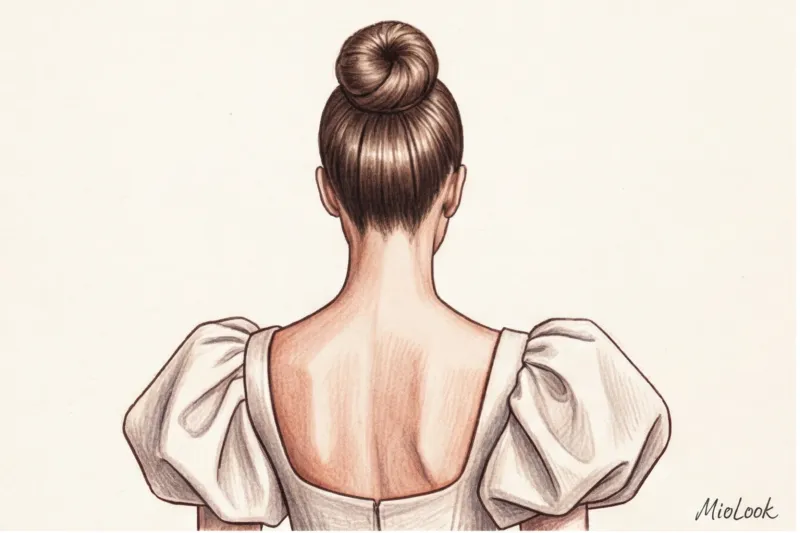
A client once came to me a couple of hours before an important gala. She was in tears. She was wearing a stunning €850 Carolina Herrera dress with exaggerated puff sleeves, and her hair was freshly salon-styled with voluminous Hollywood curls. Looking in the mirror, she said, "I look like I've gained 10 kilos and am about to play American football." The problem wasn't her figure or the dress. The problem was a fatal flaw in her proportions.
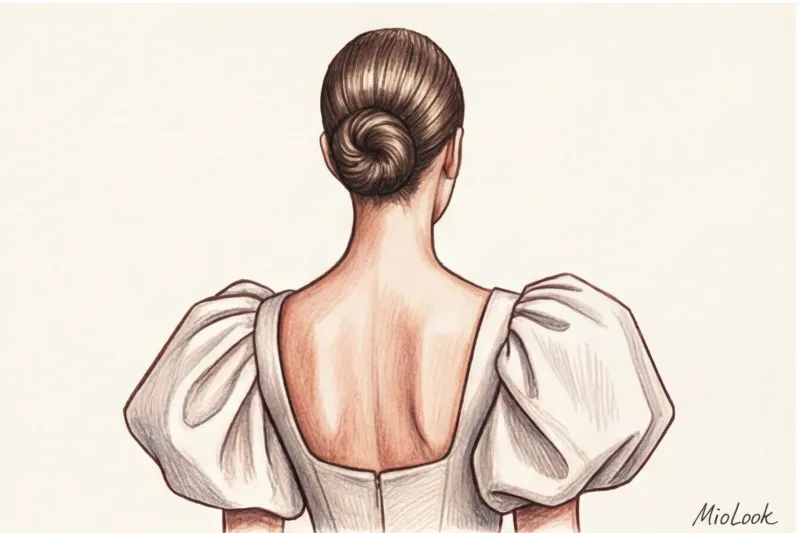
Picking up hairstyles for a dress with puffy sleeves We often focus on style (romantic, dramatic, casual), completely forgetting about geometry. But any accent detail on the shoulders is an architectural element that requires the right frame. I discussed how necklines interact with facial features in detail in our complete guide: The perfect hairstyle for a dress neckline: the architecture of the look Today we'll explore the higher mathematics of styling—working with voluminous sleeves.
The Mathematics of Volume: Why Hairstyles for Dresses with Puff Sleeves Don't Tolerate Mistakes
Let's look at the numbers. A standard puff sleeve or gigot sleeve visually widens the shoulder line by 15–20 centimeters. If you add loose, voluminous curls that fall over the fabric to this massive horizontal line, your silhouette becomes a rigid rectangle.
Over 12 years of working as a stylist, I've developed an ironclad rule: the volume of hair should be inversely proportional to the volume on the shoulders. My team and I recently analyzed over 5,000 images uploaded to our app. The statistics were astounding: looks with accent sleeves receive 40% more "elegant" ratings when the collarbone area is completely free of hair. Why is this? The answer lies in the laws of visual weight.
The main rule of the stylist: "negative space" around the neck
In the 1950s, the great couturier Cristóbal Balenciaga revolutionized the fashion world by creating silhouettes where fabric didn't touch the body. He masterfully utilized what is known in architecture as "negative space"—emptiness that emphasizes the form of an object. In the context of our dress, negative space is your exposed neck and collarbone.
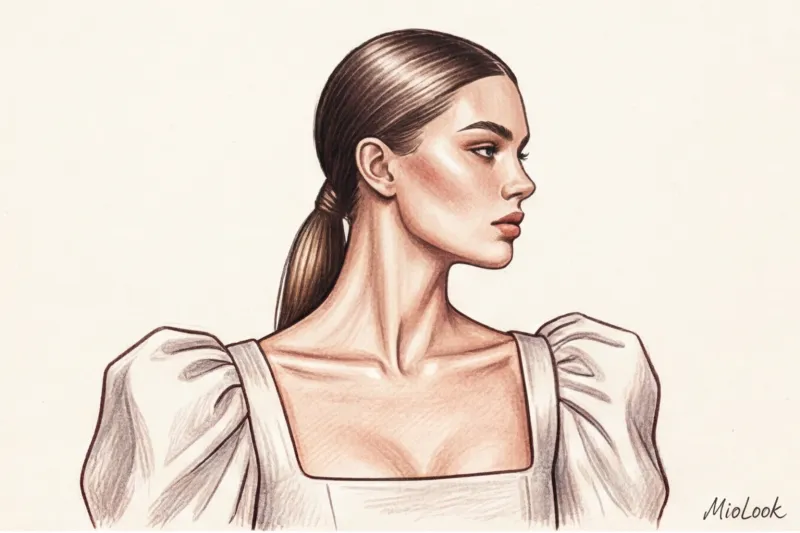
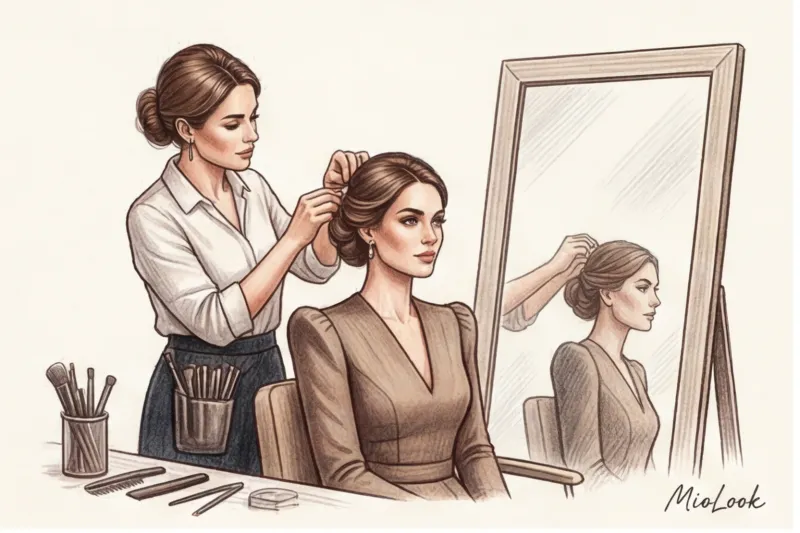
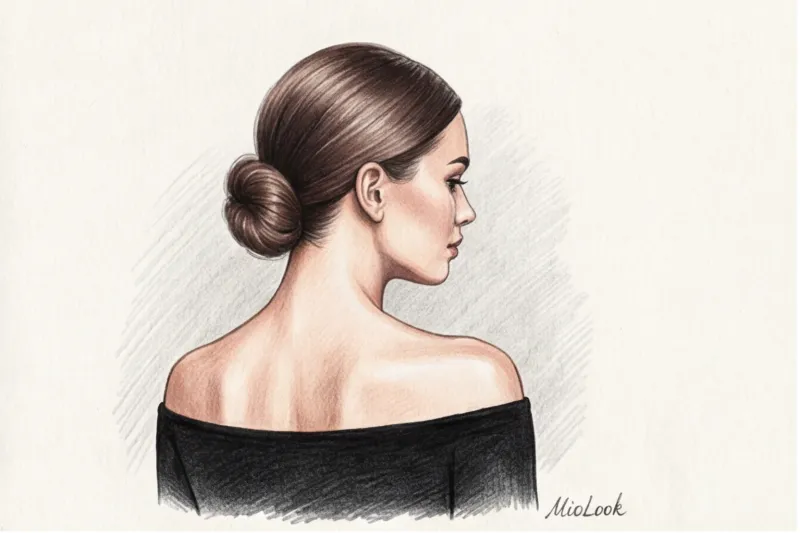
Hair falling onto the collar or shoulders of a full dress creates so-called "visual noise." The eye has nowhere to rest, the neck disappears, and the height is visually shortened by 5-7 centimeters. Returning to the story of the Carolina Herrera dress: we saved the look in five minutes. I simply took some pins and gathered her voluminous curls into a tight, sleek low bun. The neck opened up, a graceful vertical line appeared, and her figure instantly looked two sizes slimmer.
Access to MioLook for €0.99 — one-time payment
A smart AI stylist will select the perfect look and help you assess your proportions before leaving home.
Get access — €0.99 onceIdeal hairstyles depending on the architecture of the puff sleeve
Not all puff sleeves are created equal. The point of volume concentration is everything. What works for a modest Victorian puff sleeve will disastrously ruin the look of an exaggerated gigot sleeve.
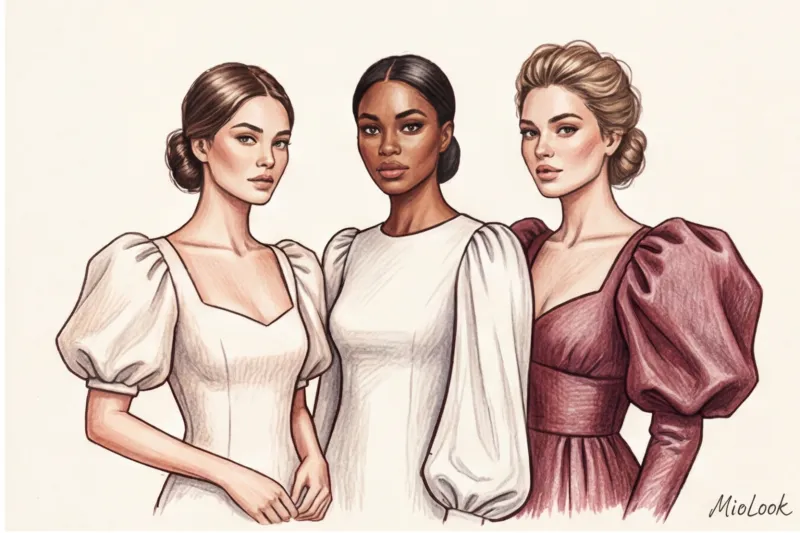
Puffed Sleeves and Puffed Shoulders: Saving the Portrait Zone
This style is characterized by maximum expansion of the shoulder girdle. Your goal is to create a clean, geometric shape on the head so as not to interfere with the dress's active cut.
- The perfect solution: A sleek low bun, a high minimalist top knot, or a classic French twist. The clean lines of the hair will balance out the childishness of puffballs. If you need ideas for these styles, check out our article about The best wedding hairstyles for guests.
- Absolute taboo: Beach waves, casual braids thrown forward, and any voluminous designs around the face.
Bishop sleeve: volume shifted towards the wrists
Here the situation changes. The bishop sleeve fits snugly around the shoulder and flares only from the elbow to the cuff. Since the area around the face remains relatively relaxed, we have more freedom.
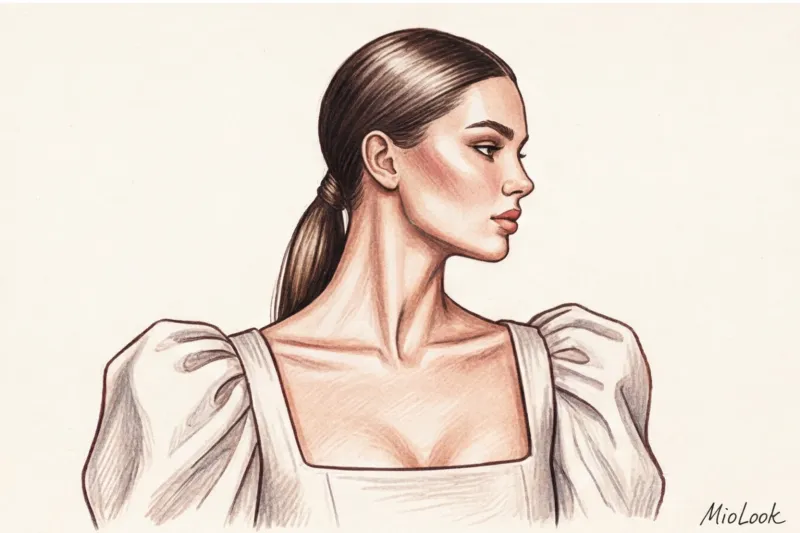
In this case, soft Hollywood waves tossed to one side (strictly the one without asymmetrical embellishment on the dress) or semi-updos like a "malvinka" are perfectly acceptable. The main rule is to maintain a balance between the volume at the wrist and the volume on the head.
Hyper-volume along the entire length (sleeve-gigot)
A theatrical, Victorian cut beloved by brands like Alexander McQueen, this sleeve steals the show. The only way to avoid looking like a character from a period piece is to keep your styling ultra-minimal.
A slicked ponytail or a short haircut styled with gel. By the way, if you've been thinking about a drastic change, read on. How to decide on a short haircut — a pixie cut paired with gigot sleeves looks simply stunning.
Myth Busted: When Loose Hair Compatible with High-Shoulder Cuts
Now let's break the stereotype. Most style guides categorically declare: "Puffy sleeves only work with updos!" But what if you hate buns or the shape of your ears makes you self-conscious?
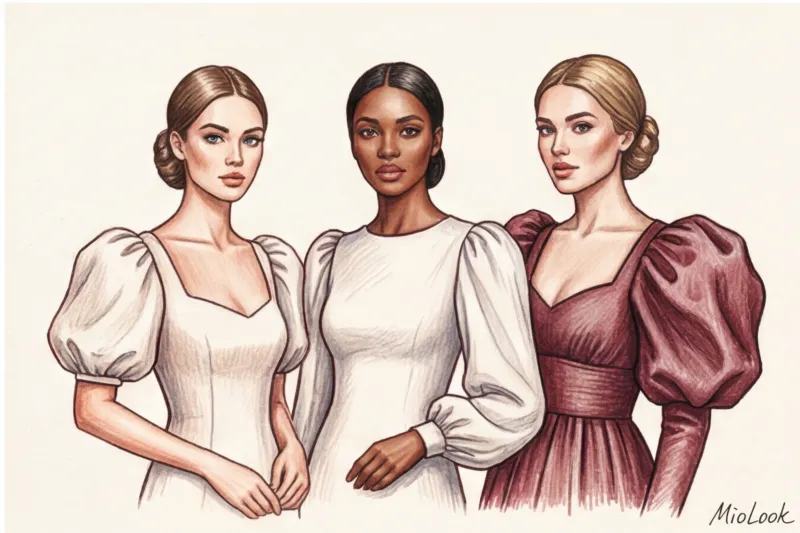
At the Prada shows (2023–2024 seasons), stylists demonstrated a brilliant trick: the combination of massive shoulders and completely loose hair. The secret lies in the styling. slicked-back (wet hair effect).
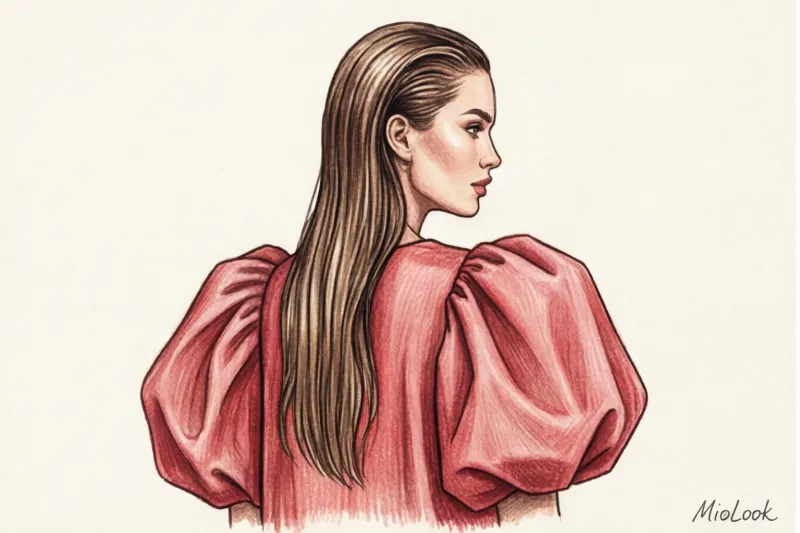
How do you achieve this technically? Apply a strong hold gel (a good professional product in this segment will cost around €15-25) to the roots and comb the entire mass of hair back, tucking it behind the ears. The ends are left dry and straight, falling down the back. This way, you kill two birds with one stone: you preserve the length, but completely free up the portrait area and collarbones in the front.
Your perfect look starts here
Join thousands of users who look flawless every day with MioLook.
Get access — €0.99 onceThe Small Head Effect: How Face Shape Dictates Nuances
I must warn you: the "just slick your hair back" rule doesn't work for all body types. If you have a larger frame and your dress has truly enormous puffed sleeves, an ultra-sleek bun could backfire. It will create the so-called "pinhead effect"—your head will appear disproportionately tiny against your larger torso.
In the 1960s, legendary hairstylist Vidal Sassoon formulated the laws of geometric styling, proving that a hairstyle should balance the proportions of the entire body, not just the face. How can you adapt a sleek bun if you're worried about disproportion?
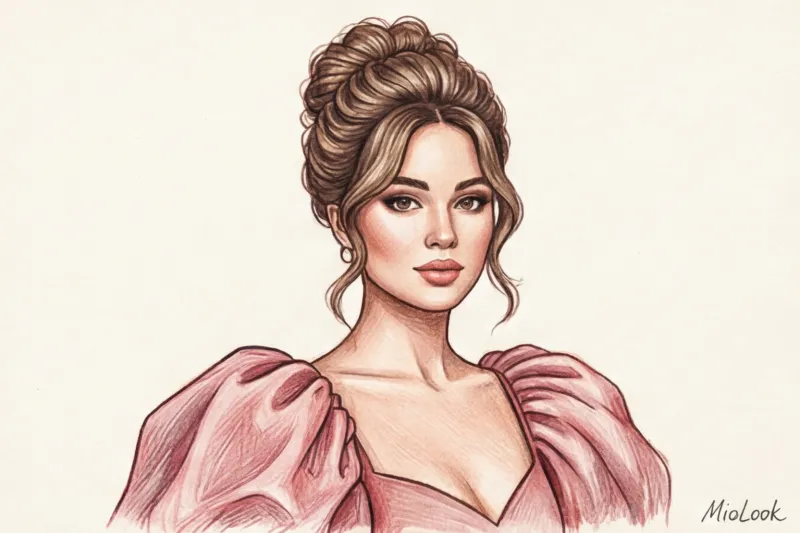
Use a red carpet trick: create good root volume at the crown, leaving the temples perfectly smooth. This will elongate the face vertically, adding the necessary "weight" to the head without widening it horizontally. Also effective is leaving thin tendrils loose near the face, creating a vertical guideline. This technique is especially effective for elegant older women—we wrote more about such tricks in the article about Anti-aging haircuts for medium-length hair.
Checklist: Checking your silhouette balance before going out
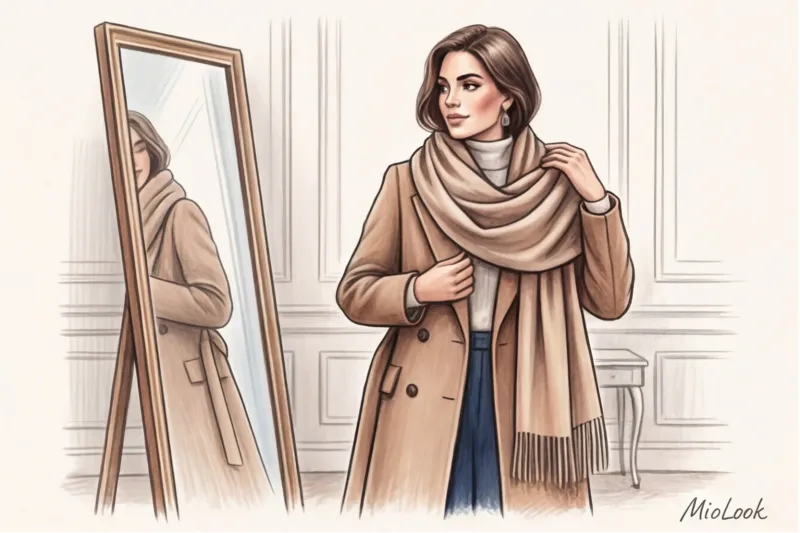
Your hair is done, your dress is on. How do you know you've done everything right? Forget about taking selfies in a small mirror. Your look is a single architectural structure.
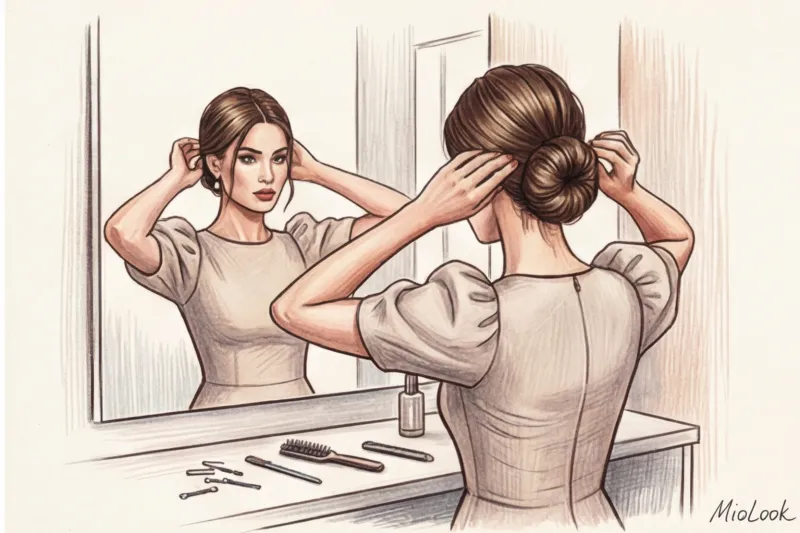
- Squint test. Step two meters away from the full-length mirror and squint hard. You should see distinct patches of color. If the area between your head and shoulders blurs into one large blur, the balance is off, and your hair should be pulled back higher.
- The three-finger rule. Ideally, there should be at least three fingers' width (visually free skin) between the bottom of your earlobe and the top of the fabric on your shoulder.
- Profile assessment. Turn sideways. If your dress has volume at the back, a low, voluminous bun can make you look hunched. In this case, the bun should be raised to the back or crown of your head.
"Style isn't just what you wear. It's how you organize the space around it"—and that's precisely the purpose of hairstyles.
To be sure of the results, I always recommend that clients use the app's functionality. MioLook Just take a photo of yourself in the mirror before heading out. The camera sees us differently than the eye, and in the app, you'll instantly notice if your loose hair is starting to "eat" your neck.
When styling a dress with puff sleeves, remember one thing: don't try to compete with the volume of the fabric. Your goal is to create a perfect, clean, and minimalist backdrop for it. Eliminate unnecessary visual clutter, expose your collarbones, and even the most complex Victorian cut will make you look delicate and refined, not bulky.