In my 12 years as a fashion consultant, I've seen hundreds of gorgeous suits hopelessly ruined by a single detail. And no, it's not worn-out shoes, cheap bag hardware, or a poorly chosen tie. It's the hair.
When clients ask me what it should be like The perfect hairstyle for a collared shirt (women's) (A variation of power dressing), I always suggest stopping thinking about hair separately from your wardrobe. Your hair is as much an architectural extension of the jacket's lapels and the crisp cotton of your pants or skirt. The connection between the construction of your clothes and how you frame your portrait is the foundation of harmonious proportions. We discussed this in more detail in our The complete guide to the perfect hairstyle for a dress neckline.
Today, we'll be looking exclusively at office wardrobe: clean lines, thick fabrics, and uncompromising geometry.
Portrait Zone Architecture: Why Shirts and Jackets Dictate Their Own Rules
In a business setting, your face is your most important asset. According to visual perception research (specifically, WGSN's 2024 reports), approximately 80% of a person's attention during business negotiations is focused on the so-called "portrait zone." This is a triangle that begins at the crown of the head and ends at the chest line.
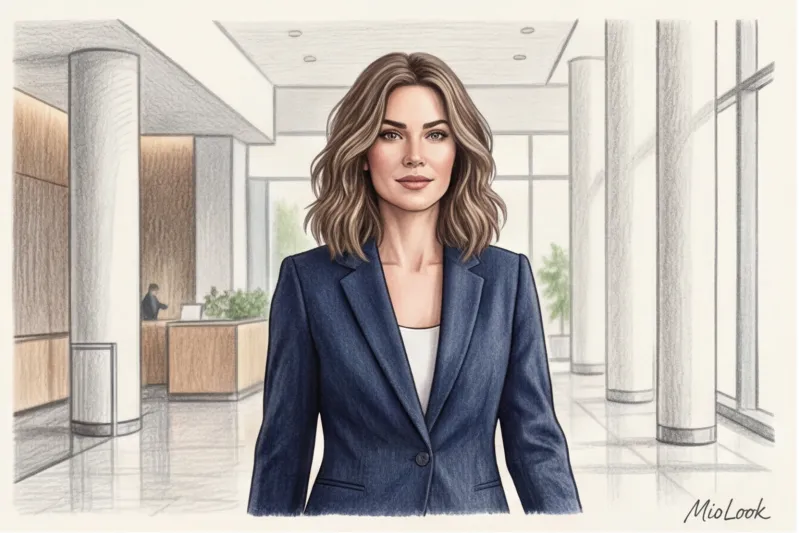
Traditional British tailoring on Savile Row has historically been built on one immutable rule: a stiff jacket collar is constructed like a pedestal, supporting the face. It elevates posture, creates a rigid frame, and frames the neck. Ever notice what happens when you let soft waves of hair flow over this "pedestal"? A visual conflict arises. The soft, chaotic lines of the locks compete with the sharp, precise angles of the lapels, creating a visual noise.
But beyond aesthetics, there's also a purely mechanical problem, which trichologists call "collar breakage." Constant friction of hair ends against the stiff edge of a starched shirt or a thick wool jacket increases split ends by 30% in the fall and winter. You're not just ruining the look of your suit with untidy strands—you're literally destroying the structure of your hair.
True femininity in power dressing isn't Hollywood-style curls cascading over the shoulders. It's an open, fragile neckline that effectively contrasts with the rigid, exaggerated shoulders of your jacket.
Access to MioLook for €0.99 — one-time payment
A smart AI stylist will select the perfect look.
Get access — €0.99 onceLapel Geometry: The Perfect Hairstyle for a Women's Collared Shirt
The basic rule of proportions I teach in my master classes is this: the higher the collar of your blouse, the higher the bulk of your hair should be tucked. The human brain thrives on order. If the neckline of your shirt, a large accent button, a necklace, and the ends of your hair all end at the same level, the viewer perceives it as chaos and untidiness.
Differences in texture are also critical. Smooth, flowing fabrics like silk or high-quality poplin with a weight of 180 g/m² (like those found in iconic Jil Sander or COS shirts) require the same impeccably smooth, hair-on-hair styling. However, textured materials—thick tweed, bouclé, wool with a pronounced pile (imagine a jacket in the mid-price range of €150–€300)—excellently tolerate a touch of casualness and textured, slightly tousled buns.
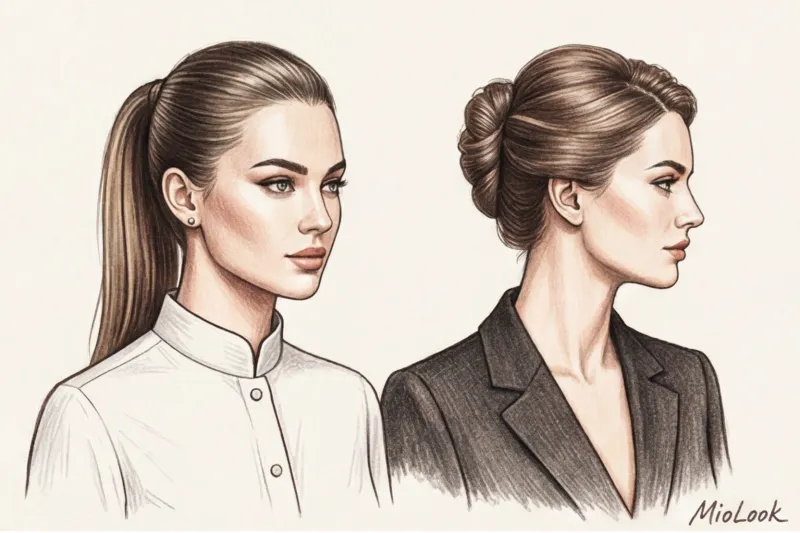
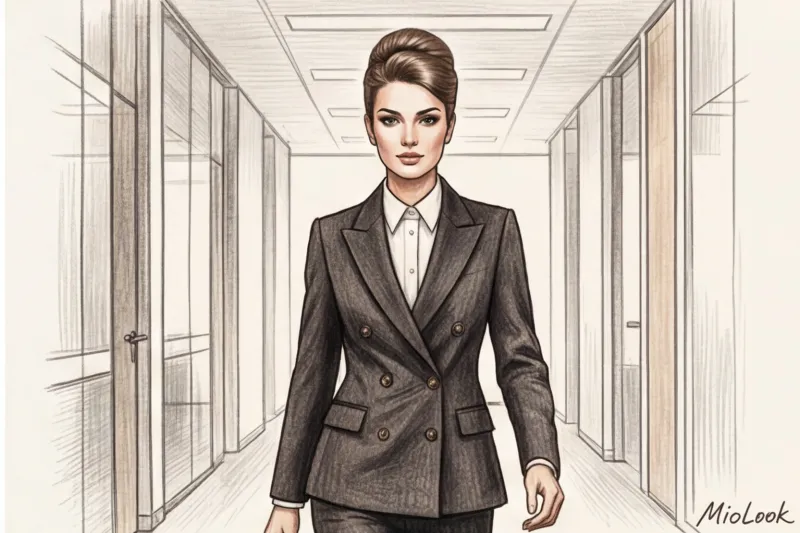
Styling for a classic turn-down collar and English lapel
Our main goal here is to ensure that the V-shaped silhouette created by the garment is not obscured. A classic turn-down collar draws the viewer's gaze down to the neckline, elongating the neck.
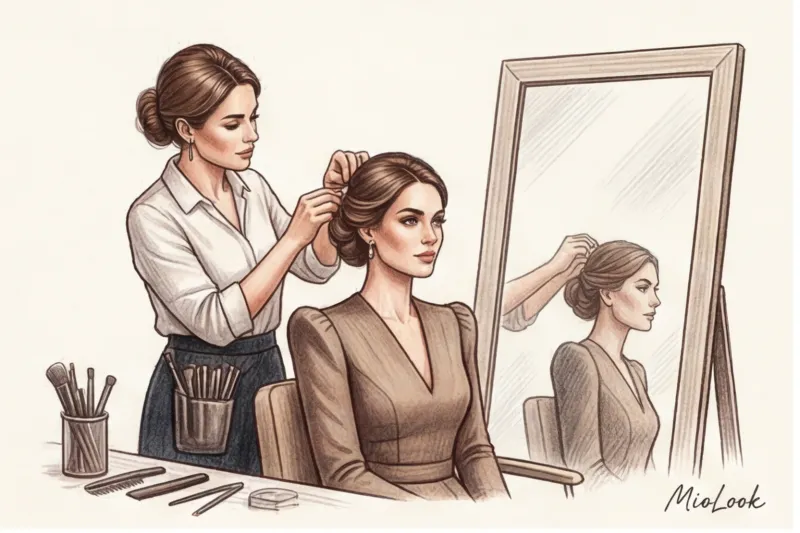
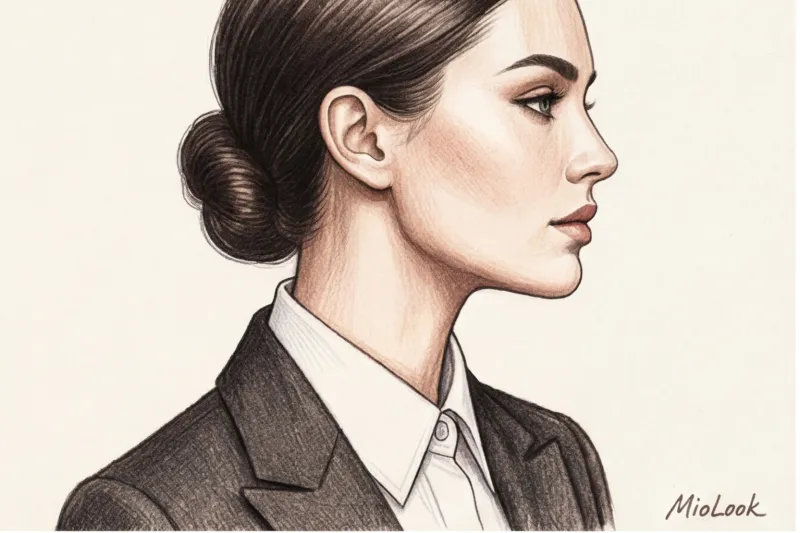
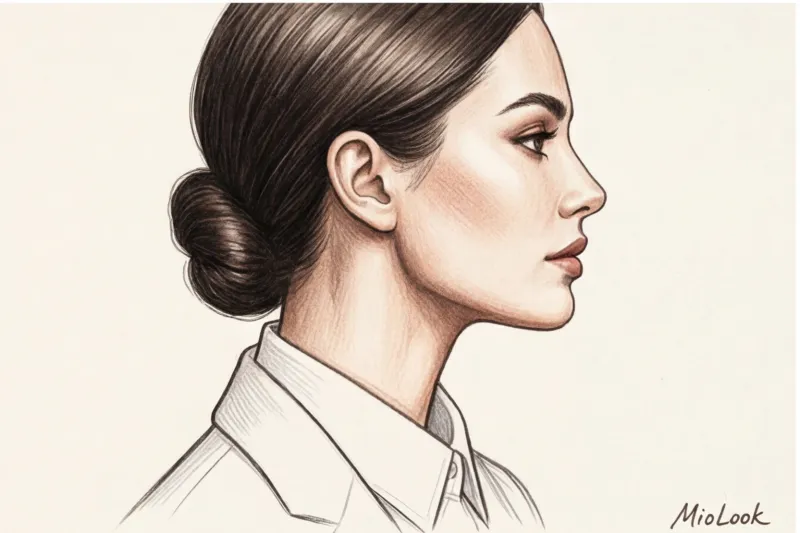
A sleek low chignon is the absolute ideal solution. It completely removes volume from the nape of the neck, leaving a clear space between the jawline and the fabric. The principles of architectural haircuts, established by the legendary Vidal Sassoon, teach us: the shape of the hair should follow the bone structure of the face. A chignon subtly accentuates the jawline and cheekbones, completely in keeping with the geometry of the shirt. If a classic chignon seems too boring, try asymmetry. Move the volume of the chignon to one side to maintain the rigidity of the collar on the other.
Solutions for stand-up collars and buttoned-up shirts
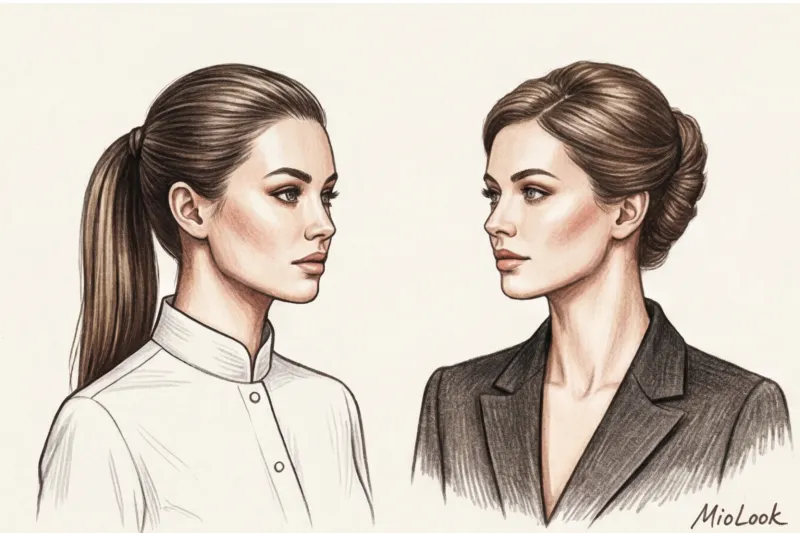
An Oxford shirt buttoned to the top or a mandarin collar obeys a strict law of compensation: a fully covered chest requires a fully exposed neck and ears. Otherwise, you risk looking like you're encased in a sheath.
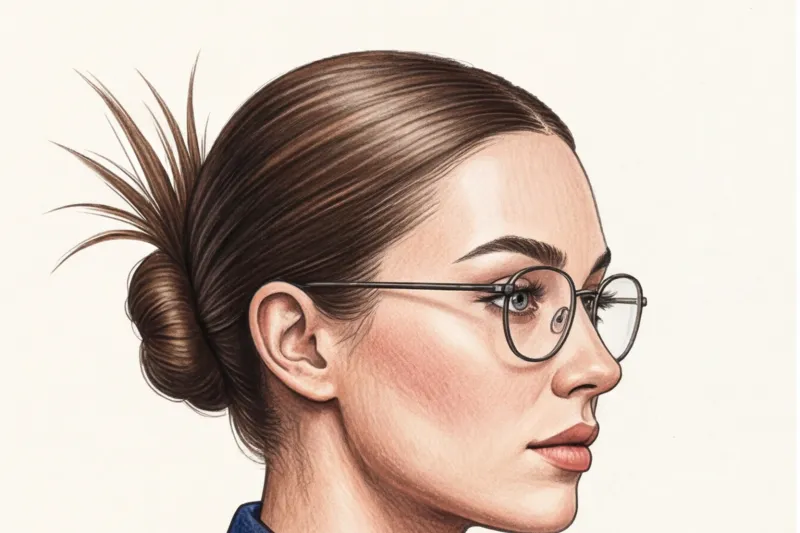
The best choice in this situation is an updo. A sleek French twist (that classic shell-like bun) or a perfectly sleek high bun will visually elongate the silhouette. However, the popular ponytail is a highly questionable choice. Every time you turn your head, it will constantly hit your collar, acting like a pendulum, becoming disheveled and ruining the formality of your business look.
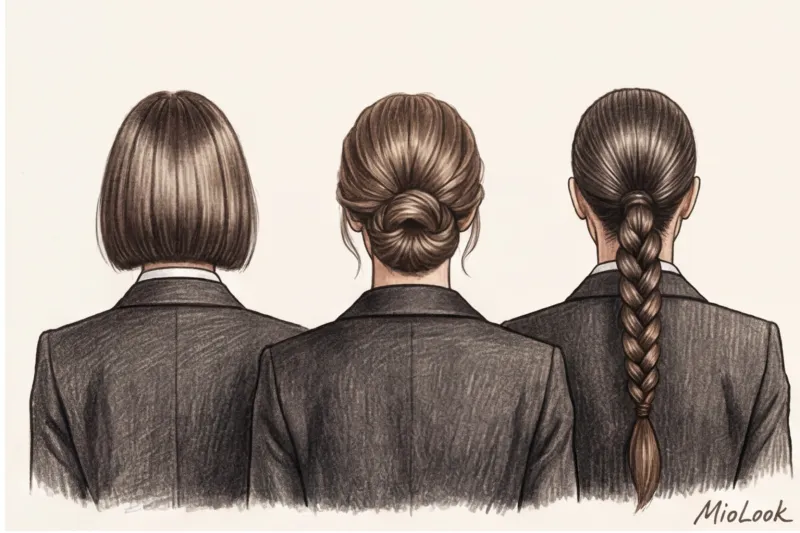
Dangerous Length: How to Adapt Your Haircut to a Strict Dress Code
Pixie cuts and short French bobs look phenomenal with men's jackets, but they pose a dangerous risk: the "helmet" effect. If your thick hair ends exactly where the stiff shoulders of a jacket begin, it visually merges your head and torso into a single rectangle. The solution? Be sure to add texture to your short hair with a dry spray. The air and lightness between the strands will break up this monolithic look.
The most problematic hair style for the office is medium-length hair (bobs and long bobs). One of my clients, the CEO of a large IT company, absolutely adored her impeccably tailored double-breasted Tom Ford jacket. But every day by 2:00 PM, her elegant shoulder-length bob would inevitably flip outward, turning into a sloppy mess—the ends of her hair would simply hit her stiff English collar. The solution was simple but effective: we switched to a half-up hairstyle (also known as a "malvinka"), pinning the front strands tightly at the nape of the neck and lifting the roots. The collar remained loose, and the status of her look skyrocketed.
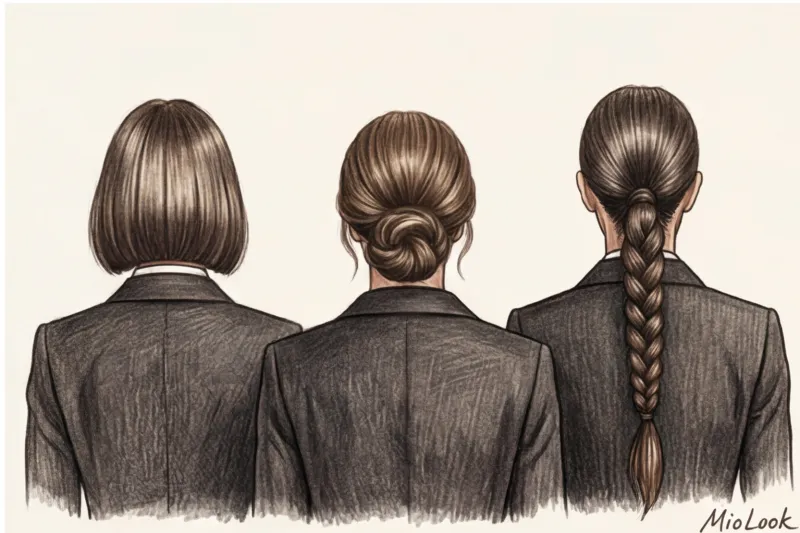
Long hair in the office is often tamed with braids. My personal professional advice: be extremely careful. A simple French braid often looks childishly naive and instantly diminishes your authority during negotiations. If you choose a braid, choose a tight, graphic twist with hidden elastics and a perfectly smooth finish.
Your perfect look starts here
Join thousands of users who look flawless every day with MioLook.
Get access — €0.99 onceThe Myth of Loose Hair in the Office: Why It Cheapens an Expensive Suit
Women's magazines still perpetuate the stereotype that long, loose locks soften a masculine two-piece suit, making you more attractive. As a stylist, I categorically disagree with this approach. It's one of the most harmful fashion misconceptions.
Let's look at the physics of the process. A mass of hair lying tightly on your shoulders and covering the collar of a white shirt visually shortens your neck by at least half. Your figure instantly becomes squat, and your shoulders appear heavy and hunched. Pulled-back, face-opening hair subconsciously evokes dynamism, career focus, and professionalism. This is pure "old money" aesthetics. A sleek low ponytail with a basic €150 jacket looks far more expensive and prestigious than voluminous Hollywood curls with a €1,000 jacket.
Are there any exceptions to this rule? Yes, but only one. Loose hair, styled with a light, matte, "yesterday" casualness, looks luxurious with oversized suits, provided there's no shirt underneath. A lingerie-style top or a buttoned-up jacket over bare skin is a game-changer. But let's be honest: in a classic corporate dress code, this is an absolute no-no.
Checklist: 5 Steps to Perfect Office-Chic Hairstyle
You don't need to be a professional hairstylist to create a harmonious and luxurious look. Just go through this checklist before leaving the house:
- Assess the height and stiffness of the collar. If it's starched, high, and stiff (like a classic men's shirt), the hair must be pulled up. No exceptions.
- Check the "friction zone". Put on your jacket and vigorously shake your head in front of the mirror. Is your hair catching on your lapels or the fabric at your back? By lunchtime, your hairstyle will be out of style and your ends will be splitting.
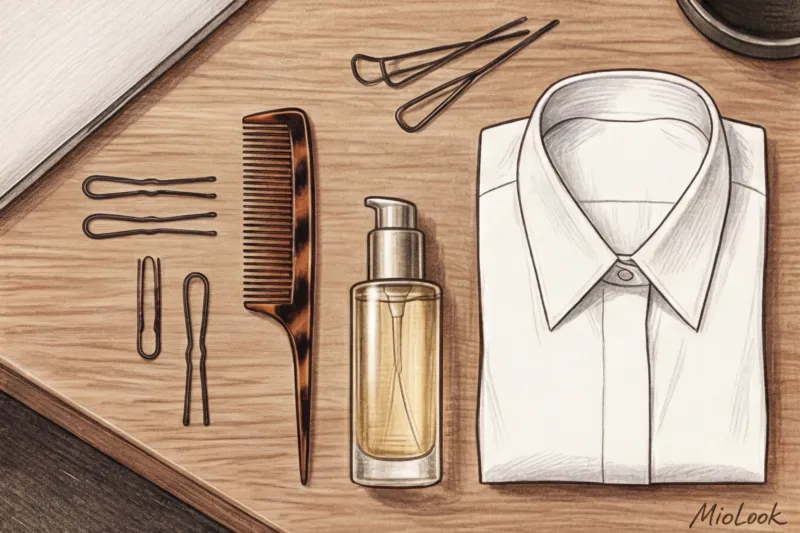
- Choose the right styling products. This is a critical point. In my experience, many successful women have ruined expensive silk and cotton blouses due to the wrong hair products. My personal crash test proved that shiny gels, serums, and oils leave disastrous yellow, greasy stains on white cotton. Use only matte pastes, clays, or dry texturizing sprays—they are 100% safe for your clothes.
- Hide technical elements ruthlessly. Telephone-style elastic bands and cheap plastic hair clips ruin the office chic look. Wrap a thin strand of your own hair around the base of your ponytail, using bobby pins that match your roots.
- Add status accessories. If your corporate culture allows, a minimalist matte gold barrette or a tortoiseshell comb made of high-quality acetate will be the finishing touch that completes the picture.
Your personal style at the intersection of fabric and shape: the finishing touches
Your hairstyle isn't an isolated part of your body with a life of its own. It's a powerful accessory to your look, working seamlessly with your shirt neckline, makeup, and jacket shoulders. If you're having trouble imagining how different updos will look with your work wardrobe, upload your photos to MioLook A smart AI stylist will help you visualize your results before you even pick up a brush.
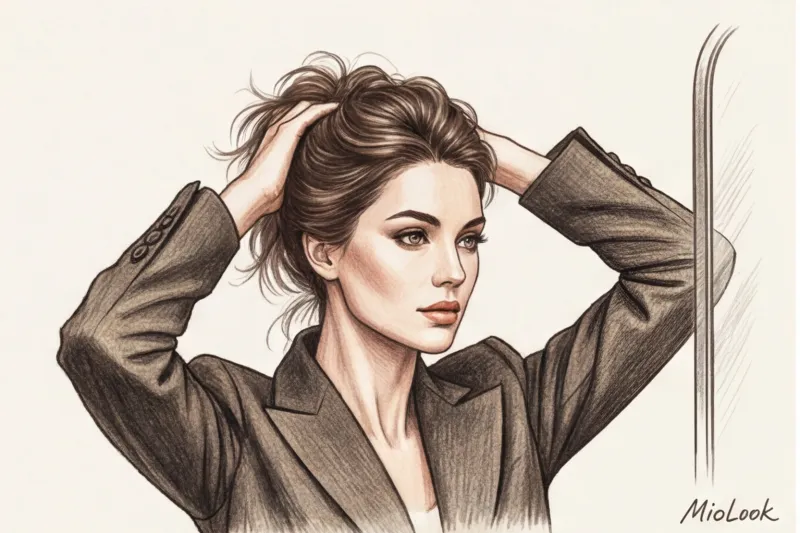
Try a simple experiment today: put on your smartest office jacket with a white shirt unbuttoned two buttons. Stand in front of a mirror with your hair down. Then, slowly, using both hands, lift it up, revealing your neck, collarbones, and cheekbones. You'll instantly see your posture straighten, your features sharpen aristocratically, and the refinement that appears in your silhouette.
It is this balance of closed, rigid fabric and open, vulnerable skin that creates that magnetic, expensive office chic that cannot be bought in any boutique in the world.