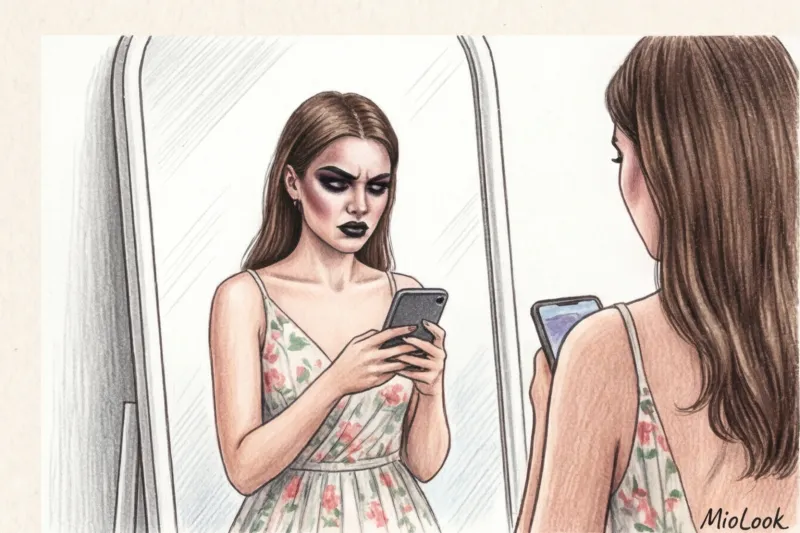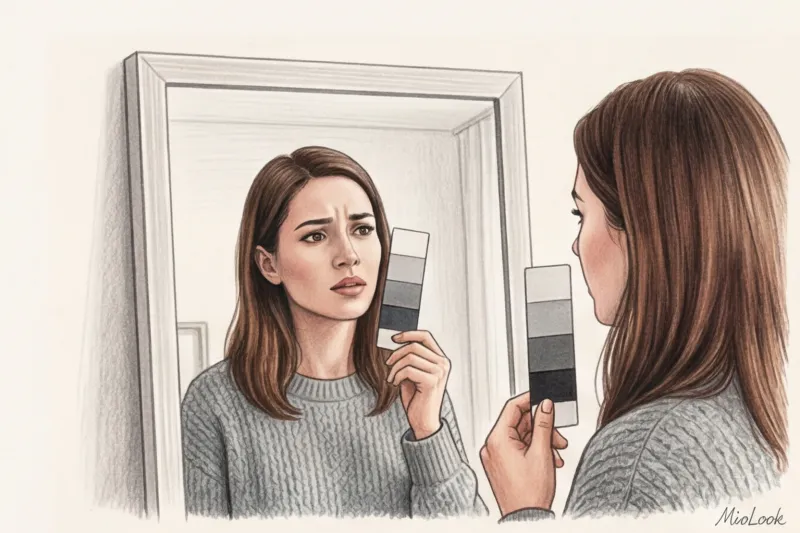
Just last week, a client named Anna came to me for a wardrobe review. She brought a stunning graphic Massimo Dutti dress for €150, which, she said, was "eating away" her face. Anna was perplexed: she'd used a popular TikTok life hack, converted her selfie to black and white, and assumed it had high contrast. So why didn't the dress suit her? The answer lies in technology: her new smartphone camera had artificially deepened the shadows, mistaking her wishful thinking for reality.
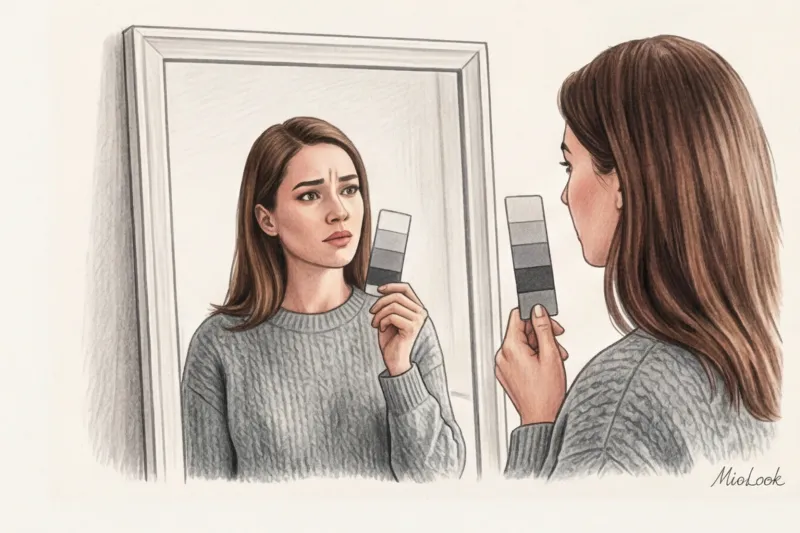
To be sure determine the contrast of appearance online , we no longer need dubious filters or subjective "eyeball" judgment. Computer vision algorithms have entered the picture. We discussed basic color theory in more detail in our the complete guide to appearance contrast , and today I suggest you look at your wardrobe through the prism of technology, the physics of color, and conscious consumption.
Why the old "black and white filter" method no longer works
The popular stylist advice to "just desaturate your selfie to check the contrast" is downright harmful in today's world. We're forgetting how our phone cameras work.
Smart HDR (High Dynamic Range) algorithms and built-in beautification automatically enhance shadows and reduce highlights. When you take a photo, the processor instantly stitches together multiple frames with different exposures. As a result, dark blond hair appears almost black, and highlights on fair skin become even brighter. The phone programmatically boosts your contrast to make the photo appear more three-dimensional and Instagram-worthy.
Because of this digital illusion, women with softer complexions often buy overly sharp, geometric prints that overpower them. Furthermore, the human eye is extremely subjective. We see what we want to see. If you have brown eyes and dark blond hair, the brain automatically assigns you to "high-contrast" types, ignoring the actual mathematical differences in pixel brightness.
How neural networks see our appearance: the physics of color and pixels
Unlike us, artificial intelligence (AI) is emotionless and doesn't know the names of colors. It doesn't divide people into "winter" and "autumn." AI stylist analyzes the image using Computer Vision algorithms, based on colorimetric standards.
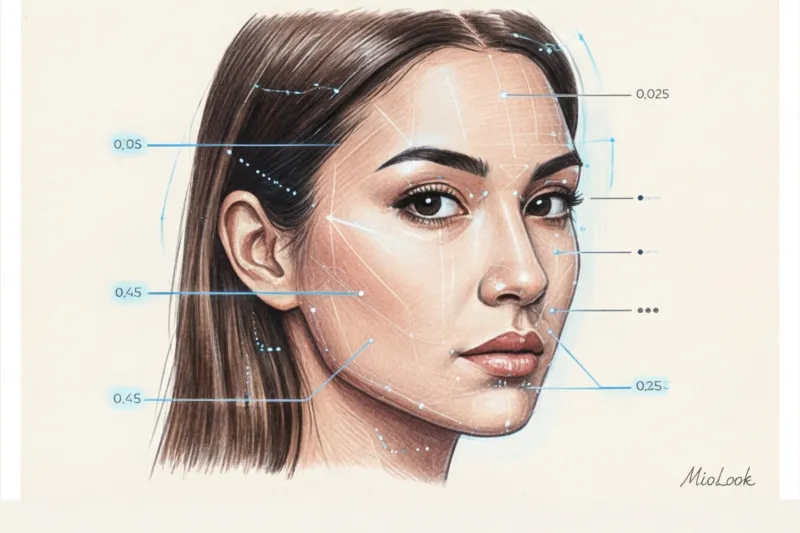
Machine analysis is based on Albert Munsell's color system, developed in the early 20th century but still used in digital optics. Munsell identified three color characteristics: hue, saturation, and value. Neural networks are interested in this scale. Value from 0 (absolutely black) to 10 (absolutely white).
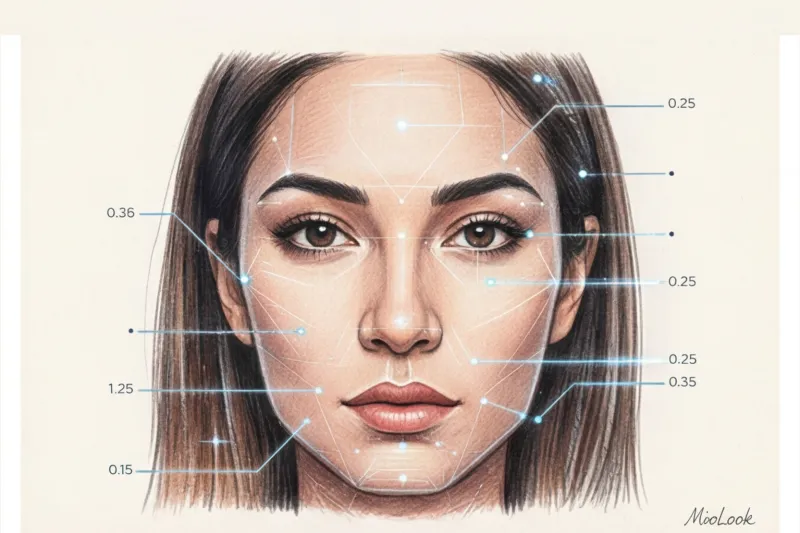
How does this happen in practice?
- The algorithm performs image segmentation: it accurately separates skin tone from the color of the whites of the eyes, irises, lips, and highlights in the hair.
- The system translates each segment into a numerical value on the lightness scale.
- The mathematical delta (difference) is calculated between the lightest area (usually the white of the eye or skin) and the darkest (pupil, hair roots, eyebrows).
"High contrast isn't 'dark hair and light skin.' It's a mathematical difference (delta) between pixels that exceeds 6-7 stops on the Munsell scale. Anything less than 3 stops is low contrast, requiring a completely different approach to fabrics," notes a colorist and color researcher at the PANTONE Institute.
Preparing the Perfect Photo for AI Analysis (Checklist)
In the world of machine learning, there is a golden rule: Garbage in, garbage out (Garbage in, garbage out.) If you feed a neural network an evening selfie from a restaurant with a flash, you'll get random numbers, not your contrast index.
To accurately determine your appearance contrast online, follow three strict rules:
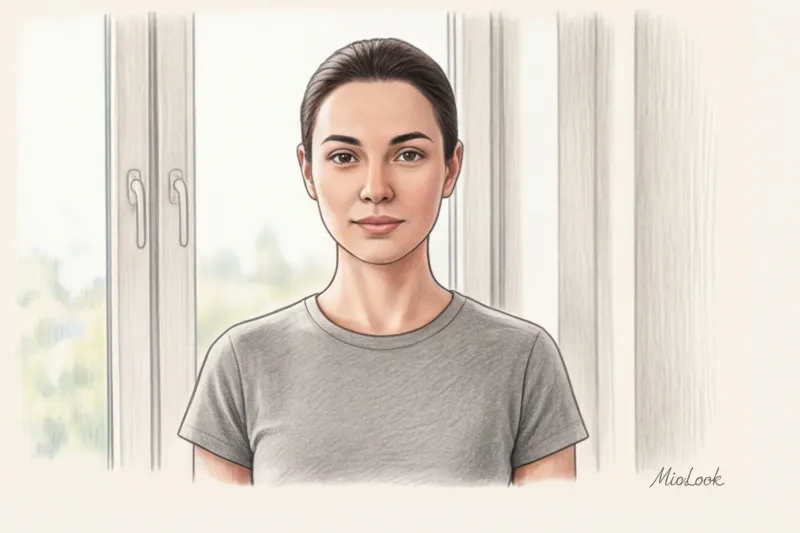
- Light: only diffused daylight. Stand facing a window (1-1.5 meters away), but avoid direct sunlight. Harsh light creates deep shadows under your nose and chin, which the AI detects as "natural dark spots."
- Blank canvas. Absolutely no makeup. This is critical. Mascara artificially darkens the lash line, and cheekbone contouring reduces the skin's lightness.
- Neutral background. Ideally, a gray or white wall without unnecessary details, so that the algorithm is not distracted by segmenting the background.
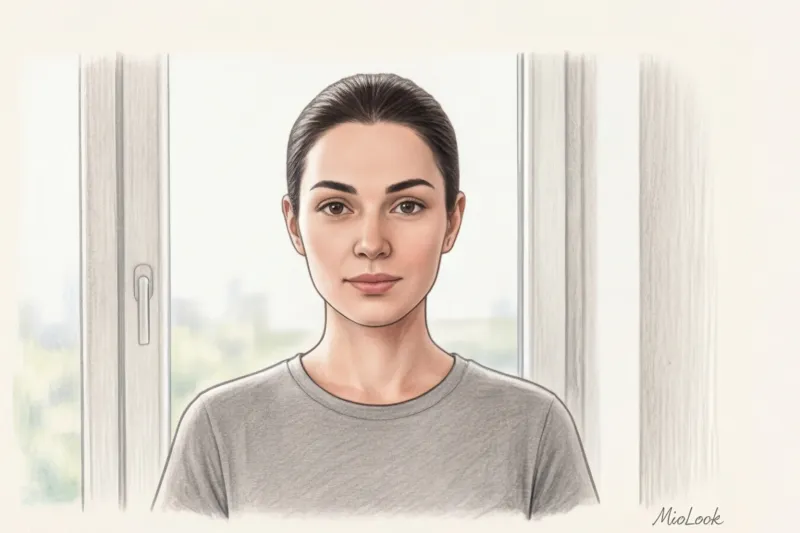
When this method does NOT work: In my experience, there have been cases where the algorithm returned errors due to temporary skin changes. If you've just returned from a vacation with a deep tan or had a deep chemical peel, redness in the monochrome spectrum will be interpreted as darkening. Wait until your skin returns to its baseline.
Access to MioLook for €0.99 — one-time payment
A smart AI stylist will select the perfect look based on your unique contrast.
Get access — €0.99 onceIntegrating AI data into your smart wardrobe
By obtaining your accurate contrast index, you gain a powerful tool for impression management. This knowledge is the foundation on which smart wardrobe , where every thing works for you, and does not draw attention to itself.
Selection of prints and pattern scales
If the AI shows a high delta (high contrast), your choice is clarity and geometric shapes. You can confidently wear classic black and white houndstooth, zebra prints, color blocking with sharp edges, and large abstract patterns. Your face won't get lost in the background of such vibrant pieces.
With low contrast (soft colors), harsh geometric patterns will look out of place. Your best bet is watercolor transitions, melange, gradients, millefleur prints (small florals), or thin stripes. The colors in the pattern should flow into each other, imitating the soft, natural transitions of your appearance.
Color blocking and the influence of fabric texture
As a textile expert, I always point out to my clients one detail that fashion magazines rarely cover. The texture of the fabric works as an optical illusion, changing the color contrast.
Glossy fabrics (natural silk with a density of 19 momme or more, satin, viscose satin) have a high light reflectivity. The curves of a €200 silk blouse create bright highlights and deep micro-shadows. Gloss Always visually increases the contrast of the garment. Therefore, for girls with a soft complexion, a silk black dress may seem too "heavy."
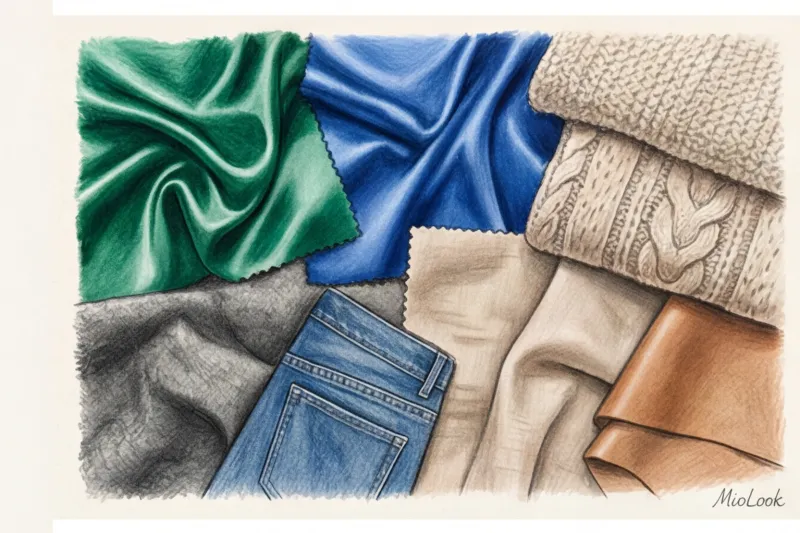
Conversely, matte textures (cashmere, heavy cotton, linen, bouclé) absorb light. Even the combination of black and white in a fluffy mohair sweater will look softer and more subdued than in a satin suit. If you want to wear items that don't quite suit your contrast level, choose matte finishes.
A Greener Approach: How AI Analytics Reduces Impulse Buying
According to a large-scale 2023 study by WRAP (Waste and Resources Action Programme), approximately 40% of the clothes in the average woman's closet haven't been worn in the past year. Over 12 years of working as a stylist, I've learned that clothes stagnate not because they're "bad," but because they create a subconscious dissonance. You put something on and feel, "Something's wrong." Eight times out of 10, the problem lies precisely in the mismatch of contrasts.
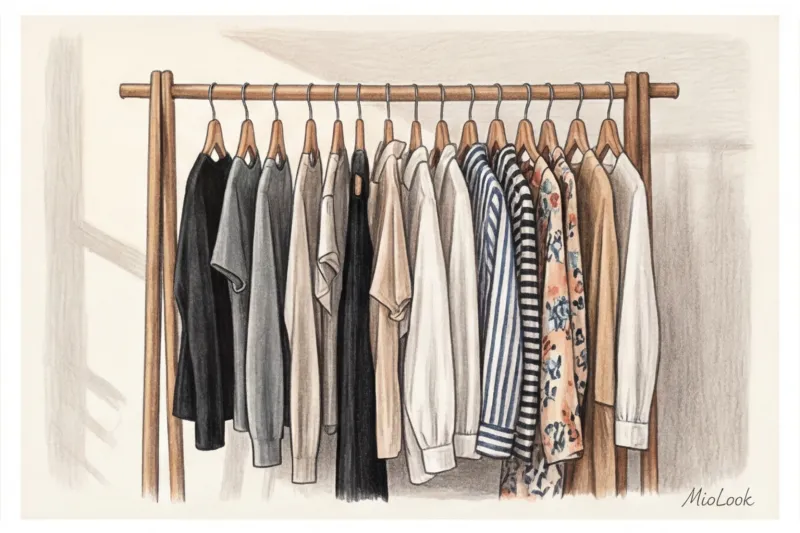
Understanding your color physics is the foundation of sustainable fashion. Knowing your AI index allows you to stop buying things "because the color is beautiful." You begin filtering out unsuitable prints and harsh color blocking while still browsing online catalogs. This saves you an average of €100 to €300 each season, protecting you from impulse purchases during sales.
Your perfect look starts here
Join thousands of users who look flawless every day with MioLook. Digitize your wardrobe in a few clicks.
Get access — €0.99 onceStep-by-step algorithm: how to determine the contrast of your appearance online right now
Theory is great, but let's move on to practice. Today, you don't need to search for spreadsheets online or download complex graphics editors.
Here's how to determine your appearance contrast online in 5 minutes:
- Take the right photo. Use the checklist from the beginning of the article (near a window, no makeup, diffused light). Clean your phone's camera—a cloudy lens reduces sharpness and distorts the analysis.
- Upload the photo to the AI application. I recommend using the stylistic analysis feature in MioLook The algorithm won't just convert the photo to black and white; it will also measure the value of the skin, hair, and eyes in digital values.
- Conduct an audit of one shelf. Don't try to go through your entire wardrobe at once. Pick 5-7 of your favorite tops or blouses. Compare their contrast levels (the difference between the colors of the print or texture) with the results generated by the neural network.
Style ceases to be an intuitive lottery when you add a little science to it. Use technology to free up time for living, leaving the agony of choosing in front of the mirror to artificial intelligence.