
What is the 30-sock rule and why it will change the way you shop?
Last week, I was sorting through a new client's wardrobe. From the depths of her closet, we pulled out eight (!) black turtlenecks from a popular mass-market brand. Each one cost about 15 euros, each one was covered in pills after the third wash, and she didn't want to wear any of them. "But they were so cheap," she justified herself. At that moment, I was once again convinced: we are too rich to buy cheap things.
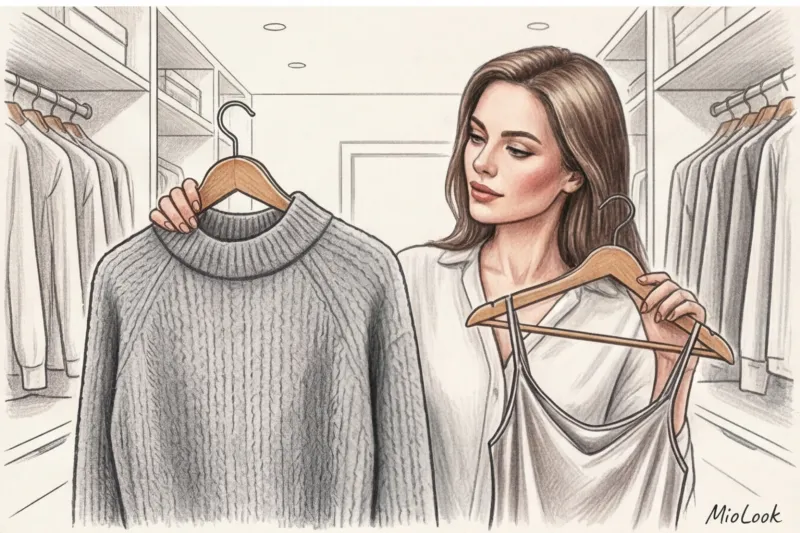
We've already covered why we buy identical, cheap things and how to break this cycle in our complete guide. How to Stop Buying Unnecessary Things: The Psychology of Shopping Today we'll talk about the naked mathematics of style.
The concept known as 30 socks rule , didn't appear out of nowhere. In 2015, Livia Firth, founder of the consulting agency Eco-Age, launched the #30Wears campaign. The initiative's premise was simple: before you go to the checkout with your next purchase, ask yourself one single question: "Will I wear this at least 30 times?" If the answer is no or you have doubts, the item remains in the store.
Why 30? According to shocking data from a 2017 study by the Ellen MacArthur Foundation, the average mass-market item is worn only 7-10 times before ending up in a landfill. We've stopped viewing clothing as an investment, turning it into a consumable. The 30-Wear Rule represents a paradigm shift: it forces us to evaluate not the number of hangers in our closet, but the actual frequency of use of each item.
Cost Per Wear Formula: How to Estimate the Real Value of an Item
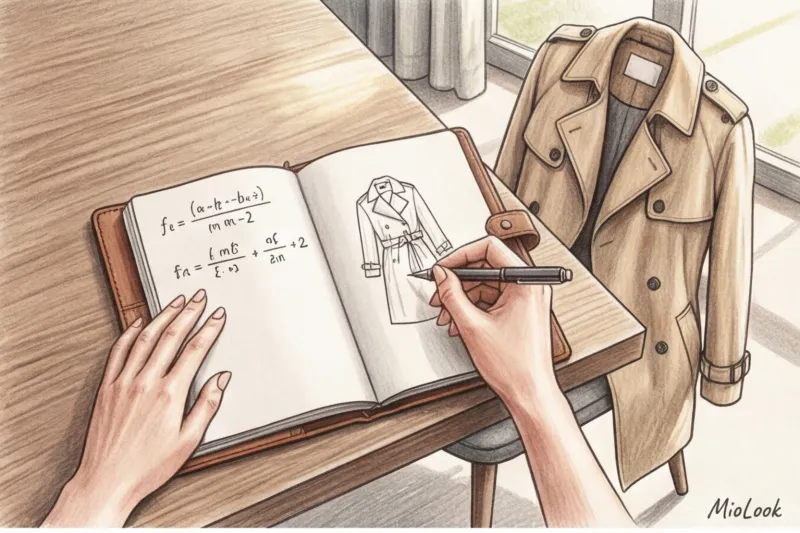
To make the 30-wear rule work in practice, stylists use metrics Cost Per Wear (CPW) — the cost of one wear. This formula is the best cure for impulse shopping I've ever encountered in 12 years of practice.
The classic formula looks like this:
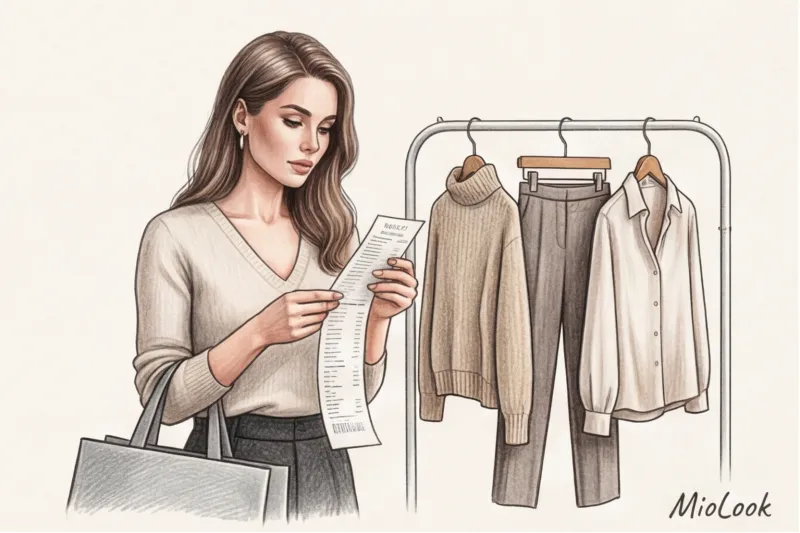
CPW = (Item Price + Care and Repair Cost) / Number of Wears
Note that we're adding in the cost of care. People often forget that buying a pair of €100 trousers isn't the final expense. If they're a bit long, you'll pay a tailor €15 for an alteration. If they're made of complex silk or structured wool, budget another €40 for dry cleaning per season. Without accounting for these hidden costs, which increase the actual cost of a garment by 20-30%, your math will be off.
A Stylist's Case Study: Zara vs. Massimo Dutti
Let's use a real-life example from a recent client's wardrobe to calculate this. Let's compare two seemingly similar office purchases.
- Purchase #1: Trendy Zara blouse made of 100% polyester. Price: €30. She wore it exactly twice—once to a presentation, and once to the office, where she realized the synthetic material was too thick to breathe. Home wash: ~€0. Result: CPW = 15€ in one go.
- Purchase #2: Basic sweater Massimo Dutti (90% wool, 10% cashmere). Cost: €150. She wore it for two seasons, wearing it about 2-3 times a week during the cold season (about 60 times). Dry cleaning and a lint remover cost €30. Formula: (150 + 30) / 60. Total: CPW = 3€ for one comfortable, warm day.
Mathematics is ruthless: a subjectively “expensive” item actually cost the client 5 times less than a “budget” one-day blouse.
Access to MioLook for €0.99 — one-time payment
A smart AI stylist will select the perfect look for every day and help calculate the cost of your wardrobe.
Get access — €0.99 onceThe Illusion of Cheapness: How the Mass Market Makes Us Overpay
Our brains are wired to receive a powerful surge of dopamine at the sight of a red price tag. Fast-fashion marketers know this all too well: we see the number "€19.99" and perceive it as a victory, completely ignoring the long-term prospects.
The most insidious trap is the hidden cost of sales. Have you ever noticed that the most expensive item in your closet (in CPW terms) is a dress you bought at 70% off? You bought it simply because it was dirt cheap. So, it's been hanging with the tag for two years. Its Cost Per Wear is infinite because the divisor (number of wears) is zero.
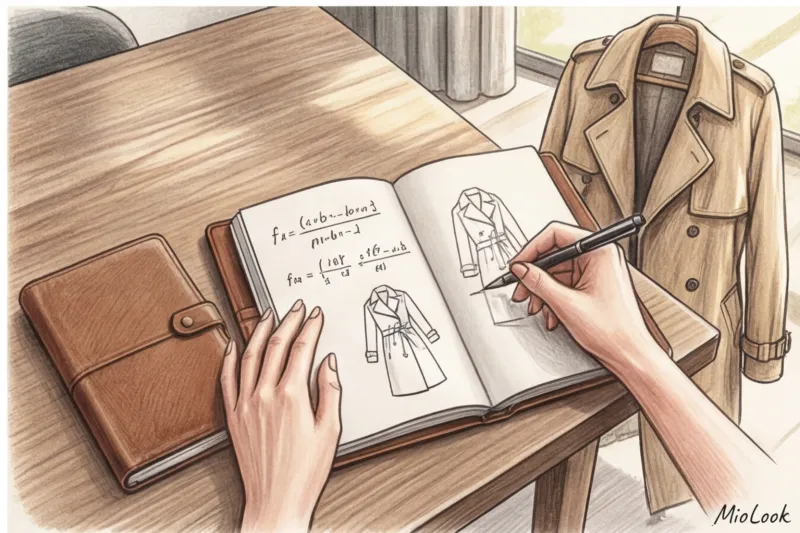
It's precisely this ignoring of cost per garment that leads to the classic female syndrome: "the closet is overflowing, but there's nothing to wear." Half the hangers are filled with items with exorbitant cost per garment—those impulse buys that are difficult to style or unpleasant to wear.

Where the 30-Wear Rule Falls Short: Cost-Per-Wear Pitfalls
As an expert, I must warn you: the 30-wear rule is not a religious dogma. It's a tool, and applying it to everything is pointless. There are situations when a rigid CPW calculation will only harm your style.
Firstly, seasonality in northern latitudes breaks this math. If you live in Oslo or St. Petersburg, your chic, lightweight linen dress won't physically be worn 30 times in one short summer. Does this mean you shouldn't buy it? No, it's just that for seasonal items, you need to plan for a 2-3-year horizon.
Secondly, blindly pursuing a low CPW often results in your wardrobe becoming a dull uniform. You start buying only gray sweaters and black jeans because they'll "definitely pay off." But clothes aren't just utilitarian; they're also a joy.
Alternative Metric: Cost Per Emotion
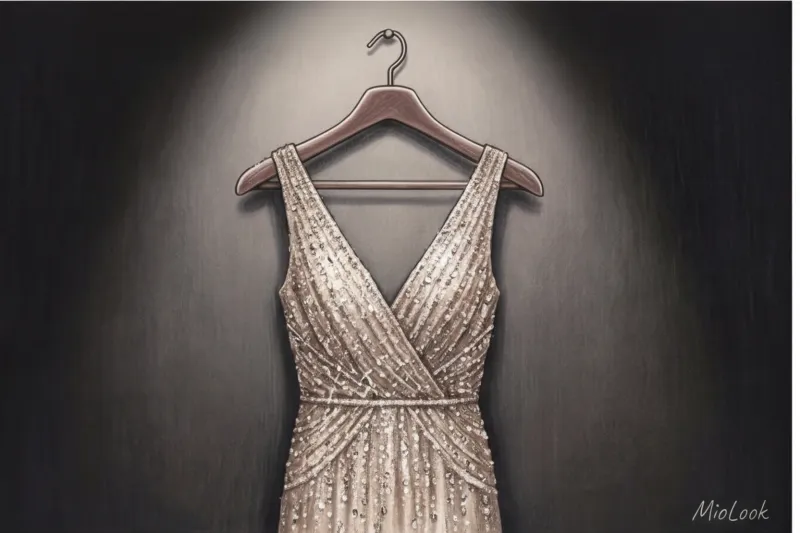
The biggest mistake is trying to apply the 30-wear rule to wedding dresses, complex eveningwear, or specialized clothing (like professional ski suits). For these categories, I use a different metric: Cost Per Emotion (CPE).
The value of an evening gown is measured not by the number of times you wear it, but by the level of confidence it gives you at a specific, critical moment in your life.
If a luxurious slip dress cost 300 euros and you only wore it to a corporate event once, but you felt like the queen of the evening, got a promotion, or simply genuinely enjoyed looking at your reflection—it was worth every penny. However, if the math still bothers you, renting evening dresses remains a better alternative to buying a one-time outfit.
Your perfect look starts here
Join thousands of users who look flawless every day with MioLook. Digitize your closet now.
Get access — €0.99 onceHow to Predict the 30-Wear Rule Before You Buy: A Checklist
How do you know if you'll wear something 30 times while you're still standing in the fitting room? I use a strict three-point checklist for my shopping-guided clients.
- The rule of three images. Can you create three different outfits with this item right now, without buying anything new, using what's already hanging in your home? If a blouse requires special trousers, new shoes, and a bag, its CPW will skyrocket.
- Lifestyle chart. Does the item reflect how you spend 80% of your time? We often buy clothes for a fantasy version of ourselves (the one who goes to fashion shows every weekend), when in reality, we work in an office with a dress code five days a week.
- Absolute comfort test. Assess the fabric and fit critically. Scratch your neck with the fabric. Raise your arms. Squat. If the skirt constantly rides up and the collar pricks your skin, you'll never wear it 30 times, no matter how beautiful the design.
Sock Tracker: How to Honestly Track Your Wardrobe Progress
Our brains tend to deceive us by exaggerating the frequency of use of our favorite (but impractical) items. To get real data, we need a tracking system.
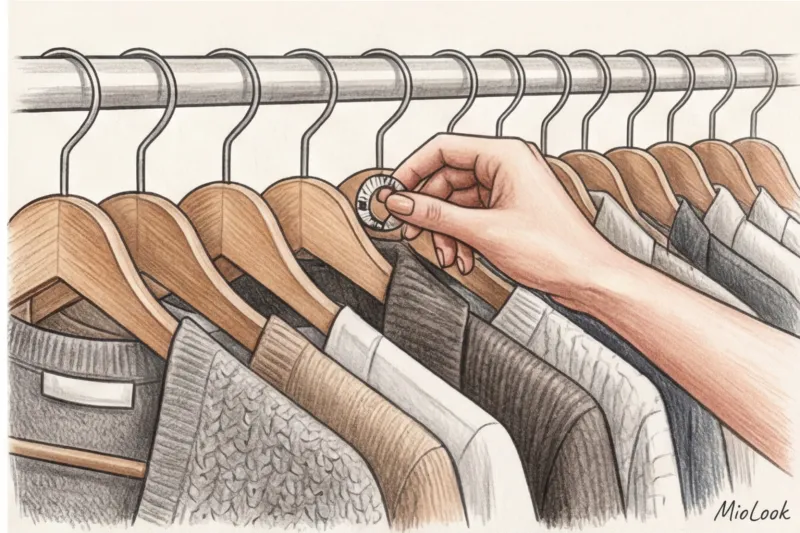
The simplest physical method is inverted hanger trick When I first tested it on myself five years ago, the results were astounding. At the beginning of the season, turn all the hangers in your closet so the hooks are facing you (unconventional). Once you've worn an item and washed it, hang it back upside down (standard). After six months, you'll visually see the "dead zone" in your wardrobe—the items whose hangers remain unturned.
For more advanced users, there's digital tracking. Instead of keeping Excel spreadsheets, my clients use the "smart wardrobe" feature in MioLook You simply collect looks in the app, and the algorithm automatically calculates wear statistics and displays the actual Cost Per Wear for each T-shirt and jacket.
Action Plan: Conduct a Wardrobe Audit Now
Knowledge without practice is just interesting facts. If you want to change your approach to shopping and stop blowing your budget on flash-in-the-pan items, follow these three steps this weekend:
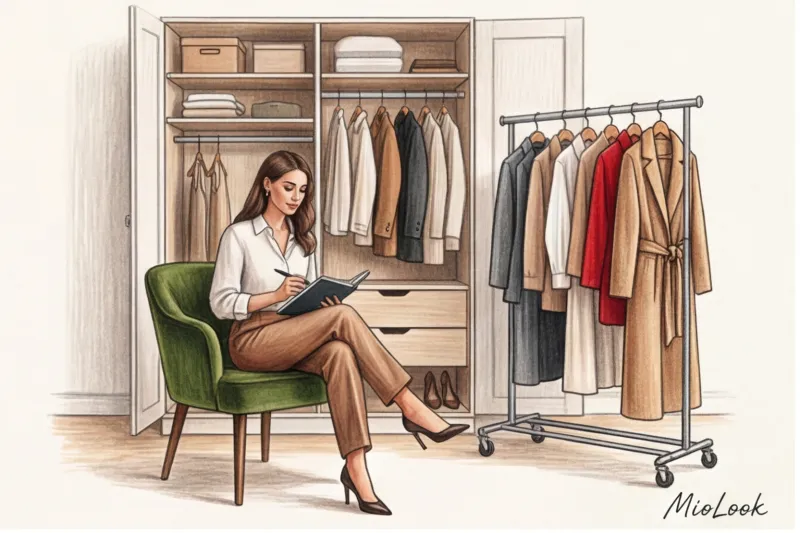
- Step 1: Find the extremes. Pull out the item you wear most often and the item with the highest (unjustified) CPW from your closet. Compare the fabric density, seam quality, and silhouette. This is your personal matrix of what works and what doesn't for your body type.
- Step 2: Enter the 24-hour rule. Establish a personal embargo: any impulsive purchase under €50 should sit in your shopping cart or in your thoughts for exactly 24 hours. We buy cheap things based on emotion; after 24 hours, 80% of these desires evaporate.
- Step 3: Invest in the foundation. Start investing the bulk of your budget in basics—outerwear, quality shoes, and well-fitting jeans. These are the ones that will easily surpass the 30-wear barrier and pay for themselves in spades.
Many people think that a mindful approach to their wardrobe, with a calculator in hand, is boring. But in my experience, it's quite the opposite. When you stop spending money on plastic blouses, you suddenly have the money for a luxurious coat or the perfect bag. A mindful wardrobe isn't about restrictions; it's about true stylistic freedom.