In 12 years of working as a fashion journalist and stylist, I've learned a paradox: the most "expensive" wardrobes usually belong to those desperately trying to save money. One of my clients once proudly showed me a collection of twenty acrylic jumpers from the mass market. Not a single one fit perfectly, most of them had lost their shape after the third wash, but "each one cost pennies." In contrast, my colleague, the editor of a Parisian glossy, has been wearing the same basic cashmere sweater from Loro Piana for four years. The difference between them isn't their salary. The difference is that the latter understands metrics. Cost per wear: how to calculate it before approaching the checkout and why mathematics is the main sponsor of good taste.

If you're used to thinking in terms of "expensive/cheap" when making a purchase, this article will change your perception of shopping. We covered the fundamental principles of finance in more detail in our wardrobe budgeting guide , and today we'll talk about how to make every penny spent work 100% for itself.
What is Cost Per Wear (CPW) and why is it the key metric for a conscious wardrobe?
Cost Per Wear (CPW) is the cost of one use of a specific item. It's the X-ray that scans your closet and reveals which purchases were investments and which were just wasted money.
Our brains regularly fall into the psychological trap of price tags. We see a jacket for €300 and panic: "Too expensive!" But we easily buy five random "trendy" tops for €20 each on sale, sincerely believing we've gotten a good deal. But let's look at the raw numbers.
According to a large-scale study by the Ellen MacArthur Foundation (2021), the average fast-fashion item is worn only 7-10 times before ending up in a landfill or on the back of a closet.
In my experience, the 80/20 rule (Pareto's principle) works flawlessly in the wardrobe: 80% of the time, we wear the 20% of our favorite, comfortable, and high-quality items. The remaining 80% of our wardrobe simply hangs, creating the illusion of choice and eating into our budget. This is precisely why the paradigm needs to shift: the most expensive items in your closet should be the ones you wear most often.
Basic formula: cost per wear and how to calculate it in practice
The classic formula is ridiculously simple, yet for some reason most people ignore it until the closet stops closing. It looks like this: Item Cost ÷ Number of Wears = CPW.
Let's compare two purchases:
- Item A: Trendy neon green polyester trousers. Bought on impulse for €40. You wore them twice (to a party and once to the office, where you realized the fabric wasn't breathable). Your CPW: €20 per outing.
- Item B: A perfectly fitting pair of classic, heavyweight denim jeans for €150. You wear them twice a week for two years (approximately 200 times). Your CPW: €0.75 per outfit.
Notice the irony? The "expensive" jeans cost you 26 times less than the "budget" trousers.

It's important to introduce the concept of "wardrobe depreciation" here. The denominator of the formula (number of wears) directly depends on how long the fabric will retain its original appearance. That's why the secret of a status wardrobe It lies not in the logos, but in the characteristics of the materials.
The True CPW: Hidden Costs of Dry Cleaning, Repairs, and Maintenance
If the basic formula seems too simple, welcome to the advanced level. A true CPW always includes hidden costs: (Price of the item + Cost of care and repair) ÷ Number of wears.
Imagine an €80 silk blouse marked "Dry clean only." You wear it 10 times a year. But after every two wears, you dry clean it for €15. Over the course of a year, you'll spend €75 on care—almost the cost of the blouse itself! True dry clean only costs skyrocket.
On the other hand, the cost of a tailored fit is an investment that CPW reduces. If you buy a jacket and take it to a tailor (spending an additional €30 to shorten the sleeves and tighten the waist), it will fit you like a bespoke garment. You'll feel like a million bucks in it and wear it three times more often. The extra expense in the numerator is more than offset by the huge denominator.
Access to MioLook for €0.99 — one-time payment
A smart AI stylist will select the perfect look for every day and help calculate the effectiveness of your wardrobe.
Get access — €0.99 onceThe Illusion of a "Cheap" Basket: Why Mass-Market Products Cost More Than Luxury
This is perhaps the most counterintuitive insight I constantly demonstrate to my clients: frequent inexpensive purchases don't save your budget; they methodically destroy it. Emotional shopping provides a quick dopamine rush, but leaves you with things that don't stand up to reality.
It all comes down to textile science. Take a 100% acrylic sweater for €30 and a merino wool pullover for €140. The lack of elasticity in the acrylic fiber means it will stretch out at the elbows within a week. The way synthetic yarn is created guarantees that pilling (pilling) will appear in areas of friction (armpits, sides of bags) after just three washes. Its lifespan is artificially shortened by the manufacturer to 1-2 months.
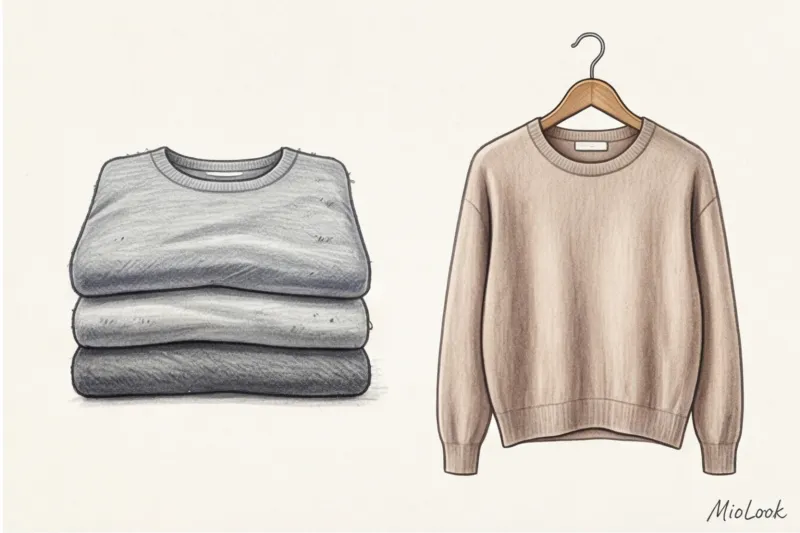
Merino, thanks to its natural fiber structure, is self-cleaning and returns to its original shape. You'll wear it for at least three years. Ultimately, you'll buy six acrylic sweaters (€180) while your merino (€140) looks like new. Mass-market clothing is like a subscription to constant wardrobe renewal, paid for with hidden fees.
How to Predict CPW Before Buying: Secrets from a Professional Stylist
The main problem with the CPW metric is that it's usually calculated post-factum, after the money has already been debited from the card and the item has been hanging with the tag for a year. The stylist's job is to make this calculation predictive.
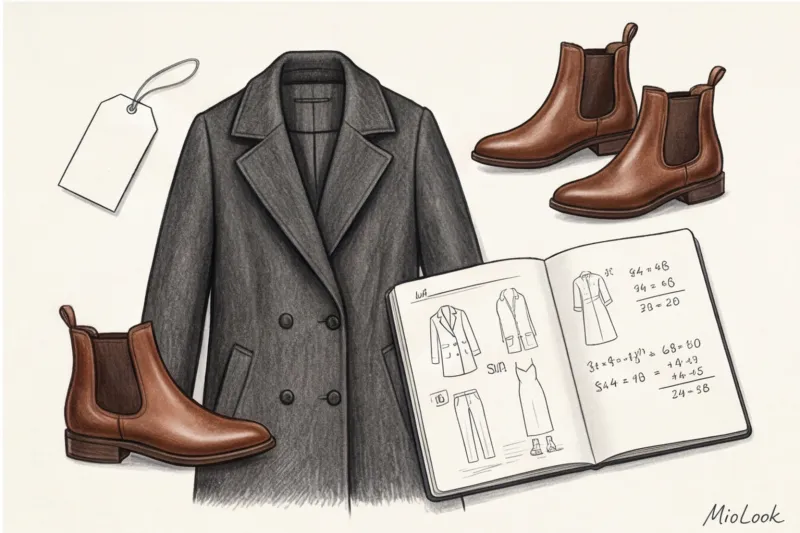
At Milan and New York Fashion Weeks, I always see the same picture: buyers and editors invest huge sums of money in outerwear, quality shoes or the perfect business bag , mixing them with simple white cotton T-shirts. Why? Because in a temperate climate, you wear a coat 120 days a year. Its predictable denominator is huge.
Before purchasing, I recommend using season matrix method Estimate how many months a year the climate in your region physically allows you to wear this item. If you live where summer lasts two months, a €400 linen suit will have a disastrous CPW. Invest that money in cashmere or mid-season shoes.

Fitting Room Checklist: 4 Questions for Calculation
Whenever I reach for my wallet, I always ask myself four questions. Save them as a checklist:
- Will I be able to wear this right tomorrow? If the answer is “no, because I need a special occasion” – the CPW will be high.
- Does this item require the purchase of new shoes, special underwear or a bag? If so, feel free to add the cost of these purchases to the numerator of the formula.
- How comfortable am I physically on a scale of 1 to 10? Is the neckline itchy? Does the waistband dig in when I sit down? Any discomfort below the figure 8 guarantees the item will stay in the closet. We don't wear anything that bothers us.
- Will this fabric last 50 washes? If the fabric is see-through, the seams are crooked, and the composition is 80% synthetic, divide the expected lifespan by three.
The Compatibility Index: How a Capsule Wardrobe Crashes the Cost of Outlet
There's a direct correlation between the architecture of your wardrobe and the cost of each outfit. This brings us to my favorite personal life hack: rule of three images If, standing in the fitting room, I can't mentally create three completely different looks using the items ALREADY hanging in my closet, the purchase is off the table.
Clothes with complex, vibrant colors, bold prints, or ultra-avant-garde cuts always have a higher CPW. Why? They're too easily remembered. If you wear a leopard print dress to the office twice a week, your colleagues will assume you've been spending the night there. If you wear a flawless navy blazer five times in a row, changing only the shirts underneath, you'll be considered a style icon.
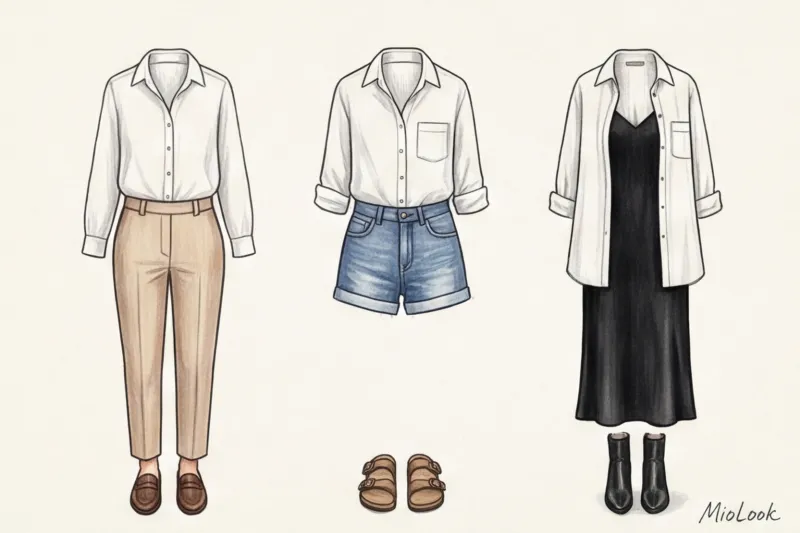
That's why basics (the powerhouses of your wardrobe) should account for up to 70% of your budget. A well-tailored jacket, thick jeans, and quality shoes are the workhorses that make your statement tops trendy. One striking, trendy blouse (bought inexpensively) instantly lowers the CPW of your expensive basic trousers, as it forces you to wear them more often.
Your perfect look starts here
Join thousands of users who look flawless every day and take control of their wardrobe investments with MioLook.
Get access — €0.99 onceExceptions to the Rule: What Items Are Normally Cost-Per-Wearable?
I promised to be honest, so here's the main caveat: the CPW rule doesn't apply to everything. It would be crazy to try to reduce the value of every single item in the house to zero. There are categories for which a high CPW is absolutely the norm.
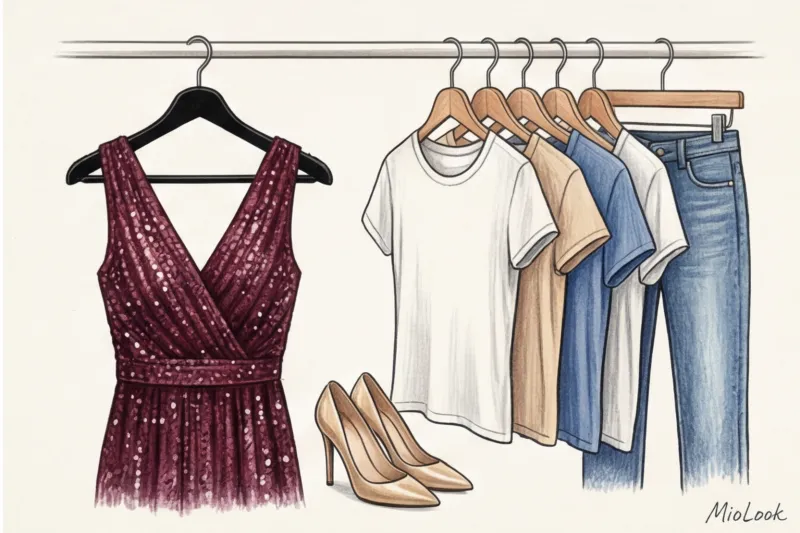
First, there's evening and wedding fashion. A bridesmaid dress, a tuxedo for a corporate event with a strict dress code, or a red carpet outfit can cost thousands of dollars and be worn exactly once. Their purpose isn't utilitarian. Their purpose is to create a moment, establish status, or adhere to protocol. You're paying for emotion and memory.
Secondly, there are so-called statement pieces. I have a stunning vintage kimono with hand embroidery in my collection. I wear it once a year in the spring. Its CPW is far from perfect, but it's a personal anchor piece that shapes the DNA of my style. Such pieces should be purchased rarely, consciously, and treated as works of art, not as wardrobe staples.
Putting CPW into Practice: A Step-by-Step Plan for Smart Shopping This Season
How do you move from theory to practice? Here's the algorithm I give to clients during their first style consultation:
- Step 1: Honest audit. Take out five items you wear regularly and five items that have been hanging with the tags for six months. Compare their compositions, cuts, and colors. You'll immediately understand what's worth paying more for in your case (for example, cotton with a density of 180 g/m² or viscose with 5% elastane). For your convenience, you can digitize your closet using an app. MioLook — Artificial intelligence will help you see your style blind spots.
- Step 2: Calculate the annual budget. Stop evaluating things in a vacuum. Set aside a budget for the season and decide how to distribute it: will you buy 10 questionable items or 3 flawless ones?
- Step 3: Target CPW on the shopping list. When writing down "buy a black coat," put your target CPW next to it. If you plan to wear it for three years, 90 days at a time, you can safely allocate a substantial budget for it—per outing, it'll cost you less than a cup of coffee.

A paradigm shift occurs when you stop asking yourself, "How can I buy this cheaper right now?" and start asking, "What can I buy today so that in three years this item will cost me next to nothing?" Once you master this skill, your closet will stop bulging with clothes, and you'll finally always have something to wear.