Maternity Office Wear: Why You Should Avoid Specialty Stores
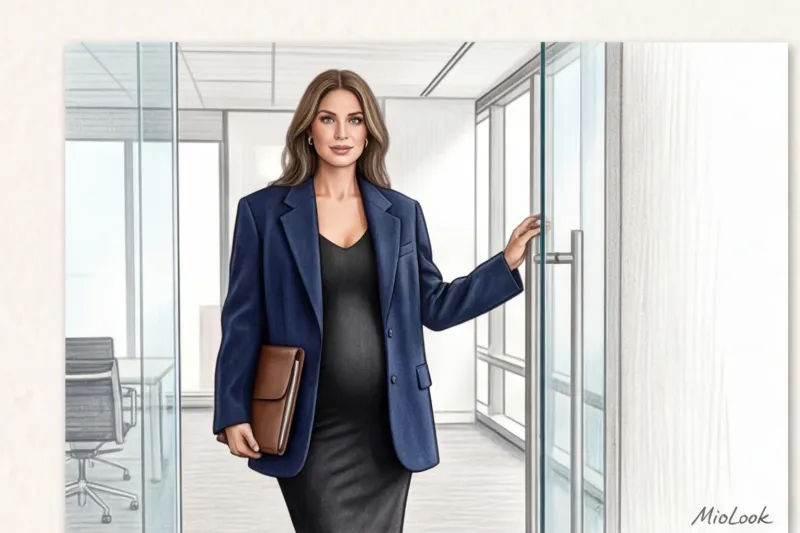
I remember the panic of one of my clients, a top manager at a large corporation, when she learned of her long-awaited pregnancy. Her first question during our meeting was, "Camilla, do I have to wear those ugly, shapeless robes with bows now?" Unfortunately, the stereotype that office wear for pregnant women The trend that inevitably meant abandoning elegance in favor of shapeless tunics is still alive and well. But as a fashion journalist and stylist with many years of experience, I want to start with the main insight: you don't need to completely change your wardrobe or buy specialized lines.
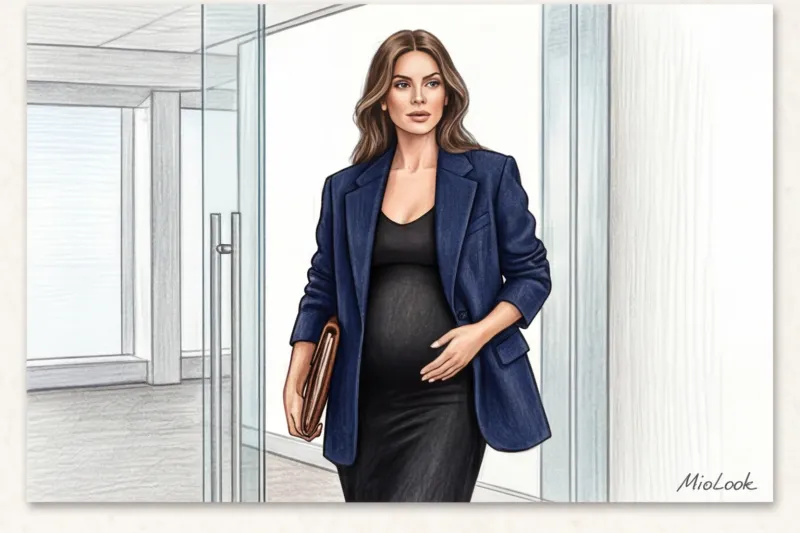
The maternity clothing industry actively convinces women of the need for a total shopping spree. This is a classic marketing myth. In my experience, 70% of your regular clothes can last until the eighth or ninth month. Long men's-style shirts, oversized jackets, midi skirts with soft elastic waistbands, or wrap dresses—all of these are likely already hanging in your closet. Before you go shopping, I recommend downloading your current database to MioLook and filter out straight-cut or loose-fitting items. You'll be surprised how many ready-made options you already have.
Let's be honest about quality: most mass-market maternity lines are made using leftovers. Manufacturers rely on hyper-stretchiness, adding up to 10-15% elastane to cheap viscose or polyester. This fabric doesn't breathe (which is critical given the changes in temperature regulation during pregnancy), quickly becomes covered in pills, and clings to every seam of the underwear. Furthermore, many brands are guilty of childish cuts—abundant ruffles, high waists (empire style), and small, naive prints. In a business environment, such designs work against you, instantly diminishing your professionalism and status.
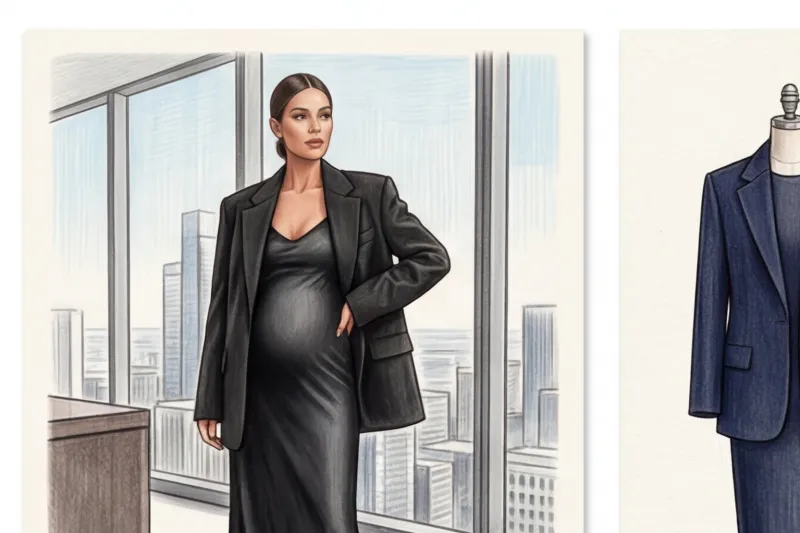
Last year, I was putting together a wardrobe for a partner at a law firm. She showed up for a fitting wearing a typical "maternity" dress made of thin stretch jersey for €120, which made her look bulky. We removed this specialized nightmare and put her in a regular silk dress, cut on the bias (a brilliant invention by Madeleine Vionnet), layered with her classic pre-pregnancy structured jacket. The look changed dramatically: authority, posture, and the necessary professional distance returned.
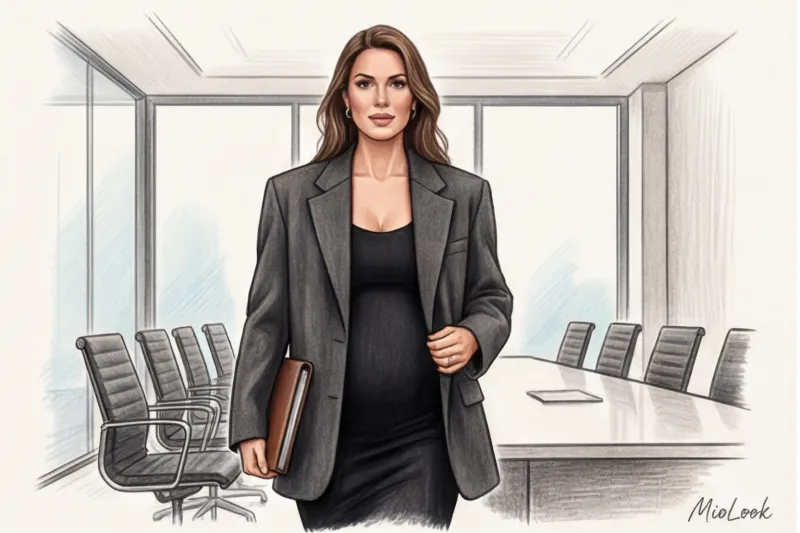
The secret lies in the architecture of a business look. In the office, authority is conveyed not through a tight fit, but through the structure of the outer lines. A strong shoulder line, peak lapels on a blazer, and tight shirt cuffs are your visual markers of strength. While the waist changes, you need to maintain clear outer boundaries of the silhouette. Incidentally, the principles of creating an elongated vertical line here are very similar to those used when we build business style for short people women.
The concept logically follows from this hybrid wardrobe Don't invest in the "maternity" label. Invest in quality cuts from mainstream brands (from premium lines like H&M and COS to Joseph). An oversized shirtdress made of thick cotton, a heavyweight knit column dress, or a men's blazer in a size up will last you not only through pregnancy but will also remain stylish after you've returned from maternity leave. Remember the golden rule: if you wouldn't have bought this item before you were pregnant, leave it on the store hanger.
Trimester Strategy: How to Manage Proportions and Dress Code
A study on the biomechanics of the female body, published in 2023 by the European Institute of Ergonomics, revealed a startling figure: over nine months, the center of gravity shifts forward by 2–3 centimeters, and the pelvic tilt changes by up to 5 degrees. What does this mean for personal style? It means that the perfect fit will inevitably deteriorate every three months. Maternity office attire is not a static uniform that can be purchased once, but a dynamic system that requires constant adjustment.
The most damaging mistake for your wallet and professional image is trying to buy a wardrobe "to grow into" in the first weeks of pregnancy. Over the years, I've seen too many brilliant professionals buy clothes two sizes too big, wasting their budget, out of fear of future changes. Let's look at why this strategy is doomed to fail:
- Violation of the cutting architecture: Buying a size 48 jacket when you're a size 44 doesn't make it adaptable. You'll get dropped shoulders, wide armholes, and a baggy back. Your silhouette loses its appeal and looks like you're wearing someone else's clothes.
- Unpredictability of proportions: You don't know in advance how your body will distribute its volume. For some women, only the abdominal area changes, while for others, the chest and hips expand. Growing-size clothing doesn't take this individual geometry into account.
- Financial inefficiency: The average cost of a mistake is between €400 and €600 for clothes that hang loosely at the beginning of pregnancy and become awkwardly stretched at the end.
The budget needs to be distributed in portions. The body's needs and the strict corporate dress code require fundamentally different stylistic solutions in each of the three trimesters.
First trimester: secrecy, comfort, and fighting swelling
The main goal of the first twelve weeks is to maintain the status quo and conceal your condition until an official meeting with management. Your figure may appear unchanged, but physiologically, this is the most dangerous period. A sharp surge in progesterone causes smooth muscle relaxation and massive fluid retention. You might show up to a morning meeting in a perfectly fitting pencil skirt, only to feel a tight belt digging into your body by 5 p.m., cutting off your breathing.
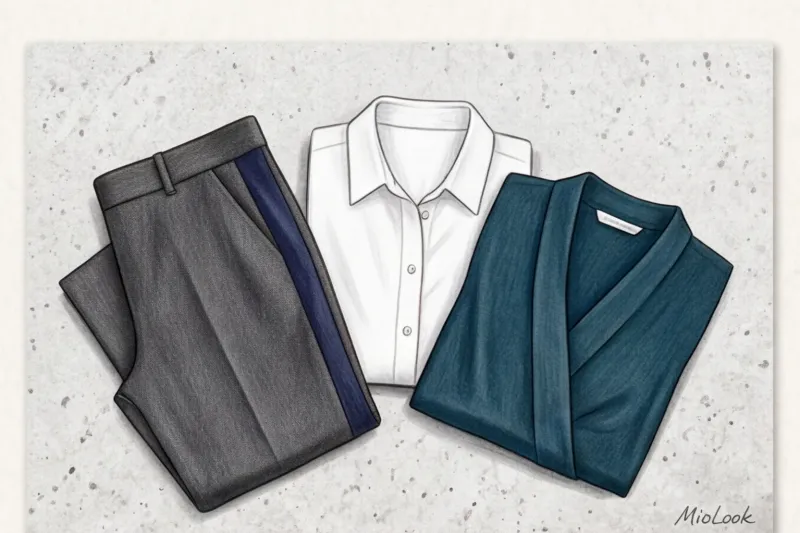
That's why we categorically reject any rigid waistbands. Your salvation will be trousers made of thick ponte knit (ponte di Roma). The uniqueness of this double weave is that it mimics the look of tailored wool or crepe, but has the stretch of a sports fabric. Look for styles with a hidden internal drawstring—it allows you to discreetly adjust your waist by 3-4 centimeters throughout the day.
In the portrait zone, blouses with a light, asymmetrical drape become our main tools of camouflage. A cowl collar, soft folds from the shoulder seam, or a wrap-over design create optical illusions that obscure the body's true contours. Pair such a blouse with a straight-cut jacket. I emphasize: straight, not oversized. The crisp, plump lines of a straight-cut jacket's lapels create a secure visual rectangle. Within this framework, any fluctuations in waist size remain entirely yours.
Second trimester: transition period and emphasis
Starting from the fourteenth week, concealing the changes becomes not only difficult but also stylistically unfavorable. The belly takes shape, and our goal changes dramatically: we move from complete concealment to a neat, stylish framing of the new silhouette. This transitional period requires precise work with vertical lines.
First and foremost, we're changing the way we wear jackets. While you used to button your blazer, we now wear them strictly unbuttoned. An unbuttoned jacket creates two contrasting vertical lines down the sides of the torso. They visually elongate the figure, act as drawstrings, and subtly trim excess volume at the sides. If corporate protocol requires you to attend a board meeting buttoned, consult a tailor. Moving the buttons 2-3 centimeters closer to the hem is a micro-investment of approximately €20-€30 that will keep an expensive garment in rotation for a couple more months.
When it comes to waistbands, it's time for proper structural adjustment. The ideal solution for the office is trousers with hidden elastic gores on the sides. They retain the classic fly area with a real zipper and button (an essential marker of formal business attire), but provide the necessary freedom for a growing belly.
Please avoid models with a giant nylon belly band stretched across the entire stomach. The slightest bend over to pick up documents or shift in a chair can cause this piece of "maternity" gear to peek out from under the blouse. In a strict dress code, revealing such functional details is considered the equivalent of revealing underwear—it instantly undermines the image's authority.
Access to MioLook for €0.99 — one-time payment
A smart AI stylist will select the perfect business look, help you integrate adaptive items with your current wardrobe, and manage your budget wisely.
Get access — €0.99 onceThird trimester: focus on shoulders and status monochrome
The final push before maternity leave presents the most serious challenges to clothing fit. Lumbar lordosis (the arch in the lower back) increases significantly. Because the center of gravity shifts forward, a woman reflexively leans back. Visually, the shoulders sink lower and appear more sloping. Without the right styling support, the figure inevitably sags and develops into a "bell" silhouette—heavy on the bottom and a flat, narrow top. In a rigid corporate environment, such a relaxed silhouette is subconsciously perceived as a loss of control.
How do we restore power balance? The focus shifts to the shoulder girdle. We need a clear, defined, almost architectural shoulder line. The use of jackets and structured dresses with shoulder pads isn't just a nod to the power-dressing aesthetic; it's a strict, functional necessity. A strong, extended shoulder line balances the maximum volume at the waist, restoring stability and hourglass proportions to the figure.
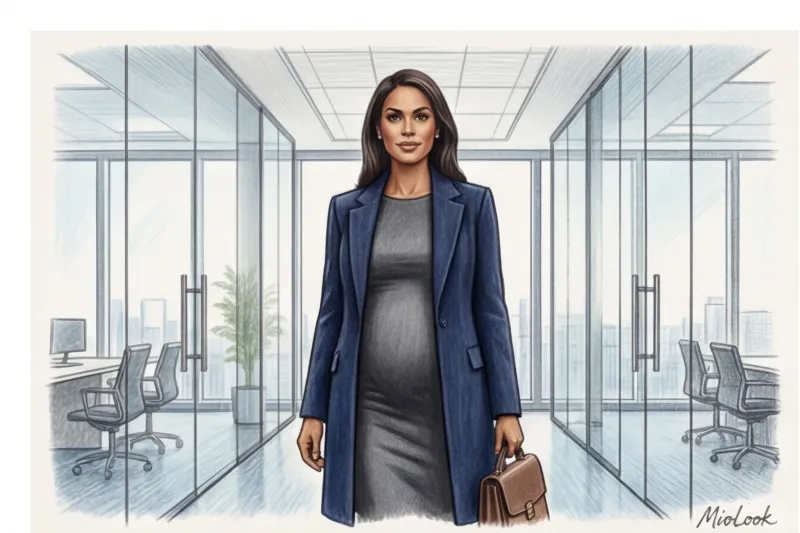
The second powerful tool of the third trimester is status monochrome. When the body reaches its peak, color blocking (a combination of a contrasting top and bottom) cuts the figure in half, accentuating the midsection. Instead, I recommend using the "color column" principle. Monochrome looks in shades of deep navy, graphite, dark chocolate, or elegant camel create a continuous optical vertical. The eye of your conversation partner glides freely from top to bottom, without tripping over horizontal boundaries.
An important detail: in the third trimester, it's crucial to avoid shiny textures. Silk, satin, or viscose with a satin sheen reflect light, turning a full belly into a shimmering sphere. Choose only matte fabrics—thick wool crepe, heavy matte viscose, or cashmere. They absorb light, visually reducing up to a few centimeters of volume, and help maintain a flawless, professional appearance right up until your last day at work.
Business Capsule: 7 Items for an Authoritative Look
In 1985, Donna Karan revolutionized the industry by introducing the concept of "Seven Easy Pieces" for the busy businesswoman. Decades later, when I'm faced with the challenge of smart office wear for pregnant women , I always return to this brilliant formula. The only difference is that now we need a wardrobe architecture that can transform.
Many people make a fatal mistake: buying dozens of cheap, compromised items to last a couple of months. But the mathematics of elegant style is inexorable: it's far more profitable to invest in seven impeccable elements that will work to enhance your image every minute of your workday. These are the "magnificent seven."
1. Elongated men's cut jacket
This is the absolute foundation of your capsule wardrobe. A tailored jacket instantly brings together and structures any knitwear, even the most relaxed one. Herein lies the most important rule, which I never tire of repeating during fittings: choosing the right length is crucial. The jacket must end strictly below The widest part of your hips. If the hemline runs right along this line, you'll visually "cut" your figure in half and add a huge amount of unnecessary bulk. High-quality wool-blend models (good basic options can be found today for €150 to €300) with a defined shoulder line will become your stylistic armor.
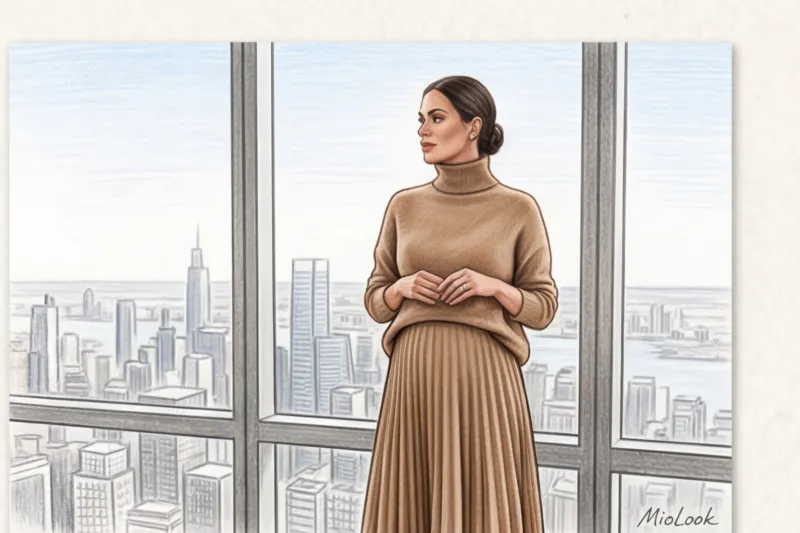
2. Pleated midi skirt with soft elastic
The perfect tool for working with changing proportions. Firstly, the strict vertical folds elongate the silhouette, balancing out a widening waist. Secondly, the elastic waistband offers incredible versatility: in early pregnancy, you can wear it strictly at the waist, later over the belly (paired with a crop top under a jacket), or delicately drape it under it. The key is to choose matte, dense fabrics, avoiding cheap synthetic sheens.
3. Wrap dress made of thick crepe
Diane von Furstenberg's iconic invention works flawlessly during pregnancy, as the cut itself physically adapts to your changing measurements, creating the perfect V-shape in the portrait area. Important note: look for styles made exclusively from thick crepe, not thin, flimsy jersey. Crepe holds its shape, doesn't cling to underwear, and maintains a sleek, put-together look. This dress is a long-term investment that you'll happily continue wearing even after maternity leave.
4. Men's shirt made of thick cotton (sized up)
Specialized maternity blouses often suffer from childish details like ruffles, bows, or odd gathers. Our answer is a classic men's shirt, bought one or two sizes too big (or borrowed from a partner). Crisp poplin is a texture that subconsciously evokes control, while a stiff, starched collar conveys a businesslike sensibility. Wear it unbuttoned as a light jacket over a dress, or tuck it in asymmetrically (using the French tuck technique) while time allows.
5. Knitted column dress made of thick viscose
Your salvation for those days when you crave maximum physical comfort but the dress code demands business formality. This dress has one strict technical requirement: the fabric must be heavy, completely opaque, and fall smoothly without a single wrinkle. Choose a dense viscose—it provides proper temperature regulation and looks like expensive minimalism, not sleepwear.
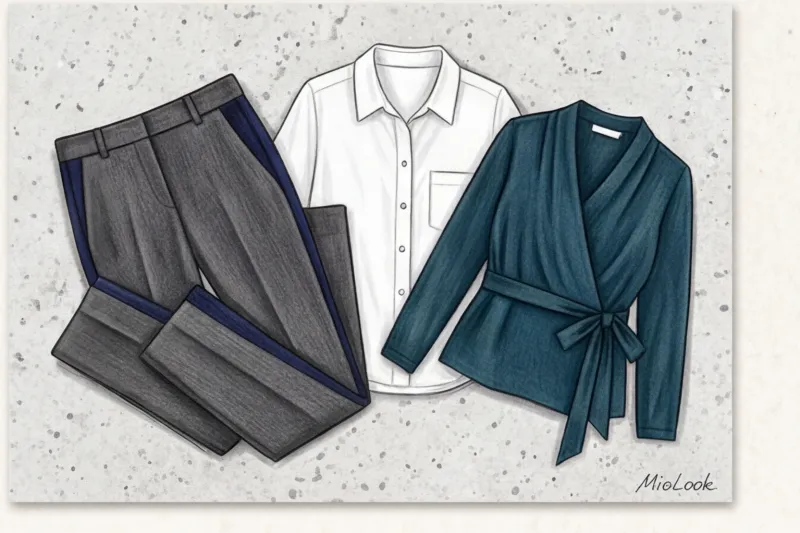
6 and 7. Basic trousers and a cashmere turtleneck
To make the capsule collection truly shine, complete it with the right pair of straight-leg trousers with hidden elasticated side panels and a loose-fitting cashmere turtleneck. These basic pieces will act as a connecting link for more statement pieces.
With these seven items in your arsenal, you can generate dozens of status combinations. To avoid wasting precious morning hours pondering in front of the mirror, I highly recommend digitizing these items. Upload them to MioLook — the app's built-in "smart wardrobe" helps you plan your outfits for the entire work week in advance, taking into account texture combinations and your personal capsule wardrobe.
Fabrics and textures: what you shouldn't skimp on
Have you noticed how dramatically your perception of temperature changes in the first few months? According to the American College of Obstetricians and Gynecologists (ACOG, 2023), due to a nearly 50% increase in circulating blood volume and dramatic hormonal changes, a woman's core body temperature rises significantly. That's why the 100% polyester you wore last winter feels absolutely unbearable now.
In an office environment with its unpredictable air conditioning, cheap synthetics act like a greenhouse. They block heat, don't absorb moisture, and instantly cause physical discomfort, which is clearly visible on your face during important negotiations. If the tag on a cute, basic €40 blouse says it's made entirely of polyester, don't hesitate to leave it on the rack; it's not worth the stress.
The second common trap is trying to achieve total body comfort through thin knitwear. I often see businesswomen buying dresses made of loose viscose or cheap cotton. This is a huge mistake. The danger of thin knitwear is that it mercilessly highlights the contours of specialized supportive underwear, the seams of tights, and every anatomical nuance of the figure. In a work environment, this instantly diminishes your authority, making your look too relaxed and homey.
Remember my main stylistic density rule Business attire fabric should hold its own architectural shape, not just cling loosely to yours. Proper maternity office attire should act as a reliable framework.
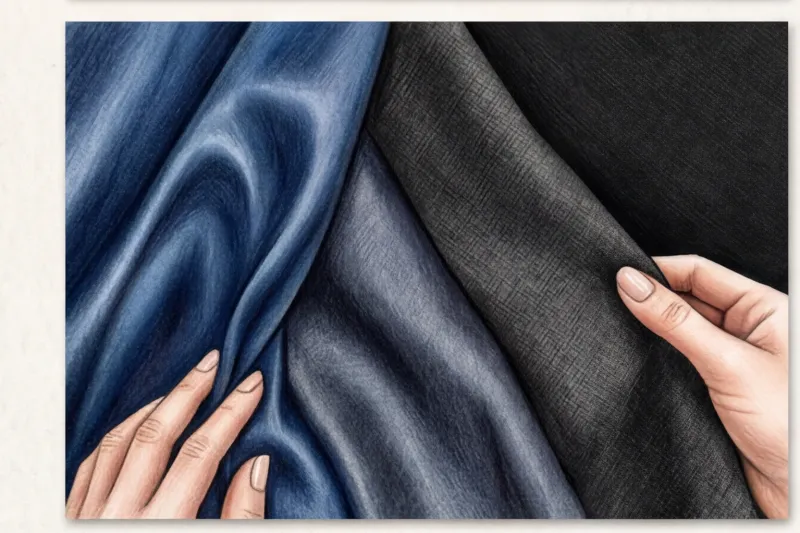
So what should you consider when choosing a base layer? I highly recommend investing in high-tech fibers and natural fabrics with a tight, twisted weave. Look for high-quality Tencel and Cupro. These materials, often found in the mid- to premium segment (in the €150-€300 range), have a delicate cooling effect. They gain luxurious heft at the hem and fall in precise, elegant folds, creating a vertically elongating effect. For structured pieces like trousers, midi skirts, or sundresses, dense merino wool with a special twist—wool crepe—is the ideal choice.
Why do I, as a stylist, insist so strongly on these particular textures? This is where pure ergonomics comes into play. In mid- and late pregnancy, you'll find it physically taxing to constantly tug at a slipping skirt, straighten out creases in the fabric after long meetings, or fight static electricity. Wool crepe, cupro, and dense linen-viscose blends have phenomenal ability to regain their shape. They practically don't wrinkle even after sitting in an office chair for long periods. You get up from your desk, and your silhouette remains as composed and impeccable as at the start of the workday, eliminating the need for unnecessary movements.
Try MioLook
for free
Start creating perfect images with the help of artificial intelligence
Get access — €0.99 onceOffice Shoes and Accessories: Relief from Swelling
In 2022, the American Podiatric Medical Association (APMA) published data that forces a new look at workplace dress codes: more than 60% of ankle injuries in expectant mothers occur in the office due to attempts to maintain a familiar style. The hormone relaxin is to blame. It is actively produced by the body to prepare the pelvis for childbirth, but it acts indiscriminately, mercilessly relaxing all ligaments, including the arch of the foot. Add to this the forward shift in the center of gravity, and it becomes clear why classic stiletto pumps should be temporarily removed from rotation. The risk of losing balance on slippery marble floors increases dramatically.
This anatomical feature gives rise to a stylistic trick that's rarely warned about in advance. By the end of the second trimester, your feet don't just swell by evening. Under the influence of relaxin, the arch flattens, making your foot physically longer and wider. My strong advice: as early as the fifth month, buy a basic pair of shoes that's half a size or even a size larger than your usual size. Look for lasts with a wider toe box and proper anatomical arch support.
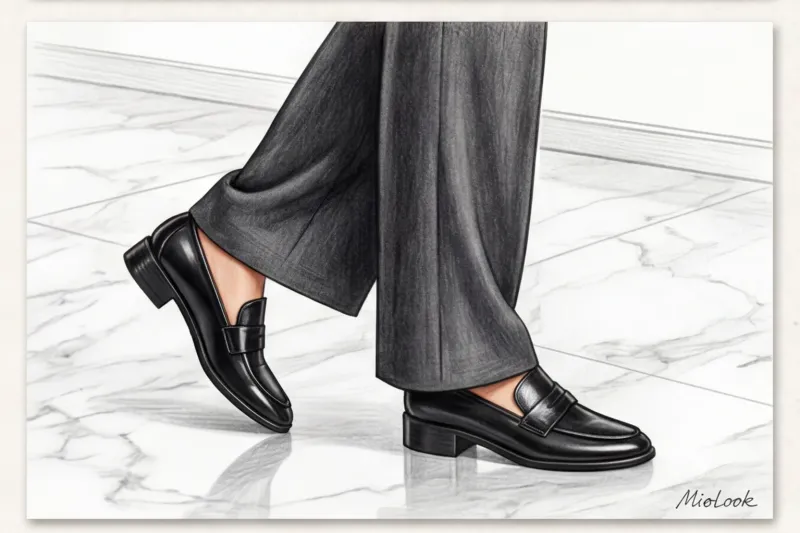
Properly chosen maternity office attire always requires a matching finish. What can you wear instead of stilettos without losing your credibility with your colleagues? Your best investments are soft nappa leather loafers with a small, stable block heel, formal brogues, or oxfords. The soft leather will absorb evening swelling without pinching your blood vessels. If protocol calls for elegance, opt for slingbacks with a micro-heel. kitten heel (No more than 3-4 centimeters). A quality pair of the right firmness, in the €150-€300 range, will not only be a beautiful addition but also a guarantee of your performance.
Avoiding high heels inevitably makes the lower half of the silhouette appear squatter. To balance the proportions, we need to artificially draw the focus upward—toward the portrait area. This is where strategically chosen accessories come into play. Large, sculptural earrings in smooth metal, vintage clip-on earrings, statement silk square scarves, and a chunky men's watch on the wrist act as visual anchors. They unerringly keep your interlocutor's gaze on your face during difficult negotiations.
Since the accessory group takes on such an important function of distraction, I recommend digitizing your jewelry in advance. MioLook wardrobe app You'll be able to visually test how statement earrings or a contrasting scarf work with the lapels of different jackets without wasting precious morning minutes endlessly changing in front of the mirror.
What to Avoid: The Main Mistakes of a "Pregnant" Business Style
Several years ago, the HR director of a Big Four consulting firm's London office shared a revealing observation with me. She noticed that brilliant female professionals, when going on maternity leave, often began to lose their authority in meetings months before they actually left. The problem wasn't their competence, but a sudden shift in their visual code. The women were unconsciously shifting from a structured business format to a "homey" and infantile aesthetic that conveyed vulnerability rather than leadership.
Let's explore the most insidious stylistic traps that can ruin your years-honed image when you need formal maternity office wear.
Empire cut (cut off under the bust). This is perhaps the most common mistake. Dresses and tops with a stiff seam directly under the bust and soft fabric flaring out from it inevitably evoke Victorian nightgowns. In a corporate setting, such a relaxed silhouette looks completely inappropriate, depriving the figure of any geometric support. Instead of an empire waist, choose an architectural A-line silhouette, which will maintain its shape regardless of your body's changes.
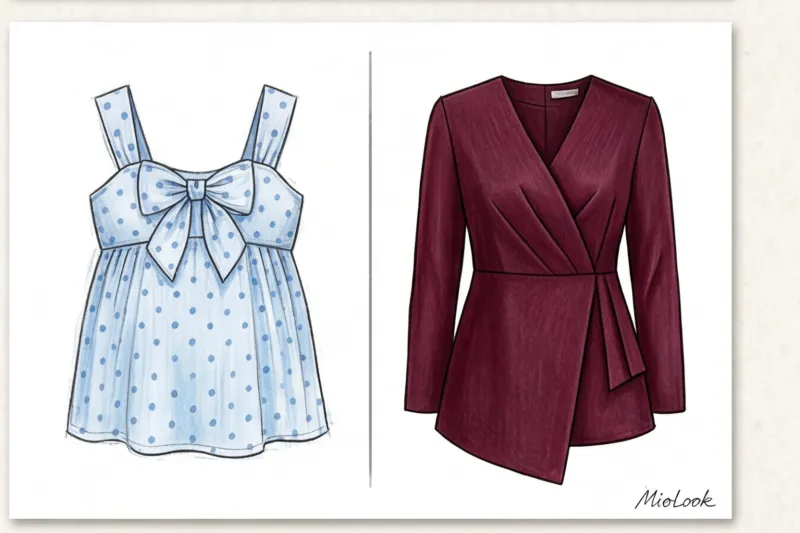
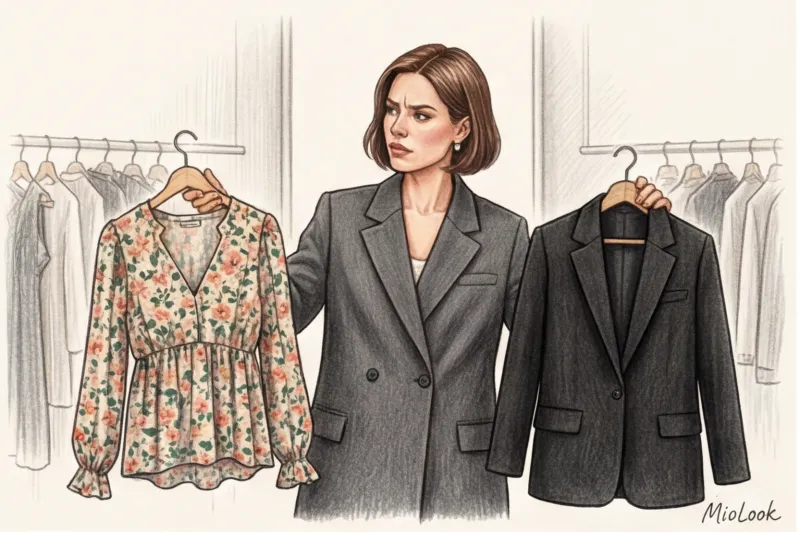
Small floral print and polka dots. Observing corporate dynamics, I constantly see how patterns influence the perception of competence on a subconscious level. Mille-fleurs (small florals) and classic polka dots instantly diminish authority, adding unnecessary naivety to the image. If you want to maintain status, shift the focus to color blocking, strict pinstripes, or deep monochrome solutions. The neuropsychology of visual perception confirms: the human brain interprets precise geometric patterns as a manifestation of analytical intelligence and control, while floral patterns indicate softness and frivolity.
Clothes that are too tight in the chest area. During pregnancy, changes in proportions often occur abruptly. Your favorite basic shirt, bought for €150, may suddenly become so tight that the buttons are ready to pop out at any moment. In strict business etiquette, excessively tight bust is an absolute no-no. Monitor this parameter weekly: if the fabric between the buttons begins to bulge, it's time to temporarily archive the item in the app. MioLook , replacing it with loose-fitting blouses with a V-neck.
Bandage jeans with a T-shirt covered with a classic jacket. This is a textbook example of stylistic dissonance, what we in the industry jokingly call the "centaur effect." On top, you're a stern executive in a suit jacket, and on the bottom, a relaxed man about to go for a stroll in the countryside. A strict, structured jacket requires equally composed companions. A basic, thin T-shirt stretched over the elastic nylon waistband of jeans ruins the entire tailoring magic. If you wear a jacket, pair it exclusively with a thick-knit column dress or full-length trousers with hidden side panels.
Your ideal image begins Here
Join thousands of users who look flawless every day with MioLook. Digitize your wardrobe and create iconic outfits without any styling mistakes.
Get access — €0.99 onceChecklist: Wardrobe audit before maternity leave
Do you know what moment causes the most style stress for my pregnant clients? It's not important boardroom meetings or public speaking engagements. The hardest part is those fifteen minutes in front of the open closet early in the morning. When the familiar armor of tailored suits no longer fits around the waist, and the new body proportions feel alien. To prevent the morning routine from turning into daily frustration, we need a ruthless and pragmatic audit.
I developed this algorithm after sorting through hundreds of wardrobes. It helps instantly reduce anxiety and reveal the hidden potential of the things you already own.
Step 1: Place all items with a rigid, non-adjustable belt on the far shelf.
Physiology dictates its own strict rules, which are futile to argue with. What feels "a little tight" at 9 a.m. will become a torture device by 3 p.m., impeding circulation and interfering with normal breathing. Be uncompromising: pencil skirts made of thick suit wool, classic trousers with a tight fit, and sheath dresses with a stiff seam at the waist are immediately consigned to vacuum packaging.
Out of sight, out of the closet. Leaving these items on the rails will only lead to morning disappointment from the discrepancy between expectations and reality. Make visual space for what truly works for you right now.
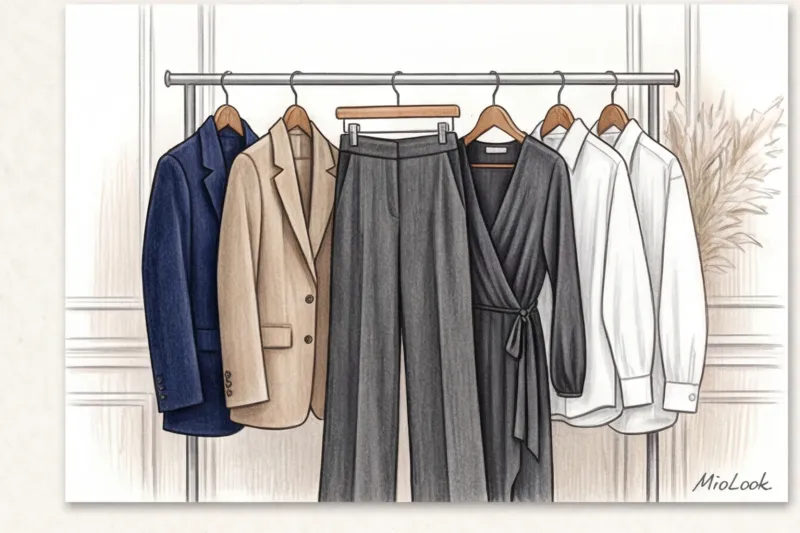
Step 2: Select tight knits and straight-cut jackets
Now we're looking for stylistic gold in what's left. The perfect maternity office wear is often already hanging in your closet; you just need to reconsider how you style it. Pull out absolutely every architecturally cut piece: oversized double-breasted jackets (in the spirit of The Frankie Shop or men's lines), smooth-knit cardigans in thick cotton, and column dresses in heavy viscose.
All of this will continue to convey your competence. We simply stop buttoning jackets—two vertical lines at the waist create the illusion of an elongated, slender silhouette, elegantly framing the changing figure.
To avoid having to keep new combinations in my head, I always ask my clients to digitize this “safe base” in MioLook Visualization of what you have already Yes, it destroys the panicky myth of "I have nothing to wear" and allows you to create status looks right on your smartphone over your morning coffee.
Step 3: Create a shopping list of only 3-4 adaptable basic items
Marketers at specialized brands will aggressively urge you to completely overhaul your closet. Don't fall for this ploy. Your strategy is surgically precise investments. You'll need just three or four smart pieces: the perfect pair of thick ponty-knit trousers with hidden side elastic panels (no nylon belly bands!), a heavy crepe wrap dress, and maybe one impeccable poplin shirt two sizes too big.
Budget in the range of €150–€300 per unit. It's better to buy three premium-quality items with impeccable cuts and expensive fittings than a dozen polka-dot polyester blouses that will pill after the first wash and instantly cheapen your professional image.
Step 4: Check your shoes at the end of the work day
This simple test has saved many brilliant professionals from serious vein problems. Only try on and inspect your business shoes after 5:00 PM. According to podiatry research, by the end of the workday, the foot volume of pregnant women can increase by 8-10% due to the natural redistribution of fluid and the hormone relaxin.
If your favorite leather loafers or oxfords are a bit tight at 5 p.m. already in your fourth month, they'll become physically unbearable by your sixth. Put them away until you return from maternity leave. Switch to soft suede or thin glove-like leather models, a half size larger.
Your style is a visual extension of your intellect, and it certainly won't go on maternity leave before you do. A well-organized, clutter-free wardrobe will help you maintain your authority and focus on your career goals. Invest in the right textures, maintain a clear shoulder line, and remember: status in a corporate environment isn't achieved by suffering in a tight skirt, but by the calm confidence that comes from uncompromising comfort.
Guide Chapters
Strict Dress Code for Pregnant Women: How to Dress for the Office
Pregnancy isn't a reason to abandon business attire and embrace shapeless tunics. Learn how to maintain professional credibility with the right wardrobe.
Business attire for plus-size pregnant women: how to choose
Forget shapeless robes and ruffles. Learn how to create an elegant office wardrobe for plus-size pregnant women using an architectural approach.
Office blouses for pregnant women: comfortable styles
How to dress for the office while pregnant without looking like a cupcake? We explore stylish and classy alternatives to typical maternity wear.
Summer Maternity Office Wear: Style and Comfort
Why are 90% of maternity clothes unsuitable for work in the heat? We'll explore the main summer dress code mistakes and put together the perfect office wardrobe.
Maternity Office Shoes: Style and Comfort
Find out how to choose stylish and comfortable office shoes during pregnancy. Practical tips from a personal stylist for busy moms.
How to Hide Your Pregnancy at Work: Avoid Oversized Clothing
A sudden shift to oversized clothing is the biggest mistake of the first trimester. We'll tell you how to choose an elegant office wardrobe to conceal your pregnancy.
How to adapt regular maternity clothes for the office
Maternity wear often ruins a business look and is too expensive. We'll show you how to stylishly transform your current office wardrobe.
Maternity Winter Business Attire: Warm Office Style
How to dress stylishly for the office during late pregnancy in winter? Stylists' tips for choosing warm, comfortable, and elegant workwear.
How to Choose Business Pants for Maternity: Style and Comfort
Pregnancy isn't a reason to give up elegance in the office. We'll explore the anatomy of the perfect bottom and learn how to choose stylish trousers without sacrificing comfort.
Office Dresses for Maternity: Stylish and Formal Styles
How to maintain your professional status during pregnancy? We'll learn how to choose stylish and formal dresses for the office without sacrificing comfort.
Maternity capsule for the office: a stylish business wardrobe
Forget about shapeless clothes from department stores. Discover the precise formula for creating a stylish work wardrobe during pregnancy.