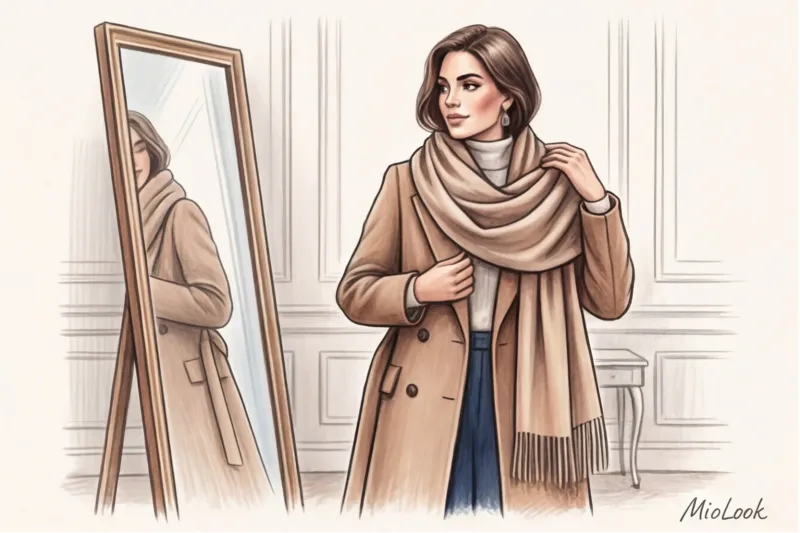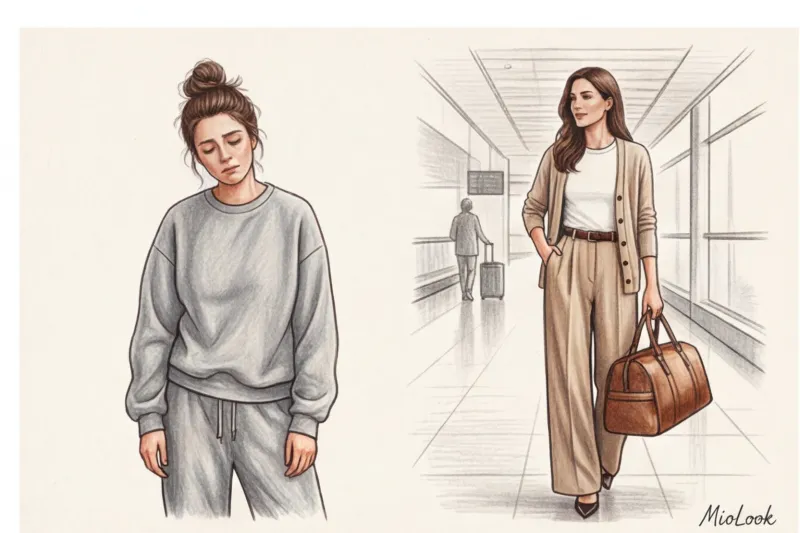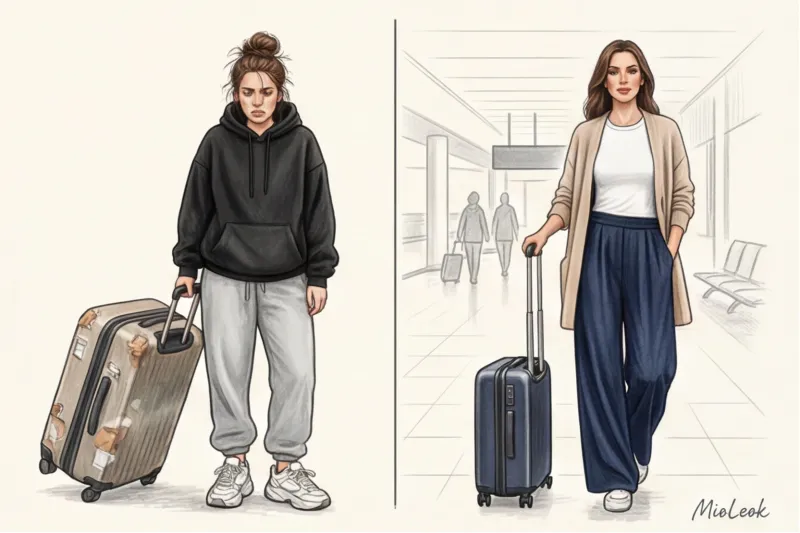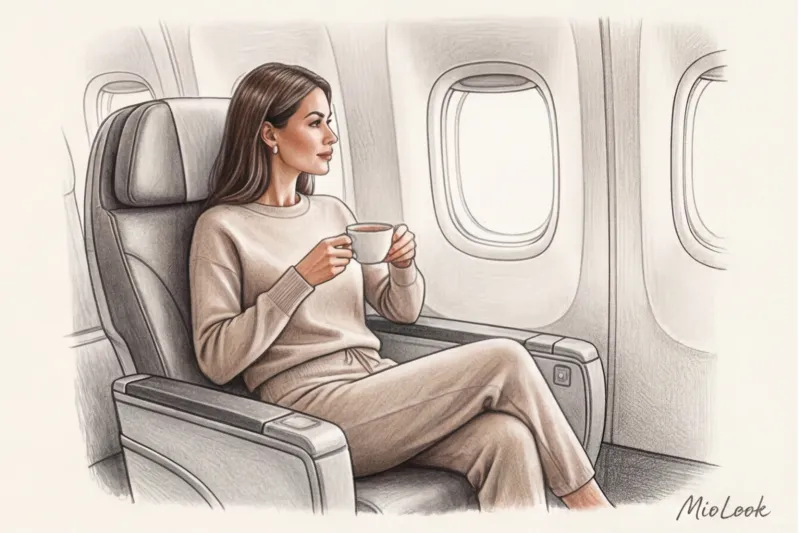
Seven years ago, I made the biggest mistake of a budding fashion journalist. Heading to Fashion Week, I decided to fly from Paris to New York in a stunning pantsuit made of premium Belgian linen. In the hotel mirror, I looked like a style icon from the cover of Vogue. But eight hours later, on a transatlantic flight, as I stepped out of the JFK terminal, I resembled someone who had slept in a haystack. My pants were deeply creased, and my jacket looked like it had been chewed.
That's when I realized: it's right wrinkle-resistant travel clothes — it's not a matter of aesthetics, it's a matter of textile engineering. We've already covered the basic rules of airport dress code in our The complete guide: what to wear on a plane And today I want to analyze the anatomy of a travel wardrobe at the molecular level.
Synthetics vs. Nature: Why 100% Polyester Is the Worst Wrinkle-Free Travel Clothing
The biggest myth I constantly hear from clients is: "To prevent things from wrinkling in a suitcase or on a plane, you need to buy synthetics." It sounds logical, as polyester does hold its shape very well. But let's look at this through the prism of physics and physiology.
According to research by aeronautical engineers, humidity in the cabin of an airplane drops to 10–20%. For comparison, the average humidity in the Sahara Desert is around 25%. In such extremely dry conditions, 100% polyester or nylon becomes a plastic trap.
In dry air, synthetic fibers instantly accumulate static electricity. Pants become uncomfortably clingy to your legs, and the fabric becomes impermeable to moisture, creating a greenhouse effect. A 2023 study by the WGSN Institute demonstrated a direct link between the tactile discomfort of clothing and stress levels during travel. This is the phenomenon of enclothed cognition: when your body experiences micro-stress from "stuffy" fabric, you arrive more tired and experience more severe jet lag.
Access to MioLook for €0.99 — one-time payment
A smart AI stylist will help you find the perfect look for your next flight.
Get access — €0.99 onceThe 10,000-Meter Rule: How Airplane Microclimate Changes Fabric Properties
In the textile industry, there's a term called WRA (Wrinkle Recovery Angle)—the angle at which a fabric recovers after wrinkling. The higher the angle, the faster the garment will smooth itself out. The trick is that the elasticity of many fibers is directly related to humidity.
A garment that performed perfectly in the humid climate of Bali or rainy London loses its residual moisture at an altitude of 10,000 meters. The fibers become stiff and brittle. This is why we need fabrics that retain their springiness even in absolutely dry conditions.
Top 5 Fabrics That Will Forgive You After 12 Hours in a Plane Seat
The Jet-Set Chic aesthetic, so beloved by Hollywood stars at airports, is based not on brand names, but on the correct weave of yarns. Luxury brands have long understood that not only the composition but also the twist of the yarn is important.
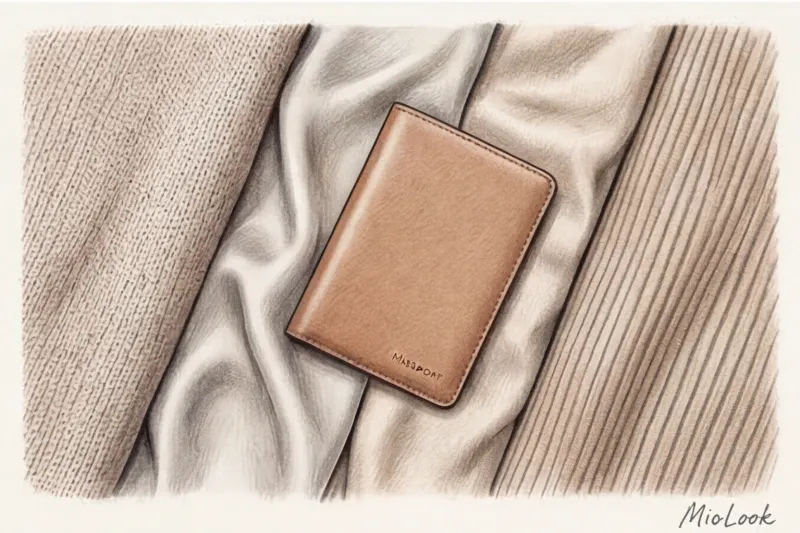
High-Twist Yarns technology involves twisting the yarn several times more than normal before weaving it into fabric. This results in a spring-like effect. For example, Loro Piana's renowned Travel Wool line is created using this principle: the fibers repel wrinkles simply due to their physical structure.
Merino Wool: The Absolute Champion
If I had to choose only one material to fly with for the rest of my life, it would be fine merino knit. Under a microscope, merino wool fiber looks like a spiral. No matter how you bend it, it tends to return to its original shape.
"Merinos is a smart climate control system. It's not too hot when you're running through the terminal with your suitcase, and it's not too cold when your neighbor upstairs turns the air conditioning up to full blast."
Unlike cotton, merino absorbs up to 30% of its own weight in moisture, remaining dry to the touch and preventing the growth of bacteria (meaning no unpleasant odors after a long journey).
Tencel (Lyocell) and Cupro: the new generation of silk
Many people confuse Tencel with synthetics, but it's a man-made fiber of natural origin (made from eucalyptus wood). It's a real find for travel.
Tencel has an incredible "glide." The completely smooth surface of the fabric fibers means there's simply nothing to catch on and create a hard crease. Wide-leg palazzo pants made from dense Tencel look just as impeccable at baggage claim as they do at boarding.
But there is an important limitation here: This rule doesn't apply to cheap viscose. Budget viscose wrinkles just by looking at it. Look for Tencel™, Lyocell, or Cupro on the label.
Blend of cashmere and high-density knitwear
Pure cashmere is beautiful, but it can stretch at the elbows and knees. The ideal formula for airplane use is cashmere with 10-15% silk or elastane. The silk provides reinforcement that maintains its shape.
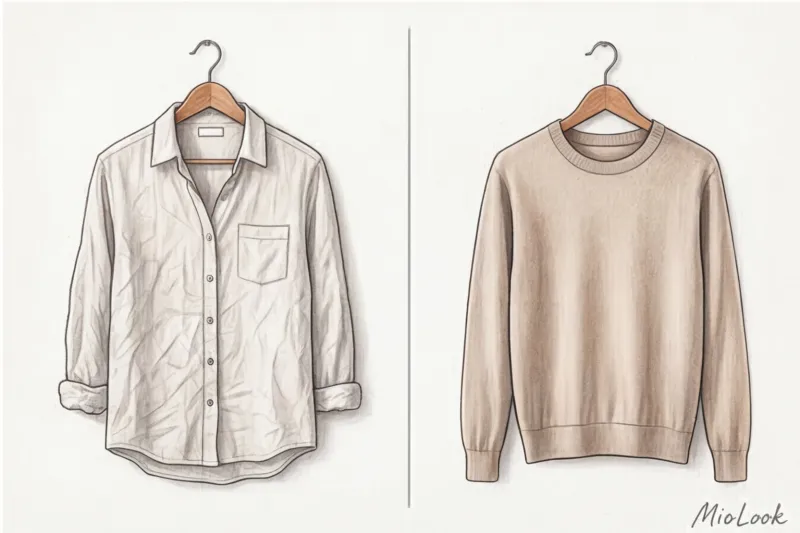
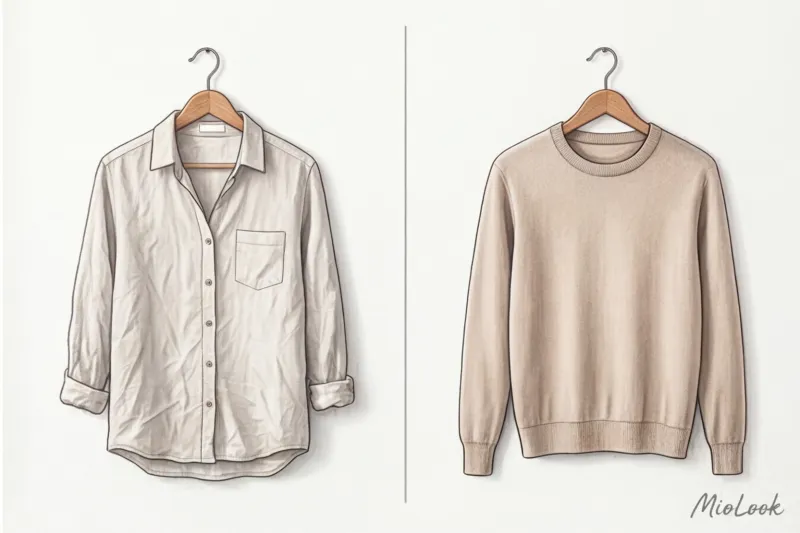
Pay attention to the density of the knit. Loose, translucent knits (even expensive ones) will deform under the weight of your body in the chair. Choose dense jersey, Milano, or pique weaves—they act as lightweight armor against wrinkles.
Your ideal image begins Here
Join thousands of users who look flawless every day with MioLook.
Get access — €0.99 onceEnemies of the Perfect Luggage: Fabrics to Forget Before the Hotel
One of my VIP clients, a top manager at an IT corporation, once flew to Dubai to sign a contract wearing a thin poplin dress. She planned to go straight to the meeting from the airport. She ended up having to frantically change in the terminal restroom because the texture of the airplane seat had imprinted on the back of her dress.
Here are three materials that are absolutely not suitable for long journeys:
- 100% linen. It has zero elasticity. Save your linen suits for strolling along the waterfront, but flying in them is a style crime.
- Fine cotton (poplin and cambric). Poplin shirts immediately become covered with a fine network of wrinkles in the folds (stomach, elbows).
- Acetate silk. A cheap alternative to silk that not only gets incredibly staticky, but also holds creases in place until you steam them.
Cutting architecture: how a style compensates for creases in fabric
Even the most carefully designed wrinkle-resistant travel clothing can fail if it's cut too rigidly. Historically, travel silhouettes have always gravitated toward freedom. Consider the bias cut, introduced by Madeleine Vionnet in the 1920s—fabric cut at a 45-degree angle flows across the body and physically cannot form rigid horizontal folds.
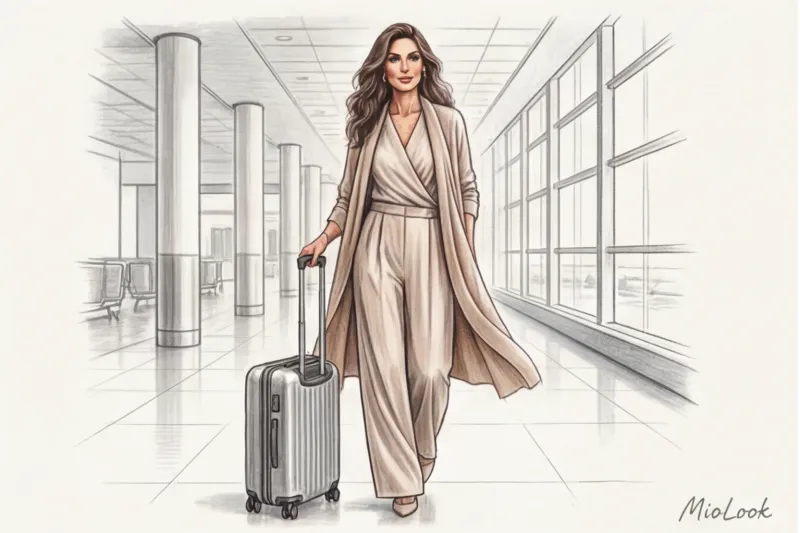
How to use the cut to your advantage:
- Drapery and asymmetry. It's a brilliant optical illusion. The top, with its gently draped waist, already has the folds the designer intended. Any new wrinkles will simply be lost in this texture.
- Refusal of rigid belts. Classic suit pants with a stiff waistband dig into your stomach when sitting and create deep creases in the groin area. Replace them with pants with an elastic back or drawstring.
- Multilayered. A chunky knit cocoon cardigan or a loose overshirt (worn over a basic top) will hide any nuances on the underlying layer.
Insider Test: How to Check for Wrinkle Resistance Right in the Store
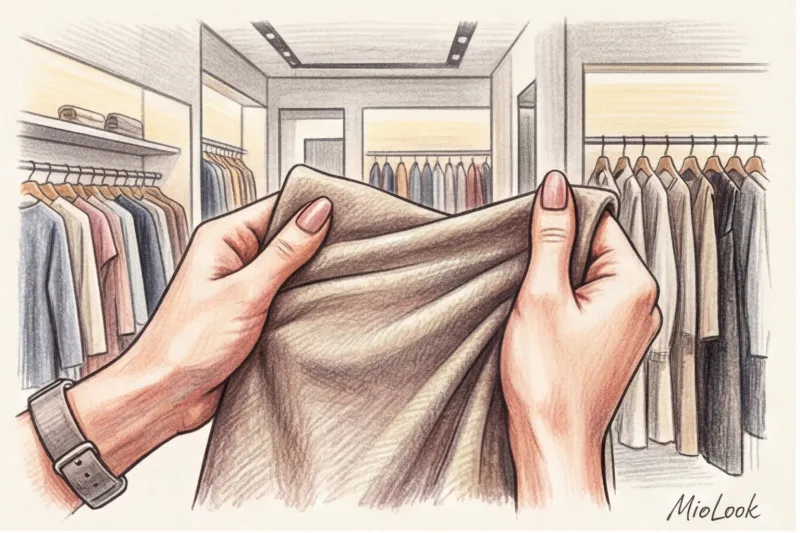
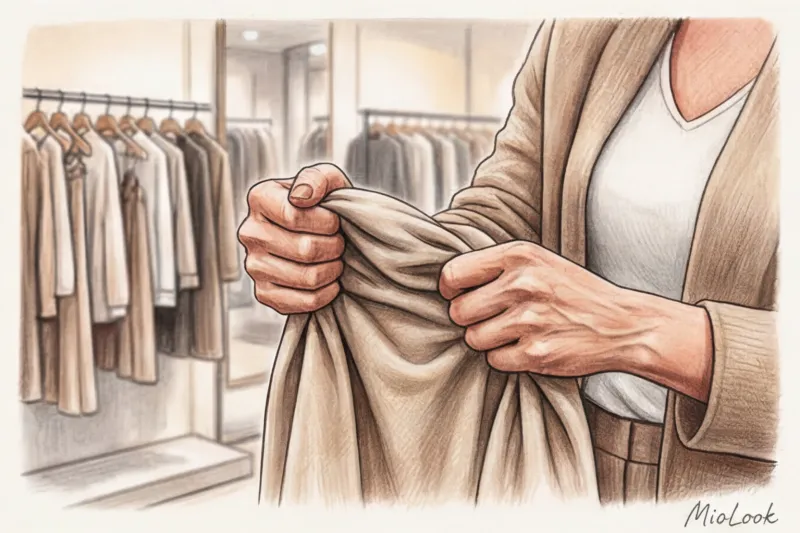
Over 12 years of working as a stylist, I've developed a foolproof method for testing items during a shopping trip. You don't need to trust labels or consultants' promises. Try the "30-second fist test."
- Take the edge of the fabric (preferably in an inconspicuous place, such as the hem) and squeeze it tightly in your fist.
- Hold for exactly 30 seconds. This is important: the warmth of your hand will simulate the heat generated by your body while sitting in a chair.
- Release quickly and shake the item.
If the fabric straightens out within a couple of seconds and there's no trace of wrinkles left, go ahead and buy it. If a distinct, wrinkled mesh remains, it will ruin your flight.
By the way, if you often doubt which items from your closet are best to take on the road, upload their photos to MioLook The app will help you digitize your wardrobe and assemble the perfect travel capsules in advance, so you don't have to stand in front of your open suitcase in a panic two hours before departure.
Ready to get started?
Try MioLook's free plan—no commitments or card required.
Get access — €0.99 onceStylist Checklist: Putting Together a Capsule of Wrinkle-Free Clothing
The perfect travel wardrobe isn't a random collection of comfortable items, but a well-thought-out system. Here's my tried-and-true formula for a basic flight capsule:
- Bottom: Wide-leg trousers made of thick Tencel or cashmere-silk joggers. No stiff denim or linen.
- Base layer: A top or t-shirt made of heavyweight cotton (at least 180 g/m²) with 5% elastane added. The elastane will prevent the cotton from wrinkling.
- Insulation: A voluminous merino wool cardigan or a thick fleece hoodie (loop, not fleece).
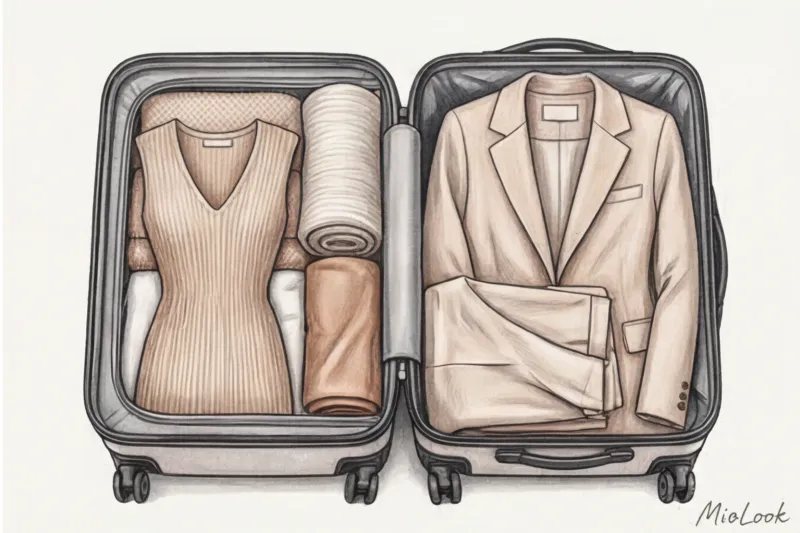
To ensure your items arrive in perfect condition in your suitcase, use the rolling technique. Instead of stacking items (which can cause creases at the folds), roll them tightly into rolls. This minimizes the amount of fabric creasing.
Remember: travel comfort doesn't mean sacrificing style. Choosing the right, high-tech fabrics is an investment in your personal brand. When you step off the plane looking fresh, put-together, and wrinkle-free, you project a confidence that's impossible to fake.