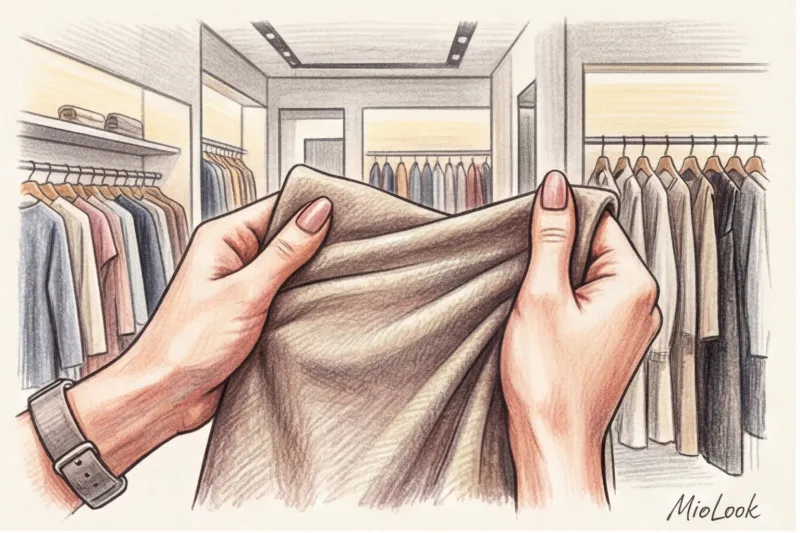
Every other article online confidently advises you to "pull a thread and set it on fire" to check the composition of an item. Seriously? Imagine this: you're standing in a Massimo Dutti fitting room, plucking a thread from a brand-new sweater, and striking a lighter on it. Security will escort you out faster than you can say "100% cashmere."
My name is Katarzyna Nowak, and over 12 years as a personal stylist, I've sorted through hundreds of wardrobes. I've seen stretched knees, sweaters that curl up after just one wear, and dresses that give you electric shocks. In real life, blind faith in a pretty label can be very costly. So today we'll talk about how to determine the quality of fabric without extreme experiments with fire.
We talked in more detail about the comprehensive assessment of cut and fittings in our a complete guide to evaluating clothing quality , but for now we'll focus exclusively on materials science. It's time to learn how to read fabric with your hands and labels with the eyes of a professional buyer.
How to Determine Fabric Quality in the Fitting Room: 3-Second Stylist Tests
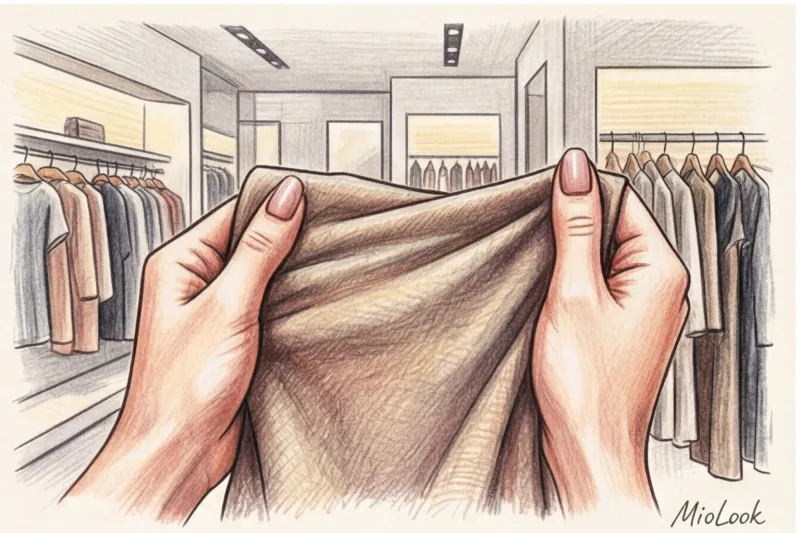
When I conduct a wardrobe audit, I don't just look at the clothes hanging on the hangers. I squeeze them, pull them, and rub them against each other. This physical contact provides ten times more information than the ingredients printed on the tag. Here are three tests that take exactly five seconds, right in the fitting room.
1. Crumple test (crash test)
Firmly grasp the edge of the fabric (for example, the hem of a shirt or a pant leg) in your fist and hold for 5 seconds. Release. If the material looks like chewed paper and the wrinkles don't come out even after gently smoothing it with your palm, return the item to the hanger. Otherwise, you'll be ironing it every morning, only to have it wrinkled again on the way to the office.
2. Transmission test
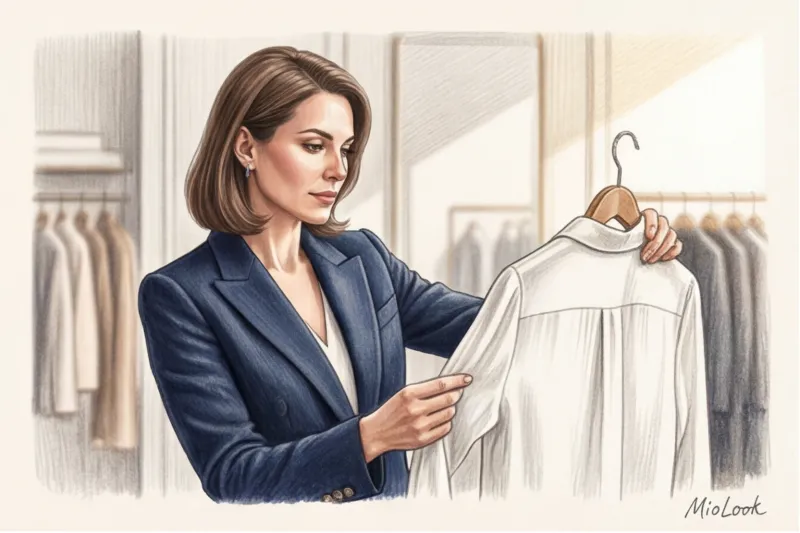
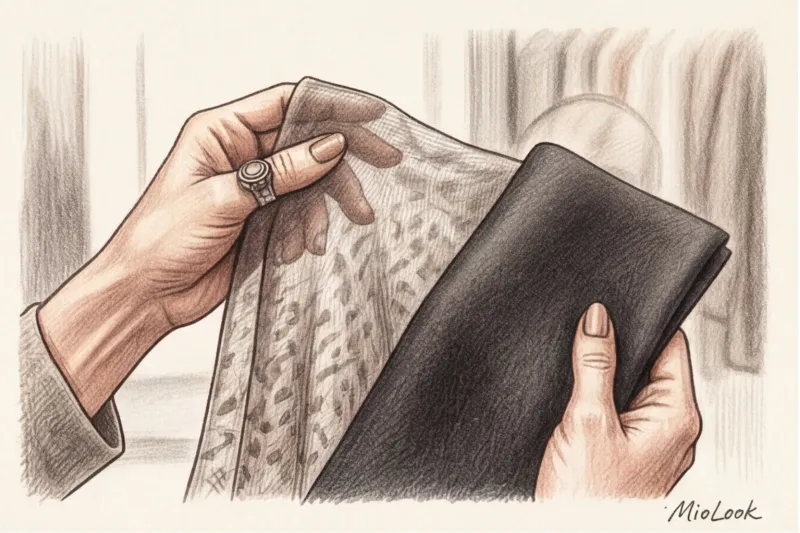
Lift the item and look through one layer of fabric at a powerful fitting room light. This is a surefire indicator of cheap yarn. High-quality fabric has a uniform, tight weave. If you see a loose mesh with uneven thread thickness and obvious bald spots, you're looking at a material that will warp after the first wash at 30 degrees.
3. Tensile test
Gently tug the fabric at the most sensitive areas (usually around the elbows or knees), then release it quickly. High-quality knitwear or a suiting blend will instantly spring back to its original shape. Cheaper fabric will leave a characteristic "bubble." To be fair, this test doesn't work for 100% linen or stiff raw denim—they're not supposed to spring back—but for basic knits, it's indispensable.
Access to MioLook for €0.99 — one-time payment
A smart AI stylist will select the perfect look for every day and help you organize your closet.
Get access — €0.99 onceNatural Materials: How to Distinguish Premium from Mass-Market
"But it's 100% cotton!" my clients often tell me, pointing to a $10 T-shirt. But why then does a basic T-shirt from COS or Theory cost five times as much, even though the label says exactly the same thing? The answer lies in the length of the fiber.
Cheap mass-market clothing uses short-staple cotton. Its threads are short, fluffy, and less able to adhere to each other. This causes the fabric to quickly become thinner, and after washing, the seams tend to twist (the side seam suddenly appears on the stomach). Expensive brands use long-staple cotton (such as Egyptian or Pima/Supima). It's smooth, durable, and has a light, elegant satin sheen.
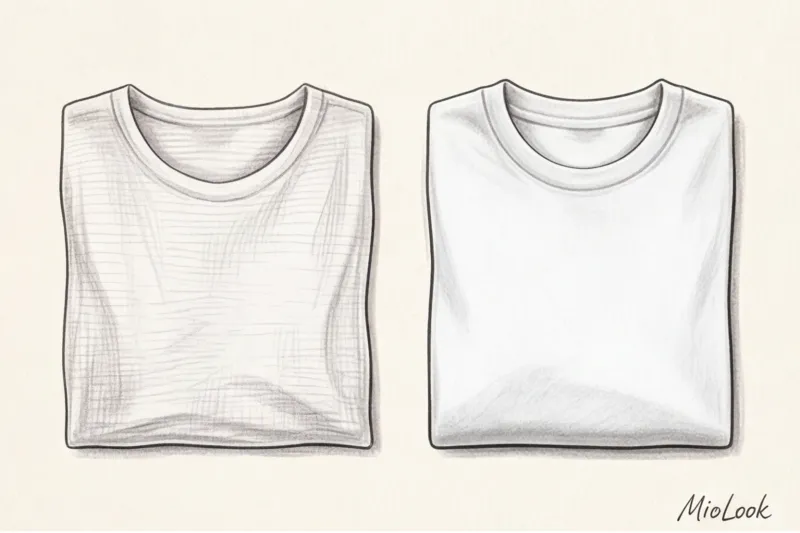
The story with wool and cashmere is even more interesting. One of my clients proudly bought a "100% cashmere" sweater on sale at a mass-market store. After three days of wearing it, huge pilling formed under the arms and along the sides. Why? Because the brand saved on raw materials by using short, low-twist down.
The secret to durable knitwear lies in the yarn twist density. According to international textile industry standards for pilling resistance (ISO 12945), the tighter the twist, the less likely it is that the fibers will emerge and form balls.
Run your finger against the direction of the knitting: if a light “cloud” of fluff immediately rises above the surface, the item will shrink beyond recognition within a week.
Silk and linen: what are we paying for?
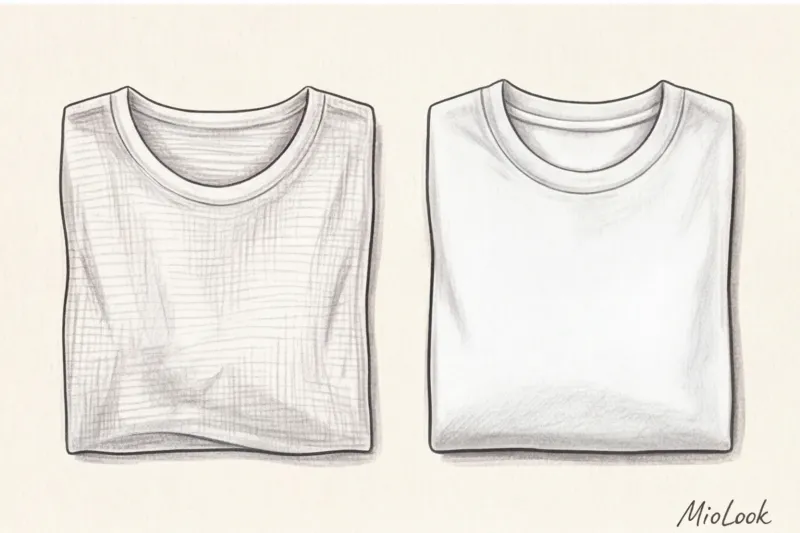
Natural linen is an aristocratic fabric. But it comes in many forms. High-quality, heavy linen (often with 5-10% viscose or cotton added) creases into beautiful, large, and smooth folds. Cheap, thin linen creases into small, sharp "accordion" creases, which look sloppy rather than stylish.
As for silk, its quality is measured in momme (the weight of a square meter of fabric). I always warn: don't buy silk blouses with a density lower than 16 momme. The ideal value for dresses and shirts is 19-22 momme. Thin silk (8-12 momme) is only suitable for gauze scarves; in a blouse, it will simply unravel at the seams under the slightest tension.
Your perfect look starts here
Join thousands of users who look flawless every day with MioLook. Digitize your wardrobe and create capsule collections in one click.
Get access — €0.99 onceArtificial fibers: hidden gems for a smart wardrobe
It's a huge mistake to confuse "synthetics" with "artificial fabrics." Synthetics (polyester, nylon, acrylic) are made from petroleum products. Artificial fabrics, on the other hand, are created artificially, but from a natural raw material—wood pulp.
These include viscose, modal, lyocell (also known as Tencel), and cupro. These are absolute favorites of the European mid-up segment.
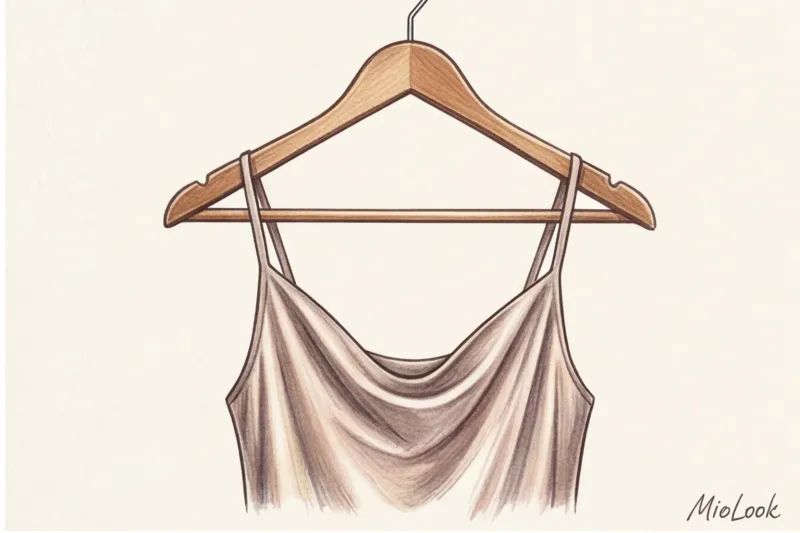
Have you noticed why collections from &Other Stories or Massimo Dutti always look so fluid and feminine? They use lyocell and cupro extensively. These fabrics are more breathable than cotton, absorb moisture, are incredibly comfortable on the body, and, most importantly, create a luxurious, heavy drape.
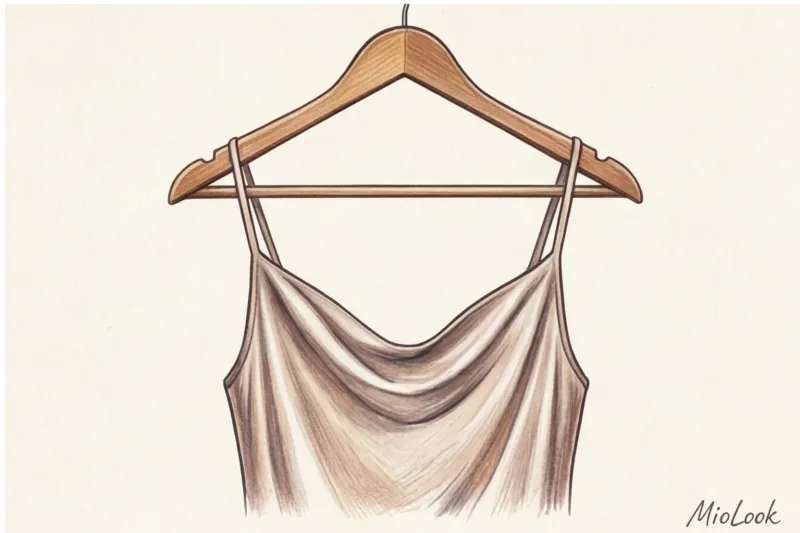
Cupro is often referred to as "vegan silk." If you want a slip dress that doesn't cling to your body and flows like water, but you're not willing to pay $300 for real silk, look for the word "vegan" on the label. Cupro.
Synthetics: When Polyester Is a Sentence, and When It's a Necessity
This is where the biggest consumer misconception lies. The myth goes, "Natural is always good, synthetics are always bad." Let's break down stereotypes. Buying a 100% wool or cashmere coat if you drive or ride the subway every day is a bad idea. Natural fibers are delicate and will quickly wear out on your elbows, buttocks, and where your seat belt rubs. necessary synthetic admixture.
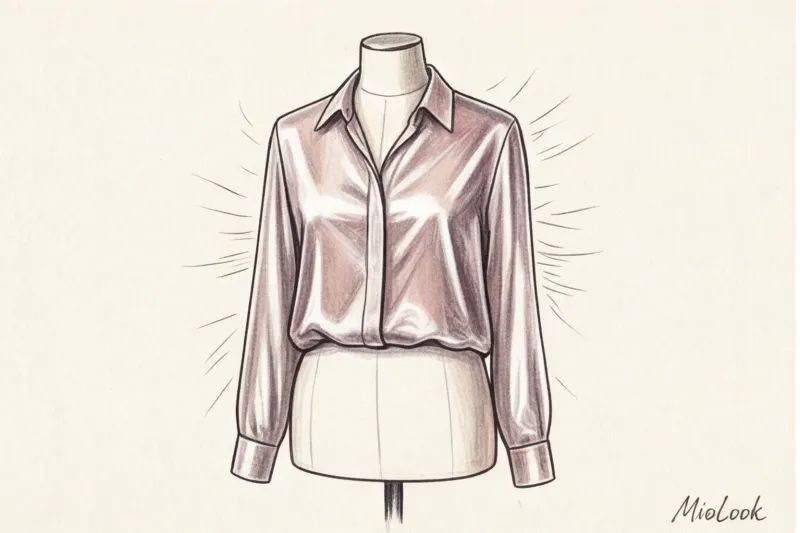
But there are red flags where polyester is unacceptable. This applies to the first layer of clothing: underwear, office blouses, summer dresses. Synthetics create a greenhouse effect, disrupting the skin's microbiome. Incidentally, in the article "What fabric doesn't show sweat stains?" We've discussed in detail how a cheap synthetic blouse can literally ruin a speaker's image at a conference due to telltale marks and odor.
Where are synthetics absolutely necessary and even justified? Sportswear, down jackets, and trench coats with water-repellent finishes. High-tech recycled polyester in a jacket will protect you from the rain like no cotton in the world can.
Perfect Proportions: Reading Labels Like a Professional Buyer
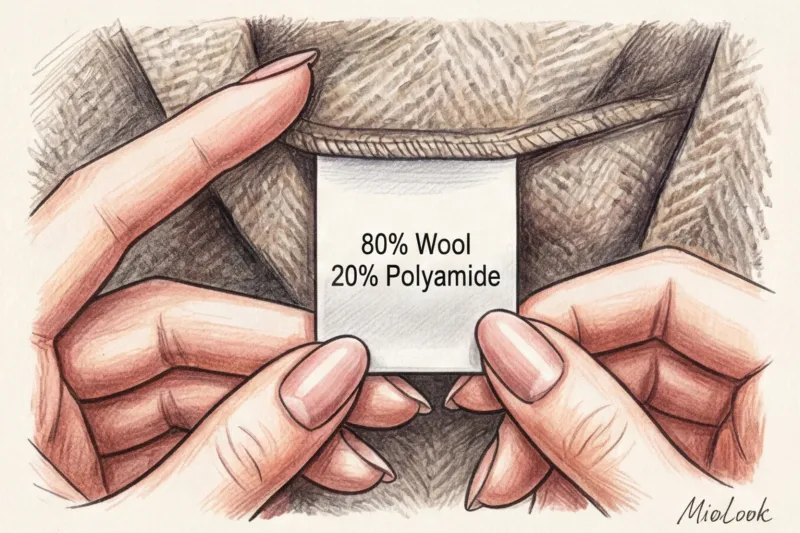
If you want your items to last for years, you need to memorize a few golden formulas. I recommend that clients save these proportions directly to their phones or in the app's knowledge base. MioLook when they plan shopping.
- The formula for the perfect autumn coat: 75-80% wool (warmth) + 20-25% polyamide or nylon (wear resistance, protection from pilling and retention of shoulder shape).
- Formula for basic knitwear and turtlenecks: 90-95% cotton/viscose + 5-10% elastane (spandex/lycra). This 5% elastane is your insurance against stretched collars and a misshapen silhouette after washing.
- The formula for perfect jeans for every day: 98-99% cotton + 1-2% elastane. Less and they'll be stiff, more and they'll turn into shapeless leggings by evening.
I'd like to warn you about a marketing ploy I call the "cashmere scam." Brands write "CASHMERE JUMPER" in large print, and you look at the $40 price and rejoice. But look at the ingredients. It's 90% acrylic, 5% polyester, and a paltry 5% cashmere. Such a garment doesn't keep you warm, squeaks, and quickly loses its appearance.
Stylist Checklist: Final Check Before Checkout
You've chosen the item, the color is perfect, the cut is yours. Take the final three steps before you draw your card.
First, check the seams for tension. Gently tug the fabric in different directions from the seam. If you see the threads of the material coming apart and creating holes, the fabric is too loose for this stitching. The garment will "pull" within the first day.
Secondly, use your sense of smell. A sharp, pungent chemical odor (reminiscent of burnt rubber or vinegar) indicates the use of cheap, toxic formaldehyde dyes. Don't delude yourself into thinking "I'll wash it out." This odor is permanently ingrained into the fiber structure.
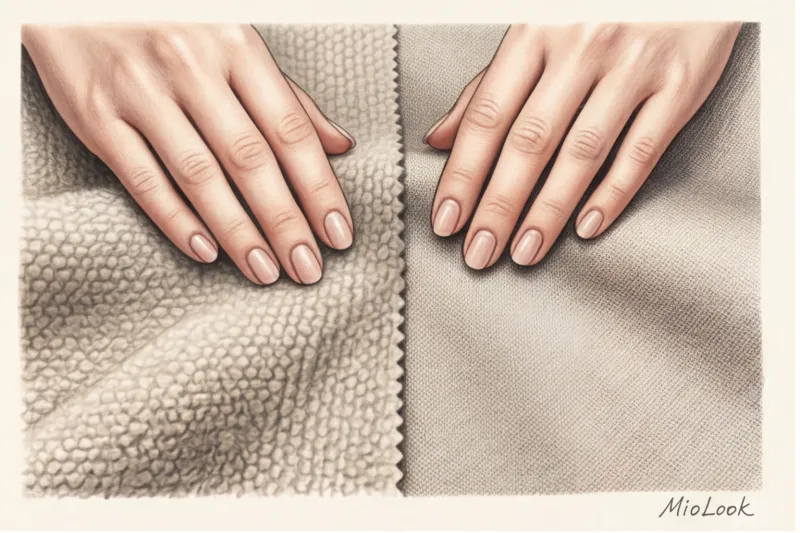
Third, run a dry hand over the fabric, applying light pressure. If your hand squeaks unpleasantly, glides unnaturally, or leaves an oily film on your skin, leave the item in the store.
My smart shopping philosophy is simple: a wardrobe is an investment portfolio. It's better to buy one shirt made of thick, flowing modal than three lopsided blouses made of loose, mass-market cotton. By learning to appreciate materials tactilely and visually, you'll stop funding the production of disposable clothing and start building a wardrobe that only looks more refined with age.