Did you know that humidity in the cabin of an airplane drops to 10–20%? For comparison, in the Sahara Desert, it typically hovers around 25%. An airplane is an extreme environment with low pressure, dry air, and a closed circulation system.
When we discuss, What you shouldn't wear on a plane Most advice boils down to the banal "give up heels." But as a textile expert and stylist who has spent hundreds of hours in the air between fashion weeks over 12 years, I approach this issue through the lens of fabric physics and anatomy. We've covered more about how to put together a basic travel wardrobe in our The Complete Guide: What to Wear on a Plane: Stylish and Comfortable Looks In this article, we'll explore the main anti-trends of air travel that ruin not only your appearance but also your health.
Mistake #1: "Cozy" Fleece and 100% Synthetics: Why They're Dangerous
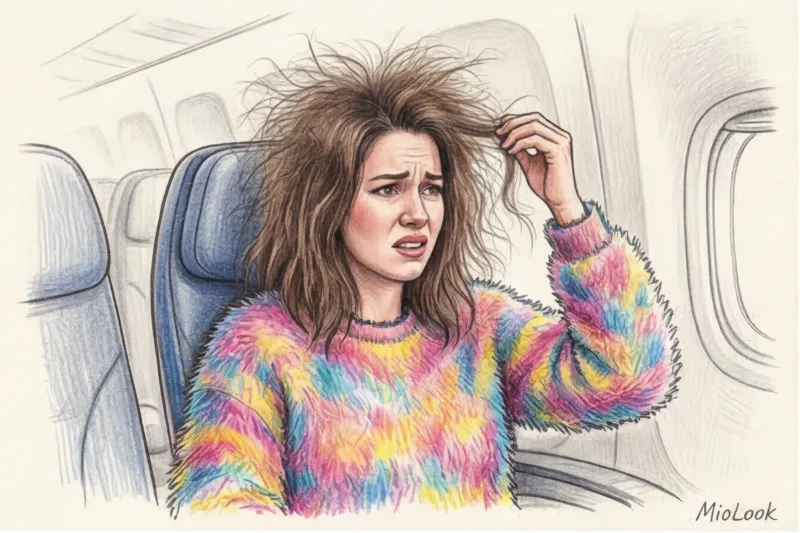
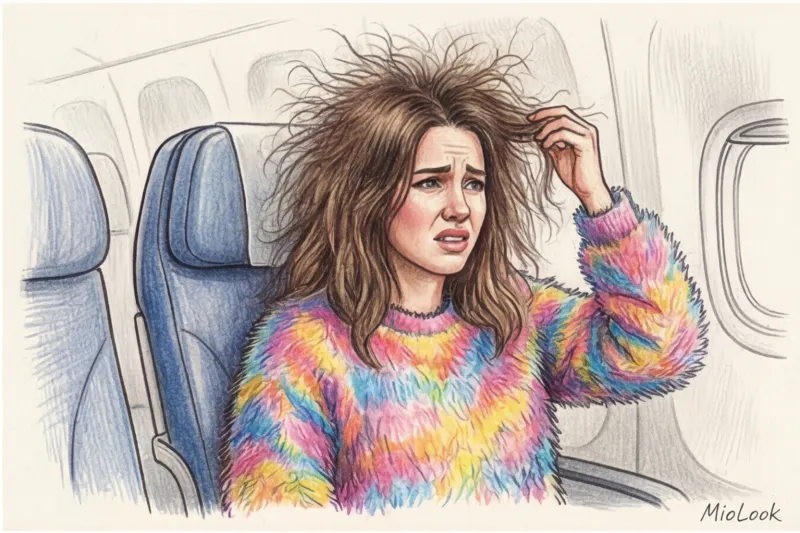
Perhaps the most harmful and yet most popular piece of advice on the internet is "wear a cozy fleece suit on the flight." It sounds logical until we remember our high school physics course. Cheap polyester fleece, at 10% humidity, turns into a powerful generator of static electricity.
Synthetic fibers are not hygroscopic (the ability to absorb and wick away moisture). In dry car interior air, friction between polyester and fabric seats can generate up to 10,000 volts of static electricity. Hair becomes staticky, dust clings to clothing, and every touch of the metal seat handle results in a nasty electric shock.
"Polyester is an oleophilic material. It doesn't absorb water, but it does a great job of absorbing sebum and trapping bacteria. In the stressful airport environment, you'll inevitably sweat, and synthetics will immediately develop an unpleasant odor that won't go away for the rest of the flight."
But there's a more serious issue: aviation safety. Have you ever noticed that flight attendants' uniforms are always made of blended fabrics with a high wool content or heavy cotton? It's not just a matter of status. In an emergency with a rise in temperature, 100% synthetics melt and literally fuse with the skin, while natural fibers smolder.
What to choose instead: Merino wool suits. Merino has natural antibacterial properties, does not accumulate odors, and acts as a temperature regulator.
Mistake #2: Skinny jeans and tight compression in the wrong place
At an altitude of 10,000 meters, the cabin pressure is maintained at a level equivalent to an altitude of about 2,000–2,500 meters above sea level. According to Aerospace Medical Association (2023) , under such conditions, blood microcirculation slows down, and the volume of the lower leg can increase by 10–15% during a flight longer than 4 hours.
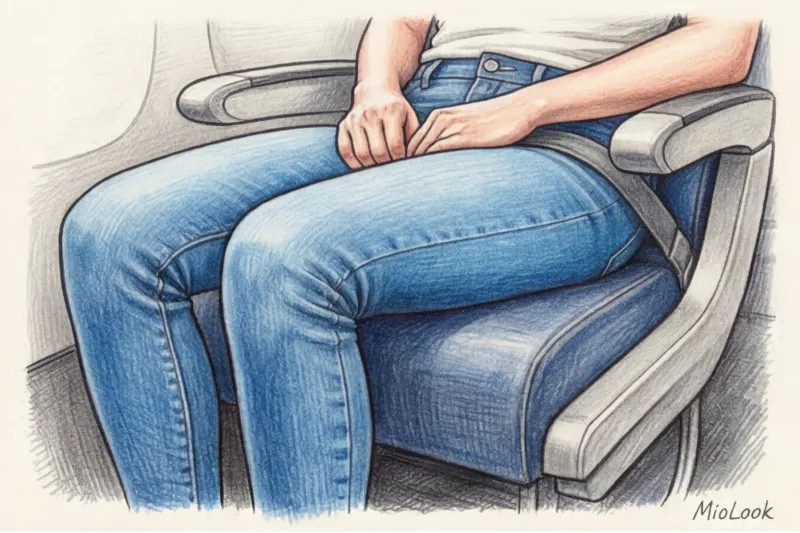
Many people confuse beneficial compression with harmful constriction. Medical compression stockings have graduated pressure (maximum at the ankle, minimum below the knee), which helps blood rise. But your favorite skinny jeans made of heavy denim act like a tourniquet. They compress the popliteal and groin veins, dramatically increasing the risk of deep vein thrombosis (DVT).
Of course, this rule has exceptions: If your flight is only 40 minutes long, skinny jeans won't cause any permanent damage. But for transatlantic flights, they're a no-no.
Eco-friendly alternative: Tencel pants—a fiber from the eucalyptus tree—flow smoothly, don't constrict blood vessels, and look much more elegant than joggers. A thick cotton jersey with 5% elastane added to maintain shape at the knees is also a good choice.
Access to MioLook for €0.99 — one-time payment
A smart AI stylist will select the perfect look for your next trip, taking into account your body shape.
Get access — €0.99 onceMistake #3: Overalls and complexly cut clothing
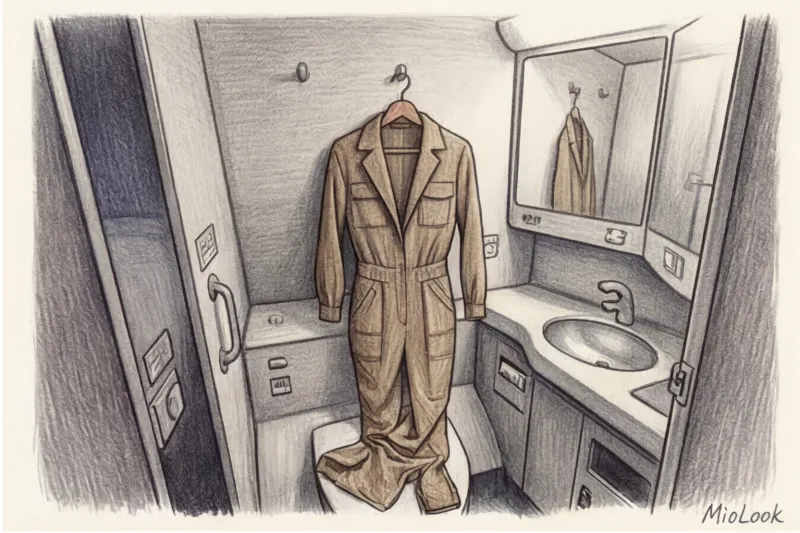
One of my clients, a top manager at an IT company, once chose a stunning silk jumpsuit with a hidden back zipper for a 12-hour flight to Tokyo. She described it as the most uncomfortable flight of her life.
An airplane restroom is a capsule of about one square meter. The ergonomics of this space are completely unsuitable for the complex gymnastics of removing clothing. When you try to remove your jumpsuit, the top inevitably falls down, risking touching the floor. And mid-flight, the floor of an airplane restroom is the last place your clothes should come into contact with.
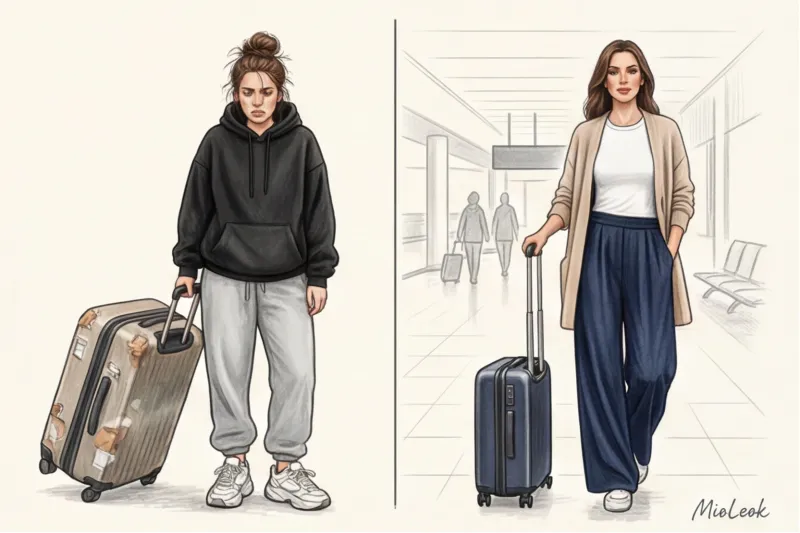
Stylist's rule: Replace monolithic outfits with layering. Separate sets (loose trousers + basic top + long cardigan) are a winner on all counts. You can easily remove the top layer if it's hot in the car, and you won't have to strip completely in the restroom.
Mistake #4: Shoes with hard soles, heels, and complicated lacing
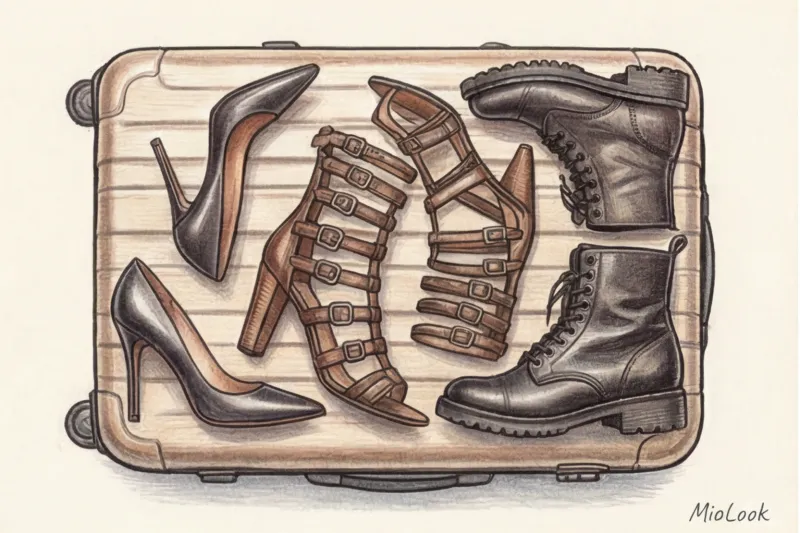
Air travel shoes must pass three tests: the swelling test, the safety test, and the security screening test. Stiff leather loafers or Chelsea boots may fit perfectly at home, but by the end of the flight they'll be a full size too small due to fluid retention.
Heels and stilettos are not only inappropriate for airport aesthetics but also a direct violation of safety regulations. In the event of an emergency evacuation via an inflatable slide, flight attendants will require you to remove your heels, as they could tear the material. Jumping barefoot onto the concrete runway (which may be hot or icy) is a dubious pleasure.
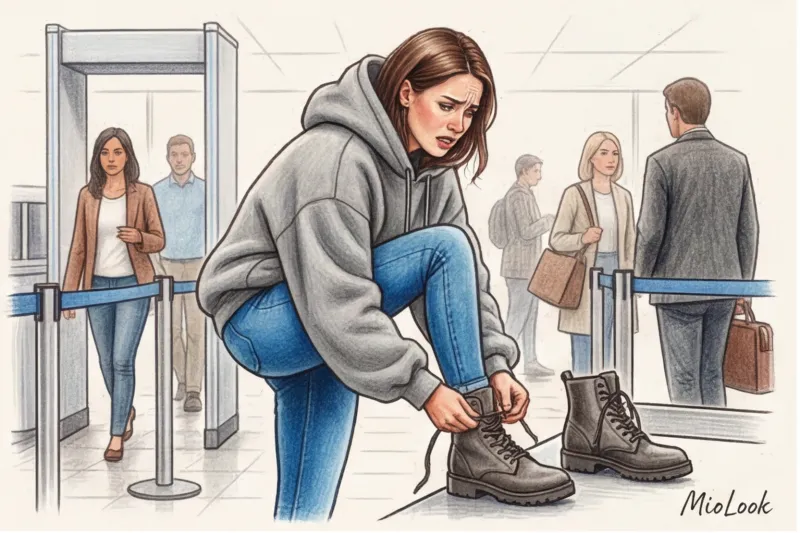
Complicated lacing or high boots are guaranteed to create a nervous queue behind you at the metal detector when security asks you to take them off.
Ideal choice: Recycled mesh sneakers that are half a size larger than your usual size or soft suede slip-ons. Shoes should be put on hands-free.
Mistake #5: Shorts, crop tops, and excessive skin exposure
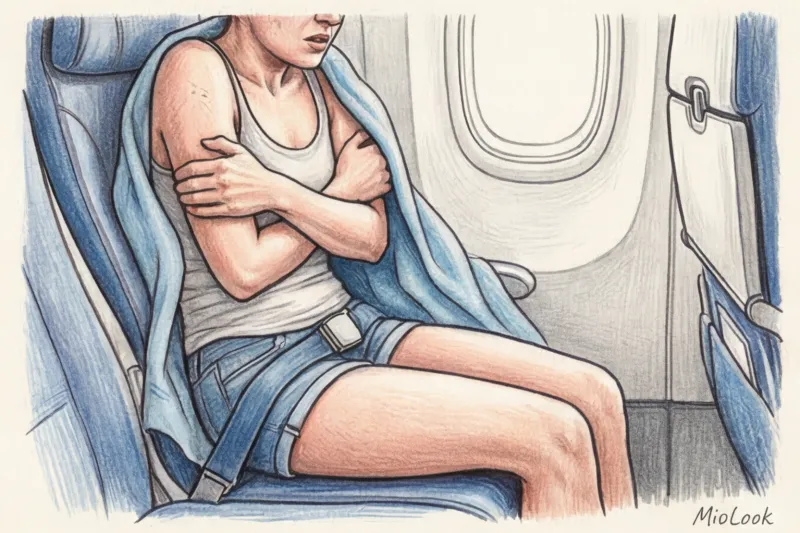
The aircraft's microclimate is unpredictable, but most often, the air conditioning systems operate in active cooling mode to minimize passenger motion sickness. Flying in shorts and a T-shirt means condemning yourself to three hours of shivering under a thin (and not always fresh) airline blanket.
But the main reason to avoid revealing clothing is textile hygiene. Airplane seats are upholstered with porous, wear-resistant fabrics that are only superficially cleaned. According to microbiological studies, armrests and seats harbor a significant number of bacteria. Your clothing should serve as a reliable barrier between your skin and the public space.
Protection formula: The "covered knees and shoulders" rule. For a base layer, choose long sleeves made of organic cotton with a weight of at least 180 g/m² or bamboo fiber. They breathe, protect the skin, and look appropriate in any business lounge.
Your perfect wardrobe starts here.
Join thousands of users who look flawless every day with the smart wardrobe organization of MioLook.
Get access — €0.99 onceMistake #6: Chunky metal jewelry and stiff belts
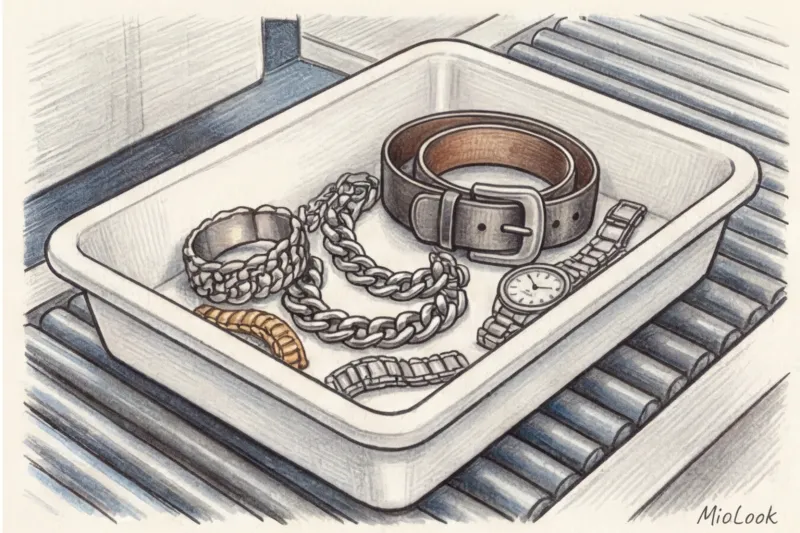
This is where logistics and physiology collide. Firstly, chunky bracelets, necklaces, and watches with metal links will jingle on every ring. Taking them off and putting them on in a hurry is a sure way to lose your favorite jewelry.
Secondly, a hard leather belt with a large buckle will inevitably dig into your stomach when sitting at a 90-degree angle for a long time, disrupting digestion and causing pain. Tight rings, coupled with swollen fingers, can become a real pitfall—in my experience, a client had to ask the flight attendants for ice to remove her wedding ring, which had become pinched.
Life hack from a stylist: I always put all my jewelry in a special soft organizer inside my carry-on bag. I put it on in the taxi or before exiting the arrivals terminal. And instead of hard belts, I choose trousers with a soft drawstring or elastic waistband.
Mistake #7: Light-colored trousers made of 100% linen or viscose
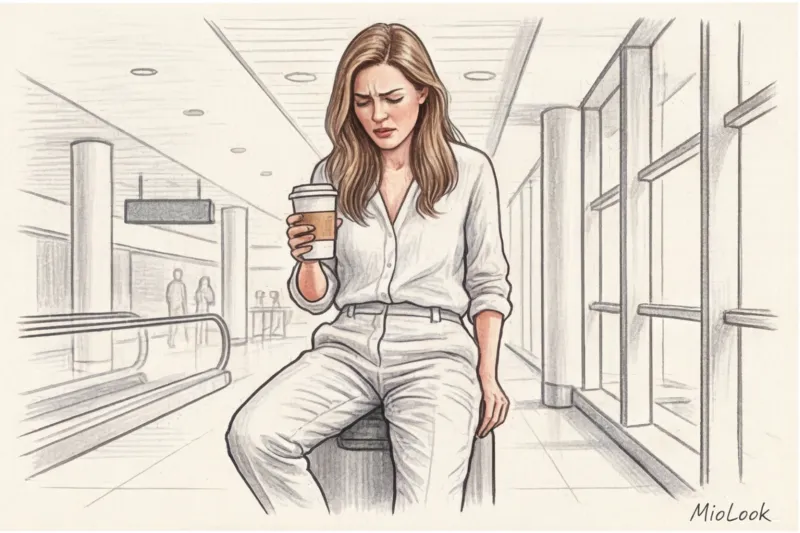
The Jet-Set Chic aesthetic is often associated with white linen suits. But in reality, 100% linen looks luxurious right up until you sit down. Linen has a critically low wrinkle index.
After just an hour of flying, deep, sharp creases will form in the groin area and behind the knees, making your look untidy. Furthermore, light-colored bottoms on a plane are a magnet for trouble. Turbulence and a neighbor's spilled tomato juice will leave your white trousers no chance.
"How do you test an item before buying it? Squeeze the fabric in your fist for 10 seconds. If it's still wrinkled after you release it, the item isn't suitable for flying."
What fabrics look expensive and don't wrinkle: Blended fabrics. Wool with added silk (providing a subtle sheen and durability), dense Milano knit, which maintains its shape thanks to a special weave, or high-quality modal.
What you absolutely shouldn't wear on a plane: the ultimate checklist
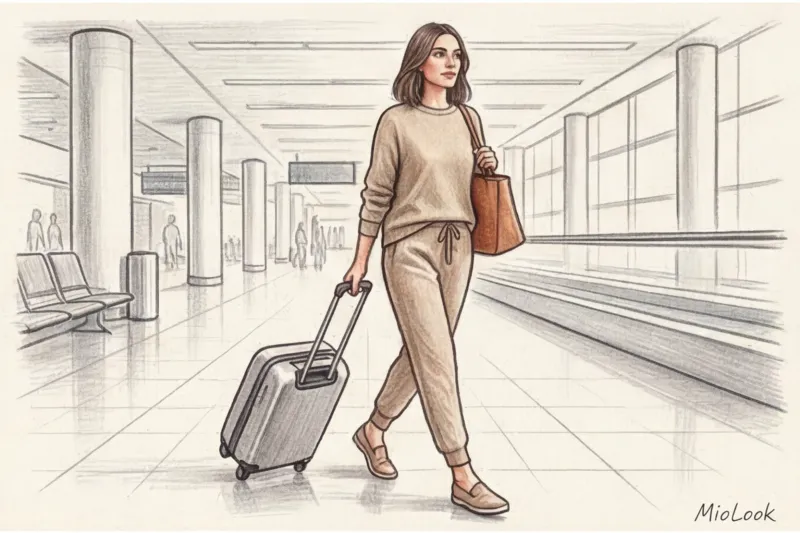
A smart wardrobe isn't about restrictions, it's about anticipating problems. As a sustainable stylist, I always encourage conscious investing in your travel capsule. Buy pieces that will work for you, not against you.
Let's consolidate what should be abandoned forever:
- Cheap polyester fleece (static and odor).
- Skinny jeans and tight belts (impaired circulation).
- Complex overalls (inability to visit the restroom normally).
- Shoes with laces and heels (swelling and problems during inspection).
- Ultra-short items (cold and contact with bacteria).
- 100% linen for trousers (looks untidy after an hour).
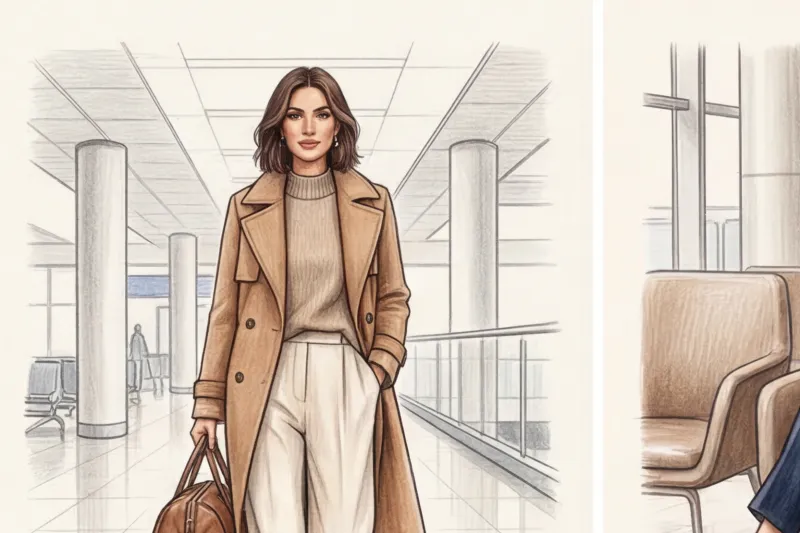
Your formula for the perfect look: A breathable base layer made of thick cotton + a loose second layer (like a cashmere cardigan) + soft bottoms without a stiff waistband + slip-on shoes half a size larger. And remember: travel style isn't measured by the height of your heels, but by how fresh and confident you look when you step out of the terminal after a long flight.