What to Wear on a Plane: The Anatomy of the Ideal Look and the 10,000-Meter Rule
Do you know which place on the planet has the most merciless and unpredictable climate? No, it's not the Sahara Desert or the tropical jungle. It's the airport transit zone and the airplane cabin at 10,000 meters. After 12 years as a fashion journalist and endless flights between fashion weeks in Paris, Milan, and New York, I've learned one ironclad rule: your comfort in the sky begins when you pack your suitcase.

So the question is, What to wear on a plane Traveling has long ceased to be a mere stylistic issue. It's a matter of physical well-being, psychological comfort, and even your safety. Let's explore the anatomy of the ideal travel wardrobe, one that will keep you safe on a hot ramp or under a freezing air conditioner.
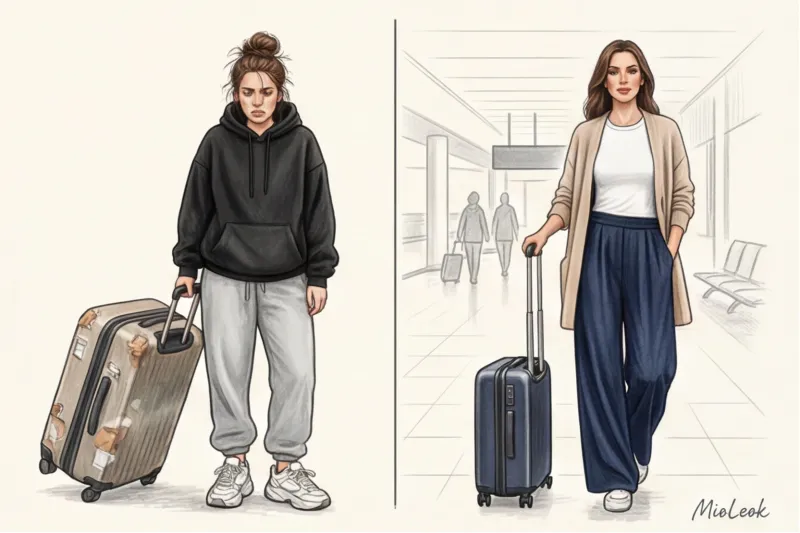
It's fascinating to observe how radically travelers' uniforms have changed. In the 1960s, the "golden age of aviation," flying was considered a luxurious experience. Women boarded Pan Am in formal tweed suits, hats, and stiletto heels, while men wore perfectly tailored two-piece suits. Then the pendulum swung back: the 2010s ushered in the era of athleisure Airports were filled with shapeless gray sweatpants, stretched-out hoodies, and Ugg boots. It seemed the world had decided that it could completely sacrifice aesthetics for comfort.
Today we are witnessing a long-awaited return to balance – aesthetics Jet-Set Chic It's a style that combines the visual sophistication of business class with the tactile comfort of pajamas. And herein lies the main catch: why can't you just put on your favorite loungewear and head out on your flight?
The answer lies in psychology and the boundaries of appropriateness. Loungewear (especially revealing pajama sets or washed-out sweatpants) blurs the line between private and public space. In psychology, there's a term enclothed cognition (dressed cognition) is how clothing influences our cognitive processes. A relaxed, sloppy appearance makes us feel sluggish, ruins our posture, and conveys a corresponding attitude to others (including airline staff). Airports are powerful networking hubs. You never know if you'll meet a future business partner or employer in the boarding line.
"The airport is not a branch of your bedroom. When choosing clothes for a flight, we must respect both our own bodies and the public space we find ourselves in."
But the main reason to ditch the casual items is the concept of the "microclimate" beneath your clothing. The physics of flight are harsh. According to aerospace medical associations, cabin humidity at cruising altitude drops to 10-20% (for comparison, in the Sahara Desert it's around 25%). Added to this are extreme temperature fluctuations.
I had a telling case in my practice. One of my clients, a top manager, once fell victim to a popular Instagram trend. She bought a thick, brushed synthetic fleece suit for a connecting flight in Dubai. She was comfortable in the cabin, but when she stepped onto the scorching ramp, where the temperature reached 42°C, the synthetic fabric instantly acted like a greenhouse. She ended up fainting and suffering from heatstroke right there on the bus. This incident forever taught us both not to ignore fabric composition.
The Three Layer Rule for Travelers

To cope with temperature changes with ease, professional travelers use the mountaineering "three-layer rule" adapted for urban conditions.
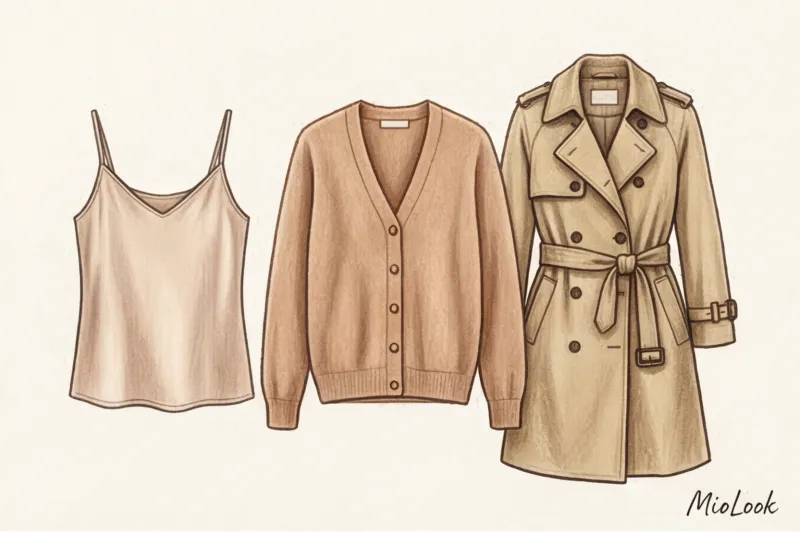
Base layer: moisture-wicking. This is where the most common mistake lies. Most people believe that 100% cotton is the best choice for the body. In fact, cotton is a traveler's worst enemy. It instantly absorbs moisture (for example, when you're running to the gate with your suitcase), but doesn't release it at all. The moment you sit down in a chair under a blast of air conditioning in a damp cotton T-shirt, a cold is guaranteed. The ideal base is modern blended fabrics (lyocell, cupro, modal) or the finest merino wool (15-18 microns thick). They act like a thermostat, wicking away moisture and retaining dry warmth.
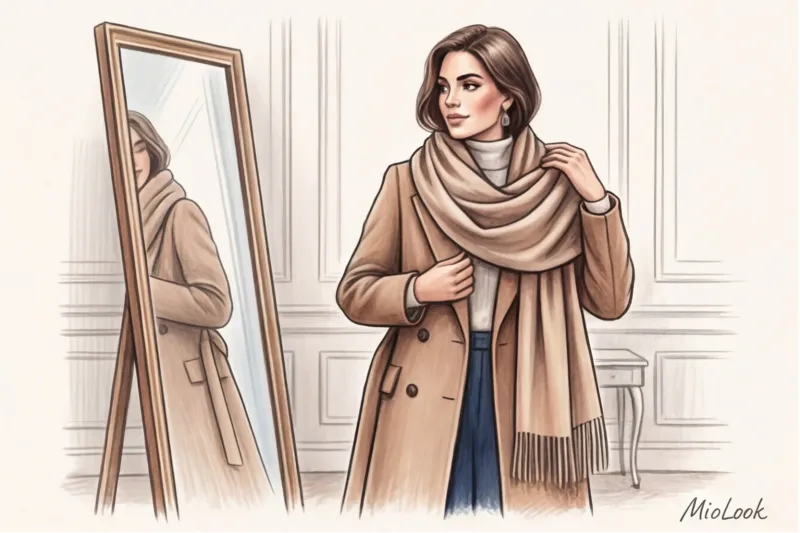
Insulating layer: flexible structure. Forget stiff jackets with shoulder pads—they'll make sleeping in a chair a nightmare. Opt for voluminous plain-knit cardigans, loose, unlined knit blazers, or wide cashmere-blend stoles. A quality cardigan will cost around €150-250, but it's a long-term investment that translates into dozens of comfortable flights. By the way, if you're traveling on business, add an accent accessory to your base layer—it'll instantly pull together a relaxed look. I wrote more about how this works in my article about silk scarf in business style.
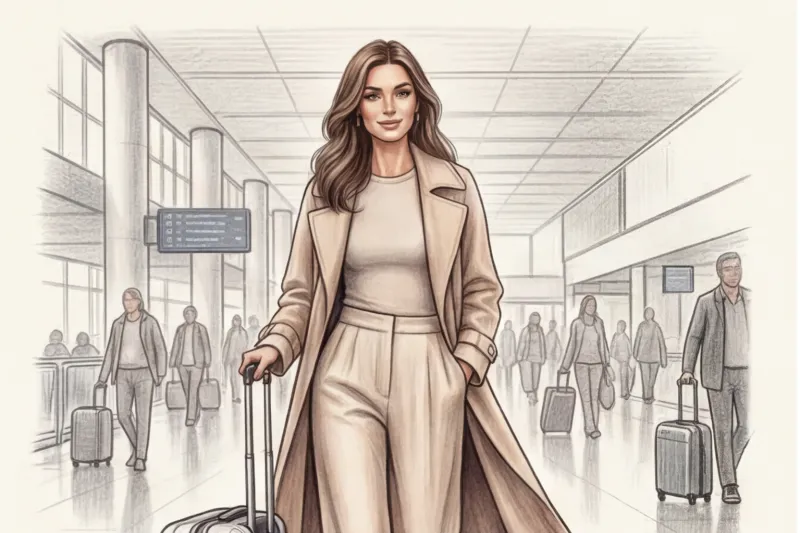
Top layer: armor and blanket. The final touch is a lightweight trench coat (such as flowing gabardine) or a soft robe-style coat. The main requirement for the outer layer is that it shouldn't restrict the shoulders. Such a coat is easy to remove before security, won't wrinkle in the overhead compartment, and can be used as a cover-up on an overnight flight if the flight attendants don't have enough blankets for you.
To avoid having to puzzle over the compatibility of these layers at 3 a.m. before leaving for the terminal, I always pack my travel capsule in advance. MioLook The app lets you photograph items and visualize how a basic long sleeve top will look with a cardigan and trench coat, ensuring all the pieces work together perfectly before you even open your suitcase.
From business class to low-cost airlines: how to dress stylishly and with class
Aviation is one of the most conservative industries, where visual assessment of a passenger occurs in a split second. According to a study by Airfarewatchdog, over 60% of flight attendants admit that a traveler's appearance directly impacts the level of service they receive. And this is where style comes into play. Smart Casual — the real diplomatic language of international airports.
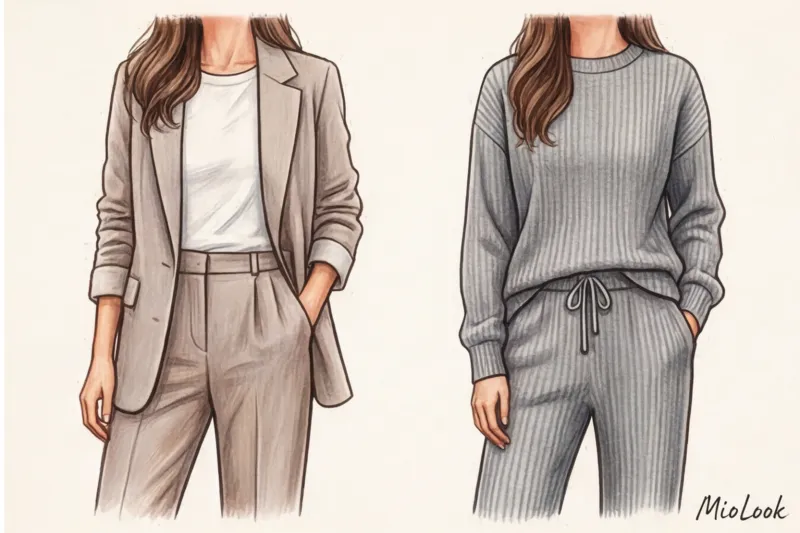
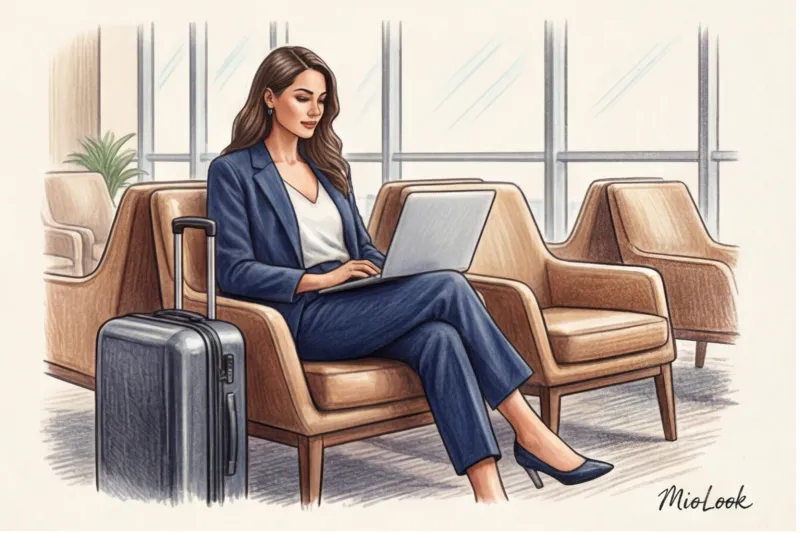
Why this? It's the perfect balance between the relaxed look needed for hours of sitting in a chair and the poised, status-defying presence. Forget about formal three-piece suits or, conversely, plush sweatpants. The transatlantic smart casual formula is built on soft tailoring: loose palazzo pants in a thick, flowing knit, a basic cotton T-shirt, and a deconstructed jacket without stiff shoulder pads. Choose deep, refined shades: navy blue, chocolate brown, graphite, or burgundy. It'll look like you're flying to sign a contract, but feel completely comfortable.
If you plan to spend time in a business lounge before your flight, your appearance becomes a kind of pass. Many travelers forget that premium lounges have a strict, though not always publicized, dress code. For example, in the official lounge access rules Emirates And British Airways The ban on beachwear and overtly sporty clothing is clearly stated.
You will be politely but firmly turned away at the entrance if you are:
- Rubber flip-flops or open beach shoes;
- Ultra-short shorts (even if they are expensive denim);
- Sports bra as a standalone top;
- Clothing with provocative or offensive prints.
Lounge hosts are required to maintain an atmosphere of exclusivity, and your attire should not disrupt the visual comfort of other guests.

Now for the most intriguing question: does clothing affect your chances of getting that coveted upgrade to business class? As a journalist, I frequently speak with crews at leading European airlines. Their verdict is unanimous: when overbooking occurs in economy class, check-in representatives look for candidates for an upgrade. And they will never upgrade someone wearing wrinkled sweatpants or shorts with a Hawaiian shirt to business class, so as not to embarrass passengers who paid 4,000 euros for the ticket.
"We always scan the crowd at the gate. If we need to upgrade someone to first or business class, we look for a passenger who looks like they've already purchased a ticket. It's an unspoken rule of aviation," a flight attendant I know at a major European carrier told me.
I had a telling example in my styling practice. One of my clients was flying from Frankfurt to New York on a packed flight. She was wearing an impeccable monochrome look: flowing camel-colored trousers, a thin cashmere sweater in the same color, and soft leather loafers. Nothing flashy or luxurious, just refined texture and a perfect fit. It was she who was approached by a gate agent who offered her a complimentary upgrade to business class, remarking that her look perfectly matched the airline's aesthetic. This incident is the best proof that elegance in travel literally pays off.
Access to MioLook for €0.99 — one-time payment
A smart AI stylist will create the perfect look for your next flight, taking into account Smart Casual rules.
Get access — €0.99 onceAnti-trends on board: what you should absolutely not wear on a flight
Social media has conditioned us to a certain visual standard for travel, which often shatters the harsh reality at 10,000 meters. What looks perfect on camera before takeoff can turn into a real disaster in the cramped cabin. Let's explore the main mistakes in choosing flight wardrobes, which are rarely covered in glossy magazines.
Let's start with the main fashion myth - the perfect travel jumpsuit Whether it's a relaxed cotton romper or an elegant silk option, this is the worst choice you can make. Why? The answer lies in the dimensions of the airplane restroom. When removing the jumpsuit, you'll have to physically hold the entire top of the garment with your hands or chin, frantically ensuring that the sleeves or wide legs don't touch the dubiously clean floor. This is completely unnecessary stress, easily avoided by choosing a knitted two-piece.
The second, much more serious problem is skinny jeans and tough leather belts This isn't just a matter of aesthetics, but of medical safety. As vascular surgeons note, sitting for long periods at a 90-degree angle in tight, non-stretchy denim is critically dangerous. A stiff waistband and rough seams act like a tourniquet, compressing the iliac vein in the groin and impairing pelvic circulation. This greatly increases the risk of developing DVT (deep vein thrombosis). Save the rigid garments for city walks, and wear straight-leg trousers with a soft, elastic drawstring for a flight.

It is also worth declaring a strict moratorium on massive metal decorations and complex fittings Cargo pants with numerous zippers, heavy multi-layered chains, large buckles, and cuff bracelets are guaranteed to cause you problems. Firstly, you'll cause an annoying delay at security. Secondly, after three to four hours of flight, these items will begin to mercilessly dig into your body whenever you try to shift position. Any item that can't be removed in two seconds should be thrown in your luggage.
"Even the most expensive outfit loses its luster if a passenger can't relax in their seat. Your comfort is the foundation of your confidence, and physical discomfort is always perceived by others as nervousness."
And finally, my favorite counterintuitive insight: You often hear advice to invest in light cashmere suit For flights. The price of such a set from premium brands can easily reach 2,000–3,000 euros. However, this is an extremely poor investment. The reason is not only the obvious risk: sudden turbulence and spilled tomato juice will instantly destroy the item.
The main problem lies in the physics of the materials. Even the finest premium cashmere is completely unable to withstand harsh mechanical stress. A stiff nylon seatbelt, tightly fastened during takeoff, landing, and turbulence, acts as an abrasive. A single transatlantic flight can cause persistent abrasions and pilling where the belt rubs against the cashmere, which cannot be removed without damaging the fiber's structure. For an insulating layer, it's better to choose dense, highly twisted merino wool—it's much more resistant to abrasion.
To avoid such packing mistakes, I recommend planning your outfits in advance. For example, by uploading your items to an app. MioLook You can create a separate virtual "On the Road" capsule, consciously excluding potentially dangerous or impractical items. This saves time before departure and ensures that your look is not only stylish but also truly safe.
Flight Shoes: Balancing Comfort and Dress Code
According to the Aerospace Medical Association (AsMA), at 10,000 meters, our bodies are subject to specific physiological stress. The combination of artificially maintained low cabin pressure (equivalent to an altitude of 1,800–2,400 meters above sea level) and the simple effects of gravity during prolonged sitting inevitably leads to fluid accumulation in the lower extremities. In medicine, this process is known as dependent edema. When choosing what to wear on a plane, many travelers ignore this fact, and pay the price in discomfort.
By the time you board a medium-haul flight, your feet may have increased in size by 5-7%, which is equivalent to going up half a size. That's why the biggest mistake is wearing new, stiff, or too-tight shoes to the airport. Leave your narrow, tanned leather Chelsea boots and favorite pumps in your luggage.

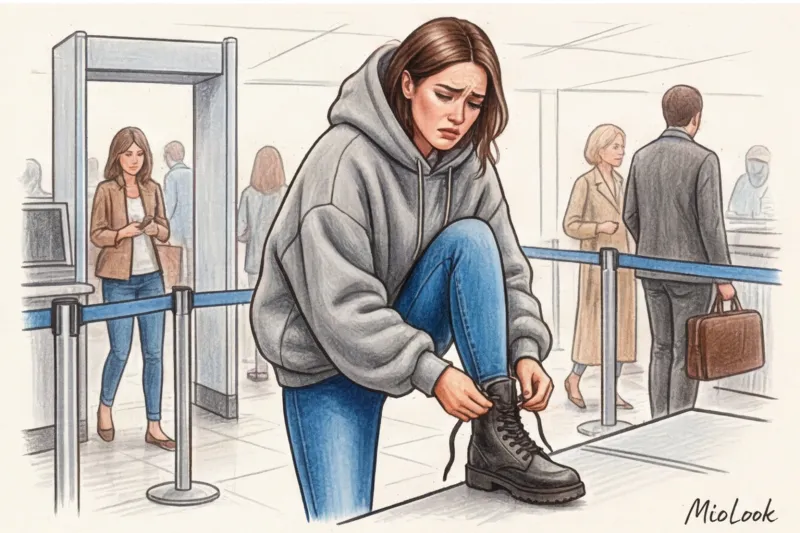
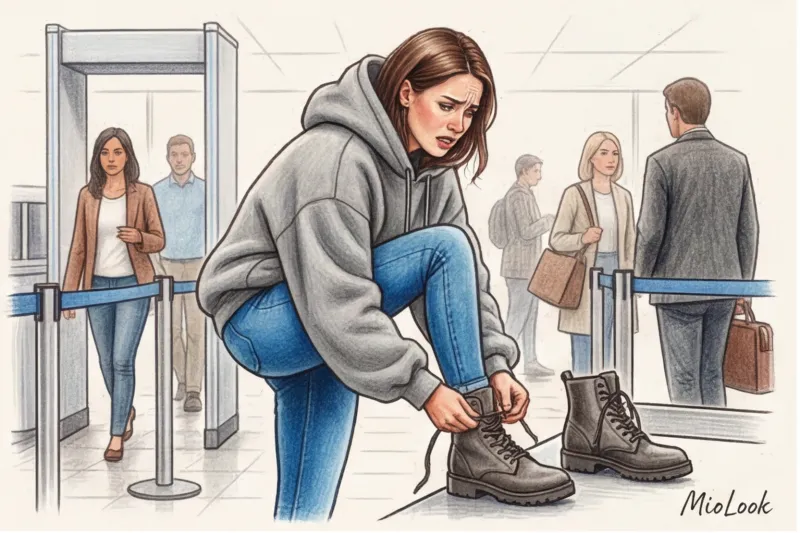
This is where the golden rule of experienced jetsetters comes into play: the "slip-on" concept. I strongly recommend avoiding complicated lacing, numerous metal buckles, and high boots. High lace-up boots will not only make you fuss around the plastic trays at security, but will also lock your ankles tightly during the flight. It's precisely the micro-movements of your joints that help circulate blood. Furthermore, a tight, high boot shaft acts like a tourniquet, exacerbating swelling. Slip-on boots, on the other hand, allow you to discreetly remove your shoes while seated, giving your feet the freedom they need.
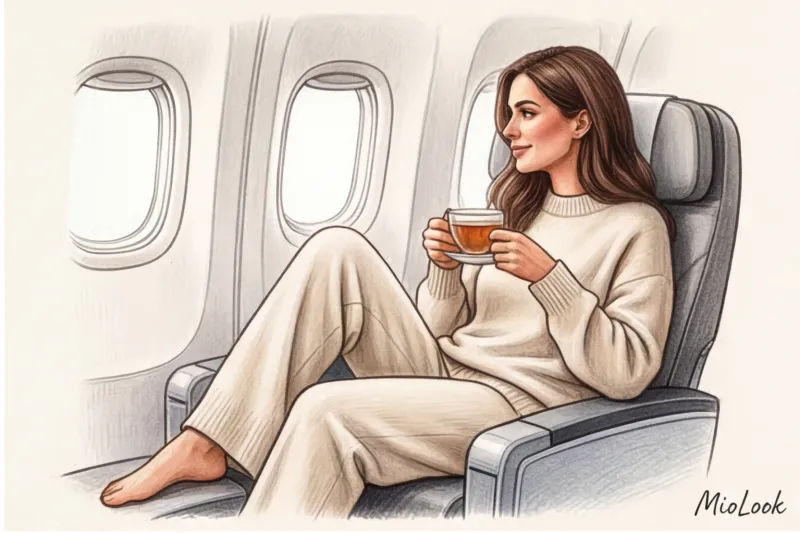
However, there's a subtle point of etiquette here that's often overlooked. Removing your shoes in the cabin and remaining barefoot or in thin, see-through slippers is absolute bad manners, infringing on the privacy of your fellow passengers. My practical advice: always pack a pair of thick, bulky merino wool or cashmere socks in your carry-on. As soon as the "Fasten your seat belts" sign goes out, swap your street shoes for these socks. This keeps your feet warm (after all, the temperature near the floor on the plane is always cooler), provides comfort, and looks neat.
Considering that modern terminals are huge, and the walk to the gate can take up to two kilometers on hard porcelain stoneware, I've compiled a list of the best travel shoes that balance cushioning, comfort, and dress code:
- Loafers made of soft suede (no hard lining). A clear favorite. Suede, unlike smooth leather, is flexible and easily adapts to the growing volume of the foot. Loro Piana-style models (the original will cost around €800-€900, but Massimo Dutti has excellent similar options for €100) look classy and fit seamlessly into a smart-casual aesthetic.
- Slip-ons and closed-toe mules. An ideal option for warmer climates, models with a cork orthopedic insole, like the Birkenstock Boston, have long been the unofficial uniform of fashion editors in terminals thanks to their anatomical arch support.
- Minimalist sneakers. If you prefer a more sporty look, choose leather sneakers in basic shades without any embellishments. To ensure slip-on style, replace regular laces with elastic (silicone) ones—they'll allow you to slip them on like slippers, using only a shoehorn.

Compression stockings as a style statement
For a long time, compression hosiery was associated exclusively with post-operative care or pharmacy items, appearing, frankly, utilitarian. Today, it's a must-have for anyone concerned about their health while traveling. To prevent DVT (deep vein thrombosis), phlebologists strongly recommend wearing compression class I socks—15–20 mmHg—during flights.
Their secret is in the graduated pressure: it is highest in the ankle area and gradually decreases towards the calf, literally helping the veins push blood upward, overcoming gravity, while your muscles are at rest.
How to integrate this medical accessory into a stylish look? Modern brands have revolutionized design. Premium brands like Falke or Item m6, as well as niche brands like Comrad, produce compression garments that are visually indistinguishable from trendy ribbed socks or thick matte tights. A quality pair costs between 30 and 60 euros.
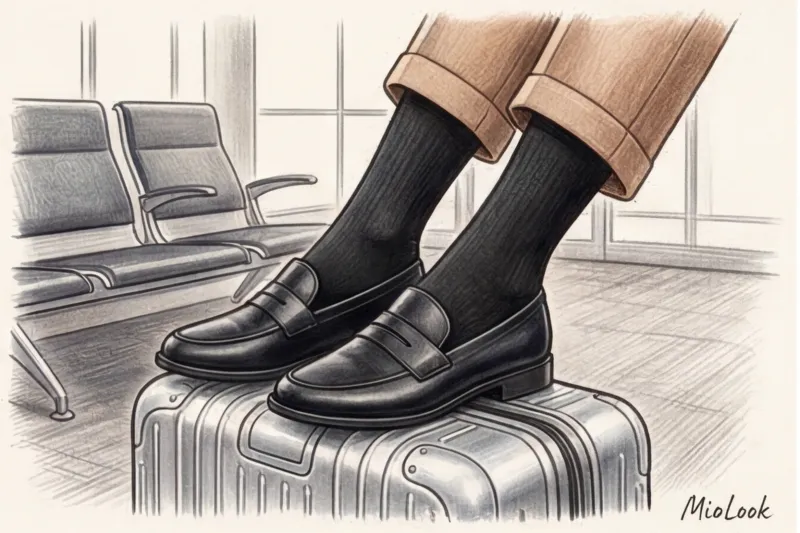
If you're flying in cropped, wide-leg pants, black sleek compression socks paired with loafers will create a neat, put-together silhouette without drawing too much attention. For a more relaxed look, pair joggers with white socks with contrasting sporty stripes—they'll look like classic tennis socks. MioLook It does a great job of selecting such unconventional combinations, helping you plan and assemble a harmonious flight capsule in advance. The main rule: put on compression stockings at home or in your hotel room, only before your legs start to swell.
Try MioLook
for free
Start creating perfect images with the help of artificial intelligence
Get access — €0.99 onceCarry-on Luggage Capsule: Creating a Transformable Look
According to IATA (International Air Transport Association) statistics for 2023, over 45% of passengers on short- and medium-haul flights travel exclusively with carry-on baggage. With airlines' strict restrictions, your travel attire can no longer be simply "comfortable, one-time wear." It's a mathematical constant of your vacation capsule, its most important and functional element.
I always apply a harsh approach to airport looks. "rule of three" If the item you plan to wear on a flight doesn't match at least three other items in your suitcase, it doesn't belong on board. Your outfit should be a complete part of your wardrobe, not a standalone ensemble.

Let's break down the perfect formula, inspired by Donna Karan's "Seven Easy Pieces" concept, but adapted for today's jet-setters. The foolproof base looks like this: knit midi dress + soft deconstructed jacket + basic loafers.
What's so brilliant about this combination? Imagine arriving in Paris or Rome at 5:00 PM. There's no time to get ready. You simply leave your bags in your room, grab your elegant heeled slingbacks from your carry-on, swap your daytime tote for a micro bag, freshen up your lipstick—and in 15 minutes you're ready for dinner at the brasserie. A soft jacket (without stiff shoulder pads, made of thick jersey or wool crepe) won't wrinkle in the airplane seat, but will add just the right amount of formality to a knit dress in the evening.
The art of carrying heavy things
This is where the most important rule of budget travel comes into play: we put the heaviest and bulkiest items on ourselves. But how can we use this life hack effectively without compromising our style and looking like a cabbage?
The secret lies in the silhouette's architecture and the play of contrasts. If you're carrying chunky Chelsea boots with thick soles or tube boots, go for it, but be sure to balance the heavy bottoms with a flowy dress or straight, cropped trousers in a flowing fabric. A voluminous wool coat or heavy trench coat (weighing up to 1.5–2 kg, which is critical for a suitcase) doesn't need to be buttoned up. Wear them unbuttoned, creating a vertical line, or drape them elegantly over your shoulders in the duty-free area. Once in the cabin, outerwear can be neatly folded on the shelf or used as an extra layer of comfort.
Transforming Accessories: Invisible Heroes of Flight
The devil is in the details, and when traveling, accessories deserve double the price. Here are my personal top 3 transformable items that serve multiple purposes:
- Silk scarf (square 90x90 cm): On the plane, it's your elegant protection from the icy blast of air conditioning (it saves your hair better than any scarf). And upon arrival, it transforms into a top for a hot day, a bandana for the beach, or a bright accent on your bag handle.
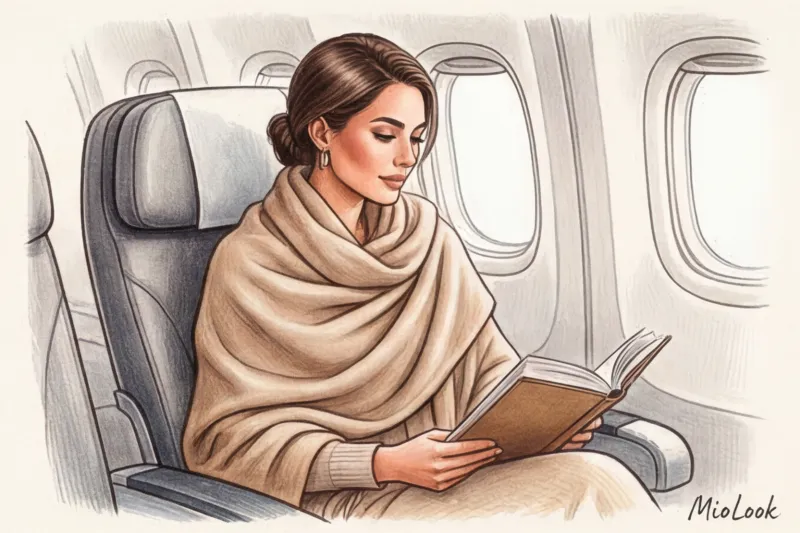
- Voluminous scarf-plaid: Choose styles made from cashmere blends or fine merino wool (a quality basic investment will cost €150–€300). On a chair, it replaces synthetic airplane blankets of dubious purity, and on a cool evening on a restaurant terrace, it works as a luxurious stole over a slip dress.
- A roomy yet structured tote: Forget shapeless fabric bags. A carry-on bag should hold its shape. Models made of thick, grained leather or high-quality canvas with leather accents look classy, fit a laptop, a makeup bag, and those dinner shoes, while still visually pulling the look together.
“To avoid having to worry about compatibility before heading to the airport, I always create a visual grid of my trip in advance. You can use smart wardrobe feature in MioLook “Just add the things you’re wearing on your flight, and the program will show you how many looks you can create with them upon arrival.”
Remember: a well-packed outfit for your flight will save you not only money on baggage fees, but also your nerves in the first hours after landing.
Features of flights of different durations
Time spent in an airplane seat is the ultimate physical stress test for any fabric. Your wardrobe strategy should change dramatically depending on whether you'll be in the air for a couple of hours or a whole night. What seems perfectly tolerable on a short flight is guaranteed to turn into torture somewhere over the Atlantic.
Short flights (up to 3 hours): the "from ship to ball" strategy
On short flights, we rarely have the luxury of stopping at a hotel to change. If you have a business meeting, lunch, or presentation right after boarding, the main goal is to exit the terminal as if you just left your office. Your appearance should convey composure.
The secret to a successful transition lies in the proper fabric architecture. Save pure linen and fine cotton for the holidays—they'll develop a network of creases even when you're fastening your belt. Your best allies on short trips:
- High-twist wool: The threads in this fabric are twisted so tightly that the material literally springs back and instantly regains its shape after sitting.
- Thick crepe or tencel: These materials drape heavily and beautifully, without holding folds at all.
- Structured jacket as "armor": Wear it with a soft long-sleeved shirt or a silk blouse. During the flight, the jacket can be neatly stowed in the overhead compartment on top of your carry-on baggage, then put back on before boarding—the crisp shoulder line will instantly tie together the relaxed silhouette.
Your ideal image begins Here
Join thousands of users who look flawless every day with MioLook.
Get access — €0.99 onceTransatlantic and overnight flights (8+ hours): Focus on recovery
When the flight timer passes the eight-hour mark, aesthetics must give way to physiology. Quality sleep and protection from the harsh, dry cabin environment become the top priorities.

For marathons in the sky, I highly recommend premium quality knitted suits Forget about the thin, mass-market viscose that hopelessly stretches out at the knees after an hour. Look for dense blends: merino wool with added cashmere or heavyweight cotton. A set of the right, shapely knitwear will cost around 150–250 euros from mid-range brands, but it's a long-term investment in your well-being.
My personal protocol for flights from Europe to the US has been honed over years of practice. To keep my face and clothes looking fresh after 10 hours in the air, I change into a silk-cashmere set right before takeoff. But the real secret lies in the accessories.
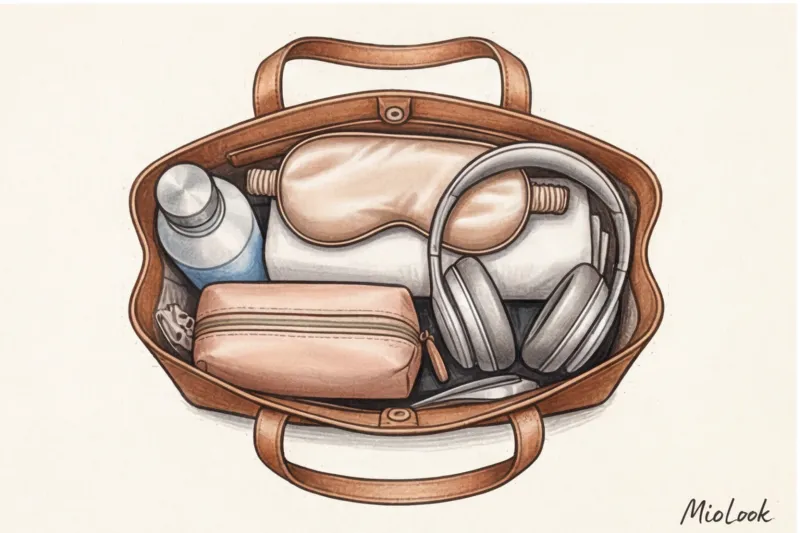
Never use synthetic sleep masks like those provided in airline amenity kits. They create a greenhouse effect, draw moisture from the skin, and cause morning puffiness. My absolute must-have is... sleep masks made of natural silk (at least 22 momme density). Smooth silk doesn't absorb your expensive skincare, prevents wrinkles on your face, and protects the delicate skin around your eyes from the extremely dry air conditioning. Forty minutes before landing, I go to the restroom, remove my knitwear, refresh my face with thermal water, and change into a fresh, urban look. The difference is enormous—you emerge into the arrivals hall feeling rested, not like a survivor.
Stylist Checklist: Final Check Before Heading to the Airport
The taxi is already waiting downstairs, your boarding pass is downloaded to your smartphone, and you're taking a final look in the mirror. When deciding what to wear on a plane, we often focus solely on aesthetics, forgetting about the biomechanics of our bodies in confined spaces. All the theory of proper layering and choosing technical fabrics is dead without a final crash test in real-world conditions. Over the years of business travel, I've developed a strict three-minute look check protocol. If my outfit fails even one step, I head to the closet to change, even at the risk of delaying the driver.
The first and most insidious stage is metal detector loop test You need to make sure your clothing doesn't contain any hidden metal parts. Once, at the Charles de Gaulle terminal, a client of mine almost missed her flight because she was wearing designer trousers with complex hidden hardware that kept the scanner from detecting. Carefully scan your appearance: check for metal underwires in bras (it's best to replace them with seamless tops or thick bralettes when traveling), chunky belt buckles, or an abundance of decorative zippers. Even your shoes—premium boots often have invisible steel insteps. The security checkpoint is like a conveyor belt, where any delay can irritate the crowd and stress you out. The right look allows you to pass security control in 40 seconds without taking off half your wardrobe.
Next up is my favorite wrinkle test , a technique I learned from the costume designers at the Paris Opera. Take the hem of your trousers, skirt, or shirt and squeeze the fabric hard in your fist for exactly 10 seconds. Release your hand. If the material remains a stiff network of creases, change it without regret. Even luxurious €800 linen palazzo pants will turn into an untidy disaster after three hours of sitting with a tight seatbelt. Ideal travel fabrics—heavy modal, tencel, cupra, and merino wool—straighten out immediately after such aggressive squeezing, returning to their original smooth texture.
The third mandatory step is "raised hands" test Stand up straight and raise your arms sharply, mimicking the movement: will you be able to comfortably stow a heavy suitcase in the overhead bin? At this point, the cut of your clothes becomes completely exposed. If your sweater rides up, revealing a strip of your stomach and underwear, if the stiff armhole of your jacket restricts your shoulder movement, and the waistband of your trousers digs mercilessly into your ribs, this outfit is absolutely not suitable for flying. Your clothes must allow for full range of motion without the need for constant tugging and adjusting.

"Travel style isn't about how you look at the check-in counter. It's about how confident you are when you walk out of the terminal in your destination city, without the urge to immediately hide from prying eyes and change."
Once you've assembled that capsule through trial and error that passes all three tests with flying colors, don't rely on memory. I always take photos of my successful airport formulas and upload them to MioLook By creating a dedicated "flight" tag in the app, you'll forever avoid the morning panic before an early flight. What's more, the algorithm will suggest how to incorporate elements of this travel uniform into your everyday outfits once you're at your vacation destination.
Compromising elegance and comfort at 10,000 meters has long ceased to be a harsh necessity. Modern fiber production technologies and a smart approach to tailoring allow us to look classy while feeling completely relaxed. Invest time in creating the right travel look, and you'll notice how the quality of your travels will improve. True self-confidence begins when you know your wardrobe is working for you, not against you.