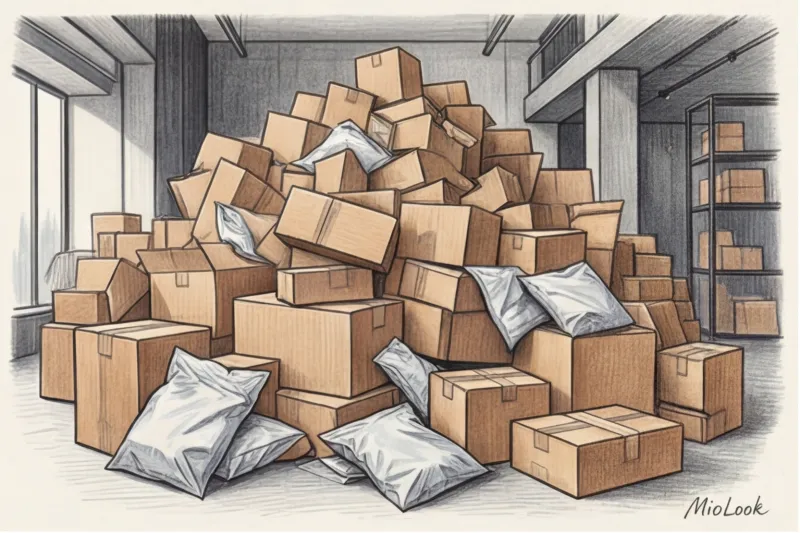
Imagine: the courier delivers the long-awaited box. You eagerly rip off the tape, unwrap the rustling tissue, and pull out a dress that looked like a second skin in the photo. You try it on—and the zipper treacherously gets stuck in the middle of your back, and the armhole cuts mercilessly into your armpits. Or, conversely, a bubble of excess fabric forms at your waist. Sound familiar? We've all been there. Around 30–40% of denim and dress items are returned to the warehouse precisely because they're the wrong size.
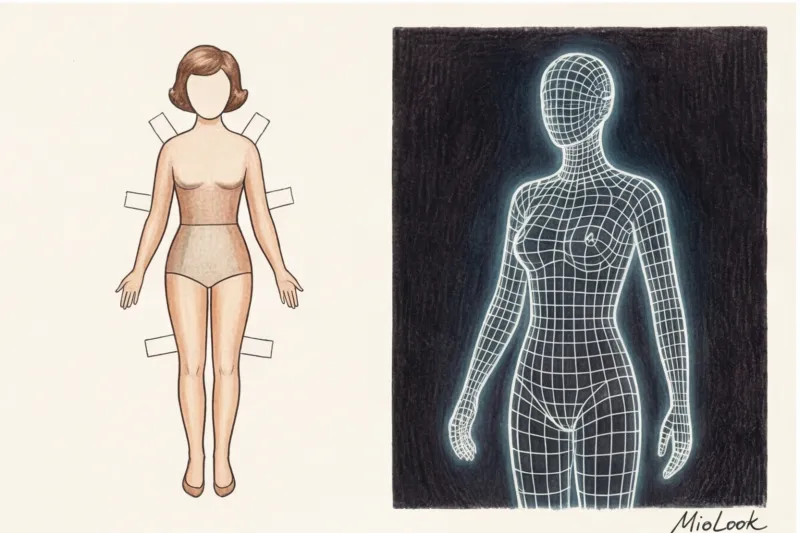
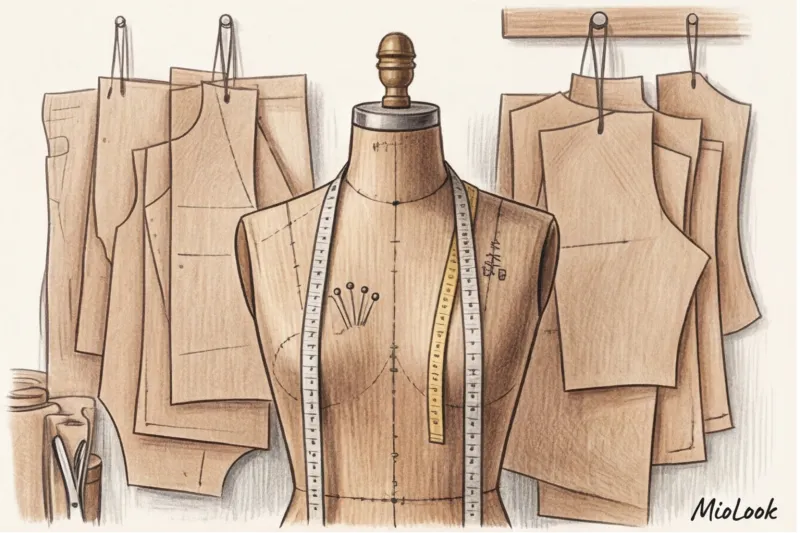
The e-commerce industry has long tried to solve this problem with the most primitive methods. We discussed the basic rules of selection in more detail in our The complete guide to online shopping without returns , but today we'll go one step further. Trying on clothes virtually online is no longer just a fun social media filter. Real AI no longer "draws" a picture—it works like a high-end tailor, calculating the physics of fabric and the 3D geometry of your body.
From "paper doll" to 3D avatar: how online virtual clothing fitting has evolved
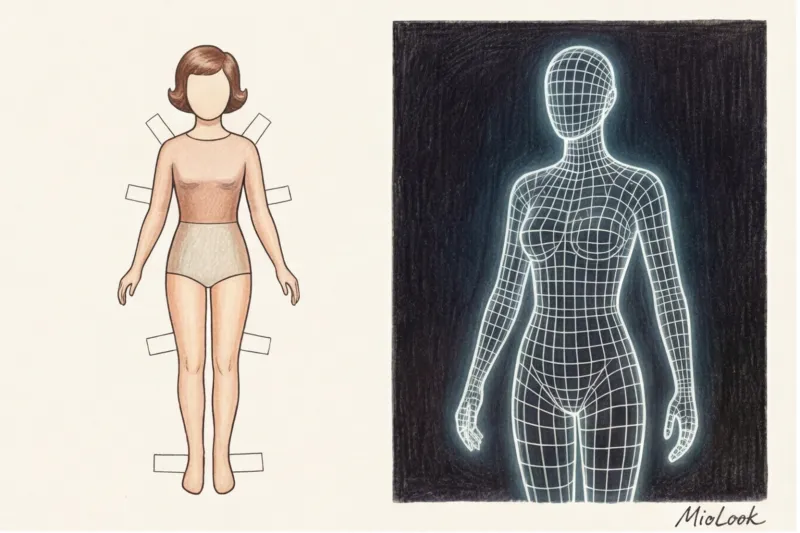
If you remember the 2000s, you probably remember those Flash games where you could "pull" different outfits onto a pixelated figurine. The concept of early virtual fitting rooms in online stores wasn't far removed from this childhood pastime. They used a 2D overlay method: you'd upload a full-face photo of yourself, and the program would simply paste a cropped image of the item over it. It looked flat, unnatural, and didn't help you figure out whether the skirt would fit your hips.
At the VivaTech technology summit in Paris a few years ago, I tested the first serious 3D scanners developed for luxury brands. It was a bulky booth the size of a small room, crammed with dozens of cameras. To obtain a digital avatar, you had to stand still, holding your breath, while lasers scanned millimeters of your body. The results were impressive, but the technology cost tens of thousands of euros and was out of reach for everyday shopping.
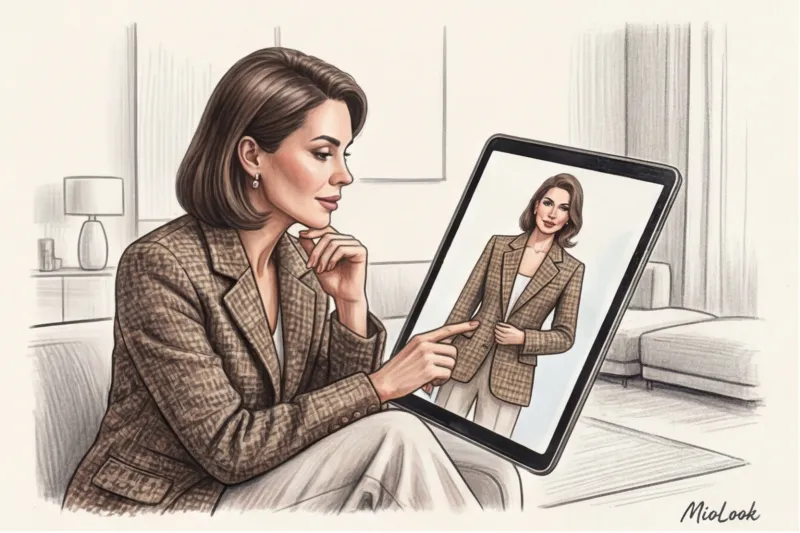
Today, this complex mathematical apparatus fits into your smartphone. Modern neural networks have learned to extract 3D data from ordinary videos or photo sequences. They create an exact parametric double of you that "lives" in virtual space and is ready to try on clothes even before they're sewn in the factory. If you're interested in how this concept applies to imaginary things, check out our article. "Digital Clothing: A Guide to Virtual Fashion".
Model Syndrome and the Fall of the Size M: Why We Keep Getting It Wrong
"I always wear M" is the most dangerous phrase in modern shopping. Over the years as a stylist, I've learned a hard and fast rule: there's no universal size chart. It's pure marketing hype.
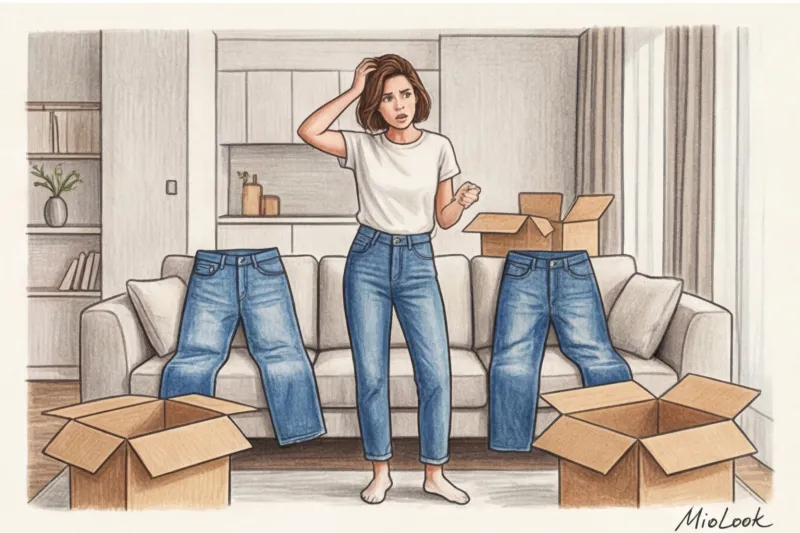
The difference in measurements for the same letter on the tag at mass-market giants is colossal. At Spanish Zara, the hip circumference for a size M might be 98 cm, while at Swedish H&M or COS, the same M would be cut to 104 cm. The difference is as much as 6 cm—that's almost one and a half full sizes! Add to this the phenomenon of vanity sizing (when brands intentionally lower the size on the tag to flatter the customer), and you understand why blind shopping is always a gamble.
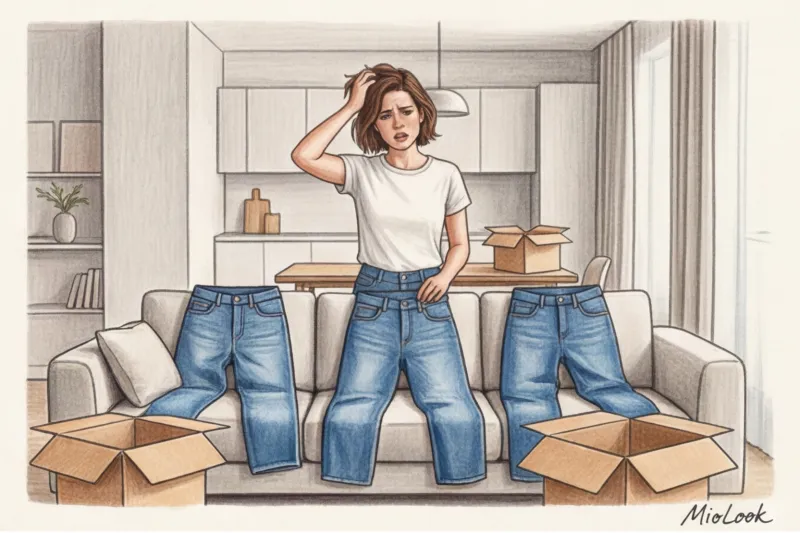
We often fall victim to "Model Syndrome." We buy not the garment itself, but the pose of a professional model, the cleverly placed studio lighting, and, let's be honest, the work of those invisible paper clips used by stylists to tuck excess fabric off a model's back during a catalog shoot.
How algorithms analyze patterns instead of tags
Smart virtual try-ons bypass marketing. When you use advanced platforms like MioLook , artificial intelligence doesn't read the size chart from the website. It analyzes grading — gradation of technical patterns of a specific factory.
AI compares your exact measurements (down to your calf circumference) with the product's technical specifications. Furthermore, machine learning algorithms aggregate return data and reviews from other customers with a similar 3D avatar. If 80% of women with your body type return this €150 jacket with the "too tight" label, the system will warn you or recommend upsizing.
Your perfect look starts here
Join thousands of users who look flawless every day with MioLook.
Get access — €0.99 onceThe Anatomy of a Digital Fitting Room: What Exactly Does the Neural Network Calculate?
To understand how AI replaces a professional tailor, you need to look under the hood of the algorithm. The program recognizes dozens of reference points on your body. It's interested not only in the basic bust-waist-hip measurements, but also in the slope of your shoulder girdle, the natural arch of your back, and the height of your hips.
Why is height often more important than weight? Two women might weigh 65 kg, but if they're 160 cm and 175 cm tall, their waistlines will be at completely different heights. If a dress is cut with a fixed waistband, the algorithm will instantly tell you whether the waistband will sit under your bust (empire style) or exactly at your natural waist.
"The most challenging task for a neural network is bust darts. A flat 2D fitting simply ignores them. Real AI calculates the depth of the dart opening to determine whether the fabric will bulge or gently contour to the volume. This is the pinnacle of parametric fitting." — Camille Durand
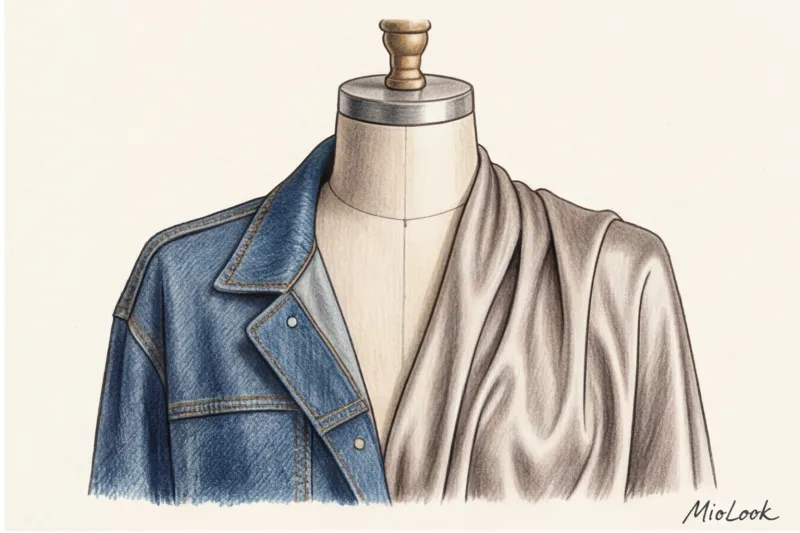
Simulated tension: from stiff denim to flowing silk
According to developers of professional clothing design software (such as CLO3D and Browzwear), the realism of virtual fittings depends 90% on fabric physics simulation. The neural network must "know" the garment's composition.
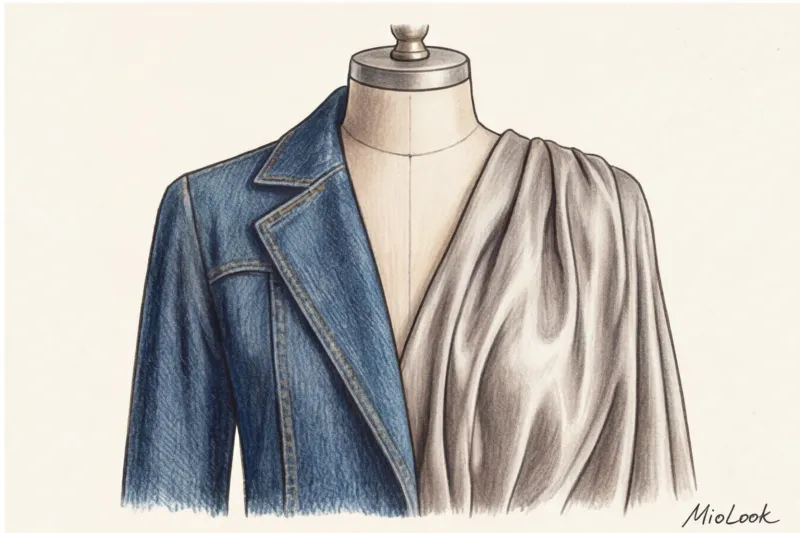
14-ounce cotton (classic stiff denim) behaves completely differently than viscose with 5% elastane. Stiff fabric creates angular creases when stretched and can visually add volume where there isn't any. Elastic fabric, on the other hand, hugs the contours. In my experience, the most complex calculations are always required for jeans fittings. The algorithm calculates not only the waist measurements but also the fabric's shrinkage, its transverse stretch, and even the thickness of the inner thigh seams.
AR Myths and Illusions: When Virtual Try-Ons Deceive You
This brings us to the main misconception. Popular AR filters on smartphones that instantly "change" your clothes through the camera are a fashion illusion. They're not a virtual try-on, but a digital makeover for your body. And it can backfire.
When an AR app superimposes a dress on you, it almost always makes you look slimmer. The program stretches the texture of the fabric over the pixels of your body, completely ignoring the thickness of the material itself, its weight, and, most importantly, gravity. In reality, a thick wool jacket will add at least 1.5 centimeters of bulk on each side simply due to the thickness of the fabric and lining. The AR filter won't show this.
A beautiful image in such an app often leads to even greater disappointment upon delivery. You expect a graceful silhouette, but instead receive a shapeless bag. How can you distinguish a professional AI fitting room from a marketing gimmick? Here's a quick checklist:
- Availability of a tension heat map: The smart fitting room shows in color the areas where the item will press on you (red) or hang loosely (green).
- Request parameters: If the app didn't ask your height and preferred fit, but immediately "put" the item on, it's a toy.
- Complex folds: Take a closer look at the armpits and groin area in the 3D model. The AI always renders realistic creases, while the AR filter leaves these areas perfectly smooth.
By the way, AI technologies work not only with clothing but also with beauty. If you're unsure about going to a salon, read our article about How to choose a haircut from a photo online.
Access to MioLook for €0.99 — one-time payment
A smart AI stylist will select the perfect look based on your actual measurements.
Get access — €0.99 onceA Shopaholic's Guide to Preparing for a Smart Try-On
I have a client, Marina. She used to order jeans between €80 and €150 consistently in three sizes (38, 40, 42) because she hated returns, but she could never get the fit of local brands right. We solved the problem in one evening by creating an exact digital avatar of her.
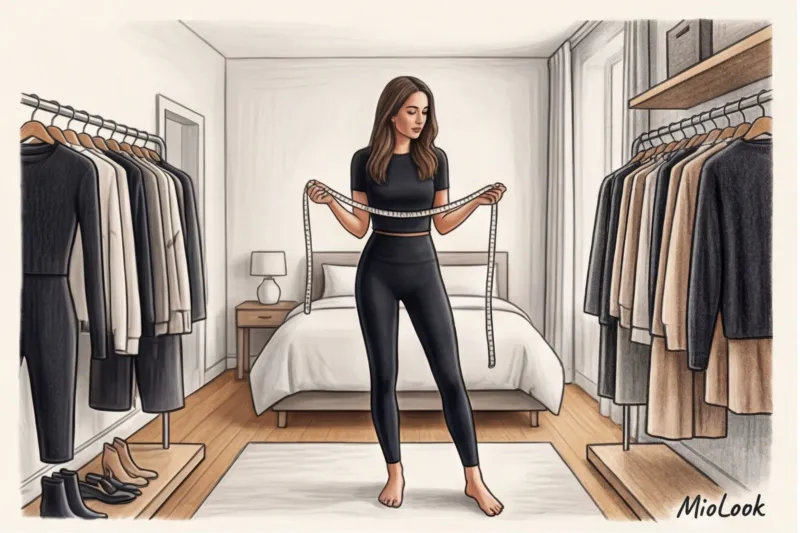
For AI math to work in your favor, you need to provide the algorithm with clean raw data. This does NOT work if you're scanning yourself in a bulky hoodie or taking measurements over jeans.
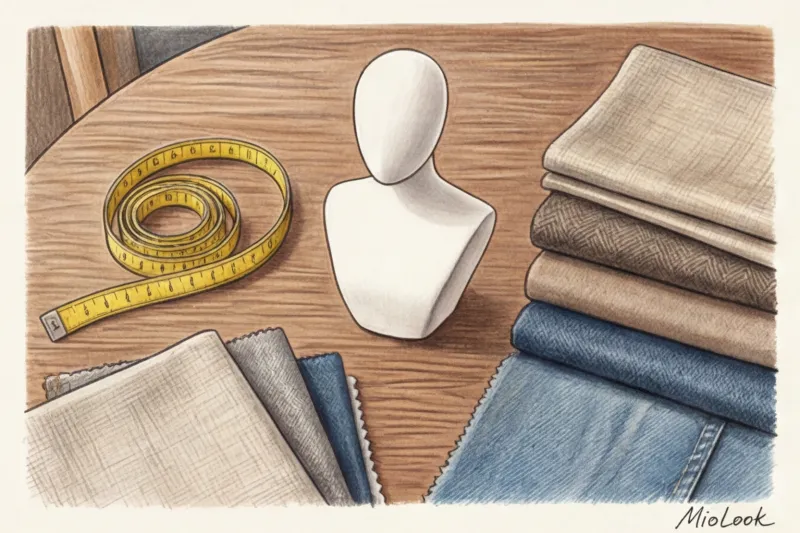
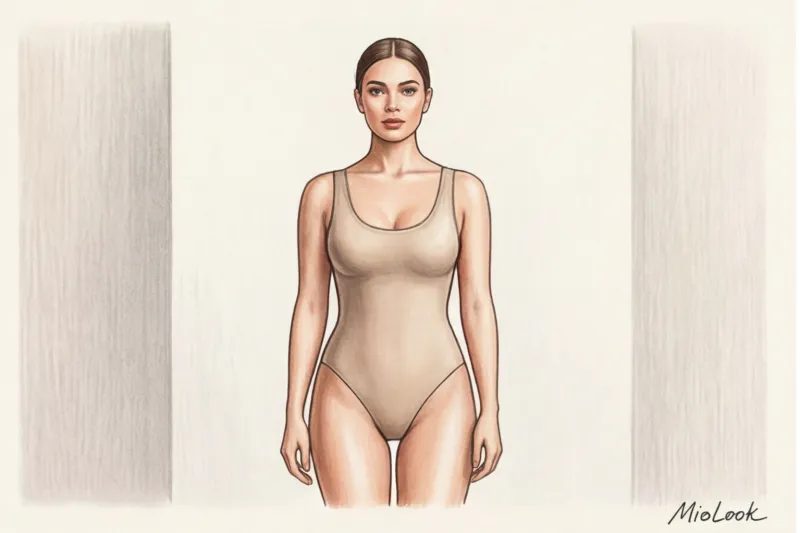
- Proper equipment: For a basic photo scan or measurements, wear the most form-fitting clothing possible. A contrasting seamless bodysuit or leggings with a top against a plain wall is ideal. The camera needs a clear silhouette.
- Honest numbers: Don't suck in your stomach. The algorithm doesn't need to flatter you; it needs to choose pants you can sit in after dinner, not just stand in front of the mirror.
- Landing settings: In professional systems (for example, when virtual try-on of clothes in the Balletcore style ) you can always indicate preferences. What the brand intended as oversize , you may want to wear it as regular Specify this, and the AI will suggest you a size smaller, ensuring that the shoulder seams don't move up toward the neck.
Ecology and the Future: Will We Forget Warehouses of Failed Purchases?
We rarely think about what happens to an item after we return it to the courier. According to a McKinsey report (2024), reverse logistics generates a colossal carbon footprint. A €50 dress that travels from the warehouse to the customer and back three times is often cheaper to dispose of than to repackage, clean, and return to the store.
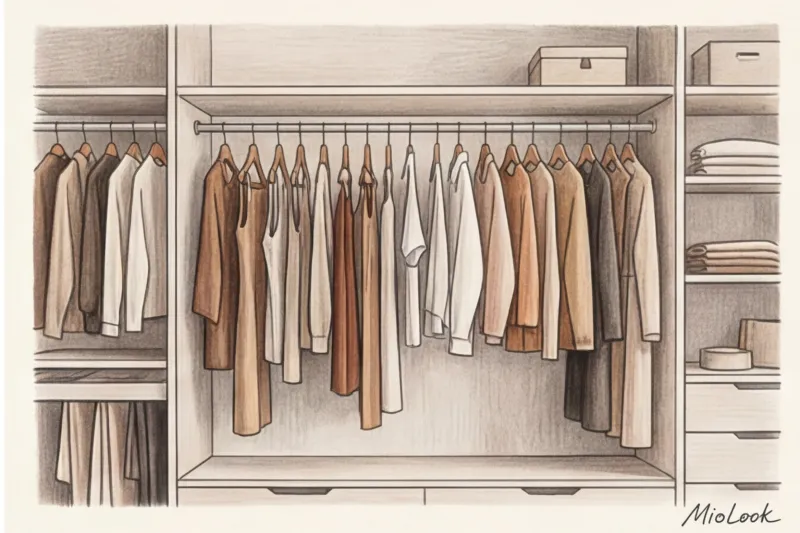
The widespread adoption of parametric AI fitting rooms is already reducing return rates by 20-25% for retailers that have integrated this technology. We are changing the very paradigm of consumption: we are starting to buy less frequently, but more accurately.
Trusting the ruthless mathematics of AI is the most reliable way to overcome "Model Syndrome." When you stop looking at the letters on the tag and start focusing on 3D geometry, your wardrobe is cleared of items that are "I'll wear them when I lose weight." Virtual fitting gives us the most important thing: the confidence that the clothes will work for us, not we for them.