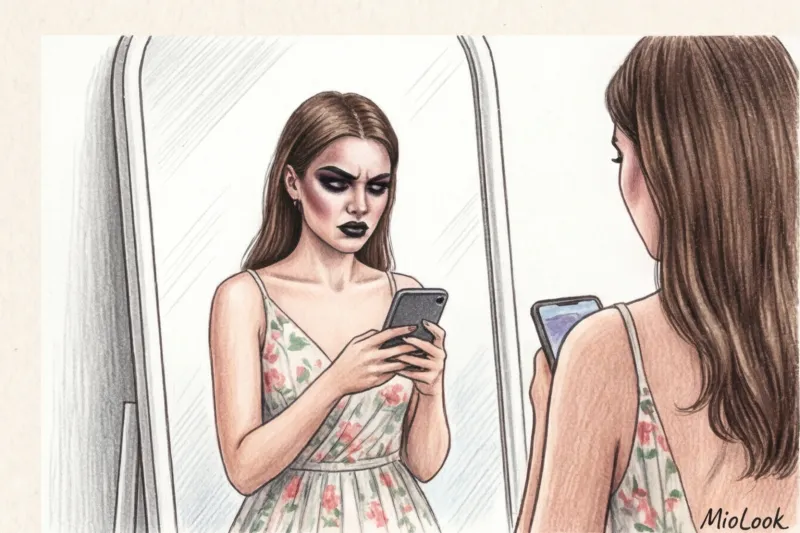
Just last week, a client excitedly showed me the results of a fashion app's design process. The request was simple: a look for a guest at a summer wedding. On the screen, a woman shone in a luxurious, impeccably fitted lace maxi dress... dazzling white. The algorithm perfectly matched the style to her body type, but completely forgot the most important rule of etiquette: don't upstage the bride.
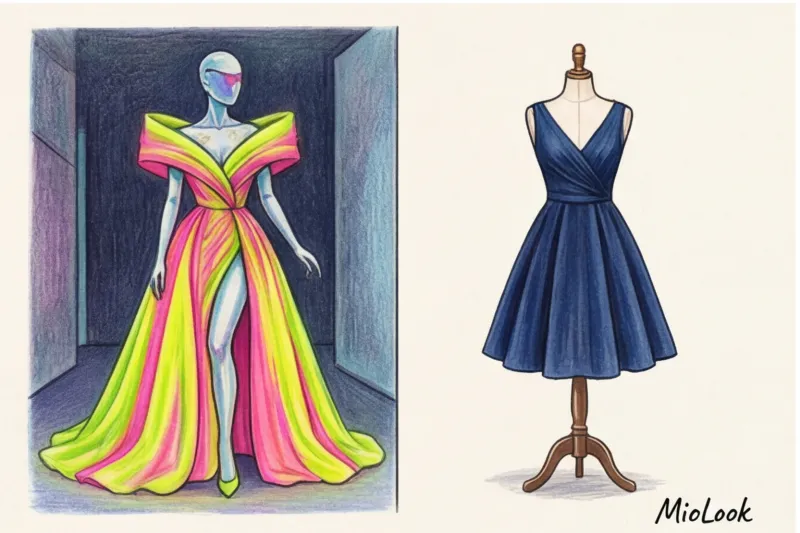
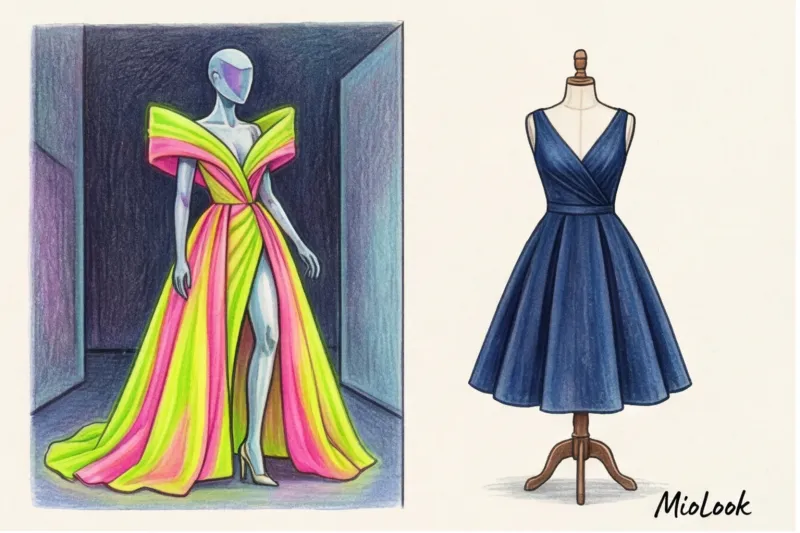
It's generally accepted that artificial intelligence will take the headache out of getting ready for an event. If you're hoping you can simply ask A neural network will help you choose an evening outfit. , and it will produce a ready-made solution without flaws—you'll be disappointed. Blindly trusting algorithms is a direct path to fashion failure. AI doesn't understand the words "sexy" or "status"; it thinks in rigid stereotypes. We discussed how algorithms recognize clothing in more detail in our The Complete Guide to AI Stylists.
As a colorist and image consultant, I constantly use neural networks in my work. But I don't view them as style oracles, but rather as obedient, if not very smart, assistants. In this article, I'll explain how to become an art director for a neural network and teach it to produce images that are appropriate, stylish, and, most importantly, wearable in real life.
Why AI Doesn't Understand the Word 'Relevance'
To control a neural network, you need to understand how it sees your clothes. Computer vision algorithms recognize shapes through so-called bounding boxes and tags. A machine sees a V-neck and a midi length, but it's completely incapable of assessing the density, elasticity, and "status" of a fabric.
For artificial intelligence, a luxurious silk slip from Max Mara and a cheap polyester shirt from a mass-market store are the same object, tagged "slip_dress." That's why a neural network might recommend wearing stiletto heels to a beach party simply because the "party" tag is tethered to the "heels" tag in its database.
Artificial intelligence is great at form, but it completely fails at context. It doesn't know that the restaurant will have dim, warm lighting, while the veranda will have a cool evening breeze.
A particular challenge for stylists is working with AI color. According to research conducted by fashion algorithm developers in 2024, approximately 70% of evening gown generations completely ignore the temperature contrast of the user's appearance. Moreover, the machine doesn't account for the phenomenon of metamerism—color distortion under artificial lighting. A dress that appears a refined, cool magenta on a smartphone screen may turn a dirty brown under the yellow lights of a restaurant. Refer to the principles of Itten's color theory when adjusting AI color suggestions: always include the color temperature and saturation in your request.
Access to MioLook for €0.99 — one-time payment
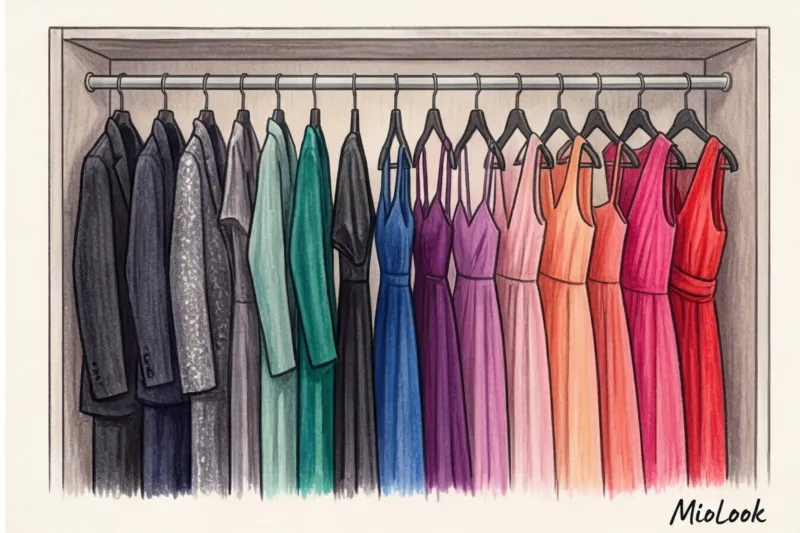
A smart AI stylist will select the perfect look from your real clothes, taking into account the context of the event.
Get access — €0.99 onceWedding: How to Escape the White Dress and Black Tailcoat
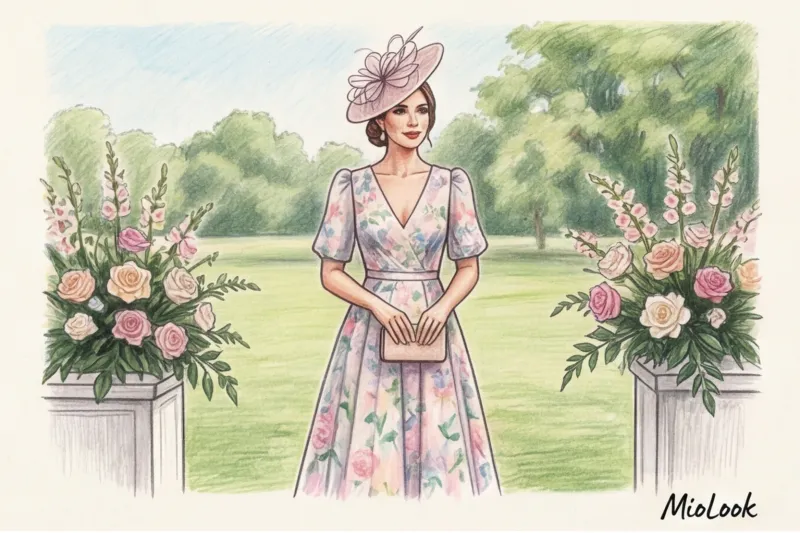
Why do algorithms obsessively suggest white dresses to wedding guests? The answer lies in the training data. Databases contain millions of wedding photos, and (surprise!) most of them are dominated by the bride's white dress. The machine draws a logical, but erroneous, conclusion: wedding = white dress.
We spent 15 minutes with the same client from the beginning of this article "saving" the proposed look. We swapped the forbidden snow-white for a sophisticated dusty rose shade, adding a matte finish to the prompt so the dress wouldn't look like a disco ball. Ultimately, we found a virtually identical style in the current COS collection, and the look turned out flawless.
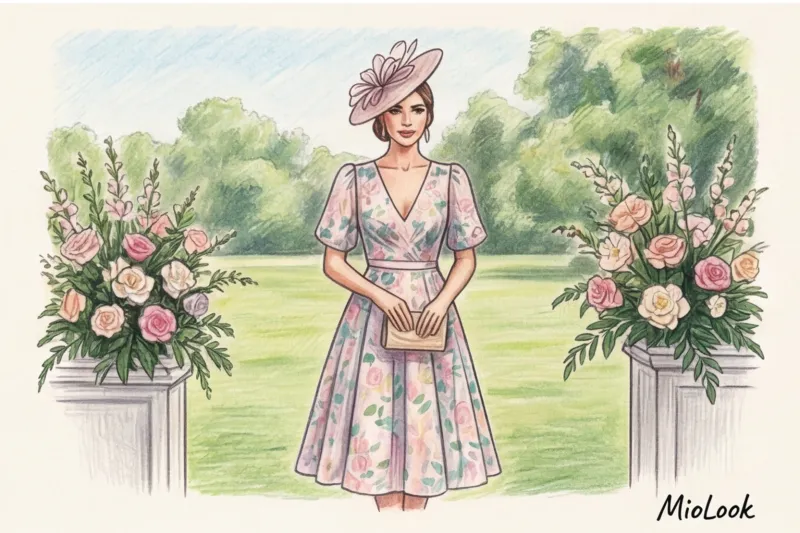
How to properly set the context for a wedding dress:
- Specify the location: "Country club in the countryside" and "classic restaurant" will yield completely different results. In the former case, ask the AI to add a sturdy heel or elegant flat mules.
- Manage the palette: Don't just type "pastels." The machine will come up with babyish pink or pale blue. Try "muted sage," "buttery" (which, by the way, is the top summer trend according to Lyst), or "ash lilac."
- Seasonality: Always specify the fabric. "Summer wedding, lightweight viscose or matte silk" will save you from being told to wear heavy velvet in July.
Black Tie and Cocktail Dress Codes in Algorithmic Language
Strict etiquette rules are where the neural network breaks down most often. If you simply type "Black Tie Dress," you risk getting either a Disney princess dress or a boring office suit (because the algorithm will react to the word 'tie').
Translate etiquette into technical parameters. For Black Tie, your prompt should read: "Feminine evening wear, full-length skirt, closed-toe pumps, no prints, deep monochrome, heavy satin or crepe, minimalist jewelry." For Cocktail, we'd write: "Midi length (just below the knee), cocktail dress, medium-weight fabric, asymmetrical cut is acceptable."
Your perfect look starts here
Join thousands of users who look flawless every day with MioLook. Upload your wardrobe and let the AI create stylish looks according to the rules of etiquette.
Get access — €0.99 onceFirst Date: Translating the Language of Romance into AI Prompts
As an experiment, I personally tested five different popular AI apps with the same query: "stylish outfit for a first date at a restaurant to look attractive." The result was comical. All five neural networks produced variations of a form-fitting red minidress with a plunging neckline.
This is the typical mistake of "overdoing it." Artificial intelligence takes the most banal cultural cliché (red = passion) and cranks it up to the max. But in real life, a straightforward red on a first date often comes across as too aggressive or forced, as if you're trying too hard.
The secret to a successful date look lies in the psychology of color and tactility, not in the amount of exposed skin. Here's how to get the neural network to think more subtly:
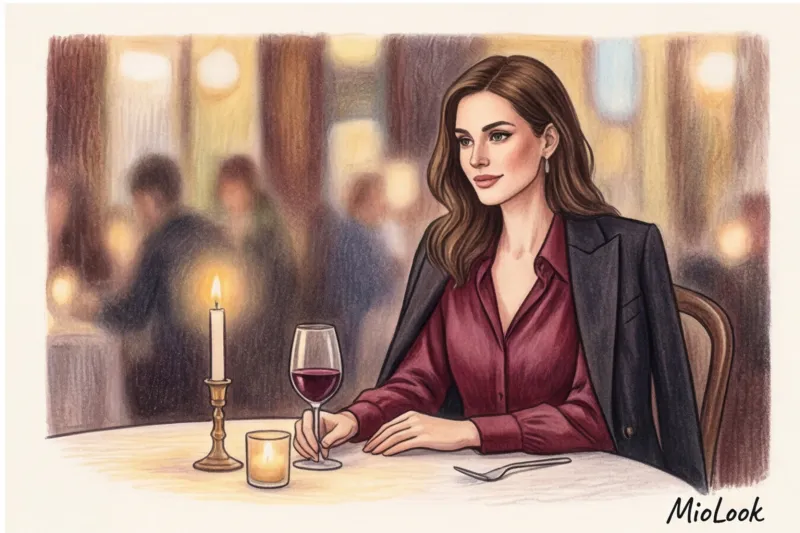
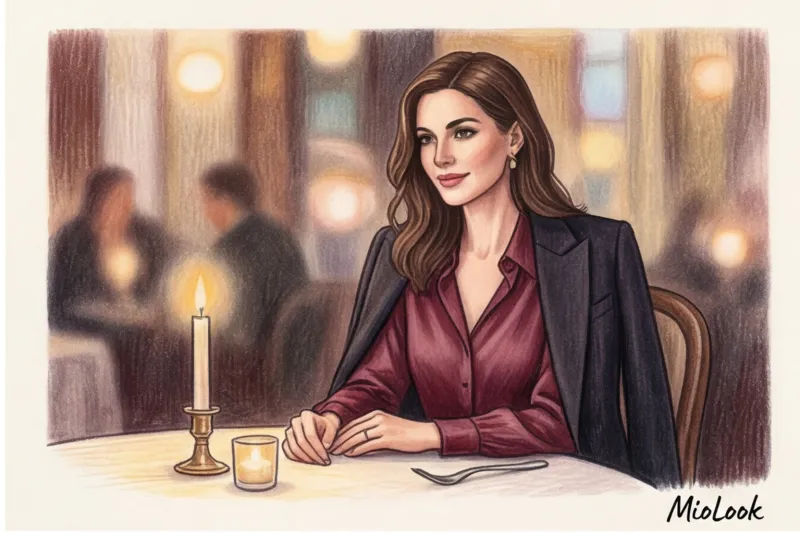
- Replace red with deeper shades: Ask the algorithm to use emerald, burgundy (the most prestigious color of 2024 according to Vogue), sapphire, or deep chocolate. These colors are intriguing, not flashy.
- Shift focus to texture: Try searching for "cashmere sweater" or "thick silk blouse." Men (and people in general) subconsciously respond to soft, pleasant-to-the-touch materials much more than hard, varnished polyurethane.
- Maintain a balance of volumes: Use the "open back, closed neckline, and long sleeves" prompt. This will force the algorithm to look for complex, elegant shapes.
By the way, if you're planning a date after work, check out our guide. How to transform a daytime look into an evening one without unnecessary items.
Corporate Event: Balancing "Colleague" and "Party Star"
A corporate event is the most treacherous zone for artificial intelligence. The machine doesn't understand the difference between going to a club with close friends and a party where the CEO is sitting at the next table. A search for "party attire" will return head-to-toe sequins and a crop top, which is absolutely unacceptable in a business environment.
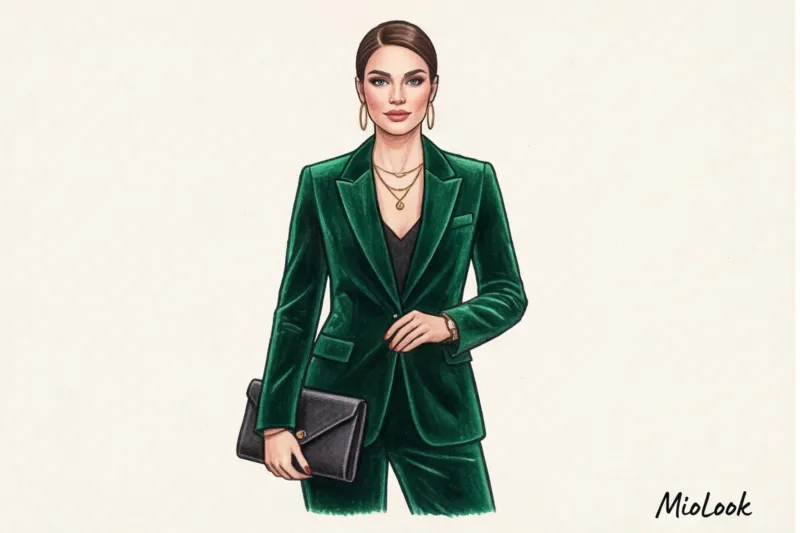
Adapting your office database with smart AI accessory search works great here. Ask the neural network to take a classic, loose-fitting pantsuit as a basis, but replace the casual shirt with a lingerie-style top or add large, statement chandelier earrings. (If you have a non-standard figure, be sure to study the material about office clothes for plus size women — there are many nuances of the suits’ fit).
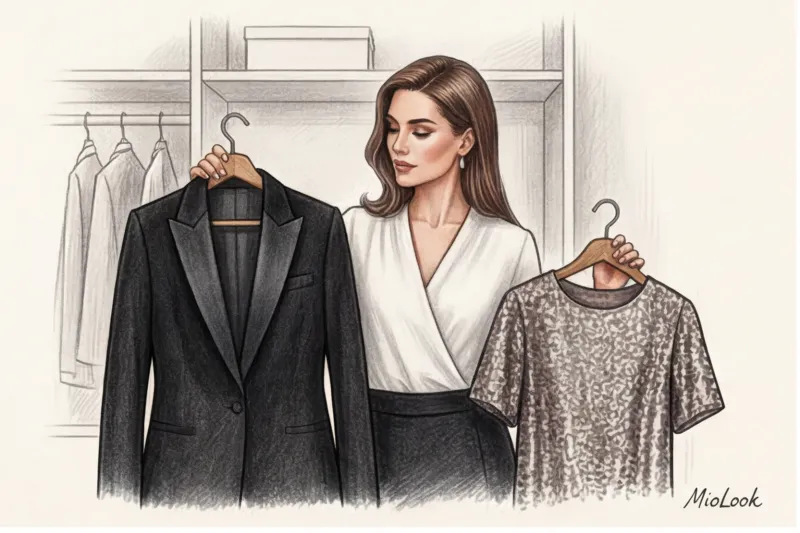
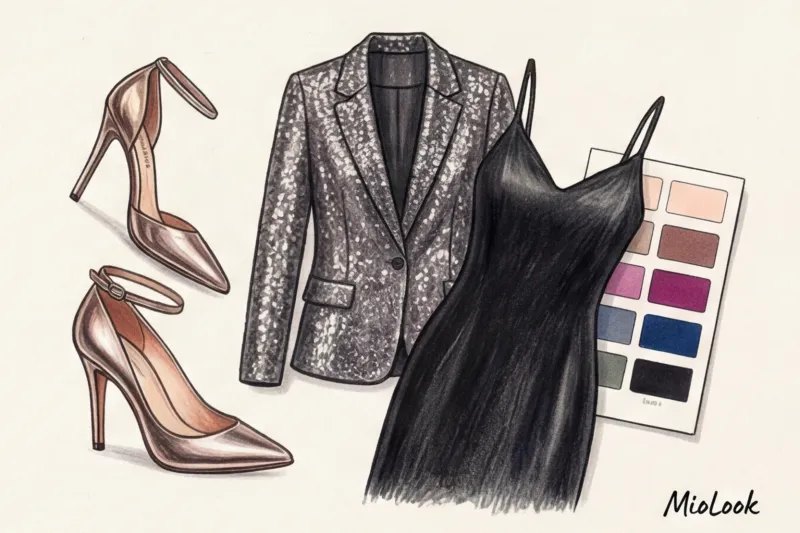
One of my favorite techniques when working with a neural network is to set a shine limit. I write in the prompt: "Matte pantsuit, only one A sparkly element—for example, metallic leather shoes or a crystal-embellished clutch. Velvet also works well. The search term "thick velvet suit in a deep navy blue" instantly produces an outfit that looks expensive and festive, yet maintains the necessary business aura.
We discussed the details of the dress code for communicating with colleagues in an informal setting in detail in the article What to wear to an interview at a creative agency — these same rules work great for Friday corporate parties.
Ready to get started?
Upload photos of your office attire and accessories to MioLook, and the AI will create dozens of combinations for the corporate event, saving you the hassle of buying a new dress for just one evening.
Get access — €0.99 onceStylist's Guide: 5 Steps to the Perfect Prompt for an Evening Look
Over four years of actively testing various fashion neural networks, I've developed a query formula that eliminates 90% of fashion junk. The secret is to treat the prompt like a technical specification for a seamstress, not like a letter to Santa Claus.
The formula for an ideal query:
Event + Location + Your Color Type + Key Texture + Taboo (negative prompt)
- Event and light: "Dinner in a dimly lit restaurant."
- Coloristics: Don't write, "Blue suits me." Write, "A deep, cool sapphire shade perfect for a high-contrast winter look."
- Texture: "Dense, flowing viscose that holds its shape" (instead of the abstract "quality fabric").
- Cut: "Semi-fitted silhouette, emphasis on the waist, A-line midi-length skirt."
- Negative prompt (most important!): In the settings of advanced generators, always specify what should NOT be included. My standard set:
--no mini, cleavage, cheap polyester, neon colors, excessive sequins, logos, casual denim.
It is important to make a fair disclaimer here: this method doesn't work If you're trying to generate an image that defies the laws of physics, the neural network will happily draw you a flowing chiffon dress that somehow miraculously has a tight, corset-like waist. In reality, chiffon doesn't behave this way. Therefore, always check the results against real-life models: do such items exist in real stores (Zara, H&M, Massimo Dutti)? Will you be able to move in this outfit?
Bottom line: AI is your assistant, not your style dictator.
Artificial intelligence is a great tool for overcoming closet paralysis. It can suggest bold color combinations in seconds that you wouldn't have thought of on your own (for example, pairing a chocolate suit with an icy blue top). But the final filter of appropriateness always rests with humans.
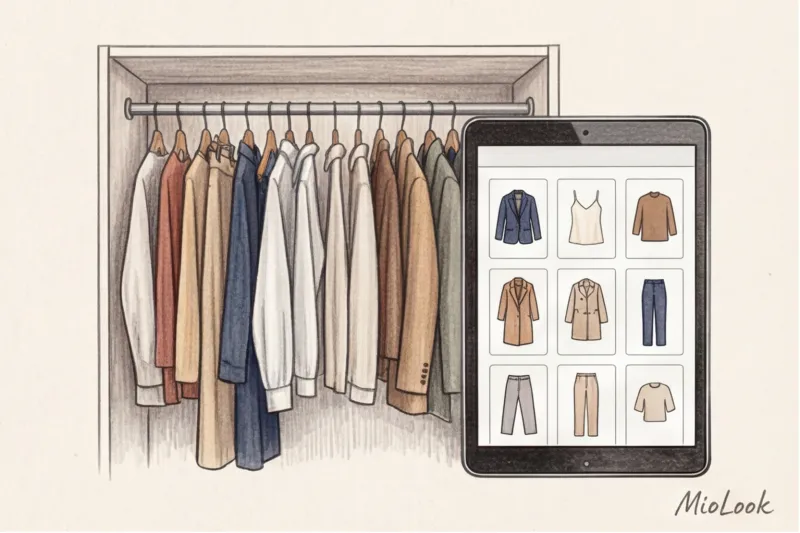
Don't try to force a neural network to create a wardrobe from scratch. It's much more effective to use algorithms to style what's already in your closet. Upload your basic pants, jackets, and shoes to the app. MioLook , and let the AI assemble an evening outfit from them. You'll be surprised to discover that the perfect outfit for a corporate event or date is already yours—you just haven't seen these combinations before.