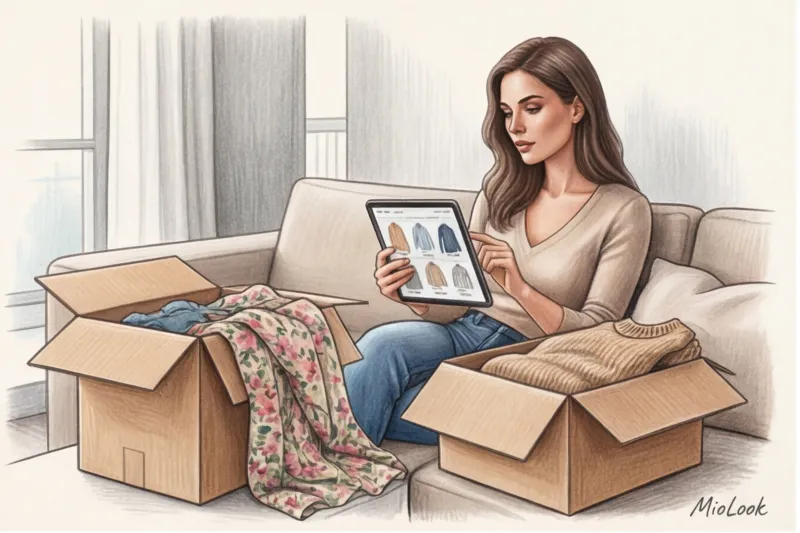
Why We're Wrong: The Main Illusions We Fall into When Buying Clothes Online
According to global e-commerce statistics for 2023, approximately 30% of all clothing purchased online is returned to warehouses. In the denim and dress categories, this figure reaches a staggering 40%. Have you ever wondered why the question of How to buy clothes online without endless returns and disappointments, still remains an unsolvable puzzle for many? We live in an era of smart technologies, about that, How online shopping algorithms make you buy more Entire studies are written about this, but we still continue to play fashion roulette: in the picture we see a luxurious texture, but at the pick-up point we get a shapeless bag.
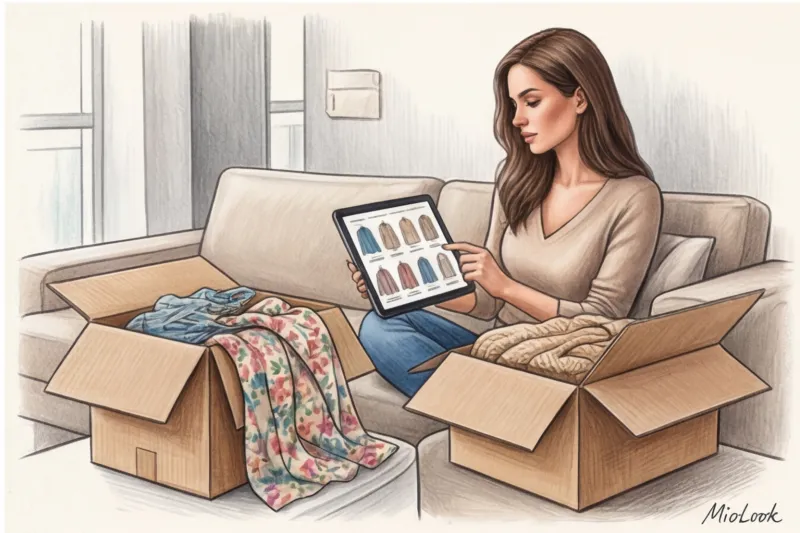
The secret is that online shopping feels like a lottery (with a perpetual conflict between expectations and reality) only when we rely on emotions rather than technical parameters. And the first, most insidious trap on this path is "Model Syndrome."
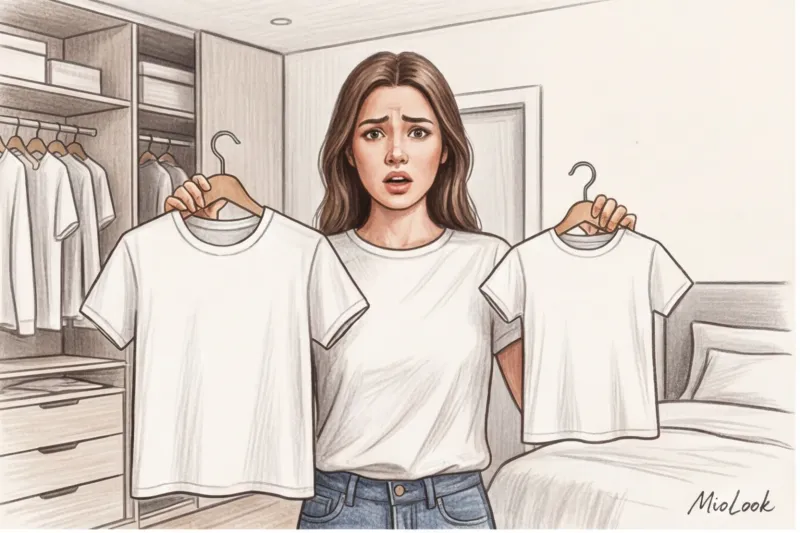
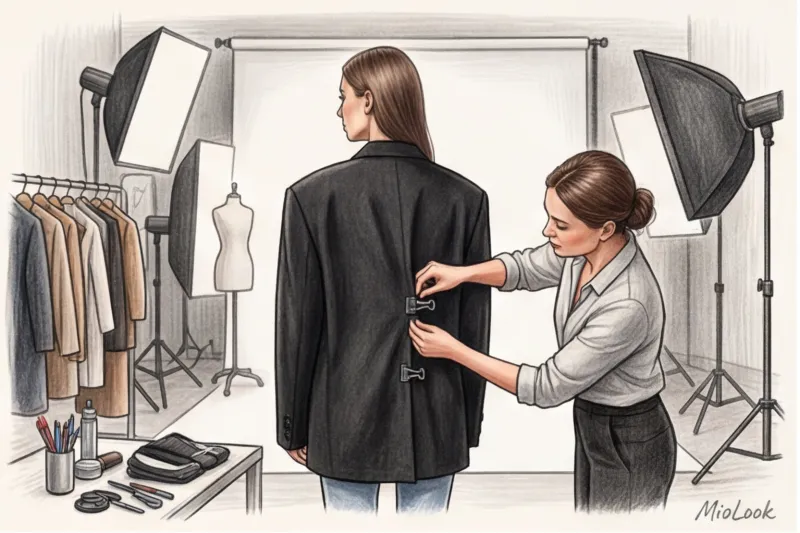
Over my 14 years as a stylist, I've heard hundreds of clients exclaim, "But it looked different in the photo!" Let's be honest: when we add a sweater or pants to our cart, we're often not buying a piece of fabric cut to a specific pattern. We're buying professional studio lighting, a retoucher's work, the perfect posture and precise pose of a 5'9" woman with measurements that are far from average. In reality, the fabric won't flutter as effectively without a studio fan, and your waistline will be 2-3 inches lower if you're 5'4". Furthermore, during shoots, stylists mercilessly use paper clips on the model's back to ensure the garment fits perfectly.
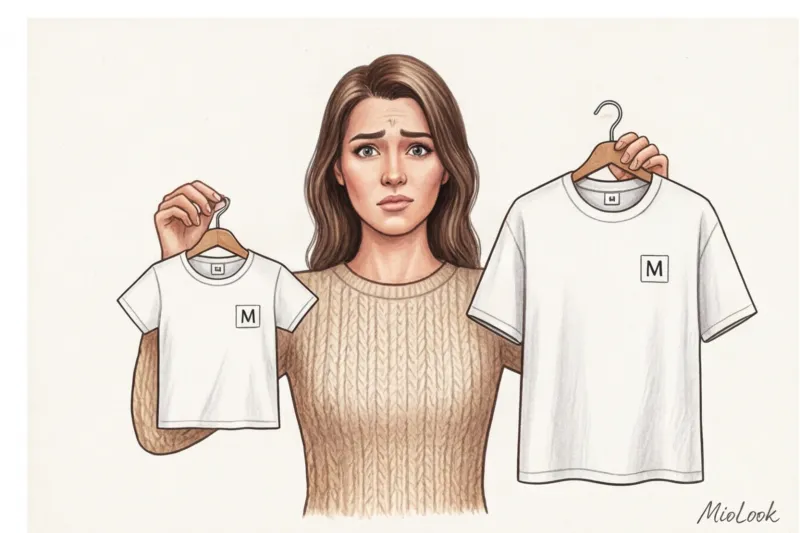
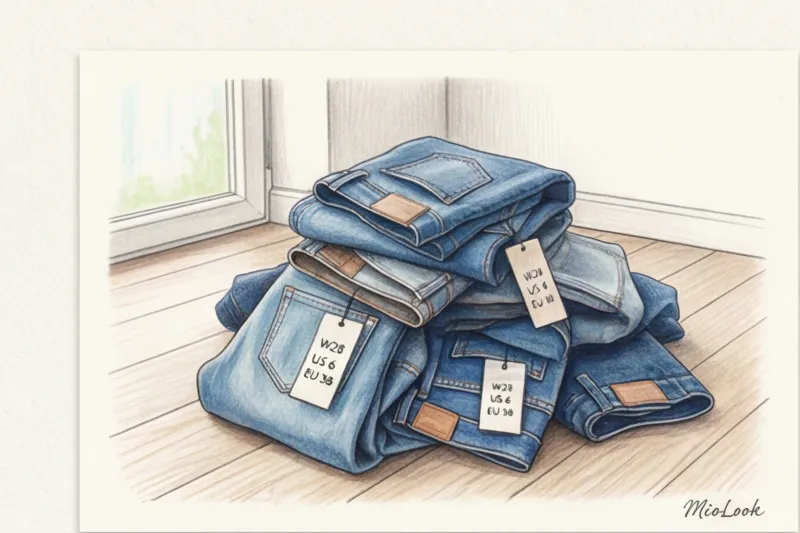
The second illusion is blind faith in the letter on the tag. Admit it, you also sometimes think, "I always wear M, so I'm wearing M here too"? Forget that phrase. The familiar, universal "size M" no longer exists. The patterns of the mass market in Spain, the premium segment in Sweden, and a niche Asian brand are three different universes (by the way, about that... Where to buy Korean clothing (We've already discussed their specific small sizes, taking into account their specific small sizes.) Even within a single collection from a single brand, a size M T-shirt can fit like a tight S, and a size M jacket can fit like a confident XL, simply because of the designer's intentions. And it doesn't matter whether the item costs €30 on sale or €300 in a new collection—sizing charts everywhere have a life of their own.
"We don't buy a thing, we buy a promise that in this thing we will look as flawless as a model in a studio background."
And here we come to the main mistake that ruins the lion's share of successful purchases: relying on subjective reviews from other buyers. When you read an angry comment like "it fits terribly big, I'm drowning in my size," stop. You don't know the author's body type, her height, shoulder width, and, most importantly, how she fits. got used to it Wearing clothes. Many women are terrified of the air between their bodies and the fabric, perceiving the current loose fit as too big.
I had a particularly telling case in my practice. One of my clients found a gorgeous straight-cut jacket. I recommended her size M to achieve that perfect, relaxed shoulder shape. But she read reviews along the lines of "it's too big, go down a size," and ordered a size S. The result? The jacket fit too tightly, the buttons stretched across the chest, the armholes dug into her armpits, and the stylish oversized look turned into a skimpy school uniform from the 2000s. The garment was hopelessly ruined by the improper fit.
To avoid relying on other people's opinions, I always recommend that clients rely on numbers and analyze their successful images. MioLook — you can digitize items that already fit you perfectly and always have your personal "standard" fit in front of you. Online shopping stops being a tape measure the moment you start measuring not your body, but the clothes themselves.
How to buy clothes online without getting the size wrong: measure the clothes, not the body
Now forget everything you learned from glossy shopping articles from the 2000s. The fastest way to end up with something that's bursting at the seams or hanging loosely is to measure your measurements (bust-waist-hips) and obsessively compare them to the brand's size chart. When my new clients ask how to buy clothes online without having to deal with returns, I impose a strict rule: we stop measuring bodies. We start trying on clothes.
Why do your body measurements lie? Because fabric doesn't conform to us like a second skin (unless it's a surfing wetsuit). There must always be air between your body and the fabric. In professional clothing design, this is called allowance for ease of fit This is the very secret of tailors and pattern makers that distinguishes a prestigious, expensive fit from a skimpy, outdated one.
Let's break this down into numbers. Let's say your chest measurement is 96 cm. If you order a silk blouse exactly 96 cm wide, the buttons will come undone at the first deep breath. For a beautiful, flowing silhouette, delicate silk requires at least 8-12 cm of extra allowance. A thick knit bodysuit with elastane, however, requires a negative allowance (minus 2-4 cm from the chest measurement), otherwise it will bunch up untidily. One of my favorite tips when choosing winter outerwear is to allow for layering. A coat should have at least 15-20 cm of extra allowance to the chest measurement, allowing for a roomy chunky knit sweater or a thin down jacket to fit comfortably underneath, while still allowing you to lift your arms freely.
To put the size issue to rest once and for all, I've developed the "Golden Wardrobe" method for my clients. It's simple: you need to carefully measure your favorite, perfectly fitting clothes once. You probably have those jeans that make your butt look like a million bucks, or that basic jacket that gets you compliments from your colleagues. These are the ones we need. Take them out of the closet, grab a tape measure, and create your own personal reference base.
Measurements are taken exclusively on a flat, hard surface—a table or the floor. The item should be fully buttoned and zippers should be fastened, and the fabric should be straightened by hand without artificially stretching it. We measure half-girths This is the distance from seam to seam in a straight line. For example, the half-chest (often referred to as PIT or Pit-to-Pit) is measured strictly from the bottom of one armhole (underarm) to the other. You don't need to multiply this figure by two—most reputable online stores, from global platforms to local niche brands, provide the half-chest measurements of the finished garment in their measurement tables, not mythical body measurements.
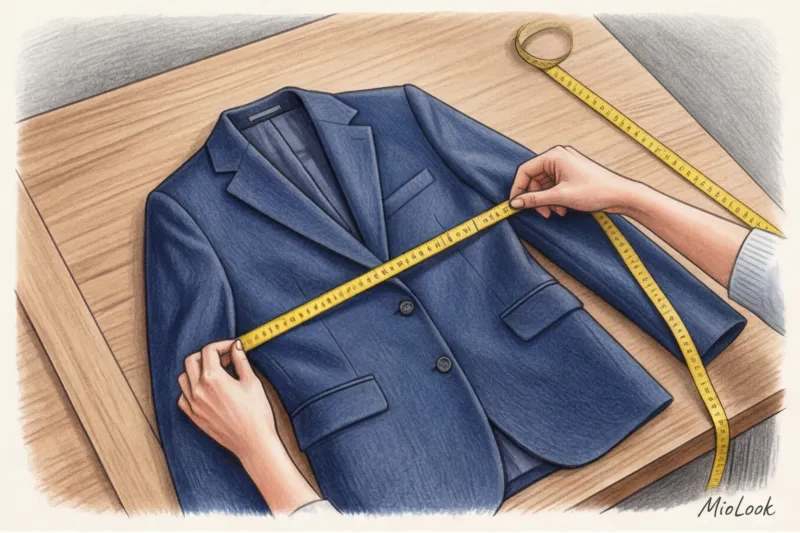
The biggest mistake beginners make is measuring only the waist and overall length. In the "Golden Wardrobe" method, we go much deeper. For trousers, always measure the leg width at hip level (just below the center crotch seam)—this ensures the fabric doesn't stretch treacherously, creating unsightly horizontal creases. For shirts, armhole height is critical: measure vertically down from the shoulder seam to the armpit. An armhole that's too tight will instantly cheapen the look and restrict movement, even if the garment fits perfectly loosely in the chest.
I also always recommend checking the length of a garment not just from the shoulder, but from the back—from the seventh cervical vertebra. This is especially critical when buying skirts and midi dresses: what gracefully reveals the knee on a 178 cm studio model might end up at the widest part of the calf on your height, visually adding bulk to your legs.
Access to MioLook for €0.99 — one-time payment
Save the measurements of your reference items in the MioLook app. When shopping online, you can compare the measurements of your new item with your "golden base" in one click, and the algorithm will tell you whether the new item will fit into your current wardrobe.
Get access — €0.99 onceThree golden measurements that will save you from returns
If you're ordering in a hurry and don't have time to meticulously measure an item using ten parameters, check at least three critical points before purchasing. These are the architectural components that create the perfect silhouette and are the most difficult to correct.
- Shoulder seam length and back width. This is the rigid frame of any garment: from a cotton T-shirt to a cashmere coat. The back width is measured horizontally between the armholes at mid-shoulder blade level. Why is this so important? While a dress's waist can be slightly adjusted at the nearest clothing store for €15-€20, a competent shoulder and armhole alteration at a reputable tailor will cost you between €50 and €100, and not every tailor will undertake this, as the garment's construction will simply shift. If the shoulders are out of place (and it's not the designer's intended oversized, dropped shoulder), don't hesitate to return the garment; it will never fit perfectly.
- Sleeve width at forearm. This is a common headache for women with non-standard figures or athletic builds. Many mass-market brands, in an effort to save fabric, narrow their sleeves. Measure the half-girth of your favorite shirt's sleeve at bicep level (the widest part of your arm) and compare it to the numbers on the website. If the sleeve cuts into your arm, you'll look two sizes larger, and the fabric in this area will quickly pill due to constant excess friction.
- Trouser rise (front rise / back rise). This is the distance from the center crotch seam (the intersection of the leg seams) to the top edge of the waistband—front and back, respectively. The store's stated "high waist" on a long-torso model and on you are two completely different heights. By measuring front rise your ideal jeans (for example, exactly 28 cm), you will know exactly where the waistband of your new trousers will end up - whether it will sit exactly on your natural waist, rest under your ribs, or treacherously slip down onto your hips, disrupting the proportions of your legs. And the indicator back rise The backseam prevents pants from sliding down when you sit down. If the difference between the front and backseam is minimal, the pants will be "shallow" in the back—a common design mistake among ultra-budget brands.
Reading Fabric Composition: A Secret Skill for Successful Online Shopping
A size chart is just a flat drawing. Fabric composition is a 3D reality. A measurement chart on a store's website may promise a perfect fit, but if you ignore the "Materials" section, your chances of a successful purchase are slim to none. It's the chemistry and structure of the fiber that determine how a garment will perform, whether it will highlight your best features or mercilessly reveal the slightest nuances of your silhouette.
Before you click "Pay," ask yourself: how should this garment fit? If you want a skirt to flow gracefully and softly hug your hips, look for cellulose fibers (viscose, cupro, modal) or natural silk. They have high flow. If your goal is to create a defined silhouette, conceal a tummy, or add volume, choose shape-stabilizing materials. Dense cotton (poplin or denim) and 100% linen don't flow, but gather into beautiful, architectural folds, acting like a soft corset.
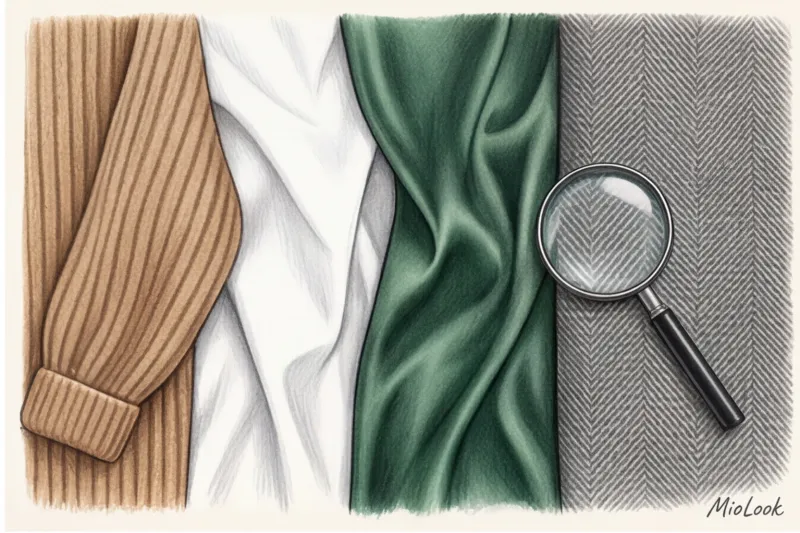
I always advise beginners to start with safe purchases. There are textures that literally "forgive" us when choosing the wrong size:
- Blended fabrics with 2–5% elastane (spandex). Even a minimal percentage of elastic in cotton trousers or a wool jacket provides the necessary range of motion. The garment will adapt to your curves, even if you're slightly off on the half-girth measurements.
- Thick knitwear (jersey, ponte, milano). Thanks to the loop weave, high-quality knitwear stretches well, yet holds its shape and doesn't deform at the elbows or knees.
- Tencel (lyocell). This modern, eco-friendly fiber is made from eucalyptus wood. It's incredibly flexible, has a delicate sheen, and fits perfectly even on figures with a pronounced waist-to-hip difference.
But online stores are full of tricky materials that require a perfect, jewelry-like fit. These include 100% linen, stiff cotton, and pure silk. These fabrics are static and lack any stretch whatsoever. If a silk blouse is too small in the chest or back by just a centimeter, it will not only restrict your movement, but also, with a sharp swing of your arm, it will come apart at the seams.
"The number one rule for buying clothes online: if the item is made from a non-stretch fabric, always check the circumference of the largest part of your figure against the item's measurements, leaving at least 4-5 cm for ease."
The 100% Viscose Trap: Why is it so insidious?
I'd like to specifically discuss pure viscose without synthetic blends. It's a wonderfully tactile and breathable material, but it has one critical drawback. When reviewing clients' wardrobes, I regularly see mid-range dresses and shirts (for example, from Massimo Dutti, Zara, or COS) that have been worn exactly once. The reason is simple: after the first wash, even on a delicate cycle, the item has shrunk a full size.
The problem is that 100% viscose shrinks significantly (sometimes up to 5-7%) upon initial contact with water. Brands in the sub-€150 price range rarely perform pre-decating—wet and heat treatment of fabric rolls before cutting. My rule of thumb: if I order a 100% viscose item online, I intentionally order one size larger. Even if it's a little looser at the pickup point, after washing, the fit will be exactly as intended.
And one more professional step. The texture of the new item should work in tandem with what's already hanging in your closet. According to styling rules, a flowing bottom calls for a structured top, and vice versa. To avoid guessing, I always upload a photo of the potential new item to MioLook This allows you to visually try on a stiff cotton jacket with existing silk dresses and determine in advance whether the look will be harmonious.
Photo Analysis: How to Understand Clothing Fit When Buying Online
A few years ago, I styled a shoot for a fairly large European brand's new collection. We were photographing classic double-breasted jackets priced around €120. Do you know the secret to their "perfect" tailored fit in the final shots? The massive paper clips. Behind the model, out of the photographer's line of sight, the excess fabric was cinched tightly with three clothespins. This is a completely standard industry practice in e-commerce: brands artificially "adjust" clothes to the models' measurements for the shoot, sculpting a silhouette that doesn't exist in reality.
That's why judging a product solely by a beautiful studio photo from the front is a guaranteed recipe for disappointment and returns. How can we buy clothes online if glossy photos deceive us? Study the product description with the eyes of a professional stylist.
What should you look at first? Ignore the waistline—it's too easy to pin or correct with light touch-ups. Focus on the strong structural points: shoulder line, armhole and sleeve length The shoulder seam should be exactly where your collarbone ends, unless the manufacturer specifically states an oversized fit. If the armhole in the photo visually cuts into the model's armpit, add to that your typical active day—you'll be catastrophically uncomfortable. The sleeve length of a proper basic jacket should reach the wrist bone. And now a life hack: if all the photos in the catalog show the sleeves carelessly rolled up or tucked high, be careful. Very often, stylists use this technique to disguise simple fabric savings or poorly proportioned factory patterns.
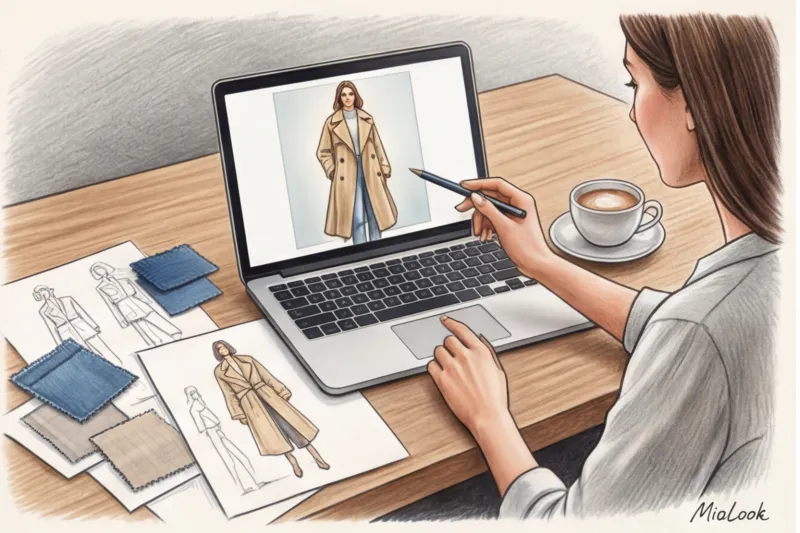
The next stage of my professional diagnostics is search for treacherous creases Photos rarely lie about fabric tension if you know exactly where to look. Pay close attention to the crotch area of the trousers (in tailoring circles, this characteristic defect is called "cat's whisker") and the horizontal folds on the chest near the buttons.
Remember the golden rule: if you see tension in the fabric or radial folds in these areas, even on a professional model (who typically wears a size S and is over 175 cm tall), the pattern is incorrect. On a figure with slightly more pronounced curves, these micro-folds will become a visual disaster. Horizontal creases always indicate a lack of width volume, while diagonal creases indicate poor balance.
How can you see the real picture without hidden clothespins? Look for video walkthrough of the model In my opinion, this is the most important and honest element of a product description. It's physically impossible to hide a poor fit with technical tricks in motion. Video is the only way to accurately assess the true density of the fabric and its behavior in space. Pay attention to telling details: does the skirt flow in heavy folds, or does the thin fabric treacherously magnetize and cling to the hips with every step? Do the wide legs flap when the model walks? Does the entire shoulder girdle of the jacket stretch upward when the model slightly raises her arms?
To minimize surprises, when analyzing a potential purchase, I always recommend saving not only carefully-shot static images, but also screenshots from videos at random angles—for example, half-turned or from the back. When uploading an item to the "smart wardrobe" feature in MioLook , add these realistic shots. This will help you and the algorithm more accurately visualize how the texture and volume of the new item will complement your favorite cashmere sweater or basic €90 jeans from an existing capsule collection.
Access to MioLook for €0.99 — one-time payment
Start creating perfect images with the help of artificial intelligence
Get access — €0.99 onceThe Riddle of Patterns: How to Buy Clothes Online from Different Brands
You've probably encountered this paradoxical situation: you order your usual European size 38, but some pants fit like a glove, while others don't even meet at the waist. The problem isn't that your measurements have changed overnight. It's all about the invisible geometry of the fashion industry—branded patterns and so-called fit models.
Every clothing brand designs not for an abstract individual, but for a specific "fit model." This is a real person or a standardized mannequin with average parameters reflecting the brand's typical client. This model has a specific lumbar arch, hip height, calf fullness, and shoulder spread. That's why successfully answering the question of how to buy clothes online often comes down to finding "your" brand, whose basic structure best matches your natural build.
The brand's geography of origin has a profound impact on fit. In my practice, I identify three distinct trends:
- Italian patterns: Brands like Pinko and Patrizia Pepe traditionally tailor to a figure with a waist accent and narrower hips. Their cuts are very flattering for an hourglass figure, but almost always run small through the bust.
- Scandinavian cut: Brands like Acne Studios and Ganni are the realm of straight, architectural silhouettes. Long sleeves, dropped shoulders, and an oversized fit built right into the pattern dominate here.
- German school: German brands (Marc O'Polo, Gerry Weber) emphasize uncompromising everyday comfort. They feature looser armholes and generous allowances for fuller arms and hips, making them ideal for those with apple-shaped figures.
To understand this difference in practice, let's compare the fit of classic wide-leg trousers in the €80-€120 price range. If you choose a pair from Massimo Dutti (a brand with a classic European, Spanish fit), they will fit quite snugly around the breeches and have a sharp, defined transition to a narrow waist. But trousers of the exact same size from COS (a prominent example of the Scandinavian approach) will fit completely differently: they are cut along a straight line, without a sharp taper toward the waist. On a figure with a non-defined waist, the COS will fit perfectly, while the Massimo Dutti will feel treacherously tight at the waist.
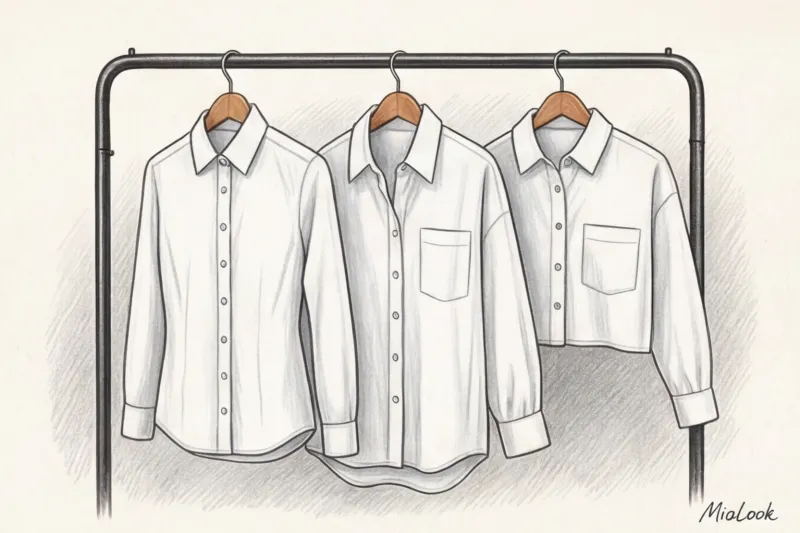
A particular headache for online shoppers is the difference between mass-market and mid-market clothing. Garment industry technologists confirm that fast fashion factories (Zara, H&M) cut fabric in giant layers, laying 50–100 layers at a time. The industrial knife blade inevitably shifts on the lower layers, causing a cutting error of up to 2–3 centimeters in the same size! That's why, when ordering from Zara, I always insist: order two adjacent sizes for fitting. The "M" label in mass-market clothing is more of a guide than a precise mathematical fact. In mid-market clothing (from €150), there are fewer layers during cutting, and quality control is stricter, so sizing charts are more consistent.
A secret of professional buyers: if an item belongs to a special line, this means changing at least five structural components of the product, and not just a shortened or lengthened edge.
Many girls under 160 cm make the mistake of buying standard clothes and simply taking them to a tailor. But the line Petite (for petite) - this is a completely recalculated geometry. In such patterns, the waistline is higher, the bust darts are shorter, and the armhole depth is significantly shallower. The same applies to the ruler. Tall (for tall people over 175 cm): not only the legs are lengthened, but also the front rise, so that the fit does not cut into the groin area and does not disrupt the proportions of the torso.
It's impossible to keep track of every brand's unique features. To systematize successful patterns, I recommend to my clients save your observations in the MioLook digital wardrobe Just leaving a note on an item once: "COS trousers - order one size smaller" or "Zara jackets - always size L due to narrow shoulders" will allow you to make future purchases with pinpoint accuracy, forever forgetting painful returns.
Technology and Virtual Try-On: The Future of Smart Shopping
According to McKinsey (2024), over 60% of fashion retailers will implement advanced AI for clothing selection in the next couple of years. And this isn't just a marketing ploy. Have you noticed how smart algorithms on major platforms have become more accurate at guessing your taste? Today, artificial intelligence is radically changing the rules of online clothing shopping. It analyzes not only your past orders but also the percentage of elastane in the items you've viewed, pattern geometry, and even typical reasons for returns to recommend just the right item.
The next step, no longer a fantasy, is virtual fitting rooms. AR (augmented reality) tools allow you to create a precise digital avatar based on your physical measurements. No more guessing blindly about how a complex architectural cut or wide palazzo pants will fit. Advanced neural networks literally stretch a 3D model of the fabric onto your virtual body, taking into account the physics of materials: how stiff denim holds its shape, and how fine silk flows over your hips. This virtually eliminates the fear of getting the wrong size.
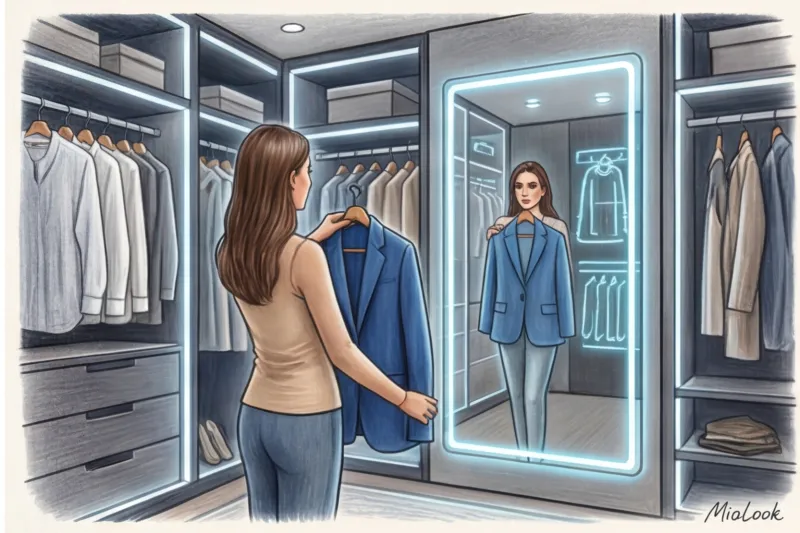
But a technically correct fit is only half the battle. The real magic of smart shopping begins when you evaluate the stylistic potential of an item before you check out. In my practice, I always use Capsule approach (capsule approach): every new purchase should be instantly and effortlessly integrated into your existing database. That's why I strongly recommend that clients sync their shopping with digital wardrobe MioLook Simply save a photo of the blouse you like from the store's website, upload it to the app, and check if it pairs well with the bottoms and jackets you already have in your closet. If the puzzle doesn't fit, close the tab without hesitation, otherwise the item will become just another "dead weight."
This conscious screening solves another crucial task: accurately calculating Cost Per Wear. This is my favorite financial tool in styling, a great sobering tool during emotional outbursts. Imagine choosing between an ultra-trendy sequin top for €60 and a basic blazer made of a thick wool blend for €240. You'll wear the top maybe twice to parties (CPW = €30). And the blazer, thanks to the app's visualization, will easily fit into 15 different everyday looks, and you'll wear it at least 80 times a year (CPW = €3). Technology makes this ruthless math clear, transforming you from an impulsive consumer into a savvy investor in your own impeccable style.
Your ideal image
it begins Here
Join thousands of users who look flawless every day with MioLook.
Get access — €0.99 onceStylist Checklist: 5 Steps to Take Before Buying Clothes Online
Is your finger already reaching for the "Checkout" button? Stop for exactly three minutes. When I do seasonal wardrobe reviews, I regularly find entire stacks of new items with tags still attached that never saw their day. Most often, this is the result of someone skipping at least one of the basic checkout steps before placing their order. To understand, How to buy clothes online Without any subsequent regrets, I created a strict, but incredibly effective algorithm for my clients.
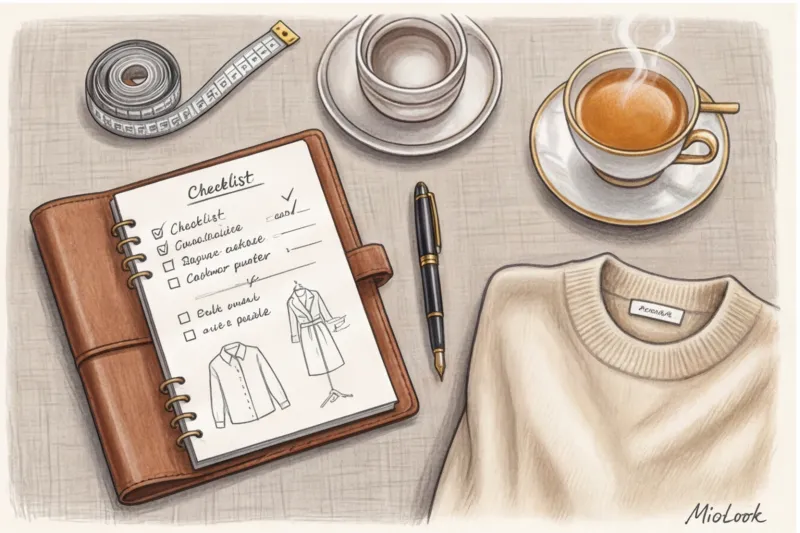
Be sure to check these five points before transferring money to a store:
- Step 1: Compare the measurements of the “reference item” with the measurements of the product on the website. Don't rely blindly on the letter on the tag. Take that shirt or pair of pants that fits you perfectly out of your closet. Measure the chest circumference, sleeve length, or front rise. Compare these numbers with the measurement chart for the specific item on the website. Does it match? Great, let's move on.
- Step 2: Check the fabric composition for elasticity and shrinkage. We've already discussed the behavior of materials, but a more technical assessment is needed here. If the trousers are made of 100% dense cotton without prior enzyme treatment (look for the marking pre-washed ), allow for a 2-3 cm drop in length after the first wash. If there's no elastane at all, the garment won't forgive even the slightest error in waist or hip measurements.
- Step 3: Watch videos or find photos of the item on real people using the brand's tags on social media. Studio lighting, clever posing, and retouching can work wonders. Go to social media and search for the item number or style name. See how that €80 sweater looks on women of different heights, in the natural light of an office or street. It instantly removes any illusions.
- Step 4: Check which 3-4 items from your wardrobe the new item will go with. The rule for a working capsule wardrobe is: mentally create at least three complete looks using what you already own. If you need to buy a special top, seamless underwear, and new shoes to match a new skirt, it's a bad investment. To avoid having to keep your entire closet in your head, I always recommend uploading a screenshot of your future purchase to MioLook and mix it with the digital database of your things directly in the app.
- Step 5: Research the return policy for this specific product category. This is the most common legal trap when shopping online. Make sure the item doesn't fall into a non-returnable category (e.g., bodysuits, swimsuits, or discounted items). Final Sale ). Be sure to check who covers return shipping. If return shipping is charged and will cost you €15–20, it's worth re-evaluating the risks.
This simple, "get it done" algorithm takes no more than five minutes, but is guaranteed to save you money and hassle, eliminating the need to work as a free courier between your home and the pickup point.
Atelier or return: what to do if the purchase is still not perfect
A perfect fit out of the box is more a matter of luck than a guarantee. Most Hollywood stars and fashion influencers don't have magical proportions; they simply budget for a good tailor. If you want to solve the problem of how to buy clothes online and look great in them once and for all, you'll need to master the simple math of proper fitting.
My personal formula for successful shopping is based on 80/20 rule If a new item fits 80% perfectly, and the remaining 20% can be easily adjusted at a tailor's shop, it's a great investment worth keeping. The key here is a flawless fit across the shoulders and chest. Shortening the length of trousers, cinching the waist of a skirt at the center back seam, or removing excess volume from straight shirt sleeves are basic, safe steps.
A common question arises: does it make economic sense to take mass-market items to a tailor? Let's be honest. Shortening the hem of an H&M dress or tailoring a basic Mango jacket will cost you between €15 and €30 on average. If you snagged a pair of excellent, heavy-duty jeans on sale online for €40, and a delicate waistband adjustment costs €20, the final price of €60 is absolutely justified. You'll get a tailored piece that will last for years, not hang in your closet as a monument to a failed compromise.
But there are some stern red flags that require the item to be repacked in its box and returned that same evening. There are cutting points that You can never re-sew without losing quality , the product's factory appearance, and its original proportions. These include the armhole (sleeve opening), the shoulder girdle of any structured jacket or coat, and the back width.
Changing the armholes and shoulder girdle requires a complete redesign. The architecture of any quality garment rests on the shoulders.
Trying to reduce the shoulders on a double-breasted jacket will cost you between €60 and €120, and no self-respecting tailor can guarantee that the lapels won't bulge outward or the sleeve cap won't wrinkle diagonally. If you notice a bubble in the back or a tight armhole, hit the return button immediately.
Another common reason for refusal of return is insidious the psychological trap of "losing weight by summer" or the reassuring "the fabric is probably stretching a little." Have you ever felt like your pants only zipped up when you took a deep breath, but you decided to keep them on as a stern motivation for the gym? This is a fatal mistake. Items that don't fit should be returned immediately.
Clothes should serve your body here and now, providing comfort and freedom of movement, not a hypothetical version of you in the distant future. Putting a new outfit on hold "for better times" will only convey a daily sense of guilt and lower your self-esteem every time you open the closet doors. Your wardrobe should be a source of joy, not a reproach.
Ultimately, mindful online shopping is much more than just learning how to read size charts or spot synthetic blends in fabrics. It's a powerful investment in your personal brand, everyday comfort, and rock-solid self-confidence. Careful selection, a ruthless refusal to compromise, and precise tailoring transform a chaotic collection of random purchases into a functional, elegant wardrobe.
When you put on something that fits perfectly and suits your lifestyle, your body language subtly changes: your shoulders straighten, your gait becomes firmer, and getting ready in the morning becomes less of a stressful experience. And it's precisely for this feeling that it's worth spending a little extra time studying filters, measurements, and compositions in online stores.
Guide Chapters
Black Friday: How to Shop for Clothes on Sale
Does a red price tag shut down your critical thinking? Find out how a mathematical approach to sales can help you build the perfect wardrobe without breaking the bank.
How to return clothing purchased online
Lost your receipt or branded dust bag? We'll explain how to return an item to an online store without losing your money and debunk the main myths about consumer rights.
Plus-size clothing online: secrets to choosing
Tired of unsuccessful online purchases? We'll explore the main mistakes made when choosing plus size clothing and learn how to select the perfect items with engineering precision.
How to order clothes on AliExpress: stylist secrets
Forget the "just read the reviews" advice. Discover a stylist's engineering approach that will save you from disappointment when shopping in Asia.
How to find an item by photo online and save money
Liked a look from Pinterest, but the price is too high? Discover stylist secrets to help you find quality clothes based on images and avoid overpaying.
How to determine the quality of clothing online from photos
Learn to recognize cheap fabric hidden behind professional retouching. A stylist's tips for visually assessing the quality of items in online stores.
How to choose your shoe size online: stylist tips
Shoes should fit perfectly from the first try-on. Learn how to measure your feet correctly and find the perfect pair online, with no returns.
How to choose the right clothes at Wildberries: secrets
5-star ratings on marketplaces are often deceptive. Learn how to analyze reviews and photos to avoid wasting time on low-quality items.
How to choose jeans without trying them on: stylist tips
Almost 40% of jeans purchased online are returned. A practicing stylist explains why regular measurements don't work and how to choose your perfect pair.
Try on clothes virtually online: shopping without returns
No more returns due to incorrect sizes. Learn how artificial intelligence and 3D technology are changing the rules of online shopping forever.
How to Take Clothing Measurements: A Guide for Online Shopping
Up to 40% of online orders are returned due to the wrong size. Learn how to measure yourself correctly to shop online without errors.
How to Determine Your Clothing Size When Shopping Online: A Guide
Size charts are often misleading, and traditional labels become meaningless. We'll explain how to correctly convert international sizes to Russian sizes without errors.