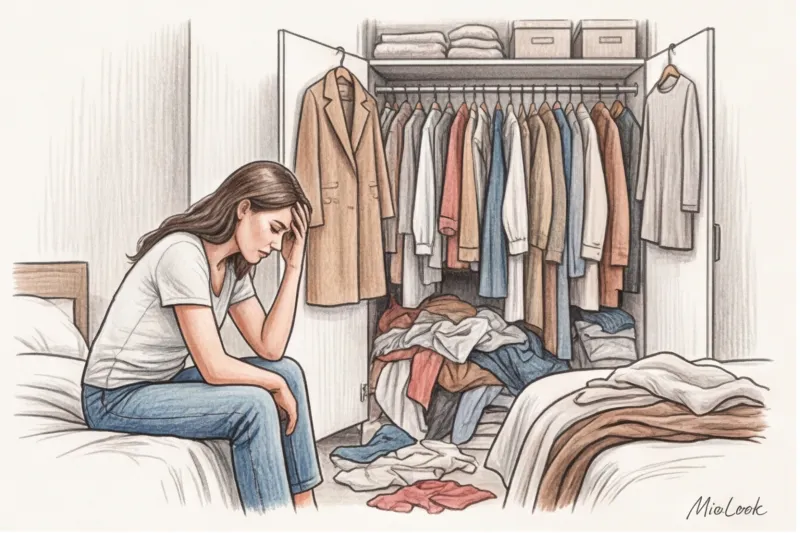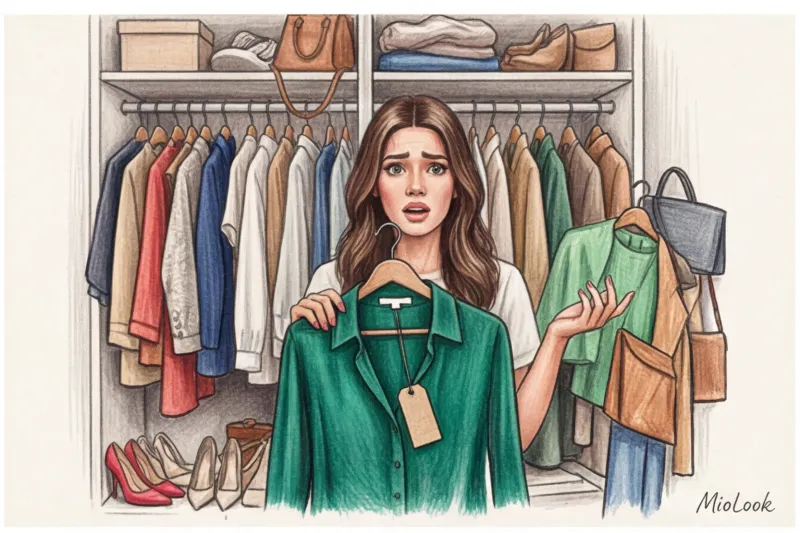
Last month, I was sorting through a new client's wardrobe. We methodically pulled out items with the tags still intact—exactly 60 of them. In total, this "museum of unfulfilled hopes" cost over €3,500. And do you know what she said to me, looking at this mountain of unsuitable silk and acrylic? "Elena, I literally have nothing to wear."
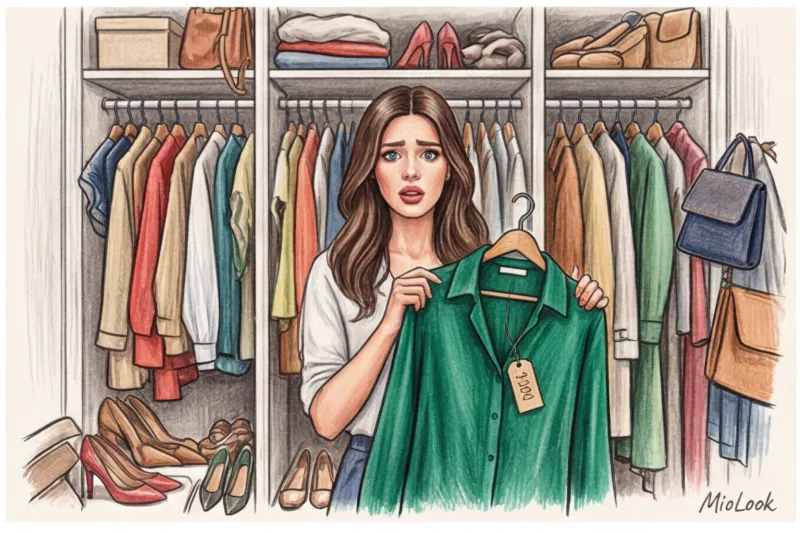
If you've ever caught yourself thinking that your closet is bursting at the seams and getting ready in the morning is pure torture, it's time to honestly figure it out. How to stop buying unnecessary clothes We discussed the basic principles of creating a smart closet in more detail in A complete guide to the MioLook app Today, I want to share a professional stylist's approach. No trivial advice like "make a shopping list and breathe for 24 hours." Over 14 years of practice, I've learned that logical lists are useless when brain chemistry comes into play.
The Psychology of Impulse Buying: Why We Buy Unnecessary Items Again and Again
Have you noticed how you often look slimmer and fresher in the fitting rooms of major mass-market brands than at home? This is no coincidence. A 2023 study in the Journal of Consumer Psychology confirmed that warm, directional lighting, which conceals shadows on the face, combined with rhythmic music (around 120 beats per minute), artificially stimulates the release of dopamine. Your brain becomes trapped in a pleasure loop and literally switches off critical thinking.
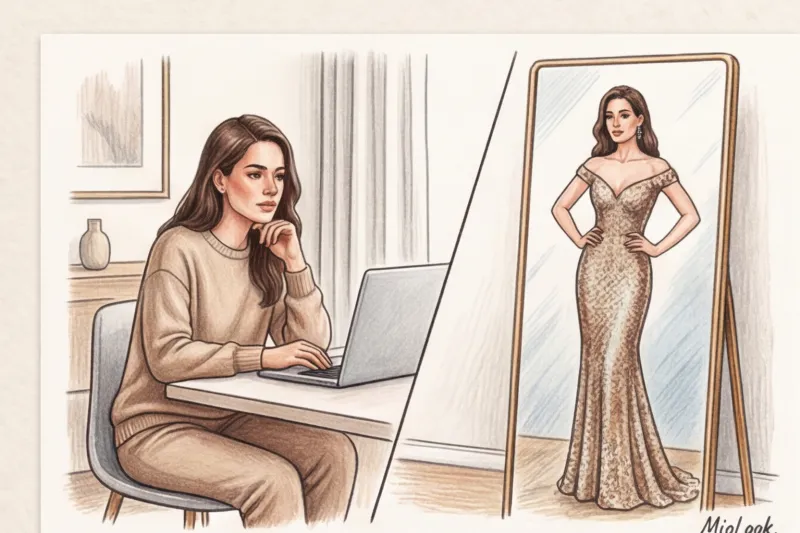
In this dopamine-fueled state, we indulge in "fantasy shopping." We buy not a luxurious sequin dress, but the lifestyle of a woman who wears it to bohemian art shows every Friday. While in reality, we work remotely and spend Friday evenings in cozy pajamas. As a result, a rigid Pareto principle develops in our wardrobe: we wear the 20% of comfortable items 80% of the time, leaving the remaining 80% of our wardrobe hanging, causing us to feel guilty.
The "Lonely Thing" Syndrome and How It Eats Away Your Budget
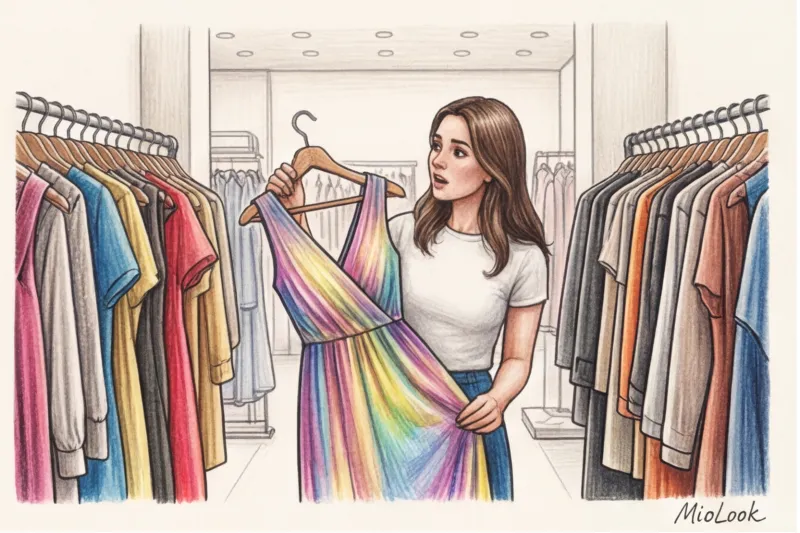
In professional stylist jargon, there's a term called a "lonely item." It's a garment (often with a complex print, an unusual length, or a highly accentuated cut) that doesn't work with anything in your current wardrobe. One such misplaced purchase sets off a domino effect.
"After buying a neon green cropped jacket on impulse for €80, you quickly realize you need the right high-waisted trousers in a neutral shade (another €70), a seamless top (€30), and matching shoes (€100). So, an innocuous purchase ends up costing you €280 or sitting on a hanger like dead weight."
To avoid creating such things, it is useful to know, How to choose quality clothing , which will serve as a base for any accents.
Step 1: How to Stop Buying Unnecessary Clothes: The Cost Per Wear Formula
To quickly calm the nerves at the checkout, I teach my clients one simple mathematical rule. Forget about the price tag. The only metric that matters in a wardrobe is Cost Per Wear (CPW) , or the cost of one output.
The formula is elementary: Cost of item ÷ Estimated number of wears = CPW.
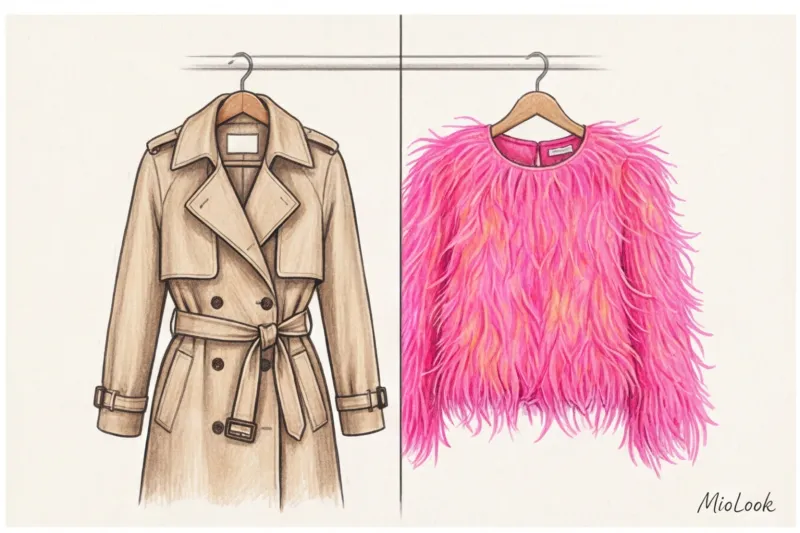
Let's do the math. You see a trendy polyester blouse with a crazy print for €40. You'll wear it exactly once to a corporate event (because it's so eye-catching it'll look ridiculous in the second Instagram photo). The cost per outing is €40.
Now let's take a classic, well-cut wool-blend jacket for €150. You'll wear it to the office, throw it over a slip dress in the evening, and pair it with jeans on the weekend at least 50 times a year. The cost per outfit is €3.
An expensive basic item is always cheaper than a cheap, trendy, one-time item. This rule works brilliantly when you're deciding How to choose a quality coat for several seasons.
Access to MioLook for €0.99 — one-time payment
A smart AI stylist will find the perfect look for your new and old items.
Get access — €0.99 onceStep 2. The ironclad rule of “three looks” in the fitting room
Never make mental promises like, "I'll buy the perfect skirt to go with it later." You won't. Or you might buy it, but the shades won't match. A golden rule that saves my clients thousands of euros: don't take an item to the checkout unless you can come up with three stylish looks for it right there in the fitting room, using what's ALREADY in your closet.
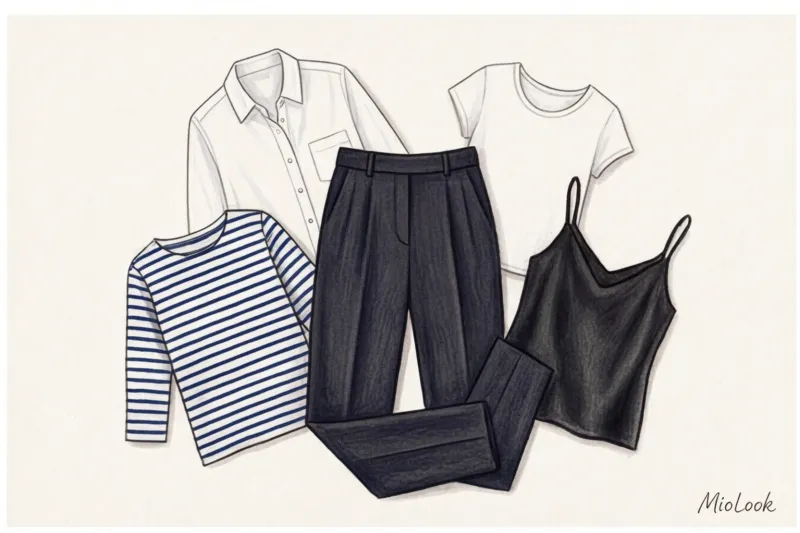
Conduct a mental visualization. You're trying on a thick, oversized shirt. Ask yourself:
1. Can I wear it unbuttoned over my basic white top?
2. Does it go with my favorite straight jeans?
3. Can I tuck it into that black midi skirt for the office?
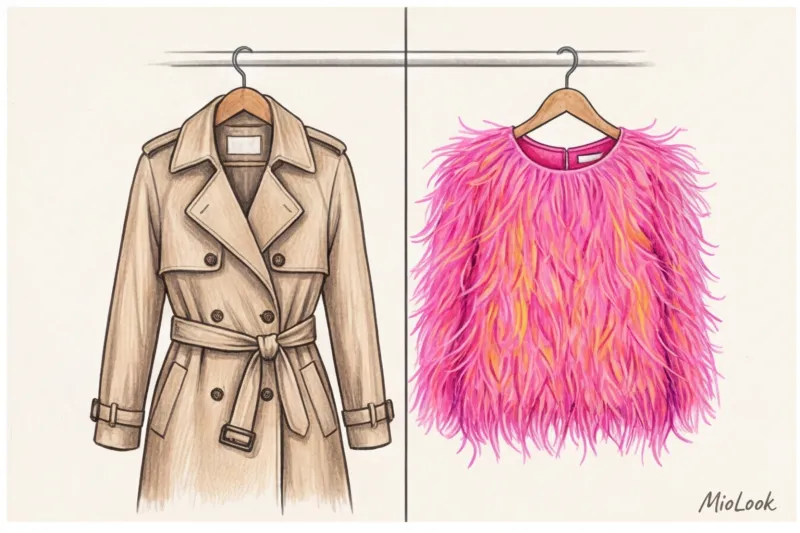
If you can barely pull off even two different looks, you don't need the item. This is especially true for complex textures. One of my clients used to buy thin silk skirts, but only wore them in the summer. We learned how to style them in three different seasons: with a lightweight T-shirt, with a chunky knit sweater, and with a heavy, structured jacket.
Step 3: Digitize your closet to avoid duplicates
Why do we bring home a fifth white shirt, differing from the previous four only in the shape of the buttons? According to research firm WGSN (2024), modern city dwellers forget about the existence of approximately 30% of their wardrobe. What isn't hanging before our eyes on the rail simply doesn't exist in our minds.

To break this cycle, your wardrobe needs to be digitized. This sounds like a massive project, but in reality, it only takes a weekend. I highly recommend using the "smart wardrobe" feature in the MioLook app When all your stuff is on your phone, you make decisions based on real analytics, not illusions.
Imagine this: you're standing in front of a display of trousers in a store. You think you absolutely need a pair of dark blue palazzo pants. You open MioLook and see that you already have similar graphite trousers, which you've only worn twice. What's more, right there in the store, you can virtually try on the item you like against your digital database and check its compatibility.
Step 4: Sale Detox: The Overpriced Trap
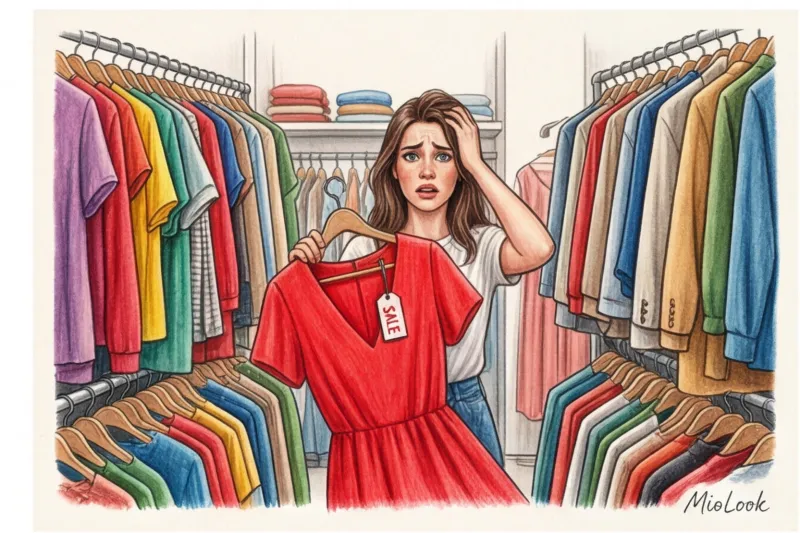
I'll say something that may seem paradoxical: sales make you spend more, not save. Red price tags have a magical property of lowering our standards to a critical minimum.

When an item costs €120, we meticulously evaluate the evenness of the seams, the fabric composition (cotton or polyester?), and the fit of the shoulders. But as soon as the same item is priced at €35, our inner critic shuts up: "Well, for that price, I can get it. So what if it's a little tight in the armholes? I'll lose weight." This is a surefire way to clutter.
The math of sales is cruel: if you buy something 70% off that you'd never buy at full price, you're not saving 70%. You're wasting 100% of your money. The only real test of a sale is the honesty test: "Would I buy this item right now if it had the original price tag on it?" If the answer is "no," feel free to return it to the hanger.
Your ideal image begins Here
Join thousands of users who look flawless every day with a smart wardrobe from MioLook.
Get access — €0.99 onceStep 5: Set aside 10% of your budget for legal "pleasure"
In the world of minimalism, it's common to demonize any spontaneous purchase. Many experts insist on creating the perfect basic capsule wardrobe, consisting exclusively of 30 high-quality beige, gray, and black items. I have bad news: for 90% of women, this approach absolutely doesn't work.

Strict stylistic asceticism and the rejection of all trends work like a strict no-carb diet—they inevitably lead to a major breakdown. If your closet is too perfect and boring, one depressing November evening you'll go to the mall and spend half your paycheck on the craziest sequined pieces you'll never wear again.
My professional solution is to legitimize emotions. Set aside 10-15% of your shopping budget specifically for weird, impractical, hyper-trendy items that simply delight your inner child. Want that acid-pink bag even though it doesn't go with anything? Buy it if it fits into that 10%. This emotional lightning rod will save the rest of your budget from spontaneous destruction.
A Mindful Shopaholic's Checklist: 5 Questions to Ask Before Checkout
To reinforce this skill, I've compiled a list of test questions. Just screenshot this list and open it every time you reach for your bank card at the mall:
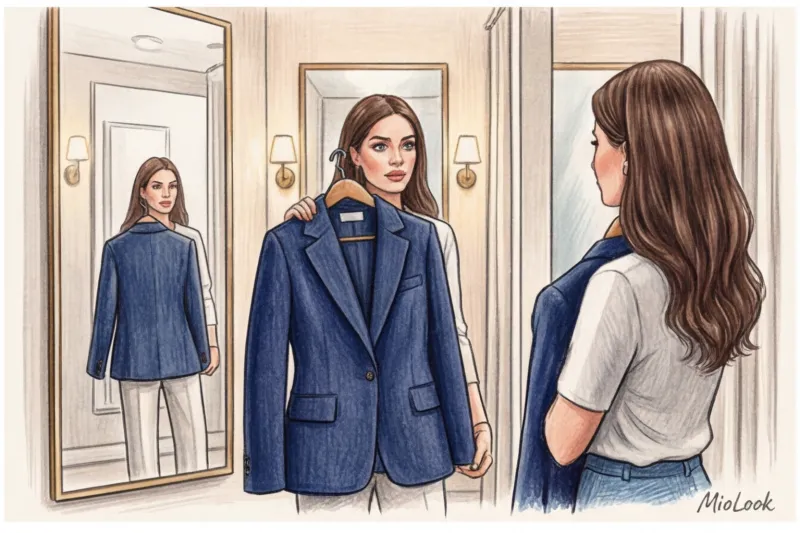
- 1. Is this for my real life or my fantasy life? (Honestly assess where you'll go with this next week.)
- 2. Can I make 3 sets with this right now? (With things that are ALREADY in your closet, not with those that you plan to buy more).
- 3. What is the Cost Per Wear? (Divide the price by the realistic number of days you can wear it.)
- 4. Would I buy this without the red price tag? (Cutting off the magic of sales).
- 5. Do I have something too similar in the MioLook app? (We open the virtual closet and check with reality).
Mindful shopping isn't about restrictions and suffering in stores. It's about clarity and respect for yourself and your hard-earned money. When you understand the mechanisms that compel you to overbuy, you regain control. And then your wardrobe starts working for you, not you for it.