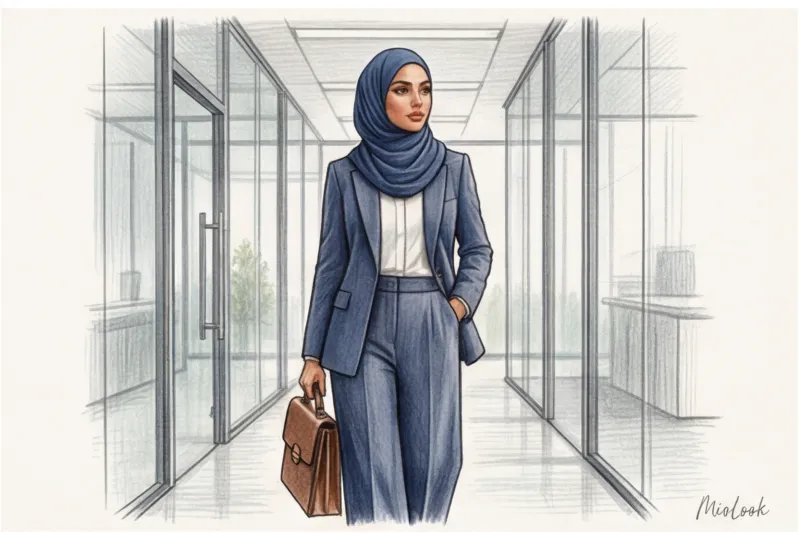
Fashion Architecture: Business Wear for Muslim Women as the New Power Dressing
Three years ago, when I sat front row at Modest Fashion Week in Dubai, one detail struck me: the closed-back silhouettes on the runway conveyed an incredible, almost tangible power. It was a moment of truth. It became clear that modern business attire for Muslim women had finally ceased being a story of restrictions and had transformed into the new Power Dressing—a powerful tool of influence in the corporate world.
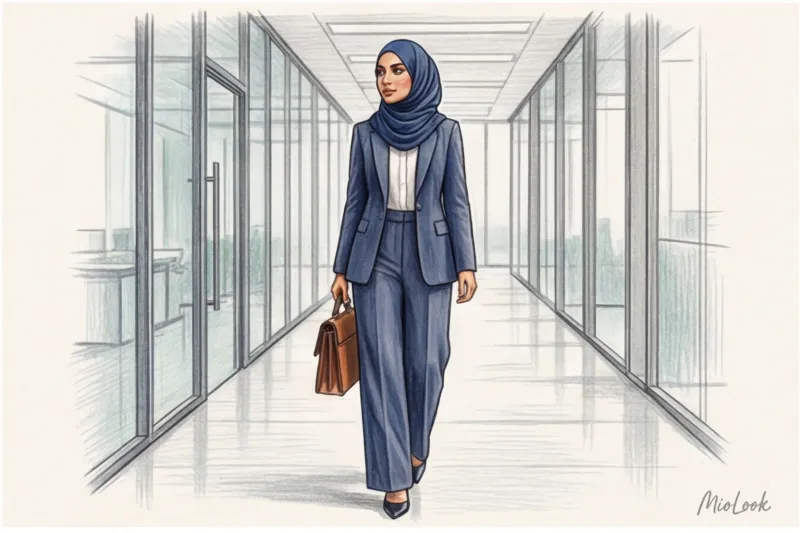
Forget the stereotype that a modest wardrobe necessarily means boring, shapeless robes that conceal not only one's figure but also one's professional character. On the contrary, in the context of top management, a closed cut demands impeccable tailoring. A prestigious garment should hold its shape, have a defined shoulder line, and a perfect fit. An architectural cut allows a woman to confidently occupy the conference room, conveying a subconscious symbol of competence and authority.
The numbers speak for themselves: according to the report State of the Global Islamic Economy (2023) Spending on modest fashion continues to soar, and global brands have finally recognized the economic weight of working Muslim women. A high-quality, double-breasted, closed-fit suit is an investment, costing between €300 and €600 today, but it will become the foundation of your professional image.
In my practice, one of the main challenges for clients is communicating with HR departments when applying for jobs at international corporations with strict regulations. How can I integrate my style into their rules without conflict? The secret lies in the correct corporate terminology. In negotiations with HR, we translate religious requirements into corporate formal language: we request “business professional attire with modesty accommodations” In practice, this means official approval for the use of opaque fabrics weighing at least 250 g/m², longer jackets that fall strictly below the hip line, and a loose fit. Western companies are readily accommodating and amending their guidelines when they see that the aesthetics of the look remain impeccably strict.
The Evolution of Modest Office Style: From Compromise to Authority
Remember when putting together a closed-toe office look was a true stylistic quest? About ten years ago, my clients had to constantly compromise: wearing a thin cotton turtleneck under an open office sundress or finding shapeless cardigans to hide the short sleeves of their corporate shirts. This created unnecessary layers that often looked sloppy, threw off proportions, and inevitably cheapened the look.
Today, we are witnessing a global shift away from this forced "adaptation" of the mass market toward the creation of self-sufficient, closed collections. This shift has been enormously influenced by the aesthetics of "quiet luxury." Trends toward minimalism, dense matte textures, and the absence of flashy details perfectly align with the DNA of the modest ethic. A closed business wardrobe is now built on the uncompromising quality of materials—heavy crepe, Super 120s suiting wool, and flowing silk. Incidentally, I discussed in detail how to make such materials work for your status in my article about a combination of textures in clothing and accessories.
If you're just starting to build your signature work wardrobe, I always recommend taking a rigorous inventory of what's already hanging in your closet first. Once you've loaded your items into MioLook smart wardrobe , you'll be able to visually assess proportions and immediately see what architectural elements are missing for the perfect business capsule wardrobe. This will save you from buying another "compromise" sweater and help you focus on the pieces that truly enhance your professional value.
Dress Code Without Conflict: How to Reconcile Corporate Formal and Modest Ethics
In 2022, I was putting together a capsule for a senior manager transitioning to a partner position at a Big Four company. For client-facing roles, the HR department issued a strict 40-page guideline—the uncompromising Corporate Formal. Historically, this set of rules is based on conservative standards: fitted silhouettes, classic pencil skirts that hit just below the knee, and cropped jackets that accentuate the waist. For my client, these requirements directly conflicted with her values and personal boundaries.
It is at this juncture that the main question arises: how business attire for Muslim women Can it fit within such strict corporate boundaries? The secret lies not in openly protesting the system, but in its competent stylistic translation.
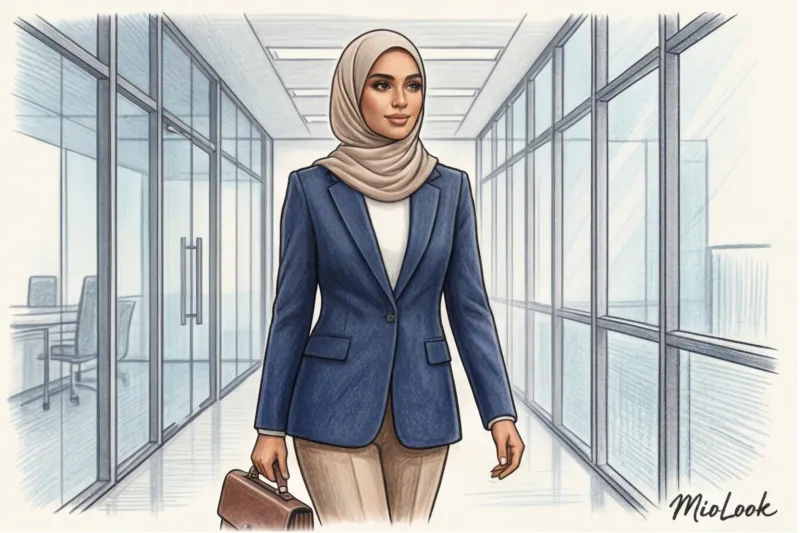
Classic rules are easily adapted if you understand their original essence—demonstrating professionalism through discipline and clean lines. We simply change the tools. The traditional slim pencil skirt is brilliantly replaced by an A-line skirt in thick gabardine or impeccably tailored palazzo pants with pressed creases defining the vertical line. A cropped jacket, designed to accentuate curves, gives way to a longer, straight-cut blazer, the hem ending just below the hip. And to offset the deep V-neck of a business jacket, you can wear blouses with ascot collars or closed bibs. This way, you maintain the required level of formality while completely concealing the contours of your body.
Volume Balance: Why "Simply Oversized" Ruins a Business Image
Here lies a counterintuitive insight that many arrive at through lengthy trial and error: soft, shapeless oversize creates a relaxed look, inevitably relegating it to the casual category. Hiding your figure behind a cozy knit sweater three sizes too big or flowing, unstructured dresses at a board meeting is a strategic mistake. The psychology of perception in business is as follows: if there are no clear boundaries in the silhouette, the visual impression of strength of character is lost.
To make a closed-off look appear authoritative, I employ the "architectural volume" rule. Your suit should hold its shape whether you're standing at a flipchart or sitting at a negotiating table. Choose jackets with a clear, accentuated shoulder line (shoulder pads are a crucial tool for power dressing). Shirts should have stiff collars and thick, wide cuffs that extend exactly 1.5 centimeters from the blazer sleeve. These graphic details create a cohesive silhouette and convey status, even if there's 10 centimeters of space between the fabric and your skin.
A smart wardrobe in your pocket
Try MioLook for free: an AI stylist will create the perfect look based on your personal preferences and strict office dress codes.
Get access — €0.99 onceFabrics and textures: status that doesn't show through
In a modest wardrobe, the texture of the material takes on the role of the main visual marker. The requirements here are uncompromising: a completely matte finish, a high weave density, and maximum wrinkle resistance. Nothing cheapens the image of a highly paid professional more than trousers covered in a network of creases after an hour of working on a laptop.
Forget thin, mass-market polyester or flowing, yet insidiously translucent, chiffon. If you're investing in a basic, light-colored blouse, look for natural silk with a 22-mommie count. It's heavy, drapes beautifully, and is completely opaque (a high-quality model will cost between €150 and €250, but it's an investment that will pay off over years of wear). For suiting, heavy crepe and dense suiting wool, labeled Super 100s or 120s, are ideal—they breathe while still providing that essential structural "armor."
To seamlessly mix these complex textures, try planning your looks in advance. MioLook virtual wardrobe The app allows you to visually assess how the texture of a wool jacket will pair with the density of a silk skirt, saving you precious morning time getting ready before an important meeting.
A Basic Business Capsule Wardrobe for Covered Women
Susie Fox, who coined the capsule wardrobe concept in the 1970s, based her formula on pared-down minimalism. But when it comes to clothing that covers up, these classic principles often fall short. While reviewing the wardrobes of my corporate clients, I discovered a clear pattern: trying to find a balance between a strict dress code and modest ethics, women buy too many disparate, difficult-to-style pieces. The result is a cluttered closet, and nothing to wear to the morning board meeting.
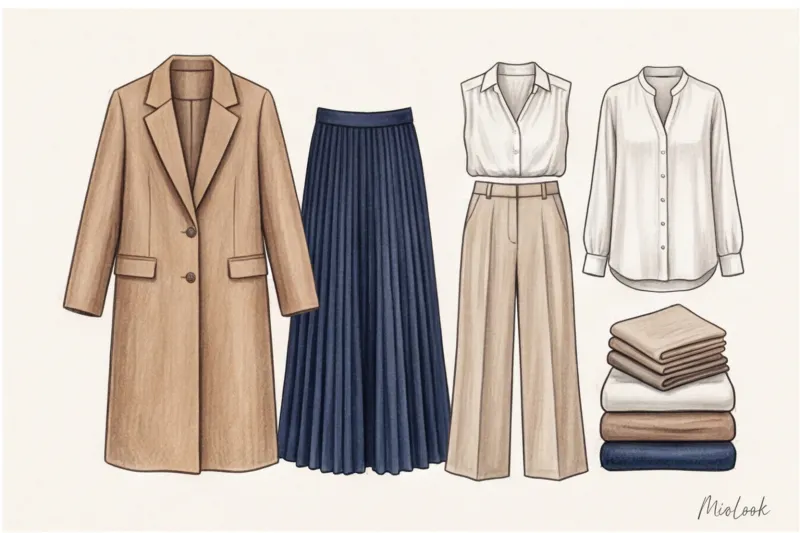
The secret lies in the correct calculation of the capsule wardrobe, taking into account the specifics of closed-end clothing. To create a complete work arsenal, you don't need dozens of items. The optimal base is just 12-15 items, which, through careful cross-combining, create up to 30 complete closed-end looks. Let's break this formula down into details: two versatile suits (a pantsuit and a skirt suit—that's already four items), three well-chosen blouses, two stand-alone maxi or midi skirts, two structured vests, and a pair of thin wool jumpers. If you upload this base to MioLook , the "smart wardrobe" function will clearly show how exactly these elements fit together into looks for the entire month without a single repetition.
The first thing I categorically change in these capsule collections is eliminating all-black. Contrary to popular belief, too much black in layered, closed-off looks doesn't make you look slimmer; it actually turns your figure into a monolithic dark blob, "eating up" the textures of the fabrics. We're making a conscious shift toward deep, elegant shades: navy, rich burgundy, emerald, and warm camel. This color palette looks expensive (especially in high-quality fabrics starting at €150 per piece) and pairs beautifully: for example, an emerald silk blouse under a camel blazer instantly conveys confidence and status.
The Perfect Pantsuit: Width, Length, and Fit
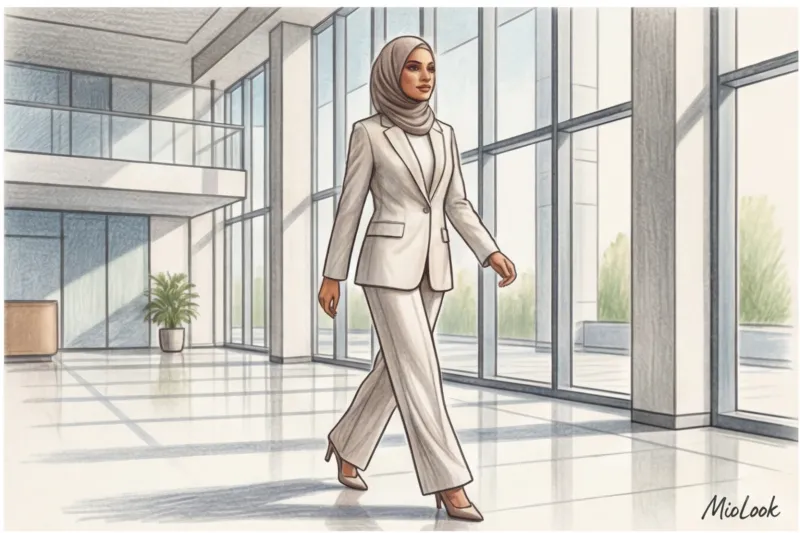
The pantsuit is the alpha and omega of the business wardrobe, but standard brand cuts don't apply here. We offer a no-compromise replacement for classic tapered cigarette pants (which hug the calves and thighs) with flowing palazzo pants or wide, straight trousers with a perfect, firmly pressed crease. The crease here serves a crucial function: it creates a graphic vertical line that visually elongates the height, offsetting the bulk of the fabric.
Pay special attention to the construction of the top. The jacket's length should be exactly below the hip line (ideally 75-80 cm at the back) to completely cover this area when walking and sitting. My absolute favorite for modest capsule wardrobes is a double-breasted, straight-cut blazer. The overlapping front panels create a secure "shield" that prevents the fabric from stretching across the chest, while the strong shoulder line maintains the overall silhouette. A good suit of this cut made of premium wool typically starts at €250-350, but it's an investment that pays off in everyday comfort.
Maxi and midi skirts: avoiding the "heavy bottom" effect
Working with full-length skirts requires a precise understanding of proportions. The most common complaint is, "In a maxi skirt and a long jacket, I look a size bigger and shorter." This is the notorious "hem-heavy" effect, caused by excess fabric. To avoid this, we build a monochrome look (skirt and blazer in the same shade) or match the scarf color exactly to the skirt—this technique draws the eye vertically.
A frequently asked question: is a midi length acceptable in a modest wardrobe? Absolutely yes, with the right styling. A midi-length A-line skirt (below the knee but above the ankle) pairs flawlessly with tall, sturdy tube boots. The key rule is that the boot shaft (leather or suede) should extend at least 5-7 centimeters under the hem of the skirt. This combination leaves no exposed skin, even when climbing stairs, and the silhouette is much more relaxed than a traditional maxi.
Blouses and shirts: concealing body lines without losing a sleek silhouette
The standard office shirt is cut to accentuate curves: it almost always features darts at the chest and waist. For a more closed-off business wardrobe, we look for a completely different cut. The main requirement for blouses is a complete absence of darts at the chest. Instead of a classic set-in sleeve, choose raglan sleeves or styles with a loose, slightly dropped armhole. They provide the necessary freedom of movement and are not tight around the shoulders.
A brilliant styling touch that my executive clients adore is an ascot collar blouse (with a wide bow or ribbons). Tied in a soft knot or a loose bow at the neck, this collar creates elegant extra volume in the décolleté. It naturally and unobtrusively camouflages the contours of the bust while remaining within the bounds of even the most formal corporate attire. Choose styles made of heavy viscose or matte silk with a minimum weight of 19 momme—they have a beautiful heft, flow down, and are completely opaque under cool office lighting.
The Art of Layering in the Office (Smart Layering)
If you search for "layering," the algorithm instantly returns hundreds of relaxed boho looks: cozy oversized sweaters, flowing scarves, and cascading capes. However, in the hallways of international corporations, such stylistic casualness is unacceptable—it comes across as a lack of discipline. A well-constructed business attire for Muslim women requires a completely different approach, which I call Smart Layering (smart layering).
The main goal of layering for the office is to create a distinctly professional look by creating clean, geometric shapes. The secret lies in working with optical illusions. By combining elements of contrasting color and texture, you create strong vertical lines. For example, an unbuttoned or semi-fitted top layer visually "cuts" the silhouette lengthwise. This elongates the height and perfectly disguises the true contours of the body, which is a key requirement of modest ethics.
Working with senior management, I regularly hear complaints about harsh air conditioning in open-plan spaces and meeting rooms. My top practical tip for these conditions: use the finest cashmere or merino wool for your base layer. Look for a 14- to 18-gauge weight on the labels. This ultra-fine thread allows you to wear a turtleneck under a formal shirt without creating a "cabbage" effect or feeling tight in the armholes. A high-quality merino long-sleeve top will cost between €120 and €250, but this investment will pay off with maximum comfort and a perfect fit for your outer layers.
Vests, bibs and long cardigans in smooth knit
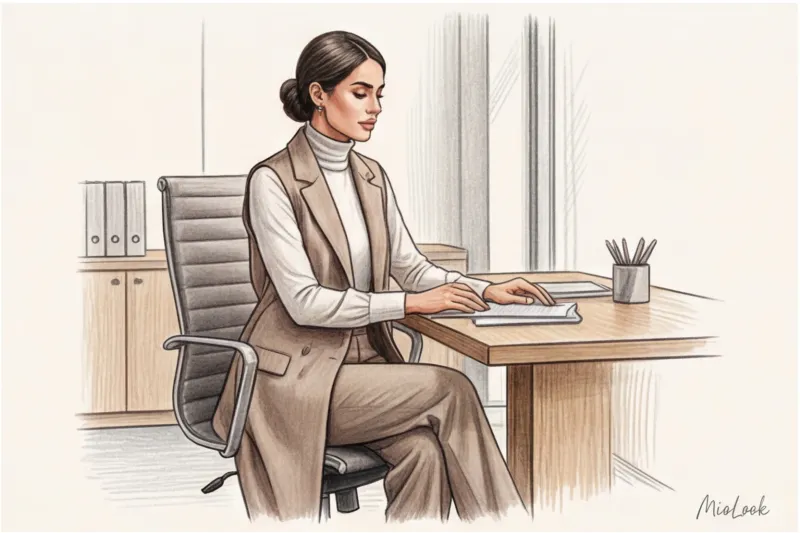
To make layering work for your authority, you need to incorporate the right transformative elements into your wardrobe. One such element is a men's suit vest. Wearing it over a loose, low-waist shirt instantly ties your look together. The vest creates a strict structure thanks to its thick suit fabric, while reliably concealing the chest and back without overheating your arms.
Bibs deserve special attention—a real find for a closed-off business wardrobe. We often find the perfect blazer with accentuated shoulders, but its V-neck is too deep. Wearing a full shirt underneath can be uncomfortable, as the double sleeves restrict movement. A bib made of thick cotton or matte silk gracefully covers the neckline, mimicking the presence of a shirt while maintaining a flawless, tailored look.
If the dress code allows knitwear, choose only long, flat-knit cardigans. Avoid voluminous cables, textured bobbles, or loose yarns. A proper office cardigan should fall in straight, heavy lines below the mid-thigh, working like an elegant, lightweight coat.
Access to MioLook for €0.99 — one-time payment
Start creating the perfect layered office looks with AI.
Get access — €0.99 onceHijab in a Business Environment: Status, Color, and Wrapping Methods
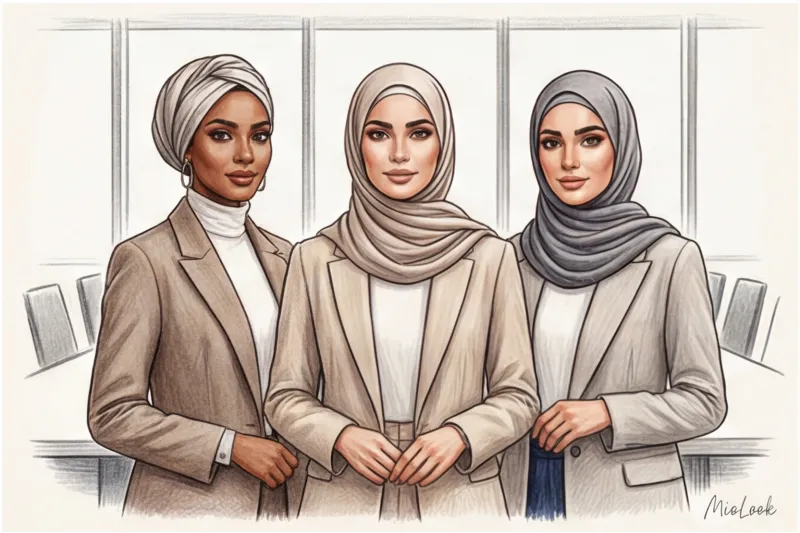
Watching videos from international economic forums, I often analyze how female leaders construct their image. In the corporate world, the portrait area is the epicenter of communication. It's here that initial eye contact is made and your authority is determined. In this context, business attire for Muslim women takes on a new level of meaning, and the hijab ceases to be simply a basic religious accessory. It becomes a powerful tool of power dressing—an architectural centerpiece that can either enhance a leadership position or completely undermine it.
The main rule for integrating a scarf into a strict dress code is radical minimalism and structure. You'll have to completely forego the excessive embellishments often found in evening or casual styles. No tiered drapes, rhinestone brooches, sparkly pins, or elaborate volume at the nape (known as the "camel hump" effect). Excessive volume not only distorts the proportions of the head relative to the strict lines of the jacket but also subconsciously connotes frivolity.
Take a look at the public appearances of Dalia Mogahed, Research Director of the Institute for Social Policy, or at how Melanie Elturk, CEO of Haute Hijab, styles her business looks. Their go-to style for the stage is a sleek updo, clean lines around the face, and invisible magnetic clips instead of clips.
This aesthetic simplicity conveys a clear message to your interlocutors and partners: you're focused on business, not on embellishment. This also applies to the choice of a basic hat (bonnet): it should either match your scarf or subtly blend with your skin tone, without creating a sharp, contrasting outline at your hairline.
Fabric choice: silk, chiffon or jersey?
The texture of the fabric framing your face is critical to your professional status. If your office operates by business formality, go all-out with a high-density matte silk (from 22 momme) or heavy crepe chiffon. These fabrics possess unique physical properties: they hold their folds perfectly, create clean, plump lines, and are completely wrinkle-free, even after long, multi-hour meetings. Investing in a quality accessory made from these materials (usually in the €70–€150 range) instantly elevates the overall look.
For Friday business casual or work in IT and creative agencies, premium jersey is acceptable. However, it shouldn't be the loose, thin viscose from mass-market brands that is see-through and loses shape. Look for dense, elastic blends with high-quality elastane that fall in heavy, elegant folds.
I strongly recommend avoiding shiny textures. Glossy satin creates cheap glare under cold office fluorescent lights. It creates an inappropriate effect of formal evening wear, which clashes with the work environment and visually cheapens even a well-tailored suit.
Integrating the scarf's color into a strict palette
The hijab's color scheme is the finishing touch, capable of bringing disparate pieces together into a unified style. The highest level of status aesthetics is achieved through total monochrome. When a headscarf is perfectly matched to a pantsuit or maxi dress, a continuous vertical line of color is created. This stylistic approach not only visually adds height but also appears understated, expensive, and incredibly aristocratic.
If corporate regulations allow for a scarf to be used as a color accent against a neutral base (such as graphite or beige), choose deep, so-called "jewel" shades: marsala, rich navy, dark emerald, or complex taupe. Be sure to avoid prints—especially large floral patterns, which instantly blur the focus and detract from the formality of the office.
Finding the perfect color pairing can be challenging, especially when your wardrobe contains dozens of items. To avoid morning stress and time-consuming fittings in front of the mirror, I recommend digitizing your accessories. My clients regularly upload their scarf collections to the "smart wardrobe" feature of the MioLook app The algorithm helps you plan your hijab and outfit in advance, selecting the perfect color combinations guaranteed to pass any HR filter and saving you at least 15 minutes each morning.
Summer Business Style: Covered Looks in the Heat
Have you ever wondered why, in July, it's so rare to see truly elegant, covered-up outfits on the streets of financial districts that don't look sweltering? The main challenge of modest style lies precisely here: ensuring uncompromising comfort in fully covered clothing in the summer, when strict corporate dress codes forbid even a millimeter of exposed skin.
According to research by the Institute of Textile Technology (Aachen, 2023), the temperature under a two-layer suit made of low-quality fabric in hot weather exceeds the ambient temperature by 4–6 degrees. In such conditions, properly chosen business attire for Muslim women turns from a visual statement into a matter of physical survival and self-confidence.
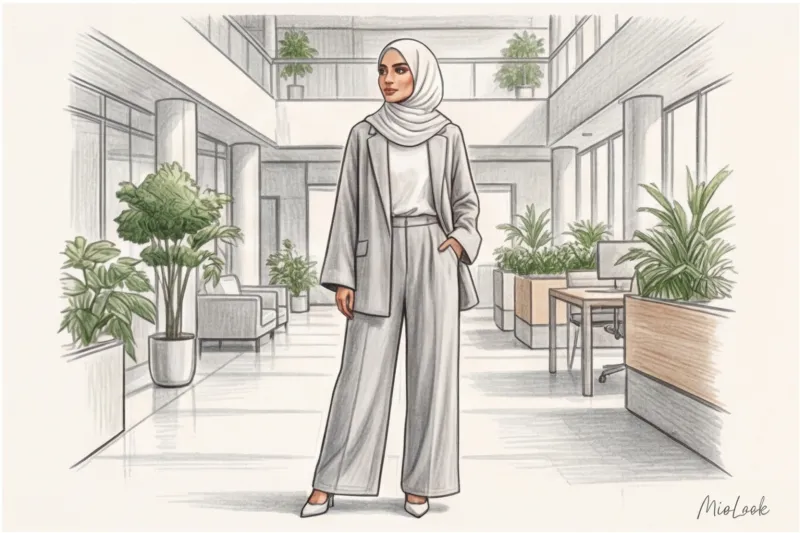
The first thing fashion portals recommend with the arrival of summer is wearing linen. As a practicing stylist, I categorically oppose this cliché within the context of business formal. A strict avoidance of pure linen is the basis for any high-status wardrobe, as this material is too wrinkle-prone for the office. Yes, it breathes beautifully, but its structural instability is fatal to your credibility. You get into a taxi or spend an hour in a conference room, and suddenly your wide-leg trousers are covered in deep, stiff creases, making your look sloppy. My rule: we choose exclusively blended fabrics where the linen is stabilized by the addition of silk or high-tech viscose, which allows the garment to retain its pristine shape from 9 a.m. to 8 p.m.
Your ideal image begins Here
Join thousands of users who look flawless every day with MioLook.
Get access — €0.99 onceTechnological fabrics and "cold" materials
Forget the stereotype that wool is exclusively for winter. A true investment in your summer wardrobe (ranging from €250 to €500 for a premium blazer) is "cool wool." How does this unique material work? The finest Australian merino yarns are twisted so tightly that the fabric is extremely fine, yet still microporous. It literally wicks heat away from the body, allowing the skin to breathe, completely wrinkle-free, and maintaining the impeccable architectural rigidity of the shoulders. For maximum cooling, I recommend looking for suits made from a wool-silk blend (70/30)—silk fibers have natural thermoregulation properties, reducing the skin's surface temperature.
When it comes to top layers and long-sleeved shirts, standard heavy cotton (poplin) creates a greenhouse effect in a closed-up look in the summer. This is why Tencel and Lyocell are ideal replacements for heavy cotton for closed-up summer blouses. These high-tech fibers, derived from eucalyptus wood, absorb 50% more moisture than cotton and instantly wick it away. Expert tests confirm that another innovative material, cupro (an eco-friendly silk alternative made from cotton fluff), works as a portable air conditioner. A cupro blouse flows smoothly against the body without clinging to the base layer and feels pleasantly cool on the hands.
You can audit your summer items and indicate their composition in the app. MioLook This will help you clearly assess what percentage of your wardrobe is truly temperature-ready, and what should be permanently replaced with smart, technologically advanced materials.
Accessories and shoes: setting status accents
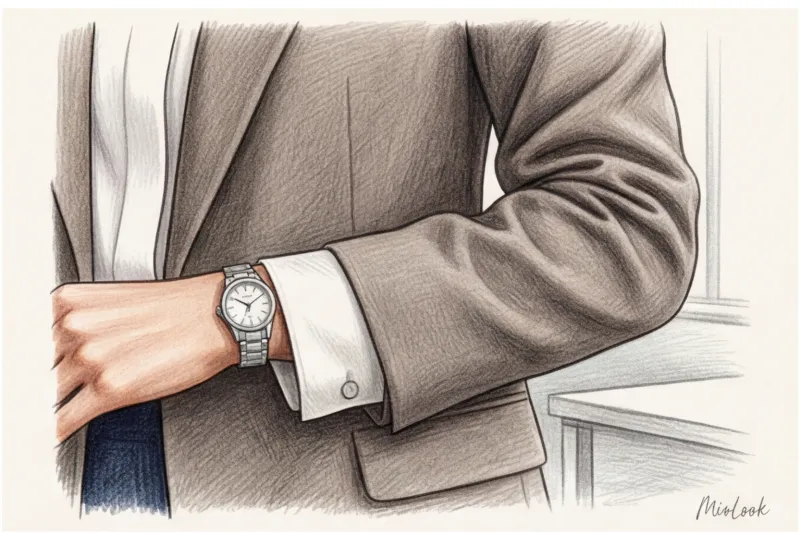
According to the laws of visual composition, the more body area is covered by fabric, the more closely the interlocutor's gaze is drawn to the details. In a closed-off look, accessories (bag, shoes, watch) play the role of primary status markers. When classic corporate attributes—like a defined waist or exposed wrists—are left out, your professional authority is conveyed by the impeccable geometry of your bag and the metal on your watch strap.
In my practice, we often rely on a rule I discussed in detail in the article "Status Accessories: What Marks a Successful Expert": invest in elements that serve as the framework for the entire look. In business attire for Muslim women, this is critical.
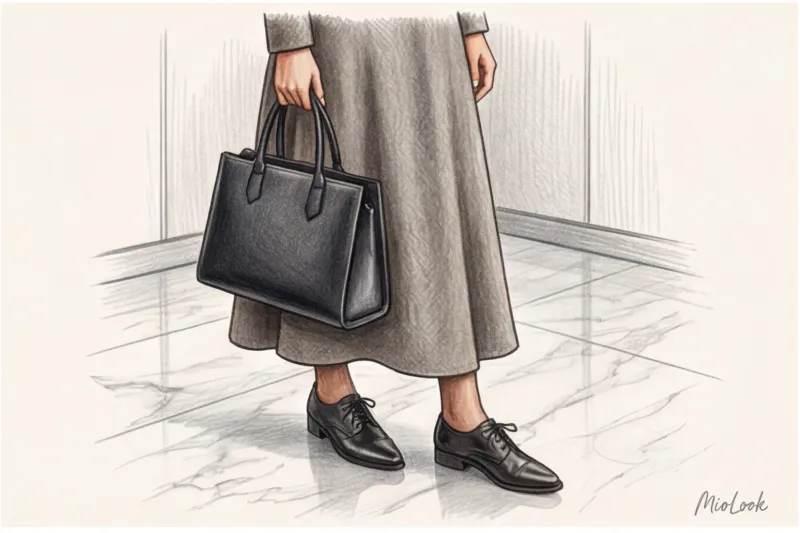
Let's start with the foundation—footwear. During personal shopping sessions, I regularly encounter attempts to complement wide palazzo pants or a formal maxi skirt with stiletto pumps. This doesn't work for a modest aesthetic. A thin heel under a massive, closed hem makes the gait unsteady and the proportions comical. That's why loafers, classic oxfords (in the spirit of traditional Church's), and closed mules are preferable to high-heeled pumps for a modest look. Shoes with a flat sole or a stable block heel give the look that visual "groundedness" and solidity needed in a boardroom setting.
The second ironclad rule concerns leather goods. If your basics consist of long blazers, silk scarves, and wide-leg trousers, contrasting volumes are essential. Rigid, framed bags act as a supporting element for soft, flowing fabrics. A soft leather bag will instantly transform you into a bohemian artist, while a sharp, angular tote (good investment models start at €350–€500) will instantly tie your silhouette together.
To wisely allocate your budget for purchasing statement shoes and bags, I always recommend digitizing your current database. If you upload your items to MioLook wardrobe planner , the algorithm and visual layout will immediately show where the soft tissues lack a rigid architectural point.
Stylist Checklist: 5 Common Mistakes in a Modest Business Wardrobe and How to Avoid Them
Having analyzed more than 400 questionnaires from corporate clients through the wardrobe analysis function in MioLook I've noticed a curious pattern. Smart business attire for Muslim women often suffers from the same subtle stylistic pitfalls. Women invest substantial sums in high-quality suits and statement bags, but their looks fall apart due to micro-mistakes that aren't immediately apparent. Below is my personal shortlist of mistakes that instantly diminish the credibility of an outfit, and practical ways to avoid them.
Mistake 1: Thin knitwear that clings to the contours of your underwear
This is a classic failure, found in every third photograph during digital revision. Wishing to maintain modesty, women buy basic turtlenecks made of thin viscose, deliberately going a size or two too big. However, the laws of physics are inexorable: the thin fabric clings to the body under its own weight, sinking into folds and treacherously emphasizing the contours of a bra or bodice.
Solution: Go for architectural textures. Look for jumpers made of milano (punto milano), thick merino wool, or cashmere blend. A quality basic long sleeve top that holds its shape and creates an airy layer is usually in the €80–€150 price range. It won't cling to your body, even if you choose a true-to-size rather than an oversized one.
Mistake 2: Too many layers creating a messy look
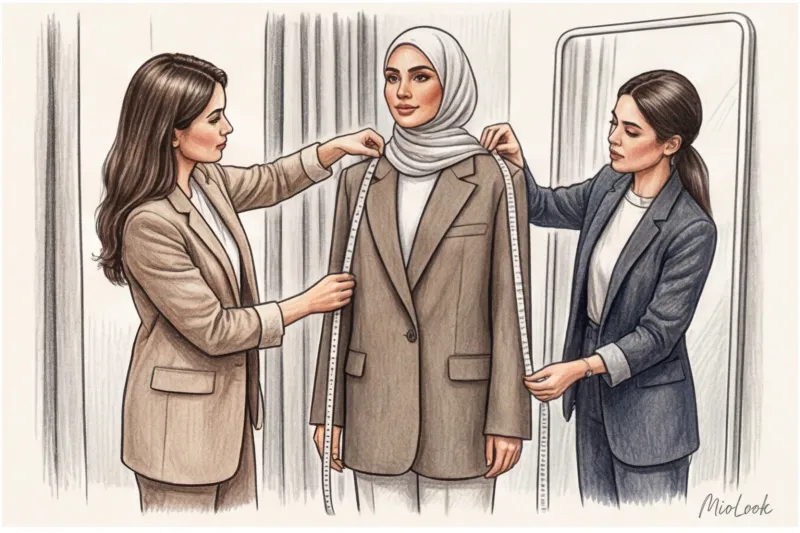
The desire to cover the décolleté and wrists often leads to "cabbage syndrome." A full, oversized shirt is worn under a classic jacket, and then a T-shirt underneath. As a result, the blazer sleeves wrinkle, the fabric bulges, and the silhouette becomes bulky and shapeless.
Solution: Create the illusion of layering. If you only need to cover your neck under a V-neck suit, wear a high-quality mock neck or a silk sleeveless top with a high collar. This will remove excess bulk from your arms and shoulders while maintaining a polished look.
Mistake 3: Open-toe or open-heeled shoes with a strict dress code
Quite often, a millimeter-precise, closed-toe look is finished with bare-heel mules or peep-toe shoes. Within the context of business formal, any display of toes or an open heel is taboo. In the context of modest etiquette, this further disrupts the monolithic silhouette, turning a business look into a casual one.
Solution: Even at +30°C, high-status business etiquette requires a closed foot. Swap clogs for classic soft leather loafers, tailored oxfords, or slingbacks (closed-toe shoes with a strap at the back), worn over a thick matte sock that matches the color of the shoe.
Mistake 4: Incorrect jacket length, cutting off the proportions of the figure
Pairing a maxi skirt with a blazer requires pinpoint precision. The main mistake is a jacket that ends right at the widest part of the hips. This visually cuts the figure in half, makes the waist appear shorter, and makes the bottom half look heavy.
Solution: Use the golden ratio. Choose either a structured cropped jacket (provided the skirt has a high waist and enough volume to conceal curves) or a longer blazer that ends below the hipline—where the volume begins to taper off.
Error 5: Inappropriate color of the bonnet (bonnet)
When choosing an expensive matte silk hijab, many forget about the bonnie—the cap that holds the hair in place. If a contrasting black stripe peeks out from under the cream-colored scarf, it creates a harsh horizontal line across the forehead. This detail instantly evokes a sporty aesthetic and detracts from the portrait area.
Solution: A bonnie should be invisible to others. Choose it either in a tone-on-tone match to your main scarf or in a shade that blends with the color of your roots. This will ensure clean and elegant lines around your face.
Creating a confident and modest wardrobe is the art of mastering the details. Thoughtful business attire for Muslim women requires no compromise between career ambitions and convictions. Once you've calibrated your proportions and eliminated these five visual noises, your look will begin to project impeccable confidence.
Guide Chapters
Office Wear for Plus-Size Muslim Women: Plus-Size Style
A plus-size office wardrobe no longer means shapeless pieces. Learn how to dress modestly, stylishly, and with authority at work.
Status accessories in modest fashion for the office
The right details act as a professional voice amplifier. Discover how shoes and bags help convey status in a closed wardrobe.
The Best Business Attire Colors for Muslim Women
Black isn't the only safe option for the office. Learn how to use deep shades and prints to create an influential business look.
Modest Fashion: Where to Buy Cover-Up Office Wear
Covered-up fashion is the new Power Dressing. We'll share the best architectural minimalist brands for creating a flawless business wardrobe.
Smart Casual for Muslim Women: A Stylish Office Wardrobe
Strict dress codes are on the wane, but how do you find the balance between status and modesty? We explore the architecture of creating a relaxed business wardrobe.
How to Dress for a Job Interview as a Muslim Woman: Stylist Tips
You only have 7 seconds to make a first impression on HR. We'll break down the anatomy of the ideal business attire for a Muslim woman.
Long skirts for the office: what to wear them with according to the dress code
Maxi skirts are replacing the traditional midi length in business attire. We'll show you how to style a long skirt for work and project confidence.
Winter Office Wear for Muslim Women: Style and Warmth
Forget the shapeless, oversized sweaters. Learn how to create a stylish and warm office look using technical fabrics and the right cut.
Summer Business Attire for Muslim Women: Style and Comfort
A one-piece suit can be cooler than a sundress at 30°C if you know the secrets of fabrics and cut. We'll explore how to dress modestly and respect the dress code for the office in the summer.
Closed blouses for the office: style and strict dress code
Forget about loose buttons and sheer fabrics. Discover how a well-chosen high-neck blouse can help you create a flawless business look and enhance your status.
Closed office dresses: stylish modest fashion styles
True modesty in a business environment means not baggy clothes, but impeccable tailoring. Discover the top business styles for modest fashion.
How to Wear a Hijab to Work: A Business Style Guide
Integrating a hijab into a corporate dress code doesn't require complicated knotting. We'll explain how to choose the right fabric and tie a headscarf for a classy look.
Muslim Women's Business Suits: A Style Guide
How can a well-chosen suit save your career? Learn the secrets of choosing formal yet understated business attire from a professional stylist.
A Basic Wardrobe for a Muslim Office Woman: A Stylish Capsule
Cover-ups have become synonymous with the aesthetic of "quiet luxury." Learn how to assemble a high-status office capsule collection without having to choose between dress code and your personal beliefs.