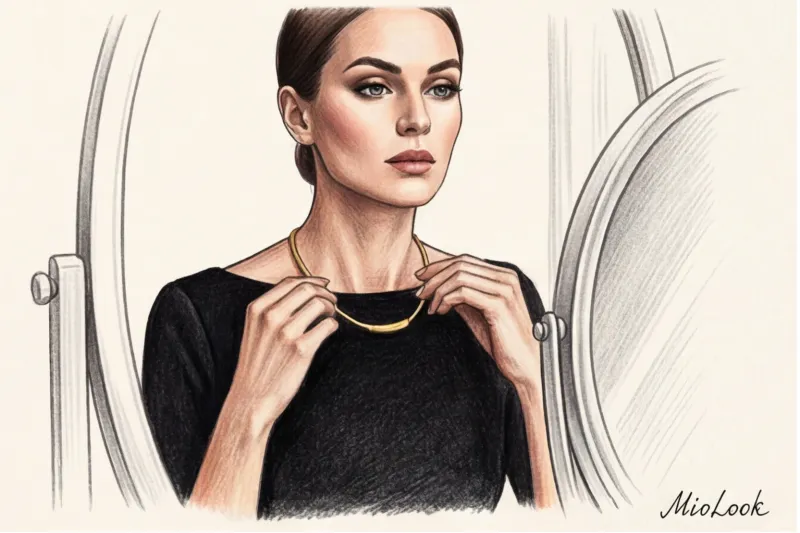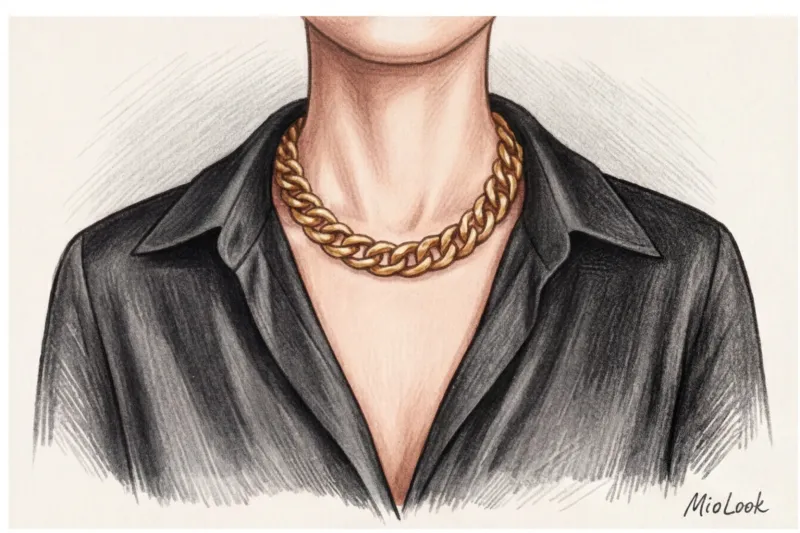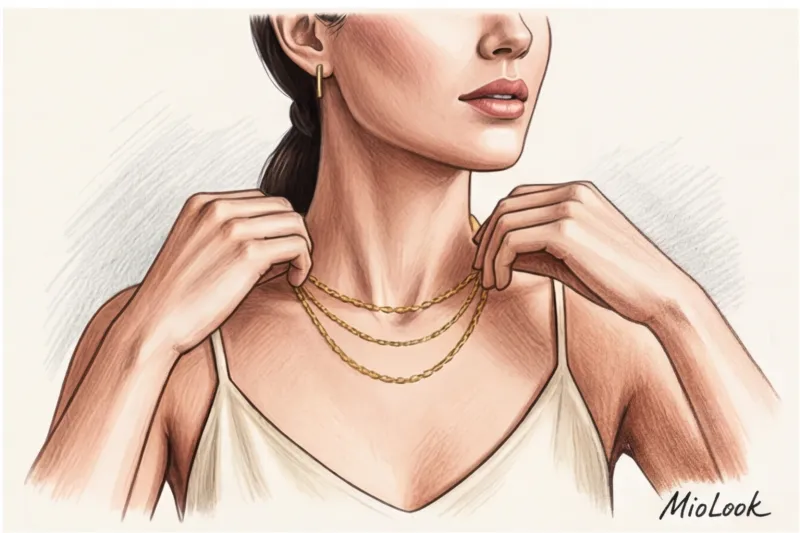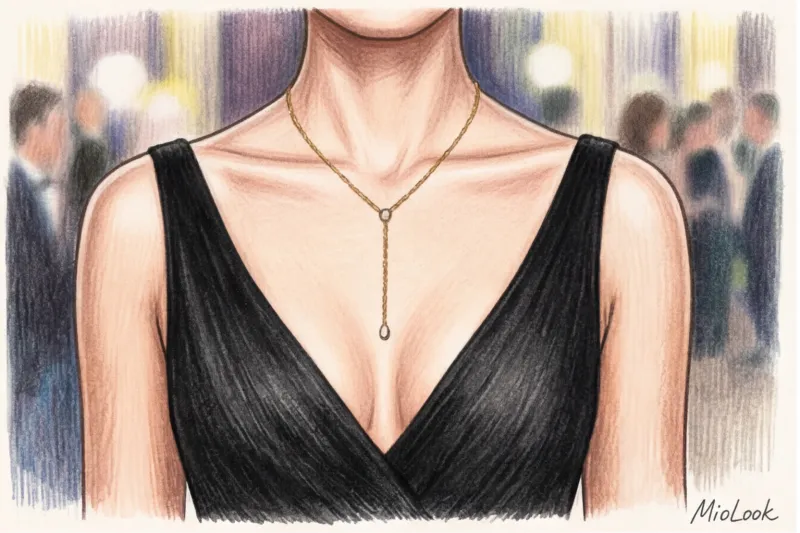
In my 12 years as a stylist, I've seen many fashion disasters, but I remember one in detail. It was the 2018 Cannes Film Festival. My client wore a stunning dusty rose silk chiffon gown. The bodice was weightless, delicately draped. Then the sponsoring jewelry house insisted on a massive diamond necklace, totaling 40 carats. As soon as the clasp clicked around her neck, the dress visually "died." The heavy metal and large stones literally crushed the fragile fabric to the ground.
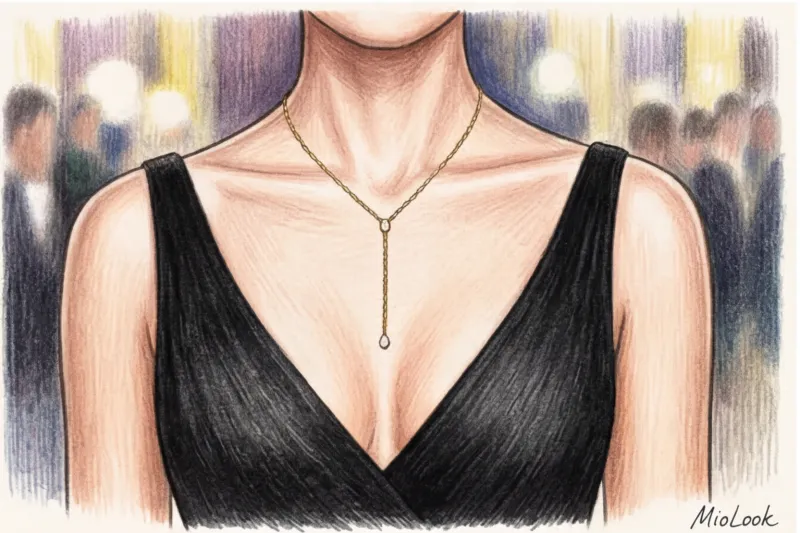
According to a 2022 University of Texas eye-tracking study in the fashion industry, exactly 70% of a person's attention is focused on your facial features—your face, neck, and collarbones. Any imbalance here is detected by the brain in a split second. That's why choosing the perfect decorations for the neckline of a dress — this is not a problem of simple geometric comparisons, but from the field of visual physics.
By the way, the principle of mass balance applies to the entire look. We discussed in more detail how fabric density dictates accessory selection in our complete guide to perfect shoes for an evening dress.
The Art of Negative Space: Why Old Jewelry Rules No Longer Work
Open any glossy magazine from the 2000s, and you'll find an ironclad rule: "A V-neckline calls for a V-necklace, and a round neckline calls for a round neckline." Forget it. Today, blindly repeating lines looks artificial and cheapens the look.
In modern styling, the concept of "negative space" reigns supreme. In painting and architecture, it refers to the empty space around an object that, in itself, shapes its form. In eveningwear, exposed skin on the neck and collarbone isn't a void that needs to be urgently filled. It's a luxurious, stand-alone design element.
"Look at archival photos of Audrey Hepburn in Hubert de Givenchy dresses. Their genius lay in the fact that the neckline served as a frame for the neck, not a showcase for diamonds," fashion historian Alexander Vasiliev often says, and I completely agree.
The right jewelry doesn't duplicate the cut, but rather engages with it. It should take into account the anatomy of your collarbones and the length of your neck. Sometimes a subtle gold highlight on the skin is a hundred times more powerful than a multi-layered necklace.
Visual weight and texture: connecting dress fabric with metal and stones
Remember the Cannes story with the chiffon dress? The problem wasn't the shape of the necklace, but its visual weight. Every fabric has its own density, reflectivity, and volume. Jewelry should perform in the same weight class.
Matte brushed gold instantly fades against the shimmer of silk satin, while heavy, dark stones (like sapphires or rubies) visually overwhelm delicate lace. Let's explore the basic formulas.
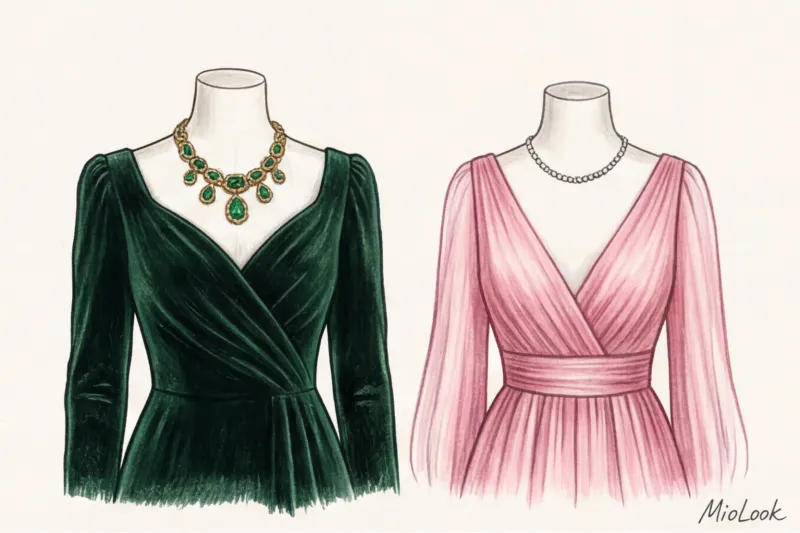
Dense fabrics (velvet, brocade, taffeta)
Smooth cotton weighing over 200 g/m², heavy theatrical velvet, or stiff taffeta—these are fabrics with strong character. They require substantial, structured textures.
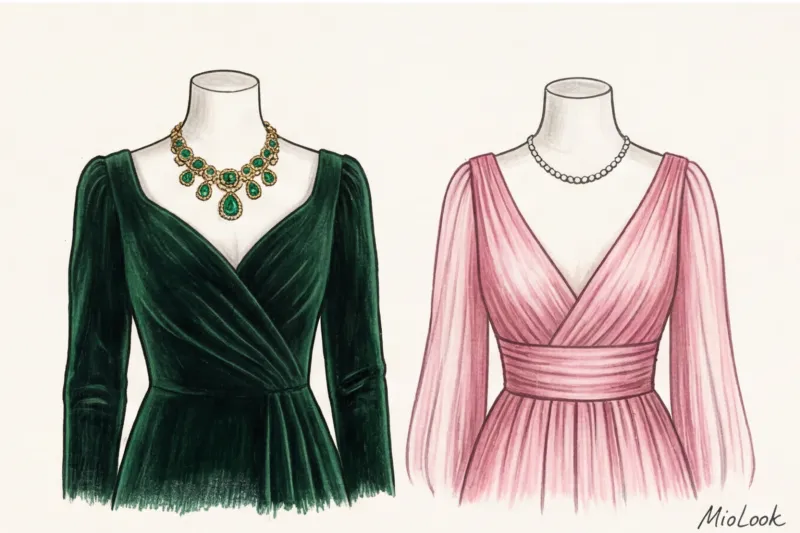
- What to choose: Vintage necklace made of blackened silver, massive baroque pearls, large cabochon-cut stones.
- Historical fact: It wasn't for nothing that royalty wore heavy velvet robes with massive tiaras and medals. A thin chain against ermine or thick velvet looks like a stray thread clinging to the garment.
Flowing silhouettes (chiffon, organza, fine silk)
If your dress is made of a fabric that responds to the slightest breeze (for example, silk chiffon with a density of 6-8 momme), the decorations should create the illusion of weightlessness.
- What to choose: Diamond threads (tennis necklaces), the finest sautoirs, elegant chains with a single transparent stone.
- Be careful with light: Make sure the reflective properties of sequins or lurex on lightweight fabrics don't clash with the sparkle of faceted stones. If your dress is particularly shimmery, choose a metal without stones or pearls.
Access to MioLook for €0.99 — one-time payment
A smart AI stylist will select the perfect look, taking into account the texture of fabrics and the proportions of your figure, in just a few seconds.
Get access — €0.99 onceThe Complete Neckline Guide: How to Adopt the Right Neckline Jewelry
In Hollywood, there's an unspoken "2-3 inch rule" (about 5-7 cm), popularly used by celebrity stylist Kate Young. The gist is simple: a necklace should either end exactly 2-3 inches before the edge of the fabric, lying completely on bare skin, or confidently overlap the neckline, falling over the dress.
The worst thing you can do is choose a pendant that hits the edge of your neckline, occasionally disappearing under it. This creates a sloppy effect. Let's look at specific ones. decorations for the neckline of a dress different forms.
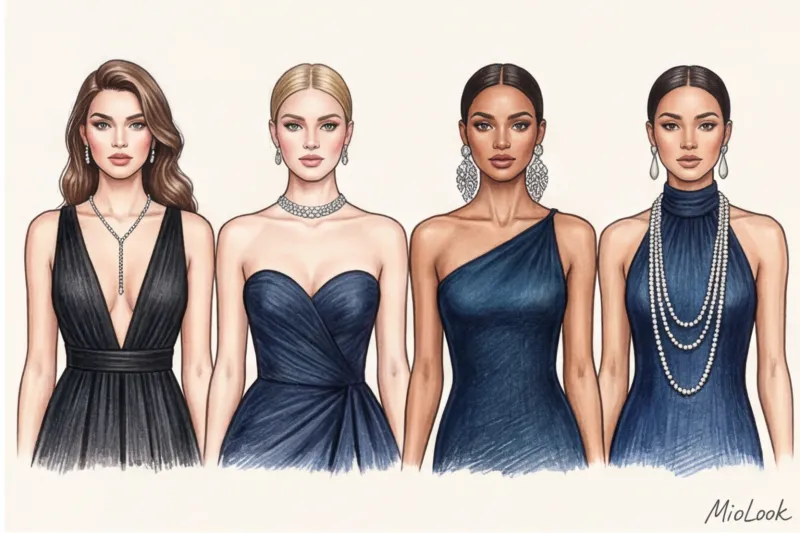
V-neck and extreme neckline (Plunge)
A deep V-neckline elongates the silhouette and lengthens the neck. Our goal is not to detract from this vertical line.
- Ideal choice: Elegant lariats (necklaces) or long Y-shaped chains, the end of which intriguingly disappears into the neckline. Golden ratio: the pendant should end exactly halfway between the sternal notch and the beginning of the fabric.
- Strict taboo: Short, round necklaces that reach up to the neck. Chokers are only acceptable here if you have a naturally long, swan-like neck. Otherwise, the choker will "cut off" your head from your body, ruining the magic of the V-neck.
Off the Shoulder (Bandeau and Strapless Corsets)
A strapless bodice is the purest, most versatile canvas in eveningwear, offering you maximum freedom of movement.
- Ideal choice: From massive collar necklaces that cover the entire space up to the collarbone to simple diamond strands. The main rule: don't leave the décolletage completely bare if you have a sleek hairstyle. Either a necklace or large statement earrings.
Boat Neckline (Bateau) and Square Neckline (Kare)
The bateau neckline is the elegant shoulder-skimming cut adored by Audrey Hepburn. The bob is a strict square, requiring equally graphic accessories.
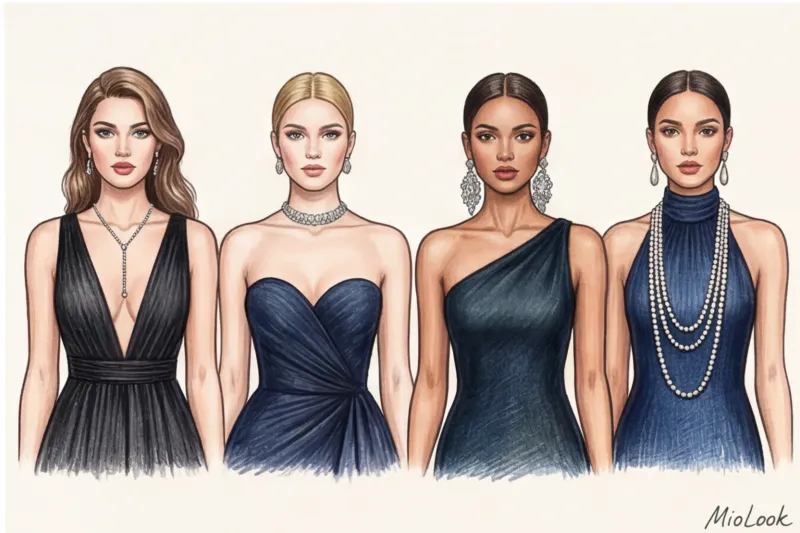
- Bato: Long, tiered strands of pearls (1920s style) reaching below the bustline. Or ditch the necklace entirely in favor of large clip-on earrings.
- Kare: Pendants in clear geometric shapes (square, diamond, emerald cut) are placed just above the neckline. Rounded, romantic medallions will contrast with the crisp lines of the dress.
Asymmetry and one-shoulder cutout
This is where many women make the biggest mistake: seeing a slanted line of fabric, they try to "balance" it with an asymmetrical necklace. Don't do this.
- Ideal choice: Asymmetry is self-sufficient. The only true solution for the neck is to leave it alone. Shift the focus: wear large chandelier earrings, or try a trendy single earring on the side opposite the dress strap. Add a chunky bracelet to your wrist.
Focus Error: When is it best to leave your collarbones bare?
This is the most counterintuitive insight that few stylists realize: the boldest and most appropriate embellishment for a complex dress is none at all.
Before a celebrity steps out on the red carpet, we often employ the "no necklace rule." I've personally removed a client's necklace more than once, minutes before the cameras flashed. If the dress's bodice is heavily draped, features ruffles, crystal embroidery, or a complex architectural design, the necklace will create visual noise. The look will feel stifled.
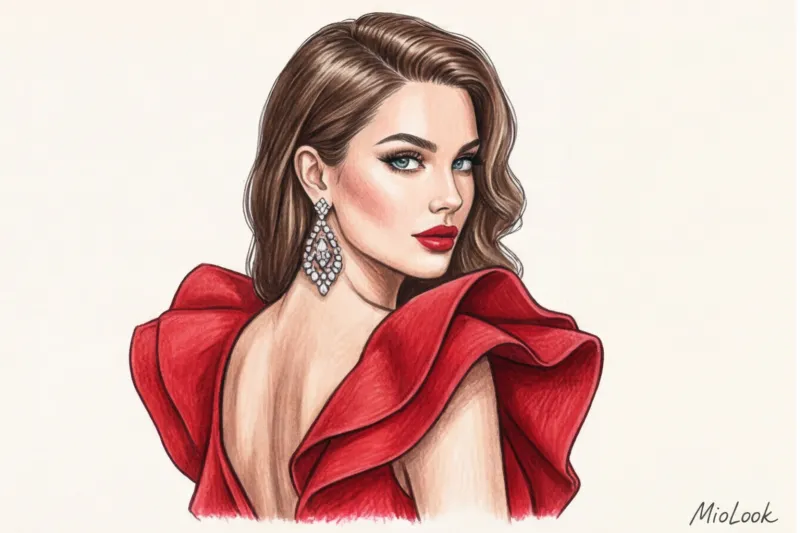
The portrait section should feature only one main character. It could be a lavish neckline (like a sculpted Mugler corset) or a luxurious piece of jewelry against a minimalist silhouette. If you choose a dress with a complex texture, shift the focus: pull your hair back, skip the pendants, and wear chunky ear cuffs or sculpted bracelets over your sleeves.
Your perfect look starts here
Join thousands of users who look flawless every day with our smart wardrobe feature. MioLook will suggest accessories that perfectly complement your outfits.
Get access — €0.99 oncePrecious Evening Dress Etiquette: Status and Appropriateness
Jewelry etiquette isn't a snob's invention, but a strict set of rules developed over decades of European gala dinners. As a jewelry historian and Christie's auction house expert notes, what's impeccable for a private reception will look out of place at a cocktail party.
Black Tie (a full-length evening gown) calls for real jewelry or high-end costume jewelry. White Tie (the strictest royal dress code) is the time for diamonds, especially after 8:00 PM. But if your event is during the day (for example, a gala dinner), massive, sparkling stones are considered a faux pas. Opt for pearls, matte gold, or colored enamel.
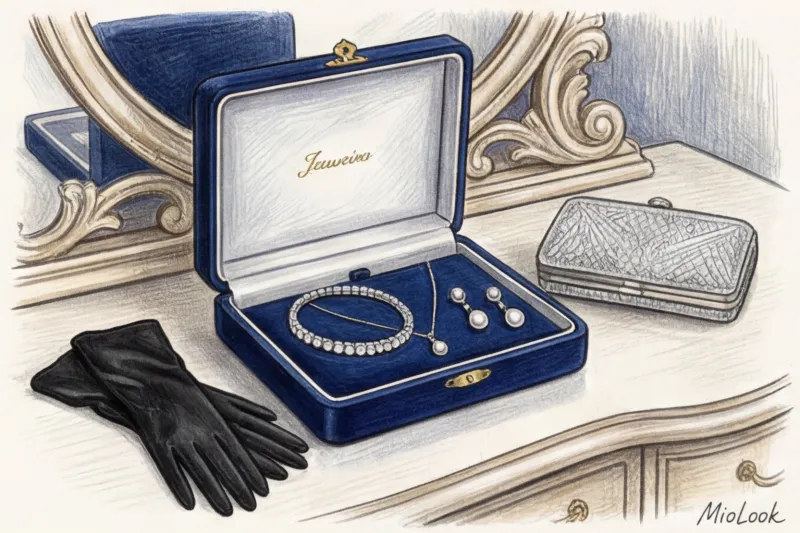
And one more important rule that is often forgotten: full jewelry sets make you look older A set of "necklace, earrings, bracelet, and ring" in a single design (a parure) is currently only appropriate for Queen Camilla's formal occasions. In modern styling, it looks heavy and mature. Choose one or two strong accents. Diamond chandeliers? Then just a cocktail ring. A massive collar necklace? Subtle studs on your ears.
Stylist Checklist: Final Check of the Image's Geometry
Before leaving the house, do a final check of your look. I ask my clients to take three simple steps right in front of the mirror.
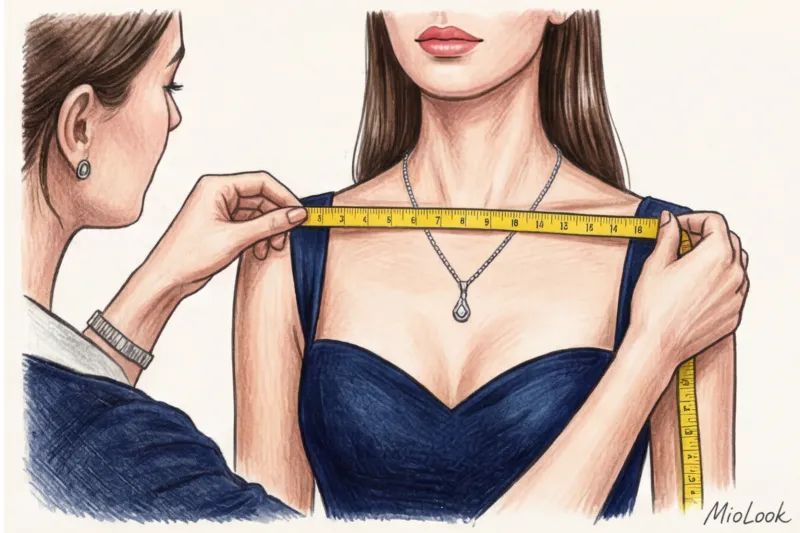
- Full-length photo with flash: Take a selfie with your phone's flash. You'll instantly see if the sparkle of the jewelry clashes with the fabric of the dress. Sometimes, what looks harmonious in the dim light of a fitting room turns into a disco ball in bright light.
- Checking the "blind zone": Take a deep breath, raise your arms, and lean forward. If your necklace keeps catching on the edge of your neckline or getting caught under it, remove it. Keep a 2-3 inch gap.
- Weight balance from top to bottom: Consider the look from head to toe. A complex updo + chunky earrings + necklace + floor-length dress = too much. Lighten at least one element (for example, wear your hair down or remove the earrings).
The most important thing to remember is that any necklace is just a frame for a picture. And the picture is your face, the sparkle in your eyes, and your confident posture. If, when you look in the mirror, the first thing you notice is the size of the stone on your neck, not your cheekbones, then you've chosen the wrong piece.