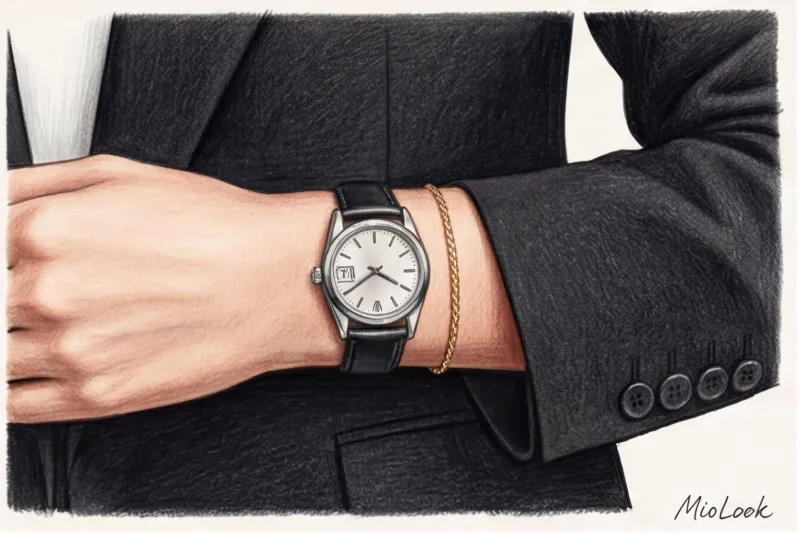
Last week, a new client came to me for a wardrobe review. She gracefully removed her tweed jacket, revealing a classic Swiss watch on her wrist, alongside a luxurious diamond tennis bracelet. There was just one problem: the sapphire crystal and the stainless steel side of the watch were covered in a network of tiny, yet noticeable, scratches. It's a very common occurrence: we invest in expensive accessories but give them absolutely no thought to their physical surroundings.
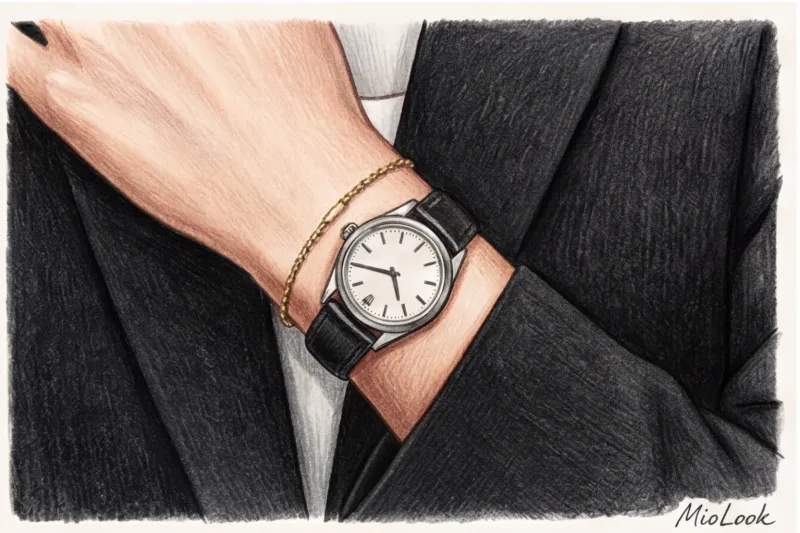
In my 14 years as a stylist, I've learned one critical lesson. How to wear watches with bracelets It's not just a matter of aesthetics and personal taste. It's the true architecture of proportions and, as boring as it may sound, a basic understanding of physics. We've covered the fundamentals of base formation in more detail in our the complete guide to your jewelry wardrobe , and today let's focus exclusively on the wrists.
Wrist architecture: the key to wearing watches with bracelets
The boho-chic era of the 2010s, when it was considered normal to wear a jingling mountain of bracelets, leather laces, and a massive chronograph on one hand, is finally a thing of the past. According to the WGSN Trend Institute's 2024 analytical reports, we have entered an era of "conscious minimalism." In professional circles, we call a well-composed wrist set the term Watch Stack (watch stack).
The biggest mistake I see 8 out of 10 women make when reviewing their wardrobes is incorrect wrist placement. Most women try to wear bracelets "higher" than their watches, closer to the elbow. This visually breaks the line of the wrist and looks sloppy.
How does proper architecture work? Remember the "70/30 Rule," based on the classic principle of the golden ratio. Your anchor is your watch. It should take up approximately 70% of the visual weight on your wrist and sit snugly behind the protruding bone (the styloid process of the ulna). The remaining 30% of the volume is given to the bracelets, which are positioned closer to the brush.
"Always start your accessory collection with an anchor watch. This instantly reduces the cost-per-wear (cost per wear) of your basics. Simple jeans and a white T-shirt paired with a well-organized watch stack are perceived by others as 'quiet luxury,' not weekend wear," says Olena Kovalenko.
It is this technique, not brand logos, that elevates your everyday look to a status category.
Safety Tips: How to Avoid Scratching Your Expensive Watch
Returning to my client's story with the scratched watch, the main enemy of expensive watch movements isn't water or impacts, but diamonds.
Let's turn to mineralogy, specifically the Mohs scale of hardness. A diamond has the maximum hardness—10. Sapphire watch crystal scores 9. But jewelry steel (for example, the popular 316L grade) scores only about 5-6, and gold even less. When a soft diamond-studded tennis bracelet rubs against the steel case of your watch, the stones act like merciless sandpaper.
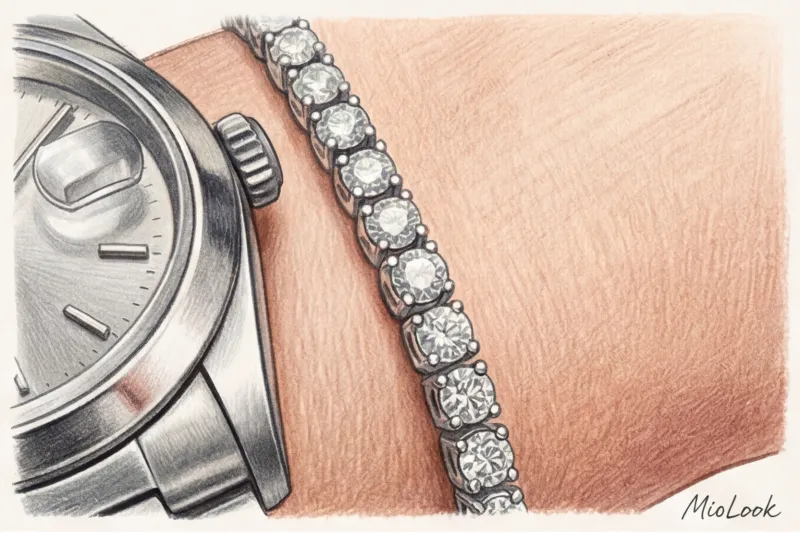
3 rules of jewelry safety:
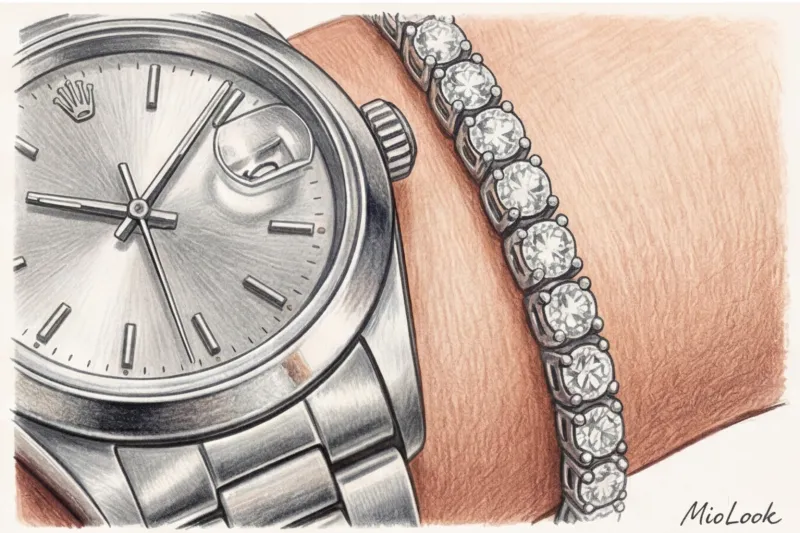
- Hard is safer than soft. Smooth, rigid cuff bracelets are less likely to damage the watch because their range of motion is limited. Soft chains have a nasty tendency to get caught under the crown and scratch the case edges.
- The skin acts as a buffer. If you want to wear chunky metal jewelry, choose a watch with a leather strap. Leather doesn't scratch as much against metal as steel does against steel.
- Keep your distance. If you're determined to wear diamonds next to your watch, layer a thin, basic bracelet (like a smooth gold band) between them. It will absorb the impact.
Your perfect look starts here
Not sure if your bracelets match your watch? Upload them to the MioLook virtual wardrobe, and a smart AI stylist will help you create flawless outfits.
Get access — €0.99 onceMyths about metals: can you combine gold, silver and steel?
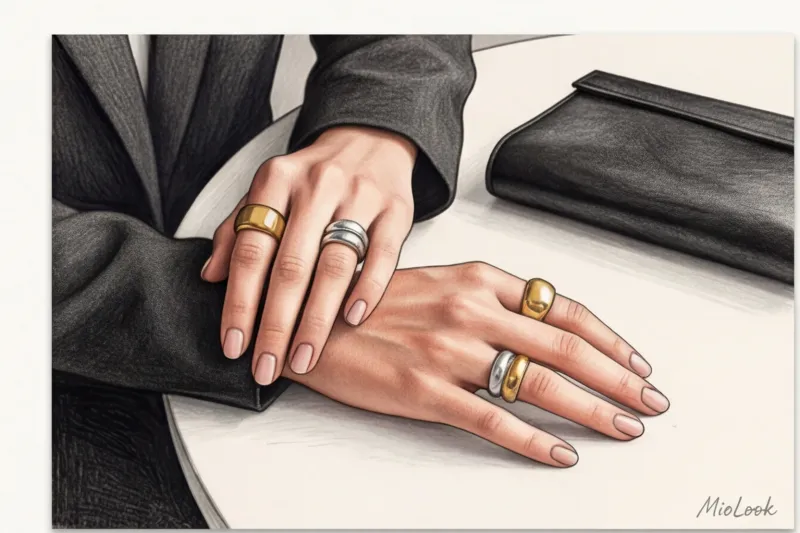
If you still believe that bag hardware, watches, and all jewelry must be strictly one color, forget it. This rule is hopelessly outdated, and we discussed why in detail in the article about outdated style rules Moreover, a perfect match of metals (the so-called mono-metallic look) today looks "flat" and makes the purchase appear like a complete set, which is considered bad taste in stylist circles.
But you have to mix it wisely. My favorite one works here. the "jeweler's bridge" rule.
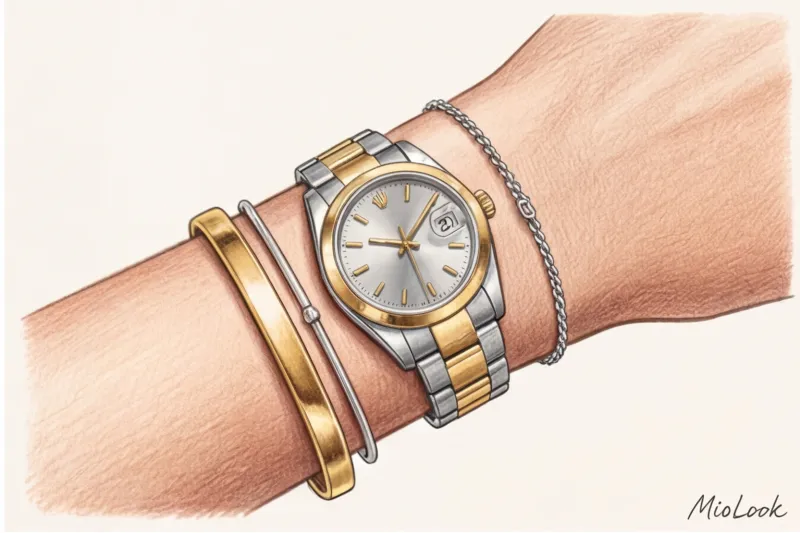
Last year, a 42-year-old client approached me. She had accumulated a substantial collection of family yellow gold from the 2000s, but her new wardrobe called for cold steel and white gold. The solution was to buy a bicolor watch. A steel case with a gold bezel or a two-tone watch bracelet instantly becomes the "bridge" that legitimizes any metals on either side.
If you don't have a two-tone watch, play with contrasting textures. Smooth polished silver will clash with smooth yellow gold. But if you pair a stainless steel watch with a matte gold bracelet or a piece with a pronounced texture (braiding, embossing), the look will instantly become complex and eclectic.
3 ready-made formulas: which bracelets to wear with women's watches
Creating meal plans is like cooking—when you know the basic proportions, you'll never mess up a dish. I use these formulas when creating capsules for my clients, adapting them to suit their different lifestyles.
Formula 1: Status Minimalism (for the office and business)
This formula will fit perfectly into your business capsule wardrobe , when you need to convey expertise without looking boring.
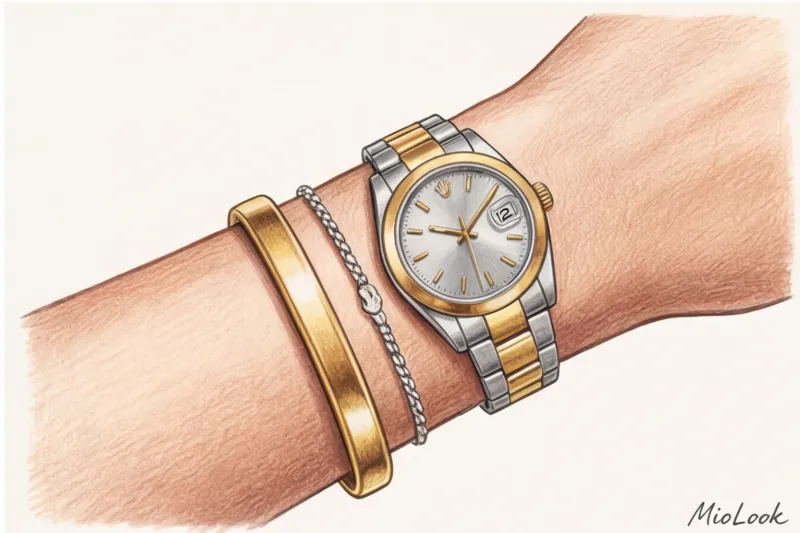
- Base: Watch on a classic metal link bracelet.
- Addition: One rigid cuff bracelet (in the style of Cartier Love or any minimalist equivalent) or a large chain bracelet.
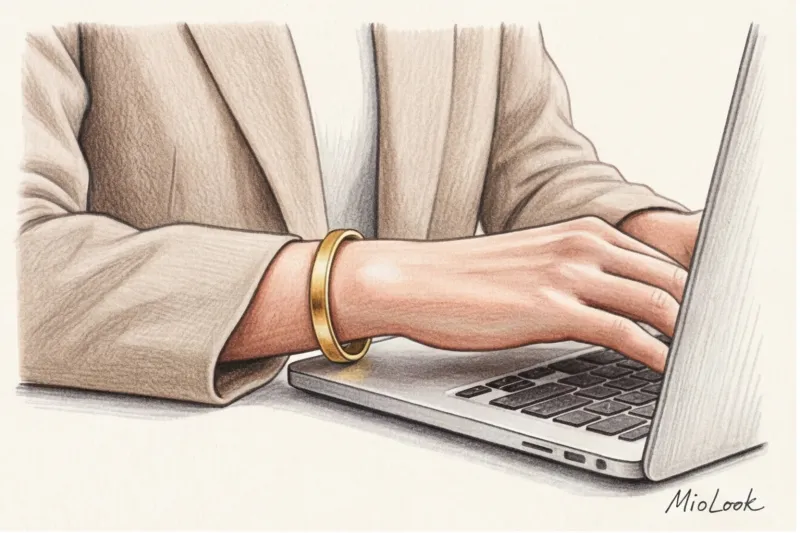
- Stylist's secret: If you have a strict dress code, avoid jingling combinations. Your set shouldn't make any noise when you're typing on a laptop or gesturing during a presentation. A stiff cuff that sits close to the wrist is the perfect "silent" companion.
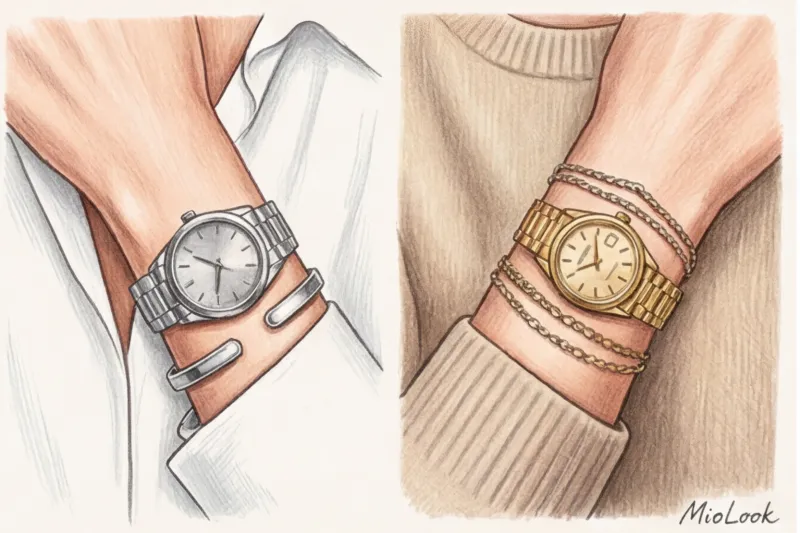
Formula 2: Relaxed Smart Casual
A formula for Friday office or informal meetings that perfectly complements the style smart casual.
- Base: The watch comes with a textured leather strap (crocodile or smooth calfskin).
- Addition: 2-3 thin chains of different weaves + one accent bracelet with small stones.
- Stylist's secret: Complement the color of the leather strap with the shade of stones or enamel in one of the bracelets. For example, a brown strap looks stunning next to a bracelet with tiger's eye or warm amber inlays.
Access to MioLook for €0.99 — one-time payment
Not sure which formula to choose? Start creating perfect looks and combining accessories using artificial intelligence right on your phone.
Get access — €0.99 onceThe main mistakes that cheapen the image
It's time to talk about when layering absolutely doesn't work. Every rule has its limitations.
1. The "gypsy" effect and lack of air
There should be a bit of negative space—a strip of bare skin—between watches and bracelets. If jewelry sits tightly against one another, forming a monolithic shield from the wrist to the middle of the forearm, the hand will appear shorter and thicker.
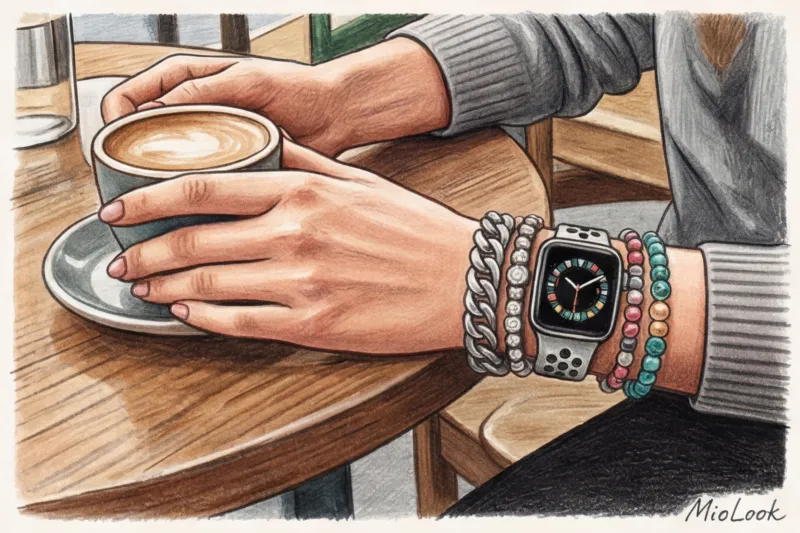
2. Smartwatches and evening diamonds
My personal stylistic taboo. The most common mistake I see from female executives is trying to pair an Apple Watch with a sporty silicone strap with classic gold chains or, even worse, diamonds. It's a stylistic clash. If you can't give up a smartwatch, swap out the silicone for a high-quality Milanese steel or leather strap—then your gadget will at least come a little closer to the world of jewelry.
3. Shambhala and strict classics
Bracelets made of wooden beads, natural stones on elastic, or woven macrame threads are perfect for vacation. But next to a simple Roman numeral watch face, they look like they were forgotten after a Bali retreat.
Checklist: Building Your First Perfect Set Step by Step
To make sure this theory doesn't just remain text on a screen, I invite you to take your watch box for a hands-on test drive right now. Here's my step-by-step algorithm for consciously investing in your wrist style:
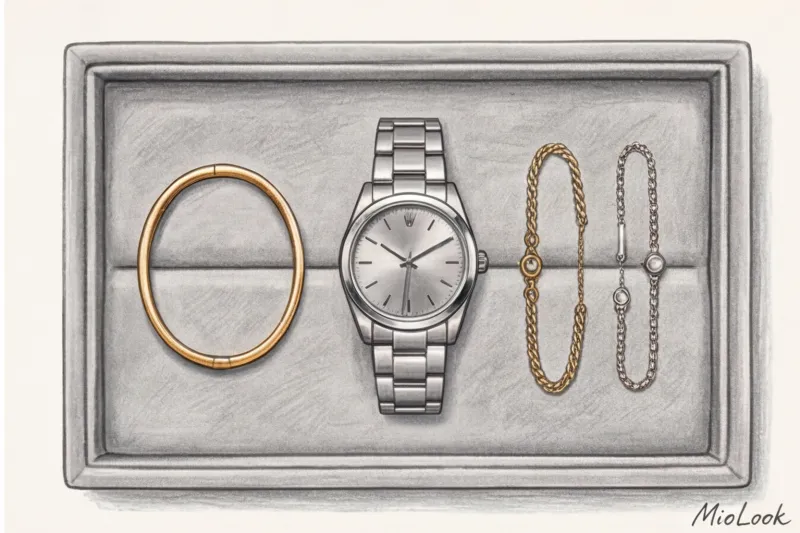
- Step 1: Fixing the anchor. Put on the watch. It should rest just behind the protruding wrist bone and fit snugly enough so that the dial doesn't slide down, but your pinky finger can still fit under the strap.
- Step 2: Base. Add a basic rigid or semi-rigid metal bracelet closer to the wrist. Consider the proportions: the watch should remain the main accent.
- Step 3: Dynamics. Add an accent—a thin chain with a pendant, a strand of small pearls, or a bracelet with a different metal texture. This detail should slide freely over your hand as you move.
- Step 4: Comfort and sound test. Shake your hand, simulate typing on a phone or keyboard. If it hurts, is too difficult, or the set sounds like an orchestra, remove one element.
A woman's wrist is one of the most delicate and fragile parts of our body. By drawing attention to it with a well-chosen jewelry set, you create a focal point that speaks volumes about your impeccable taste more than any designer handbag. Don't be afraid to experiment with metals, but always keep in mind the laws of physics and appropriateness.