A year ago, the CFO of a large IT company came to me for a personal consultation. She was a gorgeous woman, wearing an impeccable dark blue Jil Sander suit and an expensive Swiss watch. But there was one detail that ruined her entire image. During important meetings, when she gestured vigorously or typed rapidly on her laptop, her massive rings loudly clanked against each other and the aluminum case. This constant clanking destroyed the aura of a confident leader. Instead of a prestigious top manager, the woman sitting before her partners looked as if she were wearing the entire contents of her jewelry box for the first time.
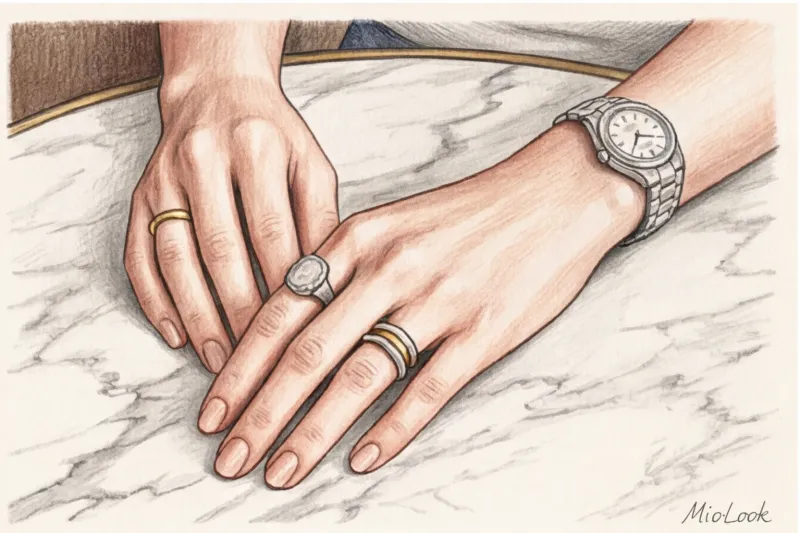
The question is, How to wear multiple rings At the same time, it has long gone beyond the simple "combine what you like." We've already discussed the basic principles in more detail in our the complete guide to your jewelry wardrobe , but today I want to dig deeper. We'll examine a trendy set not as a random assortment of jewelry, but as a thoughtful architectural design, where visual weight, hand anatomy, and even the physics of minerals play a role.
Style Architecture: Basic Rules for Wearing Multiple Rings Without Looking Ridiculous
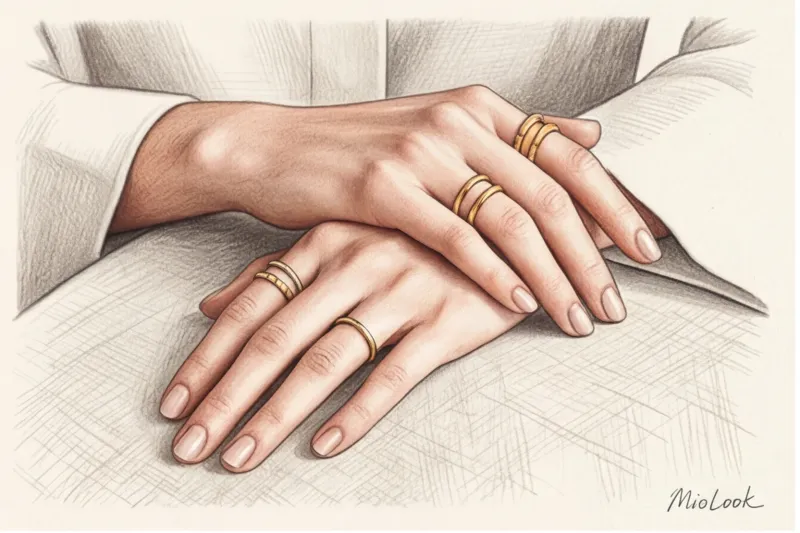
Symmetry is the worst enemy of modern style. If you wear one ring on each finger of both hands, you're not demonstrating status. You're creating a visual "brass knuckles" effect, which weighs down the hand and evokes outdated style rules early 2000s.
According to the WGSN analytical report (2024), modern luxury jewelry is built on asymmetry and the concept of "negative space." Negative space is your empty fingers. They are what allow a ring set to "breathe."
"Luxury abhors fuss. Leave at least two fingers on your hand completely free of jewelry, and you'll see how your entire look instantly acquires an aristocratic casualness."
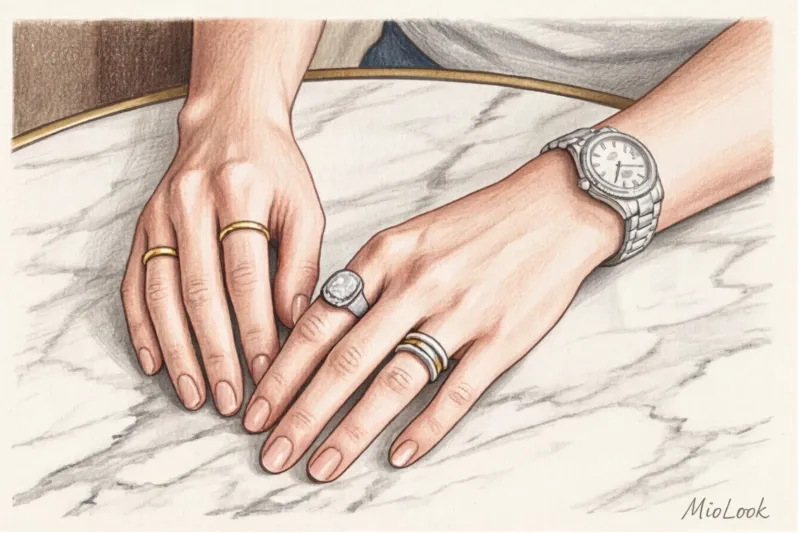
To make the set look harmonious, I always use in my work with clients 60/40 rule It involves skillfully distributing the visual weight between your left and right hands. For example, if you're wearing a chunky watch with a steel bracelet on your left wrist (which already accounts for 60% of the visual weight), add just one thin, minimalist ring. But make your right hand (the remaining 40%) the focal point by wearing a complex set of three rings on different phalanges.
Hierarchy of the set: soloist, choir and air
Any successful ring set is assembled according to a clear formula: soloist + choir + air. If all the rings shouted equally loudly, the result would be visual noise.
- Soloist (Statement ring): The largest, brightest ring, or the ring with the main stone. It's worn first and sets the tone. The ideal place for it is the index or middle finger.
- Choir: Basic smooth runner rings, thin headbands, or phalanx rings. Their purpose is to support the soloist, not drown them out.
- Air: Distance between rings. Avoid layering wide rings on adjacent fingers so that they rub against each other at the sides.
Access to MioLook for €0.99 — one-time payment
A smart AI stylist will select the perfect look.
Get access — €0.99 onceMixed Metals: Breaking the Main Stereotype About Jewelry
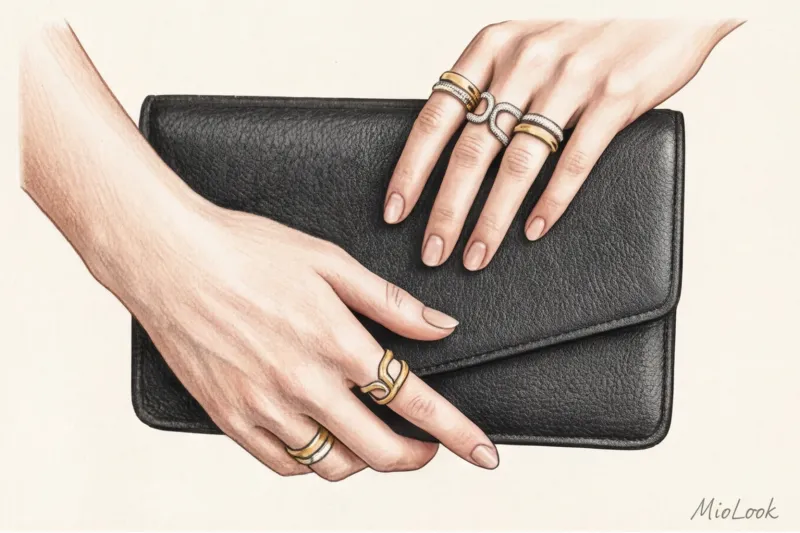
If you still think mixing white and yellow gold in one look is bad form, forget it immediately. These days, monochromatic sets look boring and often add age. But simply wearing a gold ring on one finger and a silver one on the other creates a random effect. To make the mix look expensive, I use this technique. bridge piece.
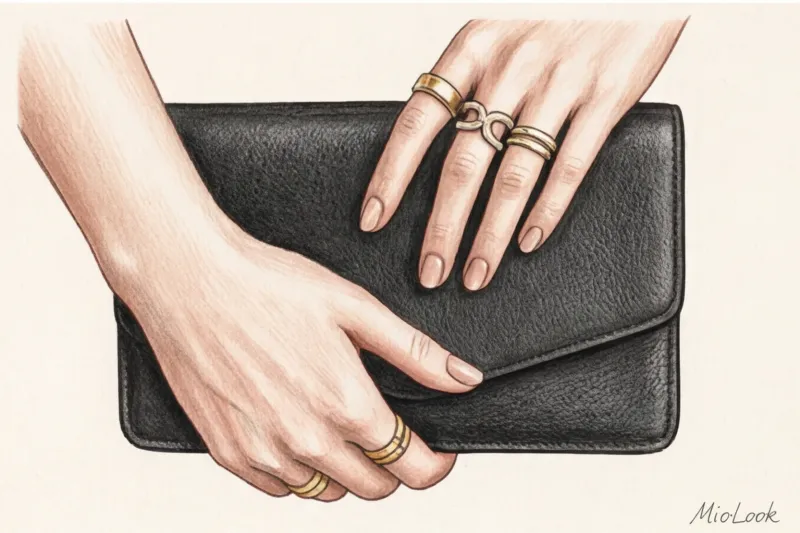
A "bridge" is a bicolor jewelry piece that fuses two metals together. The legendary Cartier Trinity ring or a fine steel and yellow gold watch are perfect for this task. Wearing this bicolor piece legitimizes any other metals on your wrist. White gold begins to "speak" the same language as yellow gold.
Another secret stylists use: playing with textures. Glossy yellow gold next to glossy silver often clashes. But try combining matte Brushed yellow gold with white gold polished to a mirror shine. The difference in texture eliminates the color clash.
Incidentally, adding two-tone jewelry dramatically reduces your cost-per-wear. You invest in one ring, and it magically ties your entire jewelry box together.
Office Dress Code: How to Stylishly Wear Multiple Rings at Work
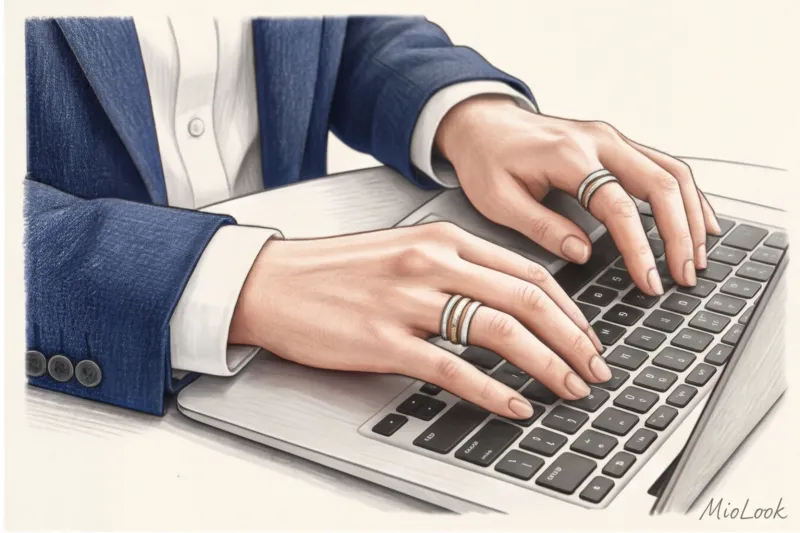
A corporate environment requires a special approach. What looks great over a glass of Prosecco on the veranda might be a bad idea in a boardroom. The line between smart casual and business formal in jewelry is a fine one.
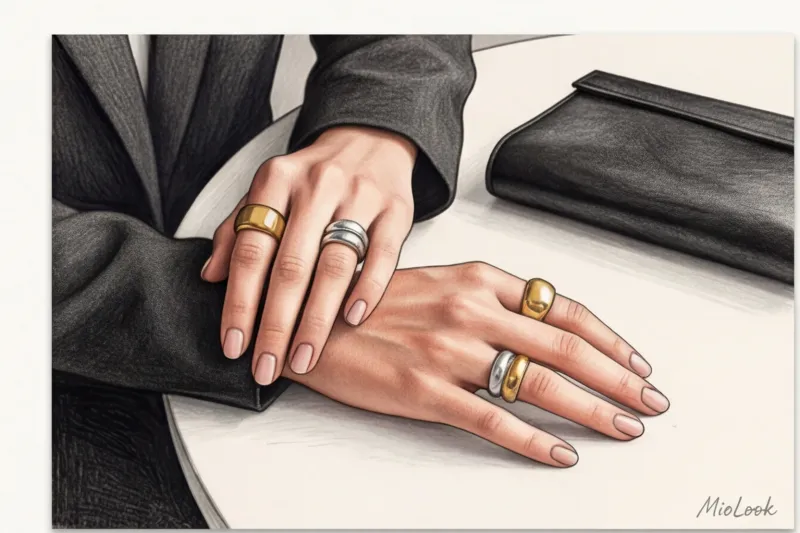
Let's recall my client from the beginning of the article. The main rule of the office set is sound etiquette and low profile Rings should not rattle, jingle, or snag on clothing. For formal looks (for example, a crisp navy blazer and a crisp white shirt), we create sets exclusively of smooth band rings without protruding settings (stone mountings).
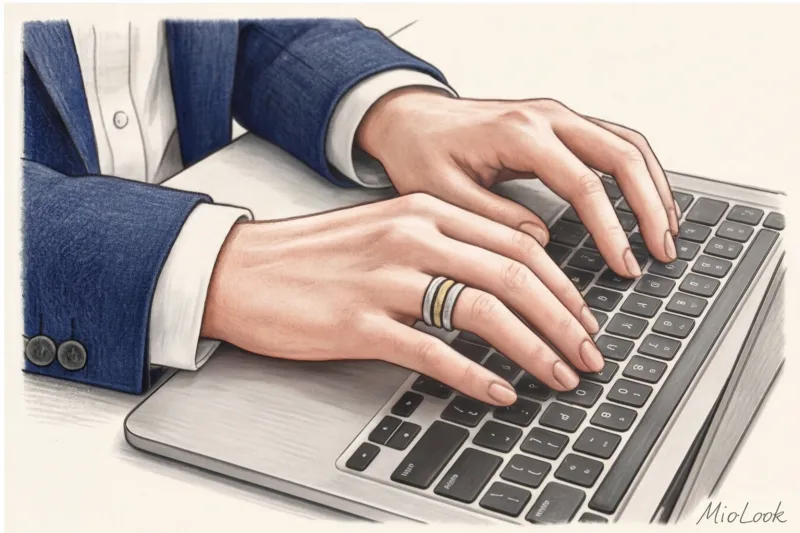
A great way to enhance your office presence is with a signet ring on your pinky finger paired with a thin wedding band on your ring finger. It looks understated and businesslike, yet with a hint of English aristocracy. If you're unsure whether your favorite set will fit into your business capsule wardrobe, use the "smart wardrobe" feature in MioLook — the app will help you visualize how specific accessories pair with your office jackets before you leave the house.
Your ideal image
it begins Here
Join thousands of users who look flawless every day with MioLook.
Get access — €0.99 onceHand Anatomy: How to Wear Multiple Rings Based on Your Finger Shape
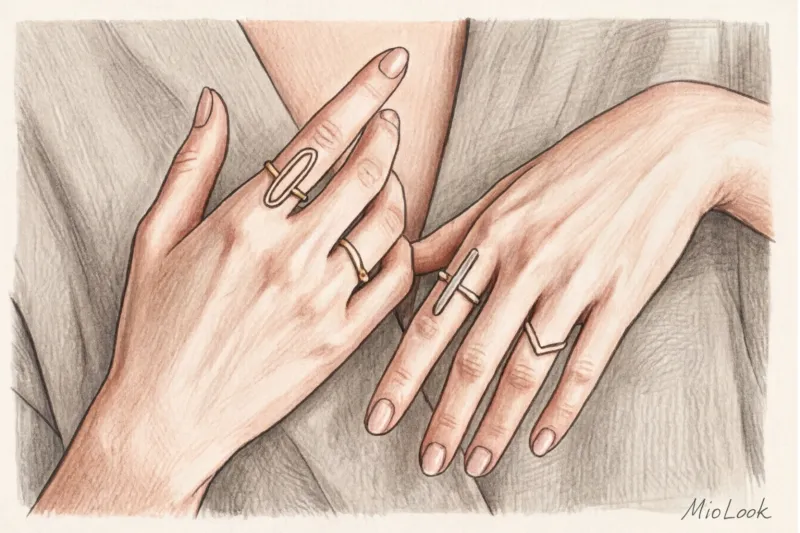
I was once sorting through the wardrobe of a stunning woman who adored wide, geometric rings. The problem was that she was blessed with rather short fingers. The wide, horizontal bands of metal visually cut into her knuckles, making her hand look heavy and her fingers look like sausages (let's be honest). We fixed the situation in a flash by simply replacing the wide bands with thin, V-shaped rings.
Jewelry ergonomics works according to the same laws as body types in clothes:
- Short fingers: Your choices include open rings, asymmetry, teardrop-shaped stones (pear, marquise), and V-shaped stones with the tip pointing toward the nail. Avoid wide horizontal rings.
- Long thin fingers: You can afford everything. Complex, multi-tiered sets, wide tube rings, and large, round or square-cut accent stones look flawless on these hands.
- Large joints: There is an important limitation here. Never Avoid very thin, minimalist rings—they'll make the joint appear even bulkier in contrast. Instead, choose voluminous solitaire rings with intricate designs or a scattering of stones. They draw attention away from the bone and draw the visual focus.
The Mohs Scale in Practice: Saving Your Investments
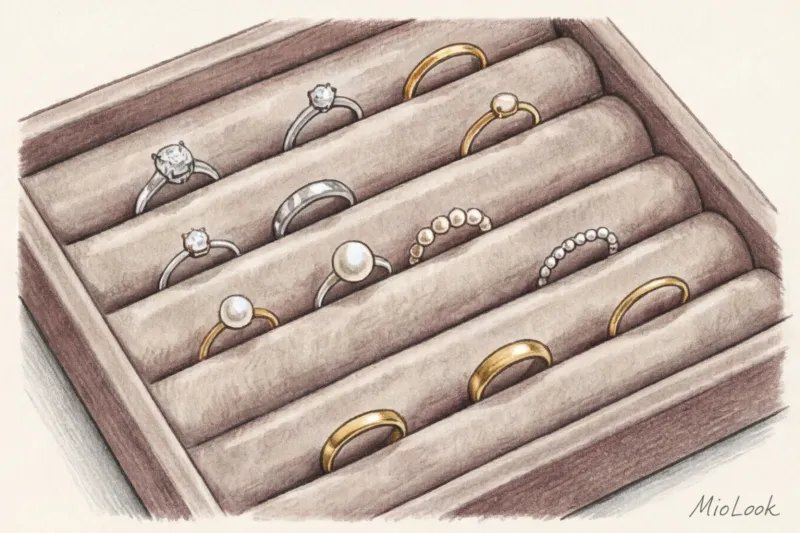
Now let's move on to physics. Do you know why jewelers clutch their heads when they see a diamond track ring pressed tightly against a smooth yellow gold ring? The answer lies in the Mohs scale—a mineralogic scale of hardness.
A diamond has a maximum hardness of 10. 18-karat gold is a very soft metal with a hardness of only 2.5-3. According to the Gemological Institute of America (GIA), more than 80% of deep scratches on basic gold rings are caused not by doorknobs, but by constant friction with adjacent diamond-set rings on your hands.
How to safely combine stones and metals? If you want to wear a ring with a prominent diamond next to another ring, use a spacer between them. spacer A spacer ring is a very thin, inexpensive, completely smooth ring made of a hard alloy (such as platinum or 14K gold) that will absorb the impact. Alternatively, simply wear them on different fingers, leaving a safe "space."
Checklist: Assembling a Trendy and Status-Pleasing Set in 3 Steps
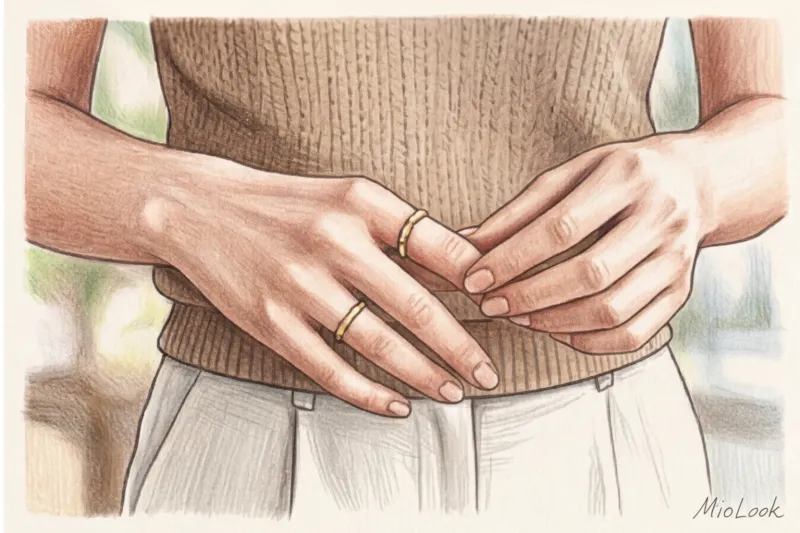
Assembling your jewelry shouldn't take you half an hour in the morning. To ensure your set always looks like it was professionally styled, use this 3-step process:
- Step 1: Determine the permanent base. If you wear a watch and a classic wedding ring, that's your starting point. Consider their metal and volume. They already take up some of the visual weight.
- Step 2: Selecting an emphasis and balancing (60/40). Choose a "soloist." If you wear a watch on your left hand, wear an accent statement ring on the middle or index finger of your right hand. Add 1-2 thin base rings for support, leaving the adjacent fingers free (negative space).
- Step 3: Ergonomics test. Put on your set? Now clench your fists tightly, then simulate typing on a keyboard. If you experience pain, the rings dig into adjacent fingers, or jingle loudly, remove one ring. Elegance cannot exist without comfort.
Jewelry is the punctuation mark in your style sentence. A single ring is a period. A trendy, well-put-together set is an exclamation point. To learn how to place these marks accurately, try planning your looks in advance using MioLook After all, true style is always a bit of mathematics, hidden behind the façade of Italian frivolity.