
In 12 years of working as a personal stylist, I've learned one hard and fast rule: you can wear an impeccably tailored Saint Laurent jacket and accessorize it with a vintage Hermès bag, but if your foundation clashes with your skin's natural temperature, the look falls apart. One of my clients, a senior executive at a major bank, once spent €150 on a luxurious Tom Ford fluid foundation. At the presentation, in daylight, her complexion looked sallow, as if she hadn't slept in a week. The problem wasn't the quality of the product, but rather her ignorance of her olive undertone.
According to Mintel's 2023 Consumer Habits Report, nearly 70% of women wear the wrong shade of foundation every day. And it's not their fault. For decades, the beauty industry has fed us simplistic, and sometimes downright harmful, advice. If you want to figure it out once and for all, How to determine your skin undertone , we'll have to forget glossy cliches and turn to the physics of color. We've already discussed the architecture of appearance and how this balance is built in more detail in our a complete guide to perfect makeup based on your color type Now let's look at the foundation.
The foundation of a luxurious look: why foundation is more important than a silk blouse
In my practice, clients often complain, "This silk blouse makes me look pale," or "I look tired in this suit." We start going through their wardrobe, and I realize the problem isn't the clothes at all. It's the foundation that's oxidized on their face, reacting chemically with sebum (sebum), and taking on a telltale reddish or pig-pink tint.
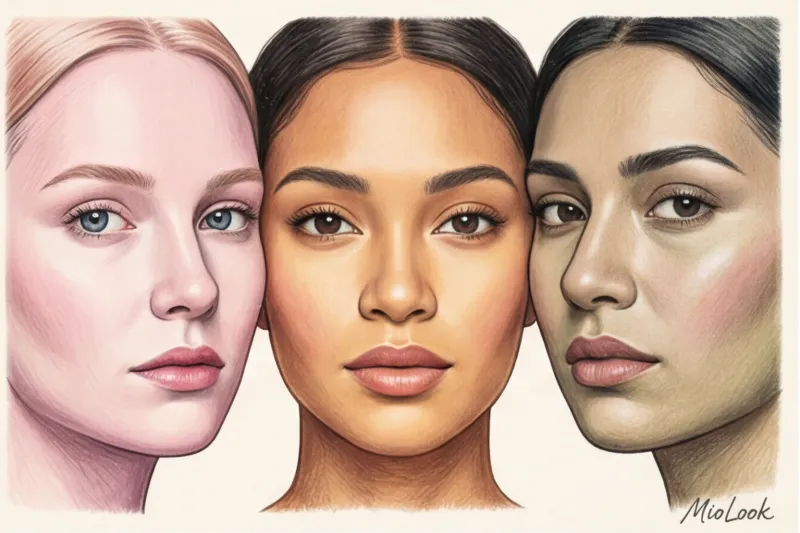
Let's immediately separate two concepts that even consultants in corners confuse. Tone (depth) — this is how light or dark your skin is (from porcelain to ebony). It can change: in winter you are lighter, in summer, after a vacation in Sardinia, you are darker. But undertone (temperature and nuance) — It's genetic. It's determined by the amount of melanin, carotene, and hemoglobin under the epidermis. The undertone never changes. You can tan to a bronze color, but your cool undertone will remain cool.
Disharmonies between skin tone and cream shade create a "separate head" effect and cheapen even the most premium outfit. You can't build a prestigious capsule wardrobe on an unstable foundation.
Your perfect look starts here
Join thousands of users who look flawless every day with MioLook. Its smart algorithm takes into account every nuance of your appearance.
Get access — €0.99 onceBusting Beauty Myths: Why the Vein Test No Longer Works
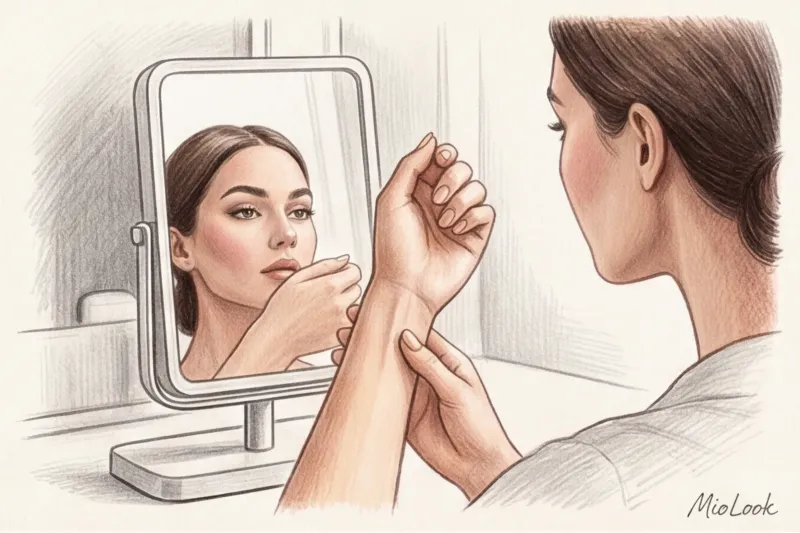
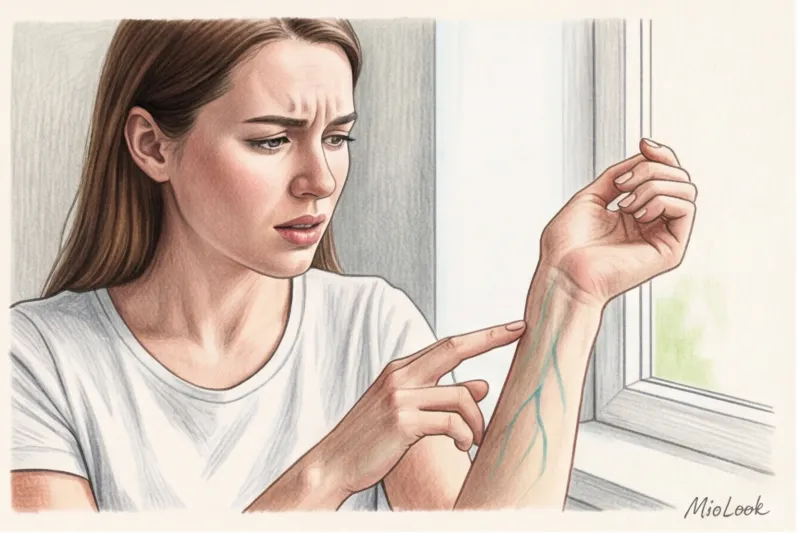
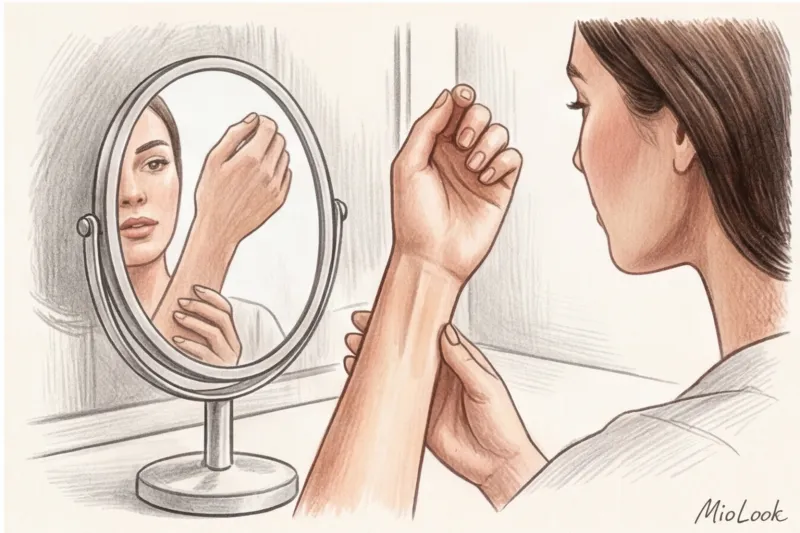
Open any basic article online, and you'll see this hackneyed advice: "Look at the veins on your wrist. Blue ones are cool undertones, green ones are warm." As a professional, I can tell you this is a completely useless and sometimes even harmful method.
Why doesn't this work? The skin on the inside of your wrist is radically different from the skin on your face. It's thinner, has virtually no sebaceous glands, and isn't exposed to the daily harsh effects of UV rays. Moreover, most women have their own facial characteristics: closely spaced capillaries, a tendency toward rosacea, or localized redness around the sides of the nose.
A woman looks at the blue veins on her hand, decides it's "cold," buys a cream with a pink undertone, applies it to her face with mild rosacea—and transforms into a blazing peony. Choosing a tone based on your wrist is the main reason for the "mask" effect, visible from a mile away.
3 Professional Ways to Determine Your Skin Undertone
Before we move on to the tests, remember the most important rule of coloristics: light is everything. The lamps in your bathroom or the boutique fitting room have a low color rendering index (CRI) and always distort the color temperature by 30-40%. Halogen lamps create a warmer tint, while fluorescent lamps add a dead green tint. Any tests should only be performed during the day, facing a window away from direct sunlight.
The White Sheet Method: Playing with Contrasts
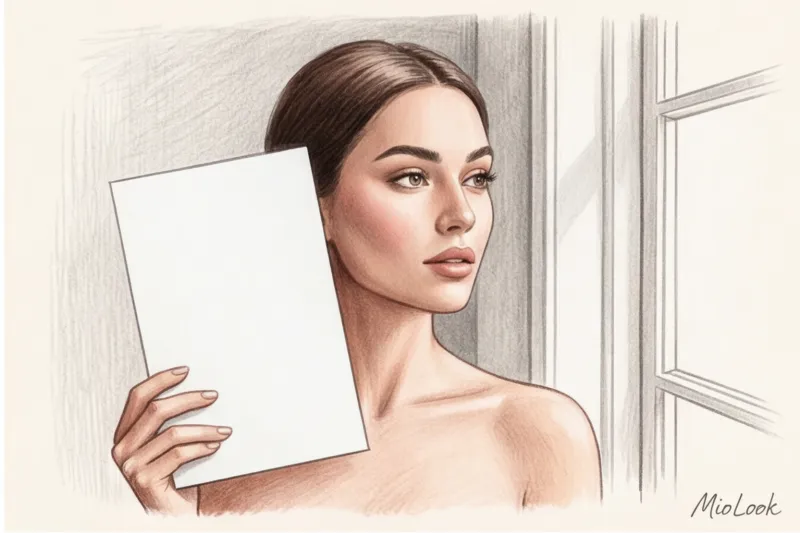
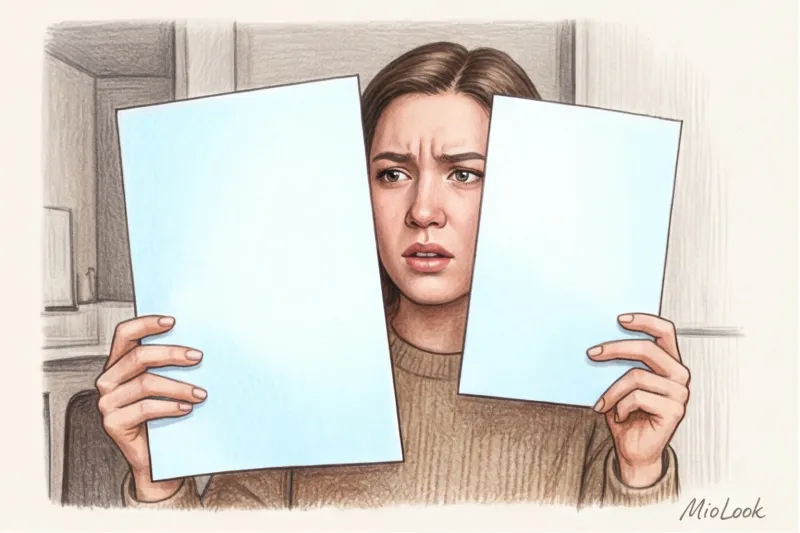
This is a favorite trick of photographers and makeup artists. Remove your makeup and wait 15 minutes for the redness from washing to subside. Take a sheet of thick, matte white paper (important: not the cheap blue-tinted printer paper, but a matte, watercolor-like paper) and hold it up to your face, level with your neck.
You need to look not at the skin itself, but at reflected contrast Against a perfect white background. If your face appears slightly yellowish or glows golden against the sheet, your undertone is warm. If you see a pinkish, reddish, or slightly bluish tint, your undertone is cool. If your face takes on a slightly grayish or greenish-yellow tint, congratulations—you have a complex olive undertone.
Jewelry Metals Test: Platinum, Yellow Gold, and Rose Gold
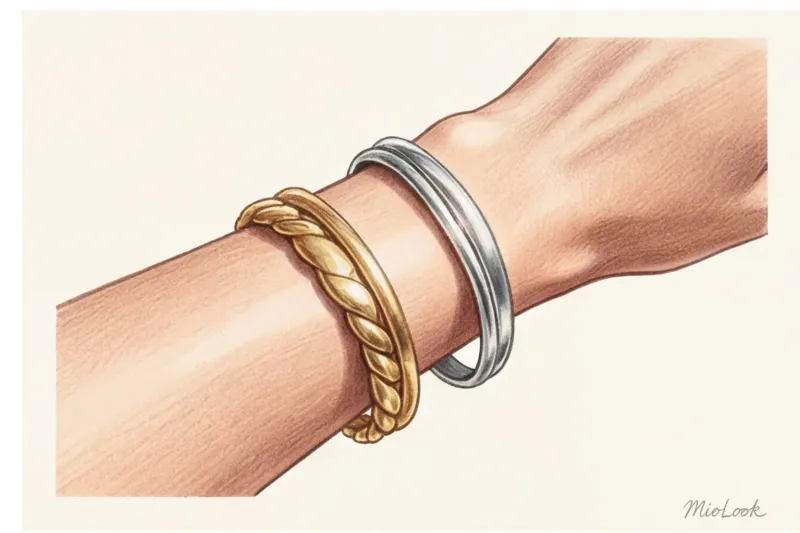
Forget thin chains—they won't provide the necessary reflective area. Opt for chunky jewelry: large necklaces, wide bracelets. Alternate between cool metals (platinum, white gold, silver) and warm metals (classic yellow gold) on your collarbones and jawline.
It's all about physical resonance. White gold makes cool skin appear lifted and radiant, but on warm skin it looks cheap and foreign, like foil. Yellow gold, on the other hand, brightens warm skin and makes cool skin appear dull. If both metals suit you equally well, or if rose gold (an alloy of warm and cool) flatters you most, your undertone is neutral.
Sun sensitivity (Fitzpatrick scale)
Developed in 1975 by Harvard dermatologist Thomas Fitzpatrick, the skin phototype scale remains a highly accurate tool. Think back to your first days at a resort without SPF. If your skin immediately turns red, burns, and only later, painfully peeling, does it acquire a light tint, there's a 90% chance you have a cool undertone. If you rarely burn and your skin easily develops an even golden or bronze tan within a few days, your undertone is warm or olive.
The main pitfall of coloristics: the mysterious olive undertone
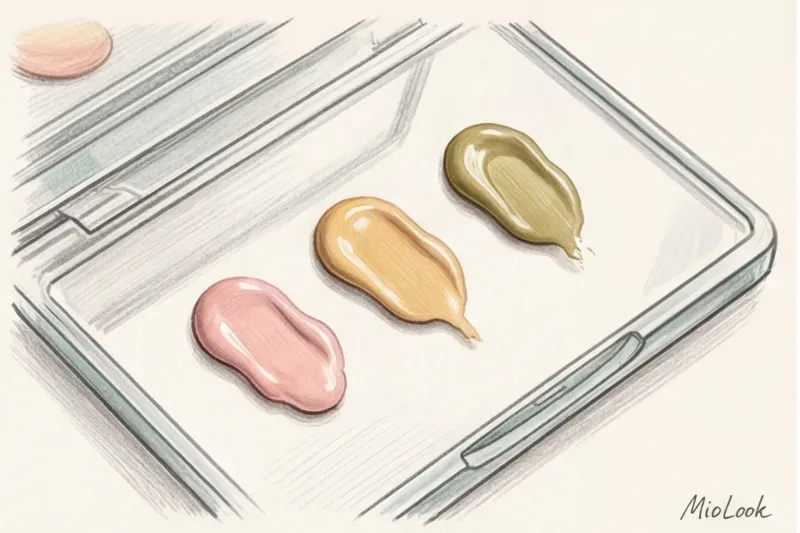
This is the pain point for countless women of Slavic and Mediterranean descent. You've been testing hundreds of jars for years, but neutral shades look gray on you, warm ones look downright orange, and cool ones make you look like Miss Piggy. Welcome to the olive undertone club.
Olive skin contains a specific greenish-gray pigment. It can be warm olive (a lot of yellow + a little green) or cold olive (gray-green without a noticeable yellow tint). Mass-market brands rarely produce such complex blends—it's not profitable for them to stock specific colors.
What should you do? First, focus on the professional and luxury segments. The legendary Luminous Silk foundation by Giorgio Armani is famous for its brilliant olive shades (for example, shade 6). Second, professional makeup artists use liquid pigment adjusters. Adding just a tiny drop of blue or green adjuster to your overly yellow or orange foundation instantly neutralizes the reddish undertones and creates a perfect olive match.
Ready to get started?
Try the MioLook plan for free—no commitments required. Create your perfect capsule based on your unique undertone.
Get access — €0.99 onceReading Labels: The Hidden Codes of Premium and Luxury Brands
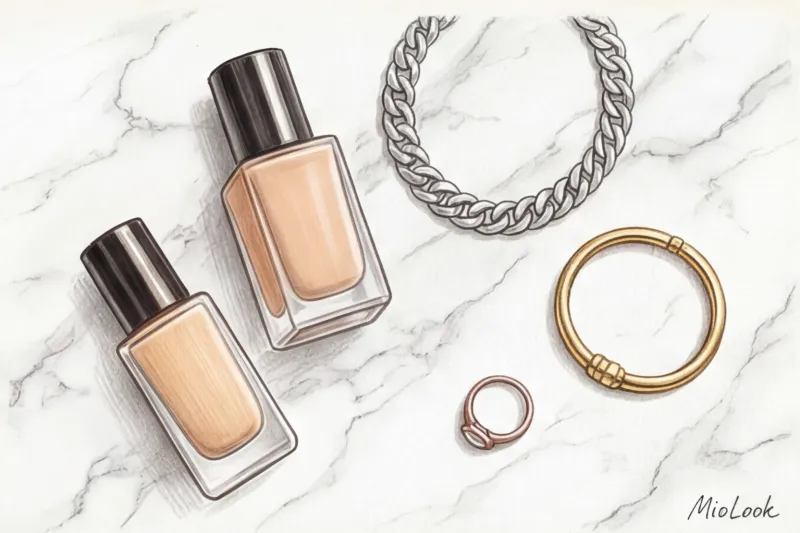
If you're at an Estée Lauder, Dior, or Tom Ford store, learning to read the letter codes will save you hours. Standard industry markings: W (Warm) - warm, golden, yellow; C (Cool) - cold, pink; N (Neutral) - neutral, balance of yellow and pink.
But here lies the main trap of the expertise—the MAC brand paradox. If you go to them and ask for a foundation for warm, yellowish skin, the consultant will give you a bottle with letters NC (Neutral Cool) And for pink, cold skin - NW (Neutral Warm) The logic of the average person breaks down, but from an artistic point of view, everything is correct.
MAC was originally created for professional makeup artists. They based their system not on consumer perception, but on Johannes Itten's classic color wheel. For an artist, yellow is a cool color relative to red. Furthermore, professional makeup operates on the principle of neutralization: to neutralize excess pinkness (warmth in MAC terms), a yellowish tone (coolness) is needed. Understanding this nuance distinguishes an amateur from someone who understands how pigments work.
European luxury brands (Dior, Chanel) have historically favored pinker, peachy bases—they create a fresh effect in the dull European climate. American brands (Tom Ford, Bobbi Brown) gravitate toward yellow and golden bases, which look better in the bright Californian sun and in photos.
How Tone Affects Your Business Capsule: The Connection Between Makeup and Wardrobe
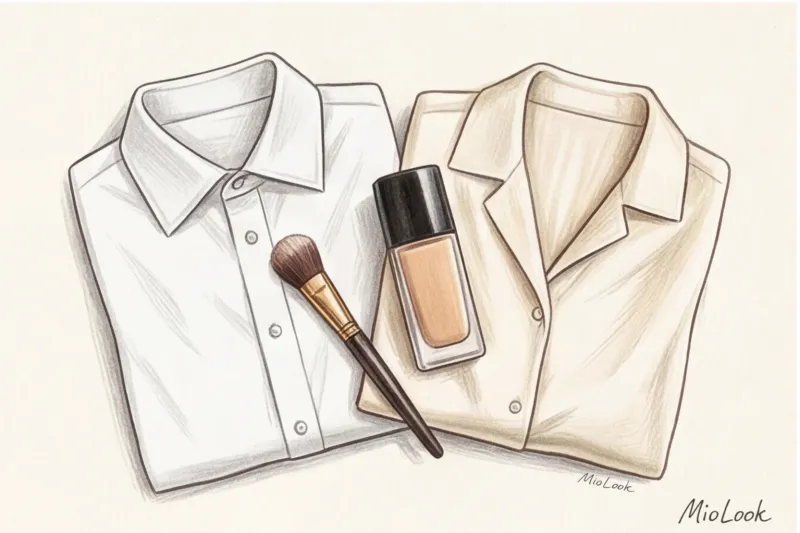
You've found your perfect tone. How does this work with clothing? Your undertone is the central element of your capsule wardrobe. It determines what you wear in the portrait zone.
Women with a cool (or neutral-cool) undertone can confidently invest in crisp white shirts. This color, reflected off the skin, will highlight the porcelain translucence and aristocratic quality of a cool foundation. However, if you have a warm or olive undertone and are wearing a golden-based foundation, a crisp white collar will act as a spotlight, drawing out any yellow tones and highlighting even the slightest imperfections. Choose from sophisticated shades of ivory, cream, or ecru.
The same goes for status accessories. Pearls come in different varieties: pinkish ones will suit C (Cool) skin tones perfectly, while golden South Sea pearls are a luxurious complement to W (Warm) skin tones. When you upload your items and selfies to the "smart wardrobe" feature in MioLook , the system takes into account these physical laws of light reflection, offering you only those combinations that make your face look fresh without additional layers of bronzer.
Invest in Perfection: A Boutique Foundation Testing Checklist

To avoid wasting money on the wrong luxury, I make my clients follow this strict algorithm. And yes, the salespeople in stores don't like it because it deprives them of a quick sale.
- Testing area. Never test a shade on your cheek or wrist. Apply three adjacent shades (for example, a light warm tone, a light neutral tone, and a medium neutral tone) in vertical stripes along your jawline, gently blending down your neck.
- The 20-minute rule. Blend the stripes. Don't buy the product right away! Modern formulas contain volatile silicones and pigments that need to react with your pH and sebum. Allow the cream to oxidize for 15-20 minutes. A beautiful light shade often darkens by a whole shade after 15 minutes.
- Change of location. Be sure to step outside the boutique. The halogen lights at the cosmetics displays are specially adjusted to make everything look warmer and more inviting.
- Digital test. Take a selfie outdoors in natural light without a flash. A smartphone camera mercilessly reveals the difference between your neck and face. If the line has disappeared and isn't visible in the mirror or in the photo, you've got your perfect tone.
Fair Limit: This checklist works flawlessly for healthy skin. BUT it may fail if you're currently experiencing active acne, severe post-peel peeling, or if you've just returned from a cold day. In these conditions, the skin's temperature changes locally due to increased blood flow to the inflamed areas. Postpone choosing an expensive foundation until your skin returns to a calmer state.
The perfect undertone isn't a constraint; it's your tool of influence. When your makeup and wardrobe are in sync, you stop looking simply "well-made up." You start looking classy, fresh, and expensive.