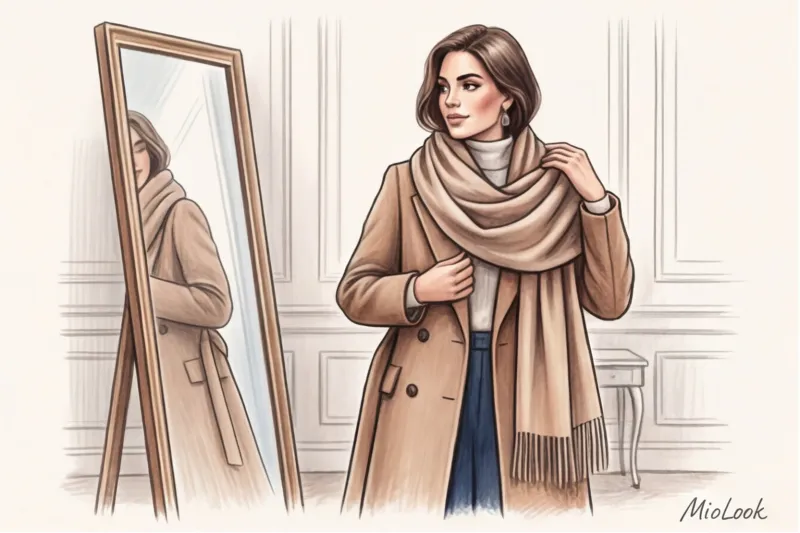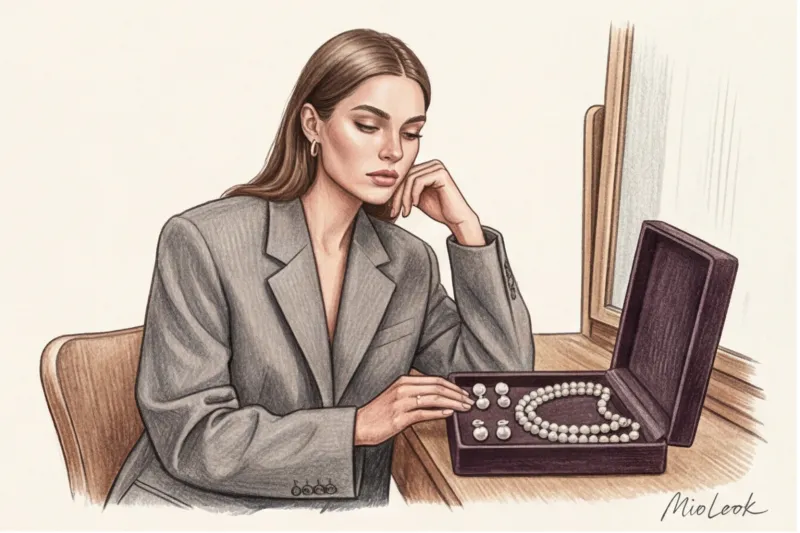
Two weeks ago, Anna, the COO of an IT company, came to me for a consultation. She complained that her business attire looked "somehow skimpy and unfinished," even though her suits were impeccably tailored. I looked at her portrait section: over a voluminous, structured, man-made jacket, Anna wore tiny diamond studs. Against the backdrop of her expressive, prominent facial features and the massive architecture of her clothes, these "basic" earrings simply vanished. Her face seemed bare, and her look underdeveloped.
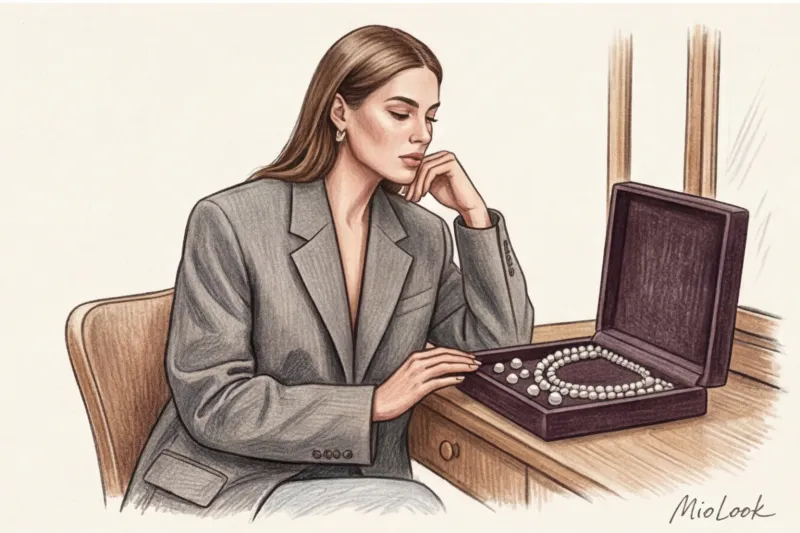
It was then that I was once again convinced: when we choose basic jewelry for every day , the old glossy rules no longer apply. It's time to forget the universal lists of "studs, a thin chain, and a leather watch." Instead, I propose an architectural approach, where your jewelry base is built on the bone structure of your face, the contrast of your appearance, and the geometry of your everyday wardrobe.
The 'Studs and Pearls' Myth: Why Old Jewelry Lists No Longer Work
If you open articles from ten years ago, you'll inevitably be advised to buy a strand of pearls and tiny gold earrings. In my 12 years as a stylist, I've seen hundreds of girls literally disfigured by this advice. A classic short strand of pearls paired with a basic cardigan is a surefire way to add 10 years to your age these days.
The concept of essentials has evolved. According to the Business of Fashion report (2024), the market has undergone a global shift from heavyweight "high jewelry" for special occasions to the "everyday fine" category—high-quality yet utilitarian items we wear without taking them off. Today, a jewelry wardrobe is a logical extension of your clothes, not a separate treasure chest. We covered this in more detail in our The complete guide to essential accessories for women.
The base no longer has to be invisible. It should be your personal uniform. For some, this might be a sleek metal choker, for others, asymmetrical earrings in crushed silver.
The Formula for Individuality: How to Choose Basic Jewelry for Every Day
The most dangerous misconception is to think of minimalism as a universal solution. This is fundamentally wrong. Minimalism in jewelry is a style, not a basic need.
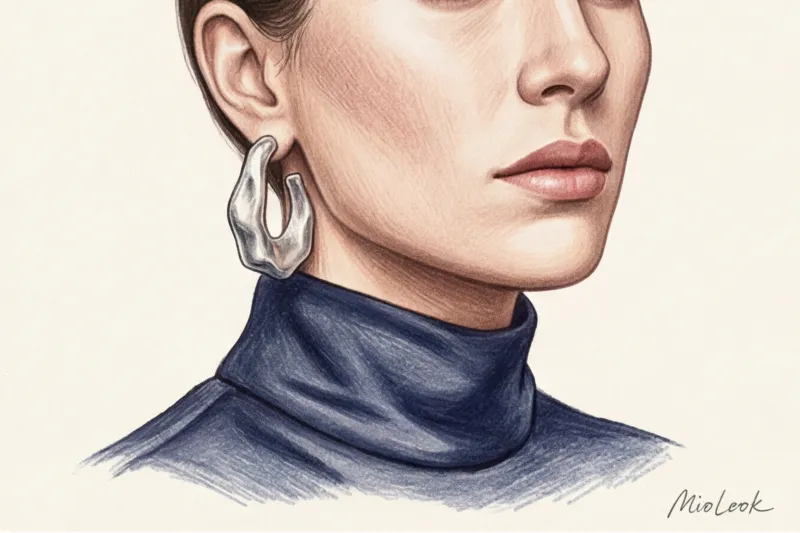
This is where the rule of proportion comes into play. If you belong to the Dramatic or Natural type according to the Kibbe typology—with prominent cheekbones, broad shoulders, and large features—small, "invisible" jewelry is a no-no. Against a large bone structure, it looks like a random speck of dust and visually widens the face. Large, sculpted shapes or textured, heavy metal will be your true base.
"Basic decoration shouldn't conflict with your natural surroundings. It should function like architectural lighting for a building: highlighting the structure's advantages while remaining functional."
I recently overhauled a client's wardrobe. She was constantly wearing a thin chain with a micro pendant over a crisp white shirt. We replaced this "basic" piece with a chunky, yet semi-hidden, anchor chain. The look instantly came together, adding character and status.
Gold, silver, or a mix? Understanding color types
The choice of metal is dictated by your skin's undertone. If you have an olive or warm, peachy undertone, the cool sheen of rhodium-plated silver can make your complexion appear earthy. In this case, yellow or lemon gold will be your ally. If your skin has a pinkish, porcelain, or distinctly cool undertone, white metals will act as a refreshing filter. You can learn more about your palette in the article about 12 color types of appearance.
What about mixing metals? Forget the old rule of "gold with gold, silver with silver." Mixing metals is not only possible now, it's even necessary—it adds complexity and dynamism to your look. The key: use a "transition piece." For example, a bicolor watch (combining steel and gold) or a single ring woven from two metals. They'll legitimize any combination in your look.
Access to MioLook for €0.99 — one-time payment
A smart AI stylist will help you visualize the combination of different metals in your everyday looks.
Get access — €0.99 onceEveryday Capsule Architecture: 4 Key Elements
To build a functional jewelry wardrobe, divide it into key areas. You don't need to buy everything—it's enough to focus on four strategic items.
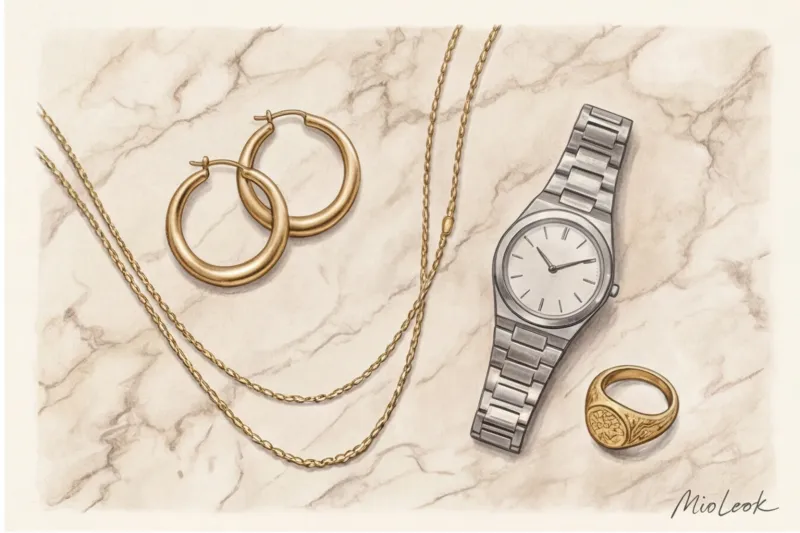
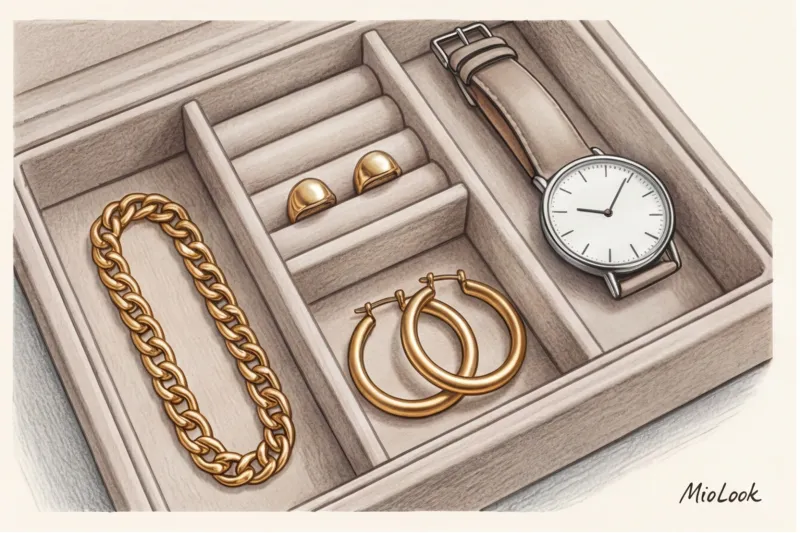
- Portrait area design (Earrings). This is the most important element, as it's what people will be looking at. The ideal base is medium-thickness hoop earrings (congos) or sculpted Bottega Veneta-style drop earrings. They won't snag your hair and create the right amount of volume around your face.
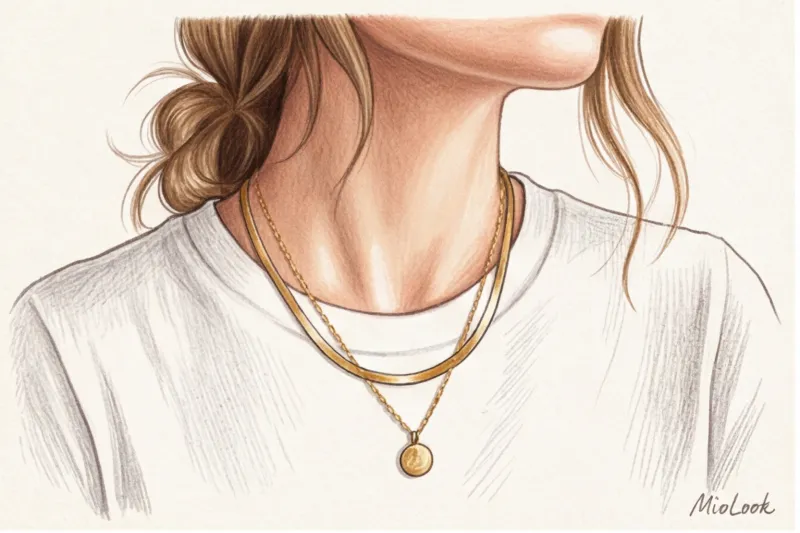
- Neckline area (Chains and pendants). Choose the chain length based on the most common necklines of your clothing. If you wear V-necks, you'll want a pendant on a longer chain. If you prefer turtlenecks or turtlenecks, choose flat snake chains or chokers.
- Accents on hands (Rings and bracelets). Smooth signet rings without stones or textured wide metal bands. They don't snag on pockets and look classy.
- Utility core (Clock). A good watch in a steel or bicolor case is the anchor around which the rest of your jewelry wardrobe is built.
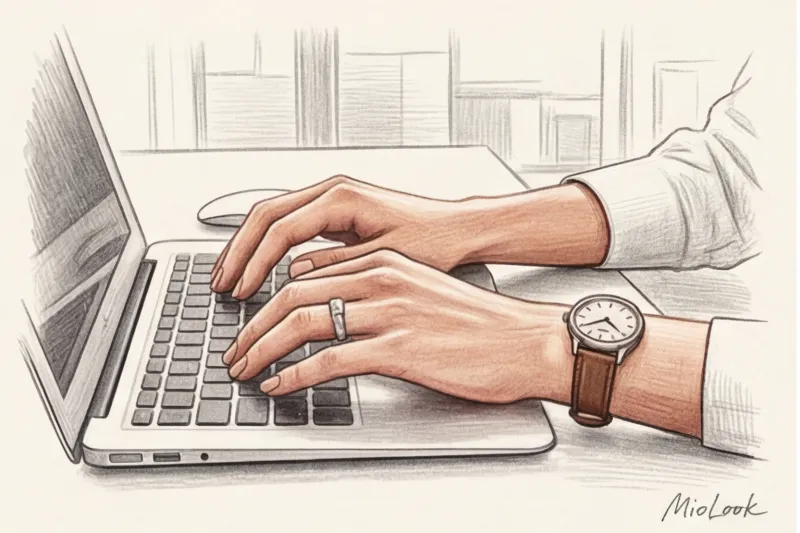
When creating a capsule collection, always keep in mind the principles of ergonomics established by the legendary Elsa Peretti for Tiffany & Co. in the 1970s. Basic jewelry should be biomechanical: it should follow the curves of the body, not dig into the skin when working on a laptop, and not snag on knitwear.
Jewelry Dress Code: Basic Jewelry for the Office and on Stage
For business environments, there's an unspoken "Three-Zone Rule." To avoid overloading your look, statement jewelry should occupy no more than three spots. For example: earrings + watch + one ring. Or: an accent necklace + bracelet + wedding ring. If you wear everything at once, your conversation partner's focus becomes distracted. For a deeper understanding of the context, check out our article about accessories for office style.
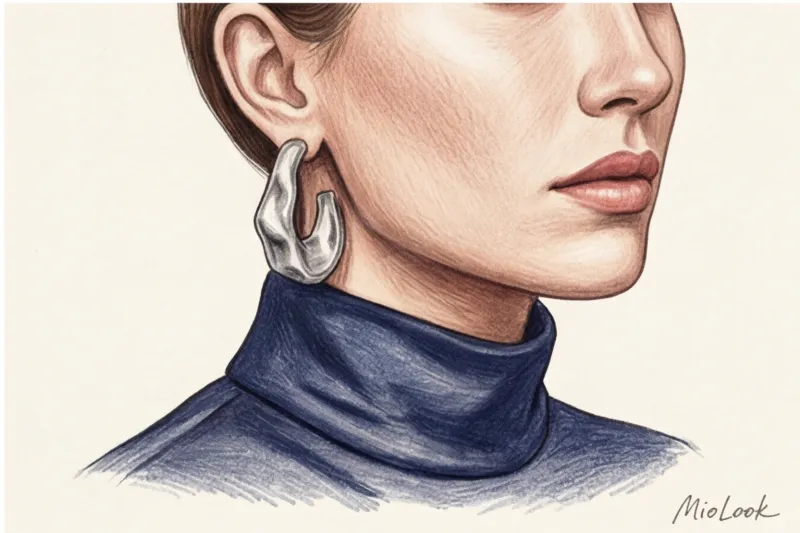
A separate insight from my experience preparing speakers for conferences is acoustic etiquette. Thin chain bracelets clanking against each other or chunky pendants smashing against buttons are an absolute no-no for the office and stage. Lavalier microphones pick up every clang of metal, turning your presentation into an aural nightmare. The same goes for glare from large glossy surfaces under spotlights—brushed (matte) metal is best for public speaking.
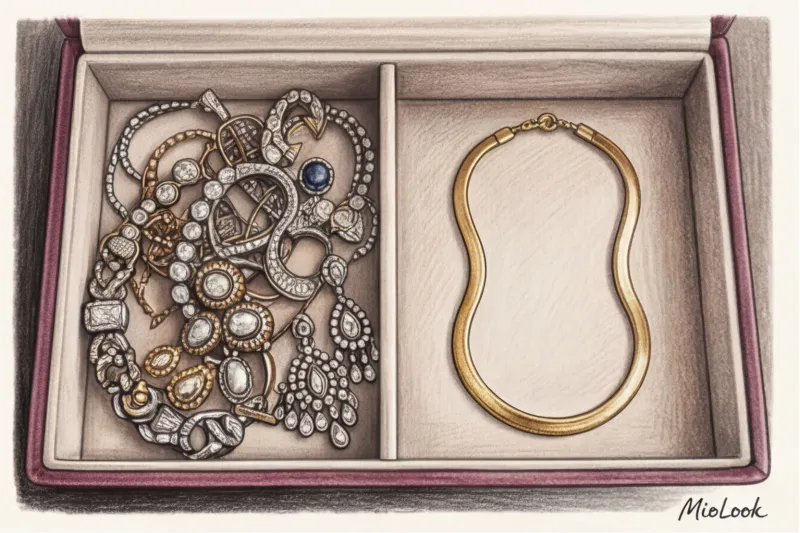
How to transform a daytime staple into an evening look? Layer it. During the day, wear one pair of sleek hoops. In the evening, before dinner, simply add a cartilage cuff and a second, longer chain over your basic earrings. Your look changes in seconds.
Your perfect look starts here
Join thousands of users who look flawless every day with MioLook, choosing accessories to suit any dress code.
Get access — €0.99 onceInvestments vs Costume Jewelry: Cost-per-wear formula
Let's do the math. You can buy a trendy ring from a mass-market store for $50. After a week of daily wear, it will oxidize, leave a green mark on your finger, and end up in the trash. The cost of one use is $10.
Or you could invest in a $500 solid gold ring and wear it every day for three years. The cost-per-wear would be less than 50 cents. That's why basic everyday jewelry is an investment, not a savings item.
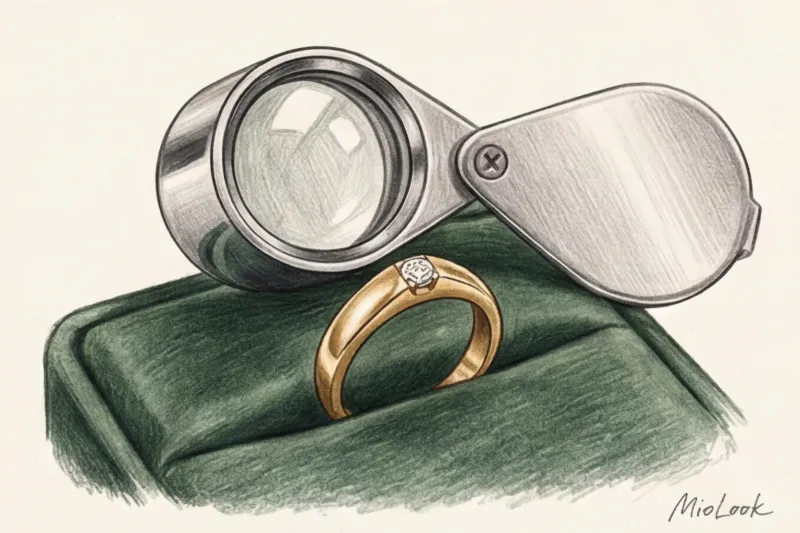
But there's a fair limitation here. Demi-fine jewelry—silver jewelry with a thick layer of gold vermeil—is incredibly popular right now. As a stylist, I have to warn you: this works great for earrings or pendants. But for base rings This is a waste of money. Due to constant friction, contact with door handles, and soap, any gold plating on rings will wear off within 6-12 months. Choose only solid metal for your hands.
If you're looking for basic stone jewelry, check the Mohs scale of mineral hardness. Only stones with a hardness of 9 or higher are suitable for everyday wear: diamonds (10) and sapphires/rubies (9). They're scratch-resistant. However, emeralds (fragile), opals (soft), and especially pearls (which dissolve when directly exposed to perfume) are a bad idea as a daily base.
Checklist: Building Your Personal Jewelry Collection From Scratch
If your wardrobe is full of odds and ends that don't fit into any look, use the algorithm I use when working with clients.
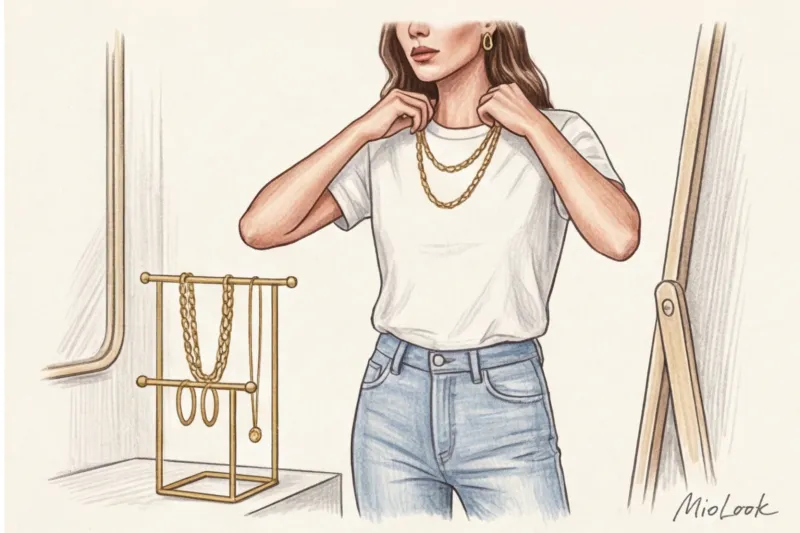
- Audit of your "uniform". What do you wear 80% of the time? If it's knitwear and soft cardigans, you need smooth embellishments without sharp edges. If it's formal shirts, you need geometric, crisp shapes.
- Determining the scale. Look in the mirror. Large facial features require voluminous (puffy) pieces, even if they're hollow and lightweight inside.
- Buying a "soloist". Start with one expensive, high-quality item that you'll wear every day. Typically, it's a watch or a pair of statement earrings.
- Gradual layering. Don't buy complete sets! Add accessories gradually, ensuring they share a unifying element: for example, a similar texture of dented metal or a single geometric motif.
To avoid making a mistake with your purchase, I recommend using the smart wardrobe function in MioLook app Take photos of your everyday items, add images of desired jewelry, and see how they fit together into a single puzzle on a virtual board.
Summary: Your Personal Fine Art Signature

Basic everyday jewelry isn't a dull compromise between a dress code and a desire to adorn yourself. It's your visual signature. The right basics can elevate even the simplest white T-shirt and jeans to Fashion Week street style.
Don't be afraid to reject conventional wisdom if it doesn't resonate with your appearance. Find your own shape, experiment with scale, and invest in pieces that make you feel confident every time you look in the mirror.