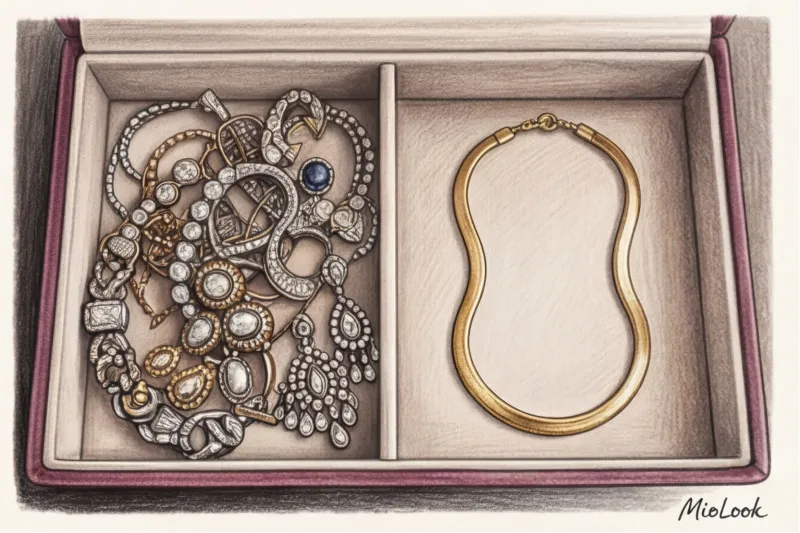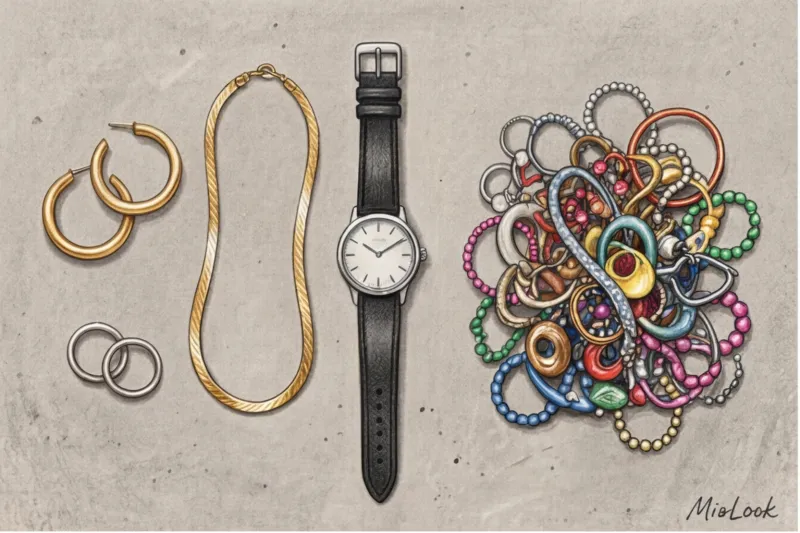
Last year, the CFO of a large company came to me to sort through her wardrobe. We pulled out a huge jewelry box from her dresser, filled to the brim with tarnished brass chains, oxidized rings, and stud earrings that had lost their marketable appearance. We sat down with a calculator and calculated: in a year, she spent over 200,000 € on this spontaneous fast-fashion jewelry. You know what's most offensive? For that money, she could have put together a flawless outfit. basic jewelry wardrobe made of four pieces in 14-karat gold that would serve her for decades without losing their appearance.
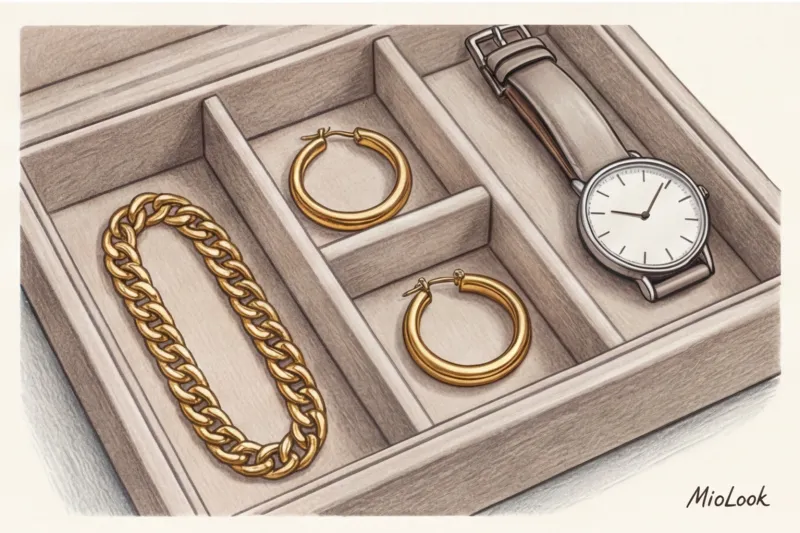
We have already talked in more detail about the philosophy of consciously choosing accessories in our The Complete Jewelry Wardrobe Guide: How to Wear Jewelry Properly But today I want to talk not just about style, but about materials science. Unlike the typical glossy magazine articles that say "just buy pearls," we'll examine jewelry essentials through the lens of the wearability of alloys, micron coatings, and the rigorous mathematics of wardrobe design.
What is a basic jewelry wardrobe and why it saves you money?
The mathematics of style are ruthless. I always teach my clients to evaluate items not by the price tag at the checkout, but by the cost-per-wear (CPW) formula. A jewelry capsule is a mathematical approach to accessories, where 5-7 carefully selected items cover 90% of your needs, from a morning meeting to an evening at the theater.
Let's do the math. You buy trendy zinc alloy earrings at a high-street store (like H&M or Zara) for $20. After a month of daily wear, they peel from contact with your perfume, leaving green marks on your earlobes. The cost per wear is almost a dollar. Meanwhile, you'll wear simple, solid 14-karat gold hoops for $500 at least 300 days a year for ten years. Their CPW is a paltry 16 cents.
Refusing disposable jewelry in favor of high-quality materials is not only a matter of aesthetics but also the simplest step toward eco-conscious consumption. The jewelry industry leaves a huge carbon footprint, and the constant purchase of cheap alloys that cannot be recycled only exacerbates the situation.
Your perfect look starts here
Join thousands of users who look flawless every day with MioLook. A smart AI stylist will help you integrate jewelry into your everyday looks.
Get access — €0.99 onceThe Anatomy of Quality: How to Choose Metal for Everyday Jewelry
When you buy gold-plated jewelry, the brand often uses vague language. According to FTC (Federal Trade Commission) standards, jewelry labeling must be strict, but mass-market brands often neglect this. Let's break down the terminology so you understand what you're paying for.
- Gold Plated and Flash Plating. This is the same "flash" coating, 0.175 to 0.5 microns thick. The lifespan of such a coating when in contact with the skin is only 3-6 months. For a basic wardrobe, this is a waste of money.
- Gold Vermeil (Vermeil). The gold standard for the mid-range budget. This is sterling silver plated with a gold layer at least 2.5 microns thick. This jewelry will withstand 2-3 years of active wear before requiring replating.
- Solid Gold. An investment for life.
Stylist's secret: If you're looking for an absolutely indestructible option for sports and the beach, consider PVD (Physical Vapor Deposition) technology on titanium or jewelry steel. Unlike electroplating, PVD coating penetrates the metal's structure. This type of jewelry is virtually impossible to scratch, and for some reason, jewelry giants, who profit from selling you soft alloys, stubbornly keep quiet about it.
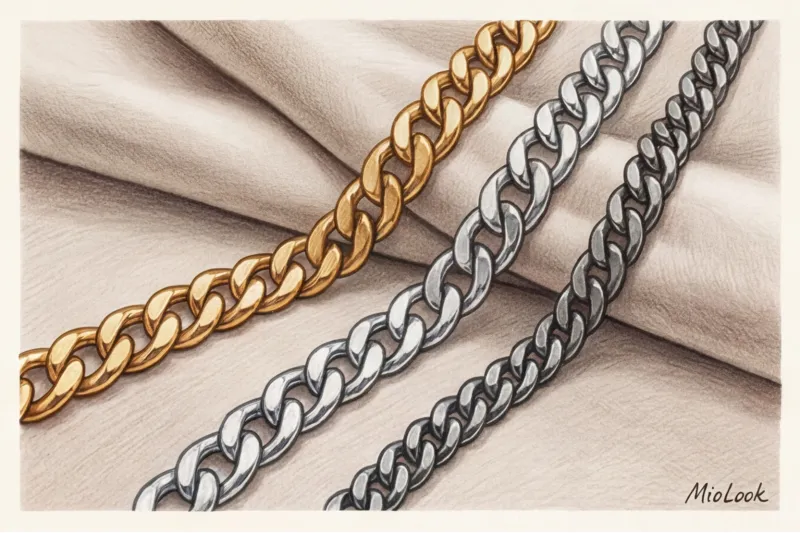
Gold, silver or high-tech alloy?
If your earlobes often turn red and itch when wearing new earrings, it's not because you "don't like gold." You're most likely experiencing contact dermatitis due to nickel, which is often added to cheap alloys for strength. Choose hypoallergenic metals: titanium, 316L medical grade steel, or 14K gold or higher.
An important detail according to GIA (Gemological Institute of America) standards: the ideal gold ratio for everyday wear is 14 karat (58.5% pure gold, or 585 fineness). 18 karat gold (750 fineness) is certainly more prestigious and expensive, but it is too soft. An 18 karat ring will become covered in a network of micro-scratches from door handles and car steering wheels within the first month of daily wear.
Three main rules for creating a basic box
Over 12 years of work, I have identified three criteria without which even the most expensive jewelry will become dead weight in a jewelry box.
- The rule of a single temperature undertone. A life hack from my practice: stand by a window in natural daylight and place a sheet of white paper over your face. If your skin appears slightly pinkish or bluish against the paper, you have a cool undertone. Base your skin: white gold, platinum, silver, or steel. If your skin has a peachy or yellowish tint, your undertone is warm. Classic yellow or lemon gold are ideal for you.
- Scale. Jewelry should be proportionate to your facial features and bone structure. On a petite woman with slender wrists (Kibbey's Gamine type), a heavy chain will look like shackles. On a statuesque woman with large features, a delicate, thin chain will simply be lost, creating the illusion of disproportion.
- Style vector. Your basics should reflect your real (not imagined) lifestyle. If you have a strict corporate dress code, your basics should be stud earrings and a bracelet. If you're a freelancer working from a cafe in a hoodie, you need a statement necklace that instantly ties together a relaxed look.
"This rule DOESN'T work in only one case: if you have a neutral olive undertone. In that case, you're incredibly lucky, as you can wear absolutely any metallic shades and mix them without damaging your complexion."
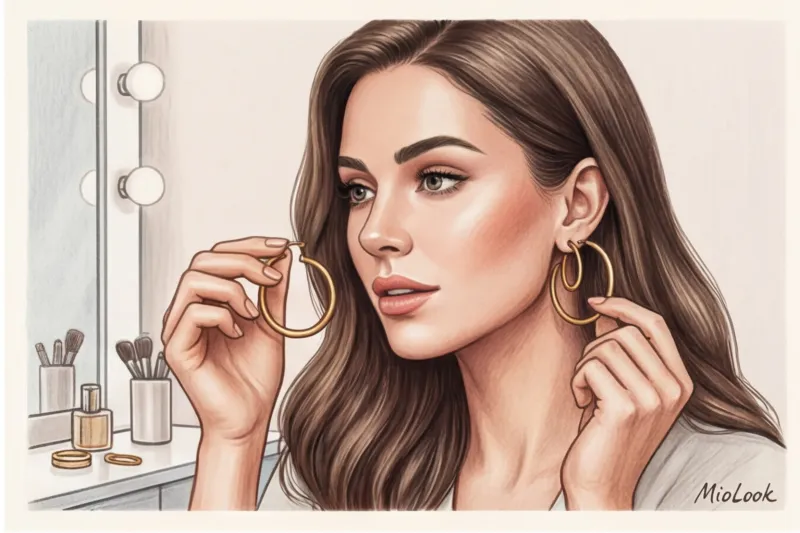
Checklist: 5 Elements of the Perfect Everyday Jewelry Wardrobe
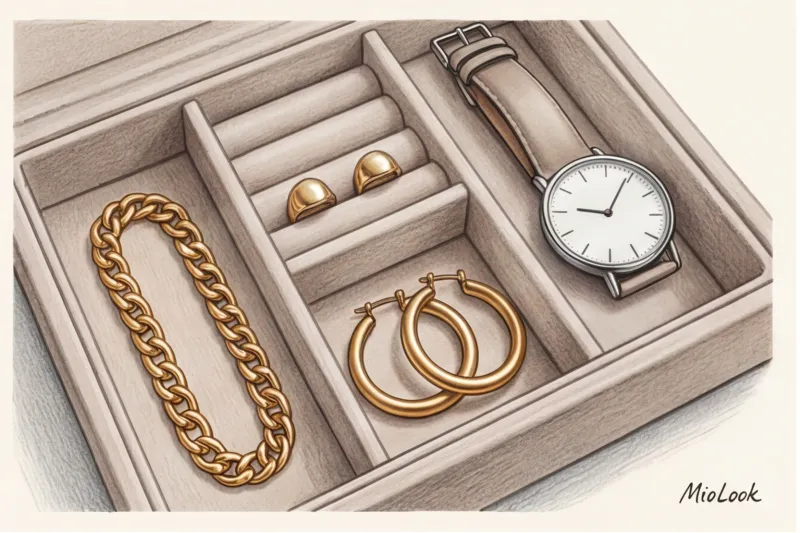
This is the bare minimum that can easily be transformed from a daytime office look to an evening one (for an unplanned trip to a restaurant).
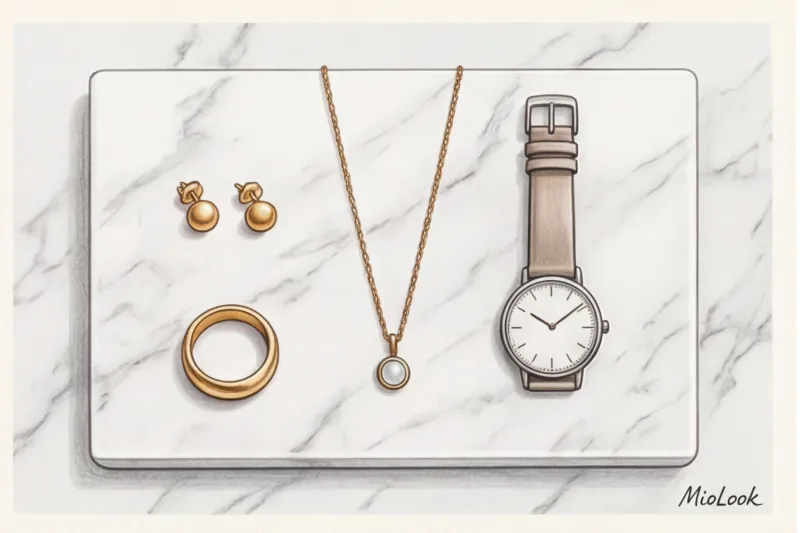
1. Structured earrings (hoops or studs)
In my experience, the biggest mistake people make when choosing basic earrings is ignoring the ergonomics of the clasp. I always check the spring in lobster clasps before recommending them to clients. A clasp is more secure than a congo clasp, which often deforms during sleep. Another strict rule: the weight of everyday earrings should not exceed 4-5 grams per ear. Anything heavier will inevitably lead to unsightly stretching of the piercing over time.
2. Base chain: anchor or armor weave
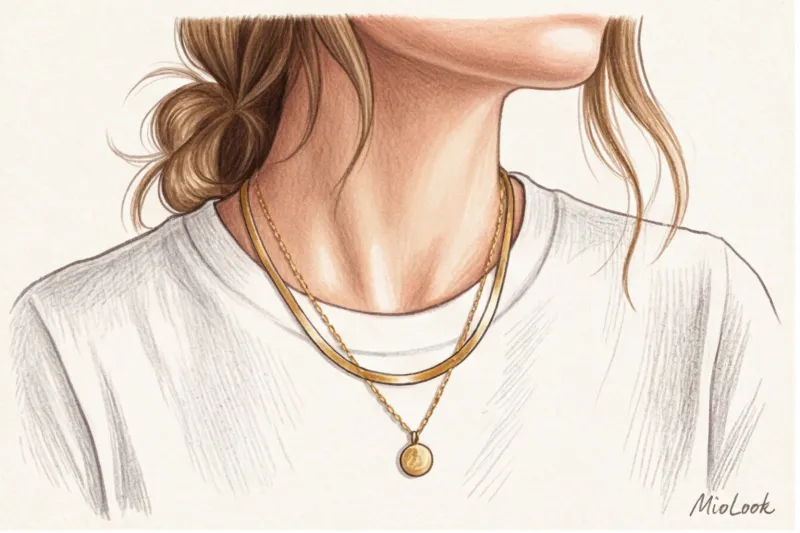
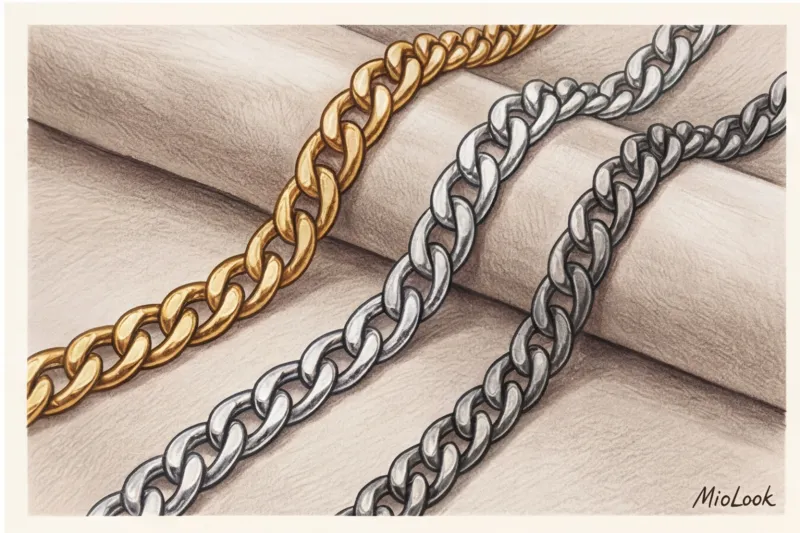
Avoid snake chains for the base. Yes, they shine beautifully, but if you bend one awkwardly or fall asleep in it, it will create a kink that no jeweler can fix. Opt for a classic curb chain or anchor chain. The ideal chain length for a V-neck unbuttoned office shirt is 40-45 cm. It fits neatly into the sternal notch, without intersecting with the collar fabric.
3. Accent signet ring or minimalist band
For the base ring, always look for the characteristic in the description comfort fit (A comfortable fit is achieved when the inside of the ring is slightly convex.) This prevents swelling in your fingers by evening. And most importantly: no high claws (the claws that hold the stone)! An everyday ring shouldn't snag your 20-denier nylon tights or leave snags on your favorite silk blouse.
Ready to get started?
Try the MioLook free plan—no commitments required. Upload photos of your basic jewelry and create stylish sets in just a few clicks.
Get access — €0.99 once4. A quality watch with a leather or metal strap
Watches have long ceased to be simply a timepiece—today they're a status symbol. If you're choosing a basic model, pay attention to the glass. Mineral glass will inevitably scratch after a year. Look for sapphire crystal in the specifications—it can only be scratched by a diamond.
The Silver Myth: Why This Metal Can Fail in Daily Wear
This is perhaps the most counterintuitive insight, often the source of controversy. Many believe that 925 sterling silver is the best and safest choice for everyday essentials. As a textile and materials science geek, I'm sorry to disappoint you.
Silver is a highly reactive metal. Unlike gold, it instantly reacts chemically with hydrogen sulfide, which is present in the air, our sweat, hand creams, and perfumes. This results in the formation of silver sulfide—the black film that makes jewelry appear dirty.
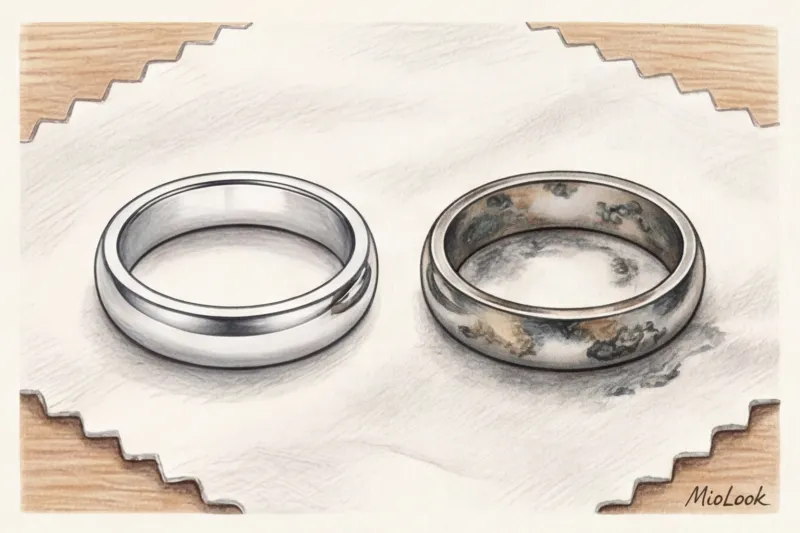
You'll need to regularly clean base silver rings with special chemical solutions. Each cleaning microscopically damages the metal's structure, making it porous and even more vulnerable to further oxidation. If you prefer a cooler tone, choose rhodium-plated silver (coated with a layer of rhodium, a platinum group metal). But remember that the rhodium layer on rings wears off within 1-2 years, requiring a paid repair at a repair shop. This is why stainless steel or 14K white gold are a much more practical choice for a base.
How to Pair Basic Jewelry with Everyday Outfits (and Each Other)
If you want to look modern, avoid wearing "sets"—a ring, earrings, and pendant all bought together from the same collection. This looks archaic and adds age.
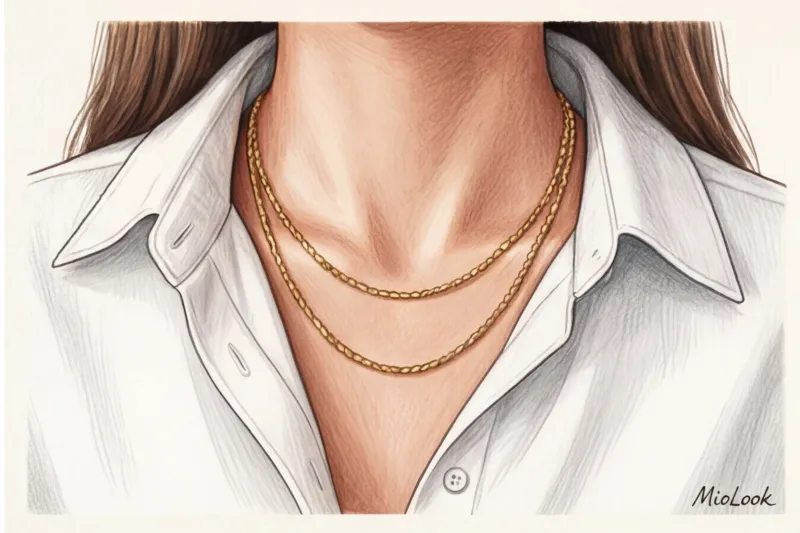
Use layering rule When pairing two chains, follow the "two-finger rule": space the pendants about 3-4 centimeters (the width of two fingers) apart. This will prevent them from tangling and create a beautiful geometric effect on an open neckline or over a basic turtleneck.
What about mixing metals? The rule against wearing silver with gold is hopelessly outdated. Today, it's a sign of good taste if you do it consciously. Use the "bridge rule." To reconcile warm gold and cool silver in a single look, add a unifying element: a bicolor watch (where steel is mixed with a yellow coating) or a Cartier Trinity stackable ring. This element will serve as a visual bridge, justifying the presence of both shades.
If you are unsure how a chosen metal mix will look with a particular jacket, I always advise my clients to use styling tools in MioLook — sometimes an outside perspective (even from a neural network) immediately highlights an imbalance in the image.
Eco-friendly care: how to extend the life of your jewelry capsule
Even the highest-quality investment jewelry will quickly lose its shine without proper care. Forget about harsh chemical polishes—they're toxic and will gradually destroy the metal.
Take the reinforced concrete principle as a rule: First off, last on (Remove first, put on last). Jewelry should only be put on after body lotion has been absorbed, hairspray has dried, and perfume has settled. It should be removed in the evening before you shower or remove makeup.
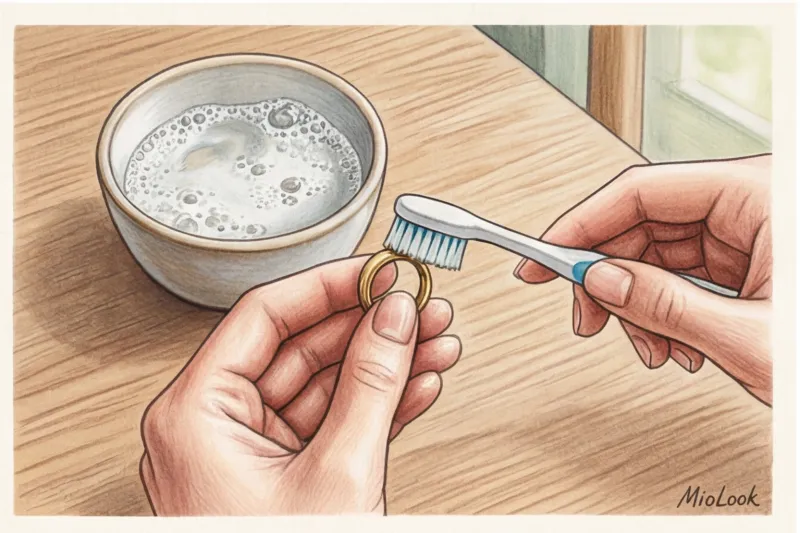
You don't need expensive ultrasonic baths for a home spa treatment. Moreover, if your base ring has micro-pavé (a fine scattering of diamonds or cubic zirconia), the ultrasonic vibration has an 80% chance of loosening the prongs, causing you to lose the stones. The best eco-friendly treatment is warm water, a drop of mild dishwashing liquid (it's great for breaking down sebum), and a baby toothbrush with the softest bristles.
And finally: never store jewelry on a bathroom shelf. Steam from a hot shower and changes in humidity are the main enemies of jewelry alloys. Keep your jewelry base in a dry chest of drawers in the bedroom, preferably in a jewelry box with soft dividers.
When putting together a basic jewelry wardrobe, remember: it's better to have three flawless, tactilely pleasing, and long-lasting pieces than a drawer of shiny but quickly tarnishing junk. Invest in quality materials, not in the number of trends, and your look will always convey a quiet, confident air of status.