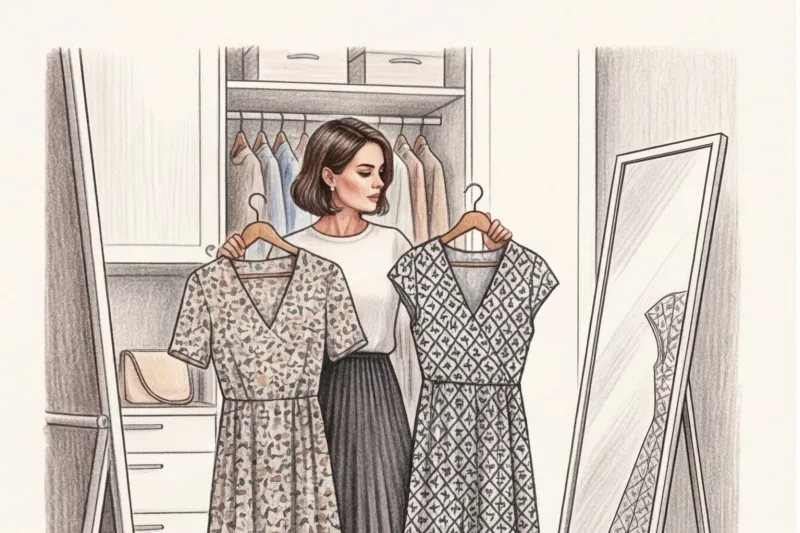
Have you ever noticed how one dress makes you look like a sophisticated Parisian, while another makes you look like an overgrown schoolgirl at a school party? If you're under 160 cm tall, you've probably Googled clothing rules at least once and stumbled upon the same ironclad rule: "Wear only small prints" As a stylist with 12 years of experience working in Europe, I can say bluntly: this advice is hopelessly outdated and downright harmful to your wardrobe.
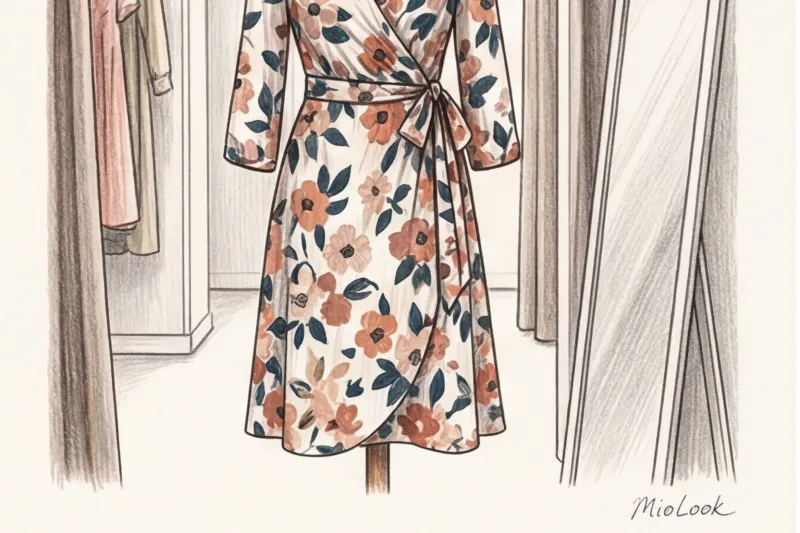
I talked about the basic laws of working with silhouettes in more detail in our A complete guide to stylish clothing for petite women up to 160 cm But today we'll dive deep into the mathematics of pattern. We'll explore the right prints for petite women, relying not on the clichés of the 2000s, but on the laws of optics, the physics of color, and the architecture of cuts.
The Biggest Myth: Why the "Small Drawing Only" Rule Ruins Your Looks
Mass-market brands, from Zara to H&M, cut clothes and scale prints to fit the standard fit model height of 168–170 cm. When a petite woman wears a pattern that isn't tailored to her height, it creates a visual glitch. But the biggest mistake is blindly relying on micro-prints.
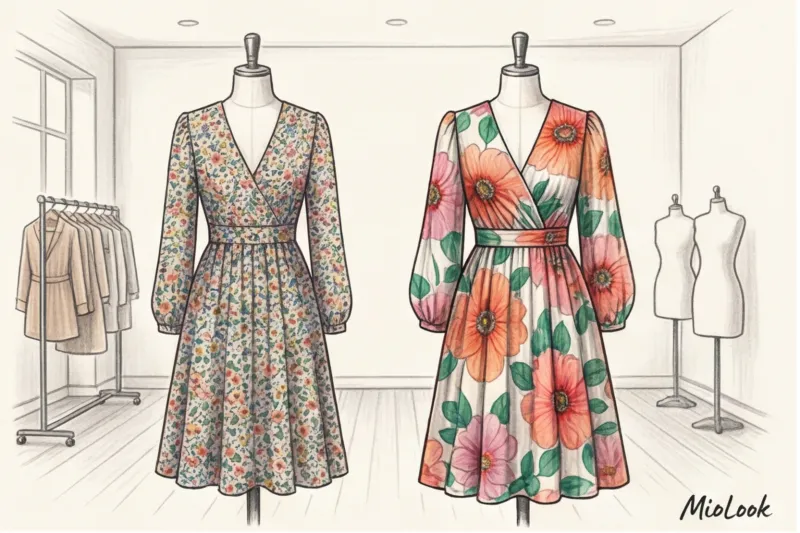
I had a revealing case in my practice. Anna (156 cm), a top manager at an IT company, came to me. In an attempt to appear taller, she filled her closet entirely with microscopic floral dresses (millefleurs) and blouses with the finest speckles. The problem was that Anna had large, dramatic facial features—high cheekbones, wide eyebrows. Against this micro-print, her face appeared coarse, and she looked less like a high-status executive and more like a girl in her mother's shoes.
The scale of the design should always be proportionate to your bone structure and facial features, not just the number on the height chart. If you have medium or large facial features and are 155 cm tall, a small ripple in the fabric will be forgiving and will not create a discordant effect.
Stripes: A Geometric Illusion That Works for You
Stripes are the most powerful optical tool in a wardrobe. But they're also the source of the most stylistic horror stories. Let's turn to science.
Vertical vs. Horizontal: Breaking Stereotypes
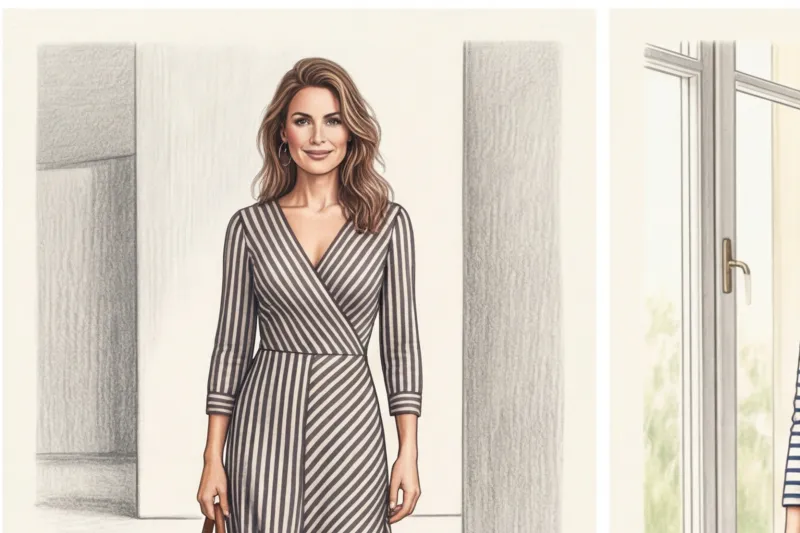
For years, we've been taught that vertical stripes make you look taller, while horizontal stripes make you look fat. This isn't just an oversimplification; it's an optical illusion.
In 1867, the German physicist Hermann von Helmholtz described an illusion that proves the opposite: a square filled with dense horizontal lines appears taller and narrower to the human eye than a similar square with vertical lines. In 2008, researcher Peter Thompson of the University of York confirmed the Helmholtz illusion using 3D models of human figures: experiment participants consistently perceived women with horizontal stripes as slimmer.
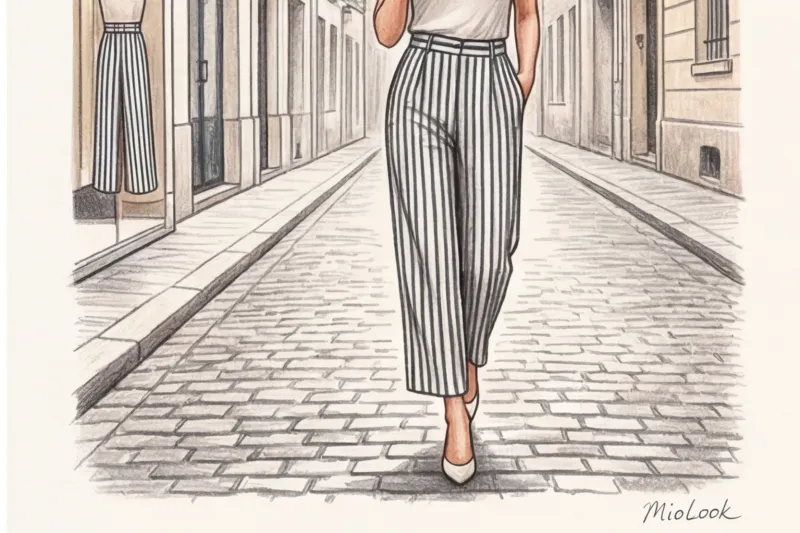
Wide, contrasting vertical stripes (especially those wider than 4-5 cm) don't add height. They break up your figure into chunky blocks, creating a "judge in the ring" or "mattress" effect, making your silhouette appear boxy.
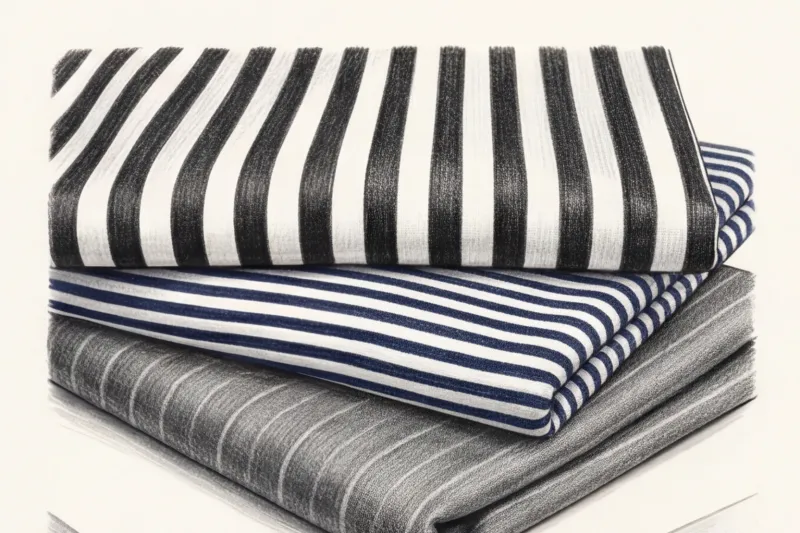
At the same time, the thin horizontal Breton stripe makes the eye slide up and down the many lines, visually elongating the figure.
Your ideal image begins Here
Join thousands of users who look flawless every day with a smart wardrobe selection algorithm.
Get access — €0.99 onceWidth and Contrast: The Mathematics of the Perfect Breton Top
If horizontal stripes are so flattering, why are so many girls afraid of them? Because they buy the wrong striped top. Here are the specific measurements of the ideal stripe for women up to 160 cm tall:
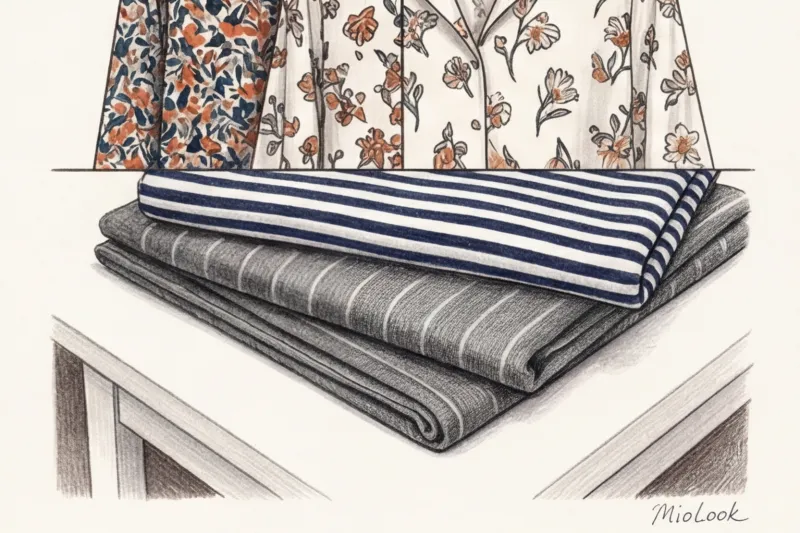
- Width: Strictly no more than 1.5–2 cm. Anything wider will start to “eat up” growth.
- Contrast: Harsh black-and-white contrasts don't work as well. Look for softer options: a dark blue (navy) or graphite stripe on a milky (not stark white!) background. Such patterns are often found in COS or & Other Stories.
- Rhythm: An uneven rhythm (such as thin-wide-thin stripes) creates a dynamic that draws attention away from the short stature.
Fair Limit: The Helmholtz illusion doesn't work if the sailor shirt is made of flimsy viscose that clings to every crease at the waist. Horizontal stripes require a dense fabric (such as cotton with a weight of at least 180 g/m²) that will hold its shape.
Polka Dot: Elegance without the "Children's Party" Effect
Polka dots are perhaps the most insidious print for petite girls. Their round, closed shape doesn't naturally elongate the silhouette. However, they're not a print you should avoid.
Size calibration: the "coin rule"
To find my ideal scale, I use a simple "coin rule" with my clients.
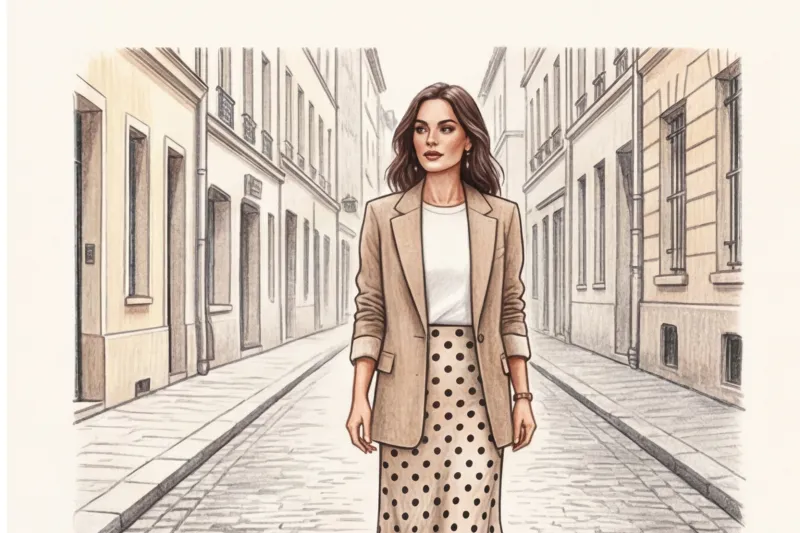
Avoid extremes. Micro polka dots (the size of a pinhead) will blur into a dirty spot or create an unpleasant ripple in a photo. Super-large polka dots (the size of an apple) on a 155 cm tall woman look comical, like a Minnie Mouse costume. Your ideal diameter is the size of a 1 or 2 euro coin (1 to 2.5 cm). This scale maintains elegance and is easy to read.
And remember about color: light polka dots on a dark background (for example, milky on a deep emerald) are much more slimming than dark polka dots on a light background.
Arrangement and density of elements
Another subtle nuance is the rhythm of the polka dot placement. Strictly symmetrical, dense polka dots create a visual "grid" that grounds the silhouette. For petite women, always choose a chaotic, sparse arrangement of elements—the so-called "dancing" polka dots. This adds airiness to the look.
Floral Print: From Romance to Drama Without Losing Height
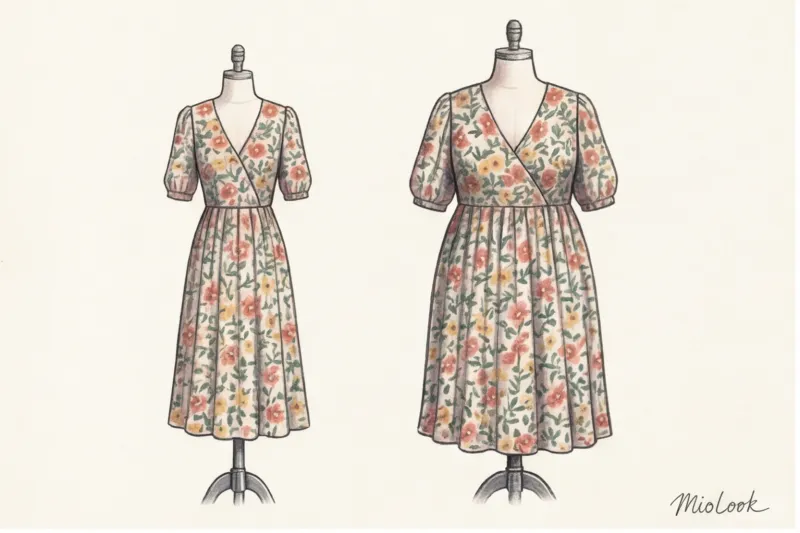
Floristry is a petite woman's petiteness. You walk into, say, Massimo Dutti, see a stunning floral midi dress, put it on, and suddenly you look shorter and wider than you actually are.
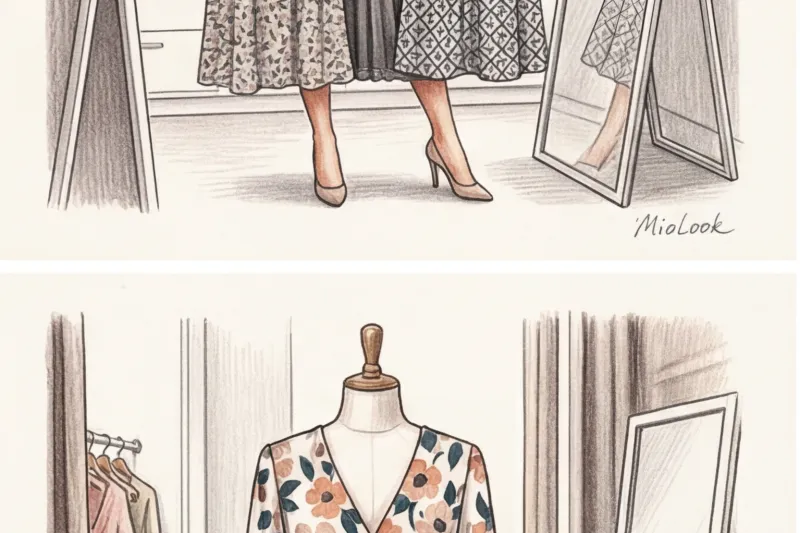
The danger of the "millefleur" (small flower)
I already mentioned Anna's story. A small, closely spaced flower often cheapens the image of a grown woman. It's associated with children's clothing or a rustic (country) style. If you don't have a distinctly ingenue aesthetic, a millefleur will make your look childish.
How to wear large flowers if you're under 160 cm tall
Contrary to popular myth, it is not tall Can Wear large flowers. The secret lies in the level of contrast and the shape of the buds.
Avoid round, clearly defined flowers (like bright peonies on a black background) that look like massive spheres. Look for prints with vertically elongated flowers—stems, vines, and irises. Another trick is watercolor shading. If the edges of a large flower are blurred and the contrast between the pattern and background is low (for example, dusty pink flowers on beige silk), the print won't overwhelm your height.
Access to MioLook for €0.99 — one-time payment
A smart AI stylist will analyze your measurements and select prints that will perfectly complement your wardrobe.
Get access — €0.99 onceStylist's Secret: The Rule of "Negative Space" in Prints
This rule is rarely mentioned in popular fashion articles, but it's a basic tool for any professional stylist. It's about "negative space"—the space between the elements of a pattern.
WGSN's 2024 trend study shows that items with densely printed patterns (where the design takes up 80-90% of the fabric, like wallpaper) perform worse in brands' petite lines. Why? Because a dense pattern subconsciously feels heavy. It detracts from the dynamic of the silhouette.
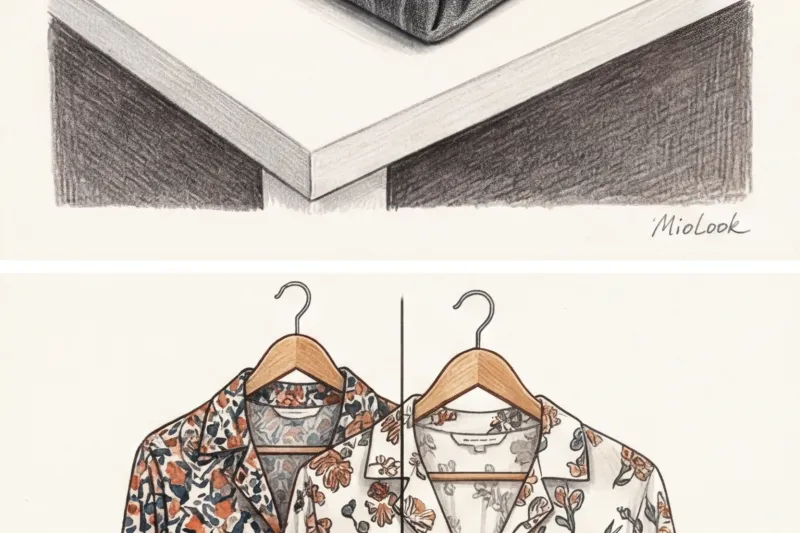
For those under 160 cm tall, space between colors or geometric patterns is crucial. Aim for mathematical proportions: the ideal print for petite women should contain at least 40–50% open background. This simple trick works flawlessly: even a large pattern won't overwhelm your figure if there's plenty of open space between its elements.
Checklist: How to Test a Print in the Fitting Room
Theory is useless without practice. Next time you go shopping and pick up a patterned item, run it through this checklist:
- Two meter test: Put the item on and take two steps back from the fitting room mirror. If the print has merged into a blurry, dirty spot (a common problem with micro-patterns), leave the item in the store.
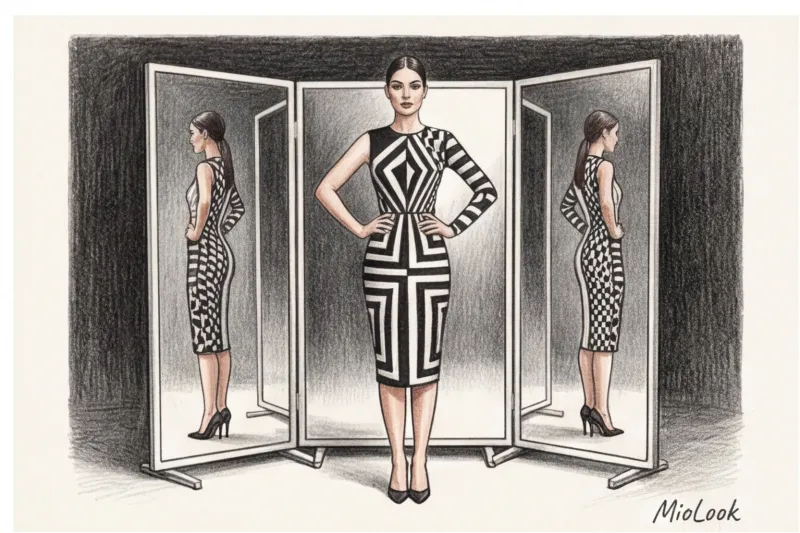
- Checking joints: Look closely at the side seams. Do the stripes or geometric patterns match? For petite women, the quality of the cut is paramount. Any distortion of the pattern at the waist will immediately draw attention and throw off the proportions.
- Selfie test without zoom: Take a full-length photo with your phone (either with the main camera or through a mirror). A smartphone lens mercilessly highlights what the brain tries to ignore. If you appear wider and shorter in the photo, the print isn't yours.
- Portrait test: Hold the fabric up to your face in good lighting. The print shouldn't overpower you. People should see your face first, and only then the beautiful pattern on your blouse.
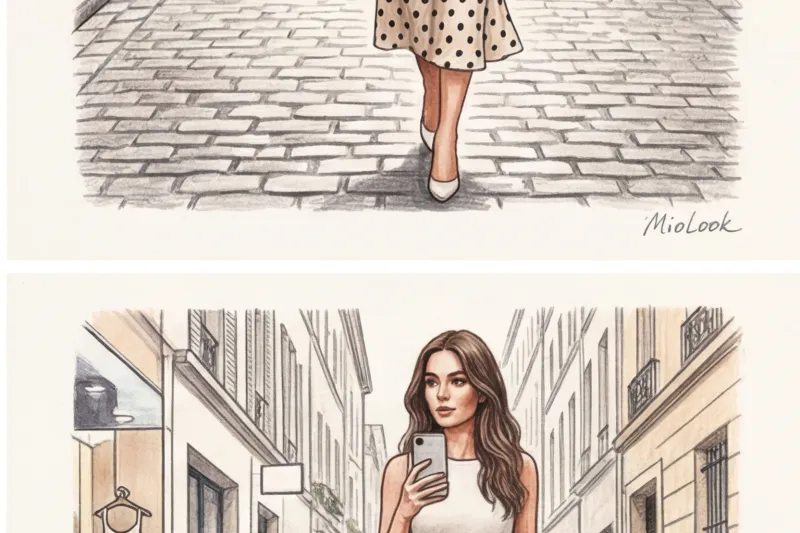
Your New Drawing Strategy
Prints for petite figures aren't a set of strict restrictions, but a flexible tool for managing focus. Forget the "small flower only" ultimatum. Match the pattern's scale to your facial features, look for a medium-sized pattern (the coin rule), and always leave 40-50% air space in the design.
Tonight, open your closet and look at printed pieces with new eyes. Get rid of anything that cuts you into squares or erases your individuality with tiny ripples. Keep only the patterns that work for you, not against you.