I vividly remember my flight from Milan to New York before Fashion Week. The flight was delayed, my layover in Paris turned into a sprint across the terminal, and immediately upon landing at JFK, I had to meet an important client. If I'd been wearing stiff leather pumps or, conversely, shapeless Ugg boots, the day would have been a disaster. But I stepped out of a Manhattan taxi in immaculate suede loafers, feeling like I'd spent the last nine hours at a spa rather than on a plane.
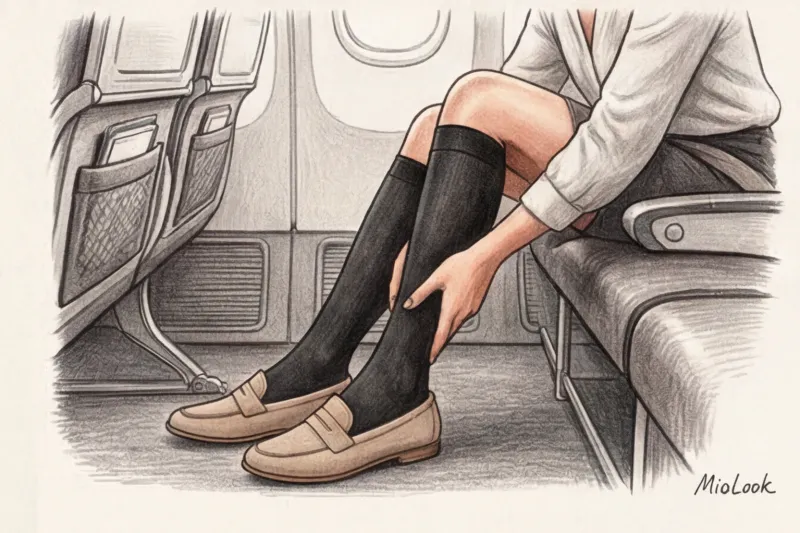
Choosing the right pair for travel isn't a compromise between beauty and comfort. It's a precise physiological and aesthetic calculation. When asking yourself, What shoes should I wear on a plane? Many women make the same mistakes: either completely sacrificing style for athletic running shoes or enduring torture in favor of elegance. We've covered more about building a complete travel wardrobe in our The Complete Guide: What to Wear on a Plane: Stylish and Comfortable Looks , and today I want to analyze only the foundation of your Jet-Set look - shoes.
The Anatomy of Flight: What Happens to Your Legs at 33,000 Feet
One of my clients, the CEO of a large IT company, once made a fatal mistake. For a flight to Dubai, she chose a stunning but completely stiff pair of leather tube boots for 1,200 euros. They fit perfectly in the VIP lounge at Sheremetyevo Airport. But five hours into the flight, as the plane began its descent, she realized she couldn't feel her toes. She had to literally pull the boots off with brute force—the leather was tightly pressed into her swollen calves.
Why do shoes that seem perfect on the ground become "sandals" in the sky? According to the Aerospace Medical Association (AsMA, 2023), reduced cabin pressure and prolonged sedentary behavior cause the volume of the foot and lower leg in a healthy person to increase by 5–8%. Blood and lymph accumulate in the lower extremities, causing peripheral edema. A stiff shoe that fits perfectly in the morning begins to block microcirculation by evening.
Add to this the temperature swings. You might walk on scorching asphalt to a ramp at +30°C, and twenty minutes later, you're sitting under a blast of ice-cold air conditioning, where the floor temperature barely reaches +18°C. Shoes should act as a climate buffer, protecting against both overheating and hypothermia.
What Shoes to Wear on a Plane: 4 Golden Rules of Jet-Set Chic
Over 12 years of working as a personal stylist, I've developed a formula for the perfect travel shoe. It's based on four principles that can't be ignored.
- Rule of plasticity (Unlined Leather): Invest in shoes without a rigid inner lining. In the premium segment, this technology is called unlined suede or unlined leather Suede or finely crafted leather without a backing layer works like a second skin—it stretches in sync with your foot's swelling and returns to its original shape after landing.
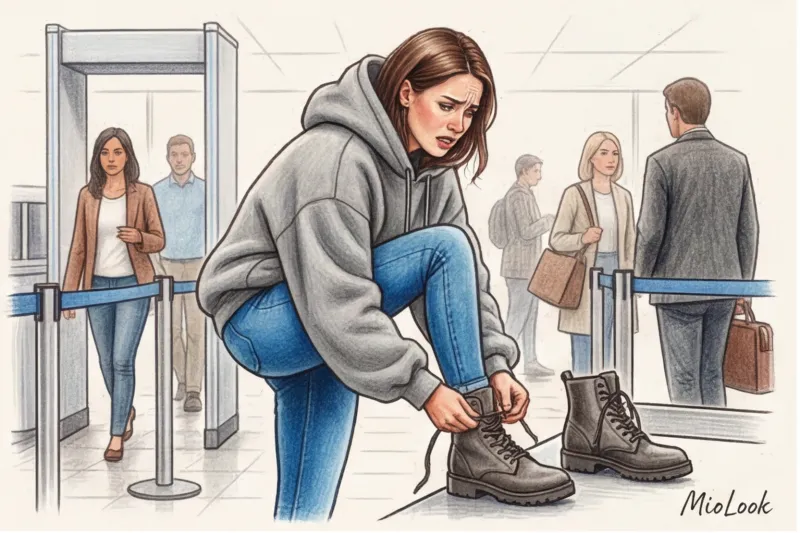
- Safety factor: Choose models without hidden metal insoles. Cheap shoes often maintain their shape thanks to a metal plate in the sole. This is precisely why you'll jingle at every metal detector and waste time taking them off.
- Cushioning for forced marches: The average passenger walks between 1.5 and 3 kilometers at major transit hubs like London Heathrow or Paris Charles de Gaulle Airport. Your soles need to absorb the impact, otherwise you'll arrive at the boarding gate with a nagging lower backache.
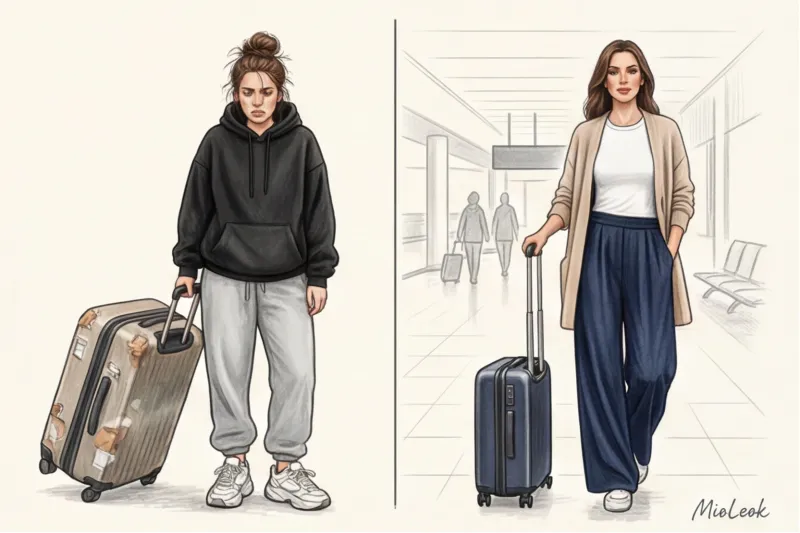
- First class aesthetics: Comfort doesn't mean the "I went out in my pajamas to buy bread" effect. Travel shoes should have clear lines and a refined texture to easily integrate into business casual look immediately upon arrival.
Your perfect travel wardrobe
Not sure what to wear with your favorite loafers on a flight? Upload a photo of them to MioLook, and our AI stylist will create the perfect travel outfit.
Get access — €0.99 onceThe Biggest Airport Myth: Why Mules and Flip-Flops Are the Worst Choices
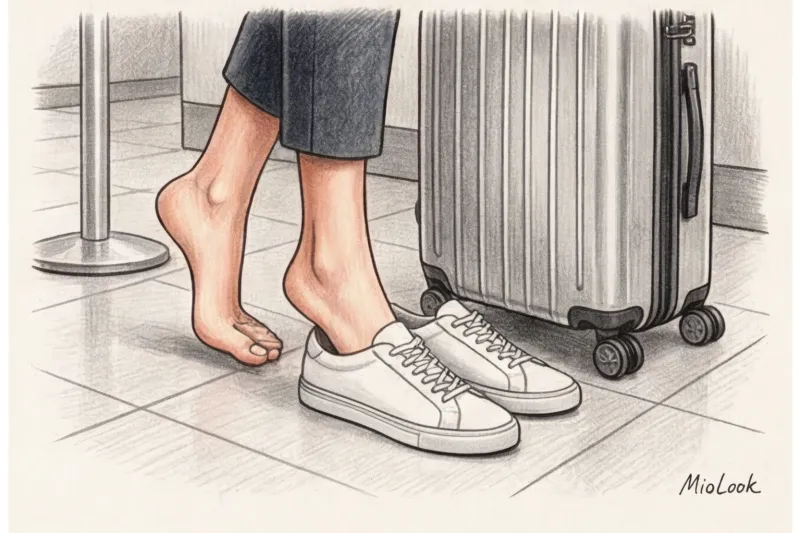
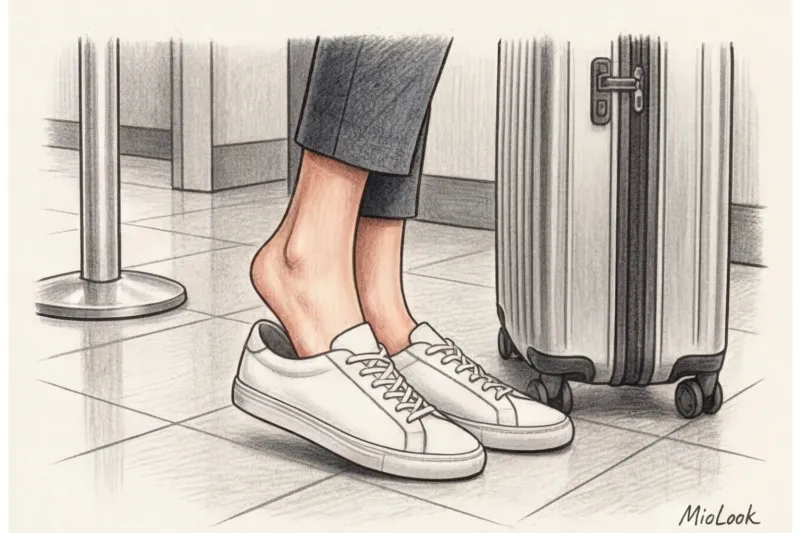
Here I want to debunk the most common travel misconception. For years, glossy magazines have been saying, "Wear mules or trendy flip-flops on the plane—they're so easy to take off at security!" As an expert, I declare: this is the worst advice anyone can give.
"Shoes without heel support force your toes to reflexively dig into the insole with each step to stabilize the sole. When walking on long platforms, this leads to strain on the plantar fascia and microspasms in the calf muscles," according to research from the American Podiatric Medical Association (2022).
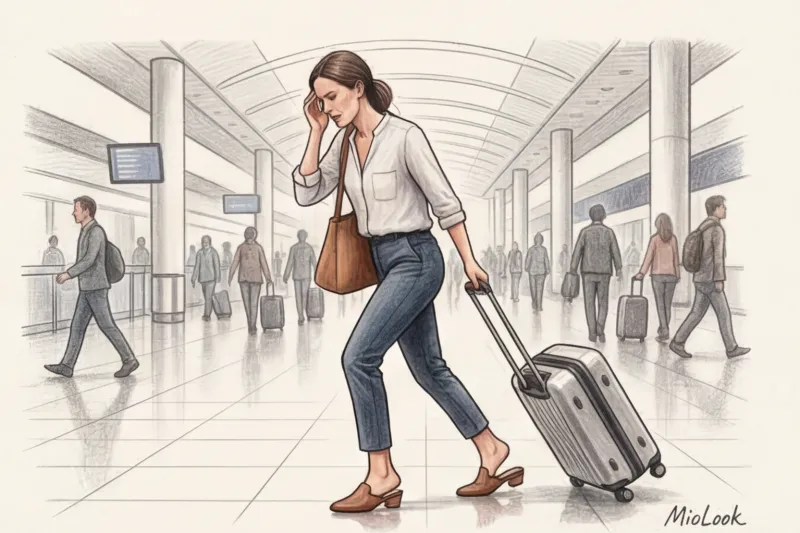
Moreover, exposed heels and toes are a surefire way to get chills in the airplane cabin. And let's be honest: standing barefoot on the cold and not always clean floor at the TSA security checkpoint is a dubious pleasure. The illusion of comfort turns into fatigue and the risk of developing a fungus.
Top 5 status and convenient flight options
So what should you choose? Here are my personal top-rated options that combine the DNA of luxury with orthopedic comfort.
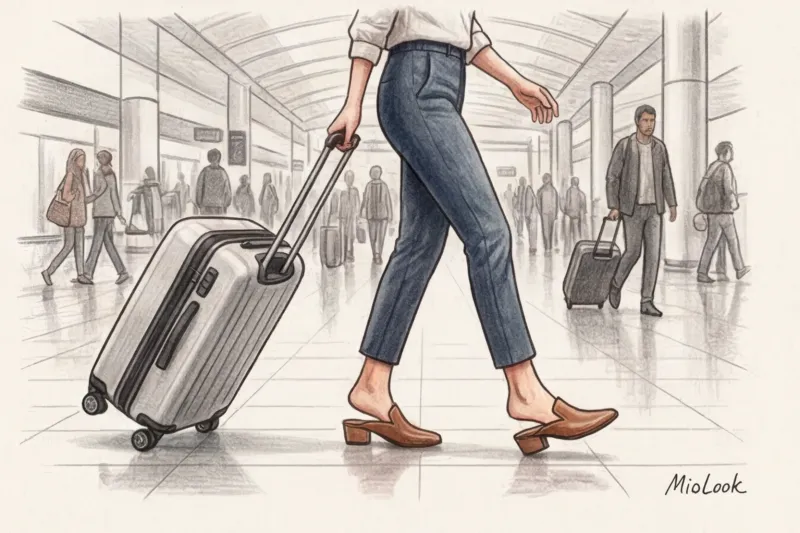
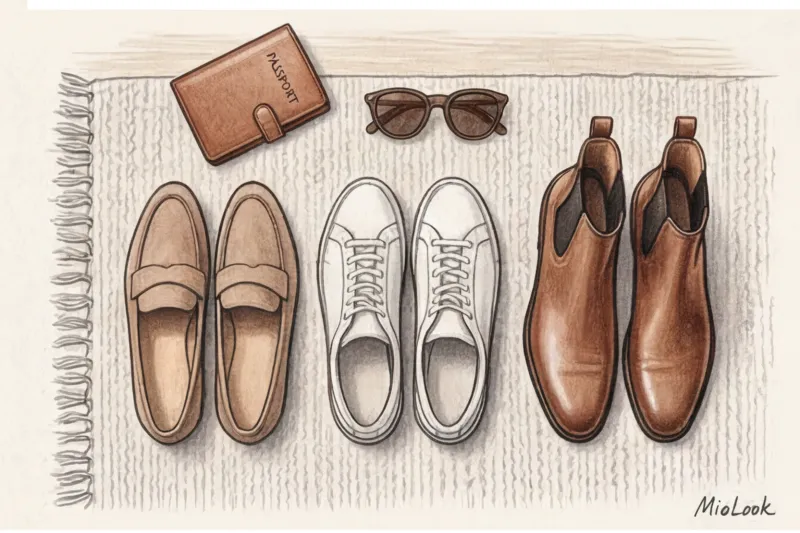
- Suede loafers (in the style of Loro Piana Summer Walk). These are the absolute benchmark for travel footwear. The soft suede adapts to the volume of the foot, and the light latex sole cushions the stride. They look casual enough for cashmere joggers and classy enough for a linen suit.
- Minimalist leather sneakers. A basic investment. Choose styles without oversized logos, perforations, or unnecessary details. Smooth matte leather with a solid-color sole. They'll fit even the most casual office dress code.
- Chelsea boots with soft soles. Ideal for winter flights and sudden climate changes (for example, Moscow to the Maldives). Thanks to the elastic side panels, they are easy to remove, don't pinch your ankles, and provide protection from the cold.
- Slip-ons made of technical knitwear (Flyknit). When comfort is paramount, the knit fabric fits snugly like a sock, providing maximum ventilation. But here lies the limitation: This option is absolutely not suitable if you need to go from the gangway to a conservative business meeting.
- Brogues or oxfords made of soft leather with a microporous sole (EVA). The perfect choice for strict business trips. The secret lies in the sole—it looks like classic leather, but weighs a third as much and is flexible in your hands.
By the way, to avoid racking your brains over which trousers will go with your new Chelsea boots, I always advise my clients to use the "smart wardrobe" feature in MioLook The app literally shows you in seconds how one pair of shoes works with different items in your suitcase.
How to combine travel shoes with a business wardrobe
If you have a meeting right after your flight, the magic is in the details. Suede loafers work perfectly with cropped trousers with a crease, provided you choose the right socks. Forget thin nylon socks—they dig into the skin and impede circulation. Opt for thick cotton or thin ribbed cashmere socks. They'll add texture and refinement to your look.
Shoe etiquette in the salon: is it possible to take off your shoes?
This question is the most contentious on travel forums. As someone who regularly flies business class, I'll give a straightforward answer: taking off your shoes in your seat is both acceptable and necessary for your health. But there are strict rules of etiquette.
In the psychology of style, there's a concept called "enclothed cognition." Even when relaxing, it's important to maintain boundaries between private and public spaces. Taking off your loafers and wearing clean, high-quality socks while sitting in your chair is considered elegant. But getting up and walking down the aisle to the restroom in just your socks is an absolute no-no.
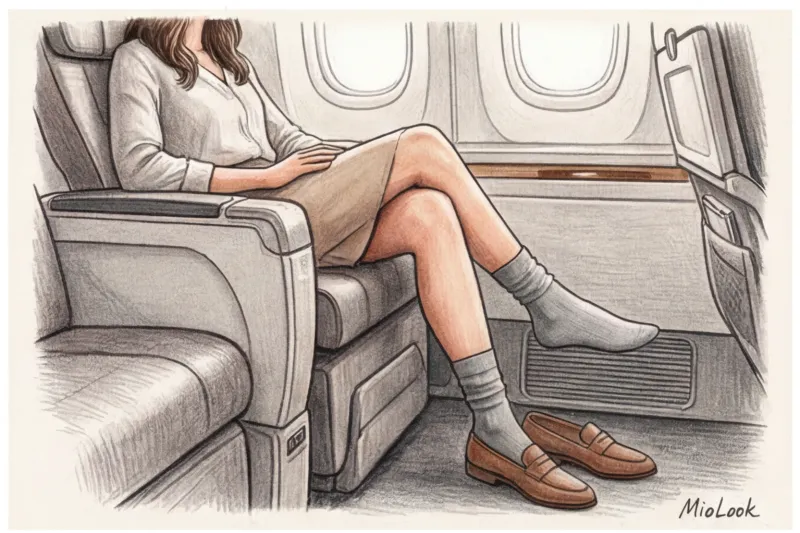
Firstly, it's unhygienic. Secondly, in the event of turbulence or an emergency, shards of plastic or spilled hot coffee could end up on the floor. Premium airlines will always offer you travel slippers. If you're flying economy, just pack sturdy, foldable slippers made of soft leather or suede.
Access to MioLook for €0.99 — one-time payment
A smart AI stylist will select the perfect look for flights and business trips, taking into account your color type and body shape.
Get access — €0.99 onceChecklist: How to Prepare Shoes for a Long Flight
Investing in premium footwear requires proper care, especially in the extreme conditions of travel. Here are three steps I make every client take before heading to the airport:
- Preventive protection. Be sure to treat suede or fabric shoes with a water-repellent nanospray 12 hours before departure. In turbulence, a seatmate can easily spill tomato juice on you. Properly treated suede won't absorb the liquid—the drops will simply roll off.
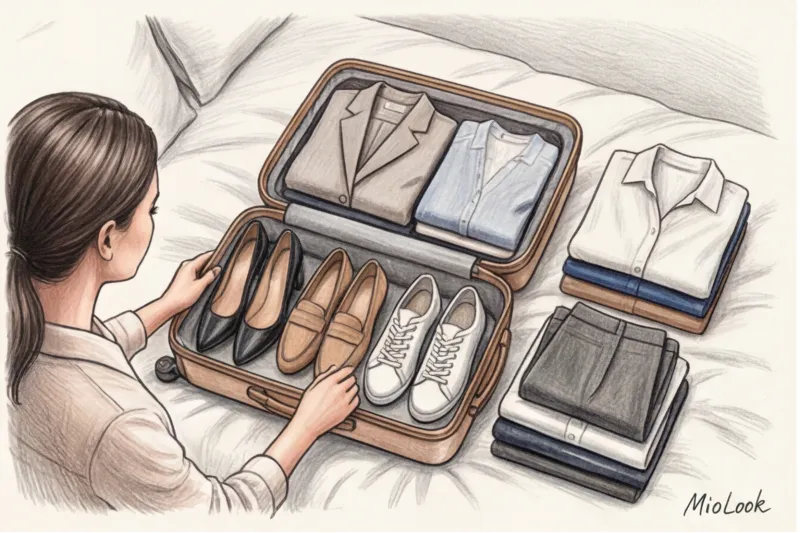
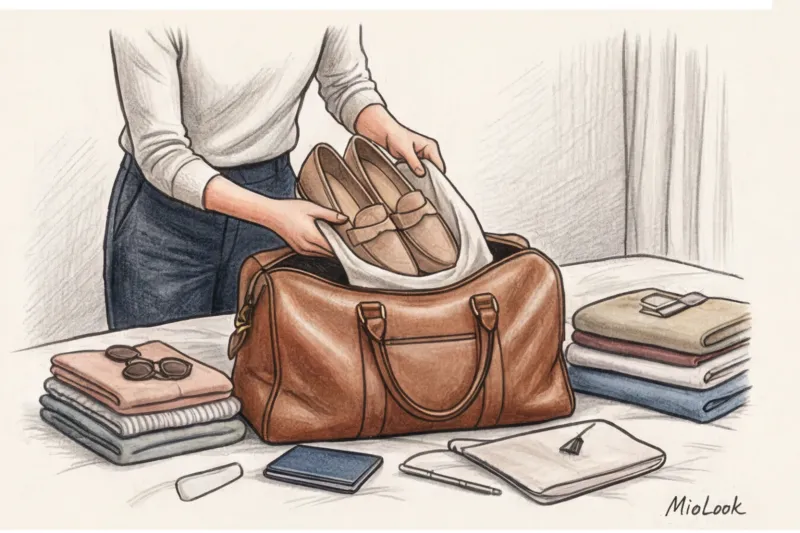
- Correct packaging of a spare pair. If you're flying in sneakers and carrying loafers in your checked luggage, never just pack them in. Insert lightweight plastic or cedar shoe trees inside, and place each pair in a separate silk or cotton dust bag. This will prevent them from warping under the weight of your makeup bag and staining your clothes.
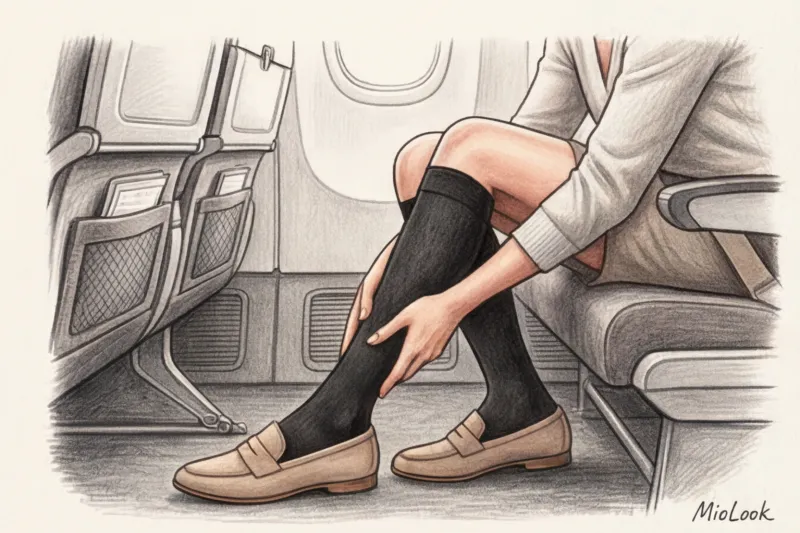
- Smart compression. If you wear compression socks (which phlebologists strongly recommend for flights longer than four hours), match their color to your shoes, not your skin tone. Nude "medical" socks peeking out from under stylish trousers instantly ruin the entire look. Black socks with black loafers create a stylish accent.
Traveling shouldn't be a test of endurance. By choosing the right travel shoes, you're investing not just in a good look, but in your own energy. When you step off the ramp without foot pain, with a light gait and impeccable style, you've already won the day, wherever you're headed.