How AI is Transforming Fashion Brands: From Chaos to Sustainability
When we hear the phrase "artificial intelligence in fashion," our brains automatically conjure up images of cyberpunk: holographic dresses, digital clothing for metaverses, and robotic couturiers. But the truth is, the biggest and most profitable revolution is happening behind the closed doors of factories and warehouses. As a textile expert and stylist, I see that and in fashion brands He does much more "boring" but vitally important things: he saves the industry from overproduction and helps create patterns that finally fit the figure.
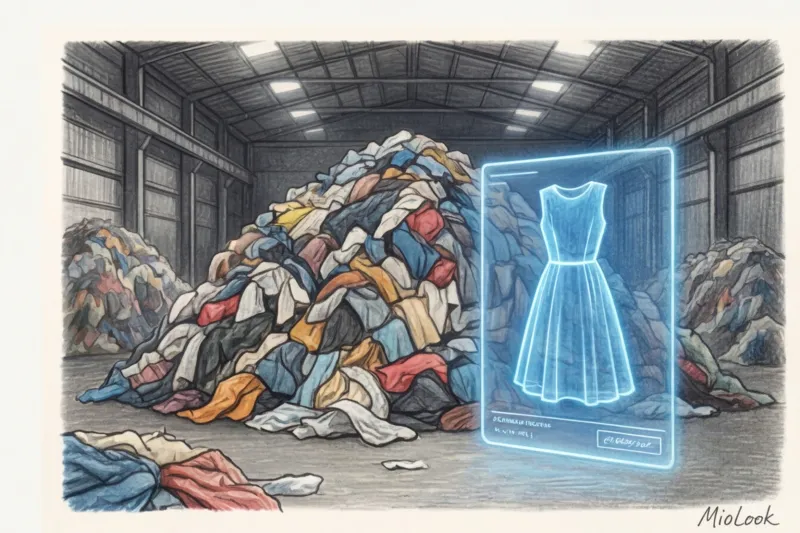
We talked about global trends in more detail in our A complete guide to implementing neural networks in the fashion industry But today I want to show you the inside story. Consider this: about 30% of all clothing produced globally never finds a buyer. This amounts to millions of tons of so-called deadstock (dead scraps) that end up in landfills. According to McKinsey's "State of Fashion 2024" report, 73% of fashion brand CEOs have made investments in generative AI their top priority, specifically to solve logistics problems, not to create crazy designs.
My goal is to teach you to read between the lines. When a brand claims to use technology, is it just a marketing ploy or genuine concern for quality? Let's explore how algorithms are changing the clothes we buy and wear every day.
Your perfect look starts here
Join thousands of users who look flawless every day with MioLook.
Get access — €0.99 onceMass Market: How H&M and Zara are using AI to combat overproduction
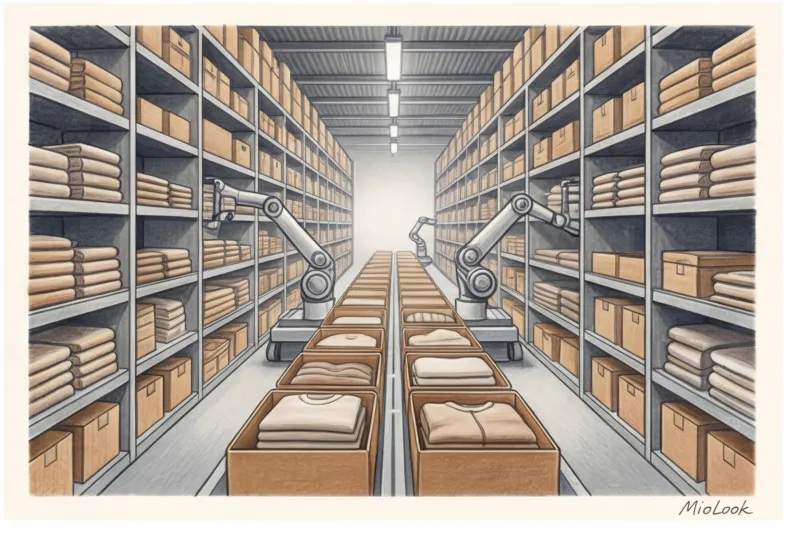
If you visit a Zara store in Berlin and one in Madrid, you'll see different product selections. This isn't a coincidence or the handiwork of merchandisers. Today, mass-market giants use computer vision and predictive analytics to scan millions of social media posts. The algorithm doesn't just understand that "blue is in." It calculates that in three weeks, a specific shade of cobalt paired with heavyweight knitwear will be in demand in Northern Europe.
For the supply chain, this means the end of blind guessing. The system knows exactly 142 sweaters in size M need to be sent to the Berlin branch, not 300, thereby avoiding unsold stock. This is a phenomenal step toward sustainability. Less wasted production means less wasted stock.
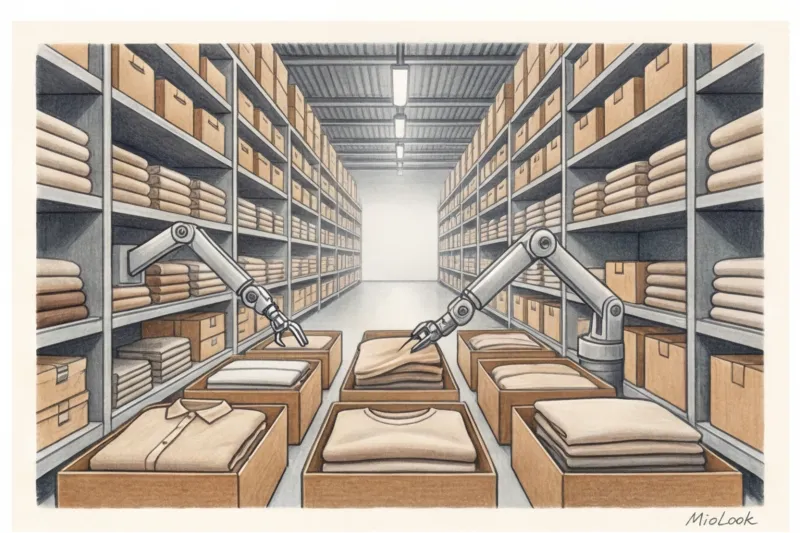
"The main value of algorithms in mass marketing is their ability to transform a chaotic conveyor belt into a system of targeted supply. But AI addresses the issue of quantity, not the quality, of the fiber itself."
And herein lies my main caveat as a stylist. Yes, Zara will make exactly as many €60 jackets as its audience will buy. But an algorithm won't make polyester breathable or acrylic durable. A neural network predicts demand, but the responsibility for reading the labels still lies with us. If a brand boasts of smart forecasting, check whether the fabric density has improved—look for basic cotton from 180 g/m² or a viscose blend.
Luxury and premium segment: Gucci, Burberry and the protection of authenticity
In the high-end luxury segment, where bags start at €2,000, the stakes are completely different. Here, AI plays the role of detective and jeweler. The main problem in the premium market is high-end counterfeits (so-called "superfakes"). Brands are implementing technologies like Entrupy—a microscopic analysis system that uses AI to examine leather texture, seam tension, and micro-scratches on hardware, delivering a 99% accuracy verdict on authenticity.

In production itself, algorithms work wonders in terms of cost savings. Cutting expensive fabrics, such as 19-momme silk or cashmere, is now entrusted to AI-controlled lasers. The program lays out patterns on the fabric so that the amount of waste is minimized. But there's a catch.
Over 12 years of working with luxury wardrobes, I've become convinced that no scanner in the world can yet assess the tactile softness of a thread. My fingers instantly feel the difference between long-fiber Mongolian cashmere and short, stiff down that will pill in a month. AI can cut fabric perfectly, but the raw materials still need to be selected by humans.
AI and Pricing: Why Do Things Cost What They Do?
Have you noticed how prices in online boutiques can change so subtly? That's dynamic pricing. Algorithms analyze demand, weather, your previous purchases, and even competitors' prices to calculate the ideal moment for a discount. Brands maintain their profit margins by avoiding sweeping sales that damage their status. If you're planning invest in a quality wardrobe , add items to your "favorites"—systems often trigger personalized promo codes specifically for items you've set aside.
Perfect Fit: Neural Networks at the Service of Levi's and Nike
According to statistics, about 40% of clothes bought online are returned. And the main reason is poor fit. If you've ever ordered jeans in your usual size, only to find they were two inches off at the waist, you know what I'm talking about. Returning clothing to an online store — this is a colossal loss for business and the carbon footprint from unnecessary delivery.
To address this issue, brands like Levi's have begun implementing AI-powered model generation for models with different body types. Instead of testing each €100 pair of jeans on dozens of different models (which is physically and financially impossible), the algorithm superimposes a 3D model of the item onto avatars of real women, from petite to plus-size.
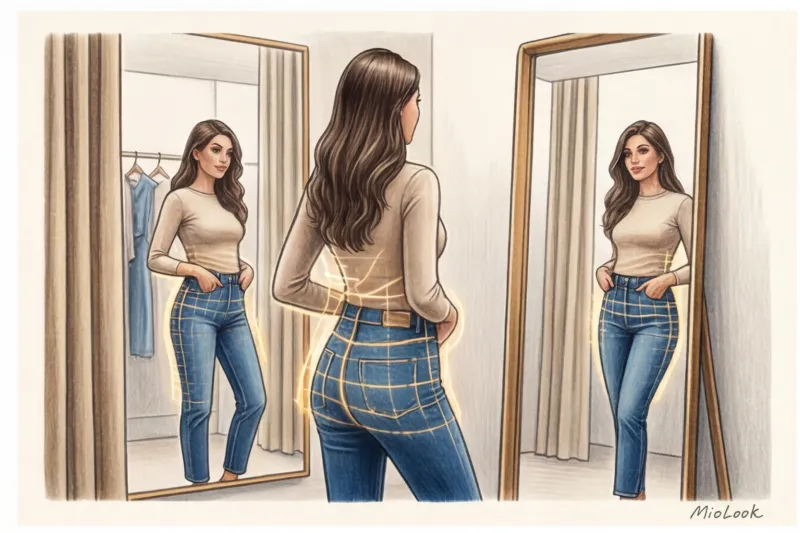
One of my online support clients, let's call her Anna, has a pronounced pear-shaped figure (narrow waist, full hips). For years, ordering pants was a gamble for her. When we started using built-in virtual fitting room widgets (where an algorithm analyzes measurements and past successful purchases), her personal return rate dropped to practically zero. If you're interested in how algorithms help you create looks from perfectly fitting items you've already purchased, try MioLook — a smart wardrobe analyzes your items and suggests ready-made combinations.
Access to MioLook for €0.99 — one-time payment
A smart AI stylist will select the perfect everyday look from your own items.
Get access — €0.99 onceSustainable Textiles: A Joint Project Between Stella McCartney and Google Cloud
Sustainability isn't just about recycled plastic bags. It's about transparency. Stella McCartney, a pioneer of ethical fashion, partnered with Google Cloud to create an AI-powered platform that analyzes the environmental impact of production. Algorithms process satellite images and supply chain data to trace the cotton's journey from a field in India to a rack in a London boutique.
According to research by the Ellen MacArthur Foundation, the transition to a circular economy is impossible without accurate compositional data. As a technologist, I always say: you can't create the perfect long-lasting wardrobe , if you don't know what it's made of. AI helps brands monitor farmers—whether they used banned pesticides and how much water they used for irrigation. For us, consumers, this is a guarantee that a €50 organic cotton T-shirt is truly organic and won't cause allergies.

The Dark Side of Innovation: When Algorithms Harm Style
It would be unfair to focus solely on the positives. There are scenarios where AI is downright destroying the art of tailoring and the environment. The most striking example is ultra-fast fashion giants like Shein. They use neural networks to generate up to 10,000 new styles a day. The algorithm spots a microtrend on TikTok (for example, a certain top cut), instantly creates a pattern, and sends it to the factory. This is the apotheosis of disposable fashion, made of cheap, squeaky polyester.
Moreover, there's a serious technological problem. AI often cuts mathematically perfect garments, but with absolutely no soul. Natural fabrics (wool, linen, natural silk) have their own inherent flexibility. A human cutter understands how the fabric will lie on the bias (bias cut) and how it will stretch with wear. The algorithmic cutting of ultra-fast fashion ignores these nuances. The result is a dress that visually looks like the picture, but in real life, it twists at the seams after the first wash at 30 degrees.
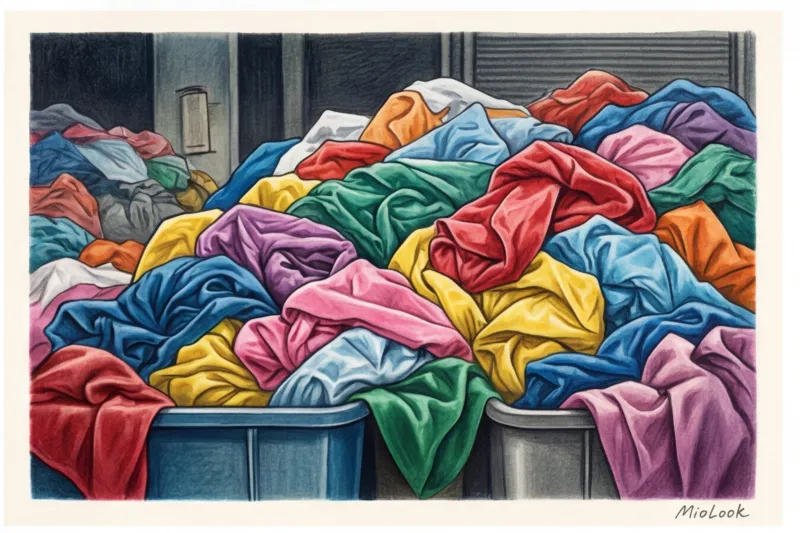
I also see a danger in the formation of an "average" style. Marketplace recommendation systems operate in an echo chamber: if you buy a gray sweater, the AI will suggest hundreds of other gray sweaters. This deprives us of insight and visual risk, turning the wardrobes of thousands of women into cloned collections.
Business Checklist: Which AI Solutions Are Brands Using to Measure Their Quality?
How can consumers understand that they are dealing with a truly technologically advanced and responsible brand, and not just a flashy press release? Here's how I recommend evaluating brands when choosing clothing for a prestigious wardrobe (for example, business casual style ):
- Look for transparency, not images. If a brand boasts about AI campaigns with virtual models, it's pure marketing; it doesn't improve the product. If a brand claims AI-based seam quality control or traceability of linen origin, it's an investment in the product.
- Test recommendation widgets. Is it implemented on the website? virtual fitting room , which asks for your body measurements and height, rather than just a standard size? If so, the brand is committed to reducing returns.
- Assess the stability of the landing. If you buy trousers from brand N year after year, and size M always fits the same, it means they have perfect algorithmic work with patterns.
Ready to get started?
Try the MioLook free plan—no commitments required. Upload your items and get smart pairing recommendations.
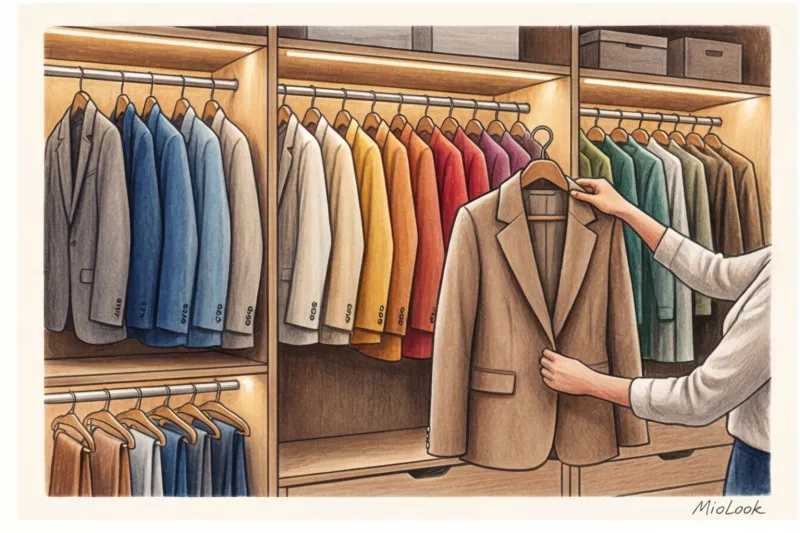
Get access — €0.99 onceThe introduction of neural networks into clothing production isn't about robots on the catwalk. It's about respect for the planet's resources and our time. Next time you put on a perfectly fitting jacket, remember: perhaps its precise proportions and the perfect collar are the result not only of a talented designer, but also of a complex mathematical model that calculated your every move.