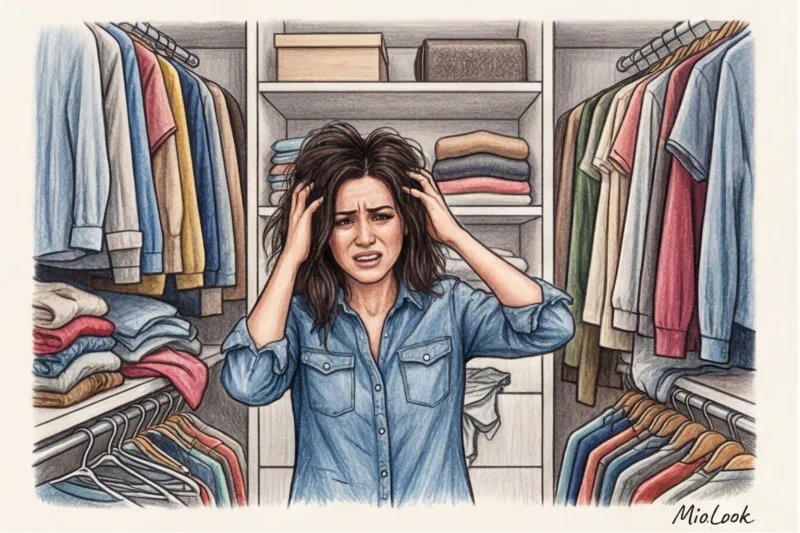
Have you ever wondered how much a mistake you made when ordering a wardrobe costs you? I'm not talking about the receipt from the furniture company. I'm talking about a stretched-out €300 cashmere sweater, the hem of your favorite silk dress collecting dust on the floor, and the misshapen handles of your designer bag. In 12 years of working as a style coach and wardrobe auditor, I've seen hundreds of luxurious pieces ruined by banal furniture ergonomics.
We talked about the global architecture of space in more detail in our The complete guide to the perfect walk-in closet layout Today we'll look at shelves, rods, and drawers through the eyes of a fabric expert. Correct filling the dressing room It's not just a way to cram the unsqueezable. It's the only way to extend the life of your things and cut your morning preparation down to 10 minutes.
Why standard closet contents ruin your clothes
I had a classic case in my practice. A client commissioned a project from a high-end furniture brand. The designer drew a flawless picture: three meters of identical hanging rods, gigantic deep shelves, and a couple of drawers. The result? Three long evening dresses lay on the floor in dust bags because the hanging rods were designed to fit men's shirts, and a collection of handbags (each starting at €500) were huddled in dust bags on the mezzanine, gradually losing their shape under their own weight.
This is where the main conflict of interests lies. Furniture makers sell you cubic meters of MDF and cabinet fronts, but you need easy access to your clothes and safe storage. Incorrect dimensions slowly but surely destroy your belongings. Leather creases in cramped drawers, knitwear stretches on ill-fitting hangers, and delicate fabrics suffocate in cramped spaces.
That's why any alteration should begin with an audit. Before inviting a measurer with a tape measure, measure your clothes. I always recommend using Smart wardrobe in the MioLook app to digitize your database and understand exactly how much long, short, voluminous, and delicate hair you have.
The Gold Standard: Ergonomics and Correct Shelf Sizes
Back in 1936, architect Ernst Neufert published a handbook on building design that is still considered the bible of ergonomics. Adapting Neufert's standards to modern textiles yields two basic rules: the "arm's length rule" (store essential items at a height of 70 to 160 cm) and the visibility principle (if you can't see something, you don't wear it).
Shelf Depth: Debunking the 60-Centimeter Myth
The 60-centimeter furniture standard is the absolute worst thing imaginable for closed shelves. Do you know why? 60 cm was invented solely to allow hangers and rods to fit freely behind closed doors. But furniture makers, out of inertia, continue to make shelves just as deep.
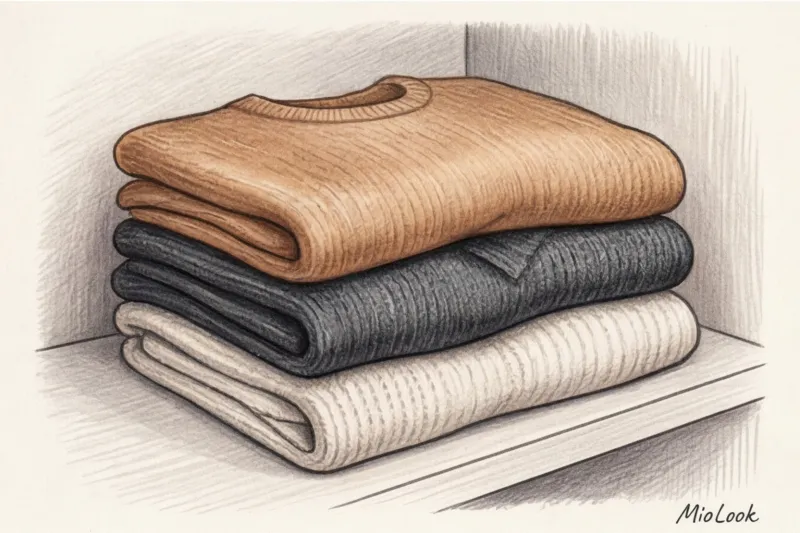
As a result, the deep shelf turns into a black hole. The ideal depth for folded clothes is 35–40 centimeters That's exactly one stack. The items in the second row are dead weight. While you're trying to get a T-shirt from the back row, you'll inevitably crush the ones in front.
A fair exception: the 40-centimeter rule does NOT apply to upper mezzanines. There, a depth of 60 cm is justified if you store bulky winter blankets, vacuum-sealed ski suits, or travel suitcases.
Shelf height: how to save knitwear from deformation
Have you noticed how the sweaters underneath you lose volume and become flat when stacked high? According to the International Institute of Textile Care (2023), a stack of 5-6 chunky knit sweaters can weigh up to 2.5 kg. Under this pressure, merino or cashmere fibers become irreversibly flattened.
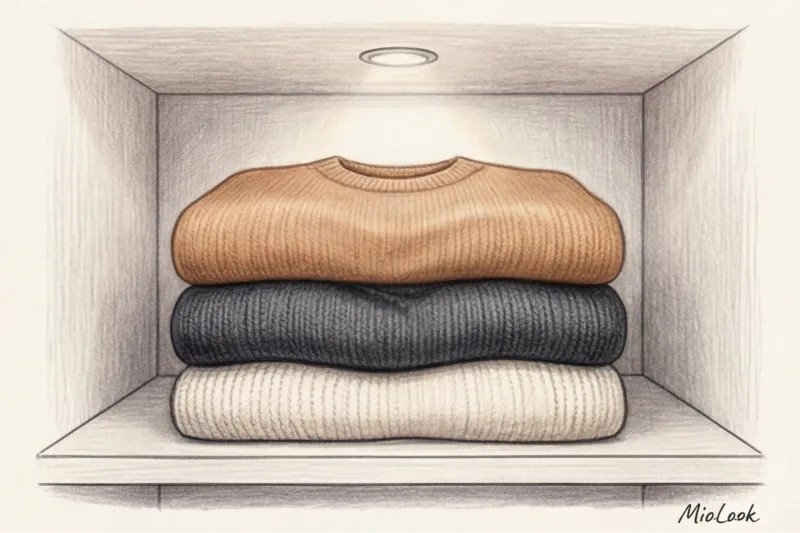
Therefore, the optimal shelf height for knitwear should be 25–30 cm This is enough for 3, maximum 4 folded items. To prevent the stacks from collapsing, use rigid dividers. If you want to delve deeper into this topic, be sure to read our A complete guide to the care and storage of knitwear.
Try MioLook for free
A smart AI stylist will create the perfect look based on your real wardrobe. Organize your closet and your life!
Start for freeCalculating the height of the barbells: from silk blouses to long coats
The layout of your closet should minimize friction between fabrics. If the hem of your silk blouse or wool jacket touches the bottom shelf, it acts as a dust brush. Furthermore, constant contact with a hard surface can cause the edge of the garment to become distorted.
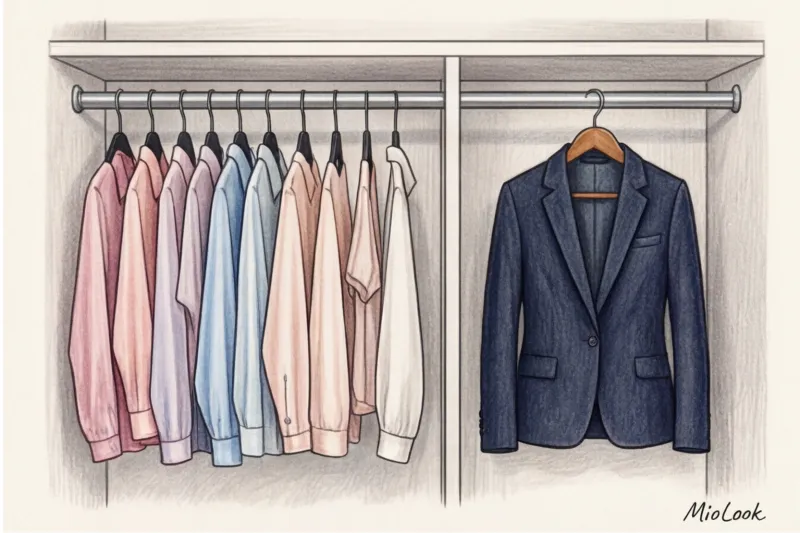
Divide your hangers by the length of your garments, not by season. And remember, the calculation starts with the right hangers: thin velvet ones will keep silk from slipping, while wide wooden or anatomical plastic ones are essential for maintaining the shoulder line of jackets.
Short items (shirts, jackets, skirts)
For 70% of a standard wardrobe, a section height of 100–110 cm This allows you to place two rods on top of each other, effectively doubling your closet's capacity. It's best to equip the top tier with a pantograph (clothing lift)—this will save you from having to use a stool every time you need a jacket.
Long items (dresses, trousers, coats)
For long dresses, trench coats and maxi coats, plan the section height from 150 to 170 cm Place these tall niches closer to the corners of the dressing room, where they won't visually fragment the space.
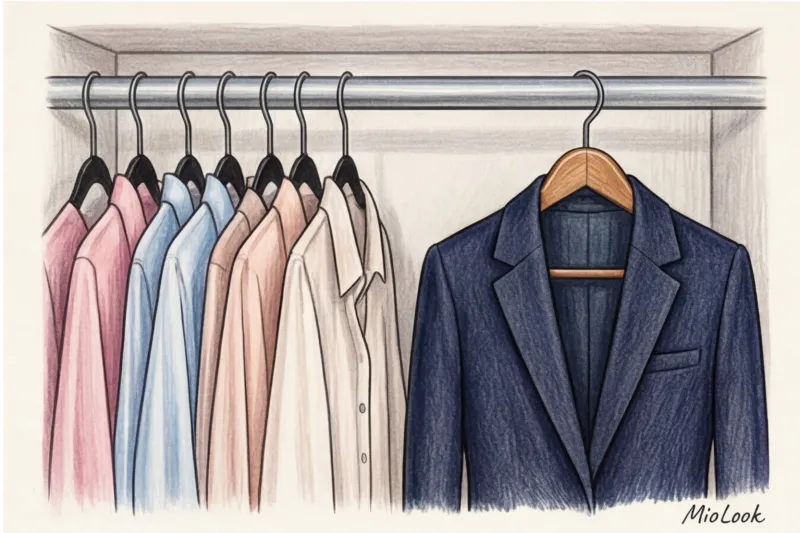
There are two options for hanging trousers: classic hangers with clips (which can leave marks on delicate wool or linen) and pull-out trouser hangers. Trouser hangers with silicone or velvet pads are the gold standard. They prevent slippage and are gentle on the fabric.
Shoes and Bags: Storage Tips for Accessories
Never, never hang bags by the handles on hooks! One of my clients ruined a vintage bag like this: after six months of hanging it, the leather on the handles stretched half an inch, and the seams at the base started to fray due to the uneven weight distribution.
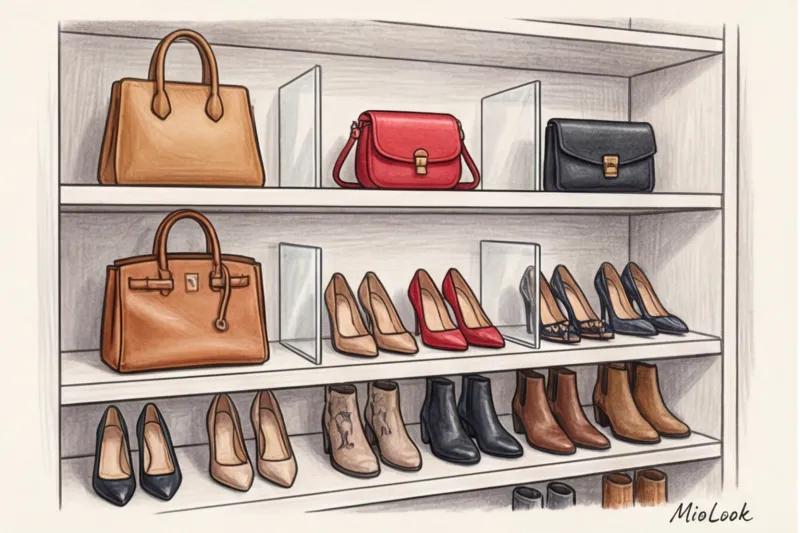
Bags need to be displayed. Ideally, on shelves 35–40 cm deep, lined with bag trees (or at least acid-free paper). A stylist's secret: use clear acrylic bag dividers. They act as invisible walls, preventing soft totes from tipping over and rubbing against each other.
Shoe racks also require an individual approach to height:
- Boots and over-the-knee boots: up to 50 cm in height. Be sure to use boot trees to prevent the leather from cracking at the creases.
- Ankle boots and high boots: 25–30 cm.
- Sneakers, pumps and loafers: 15–20 cm (no more, otherwise you’ll waste space).
By the way, proper zoning applies not only to large items. If you're interested, How to properly organize jewelry storage at home We have dedicated a separate article to this.
Your perfect look starts here
Join thousands of users who look flawless every day with the MioLook AI assistant.
Start for freeDrawers: How Many Do You Really Need?
Another pain point of standardization is drawers that are too deep, 25-30 cm. In them, underwear and socks turn into a chaotic mess, impossible to find a pair for.
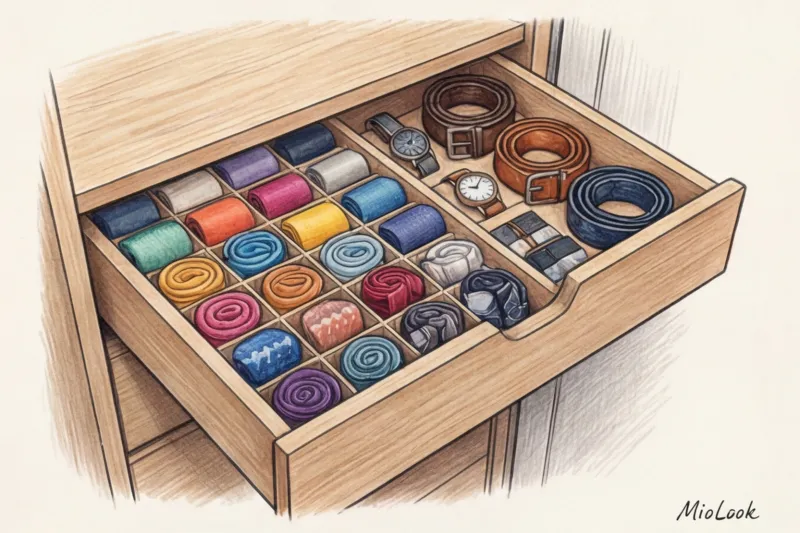
The ideal height of a drawer for underwear, hosiery and belts is only 12–15 cm This allows for the use of the vertical folding method (Marie Kondo's method), which, as space ergonomics studies show, saves up to 30% of usable space and provides an instant overview of all contents.
How many drawers do you need? A basic estimate: at least 4-5 drawers per person (1 for underwear, 1 for socks/tights, 1 for loungewear, 1 for T-shirts, and 1 for belts/ties/accessories). For the accessory drawer, I always recommend ordering a velvet lining—it will protect belt buckles from scratches and jewelry from slipping.
Step-by-step guide: how to design your own content
Any design should be based on your real-life items, not pretty pictures on Pinterest. Here's your step-by-step plan for today:
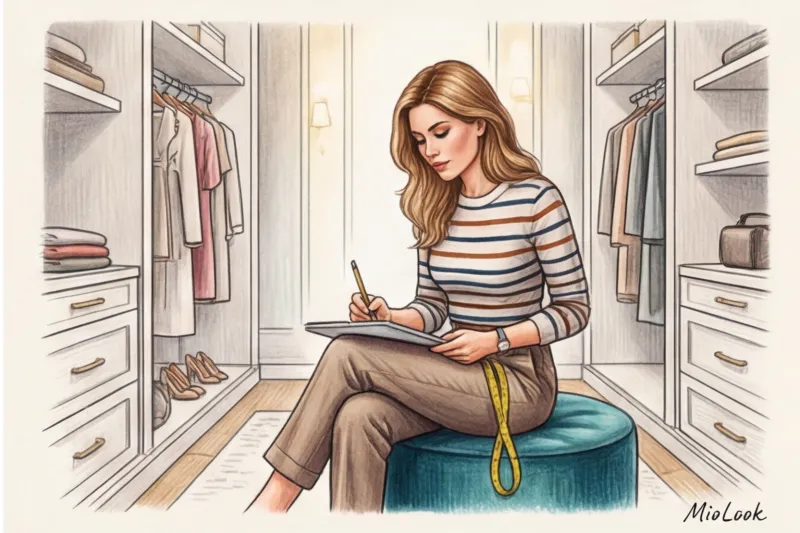
- Inventory and measurements. Take a tape measure. Measure your longest dress on a hanger. Measure your longest coat. Measure the width of your husband's shoulders (men's jackets require more closet space than women's blouses). Record these measurements.
- Virtual Assembly in MioLook. Take photos of key items. The app will help you visually assess whether you have more items in your wardrobe—things that need to be hung or things that can be folded.
- Selection of zones. Distribute the space: the active zone (the center, from the chest to the eyes) is for everyday items; the passive zone (lower drawers) is for linens and shoes; the mezzanine is for off-season storage.
- Preparation of technical specifications. Go to the furniture makers with your figures. Tell them, "I need a 165 cm high section for dresses and shelves exactly 40 cm deep for knitwear."
A well-stocked wardrobe is an investment. You spend time calculating once, but the rewards are saved nerves, quicker clothes selection, and your favorite silk blouses in perfect condition every morning.