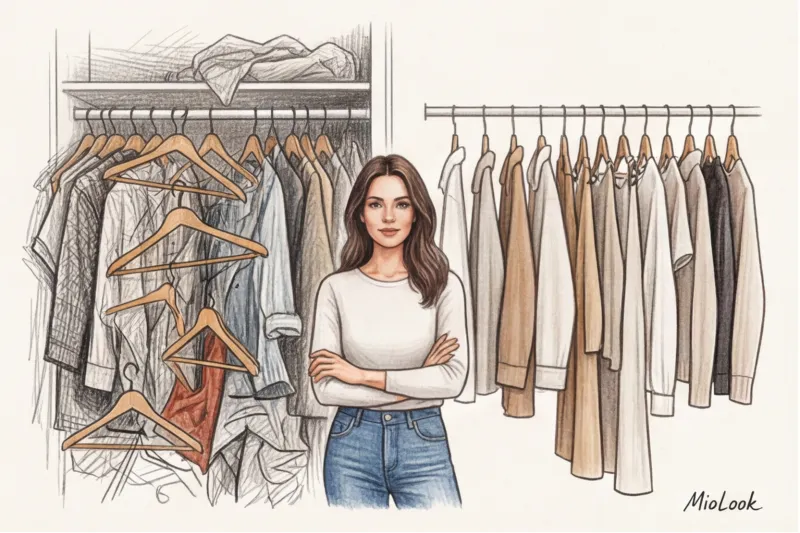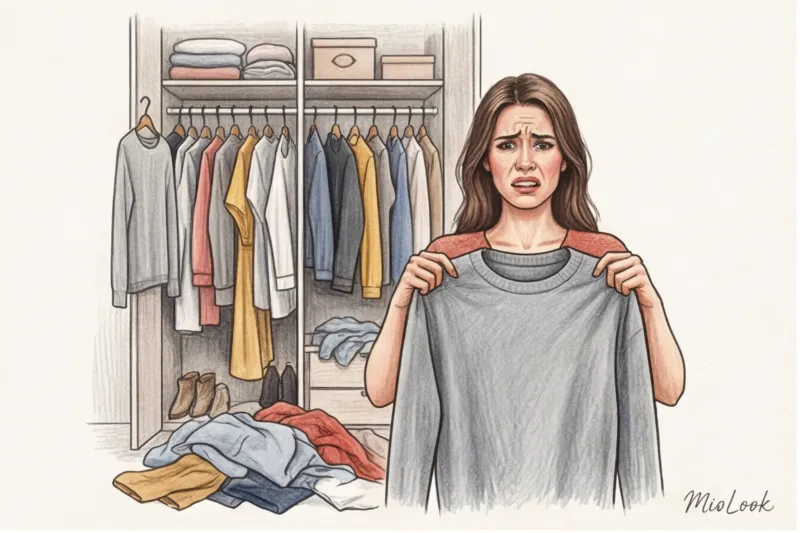
Tuesday, 7:45 AM. You stand in front of your open door, a pile of rejected items already growing on your bed, and a familiar thought is pulsing in your head: a full closet, but nothing to wear In my 14 years as an image consultant, I've seen this desperate look hundreds of times on women with completely different income levels and wardrobe sizes. And you know what? The problem isn't your taste. And it's certainly not that you urgently need to go shopping.
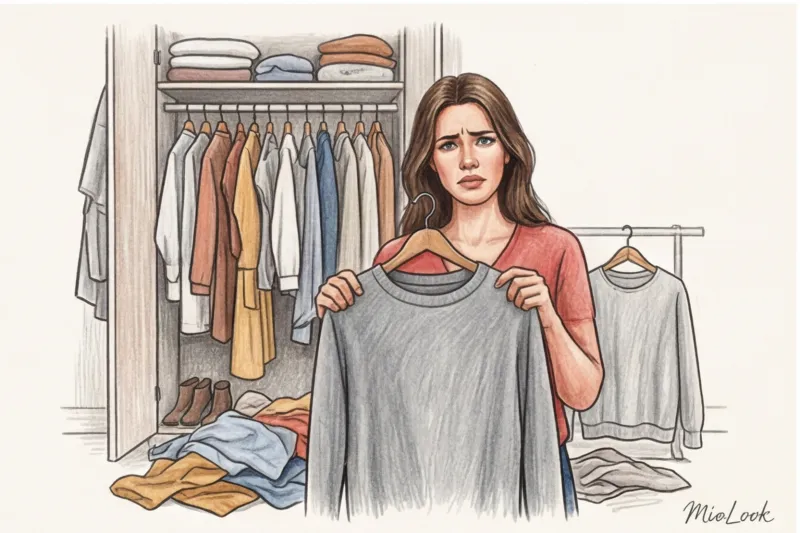
We talked about the philosophy of a conscious approach to things in more detail in our The Complete Guide to Digital Wardrobe Here, as a practicing stylist and colorist, I want to explore the physiology of this fashion paradox. We're used to thinking of a closet as simply a storage space. But in reality, it's a complex visual system that, 90% of the time, is stacked against you.
Anatomy of the problem: why the "closet full, nothing to wear" effect occurs
Let's look at the numbers. The 2023 WRAP (Worldwide Responsible Accredited Production) global study revealed a frightening statistic: on average, 70% of the contents of our closets go unworn throughout the year. Why is this? The answer lies in cognitive psychology.
There is a phenomenon decision fatigue (Decision fatigue). Every morning, your brain has a limited amount of energy. When you look at the tightly packed hangers, where the sleeve of a viscose shirt is tangled with a wool jacket, your brain perceives it not as an outfit choice, but as a complex math problem. And to conserve energy, it takes the path of least resistance—forcing you to put on the same jeans and hoodie you wore yesterday.
- Blind spots: We only wear what's at eye level and on the first row of hangers. Anything hidden in the second row simply doesn't exist for the brain.
- Single items: That same amazing sequin skirt, bought on impulse, that doesn't have a single matching top.
- Visual noise: Multicolored dry cleaner hangers, slipcovers, and piles of wrinkled knitwear block creative thinking.
The Visual Memory Trap
According to Miller's Law (one of the fundamental principles of psychology), short-term human memory can only hold 7±2 elements at a time. You physically can't remember all 150 of your clothes and mentally combine them. That's why expensive silk blouses hang in dark cases for years—you simply don't remember them when you're standing in front of the mirror in your underwear.
Access to MioLook for €0.99 — one-time payment
A smart AI stylist will select the perfect look from your items.
Get access — €0.99 onceThe Main Myth of Styling: Why Buying a "Basic" Look Doesn't Save the Situation
Open any glossy magazine and you will find universal advice: "If you have a full closet but nothing to wear, invest in a good basic. Buy the perfect white shirt, a beige trench coat, and straight jeans." As a stylist, I can officially say this is a harmful myth.
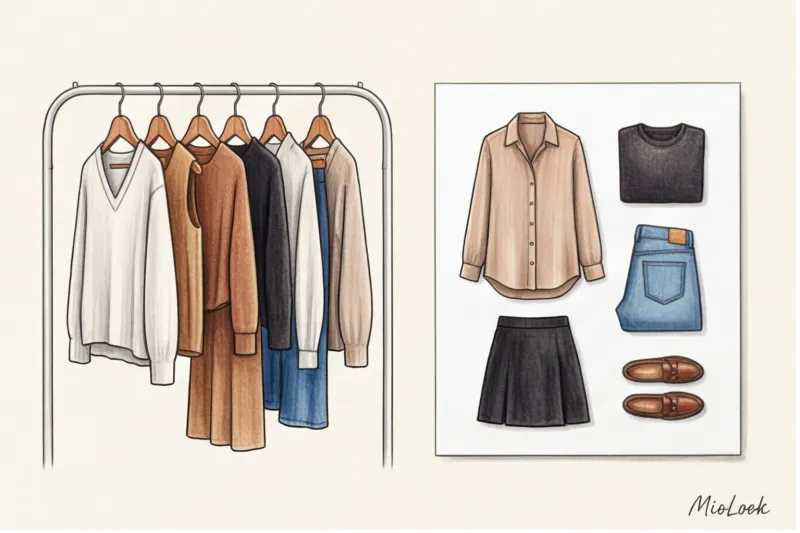
A basic item thrown into a chaotic, unorganized closet simply becomes part of the chaos. It won't magically tie together your disparate belongings.
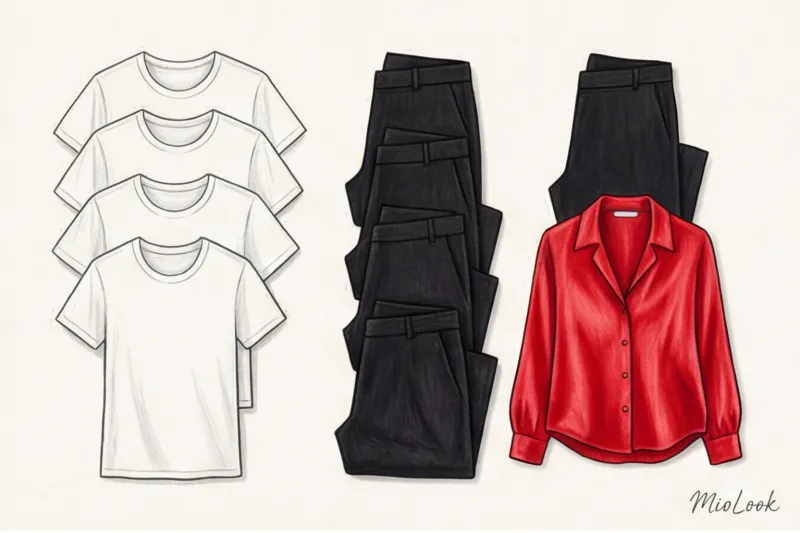
"Adding new items to an unorganized wardrobe is like trying to organize your desktop by downloading new folders. You're not solving the problem, you're just expanding the clutter."
I had a textbook case in my practice. A client, a top manager at an IT company, invited me to a debriefing. During the process, we found out five absolutely identical black turtlenecks Merino wool hangers from COS. Why five? "I thought the last one was lost or damaged, I had nothing to wear under my jacket, so I kept buying new ones," she admitted. They simply merged into a black mass in the dark corner of the closet. A basic set without a visualization system is just very expensive but useless hangers.
Wardrobe Math: How an App is Changing the Game
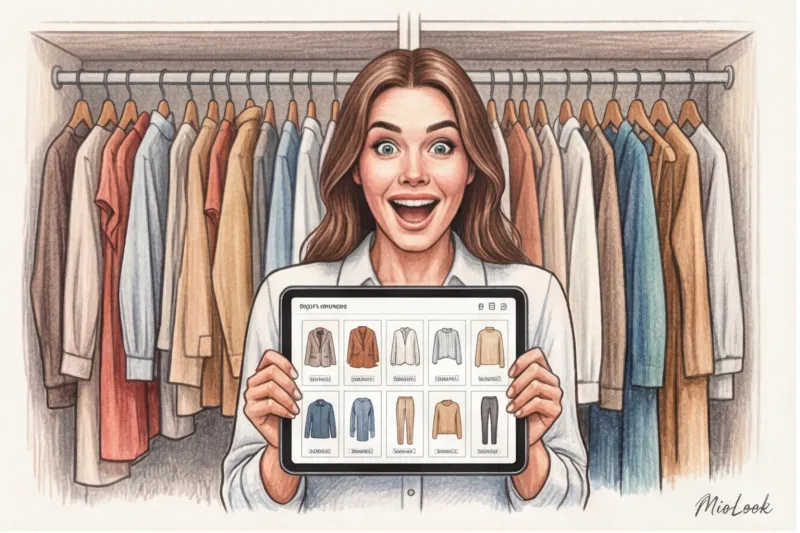
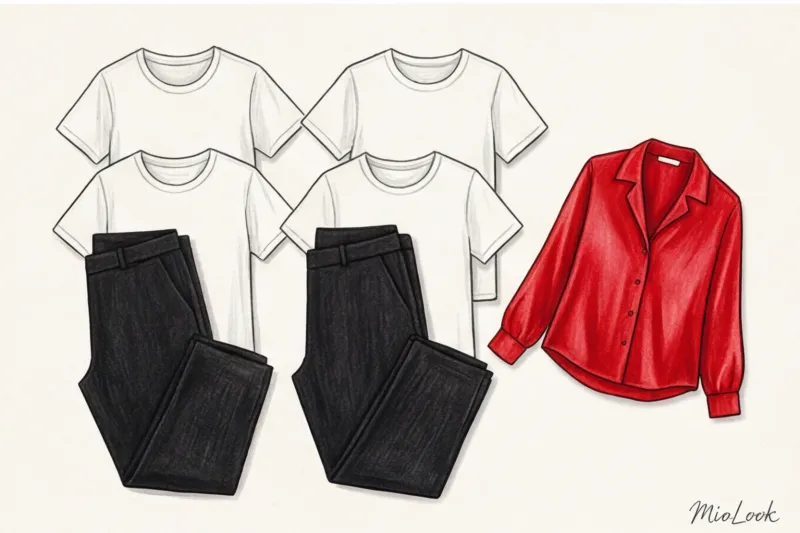
The solution to this problem lies not in shopping, but in mathematics and combinatorics. And this is where digitalization comes to the rescue. When you move your things into MioLook app , you essentially create a "second brain" for your style.
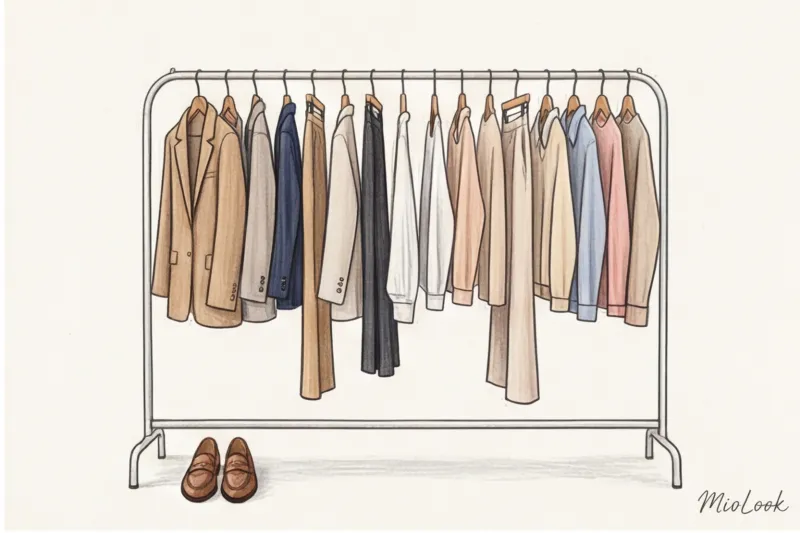
Once your items are digitized, the Pareto principle (where we wear 20% of our clothes 80% of the time) becomes clear. The app will ruthlessly but honestly show you statistics: how many times you've worn that "essential" jacket in six months (spoiler: none).
But the real magic is combination. From 30 well-chosen items (including shoes and bags), you can create over 100 unique looks. In reality, you only create 10-12 at most, because your brain is lazy. Artificial intelligence is never lazy.
But there is a fair limitation here: This doesn't work if 40% of your closet consists of items that are two sizes too small or require major repairs. A digital wardrobe is a styling tool, not a time machine. Before digitizing, you need to physically remove items that don't fit your current life and size.
Your perfect look starts here
Join thousands of users who look flawless every day with MioLook.
Get access — €0.99 onceColor Scenarios: How Digitization Helps See Combinations
As a certified colorist, I constantly encounter the same illusion. Clients say: "I only wear black and gray; bright colors are hard to combine." That's not true. Bright things are easy to combine, you're just trying to do it in the dark.
Inside a standard closet, lighting always distorts shades. Navy blue, deep emerald, bitter chocolate, and black on the hangers merge into a single dark spot. You physically can't see the nuances.
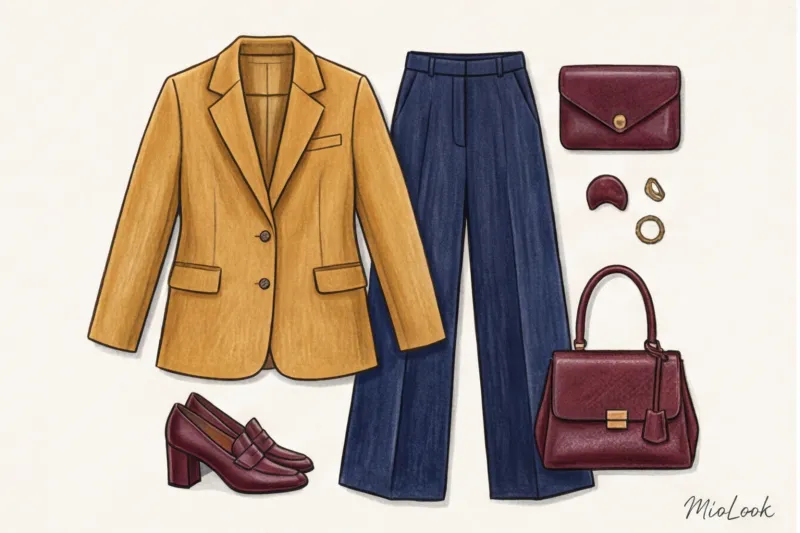
When you arrange things on a smartphone screen using an app, the magic of isolation happens. The white background of the clipping path (removing the background from the photo) makes the colors pop. This is where you suddenly notice that:
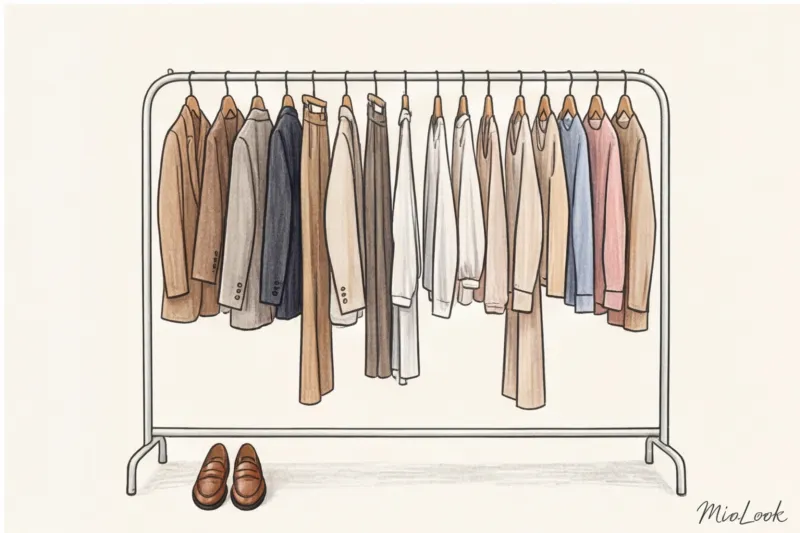
- Your mustard sweater pairs perfectly with a complementary contrasting scheme of navy wide-leg trousers.
- A burgundy bag (shade oxblood) works luxuriously in a similar scheme with a pink silk blouse.
- The print on the skirt contains exactly the right shade of green that your favorite loafers have.
A visual mood board on your phone screen trains your visual acuity much faster than hours spent on Pinterest. Because you're training on their own assets.
Step-by-step plan: how to transform a closet into a smartphone in one weekend
Digitization is intimidating for many, but the process can be made meditative if you follow a clear algorithm. The biggest mistake beginners make is trying to photograph the entire collection, all 200 items, in one Friday evening. You'll hate your wardrobe by the time you've picked up your fiftieth T-shirt.
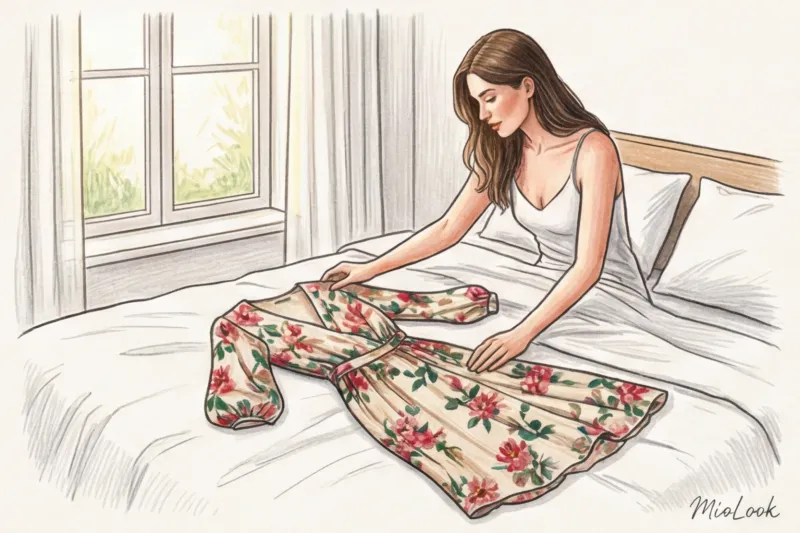
Here's a proven checklist from a stylist on how to do this without burning out:
- Light decides everything: Take photos only in diffused daylight (ideally, near a window in the morning). Artificial yellow light from lamps will ruin the true color of the fabric, and the app won't be able to accurately match the colors.
- Start with the foundation: For the first 40 minutes, shoot only shoes and bags. These are the most structured items, easy to photograph on the floor, wrinkle-free, and create a beautiful "showcase" in the app.
- Highs are more important than lows: The portrait zone works the hardest. Take photos of jackets, blouses, and shirts. If you lay them out neatly on a smooth white sheet, the app's algorithm will crop the background in a split second.
- Consolidate your success: Once you've got 15-20 items in your database (for example, 3 pairs of pants, 7 tops, 3 pairs of shoes, and a couple of bags), stop. Sit down with a cup of coffee and let the app compile 10 outfits for you for the next two work weeks. The dopamine rush from the result will motivate you to digitize the rest in a couple of days.
Ready to get started?
Try the free plan—no commitments required. Start creating perfect looks with AI.
Get access — €0.99 onceLife after digitalization: Forgetting the phrase "a full closet, but nothing to wear"
When your closet moves to your smartphone, the very structure of your morning routine changes. You no longer stand in panic in front of open doors. You choose your look the night before, lying in a warm bed, simply scrolling through ready-made capsules on your screen.
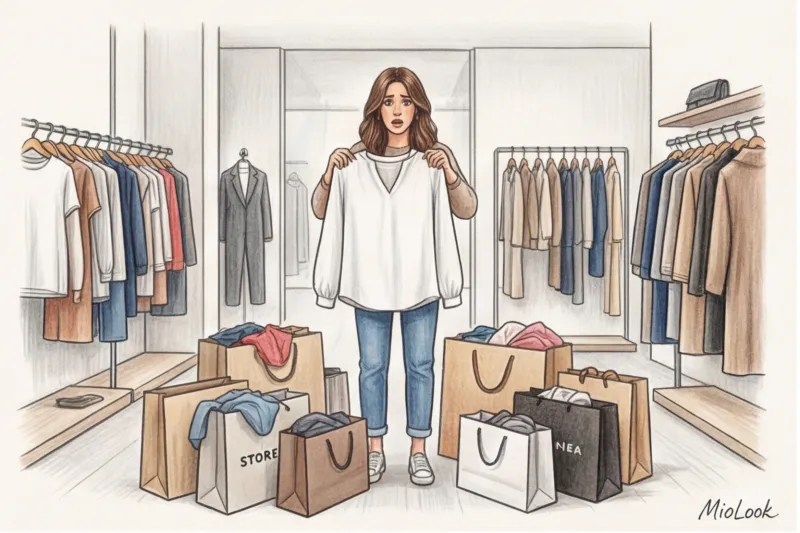
But your approach to shopping is changing even more dramatically. Imagine: you're standing in the fitting room at Massimo Dutti or a local brand, wearing a stunning terracotta vest. Previously, you would have bought it on impulse. Now you open an app and virtually "match" the vest to your trousers, skirts, and shoes. If the item doesn't create at least three complete new looks with what you already own, it stays in the store. No more random "single items."
Style isn't an innate gift or a certain amount of money spent. It's a system. When you take visual control of your clothes, they begin to work for you 100%, not a measly 20%. Take the first step, photograph your 10 favorite items this weekend, and you'll be surprised at how many new looks were hiding in your "empty" closet.