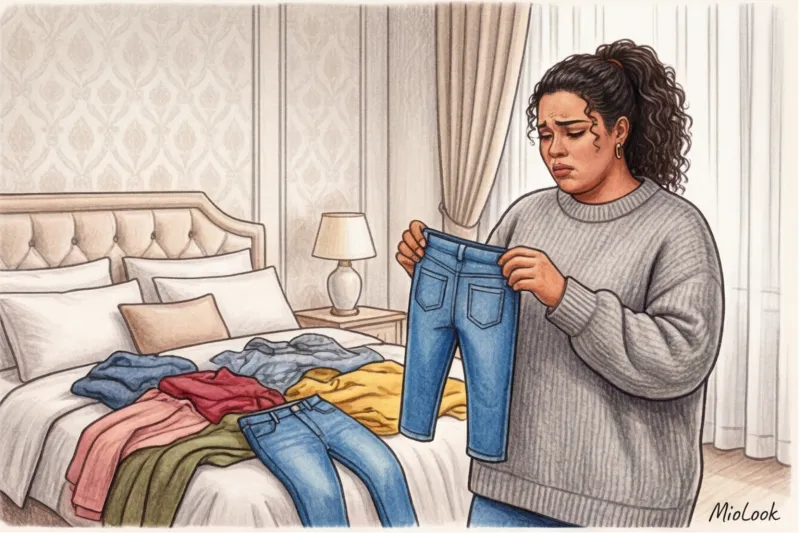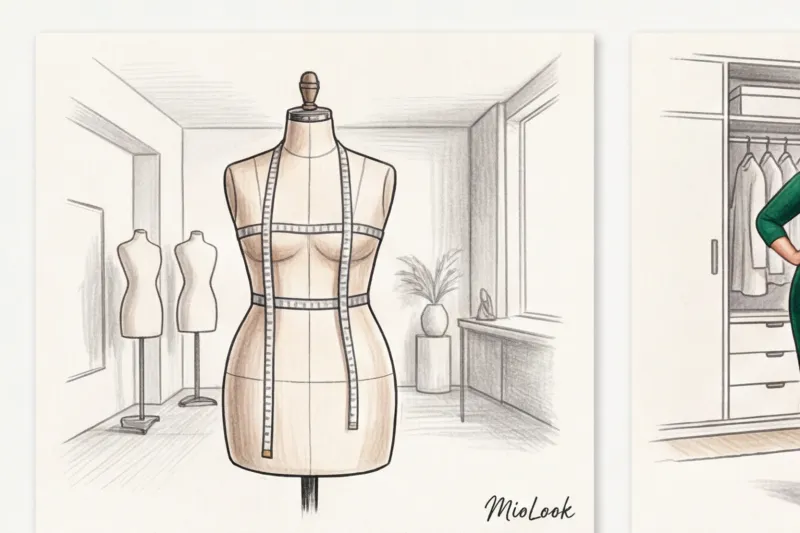
Let's be honest: how many black, shapeless cardigans and tunics are hanging in your closet right now? If you're plus-size, I'd bet quite a few. For years, the mass-market industry has been telling us that a non-standard figure should be hidden, draped, and wrapped in stretchy knitwear. But as a stylist and colorist with twelve years of experience, I can officially say: this is the worst thing you can do to your figure.
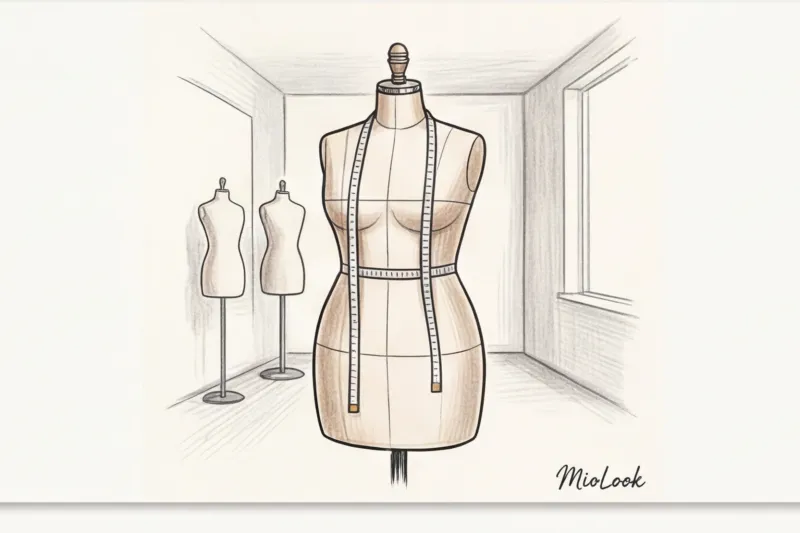
When virtual fitting of clothes for plus-size women When AI first appeared in the fashion-tech industry, I was skeptical. Just another toy? But after testing the algorithms on dozens of my clients, I realized we had a tool that literally breaks the system. AI acts as your personal tailor, allowing you to purchase structural, architectural pieces with complex cuts without fear. We've already covered how these technologies work in more detail in our A complete guide to virtual photo try-ons at MioLook.
Today we'll explore why you no longer need to fear online shopping, how color and fabric density work with volume, and why your best friend isn't a stretched-out sweater, but a double-breasted tweed jacket.
Why size charts lie: the anatomy of a non-standard figure versus dry numbers
In my experience, when we were shooting catalogs for clothing brands, the same scene always happened. A size 52 model would be dressed in a size 52 dress, and then the stylist would grab a handful of paper clips and start pinning the fabric down the back, adjusting the armholes and waist. In the shot, the fit would appear perfect, but in reality, it simply wouldn't exist.
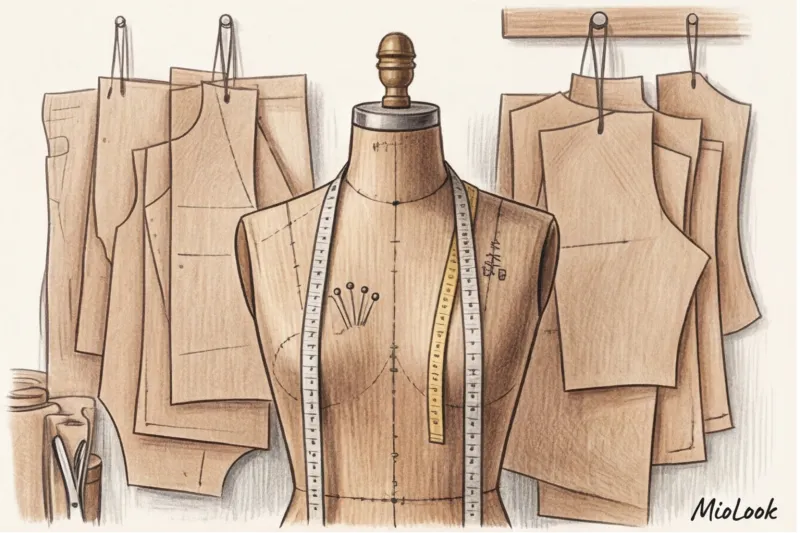
What's the problem? It's in a process that designers call pattern grading (pattern gradation). Most brands simply take a size 42 pattern and scale it up proportionally on the computer. However, according to a 2023 study by the WGSN Institute, linear scaling only works correctly up to size 48. Beyond that, women's center of gravity, shoulder volume distribution, and armhole depth change dramatically.
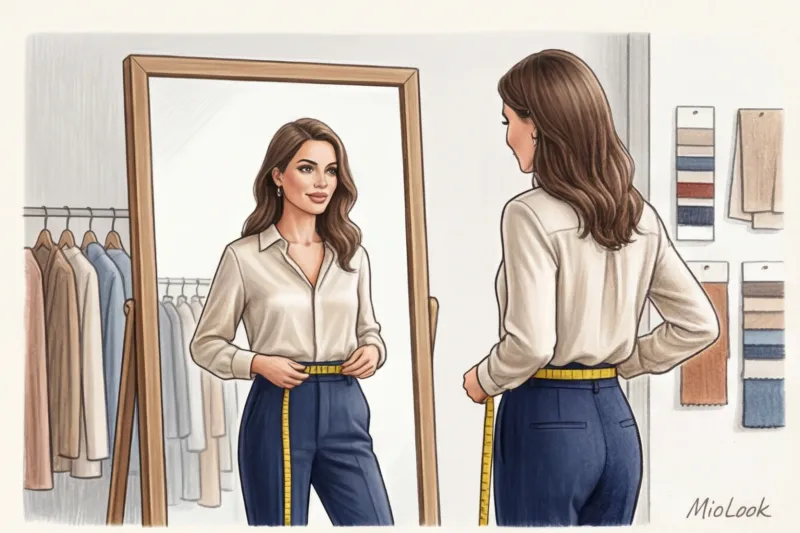
A size 54 for an apple-shaped body and a size 54 for a pear-shaped body are two completely different body shapes. The bare numbers in a size chart (bust, waist, hips) don't tell you anything about your exact measurements. That's why the statistics are so unforgiving: over 70% of plus-size clothing returns online are not due to the item being too small, but to the fit being unsuitable for a particular body type.
Virtual Plus-Size Clothing Try-Ons: How MioLook AI Understands Your Physiology
For a long time, dress-fitting apps resembled the flat paper outfits of our childhood, simply "pasted" over a photograph. This is completely useless for figures with pronounced curves. Modern generative neural networks operate according to the laws of physics.
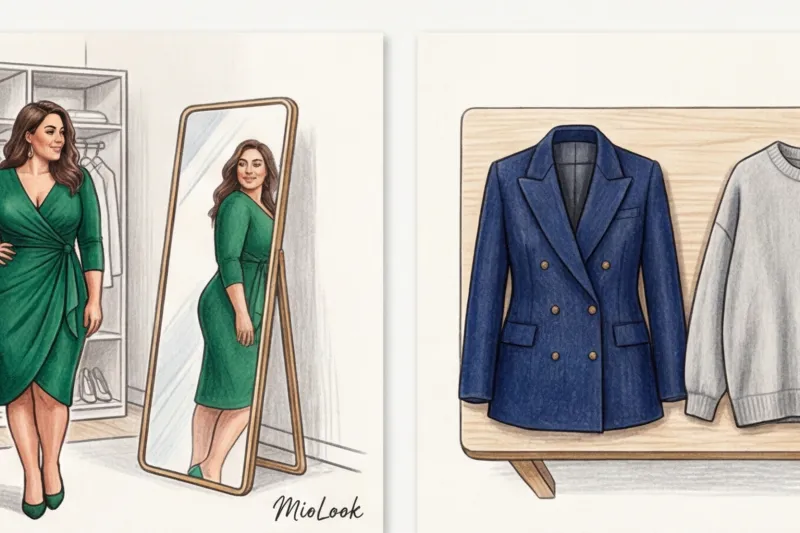
When you upload your photo to MioLook The algorithm reads not only contours but also a depth map. It analyzes your individual asymmetry (90% of women have one shoulder slightly higher than the other) and predicts how a specific material will perform. The AI understands where stiff denim will be too stiff, where thin silk will treacherously get caught on the hips, and where a cotton shirt won't fit properly across the chest due to an insufficient dart.
"Virtual fitting is no longer just a pastime. Today, it's a diagnostic tool that shows the tension distribution of fabrics even before you enter your credit card details."
Access to MioLook for €0.99 — one-time payment
A smart AI stylist will select the perfect look based on your unique proportions.
Get access — €0.99 onceThe End of the Robe Era: The Main Plus-Size Myth That's Destroying the Neural Network
It's time for the brutal truth: shapeless, oversized, thin knitwear visually adds 10 kilograms to your weight. Period. When you wear a garment without a clear shoulder line and structure, your figure turns into a monolithic rectangle. The surrounding eye reads your silhouette by the widest points of the fabric.
I had a client, Maria (size 54), who was terrified of ordering thick cotton, leather, or tweed online. Her logic was clear: a stretchy cardigan from Zara would fit her no matter what, but a jacket made of thick fabric might not fit at the waist. It's this fear of failure that drives women to wear unflattering items for years.
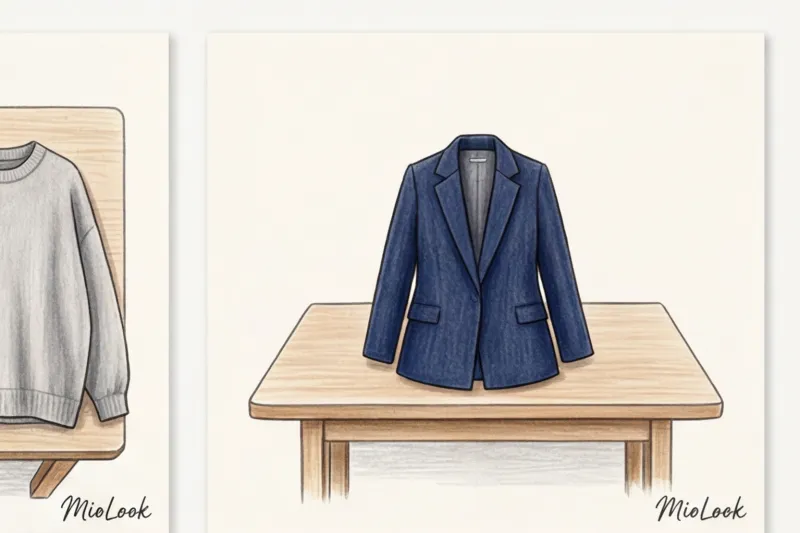
We ran an experiment in the app. I uploaded her photo and "put" a heavy, straight-cut tweed jacket by Massimo Dutti on her. The effect was stunning. The dense fabric acted like a lightweight exoskeleton: it sculpted her silhouette, defined the shoulders, and created the perfect vertical lines. The virtual try-on gave her the courage to click "Buy." And when the package arrived, the jacket fit perfectly.
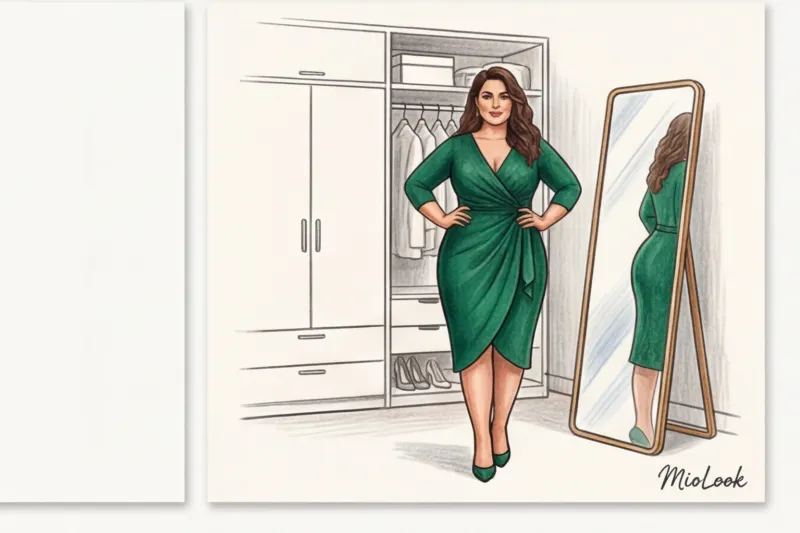
Which styles should I test in the app first?
Stop wasting time trying on basic t-shirts. Use a neural network to test complex, architectural items that are scary to buy blind.
Architectural jackets and double-breasted blazers
Pay attention to the shoulder line. Plus-size women often have sloping shoulders. A jacket with a stiff shoulder pad instantly balances a heavy lower body. The app will clearly show where the jacket's length ends: it should never cut into the widest part of your thigh (this is a common mistake). Look for a length that either reaches the hipbone or covers the buttocks.
Bias-cut dresses and slip dresses
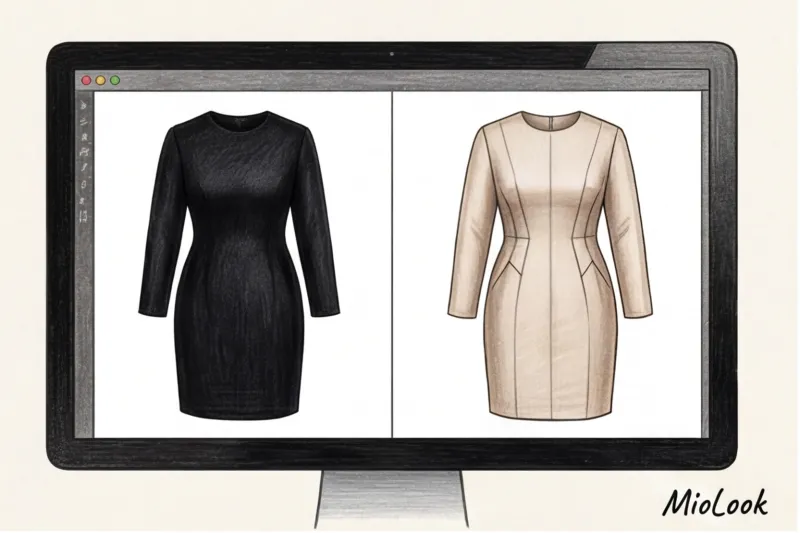
Many plus-size women avoid lingerie styles for fear of looking "caterpillar-like." But the secret lies not in the cut, but in the density of the fabric. A bias-cut dress is the best friend of soft curves, as it smoothly hugs curves without creating creases. When trying on dresses virtually, choose high-density silk (19 momme and higher) or heavy viscose, rather than cheap, shiny polyester, which will highlight even the slightest unevenness.
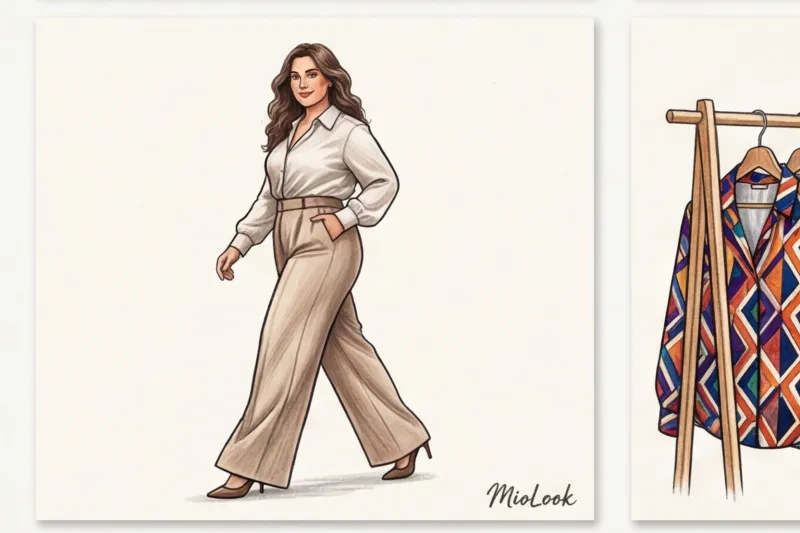
Palazzo pants and the right high waist
Finding the perfect wide-leg pants online is a pain. The app instantly shows how the fabric distributes across your stomach. If your palazzo pants have deep pleats at the waist, they can flare out on an apple-shaped figure, creating the effect of a balloon. Look for styles with a flat front and a side zipper—the neural network is great at revealing this difference in fit.
Your perfect look starts here
Join thousands of users who look flawless every day with MioLook, testing out the most daring styles.
Get access — €0.99 onceColor and print on a non-standard figure: a test drive without risking your budget
As a certified colorist, I can't ignore the main misconception: "black is slimming." Yes, black absorbs light. But it also creates the sharpest, most contrasting outline against the surrounding space. If you wear a black sling dress against a light office wall, you'll simply outline your silhouette with a thick black marker.
Deep, luxurious shades like emerald, sapphire, marsala, and dark chocolate are much more effective. They also conceal volume without making the look heavy. Using the app, you can "recolor" an item in just a few minutes and see how it changes your figure.
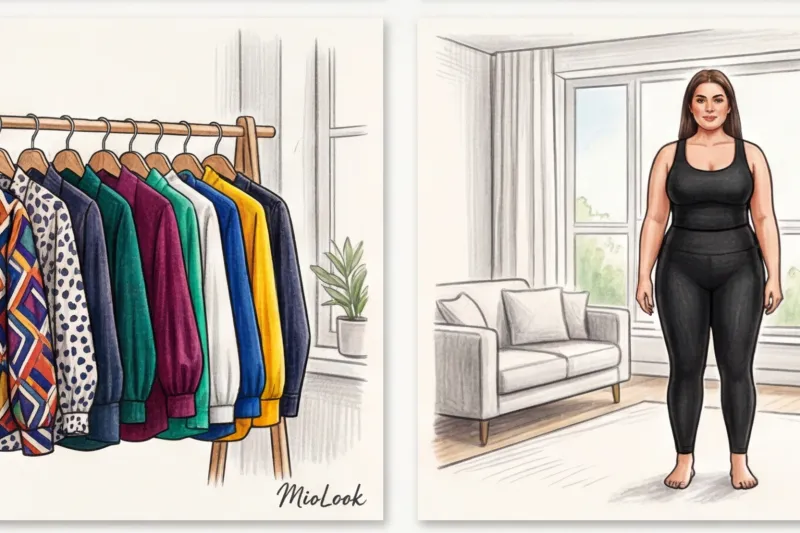
Pay special attention to the scale of the print and color blocking:
- Small flower (millefleur) On a larger figure, it often looks lonely and creates visual "noise" that expands the figure. The optimal choice is a medium to large print.
- Contrast side panels. This is a brilliant optical illusion. A dress with a light center and dark sides visually "cuts off" 5 centimeters on each side. Try this trick virtually—you won't believe your eyes.
Checklist: How to take photos for the most accurate virtual fitting
But any technology has its limitations. This is a rule I always emphasize: AI can't read your mind. If you upload a photo of yourself wearing a bulky hoodie, the neural network will build patterns based on that hoodie, adding a couple of sizes for you. For virtual fittings for plus-size women to work flawlessly, prepare the correct source material.
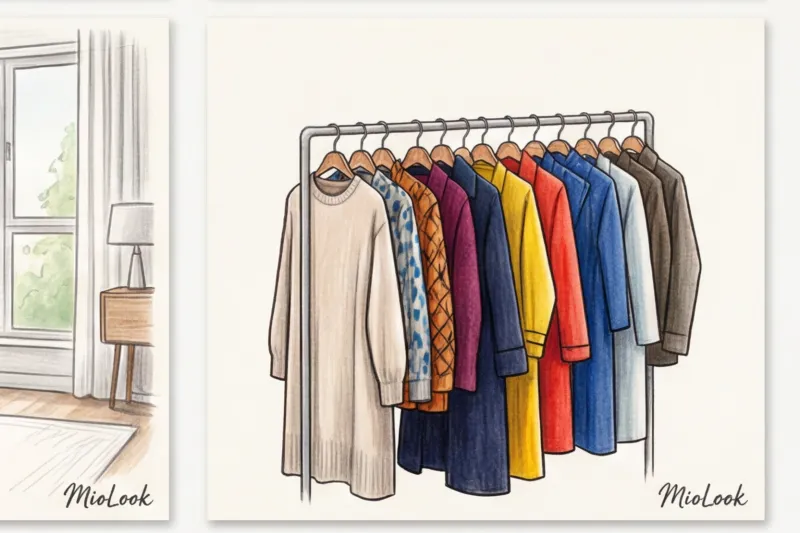
- Base layer: Take a photo wearing tight, supportive leggings and a fitted tank top. Underwear shouldn't be too tight, creating artificial curves that don't exist in reality.
- Lighting: Avoid overhead lighting from a chandelier (it creates harsh shadows under the eyes and chest, distorting volume). Stand facing a window in natural daylight.
- Angle: This is critical. The phone should be positioned exactly at chest level. If you shoot from a low angle, your hips will appear monumental. If you shoot from a high angle, your head will appear enormous and your legs will appear short.
- Pose: Stand up straight with your arms slightly away from your body (approximately 15-20 degrees). The neural network should see a clear outline of your waist and hips, not obscured by your arms.
Ready to get started?
Try the free MioLook plan – upload the perfect photo and see how your wardrobe will transform, no commitment required.
Get access — €0.99 onceSmart Investments: Building a Functional Wardrobe Instead of Impulse Buying
I often see entire shelves of clothes in my clients' wardrobes, purchased for the ideal woman they'll become once they "lose 10 kilos." This is a toxic practice that steals your money and destroys your self-esteem right now.
Virtual try-ons radically change the psychology of shopping. They reduce stress and bring back the joy of choice. You stop buying cheap, stretchy clothes out of desperation and start investing in premium brands like COS or 12 STOREEZ, where high-quality patterns pay for themselves many times over.
Stop hiding your body in bland knitwear. Invest in the design of your clothes, not the size on the tag. Use technology to find pieces that flatter your figure, not disguise it. And remember: a perfect wardrobe starts not with a diet, but with the right fit.