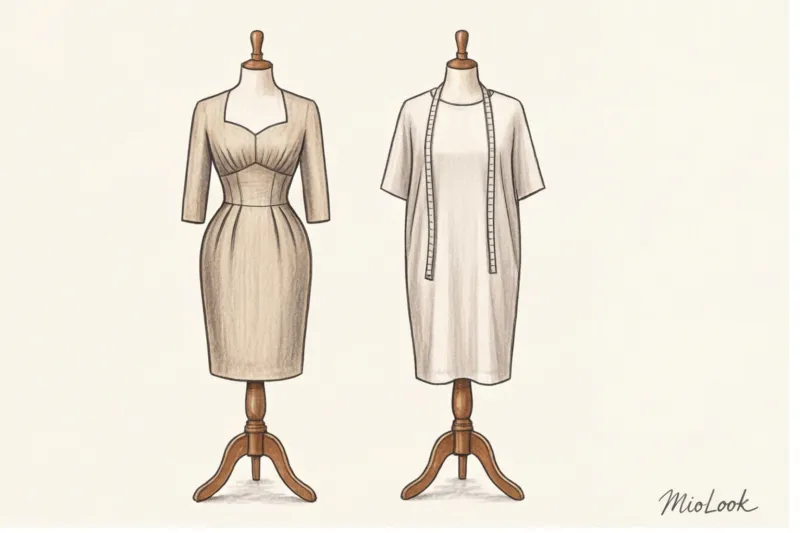
One of my clients once nearly burst into tears of frustration right during a fitting. She'd tracked down the perfect Dior jacket from the late 1970s on a European online auction. The tag was her size M, the price was a hefty €450, but it felt like the investment of a decade. When the package arrived, she tried to put the jacket on... and it got stuck at shoulder level. The armholes were so tight that her arms simply wouldn't fit. The problem wasn't that she'd gained weight. It was just vintage clothing sizes live by a completely different, almost alien metric system.
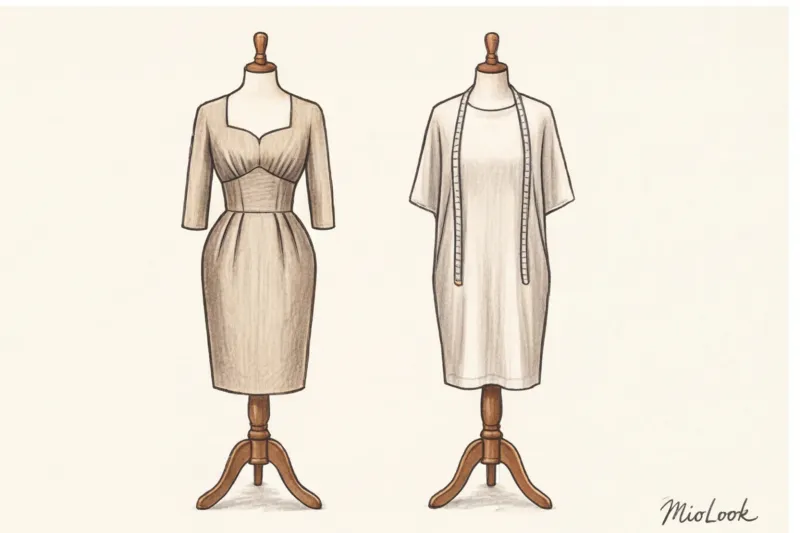
We discussed the basic rules for working with fashion house archives in more detail in our complete guide about Clothing resale and vintage: how to buy brands profitably But today I want to explore the most pressing issue—the physics, mathematics, and anatomy of old patterns. A size tag on a vintage garment isn't just useless information; it's a trap. A vintage L can easily turn out to be a modern XS, and to avoid wasting money, you need to forget about your usual size forever.
Why vintage clothing sizes are so disastrously inconsistent with modern ones
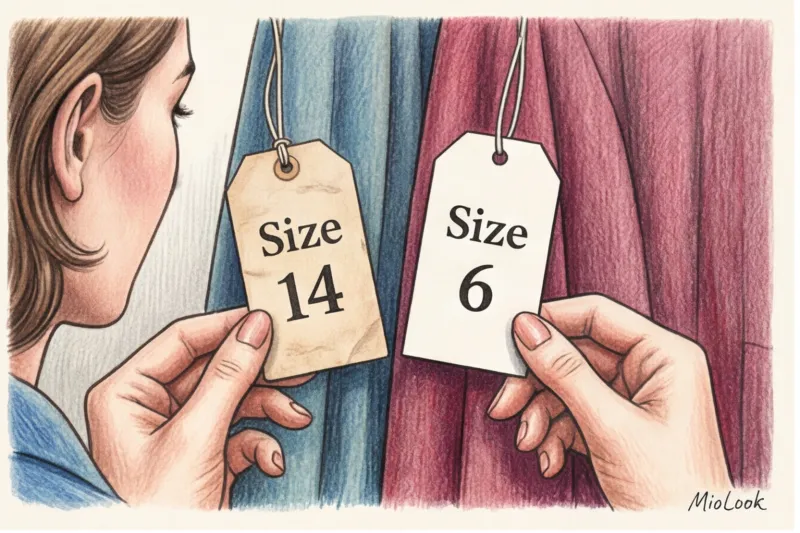
Buying vintage online can be daunting even for seasoned shoppers. The main culprit behind this confusion is the phenomenon of vanity sizing. Marketers have long understood that a woman is more likely to buy a dress if the tag says size 4 than size 8. For decades, brands have gradually increased the physical measurements of clothing while leaving the numbers on the tags unchanged, in an attempt to flatter customers.
Let's look at some hard numbers. According to research by ASTM International (American Society for Testing and Materials), standards have changed dramatically. A US size 12 in 1958 corresponded to a waist of 66 cm. Today, a size 12 corresponds to a waist of 81–86 cm. So, a dress from the 1950s labeled "12" would correspond to a size 4 or even 2 in today's mass-market stores like Zara or H&M. The difference is colossal, and if you rely solely on the letter or number, you're guaranteed to miss the mark.
The Elastane Factor: Why Old Clothes Don't Stretch
Another fundamental reason for the discrepancy lies in the chemical composition of fabrics. Costume Institute archives show that until the late 1980s, spandex and elastane were virtually unused in everyday clothing. Modern "rigid" jeans still often contain 1-2% elastane for comfort, while a basic cotton shirt contains up to 5%.
Vintage 100% cotton, heavy wool, or silk are unforgiving. They fit tightly, like armor. While a modern blouse might stretch slightly across the chest to accommodate your inhalation, a vintage shirt from the '70s will simply split at the seam. That's why you should always allow extra inches for "ease" with vintage fabrics—at least 2–4 cm to your half-girth measurement.
Access to MioLook for €0.99 — one-time payment
A smart AI stylist will select the perfect look based on your individual parameters.
Get access — €0.99 onceThe main rule of a vintage stylist: ignore tags and measure your clothes.
The most common mistake beginners make is taking a measuring tape, measuring their bust, waist, and hips, and then searching for vintage pieces with the exact same measurements. This will never work. Why? Because you're measuring a 3D body, while online retailers provide 2D measurements of flat fabric. This doesn't account for darts, material thickness, and that all-important ease.
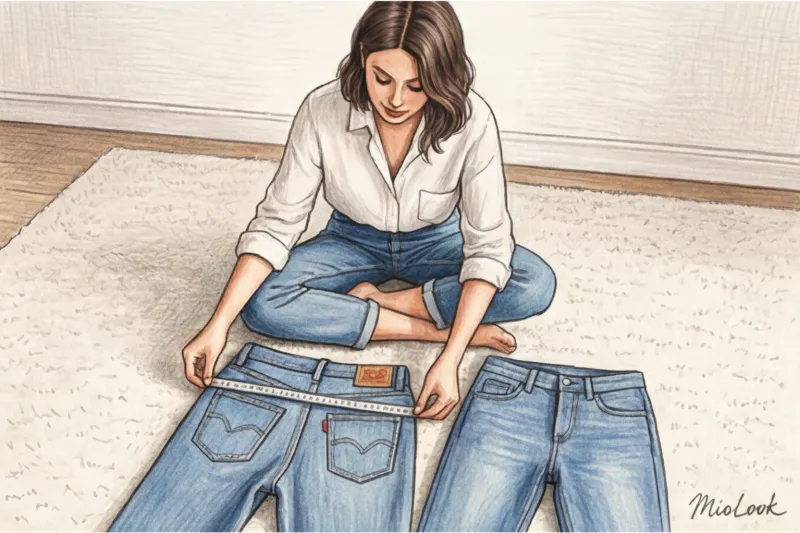
My personal method for working with clients, which hasn't failed in 12 years, is to use the Flat Lay system. The only reliable way to buy vintage online is to choose an item from your closet that fits you perfectly and measure it. her , and not yourself.
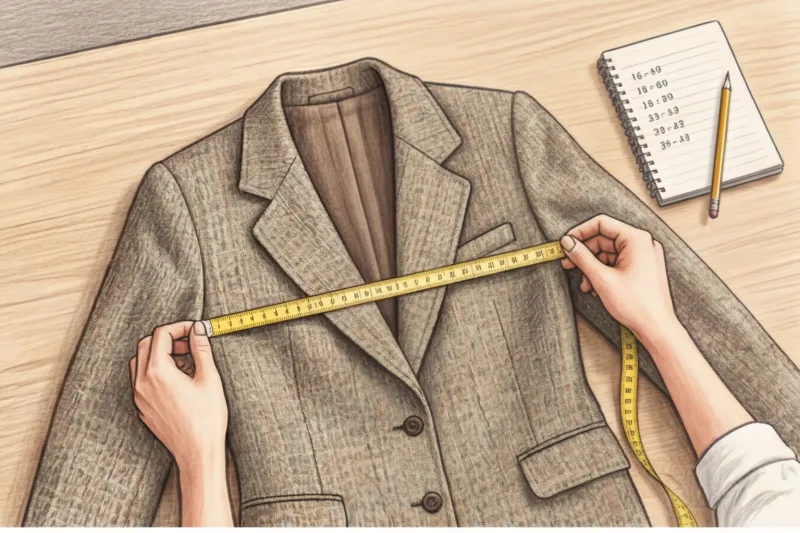
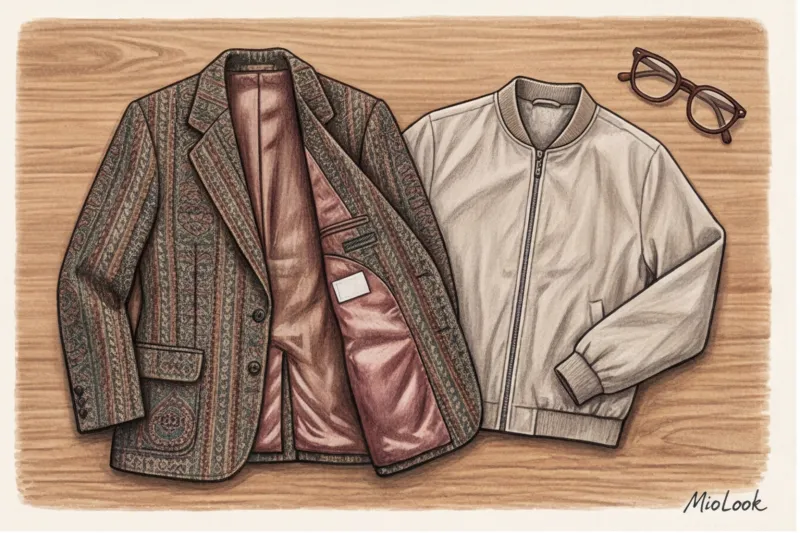
If you're looking for a vintage wool blazer, get out your best non-stretch jacket. Lay it on a flat table, button it up, gently straighten the fabric (without stretching it), and take your measurements. Your perfect measurements have been found. Now simply search online stores for items that match these measurements millimeter for millimeter.
Measurement Dictionary: How to Read Product Descriptions Correctly
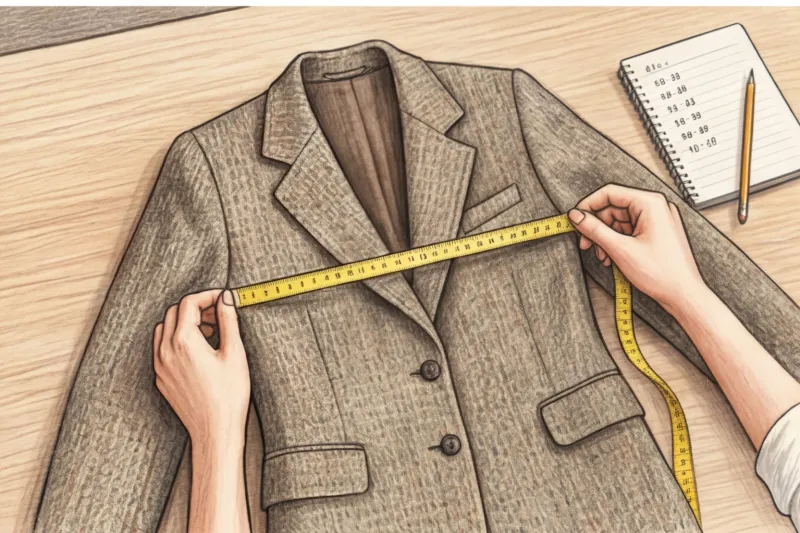
Professional vintage sellers have their own lingo. If an item's description only says "Size M, excellent condition," close the page. Reliable resellers always provide a clear table of flat measurements.
- Pit-to-pit (P2P) / From armpit to armpit: This is the main width measurement. The tape is placed exactly under the sleeves of the buttoned garment. The mathematical formula here is strict: the P2P of a vintage 100% silk blouse should be at least 2–3 cm larger than the P2P of your modern blouse made from a blended fabric with elastane.
- Waist & Inseam: When choosing trousers, waist width means nothing without the rise (the distance from the crotch seam to the top of the waistband). A 35 cm waist with a high rise (30 cm rise) will sit at the narrowest point of your torso. The same 35 cm waist with a low rise (20 cm rise) simply won't meet your hips.
- Shoulder-to-shoulder: Measured across the back from one shoulder seam to the other. For jackets and coats, this is a critical point. If the garment is too big at the waist, a tailor will take it in for €15. If the jacket is too small at the shoulders, there's nothing you can do; it will ruin the entire armhole design.
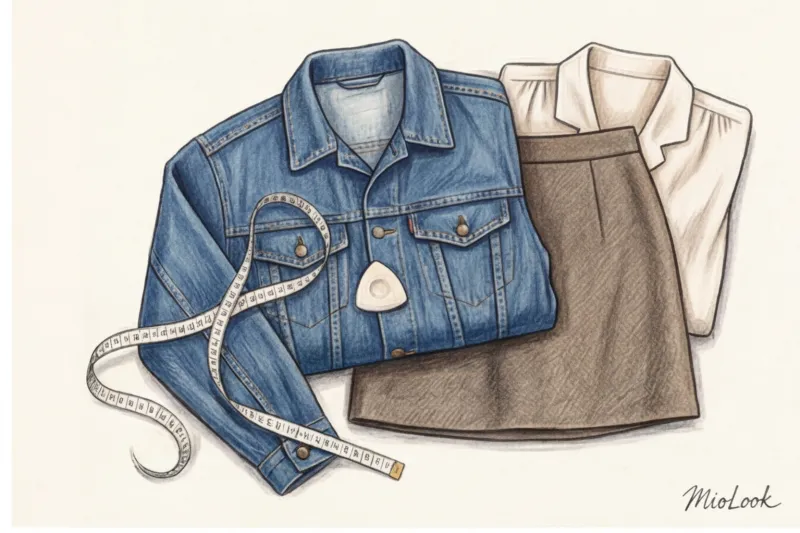
To be fair, the Flat Lay method has one limitation. It doesn't work well for bias-cut dresses, popular in the 1930s and 1990s. Bias-cut fabric looks tight on the table, but stretches out on the body, hugging curves beautifully.
Features of cut and patterns by decades
Beyond centimeters, it's important to understand the historical context. Each decade dictated its own standards for the ideal silhouette, to which factory patterns were adjusted.
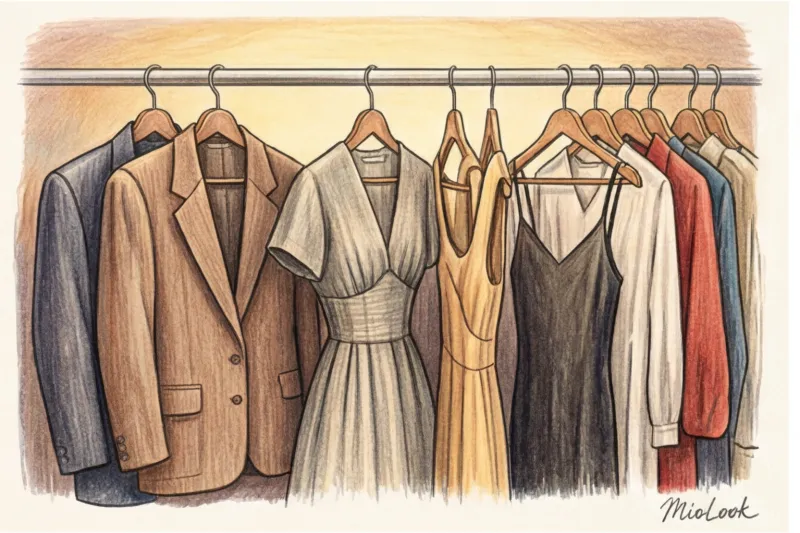
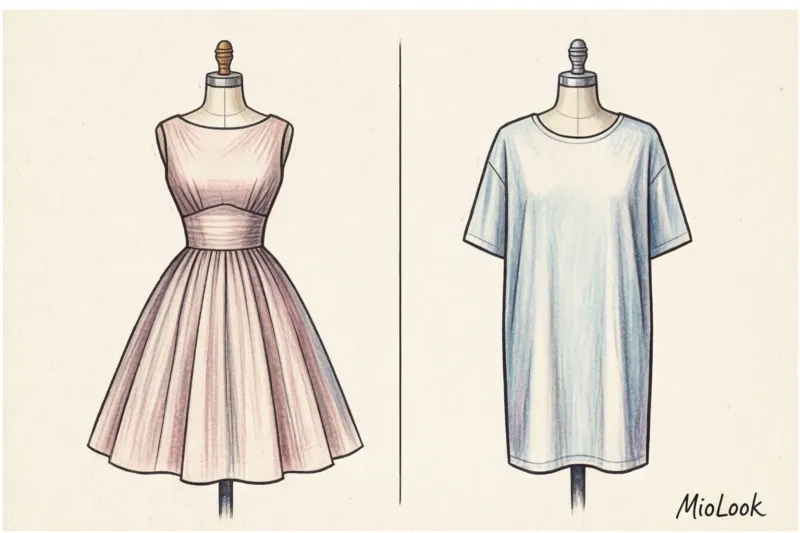
1950s–60s: The era of Christian Dior's New Look and corsetry. Dresses were cut to accommodate shapewear and cone-shaped "bullet bras." If you buy a dress from the 1950s, be prepared for a tiny waist and strange hollows in the chest due to the specific placement of the darts. Furthermore, women of that era had smaller chests due to the constant wearing of corsets.
1970s: Silhouettes are stretching. Pants are being made with extremely narrow hips and flared from the knee down. Finding vintage '70s pants that fit a modern figure with defined hips is a real challenge.
1980s: The era of power dressing. Exaggerated shoulders with massive shoulder pads and pinched waists. A client and I once bought a stunning Thierry Mugler jacket from the 1980s. According to the shoulder measurements, it seemed enormous (6 cm wider than her reference blazer), but the waist was perfect. This wasn't a design flaw—it was the designer's intended inverted triangle geometry. Modern shoulders often "sink" into such garments, requiring replacement shoulder pads.
1990s: Minimalism, straight cuts, and slip dresses. An era whose sizes are closest to our modern standards. If you're just starting out in vintage, start with the '90s.
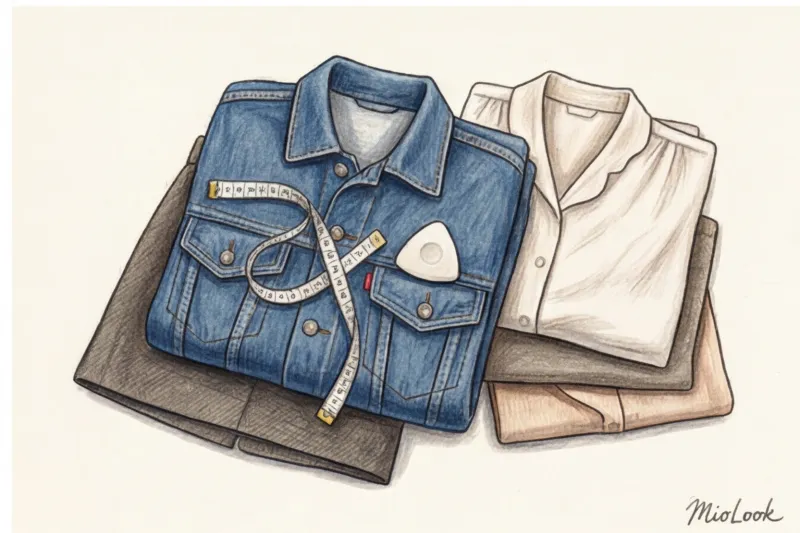
How to Calculate the Size of Vintage Levi's Jeans (-2 Size Formula)
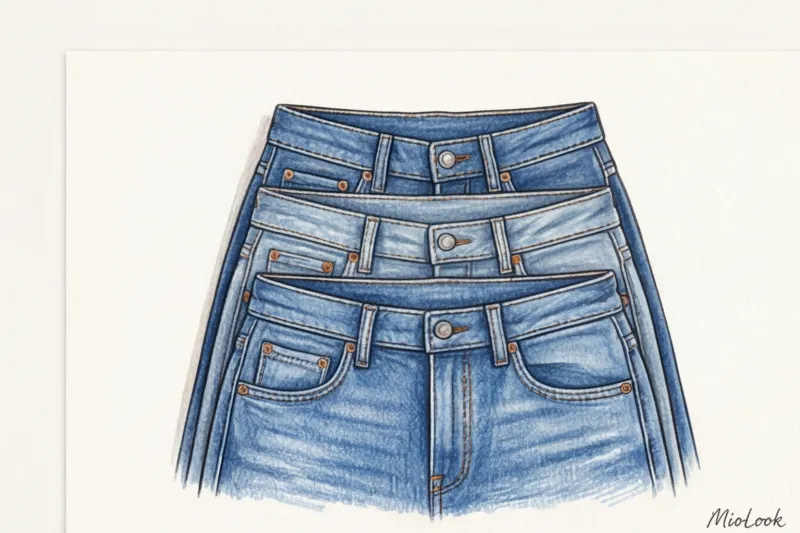
Vintage denim is a whole other world. Iconic styles like Levi's 501s and 505s from the '80s and '90s are made from 100% heavyweight cotton. No stretch. Furthermore, most of them were created using shrink-to-fit technology.
Raw denim shrinks up to 10% after the first few washes. After 30 years, the fabric not only shrinks but also stiffens. Therefore, in the resale world, there's a golden rule: "minus two." If your favorite modern jeans have a size W28 on the tag (waist 28), you should look for vintage Levi's with a W30 or even W31. And again: compare the waist measurement (in centimeters) to your heavy jeans laid out on a table.
Your perfect look starts here
Join thousands of users who look flawless every day with MioLook. Save measurements of reference items directly in the app.
Get access — €0.99 onceChecklist: 5 Must-Have Questions to Ask the Seller Before Purchasing
Don't be shy about being a discerning buyer. Vintage items are generally non-returnable. Ask these questions before transferring money:
- "Send a photo with the tape attached." Text descriptions are often misleading or based on eyeballs. Ask for a photo of the item with a measuring tape drawn across the bust, waist, and hips.
- "Were there any alterations in the cut?" Items from the past were often tailored to fit their owners. Ask if darts were added or hemlines were shortened.
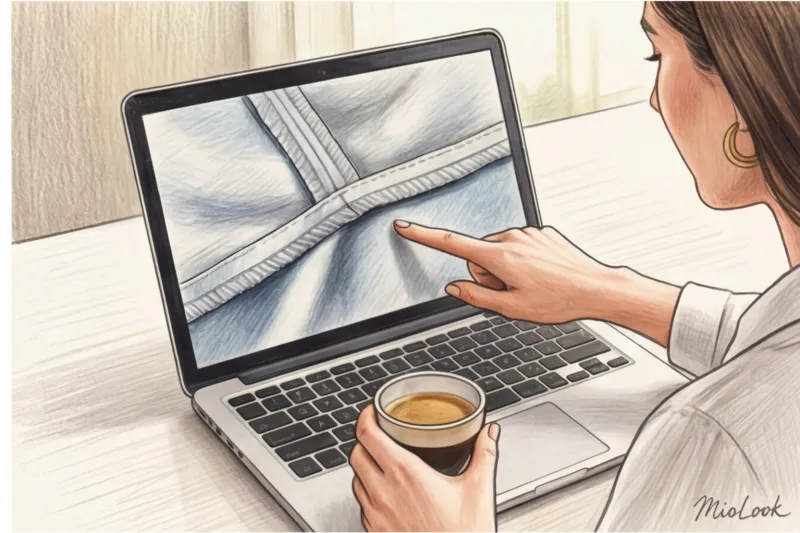
- "What is the condition of the tension seams?" This is critical for silk blouses from the 1970s. Ask for macro photos of the seams under the arms and at the seat seam of the trousers. If the fabric around the stitching has started to unravel, the item will last until the first wash.
- "Is there any extra fabric in the seams?" Vintage clothing was created with heirlooms in mind. A quality coat from the 1960s might have 3-4 cm of extra fabric inside, allowing for seams to be untucked in a tailor's shop.
- "Is there a smell of time?" The distinctive vintage scent doesn't disappear with regular washing. Budget for professional ozone dry cleaning (€30 to €50 depending on the region).
Bottom Line: Why Vintage Is Worth the Effort
Understanding measurements, requesting photos with tape, and studying the history of textiles can seem tedious. But the quality of tailoring, the density of fabrics, and the uniqueness of the trimmings of items created 30-40 years ago are unattainable by modern mass-market products in the same price range. You're buying not just clothes, but a piece of design history with an impeccable fit (assuming, of course, you measured them correctly).
To make your life easier, digitize your reference measurements. You can use the smart wardrobe feature in MioLook to save photos of your perfectly fitting trousers and jackets, along with their exact measurements in centimeters. When you find that vintage gem online, you won't have to run out for a measuring tape—all the data will be right there on your phone.
The key lesson to learn when buying vintage clothes: don't try to squeeze your body into the mold of the past. Look for pieces from the past whose geometry perfectly matches the geometry of your present.