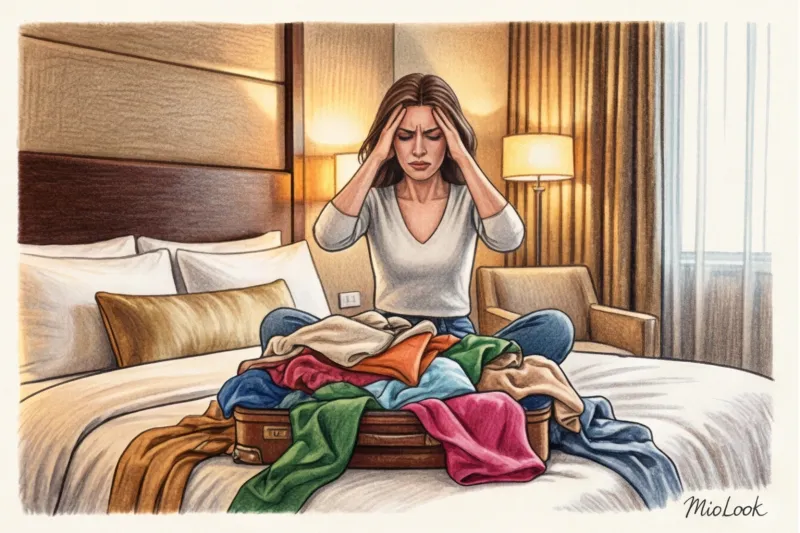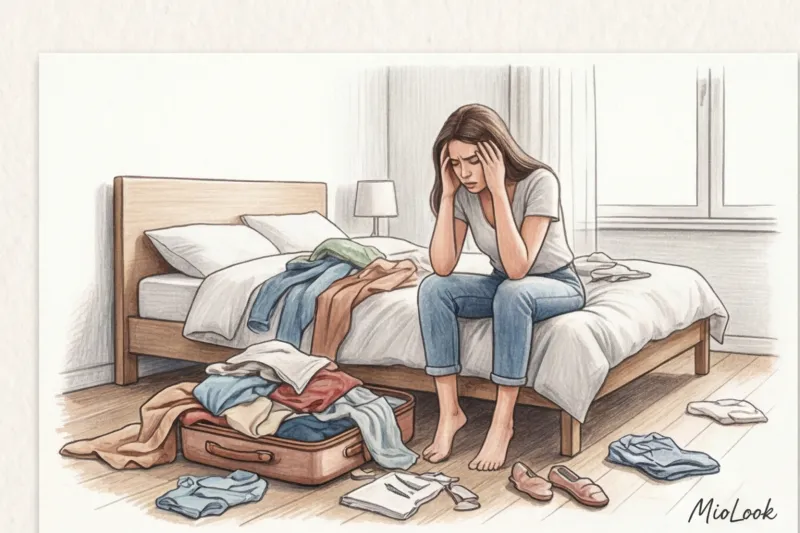
Let's be honest: how many times have you brought home half your clothes from vacation without even wearing them? You've carefully rolled them up, sat on top of your suitcase to zip them up, and ended up spending the entire seven days in just your favorite shorts and a couple of t-shirts. As a personal stylist with twelve years of experience, I see this regularly. We spend hours packing, overpay for luggage, and then, upon arrival, we're stressed out by wrinkled, mismatched clothes.
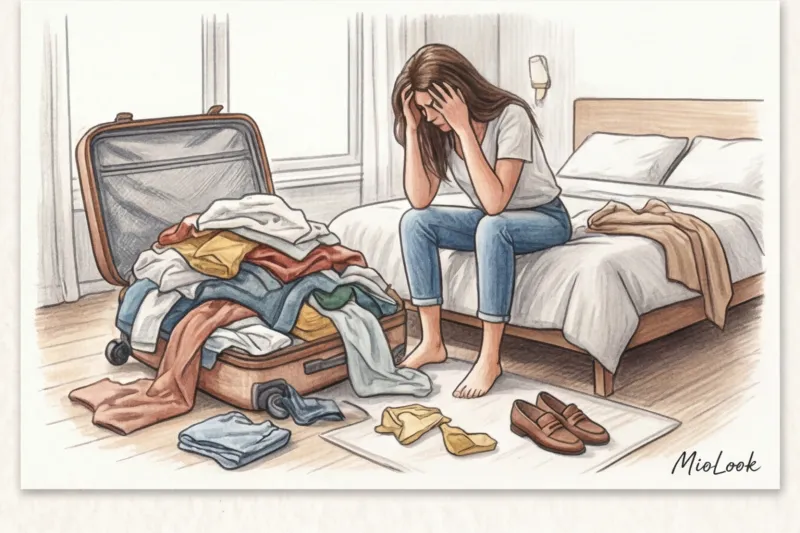
The solution to this problem lies not in buying new vacuum bags, but in changing the very approach to capsule formation. The main question my clients ask me before the holiday season is How to avoid taking unnecessary things on vacation and still look stylish in every photo. The answer lies in a rigorous mathematical approach and a visual planning method. If you want to automate this process and transfer it to your smartphone, check out our The Complete Guide to Travel Wardrobe Planning Apps | MioLook In this article, I'll share professional styling techniques that will forever change your relationship with your suitcase.
The Psychology of Baggage: Why We Pack for an "Imaginary Life"
The main enemy of a lightweight suitcase is the "what if" syndrome. What if we're unexpectedly invited to a private party on a yacht? What if I decide to go jogging along the beach in the morning? A change of location psychologically forces us to dream of a new, improved version of ourselves: more athletic, more romantic, more daring. It's for this "imaginary" woman that we buy clothes that, in real life, still have tags.
"We often pack our suitcases not with clothes, but with our unfulfilled fantasies about the perfect vacation. That's how six-inch stiletto heels end up in our luggage for a trip to Rome with its cobblestones."
A client named Anna recently contacted me. For a typical three-day business trip to Berlin, she was trying to pack five (!) different Massimo Dutti jackets. "But they create different moods," she argued. We implemented a digital wardrobe management system, and it turned out that on her previous four trips, she had never worn more than two jackets at a time.
According to Booking.com's 2023 comprehensive travel research, 50% of vacation items are never worn by travelers. Half of your suitcase is simply traveling around the world at your expense, getting wrinkled and taking up space.
Hidden losses: calculating the cost of every kilogram
Let's do some cold math. Low-cost carriers (like Ryanair or WizzAir)'s 2024 pricing policies have made checked baggage a luxury. Adding a standard 20 kg suitcase will cost you between €40 and €80 one-way, depending on the season. A round-trip costs up to €160.
Ask yourself: is it worth bringing a spare basic sweatshirt "just in case" if the extra baggage fees exceed its value? In 99% of cases, it's cheaper to forget the item at home and buy the missing basic t-shirt at your local H&M or Uniqlo for €15 than to pay for the air in your suitcase.
The Smart Packing Myth: Why Organizers and Rolling Don't Work
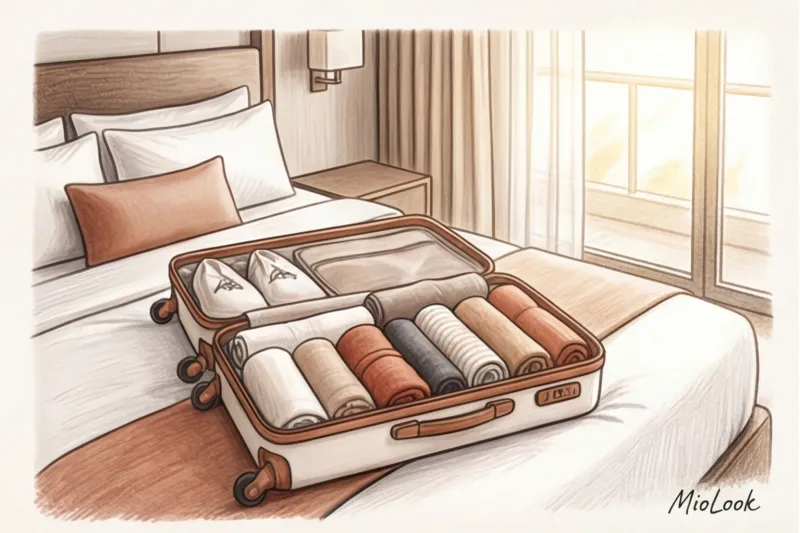
Now I'm going to say something that many online lifehackers will disagree with. Packing cubes and vacuum bags are a trap. Yes, they help pack things more compactly. But therein lies the main danger: they disguise the actual volume of clothes.
When you use organizers, you're simply squeezing 15 kilograms of unnecessary items into a 10-kilogram suitcase. The result? Guaranteed excess baggage at check-in and a penalty fee.
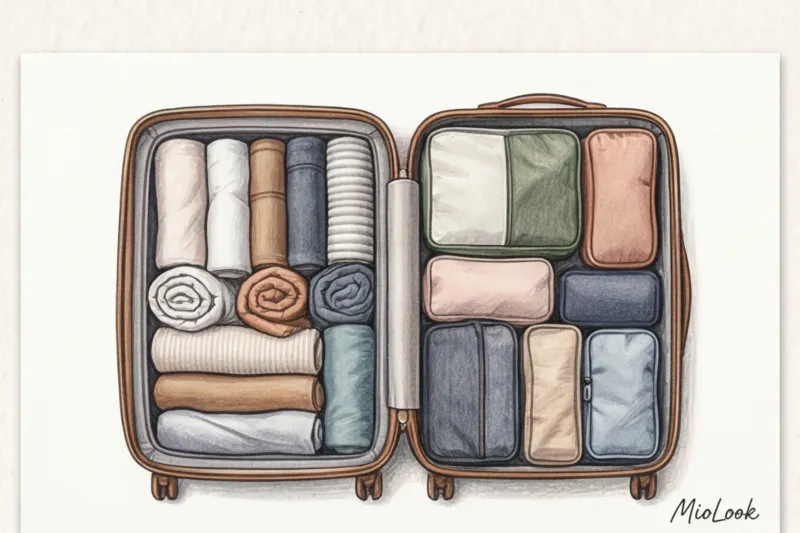
Furthermore, as a stylist, I strictly forbid my clients from using vacuum bags for natural fabrics. Tight compression breaks the fibers of silk, linen, and high-quality viscose. Your expensive linen dress, after 24 hours in a vacuum bag, will require a professional steamer, which your hotel room definitely won't have. Smart packaging isn't the art of squeezing in the unsqueezable. It's the art of taking less.
Your ideal image
it begins Here
Join thousands of users who look flawless every day with MioLook. Plan your vacation looks without the stress.
Get access — €0.99 onceVisual Planning Method: How to Avoid Packing Extra Bags on Vacation
To understand, How to avoid taking unnecessary things on vacation We need to stop collecting items piece by piece. We're not collecting items. We're collecting looks (outfits). In professional stylist circles, this is called the Outfit Grid method.
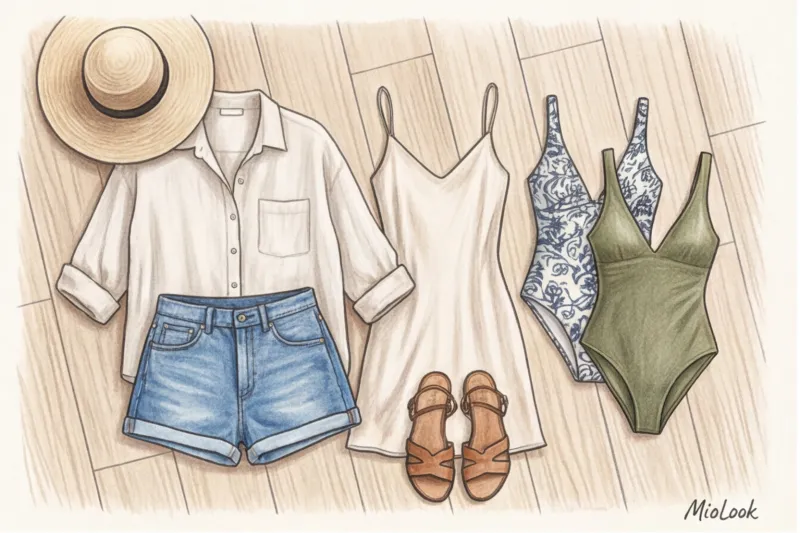
The biggest mistake is taking things out of the closet, trying them on in front of a mirror, and throwing them in a suitcase. Instead, use a flat lay—on a bed or a clean floor. Lay out absolutely everything you plan to take. This way, you'll instantly see that that coral skirt doesn't go with any of your chosen tops.
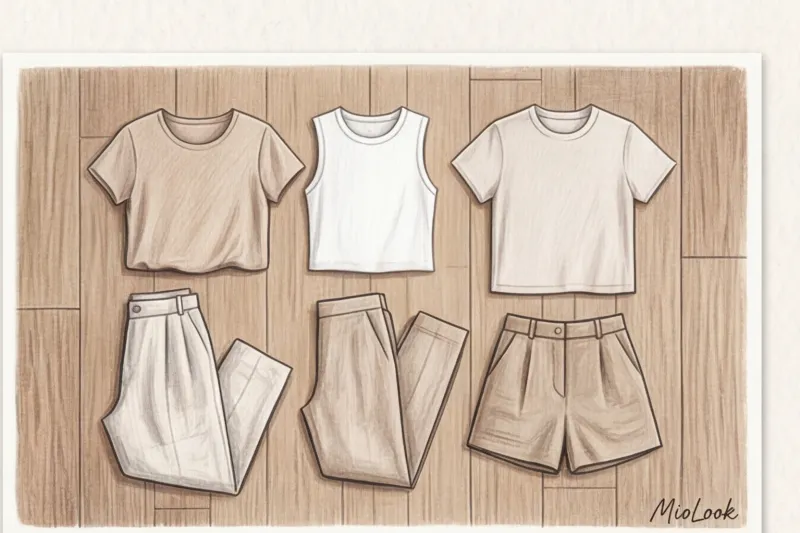
A strict rule of my method: every item in your suitcase must pair flawlessly with at least two (ideally three) other items. If you need a special blouse and specific shoes for one skirt that don't go with anything else, those three stay at home.
The Perfect Suitcase Formula: The 3-to-1 Rule
The math behind stylish luggage is based on proportion: for every one "bottom" (pants, skirt, shorts), there should be three "tops" (T-shirt, shirt, tank top). Why is this so?
- Rope clothing is worn closer to the face and underarm area; it gets dirty and loses its freshness three times faster.
- It is the “bottom” that forms the basic silhouette, and the “top” that sets the mood.
- People around you notice your portrait area first. By changing only your tops, you create the illusion of a completely new look.
If you take 3 bottoms and 9 tops (12 items total), you'll get 27 unique looks through cross-combination. That's enough for almost a month of vacation!
A Stylist's Packing Algorithm: From Chaos to System in 4 Steps
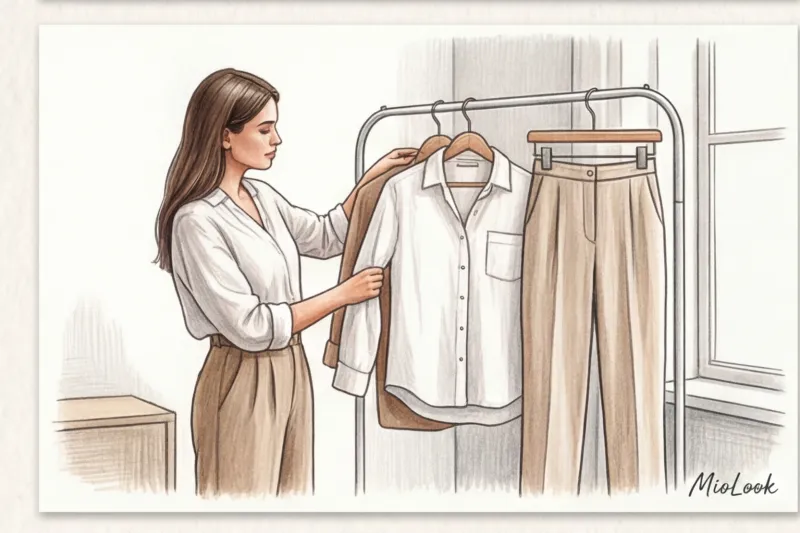
It's time to put theory into practice. Over the years, I've developed a four-step algorithm that allows you to assemble the perfect capsule in 40 minutes.
Step 1: Scenario and weather. Don't just look at the sun icon in the weather app. Check the temperature difference between day and evening. Schedule your activities: 60% city walks, 20% beach/pool, 20% evening outings.
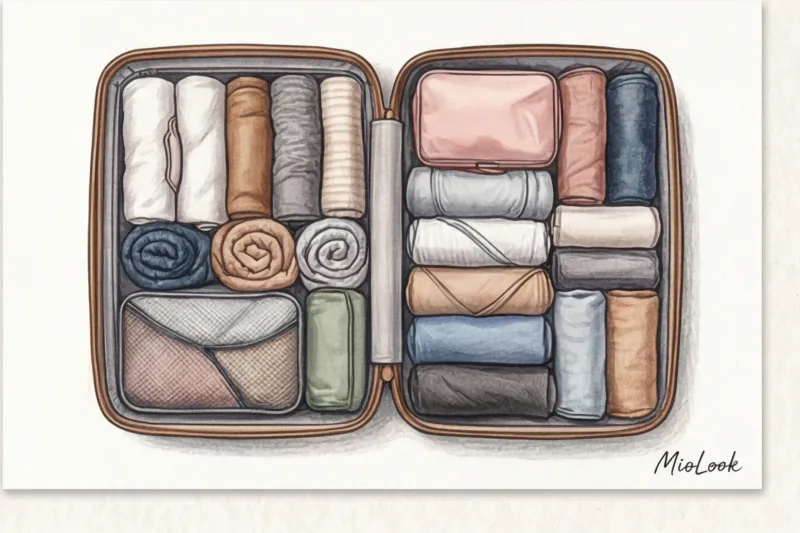
Step 2: Color palette. Choose two base colors (for example, sand and navy blue) and one or two accent colors (sky blue or terracotta). European minimalism is built on sophisticated neutrals. If your base color coordinates, you can dress in the dark and still look stylish.
Step 3: Forming the "core". The core is shoes and outerwear/layers (jacket, cardigan, light jacket). These take up the most space. The ideal layer is a heavy, oversized cotton shirt. During the day, it protects your shoulders from the sun at the beach, and in the evening, worn over a basic tank top from &OtherStories, it works as a lightweight jacket.
Step 4: Integrate accessories. Accessories change the "level of dressiness." The same basic slip dress with a canvas shopper and sneakers looks relaxed during the day, but in the evening, with the addition of red lipstick, chunky earrings, and a micro bag, it becomes an evening outfit.
Access to MioLook for €0.99 — one-time payment
A smart AI stylist will select the perfect look for your trip and help you pack your virtual suitcase.
Get access — €0.99 onceShoe Matrix: The Main Mistake That Makes Luggage Weigher
Shoes are the heaviest, stiffest, and bulkiest item of luggage. Packing five pairs of shoes on a week-long vacation is a crime against your back and wallet.
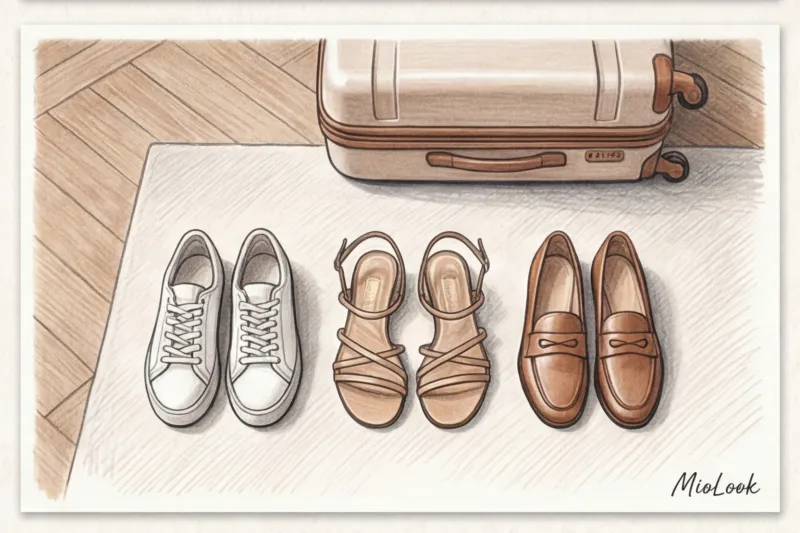
In my practice, the “Rule of Three Pairs” works great:
- A pair for the road (the most voluminous). These are usually sneakers or chunky boots, depending on the season. You put them on, saving space in your suitcase.
- A versatile pair for long walks. Simple leather sneakers in white or beige (check out classic models from Massimo Dutti or COS). They won't irritate your feet even after 20,000 steps and still look more elegant than sporty running shoes. Leather sneakers are a wardrobe saver—they pair well with shorts and a silk skirt.
- Evening/beach pair (the lightest). Elegant sandals with thin straps, mules, or loafers. They take up minimal space but radically transform daytime wear into evening wear.
European Weekend: A Sample 5-Day Carry-On Capsule
To be clear, I'll give you an example from personal experience. Last April, I flew to Milan for five days. I only had a small backpack that fit within WizzAir's strict carry-on baggage allowance.
Here's my actual 7-piece capsule wardrobe (not counting what I had on the plane—a COS trench coat, Zara straight jeans, a T-shirt, and sneakers):
- Silk midi skirt (champagne color).
- Linen blend palazzo pants (black).
- A basic white T-shirt (high-density cotton, from 180 g/m² – this is important so that it is not see-through).
- Long-sleeved vest.
- Light blue shirt of men's cut.
- Thin cashmere jumper (grey melange).
- Black slip dress.

During the day, I strolled around Brera in jeans, a Brera shirt, and a trench coat. For dinner at Navigli, I wore a silk skirt with a cashmere jumper (spring evenings in Italy are cool). And for a trip to La Scala, a black slip dress was perfect, and I threw a trench coat over it as an evening coat. These seven pieces covered all my needs without compromising on style.
To be fair, we need to define the boundaries: This visual planning method is completely ineffective if you're going on a ski trip, camping, or carrying professional equipment. Completely different rules for technical equipment apply there.
Checklist: The final, ruthless revision before departure
My signature approach to packing is absolute rigor. Every item should have its place in your luggage.
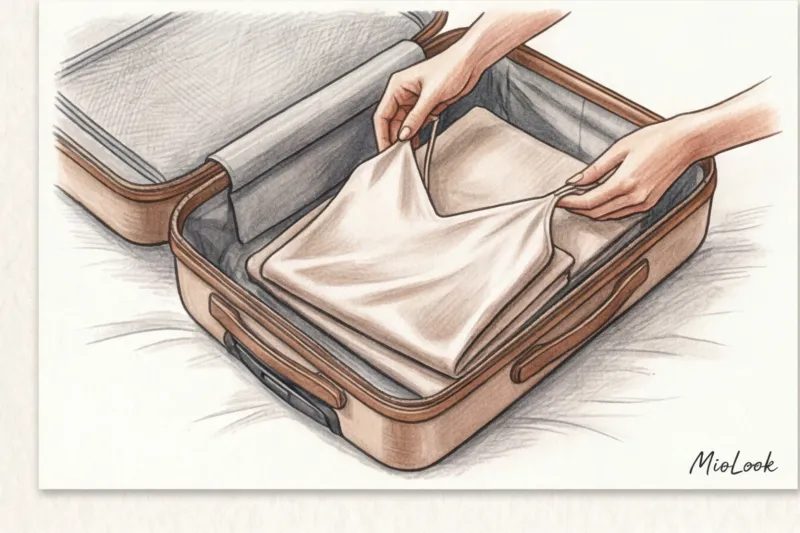
Before closing your suitcase, do a final inspection using the checklist:
- The "cooling down" rule. Packed your suitcase? Leave it open for two hours and drink some coffee. When you return to it with a fresh perspective, you're guaranteed to unpack two or three things you packed in a fit of rage.
- Test for duplicates. Do you have two pairs of blue jeans? Keep one. Two white T-shirts of the same cut? Put one out.
- Rating for the category "photo only". That striking, fine linen dress you've been dreaming of taking a single photo of against the sunset. Ask yourself: is one social media shot worth the extra weight, the hassle of ironing it, and the never-to-wear-it-again price? The answer is usually no.
Packing a suitcase isn't a game of Tetris; it's a test of your wardrobe's functionality. Leave 20% of your suitcase empty. You'll thank yourself when you decide to buy a bottle of local olive oil or a stunning vintage jacket at a flea market in Paris.