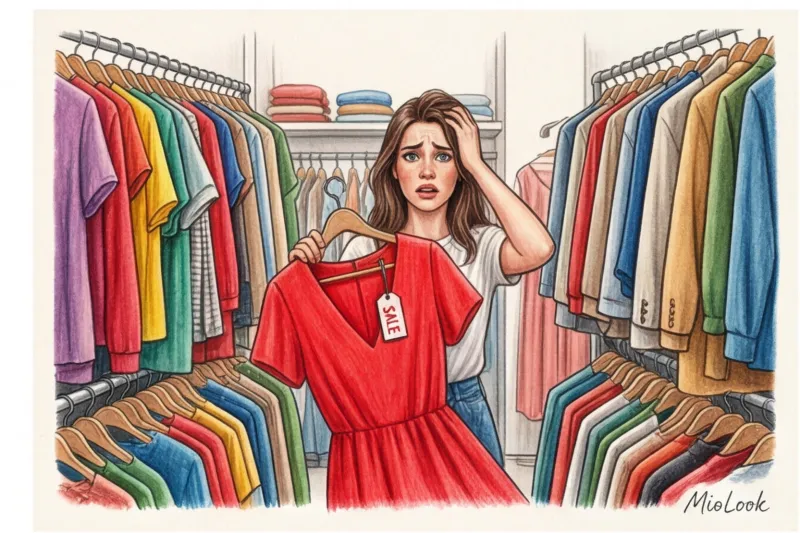
"Katarzyna, I saved almost two hundred euros!" a client happily declared to me last week, holding up three colorful, intricately cut dresses with giant red "70% off" tags. When I asked where and what she planned to wear them with, there was an awkward pause. At that moment, it became clear: she hadn't bought clothes; she'd bought a discount. This is the most common mistake I encounter as a personal stylist. By trying to outsmart the system, we're fooling ourselves.
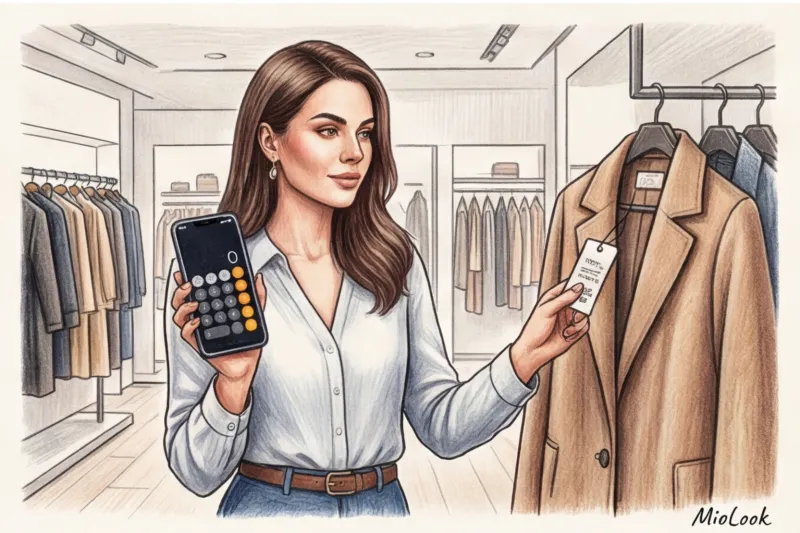
Harsh smart shopping rules are built not on the ability to find red price tags, but on strict financial discipline. In our The Complete Wardrobe Budget Guide: The Cost Per Wear Rule We've discussed in detail why the classic "100 euros a month for new clothes" strategy no longer works. This strategy leads to the accumulation of random items. True style requires an investment approach: each item should be 100% worth its place in your closet.
Wardrobe Math: Key Rules for Smart Shopping and the CPW Formula
According to a McKinsey analytical report (2024), the average European consumer wears only 20% of their wardrobe 80% of the time. The rest is clutter, purchased under the so-called "low-cost shopping cart illusion." Our brains are physiologically more stimulating to get three items for €150 (a powerful dopamine rush from the sheer volume of the purchase) than to spend the same €150 on one perfect wool jacket.
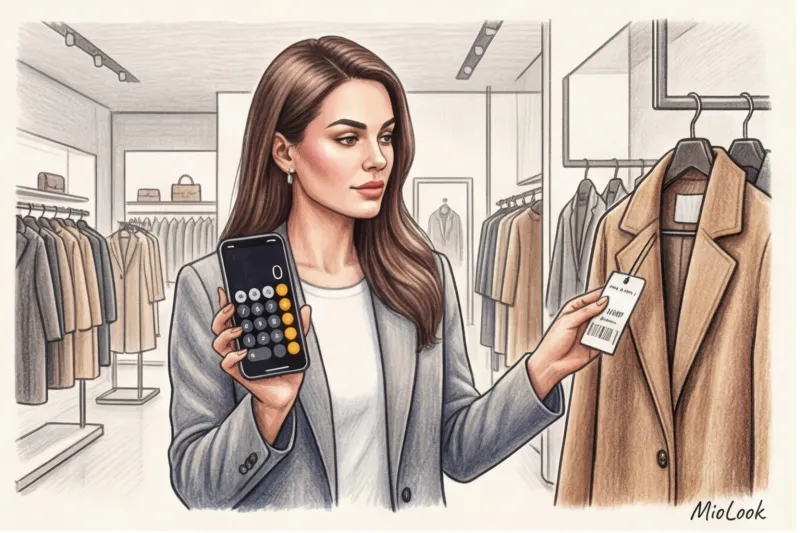
To break this dopamine trap, I make my clients calculate their Cost Per Wear (CPW)—the price of a single session. The math here is ruthless.
- Scenario A: A trendy acrylic sweater at a mass market for €30. After the third wash, it starts to pill and lose its shape. You wear it three times. Your CPW = 10€ per exit.
- Scenario B: A basic 100% merino wool pullover from a conventional COS for €140. With proper care, you'll wear it for two seasons (at least 50 times). Your CPW = 2.8€ per exit.
A cheap item cost you three and a half times more than an expensive one. This is the main secret the fast fashion industry is trying to hide from you.
Your perfect look starts here
Join thousands of users who look flawless every day with MioLook. A smart AI stylist will curate looks based on your wardrobe.
Get access — €0.99 onceThe Anatomy of Quality: What to Look for Before You Go to the Fitting Room
Understanding basic textile science forever changes your perception of the price tag. When you look at a garment through a stylist's eyes, you evaluate the design of the piece, not the brand.
I always start with the inside. The lining is the identity of a garment. A brand might use high-quality suiting wool for the outer layer of a jacket, but skimp on the lining by sewing on a stiff 100% polyester one. You'll sweat like a hothouse in such a jacket, regardless of the quality of the outer layer. A quality garment will have a lining made of viscose, cupro, or cotton.
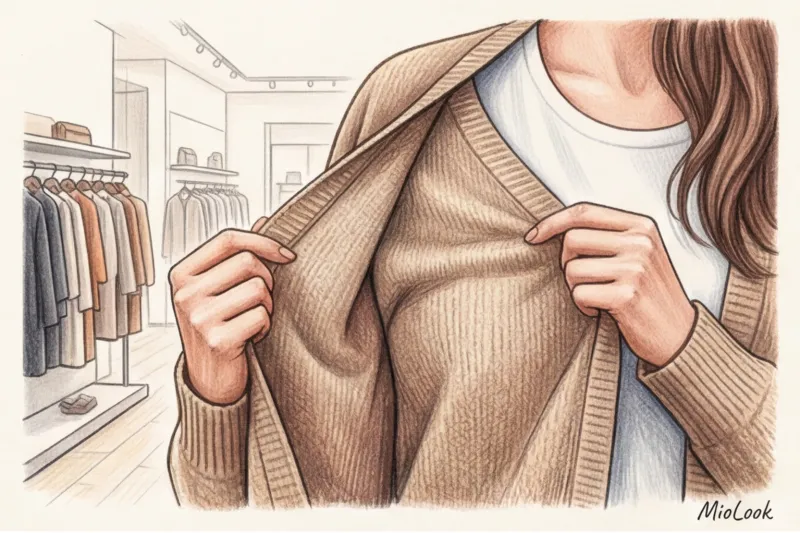
Next, look at the fittings and seams. Hold the seam with both hands and gently tug it apart. If you can see the threads when held up to the light and the fabric is fraying, the item is likely a one-time wear. Good cotton (at least 180 g/m²) holds the seam shape tightly.
Insider Trick: Test Drive Fabric in a Store
Never trust the spotlights in a salesroom. Conduct three rigorous tests right at the hanger:
- Crease test: Squeeze the edge of the fabric tightly in your fist and hold for 10 seconds. Release. If the fabric is still chewed up like paper, it will look the same after 15 minutes of driving. Leave it at the store.
- Peelability test: Rub the fabric vigorously against itself (in an inconspicuous area) for about 15 seconds. If micro-pilling begins to form immediately, the sweater won't survive the season.
- Elasticity test: Gently stretch the fabric at the elbows or knees (if they're pants) and release. It should instantly return to its original shape.
"Elastane is not the enemy, but a technical necessity. 2–5% elastane in cotton or wool trousers will save you from stretched knees by the end of the work day."
Fair Limit: This wrinkle test does NOT work with dense, textured silk, natural linen, or heavy brocade. Linen is bound to wrinkle—it's a sign of its noble origin and eco-friendliness; you just have to accept it.
The Sale Trap: Why Discounts Cost Us Too Much
It's time to voice an unpopular thought: sales are the main enemy of a smart wardrobe. In an attempt to save money, you buy items that haven't passed your critical review at full price. And these items make up the "dead" 80% of your closet.
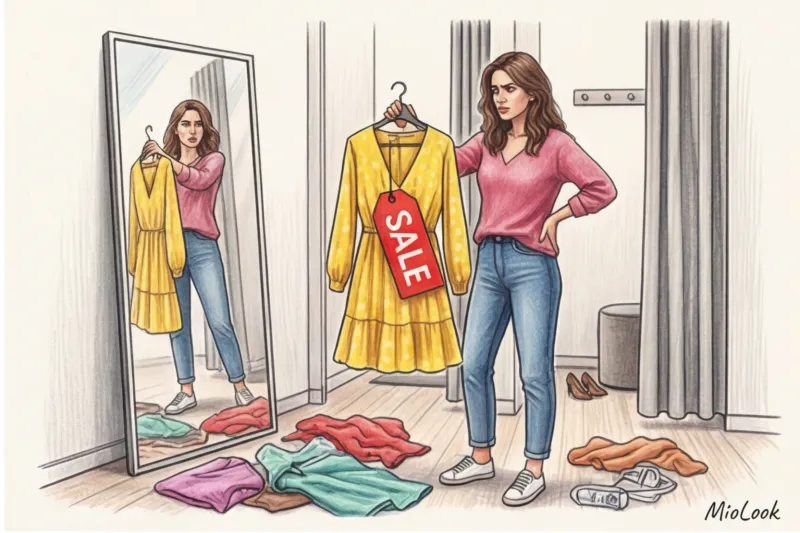
A 2022 study by psychologist Dr. Keith Yarrow on consumer behavior proves that the red price tag and the word "SALE" literally turn off the prefrontal cortex, the brain's logical processing center. You no longer evaluate whether you need those neon-green shoes. You only evaluate the size of your "victory" over the store.
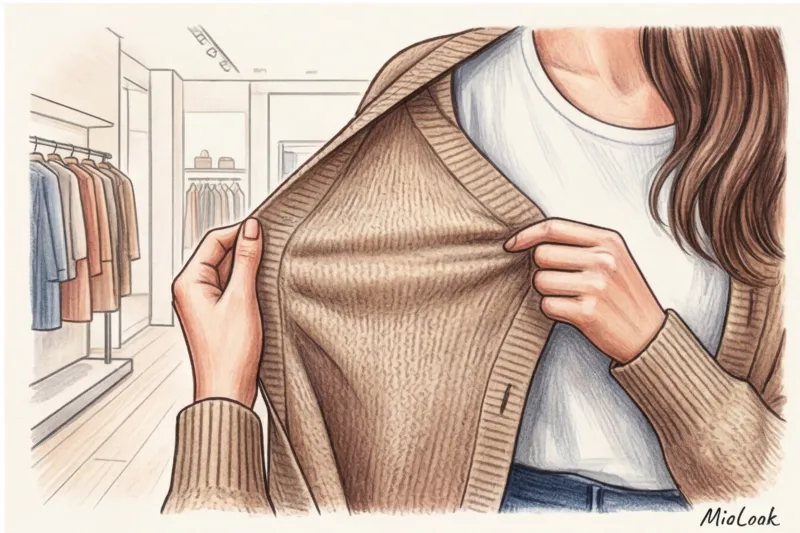
Remember the rule: buying something at 70% off that doesn't fit into your capsule is not saving 70%. It's losing 100% of your money The smartest investments in a basic wardrobe are made early in the season, when all sizes and patterns are available, rather than when you're shopping for the best of the worst.
European Mass Market: How Brands Dictate Our Purchases
The mass market is heterogeneous. Successful smart shopping depends on understanding the product matrices of different brands. You can't buy basic cashmere from a store that sells ultra-trends for a single season.
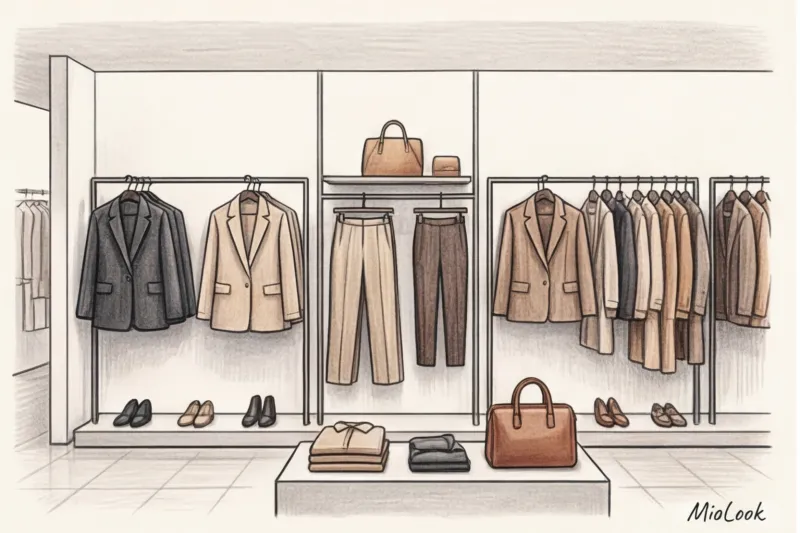
Divide stores into two categories. Zara, Bershka, or Mango are great places to find the hottest seasonal trends. Need a leopard-print micro bag or a sequin top for a night out? Those are the places to go. But if you're looking for a structured wool blazer, thick basic T-shirts, or the perfect pair of palazzo pants, your go-to spot should be Massimo Dutti, COS, Arket, or &OtherStories. The fit and fabric density there are much better.
Beware of merchandising tricks. In any mass-market store, the shiniest, trendiest items (often made of cheap, squeaky polyester) hang right at the entrance. That's a hook. The perfect basic poplin shirts and heavy jeans are always hidden in the back or near the checkout.
The Rule of Three Looks: Integrating New Items into Your Closet
This rule has saved my clients thousands of euros. When you're in the fitting room, close your eyes and try to mentally create a minimum three ready-made images with this new thing, using ONLY the clothes that are already hanging in your house.
For example, a structured gray jacket pairs easily with your basic jeans, a white T-shirt, and a black slip dress. Buy it. But an asymmetrical skirt with a complex print will require a new top, the right shoes, and a different bag. Leave it at the store.
The 48-Hour Pause Method and Emotional Shopping Hygiene
Retail therapy is a clinical fact. Buying a new item gives a quick hit of dopamine, comparable to eating a piece of chocolate cake. But this hormone has a half-life.

If you find yourself making a purchase out of impulse (tired after work, a fight with your boss, or simply craving "something new"), try the 48-hour method. Online, simply leave the items in your cart and close the tab. In person, ask the checkout counter to put the item on hold and leave the store. According to WGSN statistics, this "cooling down" prevents up to 40% of impulse purchases. After two days, an item that seemed vital often leaves only confusion.
Smart Shopper Checklist: 5 Tough Questions to Ask Before Checkout
Before you pull out your bank card, run a potential purchase through this filter. If there's even one "no," the item goes back on the hanger.
- Would I buy this if there was no discount? An honest answer immediately eliminates 80% of the junk at sales.
- Do I have at least 3 things that go with this? (The rule we talked about above).
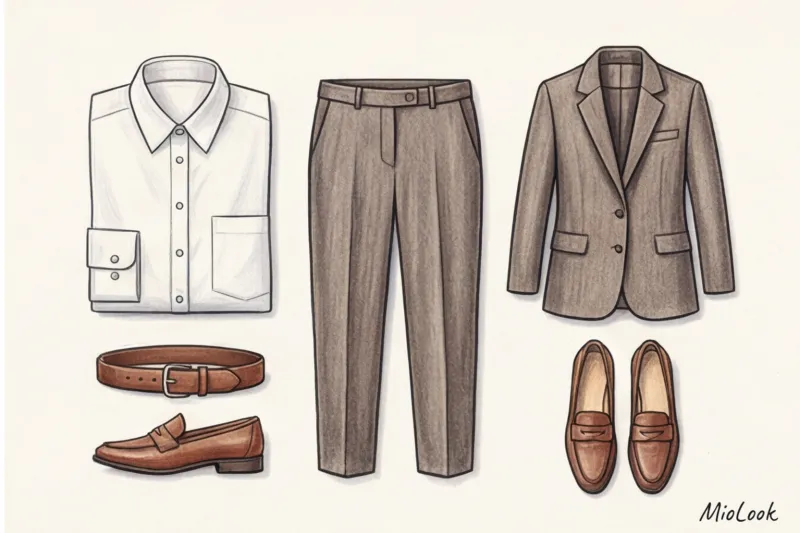
- Does this thing duplicate something I already have or fill a gap? You don't need a seventh oversized white T-shirt, but you do need a high-quality leather belt, which you're never short of.
- Am I willing to spend money and time on care? If it's a heavy wool or delicate silk that requires dry cleaning, factor these costs into the price of the item.
- Am I physically comfortable right now? The item won't stretch, won't shrink, and won't become less itchy. Only buy something that feels 10/10 comfortable when you try it on.
Access to MioLook for €0.99 — one-time payment
A smart AI stylist will create the perfect look for you. Digitize your wardrobe and stop buying duplicates.
Get access — €0.99 onceSmart Shopping Starts at Home: Digitize Your Wardrobe with MioLook
You can't manage what you can't measure. Without a crystal-clear audit of what's already hanging in your closet, every trip to the mall becomes a wandering in a fog. You'll repurchase what you already have and forget what you're really missing.
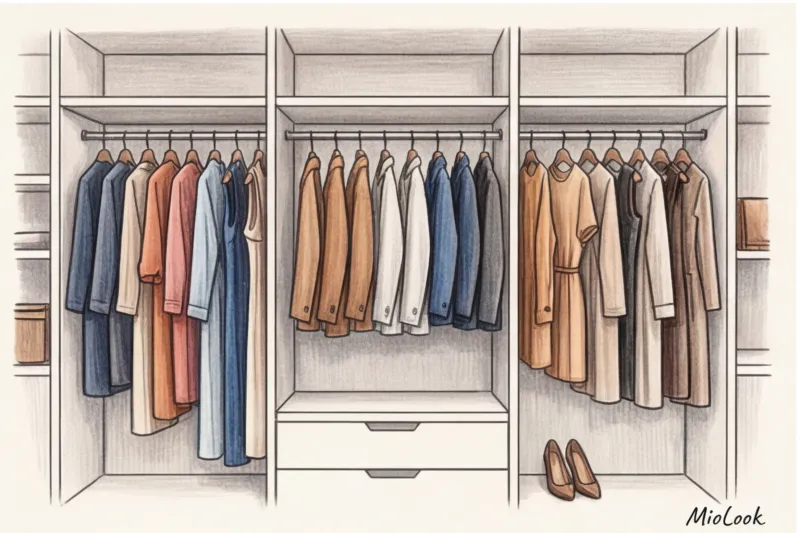
That's why I strongly recommend my clients to digitize their closets. App MioLook It's essentially a personal stylist in your pocket. By uploading your items to the virtual wardrobe, you instantly see the full picture. Before going to the store, you simply open the app, assemble a virtual capsule wardrobe for the upcoming season, and clearly see any gaps.
You don't need "any shoes," but specifically beige loafers. Not a "blouse," but a navy blue smooth-knit cardigan. Having created a dynamic shopping list, you approach the store with the focus of a predator, ignoring visual noise and marketing traps. And this is the main secret to stopping wasting money on clothes and starting investing in your personal style.