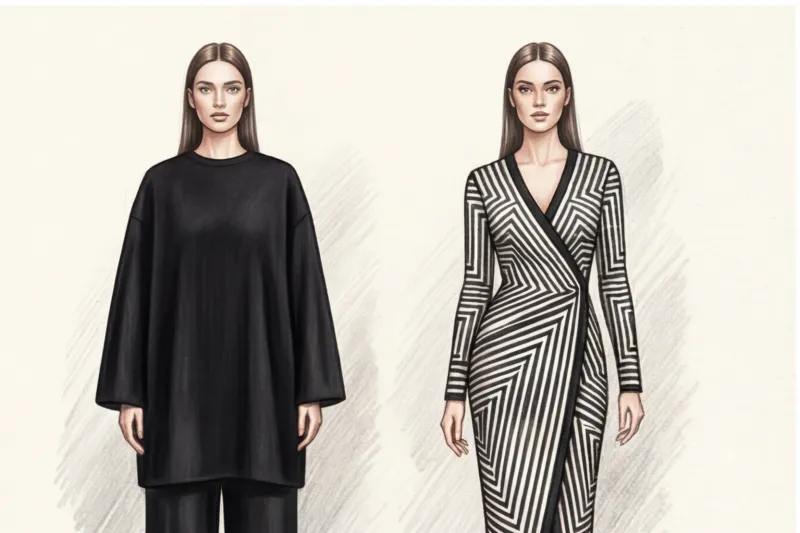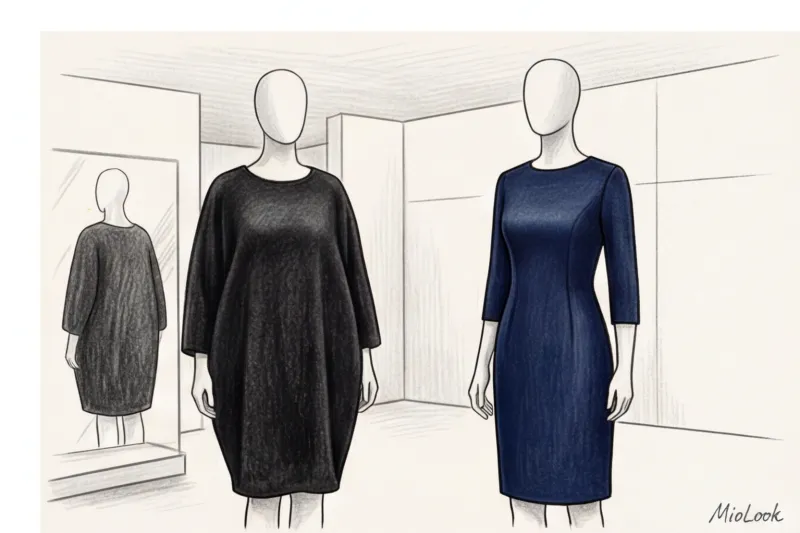
"Black makes you look slimmer, while horizontal stripes make you look fat"—if I had a euro for every one of those sayings, I'd already have a small villa on Lake Como. After 12 years working as a personal stylist in Europe, I've realized one thing: these ironclad rules are as outdated as whalebone corsets. We're used to hiding in dark robes, hoping to disappear, but the laws of optics work quite differently.
We've covered the basic principles of working with volumes in more detail in our complete guide. How to hide a belly and love handles with clothing after 40 And today we will go further and analyze prints that make you look slimmer from the point of view of physics, illusions of perception and banal common sense.
The All-Black Myth: Why a "Safe" Color Sometimes Adds Pounds
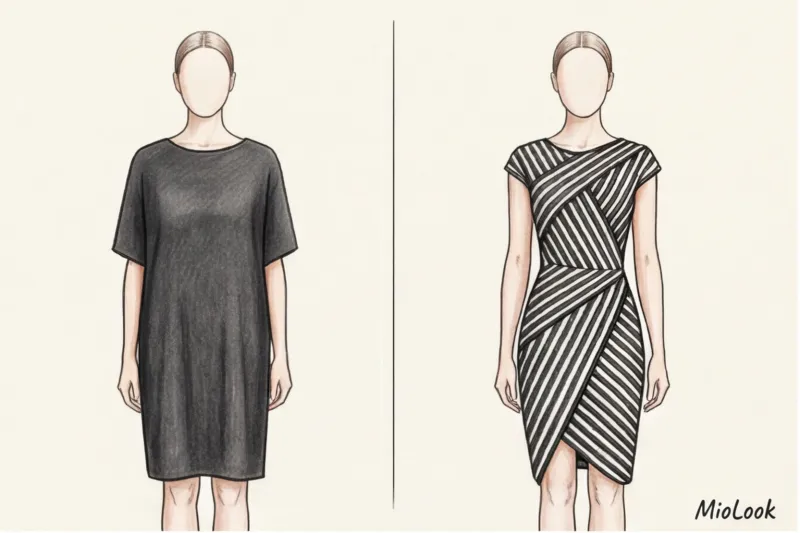
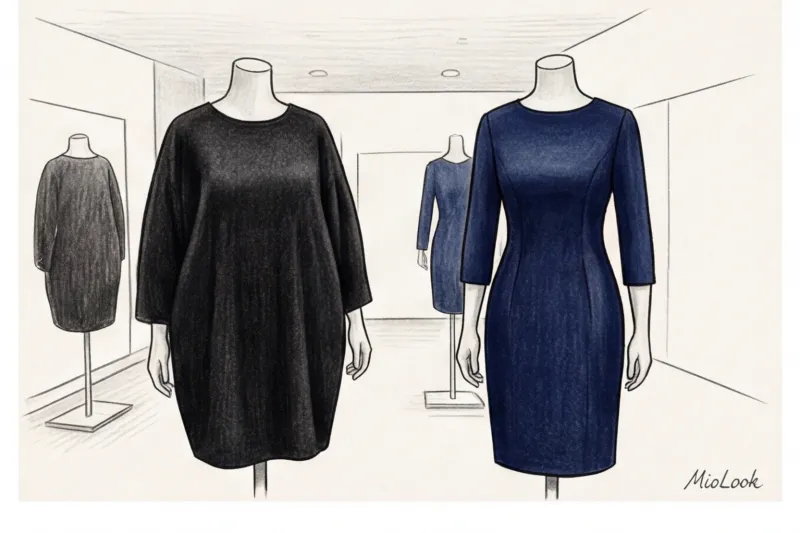
Let's be honest. All-black often makes you look fatter, not slimmer. It's a paradox that shocks 90% of my new clients. In optics, there's a "black hole" or hard-edged silhouette effect: when you wear a solid black dress, it creates a monolithic, sharply defined silhouette against a lighter backdrop (office walls, street, furniture). Every curve, every fold becomes graphic and emphasized.
One of my clients, 46-year-old Marta, with an apple-shaped figure, had been buying identical black knit dresses from H&M for years. She thought it was hiding her belly. We experimented in the fitting room: I offered her a midi dress from COS in a deep bottle green with a bold midi geometric print. The result? She visually lost about five kilograms simply because her eye was no longer drawn to the harsh black line.
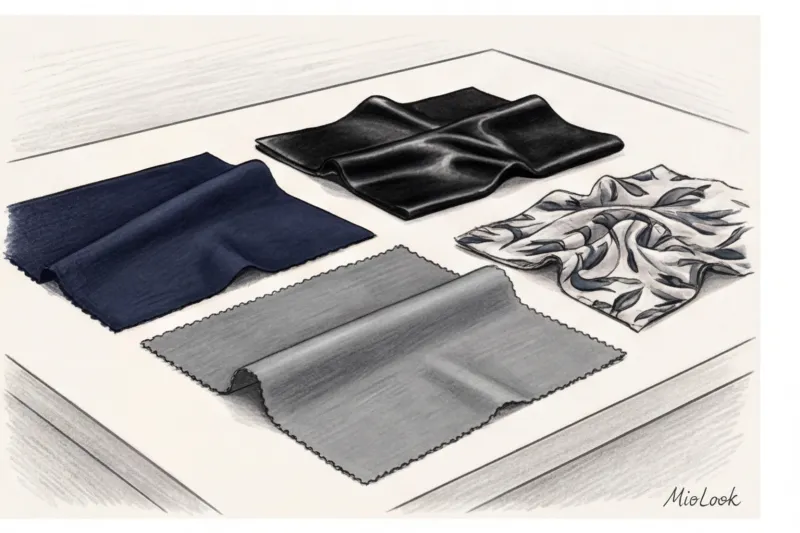
Research by the PANTONE Color Institute (2024) confirms that complex dark shades create volume more effectively than basic black. Matte navy absorbs approximately 15% more light than matte black, softening the silhouette and blurring boundaries. If you want to appear slimmer, choose deep chocolate, eggplant, or pine. And remember texture: shiny black silk or satin acts like a mirror, reflecting light and adding volume, while matte wool suiting conceals this volume.
Slimming Prints: The Key Laws of Optical Illusion in Clothing
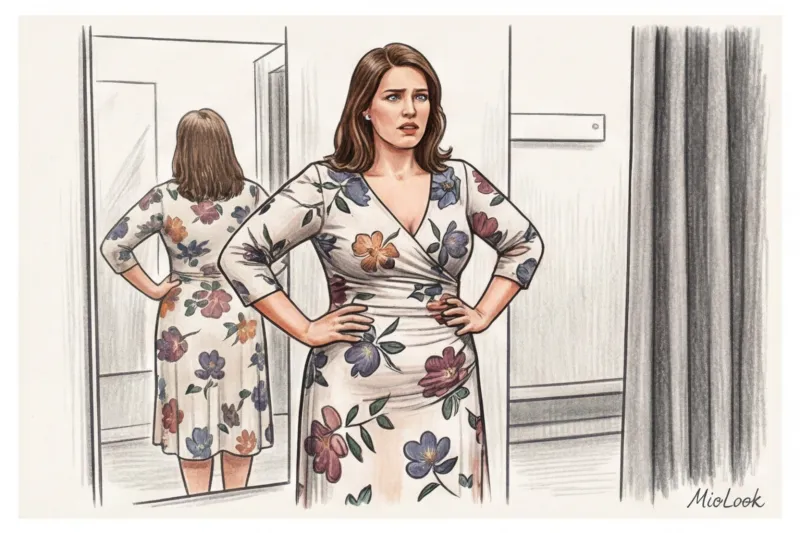
Styling isn't magic; it's geometry and architectural proportions. The basic rule is: the print should be proportionate to your facial features and body measurements. If a plus-size woman wears a dress with a tiny millefleur floral print, her figure will appear monumental against the backdrop of this tiny pattern.
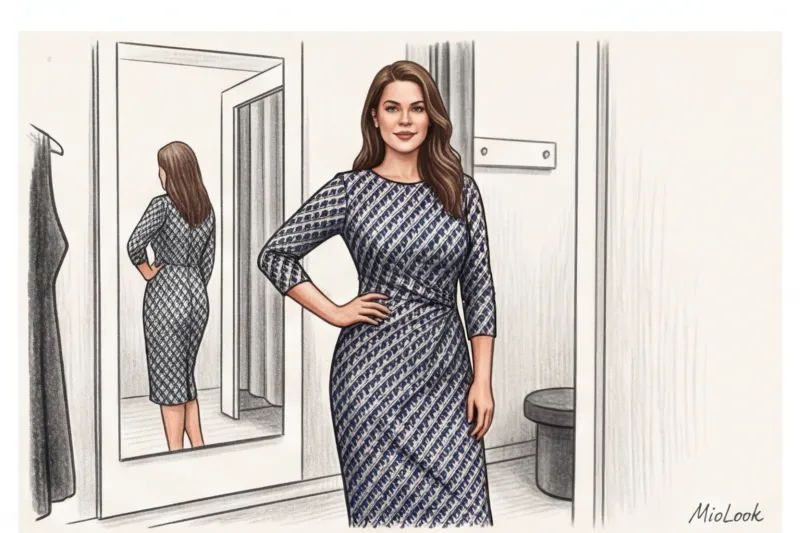
When shopping in Milan showrooms, I always pay attention to diagonal checks. Unlike straight checks, they don't cut the figure at right angles, but rather act as a sculptor. Ideal prints that are guaranteed to elongate the silhouette include classic houndstooth, polka dots on a dark background, and medium-sized abstract geometrics.
The Helmholtz Effect: Why We're Unnecessarily Afraid of Horizontal Stripes
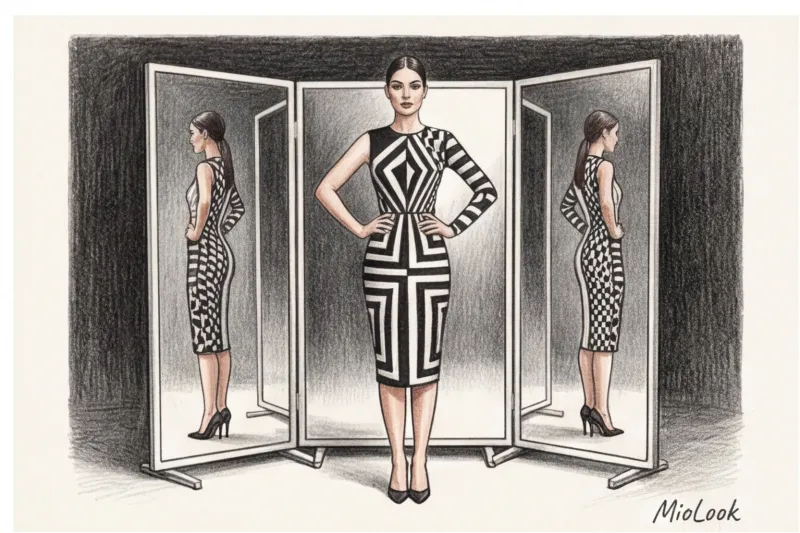
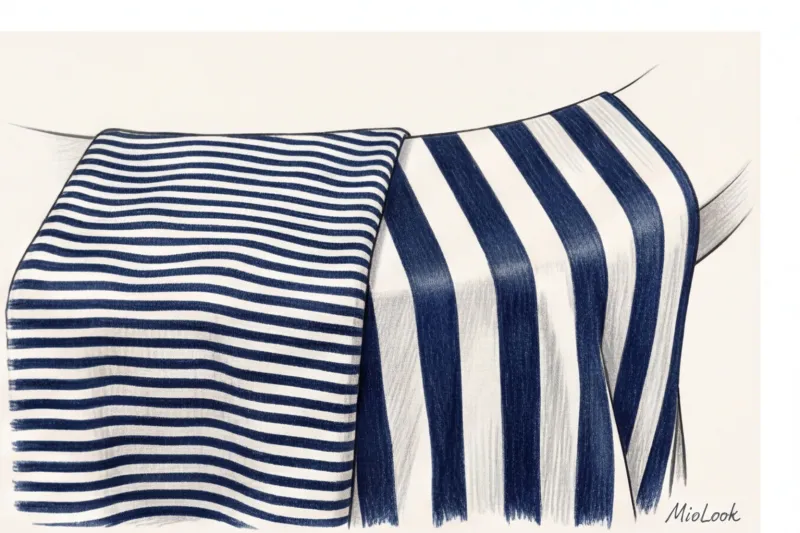
Now let's debunk the biggest fashion myth of the century. Back in 1867, German physicist Hermann von Helmholtz demonstrated a paradoxical optical illusion: a square filled with horizontal stripes appears taller and narrower than an identical square with vertical stripes. This works flawlessly in clothing: dense, frequent, and thin horizontal stripes (like those on a classic Breton striped shirt) draw the eye up and down, elongating the silhouette.
However, you need to be extremely careful with a wide vertical stripe. It falls on the chest and protruding belly, stretching across them like meridians on a globe. As a result, the stripes become curved, unmistakably pointing out each bulge. By the way, if you're concerned not only about the proportions of your belly but also about body length imbalances, check out our article. Long torso, short legs: how to dress appropriately.
Rhythm and Scale: How to Choose a Safe Pattern Size
I have a foolproof "fist test." Clench your hand and place it against the print on your dress. If a single element of the pattern (for example, a rose or geometric shape) is larger than your fist, it will visually enlarge the area it touches. A large peony on your hip? It will appear wider.
The rhythm (density) of the print is also important. Patterns without obvious gaps, where elements are tightly packed together, create a "white noise" effect. The eye can't focus on individual details, so folds on the sides or unevenness in the underwear simply dissolve into the pattern. Meanwhile, sparse flowers against a large, light background act as a magnifying glass.
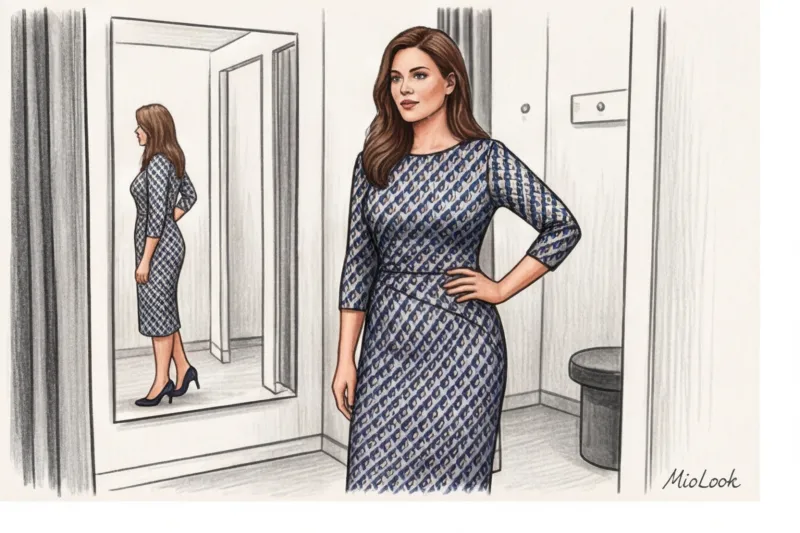
But there is an important exception here: This advice does NOT work if you're shorter than 155 cm. For very petite women, even a fist-size print is too large; you're better off aiming for a matchbox-size print, otherwise the print will simply eat up your height.
Digitize your wardrobe
Forgotten what items you already own? Upload them to MioLook, and the algorithm will suggest perfect combinations with the right prints.
Get access — €0.99 onceColor blocking as a sculpting tool: distracting attention from problem areas
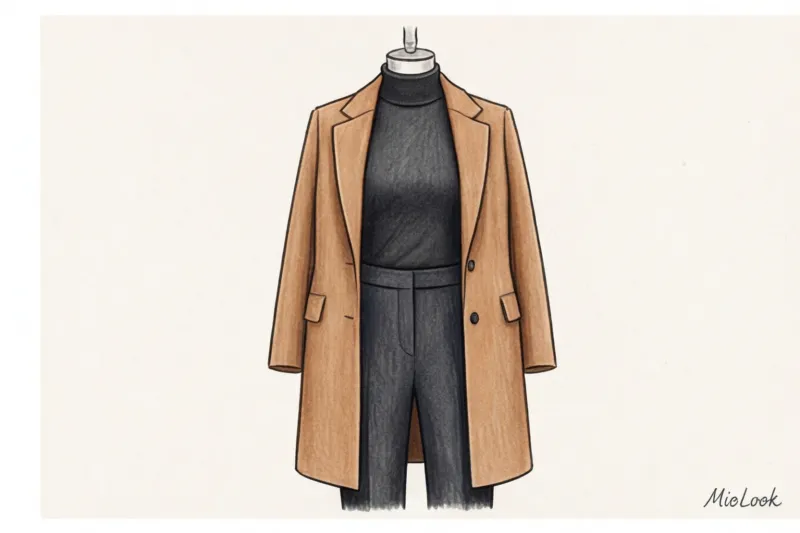
Color blocking is a powerful visual enhancement technique. The most powerful technique used by all professionals is called the "vertical color column." It's simple: wear a top and pants in the same rich color (for example, dark gray or chocolate), then layer a contrasting jacket, cardigan, or coat over it, leaving it unbuttoned.
Unbuttoned hems create two vertical lines that literally "cut off" your sides, leaving only a narrow inner column visible. Current collections from brands like Massimo Dutti and &Other Stories feature this technique in their lookbooks, where they style crisp suits with contrasting vests. Put together a basic outfit for €40-€50 at Uniqlo, add a structured blazer for €120, and you'll have a silhouette that's worth a million.
Another classic trick is the rule of thirds. Dividing the silhouette with contrasting colors in a 50/50 ratio (for example, a white waist-length top and black pants) will cut the figure in half, shortening the height and creating a squat silhouette. Always divide proportions as 1/3 to 2/3. A cropped top and high-waisted pants will visually lengthen the legs and de-emphasize the problematic stomach area. By the way, if you're choosing clothes for a specific body type with a prominent top, I recommend checking out this guide. How to hide broad shoulders.
Dangerous Geometry: Which Designs Will Accentuate Age-Related Changes in the Figure?
After 40, skin loses its firmness, and body tissues become softer. This is a natural process, but it dictates its own rules when choosing clothing. Geometric shapes are unforgiving of softness. If you wear a crisp gingham or a strict stripe on fine knitwear, the pattern will inevitably fade at the folds.
The most dangerous options for a figure with age-related changes:
- Large single elements in the abdominal area: Mandalas, single flowers, or large logos act as a target.
- Cheap leopard: A small, unnaturally bright animal print without color transitions cheapens the look and emphasizes volume.
- Horizontal color blocks on the hips: For example, a sweater with a wide contrasting stripe along the hem. This stripe will add 5 centimeters to your girth where it ends.
Texture Matters: Why the Right Color Won't Work on Cheap Fabric
This is my main rule when shopping: the thinner the fabric, the more dangerous any print, even the most "slimming," will be. Cheap, flimsy viscose from the mass market (especially in the under-€30 range) doesn't hold its shape. It sinks into every crease and clings to every roll. As a result, any beautiful pattern turns into a jagged curve.
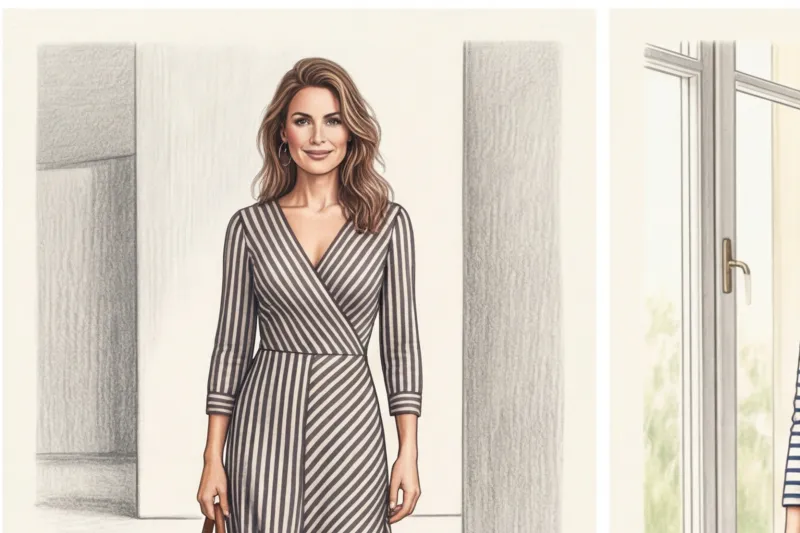
For geometric patterns to work for you, you need a structured fabric. Compare thin synthetics with dense cotton poplin (look for a weight of 180 g/m² or higher). Poplin supports its own structure, creating distance between the body and the garment. In this style, a striped shirtdress will elongate the silhouette rather than cling to it.
If you are unsure how a particular texture will look in the finished look, you can use the “smart wardrobe” function in MioLook — the algorithm will help analyze the compatibility of dense and light fabrics in one outfit.
Katarzyna's Checklist: How to Test Prints and Colors in the Fitting Room
Never trust the mirrors in fitting rooms. They're perfectly lit to soften shadows. Here's my personal 4-step process that I make every client follow before going to the checkout:
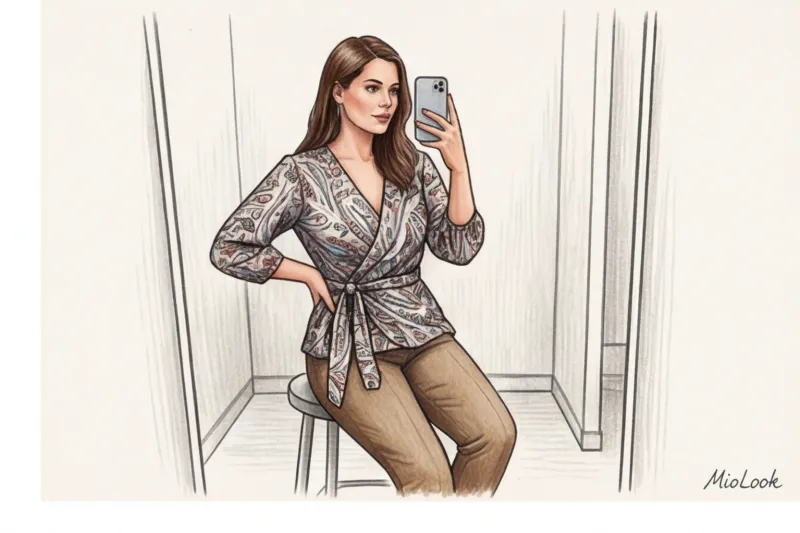
- Chair test: Be sure to sit down. Observe how the print behaves around the waist and stomach. Are the stripes stretching? Are the buttons on the chest coming apart, distorting the pattern?
- The three meter rule: Move away from the mirror to the far corner. If the small print merges into a vague, "dirty" spot, the item will remain in the store.
- Light test: Position yourself so the light falls from behind or to the side. Thin printed fabrics are often insidiously see-through, revealing the contours of your underwear and body.
- Photo with flash: Take a mirror selfie with a flash. A smartphone camera captures reality more accurately than our brains, which tend to flatter themselves in their reflections. A flash will immediately reveal a cheap sheen on fabric or an unfortunate distortion in a pattern.
Your perfect look starts here
Join thousands of users who look flawless every day by planning their looks with the help of an AI stylist.
Get access — €0.99 onceInstead of hiding in dull black robes for years, learn to command attention. Slimming geometry isn't about restrictions or diets; it's about knowing how to correctly direct the eye. Choose thick, matte fabrics, don't be afraid of thin horizontal stripes, and always test the scale of the print to ensure it's proportionate to your figure. Clothes should work for you, not you, catering to other people's stereotypes.