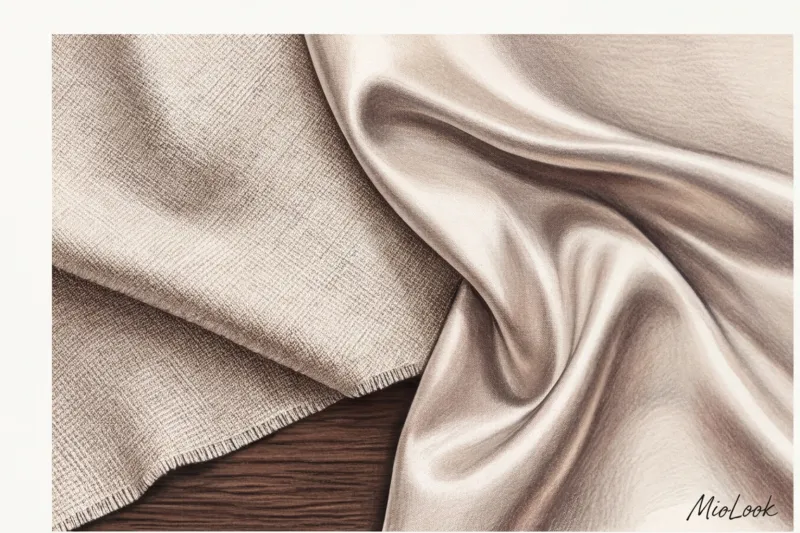
One of my clients recently texted me in tears from the office restroom. She'd bought a stunning satin dress from a popular high-street brand for an important presentation, confident she looked like a million bucks. But by eleven o'clock that morning, the fabric had clinged to her tights, and noticeable damp spots had appeared on her back. Why? Because she'd fallen for the oldest retail trick of all: paying for the illusion of luxury while receiving 100% cheap polyester.
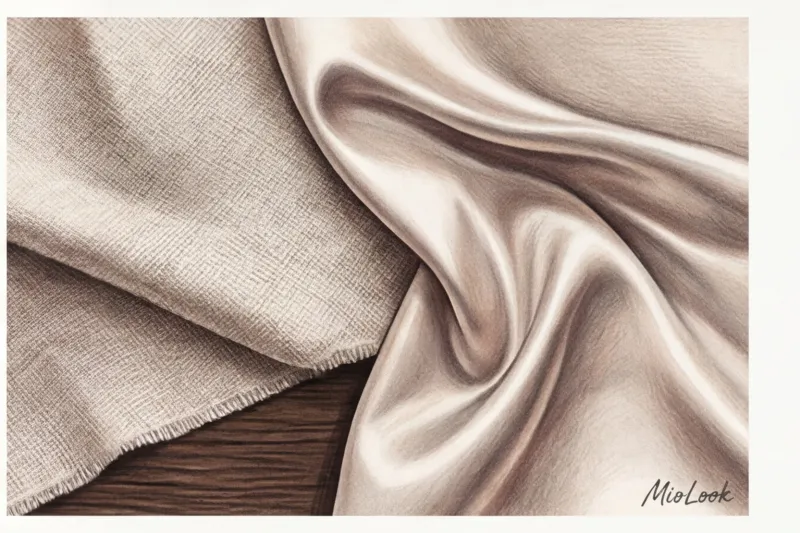
This case brings us to the most common question I hear during shopping tours: What is the difference between silk and satin? Spoiler: the very formulation of the question is fundamentally wrong, and it's precisely this misunderstanding that allows brands to make millions. We've covered how to conduct basic checks of materials in-store in detail in our complete guide. How to distinguish natural silk: tips from a stylist Today, we'll clear up this confusion once and for all—from the perspective of your budget, everyday comfort, and building a smart wardrobe.
The biggest mistake shoppers make: why comparing silk and satin is incorrect
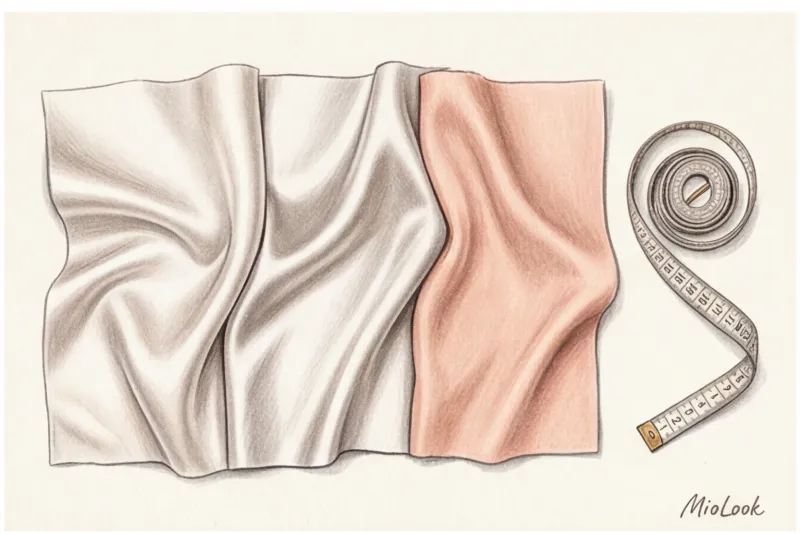
Let's settle this question once and for all: comparing silk and satin is like comparing wood and a table. One is the material from which the item is made, and the other is the shape given to that material.
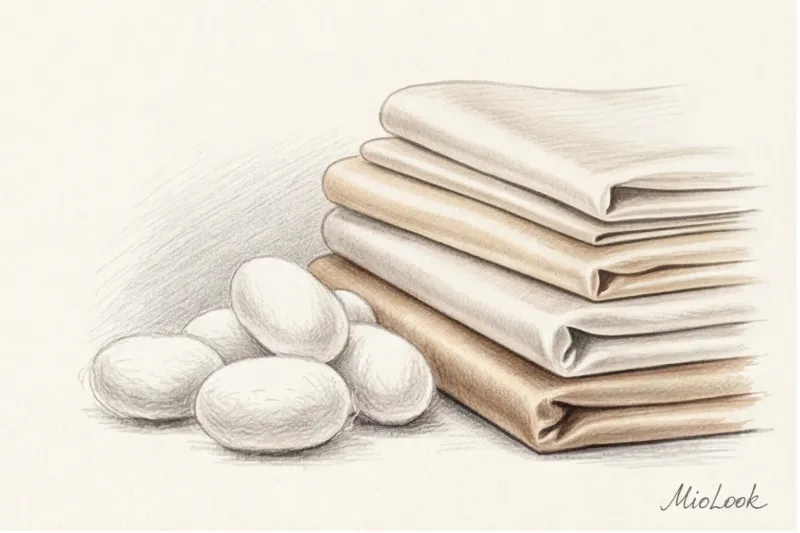
Silk is a raw material. This is a very fine natural fiber produced by silkworms. Silk thread can be woven into a wide variety of fabrics, from sheer chiffon to dense taffeta.

Atlas (in English version - satin ) is a type of thread weaving. According to The Textile Institute's technical standards, satin weave is characterized by warp threads overlapping several weft threads. On the face, this creates a smooth surface of long overlaps that reflects light phenomenally. However, the back remains rough and matte.
According to WGSN's 2024 consumer market research, 68% of mass-market brands intentionally use the word "satin" in their product names. You see a "Satin slip dress" on the price tag, and your brain interprets it as "luxurious silk," while the fine print on the sewn-in tag coldly declares: 100% Polyester. You're not buying a noble material, but simply a shiny piece of plastic.
Access to MioLook for €0.99 — one-time payment
A smart AI stylist will select the perfect look from your items.
Get access — €0.99 onceSo what's the difference between silk and satin on the store shelf?
When you walk into a boutique, you need to understand what exactly is hanging before you. Visually, these textures behave completely differently, even though both are made from natural materials.
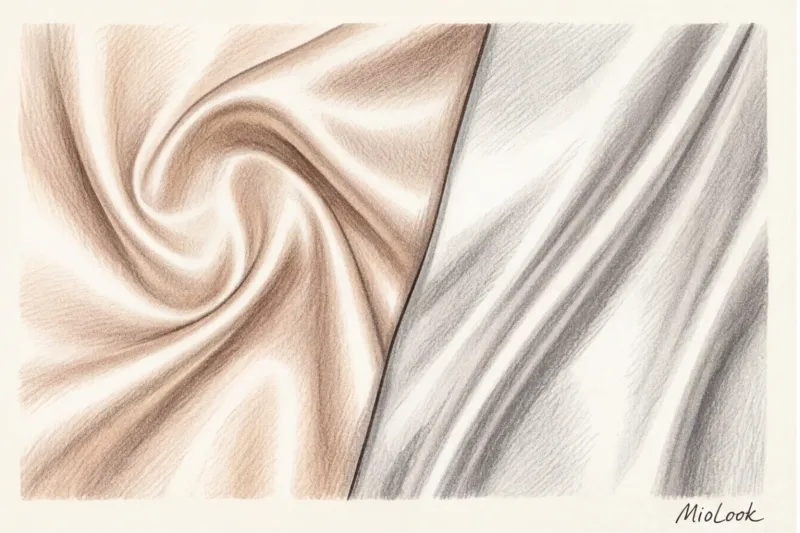
- Silk fabric of simple weave (crepe de chine, habotai): It has a soft, diffused pearlescent sheen. If you look closely, you'll notice a slight graininess to the texture. It doesn't overpower with shimmer, but rather has a discreet and expensive appearance.
- Satin weave fabric (from any raw material): It has an intense, almost mirror-like sheen on the front side. It's smooth, slippery, and immediately eye-catching.
- Silk satin: This is the pinnacle of textile art. It combines the naturalness of protein fiber with the luxurious sheen of its weave. It's expensive, looks stunning, but carries a host of dangers for everyday wear.

Fitting Room Battle: Polyester Satin vs. Silk
When I'm shopping with clients, I love to conduct a "blind test" at premium high-street stores like Massimo Dutti or COS. I ask the client to close her eyes and touch two blouses: one made of viscose or polyester with a satin sheen, and the other made of 100% silk. The difference is obvious within seconds.
Synthetic satin gives away its flat, cheap sheen in daylight. It creaks under your fingers, quickly becomes staticky, and clings treacherously to your legs, highlighting even the slightest unevenness in your underwear. Natural silk, on the other hand, flows like water, creating deep, soft shadows in the folds.
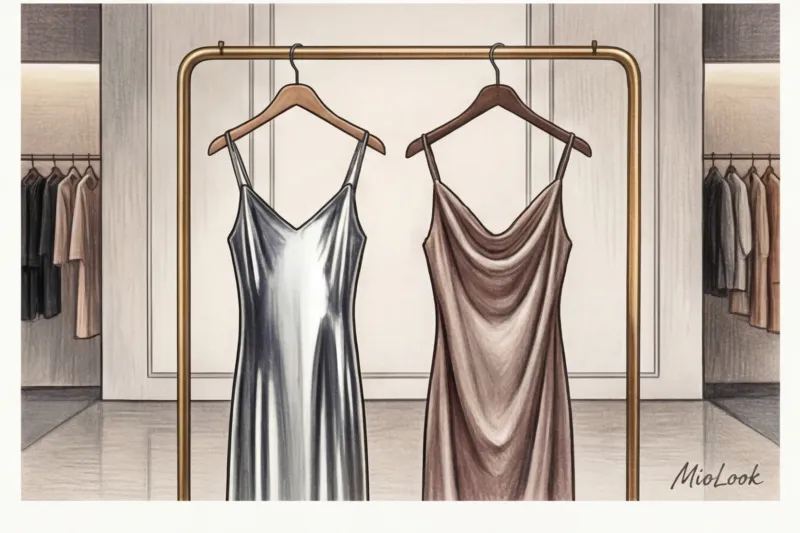
But the main test occurs not in front of a mirror, but in life - it is a thermoregulation test. Scientific fact: Natural silk can absorb up to 30% of its own weight in moisture while remaining dry to the touch. Polyester, on the other hand, absorbs less than 1%. That's why a shiny synthetic blouse from Zara can create a greenhouse effect for your body, causing you to sweat within 15 minutes in a warm office, while a silk shirt will keep you perfectly comfortable throughout the workday.

Your perfect look starts here
Join thousands of users who look flawless every day with MioLook.
Get access — €0.99 onceWhat to Choose for a Basic Wardrobe: A Stylist's Checklist
Here, I'm ready to debunk a popular fashion myth. Many glossy articles convince us: "Invest in a natural silk satin skirt—it's the basics." As a practicing stylist with 12 years of experience, I categorically disagree. Glossy silk satin is a terrible idea for an everyday capsule wardrobe.
Why? Because it's an incredibly fragile fabric. Even a tiny drop of clean water (like when you wash your hands) will leave a noticeable stain on natural satin. And the strap of your crossbody bag will leave tiny snags on the glossy surface the very first day. Furthermore, the intense shine visually expands the area it's worn on, which isn't flattering for all body types.
My absolute favorite for a basic wardrobe is matte silk (crepe de chine). It's highly durable, doesn't glare, doesn't stain even with the slightest moisture, and looks incredibly classy. Let's do the math. Cost Per Wear (cost per outing). A €120 silk crepe de chine blouse that you'll wear at least 50 times to the office (€2.40 per outing) is a much smarter investment than a €40 polyester satin shirt that will pill and end up in the trash after 5 washes (€8 per outing).
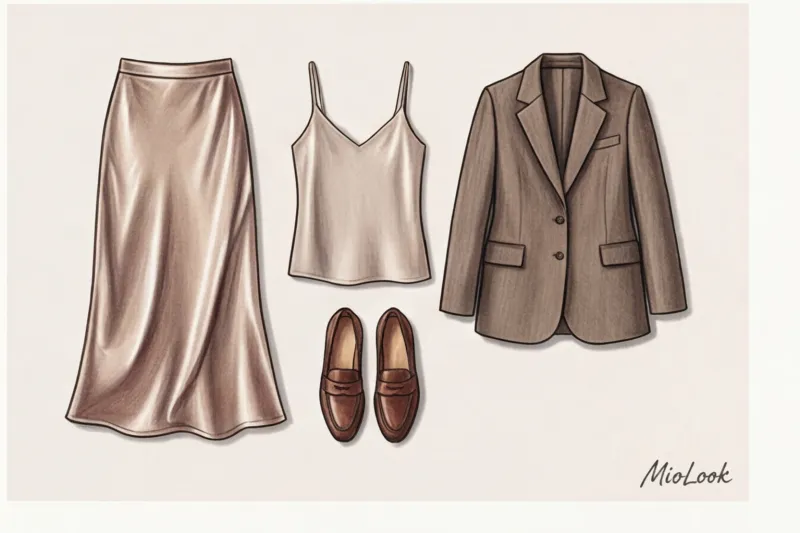
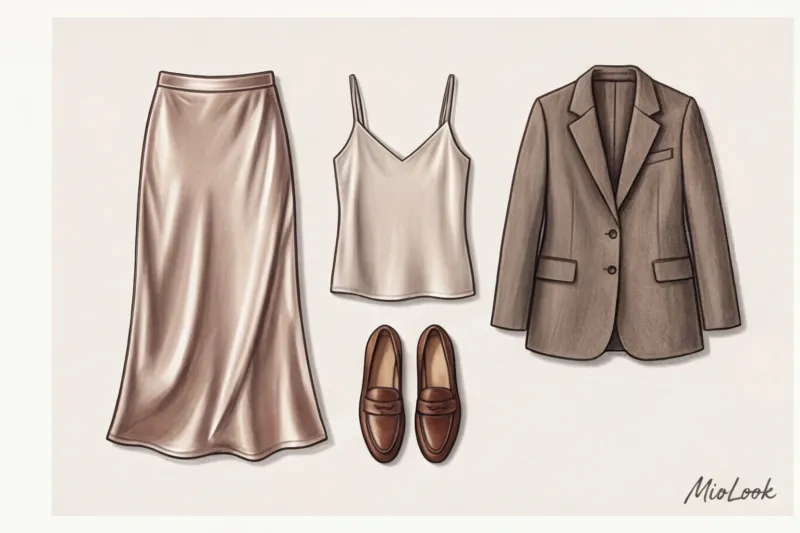
When is satin truly appropriate? Save it for an evening capsule: a slip dress for going out, a top with thin straps under a tailored wool jacket (playing with contrasting textures), or statement accessories like bob scarves and voluminous hair ties.
Alternative: Is it worth investing in viscose satin and cupro?
What to do if your shopping budget is strictly limited (up to 50-70 euros per item) but you want to add a silky texture to your wardrobe? Look for the words "Cupro" or "Viscose" on the labels.
Cupro is often called "vegan silk." It's a man-made fiber made from recycled cottonseed cellulose. It offers incredible breathability, a delicate sheen, and excellent drape. Unlike polyester, cupro and dense viscose are breathable, static-free, and look three times more expensive than they actually are. It's the perfect compromise for the modern urban capsule.
Ready to get started?
Try a free plan and upload your items to your digital wardrobe with no commitments.
Get access — €0.99 onceHow to Avoid Being Fooled: 3 Quick Tests for Fabric Authenticity
To avoid blowing your budget on beautiful synthetics, make it a rule to conduct three-second tests right in the store. No lighting the threads with a lighter (we'll leave that advice to internet theorists)—only practical steps.
- Rule for reading labels: Ignore large labels on cardboard tags like "Silky Touch," "Satin Collection," or "Silk Feel." These are marketing gimmicks. Turn the garment over, locate the internal sewn-in tag in the side seam, and look for the following stitching: 100% Silk (or Seide / Soie ).
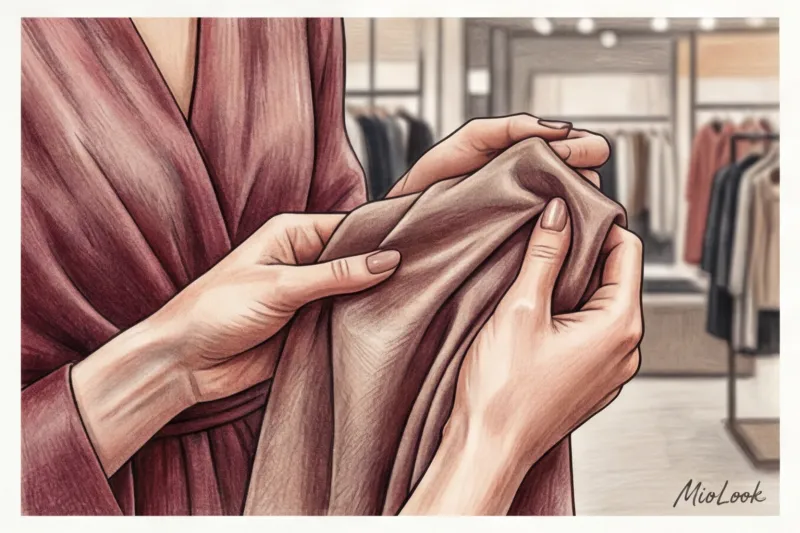
- Crease test (in an inconspicuous place): Take the edge of the hem and squeeze it tightly in your fist for 5 seconds. Natural silk will straighten out, leaving soft, smooth folds that look natural. Cheap polyester will either spring back like plastic (without any creases) or leave hard, sharp creases, reminiscent of crumpled paper.
- Heat test (tactile): Place the fabric against your cheek or the inside of your wrist. Natural silk thread will feel cool at first, but will quickly warm up to your body temperature. Synthetic thread will remain cool and aloof.
Conclusions and an action plan for your wardrobe
To summarize: satin is simply a characteristic of luster, while silk is a guarantee of status, temperature regulation, and comfort. Your task is to learn to distinguish between these concepts and avoid paying the price of fine fabrics for polyester.
Your action plan for the coming weekend:
- Take stock of your closet. Ruthlessly get rid of squeaky polyester satin, blouses that get staticky, and skirts that cling to your tights. These items systematically cheapen your look.
- If you find it difficult to create stylish combinations from the remaining items, take photos of them and add them to MioLook smart wardrobe — the app will suggest fresh combinations of textures.
- Make your first smart investment. Buy one perfect blouse or shirt made of thick, matte silk (crepe de chine) in a neutral shade. I guarantee the difference it will make in your posture and how you feel about yourself will be worth every penny.