Daily Hair Styling: Why We're Wasting Time (and How to Fix It)
Have you ever noticed that 90% of saved hair tutorial videos remain dead weight in your bookmarks? And the 10% we actually try to recreate in front of the mirror at 7:30 AM, armed with a hairdryer and styling tools, usually end with nervous combing and the usual "claw" style. Daily hair styling has become a real stress for many, although technically it should be the fastest, most understandable and predictable stage of the morning routine.
In my practice as an image stylist, every second client comes with references from social media. Illusion effortless style The casual chic look seen on screen is enticing, but deceptive. Copying hairstyles from Instagram or TikTok almost always ends in disappointment for one simple reason: we see the final image, but ignore the original. The influencer in the shot might have double the volume thanks to hidden extensions, perfectly positioned studio lighting, and an hour of painstaking work by a professional stylist. Trying to recreate this "effortless" magic in 10 minutes on fine, porous hair is a surefire strategy.
Moreover, a hairstyle never exists in a vacuum. There's an immutable rule in the fundamentals of imageology: hair is the pinnacle of your silhouette, and it must work in conjunction with the lines of your clothing. Over the years of working with personal style, I've observed hundreds of times how an ill-fitting haircut literally "cheapens" a luxurious, structured €800 jacket. Overly fluffy, unstructured ends against a dense, expensive wool create a persistent, unkempt effect. Conversely, a sleek, precise bob or a perfectly pulled-back ponytail can elevate even a basic casual look with a simple cotton T-shirt and jeans.
"Hair is your most important accessory, the one you wear every day. If the geometry of your hair clashes with the geometry of your neckline, the whole look falls apart, no matter how much it costs."
By the way, if you often wear clothes with an accentuated neckline, pay attention to our detailed guide about the perfect hairstyle for a V-neck — there I analyze in detail the mechanics of combining lines.
So how can you break the cycle of morning dissatisfaction? I highly recommend implementing the concept of a "capsule wardrobe" for your hair. Instead of endless and chaotic experiments, you only need 3 basic styling , brought to full automatism:
- Smooth base: for days when you need status and strict lines (ideal for business meetings or aesthetic looks) Old Money ). Takes 5 minutes with a flat iron and heat protection.
- Textural carelessness: A relaxed, slightly beachy option using salt spray for soft fabrics and cozy knits.
- Architecturally assembled form: A sleek low bun or ponytail with a neat parting for times when you're short on time or have a busy schedule.
The easiest way to sync this system with your closet is through MioLook When creating a weekly capsule wardrobe in the app, you can immediately visualize which of three basic outfits will best complement your chosen items. This completely eliminates the cognitive load in the morning and saves at least 15 minutes of precious time before leaving the house.
The foundation for quick styling: cutting geometry and texture
"My hair is unruly; it just won't stay put." Over 12 years of image consulting, I've heard this phrase hundreds of times. Spoiler alert: genetically "unruly" hair doesn't exist. There's only a serious dissonance between your natural texture and the shape people try to force onto it every day.
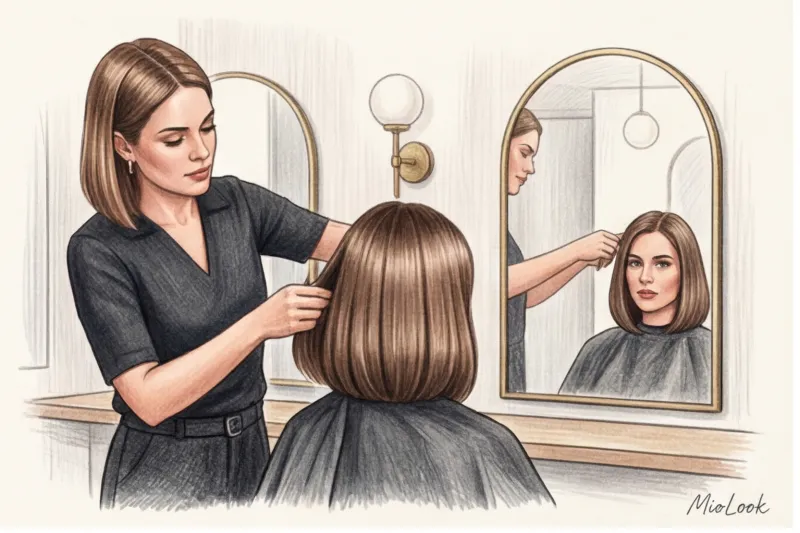
The British school of hairdressing (in particular, the Vidal Sassoon methodology) has long ago deduced 80/20 rule It states: exactly 80% of the success of your daily hair styling depends on the correct cut architecture. And only 20% depends on the styling product or brush you use in the morning in front of the mirror. If the shape is correctly constructed, taking into account the bone structure of the skull and the direction of hair growth, the strands will naturally fall into the desired pattern.
The first step to saving time is to stop fighting nature. Let's look at the physics of the process. Straight, low-porosity hair (the so-called "glass" type) has tightly adherent cuticle scales. They are physically unable to hold a curl for long, as their structure strives to return to its original smooth state. On the other hand, porous, curly hair acts like a sponge. Its cuticle is slightly open, so at the slightest increase in humidity outside, it instantly absorbs water from the air and begins to frizz.
Trying to straighten porous curls with a flat iron in rainy weather is like defying the laws of physics. You'll spend 40 minutes, and the results will disappear on the way to the office. How can you determine your true texture? Try a simple test: wash your hair with a basic, silicone-free shampoo, skip the conditioner, and let your strands air dry. What you see in the mirror a couple of hours later—a subtle wave, absolute smoothness, or a fluffy "cloud"—is your starting point.
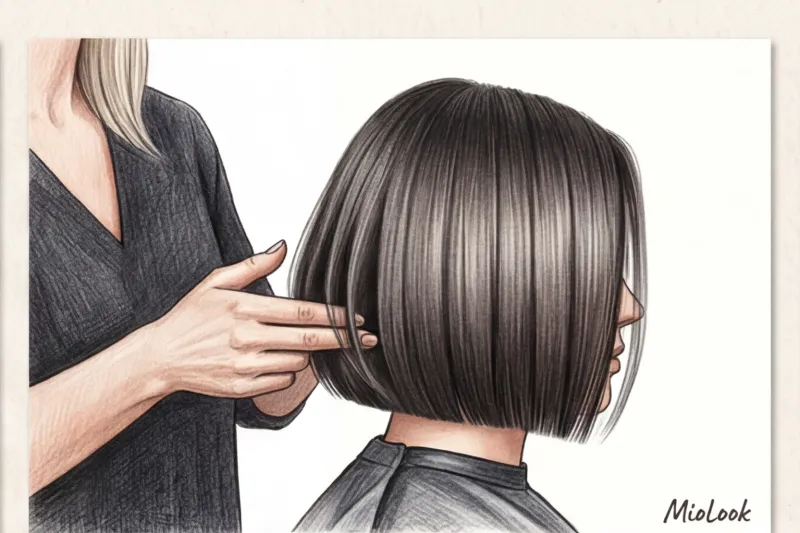
Recently, a client came to me who spent half an hour every morning trying to curl her heavy, straight Asian-style hair with a curling iron. By lunchtime, her curls would inevitably droop. Once we switched gears and focused on a perfectly even, graphic cut (blunt bob), her morning routine was reduced to just five minutes of blow-drying with heat protection.
Here we encounter another pitfall: thoughtless thinning. In an attempt to "lighten" the thick mass, stylists often resort to thinning scissors. The result, for everyday wear, is often disastrous: the lower third of the length becomes thinner, and the ends look untidy and stick out in all directions. Thinning is primarily justified on very short haircuts.
For medium and maxi-length haircuts, skilled stylists use the technique "hidden layers" (invisible layers) In this case, weight is delicately removed from the inside of the strand using a slicing technique, while maintaining a tight outer edge. This technique allows the hair to curl naturally inward when blow-dried with a regular hair dryer.
Access to MioLook for €0.99 — one-time payment
A smart AI stylist will select the perfect look based on your portrait zone and styling.
Get access — €0.99 onceTo be fair, this approach requires an initial investment. A high-quality structured haircut at a reputable European salon rarely costs less than €80–€150, as it requires pinpoint precision and an understanding of geometry. But this investment pays for itself many times over when you stop fighting your own reflection every morning.
Daily hair styling for short hair (Pixie, Bob, Garson)
The most common misconception I hear from women during personal consultations is: "I'll cut my hair into a bob or pixie so I don't have to brush my hair in the morning and can sleep half an hour longer." This is a dangerous, albeit very tempting, illusion.
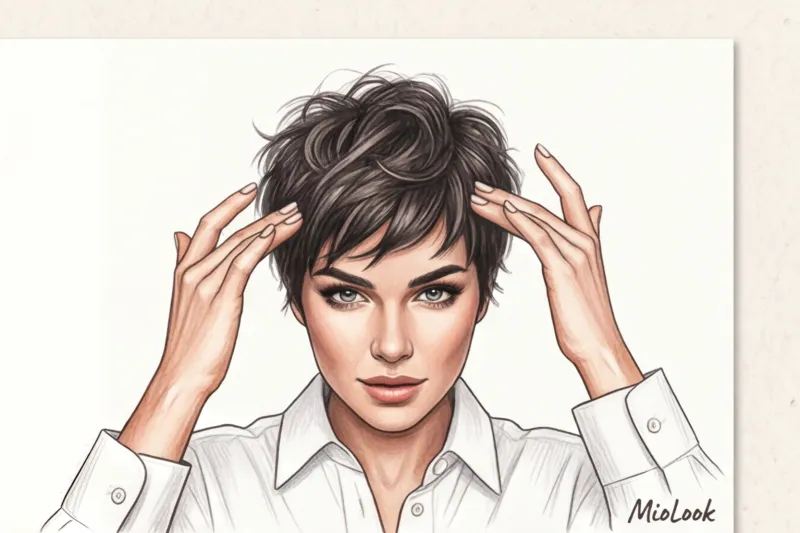
In reality, a short haircut—whether it's a sassy pixie, a classic French garcon, or a textured bob—demands your attention every morning. I'll debunk this myth right now: due to the lack of length and, consequently, weight, short strands can't naturally fall down under their own weight. Overnight, they memorize the shape of your pillow, creating frizz at the back of your head or temples that can't be easily brushed away. Furthermore, each strand in a quality short haircut is carefully sculpted by a stylist to highlight cheekbones, open up the neck, or contour the face. Without styling, this architectural design simply falls apart.
Proper daily styling of short hair is not optional, but a must. But the good news is that with the right technique, it really does take just three to five minutes, rather than wasting precious morning time.
3-Minute Texturizing: The Salt Spray Rule
If you simply blow-dry your short hair without using any styling products, you risk creating a "dandelion-like" effect. The whole point of short hair is texture and movement. Your minimalist morning arsenal should consist of the right finishing products: pastes, matte clays, and salt sprays.
A good texturizing clay (a high-quality professional product costs between €20 and €35 per jar) takes months to use up, but it completely transforms the visual appeal of a hairstyle. Salt spray, meanwhile, works as an ideal primer—it makes overly soft, frizzy hair stiffer, more manageable, and more manageable.
The styling process itself is based on the hand-styling technique. Rule number one: forget about the round brush in the first step. Direct the airflow from the hairdryer strictly along the hairline, combing the strands with your fingers in a zigzag motion. This simple technique eliminates frizz at the roots and creates a natural flow.
Once the base is 90% dry, move on to the texture. Rub a pea-sized amount of matte paste between your palms—this is crucial! Rub vigorously until the product warms up and becomes completely transparent in your hands. Only then, work through the ends of the hair using patting motions. Highlighting individual strands near the face, accentuating the temples, and light, controlled chaos at the crown creates that "luxury, careless" look for which French women are so famous.
Slicked-back hairstyle: status with minimal effort
What if you need a sleek, put-together look today? The sleek look—a perfectly sleek hairstyle—comes to the rescue. It's a powerful styling tool, but the line between luxurious gloss and the "I haven't washed my hair in three days" effect is extremely fine.
The secret to a classy comb-over lies in the product's formula. No thick end oils or cheap, mass-market gels! To keep your hair looking polished and luxurious, use water-based pomades or special smoothing creams. They securely hold the shape, impart a delicate, satin shine, without gluing strands together into a stiff, stiff "helmet."
Apply the product to slightly damp hair, distributing it with a fine-toothed comb. If you have a round or square face, be sure to leave some volume at the roots above the forehead before combing the mass of hair back. A deep side part will add asymmetry, visually elongating the oval of the face and making the features more expressive.
A sleek comb-over is the perfect platform for playing with stylistic contrasts. According to the laws of imageology, this strict, graphic head shape works flawlessly in two directions. Firstly, it reinforces the business dress code when worn with an architectural oversized jacket. Secondly, it instantly elevates relaxed casual chic: a simple basic white T-shirt, straight jeans, loafers, and statement earrings with a sleek hairstyle look like something straight out of a Vogue cover. If you're unsure whether this hairstyle will suit your outfit today, upload your look to MioLook — a smart algorithm will help you assess whether the hard lines of your comb-over harmonize with the geometry of your collar and the overall silhouette of your clothing.
Stylish solutions for medium-length hair (Bob, Shaggy, Cascade)
According to WGSN's 2023 trend analysis, over 60% of women in Europe prefer medium-length hair—from the classic long lob to a textured shag. It's truly the most versatile cut. You can pull it back into a ponytail, curl it, or leave it down. However, as a colorist and stylist, I must warn you: medium length is also the most fickle. Why? It's all about anatomy. As soon as the cut reaches the collarbone or shoulder line, the ends begin to rub against clothing and the anatomical curves of the neck, bending in completely unpredictable directions. Daily hair styling in this case often turns into a morning struggle with physics.
The secret to maintaining a mid-length hairstyle lies in consciously taming the ends. The choice between curling them inward or outward isn't just a matter of taste, but a powerful tool for correcting proportions. I'll give you an example from my own work with facial architecture. When we curl the ends of a bob strictly inward (toward the neck), we visually round the lower jaw. This works great for softening a square or rectangular face. But if you have a naturally round face with soft cheeks, this style will create a "ball" effect. Conversely, ends turned outward (like a '60s-style flip style) create horizontal movement. This technique stunningly widens a narrow chin in women with an inverted triangle face shape, but is strictly contraindicated for those with a massive, heavy jawline, as it will inevitably draw all the attention to it.
'Smart' Casualness: How to Create Volume Without a Curling Iron
Most women make the same mistake: they only reach for their dry shampoo on the third day, when their roots are already looking decidedly dull. In professional settings, we use this product differently. Applying dry shampoo to completely clean, freshly dried hair is a brilliant preventative method for creating volume. The powder's microparticles immediately envelop the hair shaft, preventing sebum from weighing it down, and create an invisible yet rigid framework at the roots. As a result, your hairstyle doesn’t fall out by lunchtime, but stays in place until late evening.
The second trick, which works perfectly on haircuts like shaggy and layered styles, requires only a texturizing spray (excellent options can be found in the €15 to €35 range) and a dynamic parting. Apply the spray to the lengths, fluff the strands with your fingers, and blow-dry your hair, parting it deep to the side. After a couple of hours, when the volume starts to fade, simply flip your hair to the opposite side. The hair follicles, having "remembered" the previous direction, will lift, giving you an instant push-up effect without using a single hot tool.
Access to MioLook for €0.99 — one-time payment
Start creating perfect looks with the help of artificial intelligence and assemble your stylish capsule wardrobe.
Get access — €0.99 onceLow sleek ponytail: an alternative to a boring bun
If your hair is barely long enough to be pulled back at the nape of your neck, forget about messy buns. On medium-length hair, they often look like a short, mousy ponytail and visually cheapen the look. A much more elegant and classy alternative is a sleek low ponytail. The magic of this hairstyle lies in the design of the parting. A deep side part adds a graphic, subtle drama (perfect for evening outings or formal office attire), while a crisp, center parting accentuates facial symmetry and fits seamlessly into a minimalist, casual look.
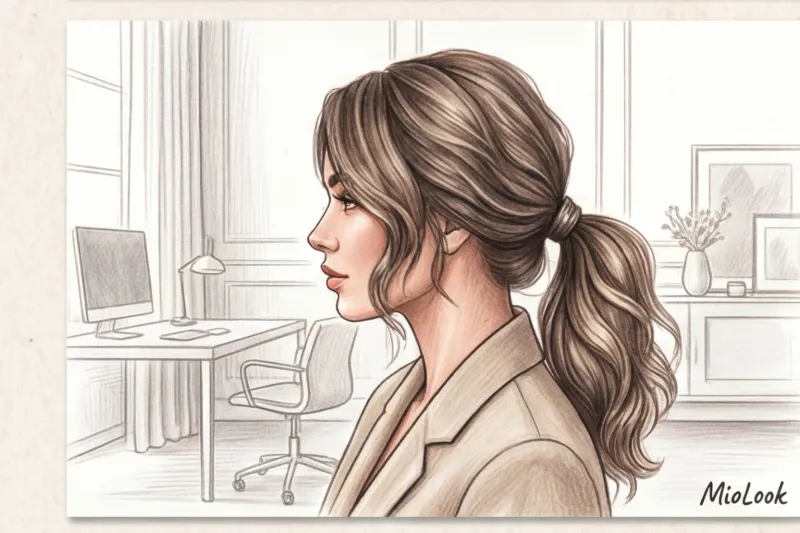
The cardinal rule of any expensive hairstyle: technical details must be hidden. A hair tie, no matter how thin, instantly ruins the aesthetic. Here's a step-by-step guide on how to hide it in just one minute:
- Gather your hair into a tight low ponytail, securing it with a thin elastic band that matches the color of your roots.
- Separate a thin strand (about 0.5 cm thick) from the bottom of the tail.
- Wrap this strand around the base of the ponytail 2-3 times like a ribbon, tightly overlapping the elastic.
- Secure the end of the strand with a small invisible pin, inserting it under the base of the ponytail parallel to the direction of hair growth, or simply “glue” the end with a drop of strong hold hairspray.
This simple touch takes your look from the "I threw my hair up on the run because I overslept" category to one of conscious, thoughtful minimalism.
Quick Daily Hair Styling for Long Curls
Growing your hair long is only half the battle. The real stylistic quest begins when you try to make your luxurious mane hold its shape for more than a couple of hours. The main problem with long hair is the inexorable force of physics: volume loss at the roots under its own colossal weight. No matter how much texturizing powder you apply, gravity takes its toll, leaving the crown flat and the silhouette disproportionate.
That's why daily hair styling Below the shoulder blades, hair requires a strategic approach, not just gallons of extra-strong hold hairspray. Moreover, attempts to "tame" heavy strands with tight elastic bands are downright dangerous. I regularly speak with fellow trichologists, and their verdict is unanimous: constantly wearing tight high ponytails and buns (the very same one beloved by many) sleek ponytail ) leads to traction alopecia—irreversible thinning and hair loss along the hairline. We need safe, fast, and stylish alternatives that don't damage the follicles.
The Crab is Back: A Modern Interpretation of the 90s Trend
The hair clip has long ceased to be a staple of the pre-wash routine. Today, it's a legitimate accessory for street style and even business meetings, if you choose the right texture. Forget flimsy, glossy plastic in neon shades. A good basic hair clip will cost between €15 and €35, making it a smart investment in your everyday look.
The rule for a harmonious silhouette: match the texture of your hair clip to your outfit. Matte geometric claw clips (architectural shapes) are the perfect complement to minimalism in the spirit of COS; a classic tortoiseshell pattern will elevate smart casual looks, and metal hair clips will accent evening outings or tailored pantsuits. Keep in mind the temperature of the metal—it should match your basic jewelry.
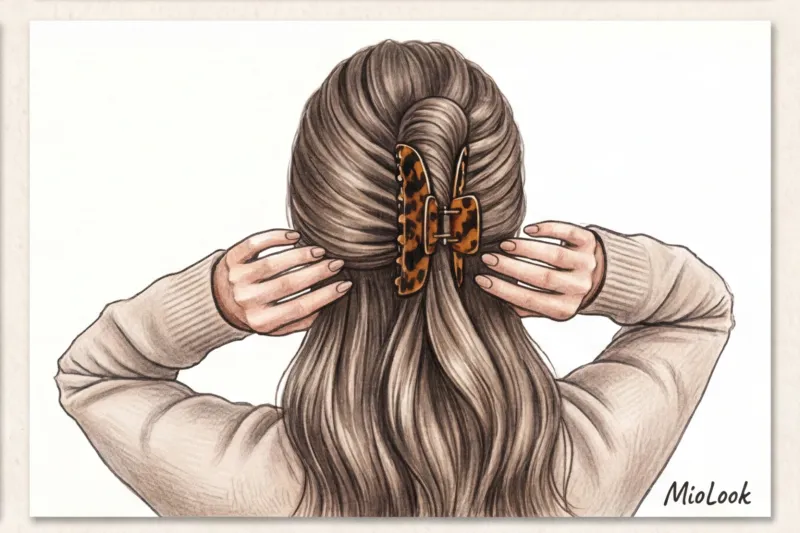
My favorite technique for long locks is the French twist with a hair clip, which takes exactly one minute. Gather your hair into a low ponytail at the nape of your neck (without securing it with an elastic), twist the twist clockwise, lift it up along the nape of your neck, and tuck the remaining loose ends into the resulting bun. Secure the entire structure with a large hair clip. Leave a few strands loose near your face—this will soften your cheekbones.
Lazy Waves: Nighttime Preparation and Morning Triumph
If you're not ready to part with your loose hair but don't have time to curl it in the morning, cold curling can be a great option. The viral trend for silk rollers is entirely justified, but many complain about unpredictable results and kinks at the roots.
The secret lies in two details: the material and humidity. Use only 100% silk curling tape (ideally 22-momme), which prevents friction and split ends. Your hair should be 90% dry when curling—if it's too damp, the thick lengths simply won't dry overnight, and the curls will fall apart within half an hour.
- Kink-free technique: Place the headband not on the crown, but closer to the back of your head. Curl the strands away from your face, without pulling them too tight at the roots. Leave 2-3 centimeters straight at the ends—this will give you modern texture, not those 18th-century doll curls.
- Morning refreshment: Remove the headband and avoid brushing your hair with a brush. Comb your hair with your fingers. Rub a few drops of light oil (such as argan) into your palms and apply only to the ends to reduce frizz.
By the way, to understand which type of waves - structured or casual - fits best into your clothing capsule, try uploading your everyday looks to MioLook The app will help you visualize how the geometry of your hairstyle interacts with the necklines of jackets and the silhouettes of dresses.
Tools and Styling: A Minimalist Hair Bag
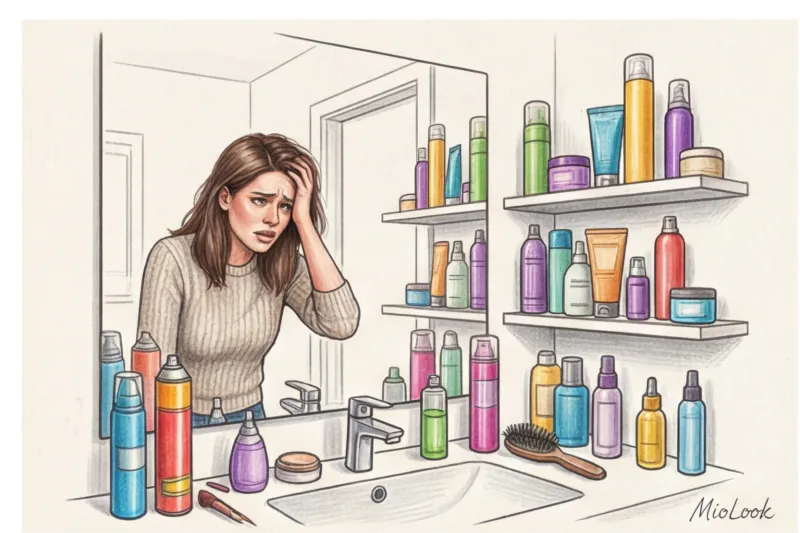
Take a look in your bathroom: I bet there are at least five half-empty bottles of styling products gathering dust on the shelf, bought in a fit of inspiration. There's an unspoken rule in the beauty industry that cosmetics manufacturers rarely talk about: to create 95% of everyday hairstyles at home, you only need three right products and two tools. Everything else is visual noise that only complicates your morning routine.
Basic set: hair dryer, heat protectant and texturizer
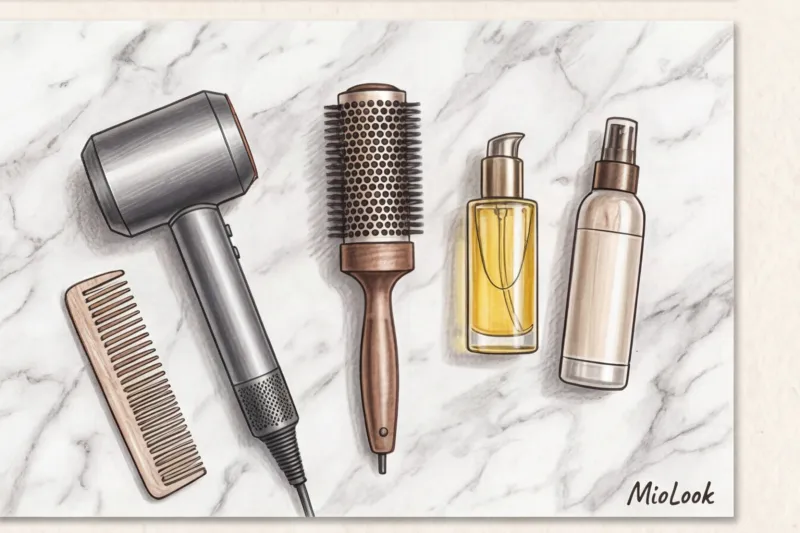
Let's assemble a functional capsule. First and foremost, a hair dryer with a power of at least 2000 watts. The key feature here isn't the number of temperature settings, but the presence of a narrow, slotted nozzle (concentrator attachment). This nozzle directs the airflow precisely along the cuticle, sealing the scales and polishing the hair to a glossy shine.
As for the products, it is literate daily hair styling This style requires only two ingredients. The base is a weightless heat protectant. Look for hydrolyzed keratin or silk proteins: when heated, they act as a building block, filling the voids within the hair shaft. The finish is a dry texturizer. Unlike traditional sprays, a high-quality texturizer based on zeolite or volcanic ash creates flexible volume at the roots. Its magic is that you can re-shape the hair with your hands throughout the day, simply by massaging your scalp.
Investing in Quality: Why Proper Brushing Matters
Now about the most pressing issue—brushes. I often see girls buy expensive hair care products but dry their hair with a cheap metal-barrel brush. This is a disastrous mistake. Metal heats unevenly and can burn the ends faster than a bad hair dye.
Invest in a professional brush (in the €30–€50 range) with a ceramic or tourmaline coating and combined bristles. Ceramic distributes heat smoothly, turning the brush into a gentle straightening iron. For medium-length and layered haircuts, a 43–55 mm diameter is optimal—it provides that prized salon curl without harsh kinks.
What to throw in the trash immediately
To make this minimalist system work, you'll have to conduct a ruthless audit. What should definitely be eliminated from your inventory?
- Strong hold sticky hairsprays. "Cement" sprays glue strands together, creating the effect of a rigid helmet. This instantly adds age and makes the look artificial. Modern aesthetics are built on dynamism: hair should move as you walk.
- Cheap volume mousses. If the first positions in the lineup are Alcohol Denat , such a product will mercilessly dry out the cuticle, making the hair brittle. Replace them with modern thickening lotions or blow-dry creams—they are much gentler.
We often buy harsh styling products out of fear that the style will fall apart within an hour. In fact, if the shape is set with the correct tension on the brush and secured with the cool shot button on the hair dryer (yes, that's what it's for!), you don't need any harsh hairspray at all. Minimizing the amount of layering products not only saves time in the morning but also results in healthy, shiny hair in the long run.
Your ideal image
it begins Here:
Join thousands of users who look flawless every day with MioLook.
Get access — €0.99 onceBusting the myths: why the messy bun doesn't suit everyone
Open Pinterest, search for "messy bun," and you'll see thousands of photos of Hailey Bieber or Gigi Hadid. It seems like the perfect everyday hairstyle: gather your locks on the run, secure them with an elastic, and you look like a street style icon. But let's be honest. 90% of the time, trying to replicate this relaxed chic look in front of the hallway mirror ends up looking less stylish and more like we slept through our alarm and didn't have time to brush our hair.
This illusion effortless style Effortless style is one of the most insidious myths in the beauty industry. On models, this "random chaos" is created by a team of professionals using invisible pins and expensive texturizing sprays like Oribe Dry Texturizing Spray (which, by the way, costs around €50 a bottle). But it's not just about styling. The main reason lies in your natural features.
As a colorist and image styling specialist, I explain the failure of messy buns through the lens of facial contrast. The success of relaxed shapes is tightly tied to your facial architecture. If you have high contrast—fair skin, bold dark brows, and prominent cheekbones (what David Kibbee calls a "Dramatic" type)—tousled locks create a stylish paradox. Sharp facial features easily elevate the messiness of your hair, transforming it into a deliberately bold look.
However, most Northern European women have a complexion built on soft nuances: light-brown hair, light eyes, and a soft jawline. In this case, soft facial features paired with a soft, shapeless hairstyle create a look of unkemptness. A "messy bun" instantly erases the shine and makes the look appear tired.
"Relaxation in appearance is always a luxury that should be strictly measured. If your hair looks like you just woke up, your clothes should look like they've just been dry-cleaned"—I make every client learn this rule in my basic style course.
Does this mean those with soft hair coloring will have to give up their comfortable updos forever? Not at all. The secret lies in adaptation: any visual sloppiness should be offset by a strong geometric shape.
- Strict collar: Swap out a soft knit sweatshirt for a heavy cotton shirt (poplin) or a jacket with defined shoulders. A crisp collar will instantly set the desired architecture for the portrait area.
- Frames with sharp angles: Optical or graphic-framed sunglasses (think classic Tom Ford or Celine styles) act as a rigid frame for a relaxed hairstyle.
- A bright accent in makeup: A graphic red lipstick or clearly defined eyeliner sends a clear message to others: “Yes, my hair is disheveled, but that’s by design, not due to morning laziness.”
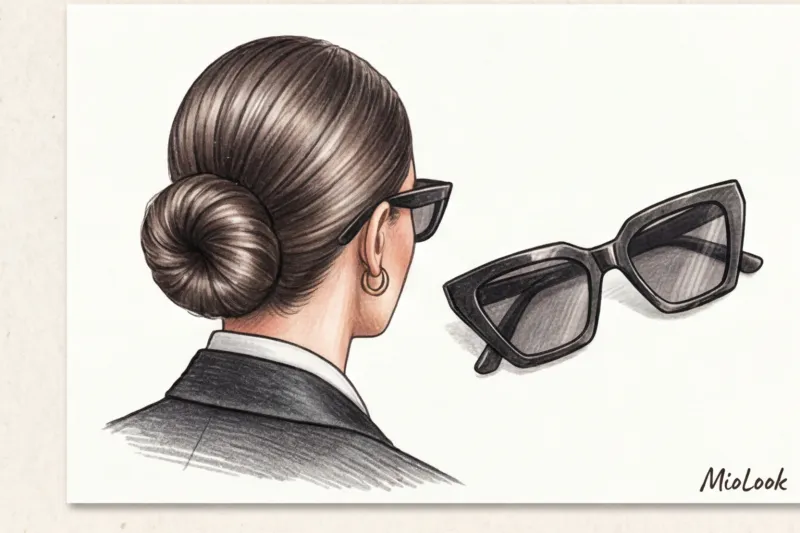
Remember this simple equation: the more relaxed and chaotic your daily hair styling, the more put-together your makeup and clothing should be. Only with this balance will the myth of casual chic become your stylish reality.
Checklist: How to choose the perfect hairstyle to match your look and dress code
According to an internal study by the styling department of the Istituto Marangoni (2023), a disharmonious texture between fabric and hairstyle is the main reason why even expensive designer pieces can look "unfinished" in real life. We often treat hair and clothing as two completely independent variables. However, in the philosophy of a smart wardrobe MioLook We always consider hairstyles as a full-fledged element of an outfit, equal in importance to a structured jacket or a pair of shoes. Proper daily hair styling should tie together the silhouette, not disrupt its proportions.
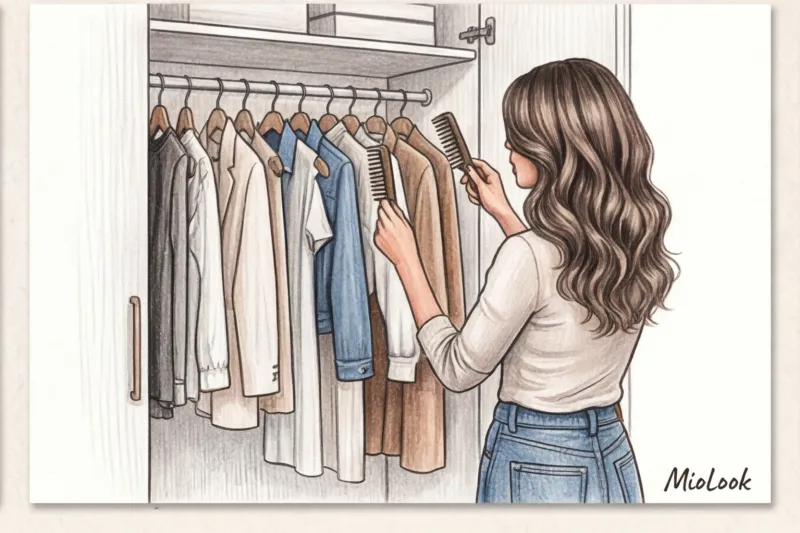
To stop guessing in front of the mirror in the morning, follow this four-step checklist I use when creating personal style books for my clients:
- Time Estimation: Be Brutally Honest. How many minutes do you really have between your morning coffee and heading out the door? If the stopwatch says 7 minutes, don't fool yourself into thinking you're planning a complex Hollywood brushing session. The ideal base for this kind of timing is a texturizing spray and a shape you can create with your hands, without the use of hot tools.
- Wardrobe Analysis: Clean Lines or Contrasting Textures? Take a look at your seasonal capsule wardrobe. If your work dress code consists of architectural jackets (for example, crisp, double-breasted models in thick wool in the €150-€300 range), you have two options. Either maintain this graphic look with a perfectly sleek hairstyle or create a deliberate contrast with slightly tousled waves. A soft, vibrant hair texture perfectly counteracts the overly conservative nature of a business suit, leaving your face looking fresh.
- Testing 3 basic forms on a weekend. Never try a new hairstyle on a Tuesday morning when you're running late for a meeting. Dedicate one weekend day to testing. Try three basic styles with your most popular clothes: hair down (natural texture), hair sleek (low ponytail/bun), and hair half-up. Take a full-length selfie. You'll immediately notice how strands pulled back at the nape of your neck can visually lengthen your neck and make you look slimmer.
- Synchronize your styling with your makeup and accessories. The "two-accent rule" works flawlessly here. If you're wearing chunky, sculptural earrings and graphic eyeliner, your hair should serve as a calm, neutral backdrop. A sleek comb-over is ideal. If your makeup is nude and your jewelry is minimalist (like delicate studs), feel free to add volume and complex, distinct texture to your hair.
Conclusion: From morning routine to stylish ritual
Style ends where morning neurosis begins. If every morning you find yourself in an uphill battle with a brush, a straightener, and five types of fixatives, it's time to admit: this strategy isn't working. In modern imageology, we increasingly rely on the concept Hair Neutrality — respect for one's natural gifts. A fundamental rule I ultimately impart to each client after lengthy consultations: Accepting your hair is the key to fast styling.
Stop forcing glassy strands to hold airy curls without a rigid frame, and naturally porous curls to pretend to be mirrored. When you stop aggressively breaking your genetically determined texture and start working with it in tandem, morning magic happens naturally. You'll suddenly discover that a soft curl isn't a sign of "untidiness," but rather your personal charm.
Remember the main idea: Daily hair styling shouldn't be a challenge. In an ideal scenario, it takes exactly the same amount of time as making your morning coffee. Beauty that requires hours of daily sacrifice looks unnatural these days. True elegance lies in ease, and this ease is only possible when you have a clear, predictable daily routine.
Let's sum it up brief summary Your ideal routine, which will free up at least half an hour every morning, rests on three pillars:
- Geometry. A smart haircut with proper weight distribution and a tight cut does 80% of the work for you. If the shape is properly shaped, the hair naturally tends to flow in the desired direction.
- Minimum funds. You don't need fifteen jars just taking up shelf space. Put together a simple base: high-quality heat protection (basic, working versions cost €15–€25, premium ones up to €50) and one finishing product tailored to your texture—a salt spray, a lightweight paste, or a volumizing powder.
- A couple of practiced movements. Don't try to impersonate a salon professional every day. Learn exactly two techniques that suit your hair length. For example, drying the roots in the opposite direction from the parting for volume, plus texturing the ends with your hands. Practice these movements until they become automatic.
My final piece of advice: start treating your hair as a full-fledged element of your personal capsule. You wouldn't wear a formal tuxedo to go out for coffee, would you? Likewise, your hairstyle should sync with your wardrobe. Try consciously recording your looks over the next week. Take a photo of your finished look and upload it to MioLook app , noting which hair shape worked best with a particular dress neckline or jacket collar. My clients who adopt this habit quickly notice patterns: for example, that a voluminous sweater calls for a pulled-back hairstyle, while a formal suit is softened by soft waves.
Tomorrow morning, give yourself exactly seven minutes. Put away your complicated tools. Grab your hairdryer, apply a pea-sized amount of your favorite styling product, and let your hair fall as it was designed by nature and the architecture of your haircut. Make this process not a forced chore, but a pleasant ritual for setting yourself up for the new day. After all, the most stylish hairstyle is the one you forget about the moment you leave the house because you feel completely confident in it.
Guide Chapters
What products are needed for hair styling: a basic set
Are your shelves overflowing with jars, and your hair is in a messy bun again? A stylist explains how to apply minimalism to your beauty routine and create the perfect styling capsule.
How to make a sleek bun at home without combing
Dreaming of the perfect Hailey Bieber-style hairstyle, but your hair is sticking out? A stylist reveals the secrets to creating a trendy sleek bun.
Styling Curly Hair with a Diffuser: Everyday Tips
Tired of straightening your frizzy hair with a flat iron every morning? Learn how proper care and curl management will help you sleep longer and look more luxurious.
Blow-Drying with a Brush: A Beginner's Guide
A messy hairstyle can ruin even the perfect outfit. Learn how to use a blow dryer to create a luxurious style and save time in the morning.
Top Ideas: Quick and Stylish Hairstyles for Dirty Hair
Overslept and don't have time to wash your hair? We'll show you how to transform dull roots into a stylish, expensive-looking style in just a few minutes.
Cold Styling: How to Curl Your Hair Without a Curling Iron
You can create luxurious curls without extreme heat or damaging your hair. We reveal the secrets to long-lasting, cool-looking hair that will last all night.
Quick styling for long hair in 5 minutes in the morning
Spending 40 minutes on your hair every morning? Discover stylist secrets that will help you style long hair stress-free in just 5 minutes.
Secrets: How to make your hairstyle last longer
Forget about rigid hairstyles. Learn the secrets of proper hair preparation and styling for vibrant yet incredibly long-lasting styles.
Styling for fine hair lacking volume all day long
Tired of your hair losing its shape by lunchtime? We reveal professional secrets for creating long-lasting volume on fine hair without weighing it down.
Quick styling for short hair for every day
A short haircut should save time, not waste it. We'll show you how to spend minimal effort and look stylish every morning.
Curls with a flat iron for medium-length hair: styling in 10 minutes
Your hair is the pinnacle of your silhouette. Learn how to create the perfect basic straightening iron style in just 10 minutes.
How to create root volume: products and life hacks
Flat hair can ruin any stylish look. We'll show you how to create long-lasting root volume and visually balance your figure's proportions.
How to style curtain bangs: secrets for quick styling
Are your curtain bangs losing their shape after just one wash? Learn the professional drying and styling secrets to create perfect volume at home.
5 ways to style a beautiful bob in 5 minutes
Women with short haircuts often spend more time styling their hair than those with long hair. We'll share a systematic approach and 5 quick ways to style a perfect bob.