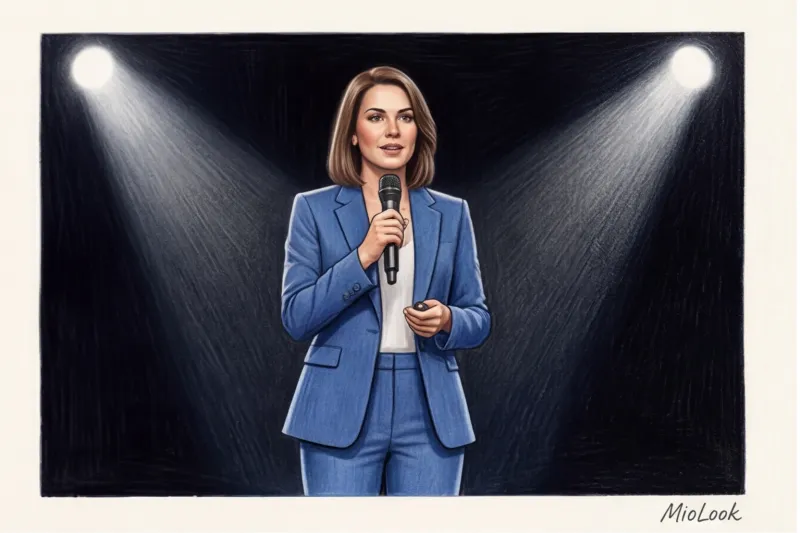
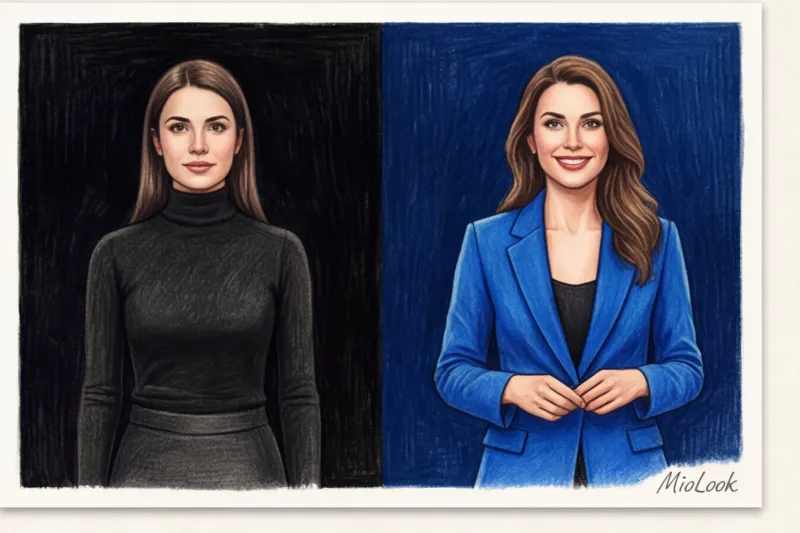
You know what the most common comment I hear from broadcast directors at major conferences is, "Another floating head on legs." The audience sees a flat, dark silhouette blending into the black backdrop of the stage, and the speaker's face desperately trying to hold the audience's attention. Spoiler alert: in the age of clip-based thinking, the face almost always loses out to the glowing screens of smartphones.
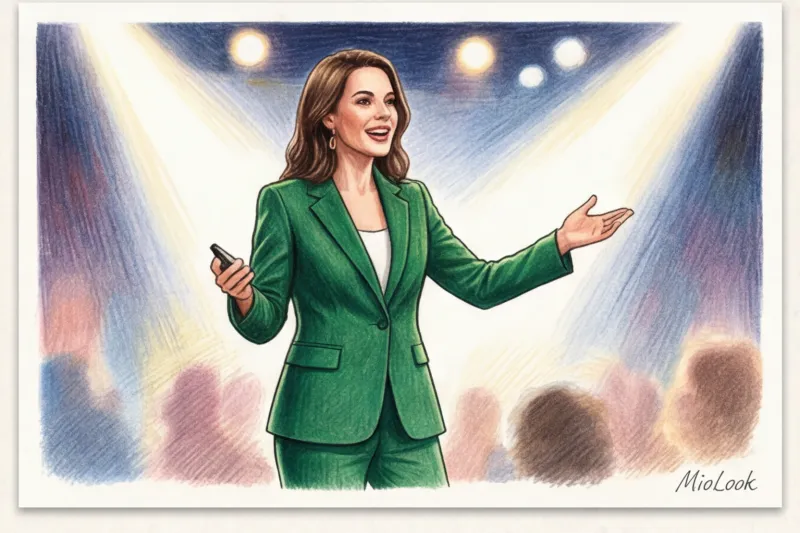
Over 12 years of working as a stylist and fashion journalist, preparing speakers for TEDx and international forums, I've learned one ironclad rule. The right choice color of clothing for public speaking — it's not just a matter of your personal comfort or aesthetics. It's a powerful kinetic tool, pure optical physics, and the architecture of attention. We discussed the basic principles in more detail in our The complete guide to the psychology of color in clothing and impression management , but the stage dictates its own, much stricter laws.
Clothing Color for Public Speaking: Why Basic Psychology Is No Longer Enough
We're used to thinking in clichés: "blue for trust, red for power." But when you take the stage, basic psychology takes a back seat to physiology. According to fundamental research by the Institute for Color Research, the human brain forms a subconscious judgment about a person in the first 90 seconds, and 62% to 90% of this assessment is based solely on color.
The problem with modern performances is total visual fatigue. Audiences lose focus every 10-15 minutes. As molecular biologist John Medina notes in his book, "Brain Rules," without emotional or visual "anchors," listeners' attention plummets. At this point, your costume becomes more than just clothing; it's a tool for maintaining eye contact. Color acts as a beacon, triggering the audience's hypothalamus to respond to contrast and return their gaze to the stage.
The Steve Jobs Illusion: Why Total Black Is Your Main Enemy on Stage
What about Steve Jobs? Didn't his black turtleneck become the standard for presentations? This is the most dangerous misconception of beginning speakers. What worked for the Apple genius will, with a 99% probability, ruin your presentation.
Wearing black on stage doesn't make you a minimalist. It makes you invisible.
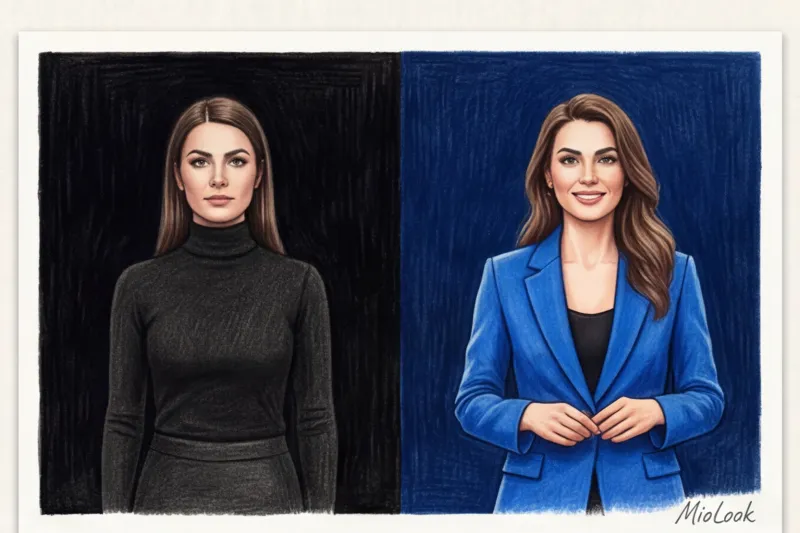
From a light physics perspective, matte black fabric (especially cotton or wool) acts like a black hole—it absorbs the spotlight. As a result, your silhouette becomes flat. Audiences lose track of your body movements, breathing, and shoulder gestures. A "floating head" effect occurs—you lose body language, which is crucial for building trust.
I had a telling case. A client, the CEO of a major fintech startup, insisted on a formal black pantsuit for her presentation at a specialized forum. During the dress rehearsal, we witnessed a disaster: she literally blended into the dark velvet backdrop of the stage. An hour before the presentation, we quickly swapped her jacket for a rich sapphire one from my backup capsule. Later, in reviews of the presentation, audience members noted her "incredible energy"—even though the text and delivery remained unchanged, only the appearance of her gestures changed.
Access to MioLook for €0.99 — one-time payment
A smart AI stylist will create the perfect look for your next performance, taking into account lighting and format.
Get access — €0.99 onceThe Architecture of Attention: How Color Controls Audience Focus
Stylists working with public figures create a visual path for the viewer's eye. We call this creating a "visual anchor." If your look is overloaded (complex prints, five different shades), the viewer's eye gets tired and turns to their phone. If the look is too monotonous, the eye gets bored and also turns to their phone.
The rule of contrast with the background
In theatrical lighting, there's a golden rule of 3:1 contrast. Your outfit should be at least three times brighter or more vibrant than the background (presentation screen or stage backdrop) to ensure clear visual perception. Before any performance, I always request a technical rider from the organizers:
- What color is the stage backdrop?
- What is the light temperature of the spotlights?
- What color are the chairs on stage (if it's a panel discussion)?
Color accents: portrait area
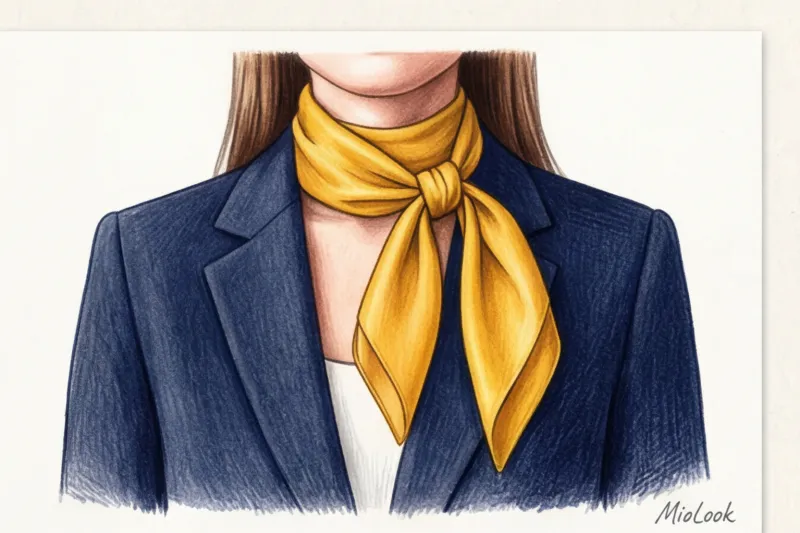
The lightest or brightest element of your outfit should always be near your face. This is a biological trick: the human eye automatically focuses on the point of greatest contrast. Use silk scarves, contrasting lapels, or accent jewelry. By the way, to avoid racking your brain over combinations, I recommend uploading your accessories to MioLook — the app will instantly show you which scarf will create the right contrast with your jacket.
Speaker Palette: 4 Colors Guaranteed to Work for Retention
Let's leave neon trends aside and turn to colors that have proven their effectiveness on TED-style stages and at international summits.
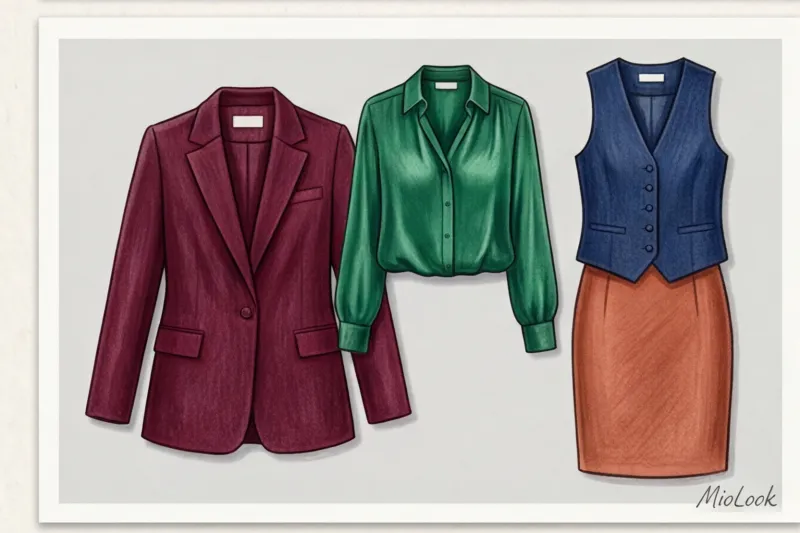
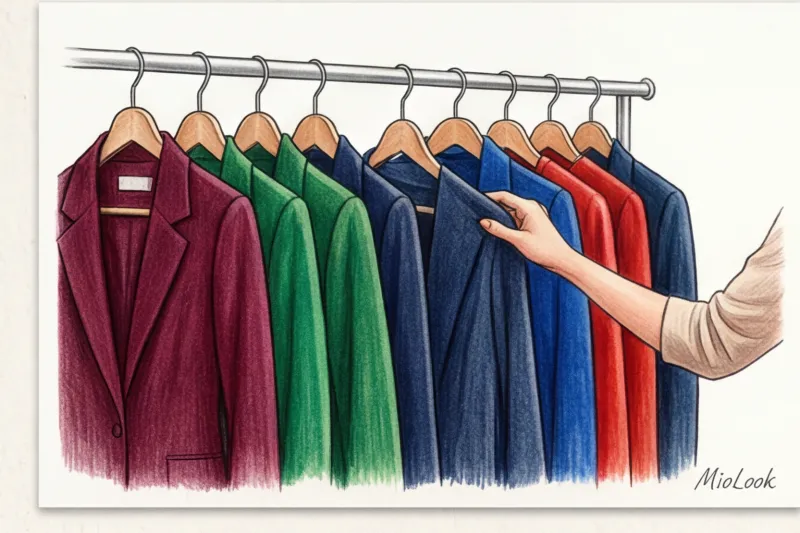
- Deep Blue (Navy/Sapphire): An absolute favorite. Unlike black, blue reflects enough light to maintain the silhouette's volume. It conveys authority without being arrogant. Ideal for pitching, analytics, and numbers.
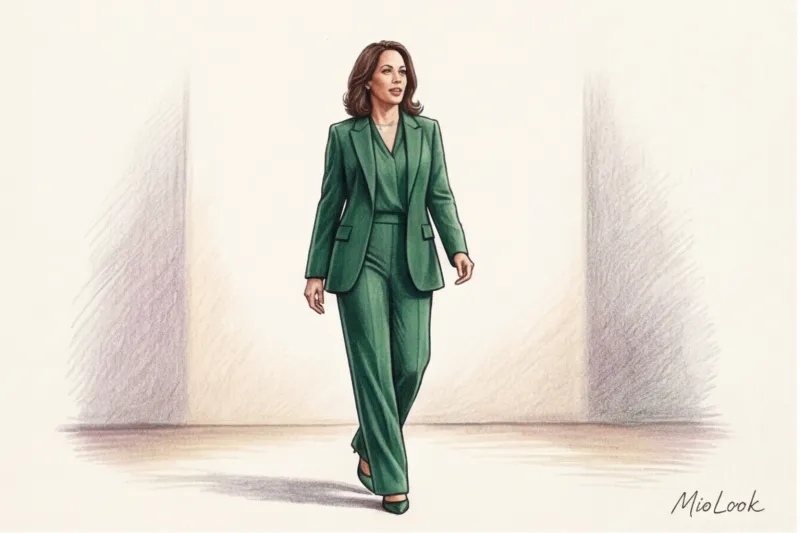
- Emerald: A lifesaver for long lectures. The green spectrum hits the center of the retina precisely, requiring no focusing effort. It's literally a rest for the audience's eyes.
- Wine/Burgundy: Forget the garish scarlet of the '80s—it evokes subconscious anxiety. Wine-colored shades offer energy and dynamism, yet look refined and expensive. A great choice for motivational speeches.
- Terracotta/Mustard: Warm, grounding shades. They break down the barrier between the stage and the audience. They're the perfect choice for interactive experiences, facilitation, and workshops.
Your perfect look starts here
Join thousands of users who look flawless every day on stage and in life with MioLook.
Get access — €0.99 onceTechnical checklist: how color behaves under spotlights and lenses
What looks amazing in your dressing room mirror can be a disaster on camera. Fashion Weeks broadcast cameramen taught me three things to always check.
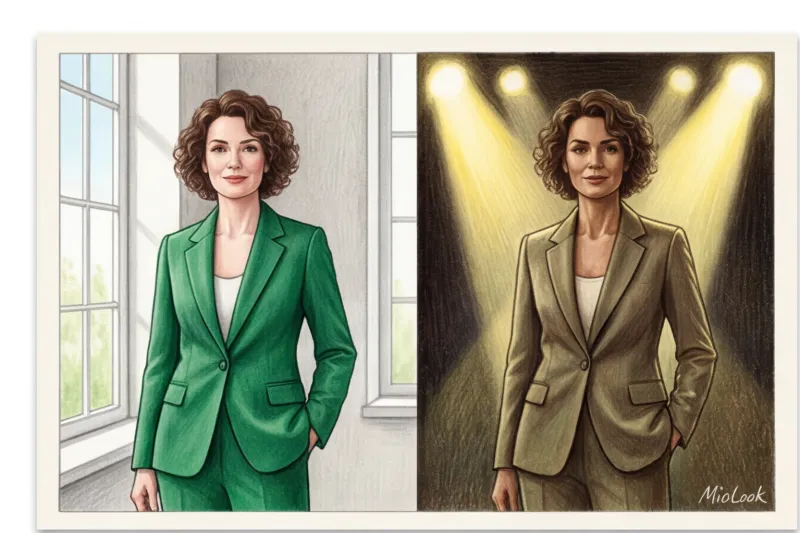
Temperature of light. Stage lighting comes in warm (around 3200 Kelvin) and cool (5600 Kelvin). If you wear a cool pastel blue suit and the stage lights are warm yellow, the laws of color will turn your gorgeous blue into a dirty gray. Always choose dense, saturated colors for the stage—they're less susceptible to distortion.
The danger of small patterns. Houndstooth, pinstripes, and small polka dots are absolutely taboo. On broadcast screens, they create a stroboscopic moiré effect (when the fabric begins to "ripple" and "jump"). This is physically painful for the viewer's eyes.
Shiny fabrics. Smooth silk and satin are highly reflective. Bright spotlights will create white highlights on them, which will appear as extra volume on camera. Choose matte fabrics with a light satin finish, such as heavy viscose or fine wool suiting.
Format Matters: Adapting Color to the Type of Performance
There's no single perfect color for every occasion. Context is everything. Let's look at three main scenarios.
Board of Directors or Pitch Session. High contrast and structure are essential here. A dark blue suit and a crisp white shirt (at least 180 g/m² cotton). The contrast conveys decisiveness and clarity of thought.
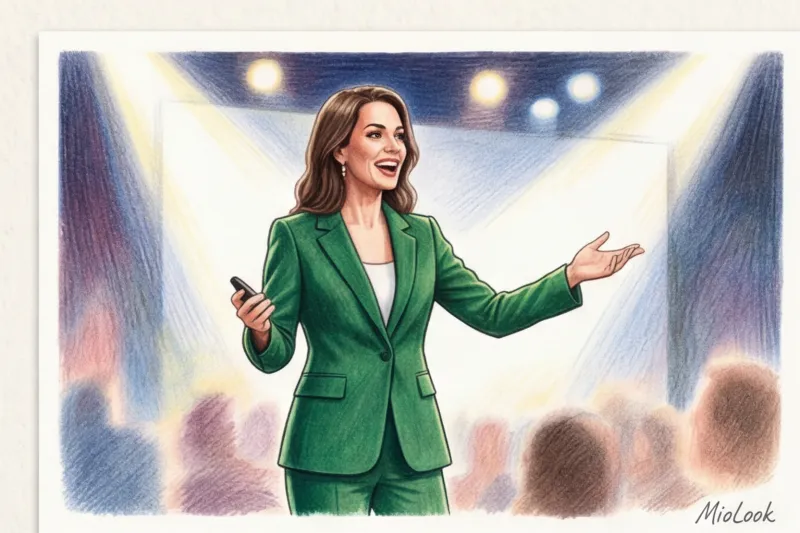
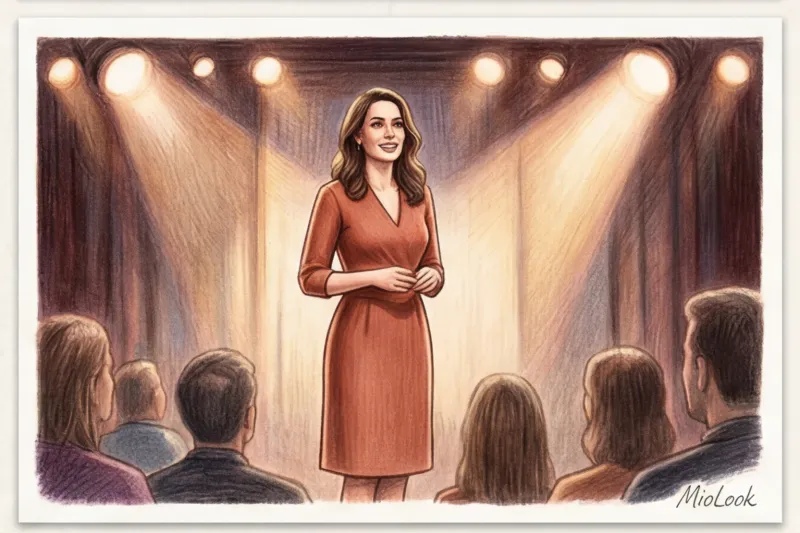
Motivational speech (TED format). Use a color blocking technique—one pure, saturated color (for example, a deep emerald or a monochrome wine). This creates a solid splash of color that's easily read from far away and looks great on YouTube videos.
Educational workshop. Reduce contrast. Soft, warm tones (a mustard sweater, terracotta pants) encourage conversation. But there is an important exception here: This advice doesn't work if the workshop is taking place in a cheap rented classroom with cold office fluorescent lamps. Under such lighting, mustard yellow will give your skin a sickly, yellowish tint. In this case, it's safer to switch to a neutral blue.

Ready to get started?
Try the MioLook free plan—no commitments required. Create your perfect performance capsule in just a few clicks.
Get access — €0.99 onceSummary: Your Personal Wardrobe Planning Plan
Preparing a speaker's visual image isn't about creativity; it's about protocol. To ensure your next presentation goes flawlessly, follow these four steps:
- Request a photo of the stage from the organizers. Make sure your costume doesn't clash with the backdrop or seats.
- Take a test drive under artificial light. Photograph the look with a flash to check the fabric for transparency and reflectivity.
- Create an "anchor" in the portrait area. Add a highlight near the face.
- Digitize your business capsule in MioLook to plan your looks for business trips and conferences in advance without unnecessary stress.
Remember the key: on stage, color is your invisible microphone. It begins speaking to the audience a second before you utter your first word. Make sure this first visual message is strong, confident, and holds their attention until the applause.