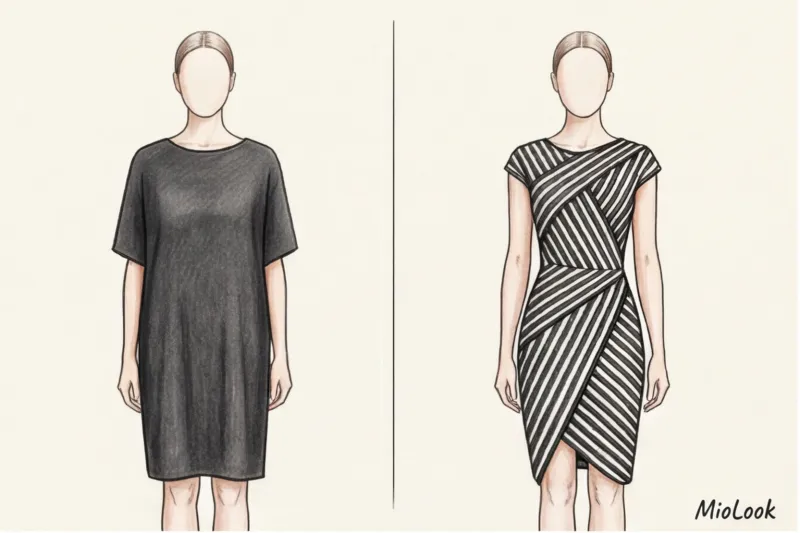
I remember that fitting before the Milan show vividly. The fashion house's head cutter, dissatisfied with the way the jacket fit the model, took a piece of contrasting diagonal striped fabric and simply pinned it above the model's hips. Instantly, her silhouette visually lost a couple of kilograms, and her hips began to appear incredibly narrow. This wasn't haute couture magic. It was pure physics.
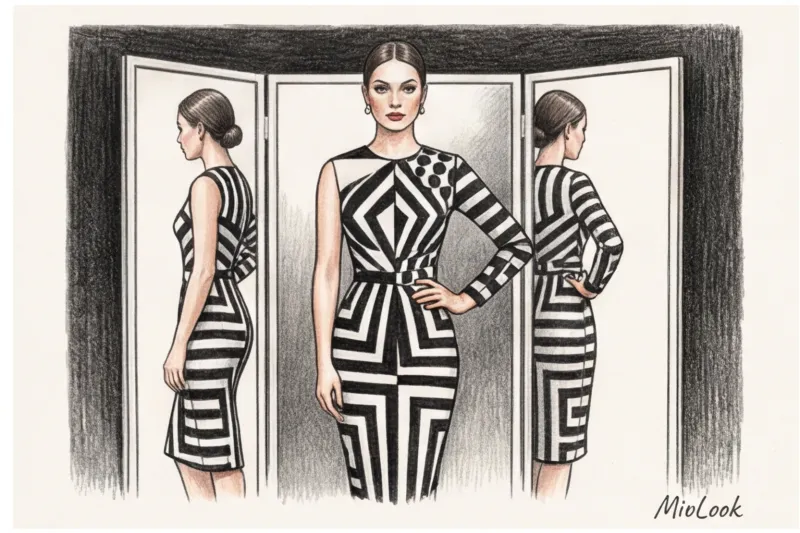
Clothes are canvases, and you and I are the architects of our own proportions. However, when it comes to What prints make you look slimmer? For decades, glossy magazines have been feeding us the same cliché: "vertical stripes make you look taller, horizontal stripes make you look fat." As a journalist and stylist with over a decade of experience, I can confidently say: this is one of the industry's biggest misconceptions.
We talked about the art of mixing and the basic rules of combination in more detail in our A complete guide to combining prints in clothing Today, we'll delve deeper. We'll explore how pattern scale, negative space, and even thread density trick our brains into seeing completely different volumes.
The Anatomy of an Optical Illusion: How Our Brains Read Patterns
Our eyes are incredibly lazy. They don't scan a figure entirely, but instead latch onto contrasting dots and lines, completing the rest of the picture. Research into visual perception has proven that high-contrast patterns (such as black and white geometric patterns) attract three times more visual attention than soft tonal transitions.
This is where the famous Helmholtz illusion comes into play, described by the German physicist Hermann von Helmholtz back in 1867. He drew two identical squares: one filled with vertical lines, the other with horizontal ones. The square with horizontal lines paradoxically appeared narrower and taller.
"The biggest fashion myth has been debunked by science: narrow, closely spaced horizontal stripes don't broaden the silhouette. They create a 'white noise' effect, causing peripheral vision to narrow the object."
This explains why a classic French Breton sailor shirt with its well-placed narrow stripes makes the torso appear more compact, while wide vertical stripes on trousers (especially if they deform at the hips) can make you look like a circus tent. The principles of optical art (Op Art), actively used in 1960s fashion, were based on precisely this: the distance between elements (negative space) is more important than the design itself.
Which prints are slimming: a guide to safe patterns
When my clients ask me which prints are sure to slim the figure, I always start with geometric patterns rather than florals. They act as a rigid framework for your silhouette.
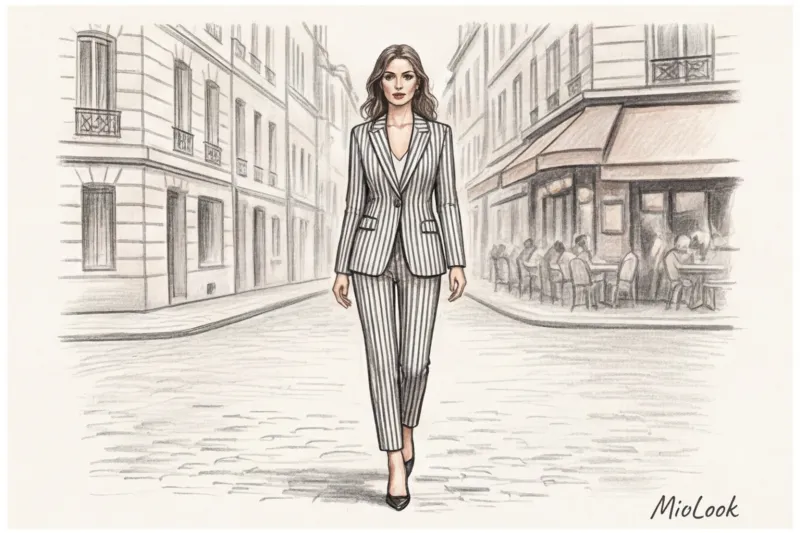
Thin chalk strip (pinstripe). This is the secret weapon of London's Savile Row bankers. Unlike a wide, contrasting stripe, a thin, barely noticeable thread on a dark background (blue, gray, or burgundy) creates a continuous vertical line. The eye glides along it from top to bottom without stopping, making legs seem endless and height seem more impressive.
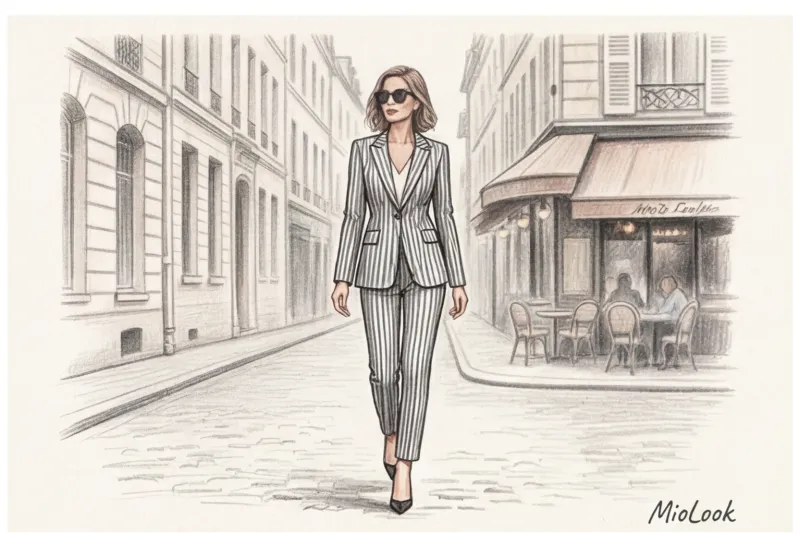
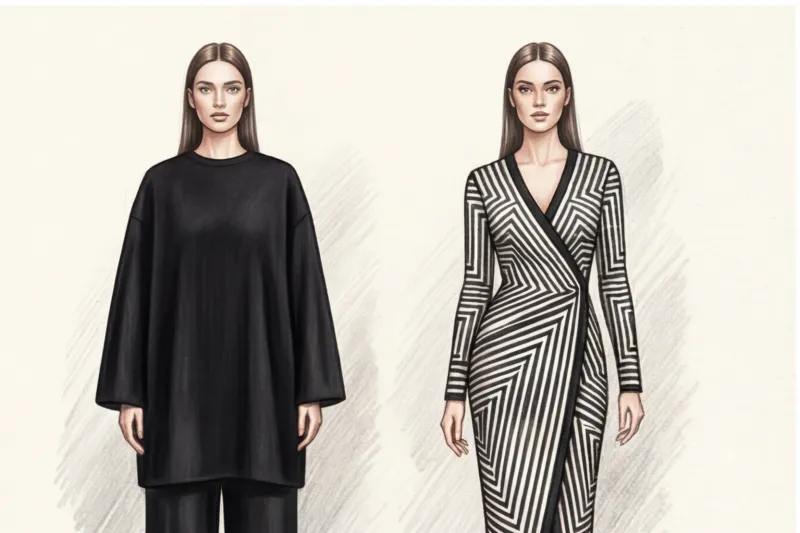
Diagonal and chevron (herringbone). Any line that runs at a 45-degree angle to the center of the body visually "cuts off" the sides. Try a dress with a chevron print that tapers toward the stomach. This creates a wrap effect—an artificial waist where none physically exists.
Small pattern (millefleurs). I had a client who was convinced that her size 50 figure could only be hidden behind tight black robes. I suggested a wrap dress with a millefleur print (a small scattering of wildflowers on a dark background). The effect was stunning. Because the eye can't focus on one specific detail, the silhouette feels like a single, compact monolith.
Your perfect look starts here
Join thousands of users who look flawless every day with the MioLook smart wardrobe.
Get access — €0.99 onceBeware of Volume: Patterns That Visually Add Pounds
Knowing what to wear is half the battle. Knowing what to avoid is a true mastery. There's a rule I call the "fist rule." Clench your hand. It's about 8-10 centimeters long. Any repeating pattern on the fabric that's larger than the size of your clenched fist is guaranteed to add visual volume.
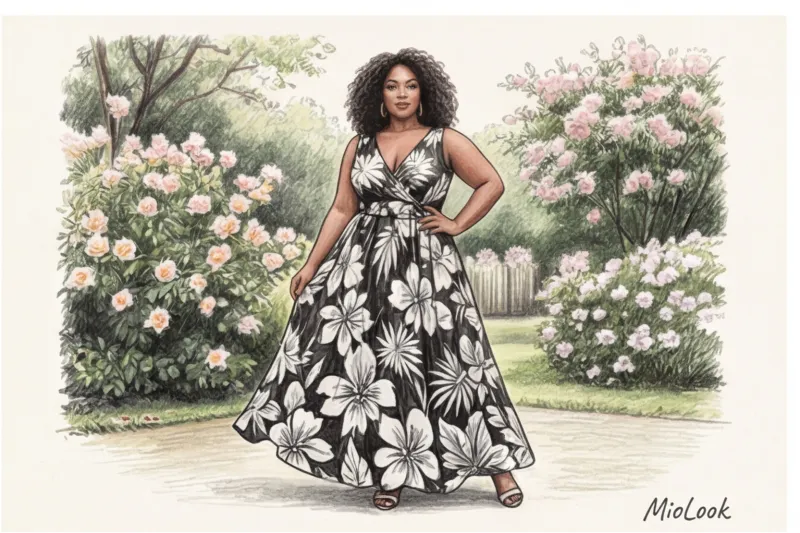
Why does this happen? A magnifying glass effect is activated. When a large watercolor peony or giant polka dot lands on the most prominent point of the body—the chest or stomach—it acts like a 3D lens. The design stretches, creating the illusion of colossal expansion.
- Large Vichy check or tartan: If the width of a square block exceeds 5 cm, the checkered pattern will "chopped" the figure into wide horizontal segments, making it appear square. This is a disaster for short girls.
- Light background with a rare large print: A common mistake beginners make is buying summer dresses with huge, sparse monstera leaves on a white background to "hide" their full figure. There's too much negative space, making the figure appear larger.
Fair Limit: If you want to add volume to your slender hips, feel free to wear a skirt with large polka dots. But for choosing clothes according to your body type without stereotypes It is important to understand this mechanism and manage it consciously.
Woven versus cheap print: how texture affects silhouette
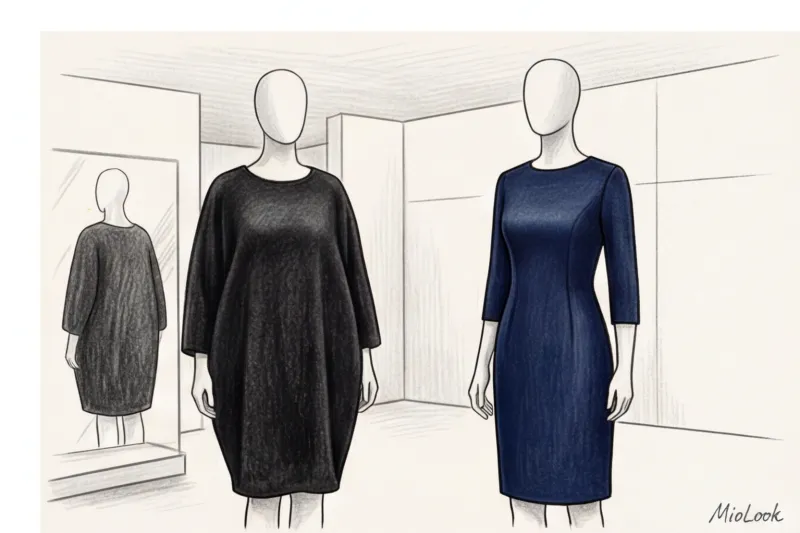
Over the years of sorting through wardrobes, I've developed a "blind touch" method. I close my eyes and touch the item. If the print is printed on cheap, thin polyester (in the €30-€50 range), I almost always know it will ruin my figure. Here's why.
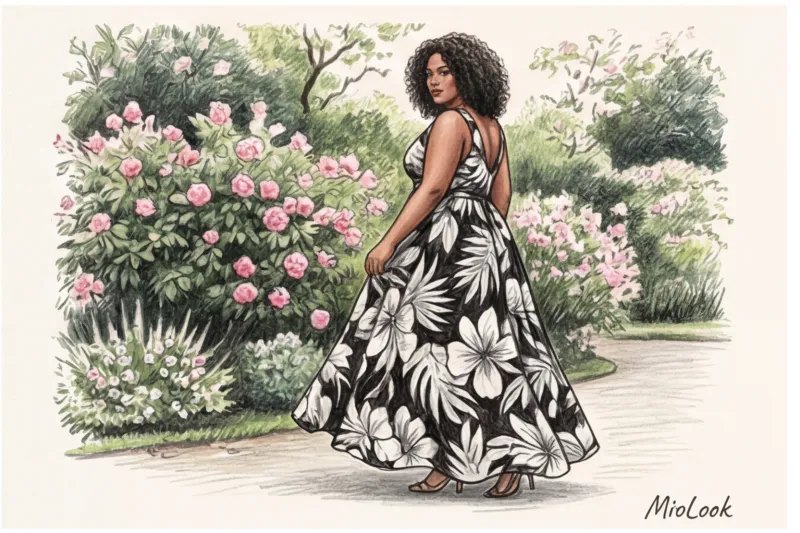
Cheap surface printing is essentially a layer of pigment on an unstable base. When such fabric is stretched across the chest or hips, the pattern deforms. Round polka dots turn into stretched ovals, and straight lines become crooked waves, treacherously emphasizing every fold of the body. Furthermore, cheap ink often reflects in the light, and any unnatural shine is the main enemy of a slim figure.
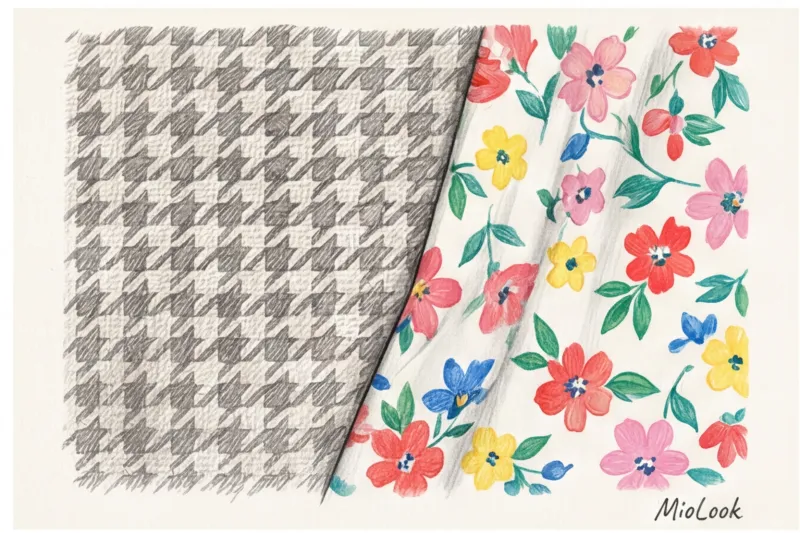
Structured fabrics work completely differently: jacquard, tweed, and heavy cotton (from 180 g/m²). In these fabrics, the pattern is created by the interweaving of the threads themselves. This pattern architecture works like a corset. A good jacquard suit (even in the mid-price range of €150–€250) maintains its own structure, preventing the print from flowing along the curves of your body.
Access to MioLook for €0.99 — one-time payment
Tired of wondering if this item will suit you? Our smart AI stylist will find the perfect combination of prints and textures just for you.
Get access — €0.99 onceBody Geometry: How to Use Prints to Correct Proportions
Christian Dior was a genius of optical illusions. In his legendary New Look collection (1947), he used houndstooth fabric to create impossible proportions. On the waist of the Bar jacket, the pattern was microscopic, but on the full skirt, the size of the pattern increased, making the waist appear waspish.
We can use this color blocking principle in our everyday lives. The focal point technique works flawlessly:
- For a pear-shaped figure: We put on a printed silk blouse with a bold geometric pattern and tailored, solid-color palazzo pants made of a thick, matte fabric. The person's eye is fixed firmly on the upper body, ignoring the size of the hips.
- For the apple shape: Use a solid-color basic top (like navy blue) and layer a long cardigan or jacket with a delicate print over it, leaving it unbuttoned. You'll create a contrasting vertical stripe inside the unbuttoned jacket, trimming away the belly fat on the sides. We wrote more about this technique in the article about office clothes for plus size women.
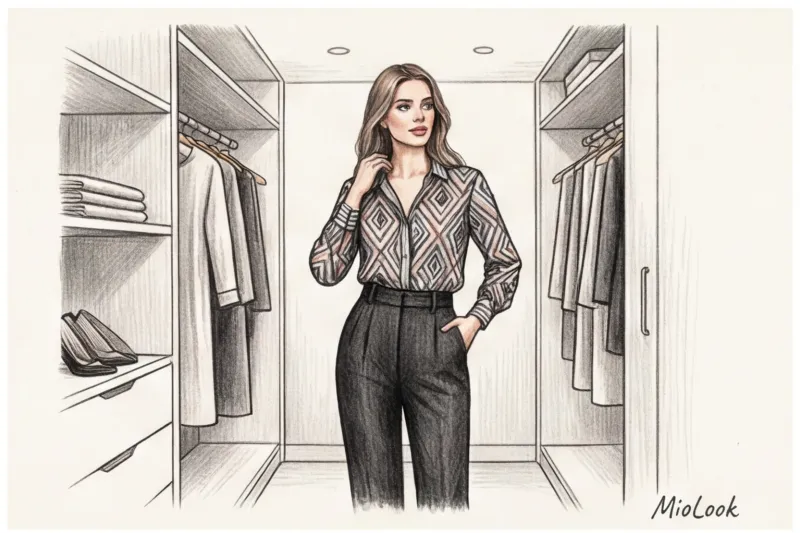
Virtual fitting room function in MioLook app It's great for helping you see where the focus will be in a particular outfit before you buy it.
Stylist's Checklist: 4 Steps to Choosing "Your" Fitting Room Print
Theory is great, but let's move on to practice. When you find yourself in the fitting room with a printed item, run it through these four filters:
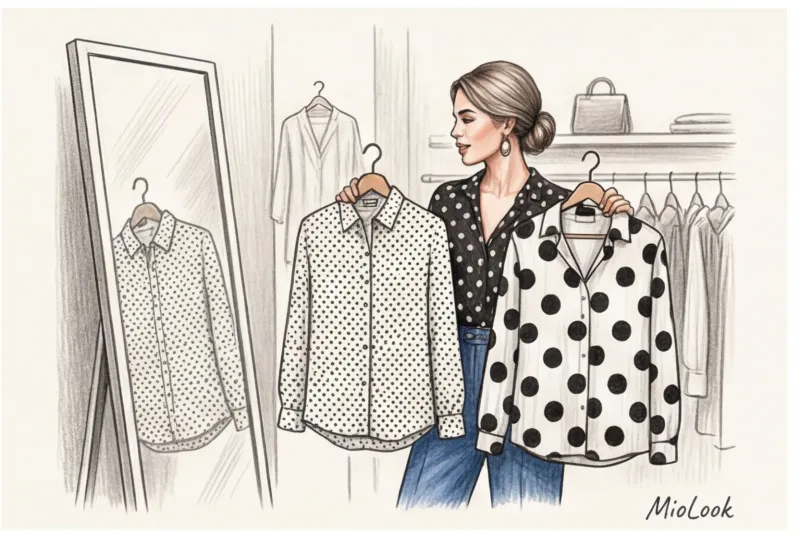
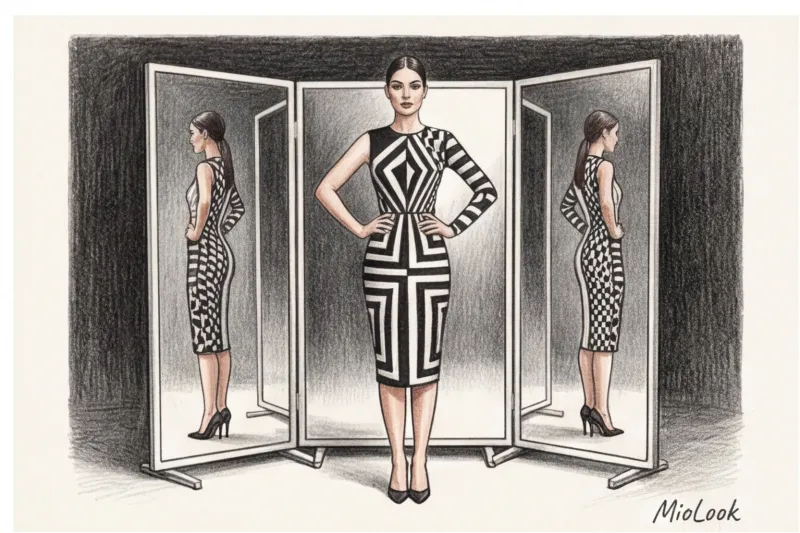
- Test in motion. Take a long step, squat, or bend over. Notice how the print behaves in the widest areas. If the stripe is warped, leave the item in the store.
- Checking the seams. This is the main quality marker that distinguishes expensive tailoring from sloppy mass-market clothing. If you're trying on a check or stripe, look at the side seams. The pattern should match perfectly, flowing from the back to the front. A torn or mismatched pattern at the seams instantly breaks the vertical line and cheapens the look.
- Contrast level. If you have a soft, low-contrast complexion (light brown hair, light eyes), a harsh black-and-white graphic print will "eat up" your face. Opt for tonal prints (beige-brown, blue-light blue).
- Proportionality. Petite women should avoid giant buds—they'll make you look like Thumbelina wrapped in a carpet. Stately, curvy women should avoid overly small, fussy chintz flowers, which will accentuate bulk against larger body proportions.
Patterned clothing isn't a lottery where you either get lucky or you don't. It's a precise mathematical calculation, where scale, contrast, and the right texture of the fabric act as your own personal retouchers in real life. Remember the most important thing: prints don't make you look fat—they do when they're poorly placed on the body and poorly executed.