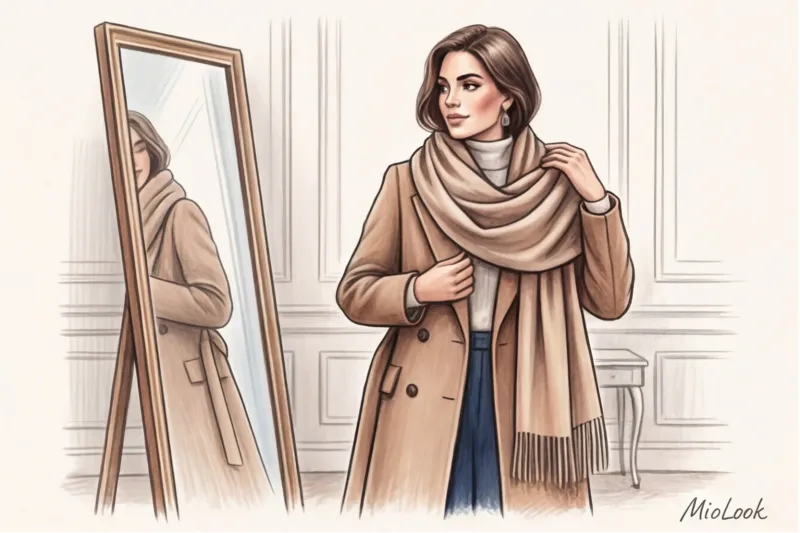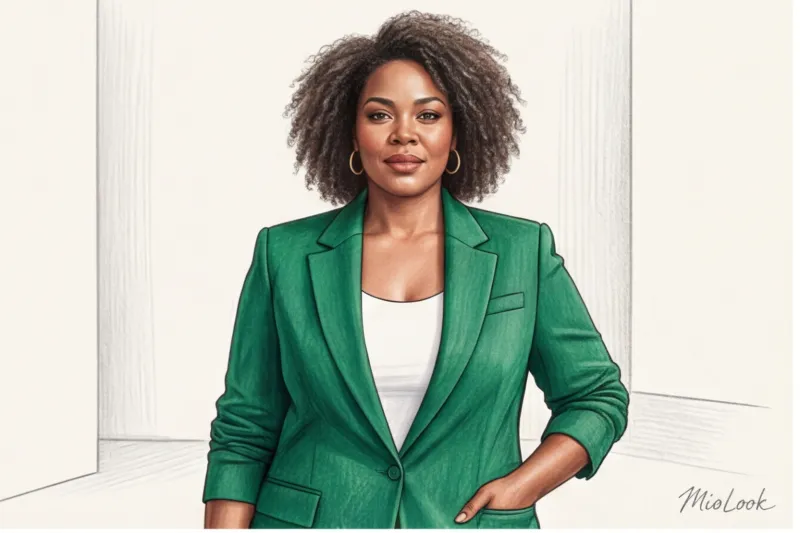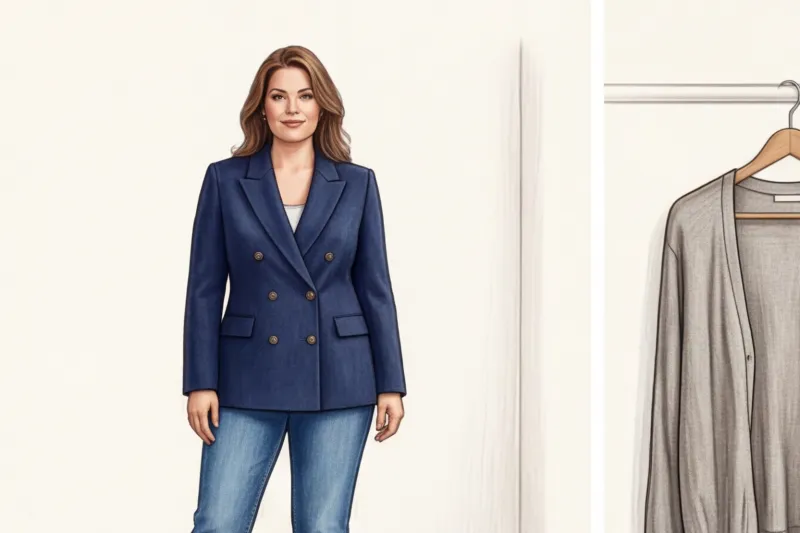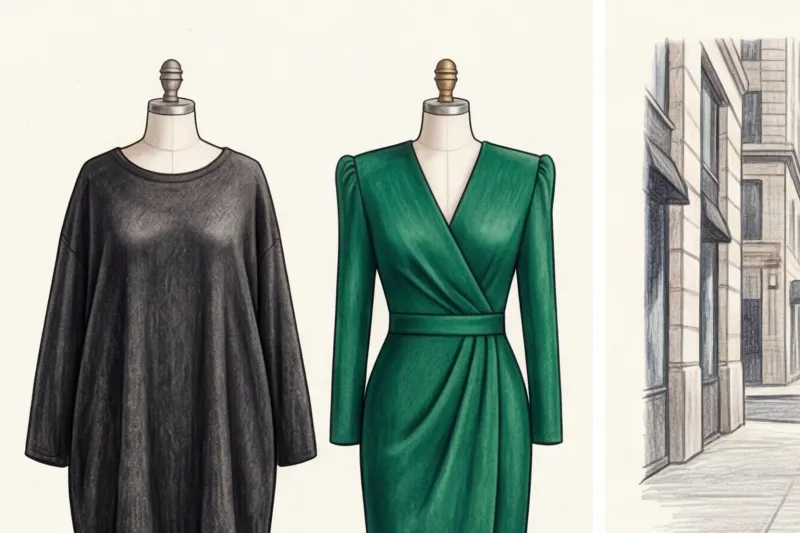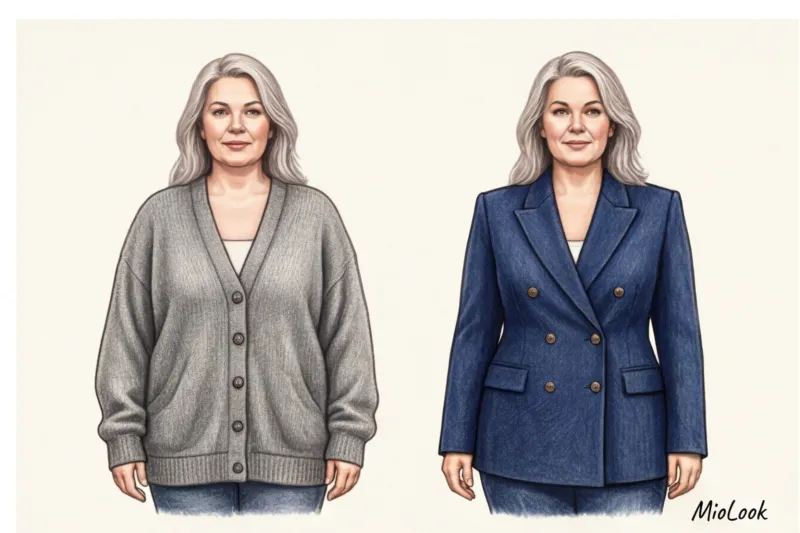
Last week, a 45-year-old executive client (size 52) came to my Paris office. Her suitcase, which she'd brought with her to sort out her wardrobe, contained fifteen shapeless knit cardigans, eight tunics, and no jackets. When I asked her why she chose such items, her answer was typical: "I just want to hide my stomach and hips." It's a classic example of "invisibility syndrome"—a psychological trap that many women fall into after they reach forty.
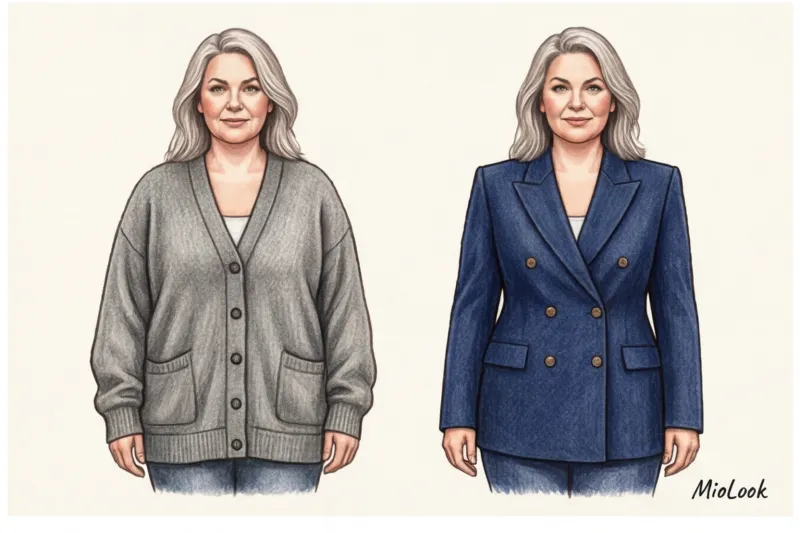
Modern Fashion for plus-size women over 40 has long since abandoned the concept of camouflage. We discussed the global paradigm shift in more detail in our A complete guide to clothing style for women over 40 , but today I want to focus on the main rule of a plus-size wardrobe. We're not talking about how to "visually slim down," but rather how to create an architectural framework that brings your figure together and conveys your status.
The Myth of Camouflage: Why "Robes" Add Weight and Age
The biggest myth I've heard in 12 years of working as a stylist is that oversized clothes and black hoodies are slimming. From a physics and optics perspective, this is a disastrous misconception.
How does shapeless clothing work? Thin, unstructured fabric falls from the most prominent point of your figure (usually your chest or stomach) straight down at a tangent. This creates a "tent effect." People around you judge your silhouette not by the actual contours of your body, but by the outer edges of this fabric. As a result, a shapeless tunic adds at least two sizes to your figure.
- Correct oversize vs. ill-fitting: A truly oversized sweater has a rigid structure (for example, a larger but defined shoulder line). A soft sweater bought three sizes too big is simply a sack.
- The danger of total black: Black absorbs light. After 40, a dull black near the face highlights all the signs of aging: wrinkles, dark circles under the eyes, and tired skin. Save black for trousers, and use deep, complex shades (emerald, sapphire, burgundy) for portraits.
"At Marina Rinaldi's recent Milan shows, we saw a stunning contrast: plus-size models looked truly luxurious not in draped dresses, but in perfectly tailored trench coats and suits with sharp shoulders. Structure is your best friend."
Access to MioLook for €0.99 — one-time payment
A smart AI stylist will select the perfect look based on your proportions and preferences.
Get access — €0.99 onceFashion for Plus-Size Women Over 40: 5 Key Rules for a Structured Wardrobe
An architectural wardrobe is clothing that holds its shape regardless of your posture. When you sit down, your jacket shouldn't turn into a wrinkled rag. Here are five rules that underpin such a wardrobe.
- Investing in a hard shoulder line. Anatomical shoulder pads save even the simplest jacket. A well-defined shoulder automatically straightens your posture and creates a clean, geometric shape that makes your hips appear narrower.
- Mathematics of lengths. Any horizontal cut (skirt hem, jacket edge, cropped trousers) should end at the narrowest point. If the jacket ends at the widest part of your hip, it will visually "cut" you and add volume.
- "The Freedom Gap" There should always be air space between your body and the fabric (at least 1.5–2 centimeters). Clothing that digs into your body screams that it's too small.
- Color blocking instead of small print. A millefleur floral pattern on a size 50+ often looks like sofa upholstery. Use large color blocks: for example, dark trousers and a bright top under an unbuttoned jacket.
- Asymmetry as a tool. Diagonal lines (wrap, asymmetrical hem) make the gaze slide rather than fixate on one point.
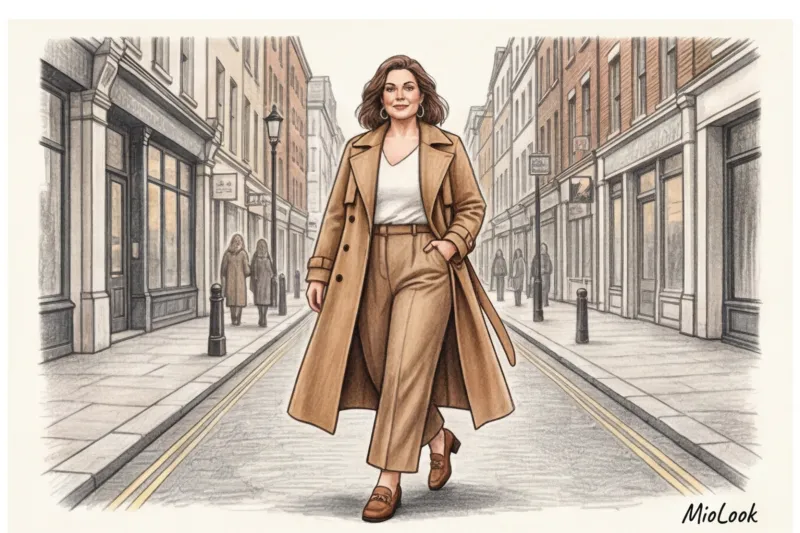
Fabric density is everything: a technical approach to selection
In the textile industry, there's a metric called GSM (grams per square meter). This is the density of the fabric. When choosing plus-size trousers, the minimum density should be at least 250–300 g/m².
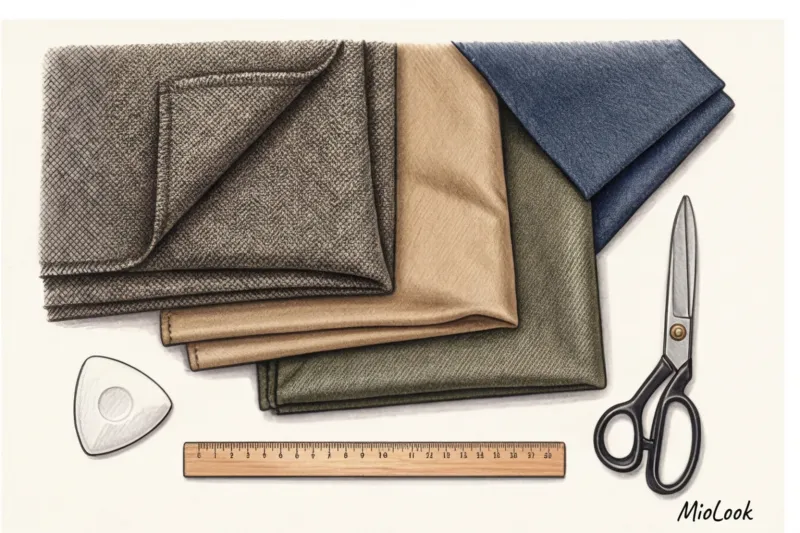
What should you absolutely not wear if you want to look classy?
- A thin jersey fabric (T-shirt fabric) that treacherously clings to every fold and emphasizes the texture of the skin (cellulite).
- Cheap shiny viscose or satin - the shine creates highlights that visually increase volume.
Ideal materials: dense cotton with elastane (2-3% for comfort), heavy silk, gabardine, and tweed. The fabric should hold you in like a light corset.
Anatomy of the ideal silhouette: starting from proportions, not size
Forget the "apple" or "pear" typology—it's hopelessly outdated. Modern styling analyzes bone structure proportions, neck length, and waist height.
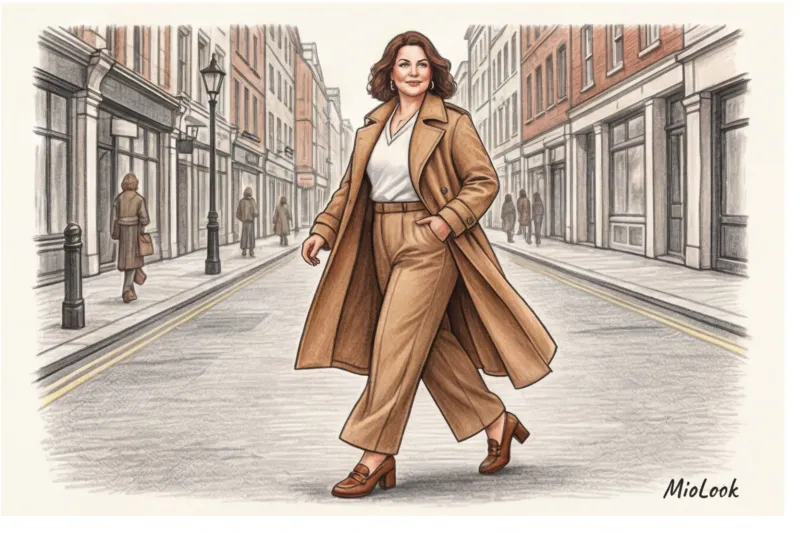
Remember the principles of Christian Dior's architectural tailoring (the famous New Look). Dior built the silhouette on contrasting volumes. We can adapt this principle to sizes 50-54. If you don't have a defined waist, avoid cinching your stomach with a narrow belt—this will only create bulging volume at the top and bottom.
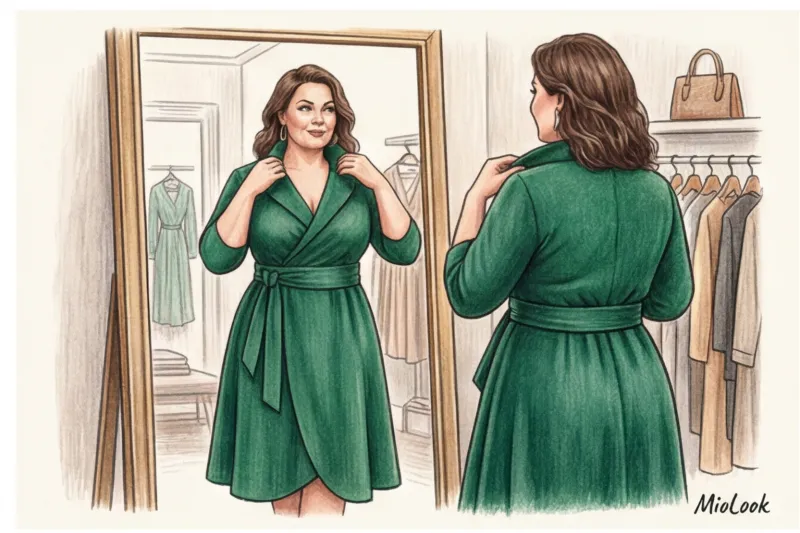
Use savile row techniques adapted for women's wardrobes. For example, diagonal darts. We "create" an artificial waist by wearing a loose top and a structured jacket over it, buttoned with one button just below the bust. The flared hem of the jacket creates an hourglass figure.
The décolleté is your secret weapon. A well-chosen V-neck or an unbuttoned stiff collar on a men's shirt will dramatically elongate your neck and draw attention to your face.
Plus-Size Wardrobe Essentials: What to Invest in After 40
For that same size 52 client I mentioned at the beginning, we put together a capsule collection of 10 essential pieces that completely replaced her 40 shapeless tunics. Here's a list of absolute must-haves worth the splurge.
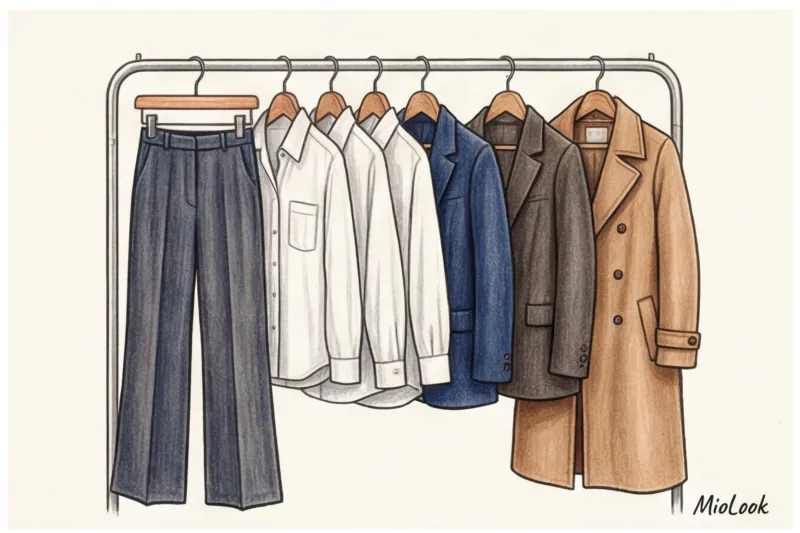
- Two-piece suit with an elongated jacket. An unbuttoned jacket creates two vertical lines that literally "cut off" the sides. Choose a mid-range or premium suit (suits from €200–€350). Don't be intimidated by the price: if you wear a quality €300 suit at least 100 times over two years, the cost per wear (CPO) will be only €3.
- Palazzo pants. Made from a flowing yet heavy fabric, they balance out the heavy top and make your legs look endless.
- Midi length shirt dress. Must have a stiff collar and cuffs.
- The right shoes. Thin stilettos are not recommended for those with a fuller figure—they create a comical contrast between a heavy body and thin heels, emphasizing the fullness of your calves. Opt for a sturdy block heel, a bobble toe, or stylish loafers.
Your perfect wardrobe starts here.
Join the thousands of users who have decluttered their closets and look flawless every day with MioLook.
Get access — €0.99 onceMistakes that ruin your look: insights from a stylist
Sometimes one detail can ruin an entire, painstakingly constructed silhouette.
Cheap hardware is the worst enemy. Gold-plated plastic buttons on mass-market jackets give away a garment's true value a mile away. A strictly insider tip: buy a jacket from Zara or H&M for €60, take it to a tailor, and replace the buttons with horn, metal, or fabric-covered ones. The garment will instantly acquire a premium look.
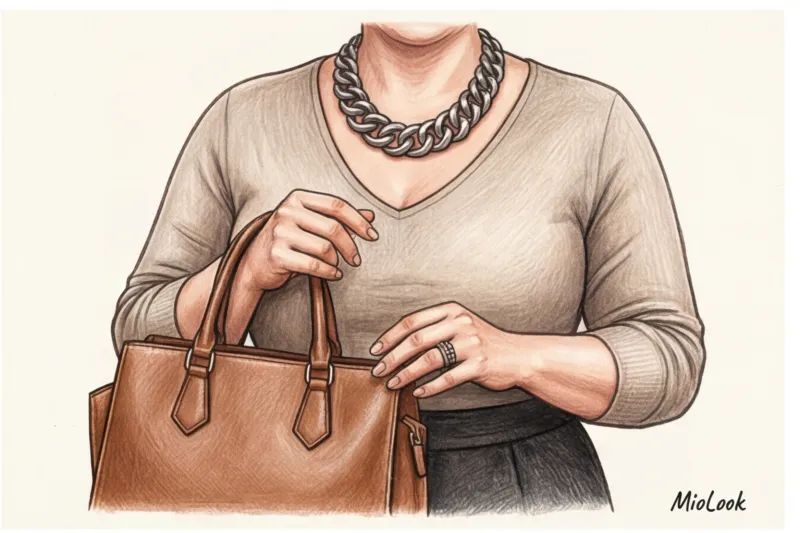
The second common mistake is micro-accessories. Trendy, tiny Jacquemus handbags look like Christmas tree ornaments on a size 52 woman. Scale should match the figure: choose medium to large, rigid bags. The same goes for jewelry—chunky chains and large earrings balance out the proportions.
But the main warning concerns shapewear. Many women buy shapewear a size too small, thinking it will work. In reality, over-contracting the body simply redistributes volume, creating new folds where the fabric ends. Shapewear should be exactly your size.
Checklist: How to Create a Stylish Everyday Look for a Curvy Figure
In the morning, go through this process in front of the mirror. It takes exactly one minute, but it dramatically changes the way you perceive your appearance.
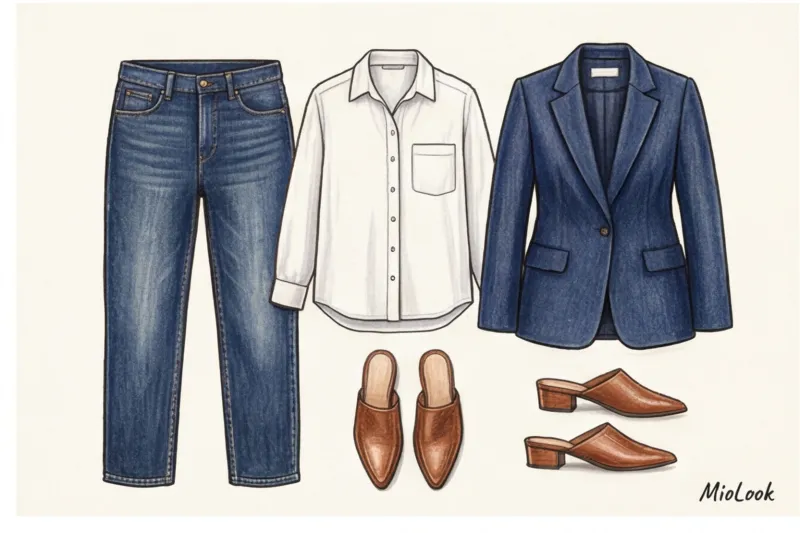
- Step 1: Form a rigid frame. Are you wearing at least one piece of clothing that holds its shape? (A thick cotton shirt, a jacket, a trench coat).
- Step 2: Check the verticals. Are there any lines running from top to bottom in the image? (Crease in trousers, a long row of buttons, unbuttoned flaps of the top layer).
- Step 3: Loose fit test. Can you fit two fingers under the waistband of your pants? Does the fabric stretch across your hips when you sit?
- Step 4: Scale the accessories. Is the bag proportionate to your proportions?
- Step 5: Check the portrait zone. Does the color brighten your complexion? If you're wearing a dark jacket, add a light top or a silk scarf.
Summary: Your style is your manifesto
Being over 40 and plus-size is a time for confidence, status, and self-love, not apologizing for your size. Stop hiding.
Conduct a ruthless wardrobe overhaul. Get rid of all the thin knits, rhinestone-embellished blouses, shapeless hoodies, and waterfall cardigans. Focus on architectural cuts, dense fabrics, and the right scale. And if you don't know where to start, you can always use image selection function in MioLook to experiment with new combinations virtually. Remember: clothes should work for you, not you, serving other people's stereotypes.