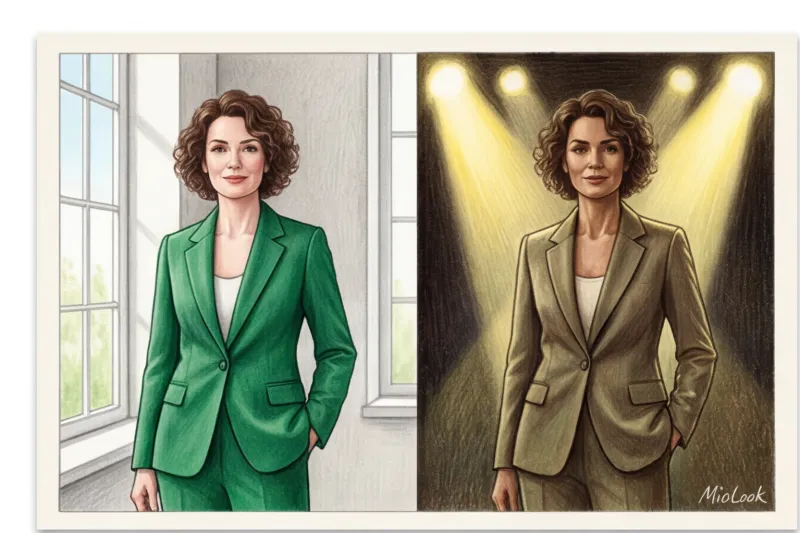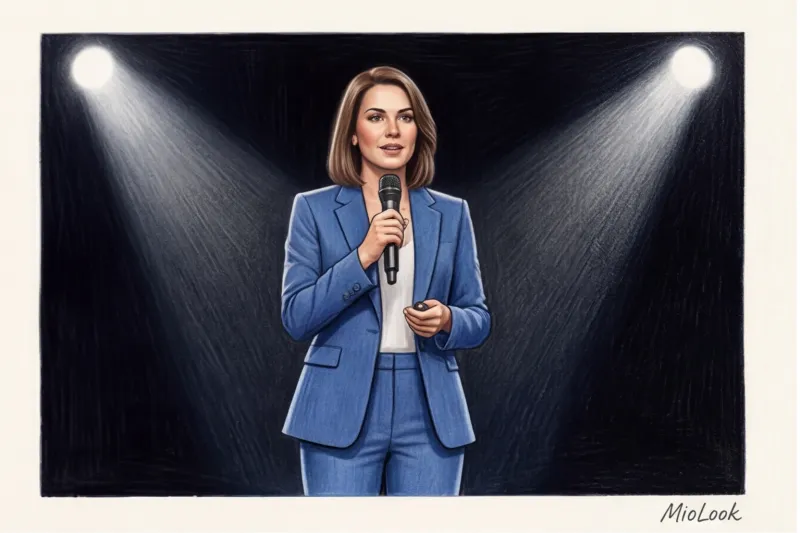
Last month, I watched a webinar given by a brilliant financial analyst. She was impeccably prepared: a complex presentation, perfect diction, and classy designer clothing. But on the screen, all I saw was a floating head. Her perfectly tailored, deep black jacket merged into a single, flat spot, completely engulfing her silhouette, and the camera's autoexposure brightened the background so much that the speaker's face was in deep shadow.
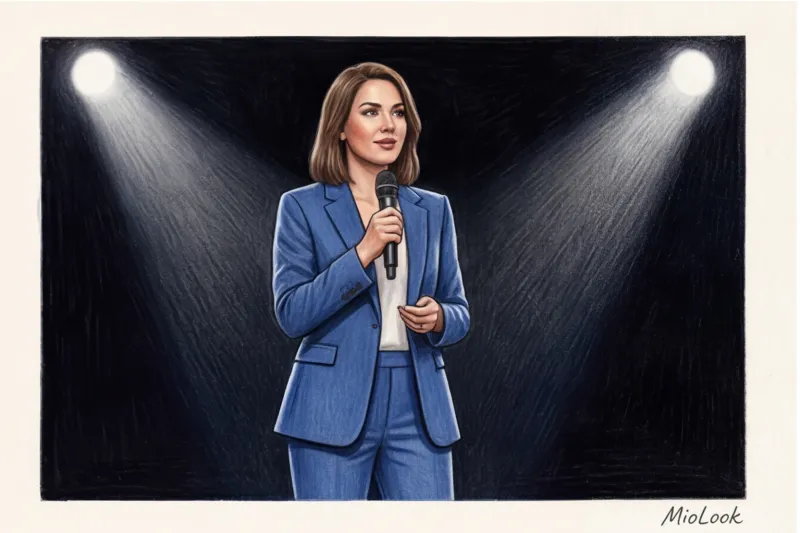
When we discuss color of clothes for performance , most advice boils down to the banal: "Wear blue to inspire confidence." But in reality, choosing a palette for a stage or a Zoom call isn't just about aesthetics. It's about the pure physics of light, lens optics, and fabric texture. Psychologically, we perceive shades in the first 90 seconds (I discussed the mechanisms of this perception in more detail in our A complete guide to the psychology of color in your wardrobe ), but when a camera lens or stage lights come between you and the audience, the rules of the game change dramatically.
Unlike typical articles, we won't be talking about how red signifies passion. Today, we'll explore how the same shade can make or break your presentation, depending on your webcam sensor and fabric texture.
Optical illusion: Why performance clothing colors work differently than in real life
The human eye can adapt to any lighting conditions. A camera cannot. The sensors of modern webcams and even professional studio cameras have a limited dynamic range (the ability to simultaneously capture very bright and very dark areas). Moreover, under typical home lighting conditions, budget lenses cut off up to 20% of the color spectrum.
According to broadcast technical standards (specifically, SMPTE contrast ratio recommendations), a speaker's clothing should remain within a safe luminance range. Color temperature also plays a significant role. Warm yellow stage lights will instantly turn a cool lavender suit into a dirty gray, while a cool LED ring light from Amazon will transform a beautiful peach top into a pale, skin-toned color.
The Webcam and Spotlight Trap: What Happens to Color
Have you ever noticed how your face in a video suddenly darkens as soon as you lean back in your chair? That's the work of autoexposure algorithms. Skype, Zoom, or Teams constantly analyze the image and try to calculate the "average temperature in the hospital." If you're wearing something too light, the camera decides there's too much light in the frame and automatically reduces the overall brightness. As a result, your crisp white blouse looks fine, but your face is washed out.
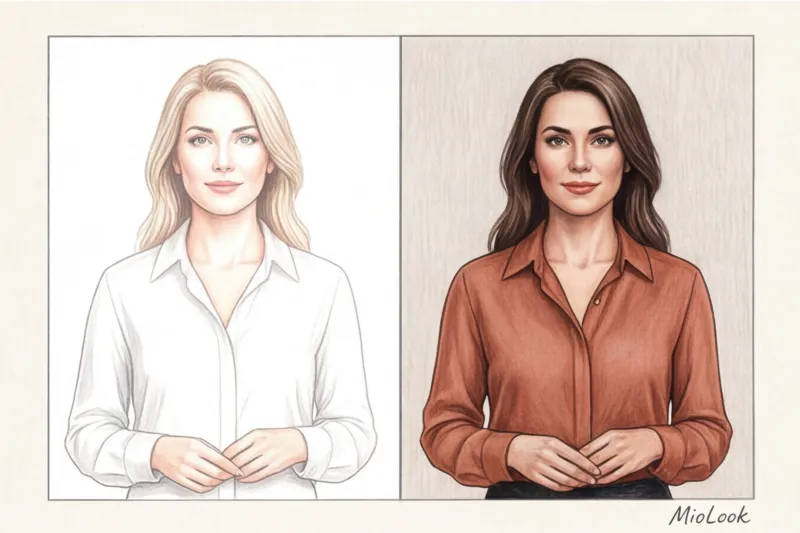
On the big stage, another problem arises: wash lights. Powerful theater lights literally "wash out" delicate pastel shades. What looked like an elegant powdery pink in the dressing room mirror will look like a washed-out white from the 15th row of the auditorium.
Absolute Taboos: 4 Colors That Will Ruin Your Stream
The most common myth I've been fighting for years is "Black and white are the safest and most austere colors for an important presentation." In reality, they're the worst choice for any format that includes a lens.

- Snow-white: Creates a "blowout" effect. The camera's sensor can't handle such bright reflected light. The white shirt turns into a blinding highlight, devoid of wrinkles and detail, and the speaker's face becomes underexposed.
- Deep black (Vantablack effect): Black absorbs light. In videos, it often loses any texture, turning into a black hole. Worse, the harsh contrast of black clothing highlights all the shadows on the face—nasolabial folds and bags under the eyes appear deeper, visually aging the speaker by five to seven years.
- Neon shades: The physics of light causes bright colors to reflect onto nearby surfaces. This is called "color bleeding." A bright green jacket will cast a green reflection on your neck and chin, creating the illusion of motion sickness.
- Small patterns (houndstooth, pinstripes): It's not exactly color, but it's a critical element. A high-contrast, fine pattern creates a stroboscopic effect (moiré)—the fabric in the video begins to "dance" and ripple, making viewers dizzy.
"I had a situation backstage at a local TEDx conference in 2022. The male speaker arrived wearing a beautiful, expensive shirt with fine blue and white stripes. During a test run, his chest literally turned into a flickering screen on the cameramen's monitors. I had to take off my own plain, dark blue long-sleeved shirt and give it to him 10 minutes before he went on stage. It saved the broadcast."
Access to MioLook for €0.99 — one-time payment
A smart AI stylist will create the perfect look for your next big event, taking into account your individual characteristics.
Get access — €0.99 onceDeep and Complex: The Perfect Webinar Color
If black and white are off-limits, what should you wear? Mid-tone shades are your best ally. Cameras love colors that don't hit the edges of the luminance histogram. Jewel tones are an absolute favorite among TV stylists.

Sapphire, emerald, deep ruby and amethyst They work flawlessly. They're dark enough to project authority, yet still contain enough color pigment for the camera to focus easily and capture beautiful texture. Faces always look fresh against these shades.
If you're accustomed to warm tones, look for basic alternatives to your usual neutrals. Swap out your white blouse for ivory, dusty pink, or light beige. Swap out your black blazer for deep terracotta, muted mustard, or rich chocolate.
The most important rule of webinars: contrast with the background If you're sitting in front of a white home office wall, a beige sweater will blend you in. Choose a crisp emerald green. Conversely, if you have a dark bookcase behind you, a light blue or camel shade will be a lifesaver.

A Palette for the Big Stage: How to Capture the Audience's Attention
Taking the stage requires a comprehensive approach. Here, we're working not with a webcam lens, but with the eyes of hundreds of people. According to research by the Institute for Color Research, the color of a speaker's clothing influences audience engagement and their trust in the facts.

Take red, for example. It's a powerful attention-grabber. But it has an important limitation that is often forgotten. A red suit is ideal for a 15-minute startup pitch or a TED talk—it conveys drive and confidence. However, if you're leading a four-hour training session, red will begin to physiologically tire the audience and may even provoke subconscious aggression and skepticism. For longer formats, there's nothing better than blue: from classic navy for corporate annual reports to vibrant royal blue for visionary lectures.
To be clearly visible from the back rows, use Color blocking or monochrome looks. A suit in a single color (for example, dark burgundy trousers and a tone-on-tone jacket) elongates the silhouette without breaking up the figure. The audience stops scanning your clothes and focuses precisely on your face and body language.
The Secret Stylist Factor: How Fabric Texture Changes Color
Here's something that's almost never mentioned in style articles: color doesn't exist in a vacuum. Color is light reflected from a surface. Therefore, the same shade of red on silk and on matte wool appear as two completely different colors to the viewer.
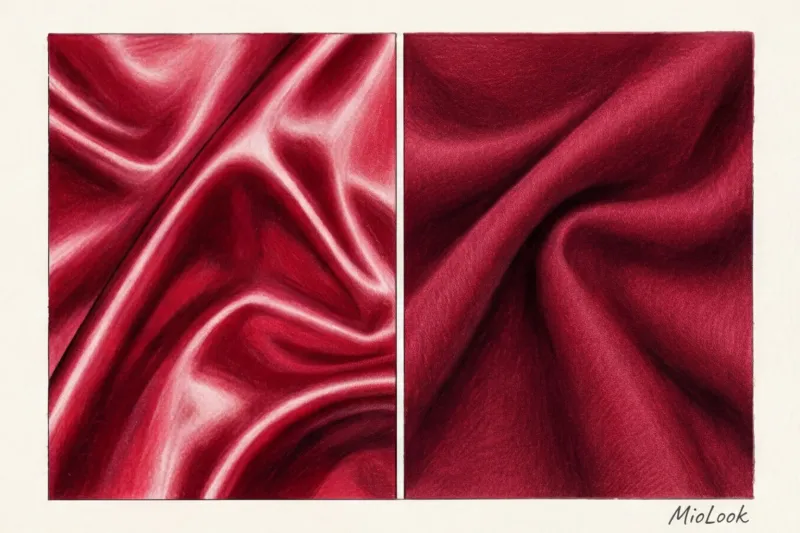
Shiny fabrics (satin, silk, and especially cheap polyester costing under €30) start to glare under spotlights or ring lights. These white highlights on the shoulders and chest completely destroy the depth of color. Furthermore, a synthetic sheen always cheapens the look on camera. You can wear a perfectly sapphire-colored blouse, but if it's 100% cheap polyester, it will look like a plastic bag on camera.
The secret of aesthetics old money In the video, these are matte, light-absorbing materials. Crepe wool, heavy cotton (from 180 g/m²), high-quality matte viscose, or cashmere absorb up to 80% of incident light. As a result, the color becomes incredibly deep, rich, and luxurious.
From a conscious consumer and sustainable fashion perspective, investing in a good matte wool blend jacket in the €150–€300 range will pay for itself hundreds of times over. This fabric not only beautifully captures color in photos, but also lasts for years without losing its shape or pilling, which a camera's macro lens instantly catches.
Your perfect look starts here
Join thousands of users who look flawless every day. Digitize your wardrobe and create stylish combinations.
Get access — €0.99 onceChecklist: Testing Your Look Before a Performance
Even if you've chosen the perfect matte emerald suit, professional TV stylists never send a spokesperson on air without a final test. I strongly recommend running your look through this short process:
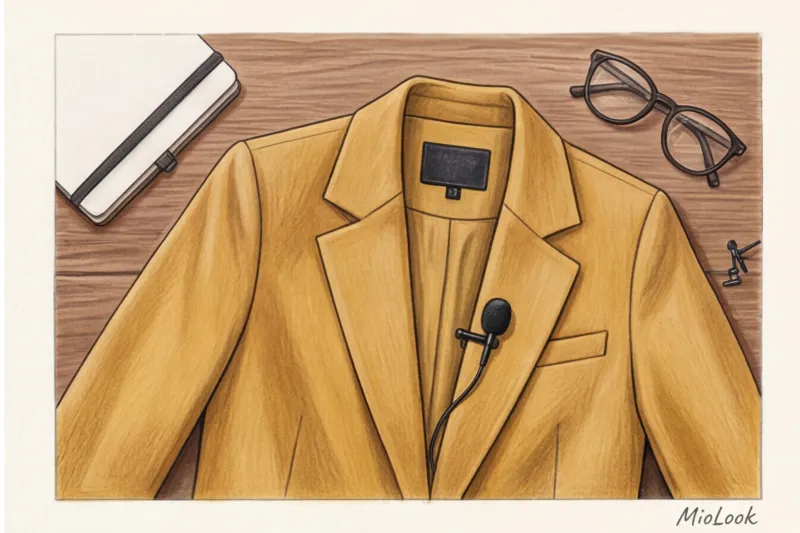
- Flash test: Put on your chosen outfit and have someone take a photo of you with a phone flash in a dark room. This simulates the harshest directional light. If the fabric starts to shine unattractively or your underwear starts to show through, replace the item.
- Webcam time test: Open Zoom on your laptop at the exact time of day your webinar will take place. Lighting at 11:00 AM and 5:00 PM will be dramatically different. Check how your camera's sensor handles color in the current natural light.
- Brandwall check: If you're performing in person, ask the organizers for a photo of the stage in advance. What color is the backdrop (brand wall)? What color are the stage chairs? Wearing a blue suit against a blue banner will make you invisible.
- Chest crop: For webinars, 80% of your body is irrelevant. Focus on the portrait area. A deep V-neckline on a collarbone-length frame can create the impression that you're sitting naked in front of a monitor.
The right color for public speaking is like a good sound engineer—it goes unnoticed when everything is going perfectly, but it ensures clarity of perception. Choose thick, matte fabrics in a mid-tone palette, avoiding extremes like crisp white or black, and the camera will become your ally, not a merciless critic. And to avoid spending hours choosing that perfect combination before each broadcast, integrate your wardrobe into MioLook and let the algorithms offer you proven solutions that you can feel 100% confident in.