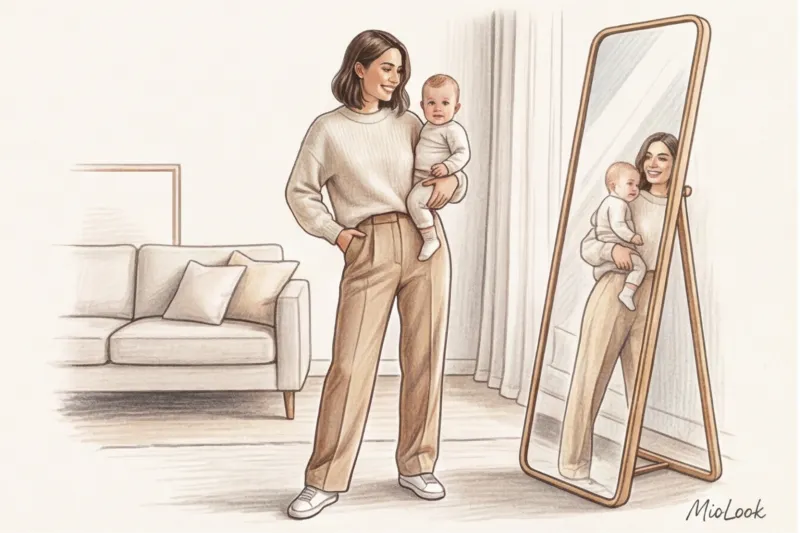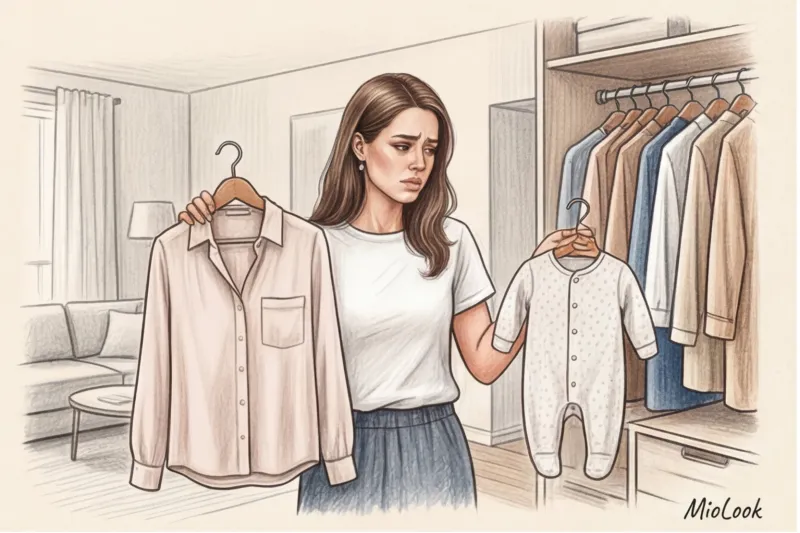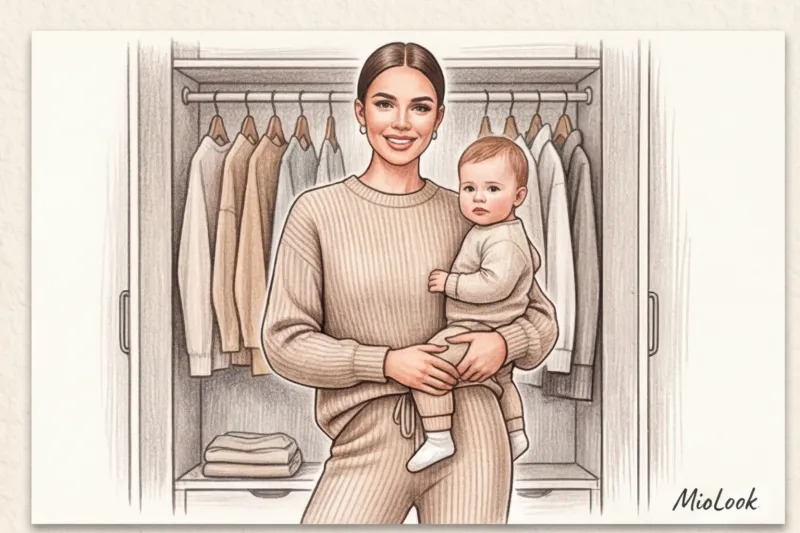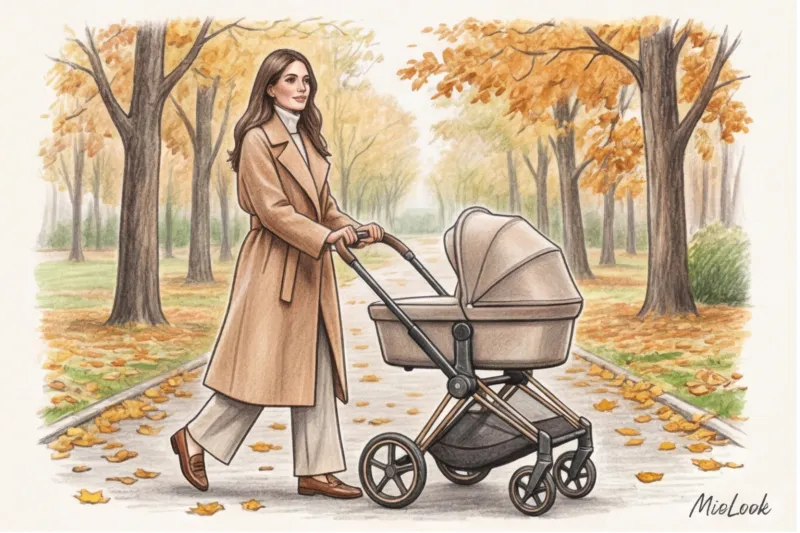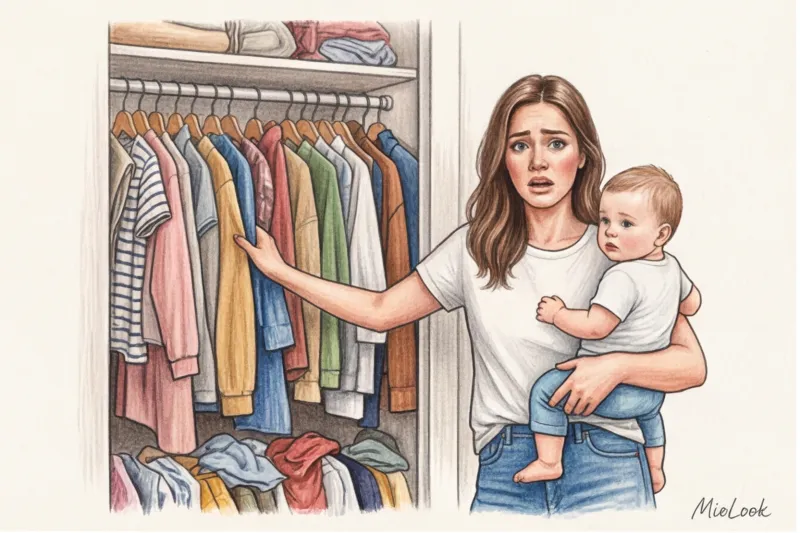
According to cognitive psychologists, by 9 a.m., a new mother has made over 100 micro-decisions. Should she change the diaper now or after breakfast? Should she put on a lighter or warmer hat? Should she take her favorite toy for a walk or leave it at home? By the time she reaches her closet, her brain's decision-making capacity is practically depleted.
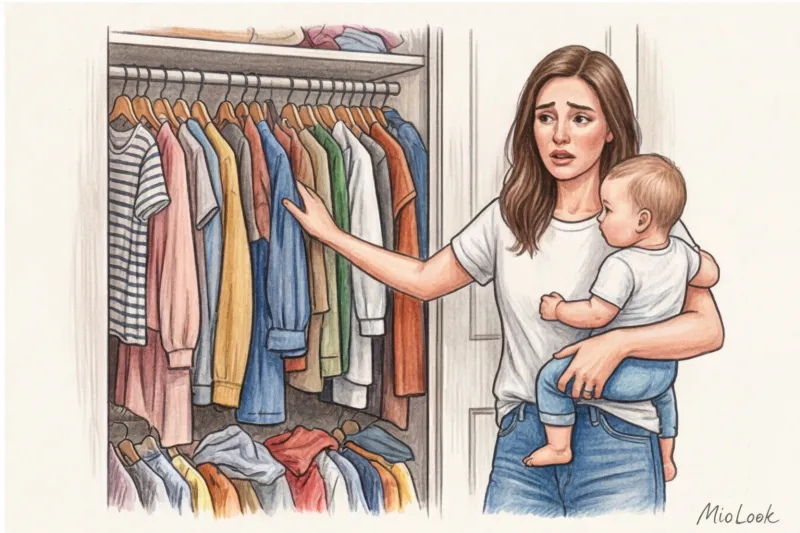
That's why we collect A basic wardrobe for maternity leave: a minimum of items — this isn't just a nod to fashionable minimalism. It's a piece of engineering that can cut your morning routine from 20 agonizing minutes to 3 minutes of automatic action. We discussed the fundamental principles of building such a closet in more detail in our A complete guide to a capsule wardrobe for a stay-at-home mom: style and comfort Today, I propose considering this process as a mathematical problem, where the right textures and cut are everything.
Why the ideal basic wardrobe during maternity leave is a minimum of items
There is a term in the industry decision fatigue (Decision fatigue). When you're faced with 50 random, mismatched items, your brain perceives it as a threat and a challenge. You waste energy trying to figure out if this blouse will go with these jeans, and eventually give up, wearing the same faded sweatpants.
But the problem goes deeper than just appearance. In 2012, researchers Hajo Adam and Adam Galinsky of Northwestern University introduced the term Enclothed Cognition It's been proven that clothing physically alters our cognitive processes. What you wear programs your brain for alertness and focus, or for apathy and fatigue.
"Every extra item in your closet that's 'waiting for its time' or doesn't fit well is visual noise that steals your energy. 15 well-thought-out items always work better than 50 random ones."
The math behind minimalism (the Mix & Match concept) is simple: if all 15 items in your capsule wardrobe are perfectly coordinated in color, cut, and weight, you'll have over 120 unique combinations. You can literally get dressed in the dark while your baby sleeps and still look flawless.
Access to MioLook for €0.99 — one-time payment
A smart AI stylist will select the perfect look from your items and save you time in the morning.
Get access — €0.99 onceCapsule Anatomy: The 5-4-3-2-1 Formula for Mom
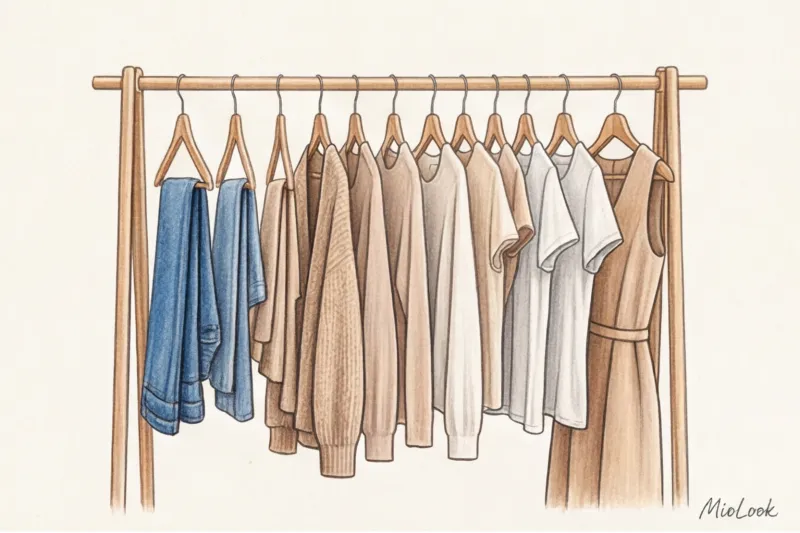
Over 12 years of practice, I've tested dozens of closet decluttering systems, but for clients with small children, I always return to the ironclad "5-4-3-2-1" formula. It mathematically eliminates the "nothing to wear" problem.
What this looks like in practice:
- 5 tops (T-shirts, long sleeves, shirts)
- 4 bottoms (jeans, trousers, skirts)
- 3 second layers (cardigans, jackets, hoodies)
- 2 outerwear options (depending on season)
- 1 universal dress
The secret to success lies in strict color discipline. To make the system work, choose a rule: three base colors and two accent colors For example, base colors are deep navy, graphite gray, and camel. Accents are emerald or burgundy. Avoid crisp white in favor of ecru or oatmeal—they look more expensive and are easier to wash.
Tops and bottoms: a base that works for you
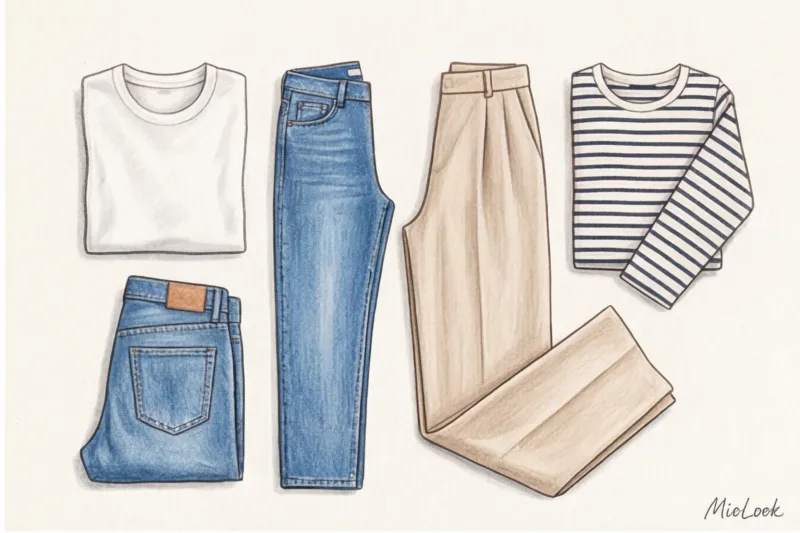
Don't buy thin knitwear. This is the main mistake I see when audits of my clients' closets Thin fabric makes underwear see-through, highlights every fold on the stomach (which is completely normal after childbirth, but often causes discomfort), and loses its shape after the third wash.
Your 5 tops should be structural:
- Two basic T-shirts made of heavy cotton (look for a weight of 180 g/m², like the basic COS or Uniqlo U lines).
- One long sleeve shirt with Breton stripes (a striped shirt makes the face look fresh).
- One semi-fitted jumper made of viscose with elastane.
- One loose but well-fitting cotton shirt.
For bottoms, the rule of comfort without sacrificing structure applies: straight-leg jeans with a mid- or high-rise, joggers made of thick fleece, palazzo pants with a wide elastic waistband, and an A-line midi skirt. Forget skinny jeans—they restrict movement when you need to squat down on your baby 50 times an hour.
Second Layer and Accents: Layering as Salvation
Layering isn't just about warmth; it's a visual trick that pulls an outfit together. A chunky knit cardigan or a heavy denim jacket create vertical lines, visually elongating the silhouette. Add a basic hoodie without prints or logos, and you've got the perfect armor for chilly evenings in the park.
Rounding out the list are one versatile dress (like a ribbed knit midi or a nursing-friendly shirtdress) and two seasonal outerwear options: a quilted coat and a classic, loose-fitting trench coat.
The Main Myth of Maternity Leave: Why Oversized Clothes Are a Trap
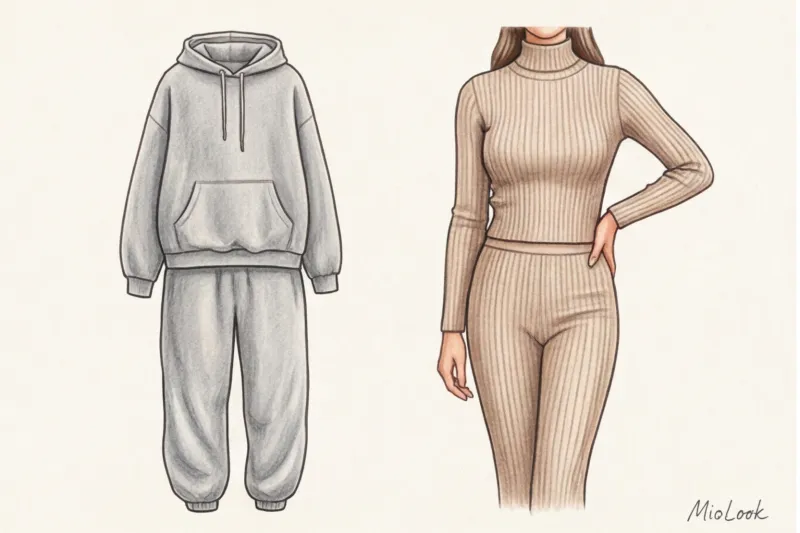
One day, Anna, a talented architect, approached me. During her first year of motherhood, she, like many others, had "moved" into oversized 3XL tracksuits. "Camilla, I feel invisible, like there's nothing left of me." " she said at our first meeting. This is a classic manifestation of postpartum dysmorphia, which is only exacerbated by oversized clothing.
Conventional advice says: wear oversized clothes, they're comfortable. I strongly disagree. Constantly wearing baggy clothes blurs the boundaries of your body. Your brain stops recognizing your figure's contours, which paradoxically lowers your self-esteem and makes you look tired.
An alternative? Semi-fitted.
Clothes should leave air between the body and the fabric (about 2-3 centimeters), while still maintaining the shoulder structure and defining proportions. We replaced Anna's oversized sweatshirts with structured knit sets and straight jeans. The effect was stunning: her posture and confidence returned. By the way, if you're unsure which styles will suit you, upload your measurements to image selection function in MioLook — the neural network will show how structured objects change proportions.
Fabrics and Textures: Stylist Secrets for Active Weekdays
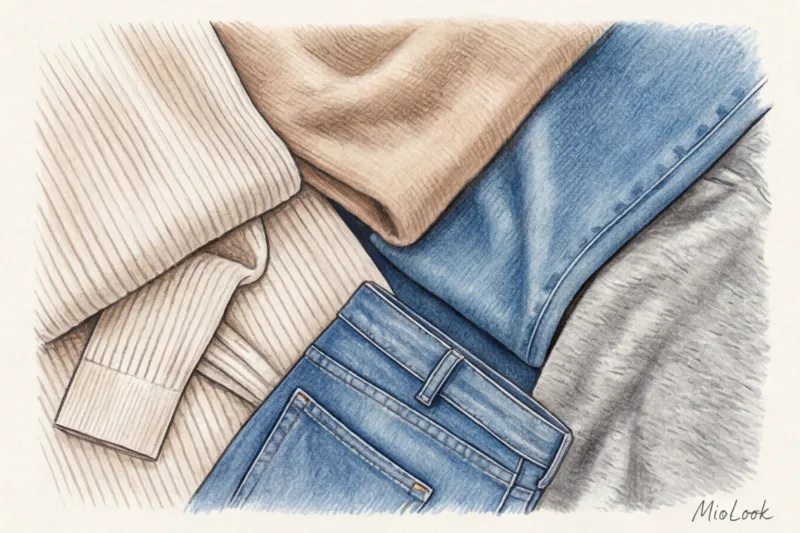
While on maternity leave, clothes are crash-tested with drool, baby food, sand, and frequent washings. Therefore, fabric composition is more important than fashionable style. As experts at the WGSN trend bureau note, the future of everyday wardrobes lies in "smart" blended materials.
Before I recommend things to clients, I conduct fist test Right in the store. Squeeze the edge of the fabric in your fist for 10 seconds with maximum force. If the fabric is still wrinkled after you release it, return it to the hanger. 100% linen or thin viscose will wrinkle the second you pick up your baby.
Look for the right compositions:
- Thick cotton with 5% elastane: holds the shape of the knees and elbows.
- Washable merino wool: It warms, breathes, does not itch and can withstand delicate machine cycles.
- Modal and Tencel: an excellent alternative to capricious silk.
And the main life hack of a stylist: anti-stain texture Smooth, solid-color cotton will shed even the slightest drop of water. But ribbed fabric, mélange (fabric made from threads of different shades), or a fine ripple print create an optical illusion—they brilliantly conceal minor stains, eliminating the need to change clothes three times a day.
Your perfect look starts here
Join thousands of users who look flawless every day with MioLook.
Get access — €0.99 onceHow to put together a basic wardrobe while on maternity leave with minimal items: a step-by-step checklist
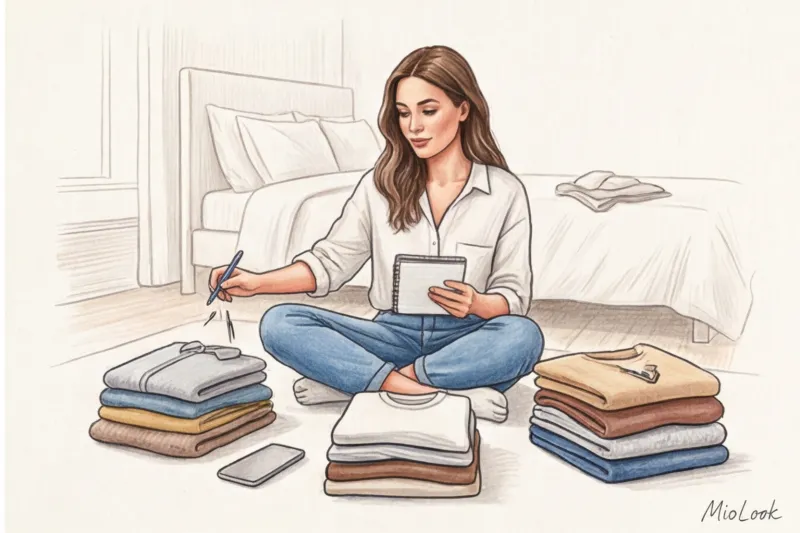
To build a work capsule, you need to stop buying new things and first sort out what you have. I use an algorithm that works great in my paid consultations.
Step 1: The Three-Box Rule
Take out everything. Absolutely everything. Divide it into three piles: "Wearing it now with pleasure," "Donate/sell," and "Put away before going to the office." Your formal suits, silk blouses, and sheath dresses shouldn't hang next to your hoodies. They create visual noise and a sense of guilt. Vacuum-seal them.
Step 2: Temperature and Color Core
Consider your lifestyle. Do you spend three hours a day walking in the park? Or do you commute to the mall? This will determine whether your outerwear choice will be a shell parka or a cashmere coat. Choose three basic colors that complement your appearance.
Step 3: Spot Shopping
Compare the remaining ideal items with the formula 15. What's missing? Add only that to your shopping list. If you already have two great jeans, you're forbidden from looking at denim in the store.
Shoes and accessories: how to complete the look
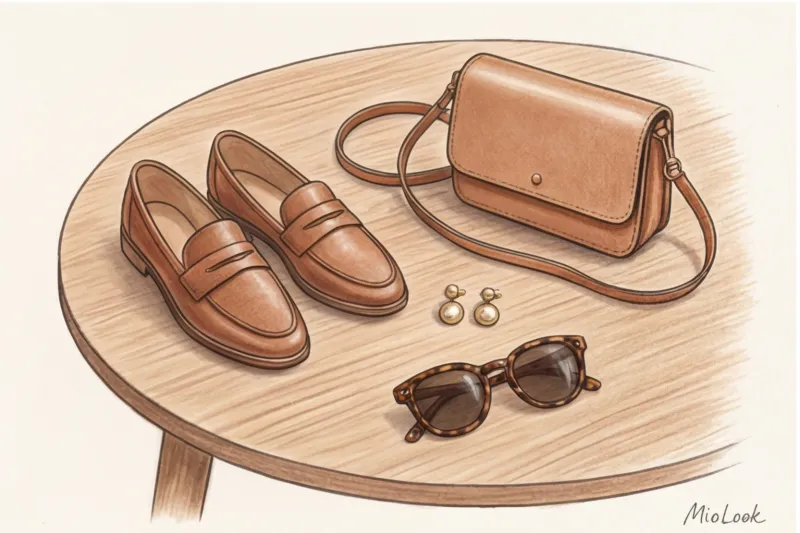
I once experimented with a client: we dressed her in basic jeans and a white T-shirt. In the first version, we added running shoes and a fabric shopper. In the second, we added leather loafers, a rigid crossbody bag, and a minimalist watch. The difference was colossal. Shoes and a bag are the frames that make a painting a masterpiece.
While on maternity leave, sneakers seem like the only option. But trust me, soft suede loafers, Chelsea boots, or minimalist urban sneakers (not for the gym!) are just as comfortable and instantly add a touch of luxury and polish.
When it comes to bags, your choice is the rule hands-free Smooth leather backpacks or high-quality, medium-stiff crossbody bags are recommended. Avoid shapeless duffel bags. Be pragmatic with jewelry: long earrings are dangerous around a baby's clingy hands. Replace them with stylish studs, a couple of smooth rings, and a quality watch with a leather strap.
Summary: Your style is your inner support
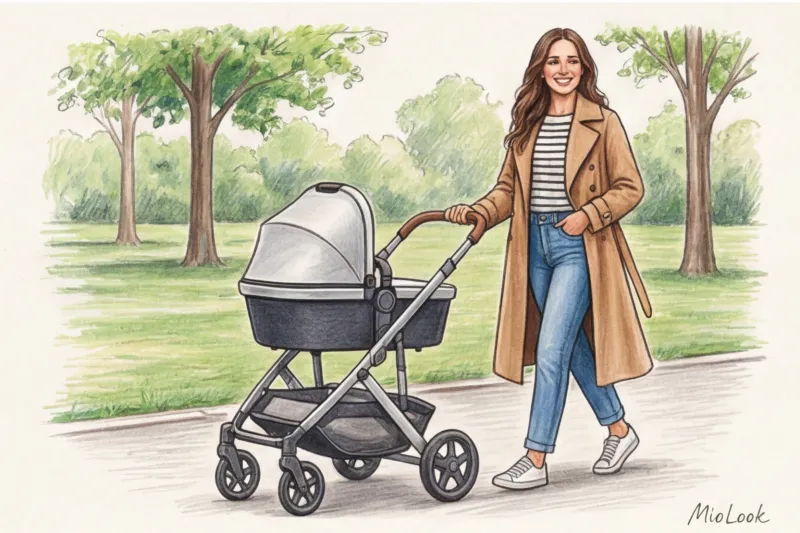
Remember, maternity leave isn't a pause in your life that you have to endure in stretched-out sweatpants. It's a challenging, incredibly energy-consuming, but important period. And how you look in the mirror in the morning directly impacts your mood for the day.
A well-thought-out 15-piece wardrobe isn't about restrictions. It's about freedom. Freedom from morning panic, freedom from endless laundry, and the freedom to be yourself—a beautiful, confident, and energetic woman. Start small: organize just one shelf of your tops this evening. You'll be surprised how much it will change your morning.