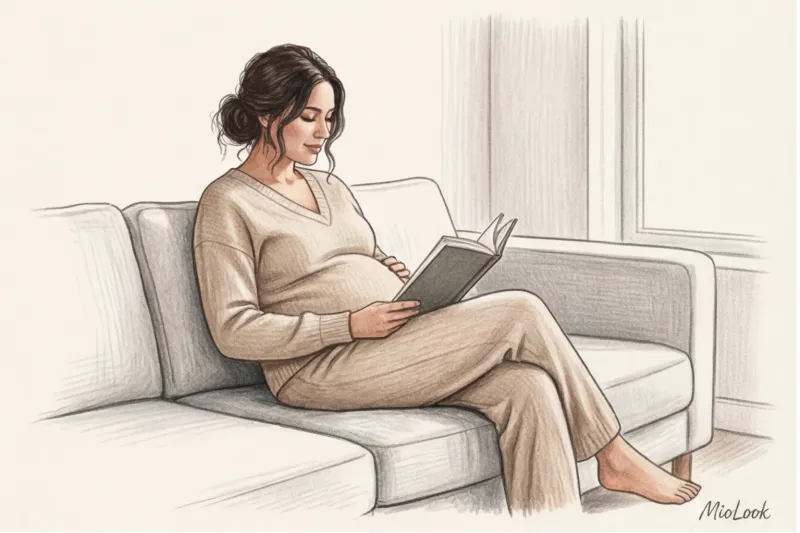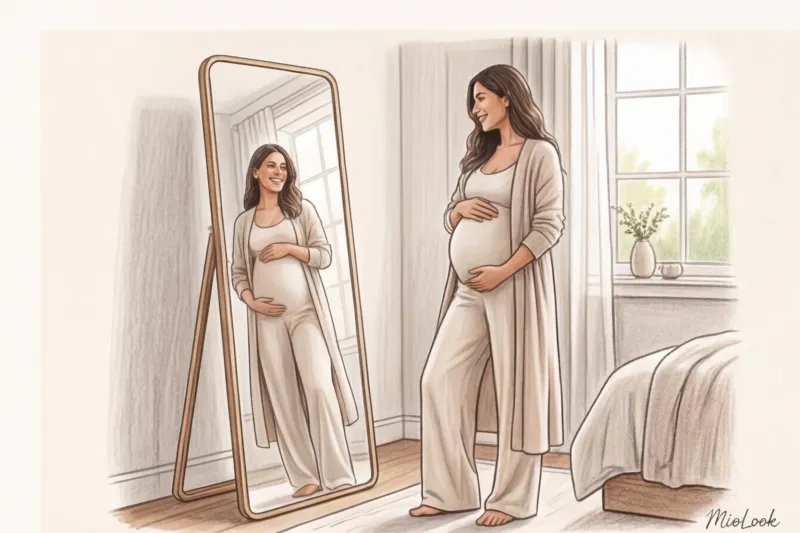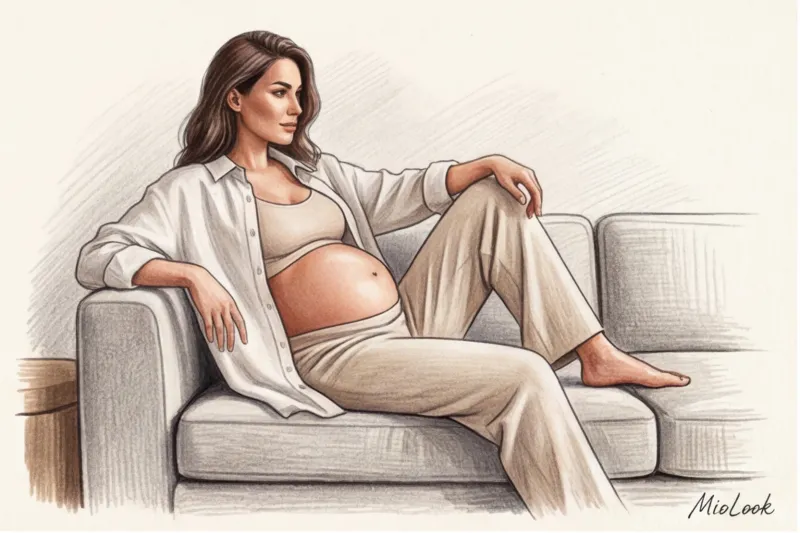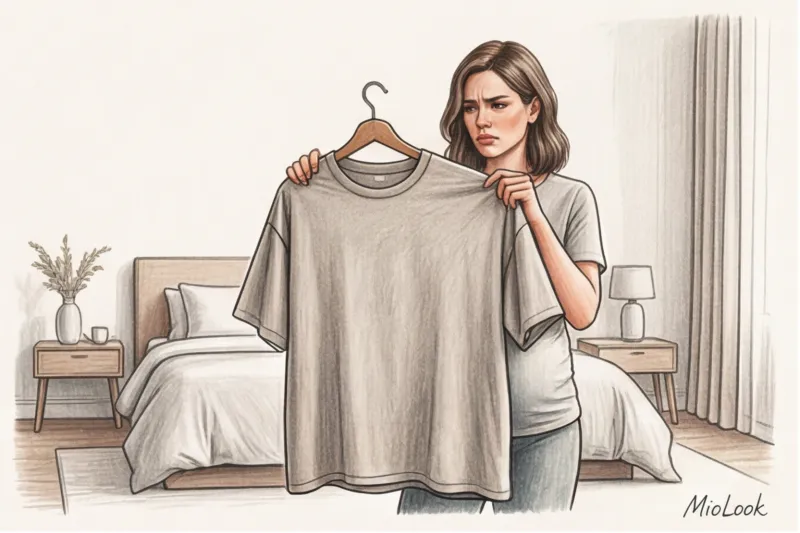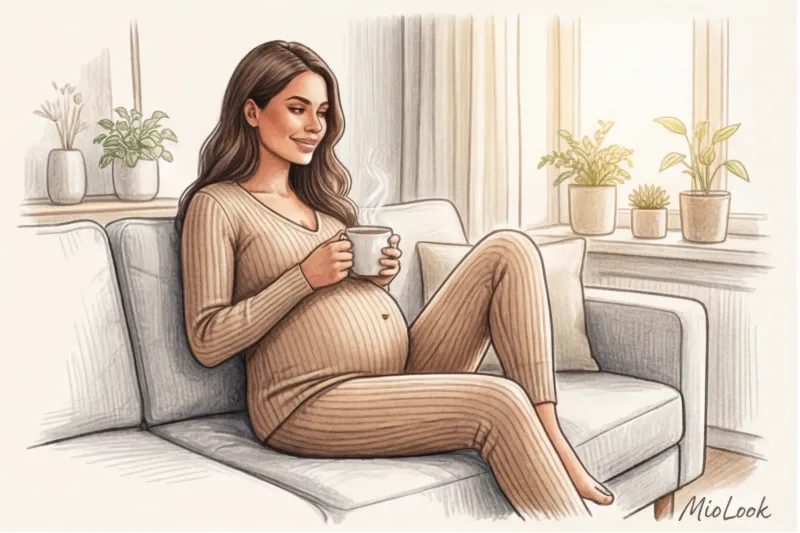
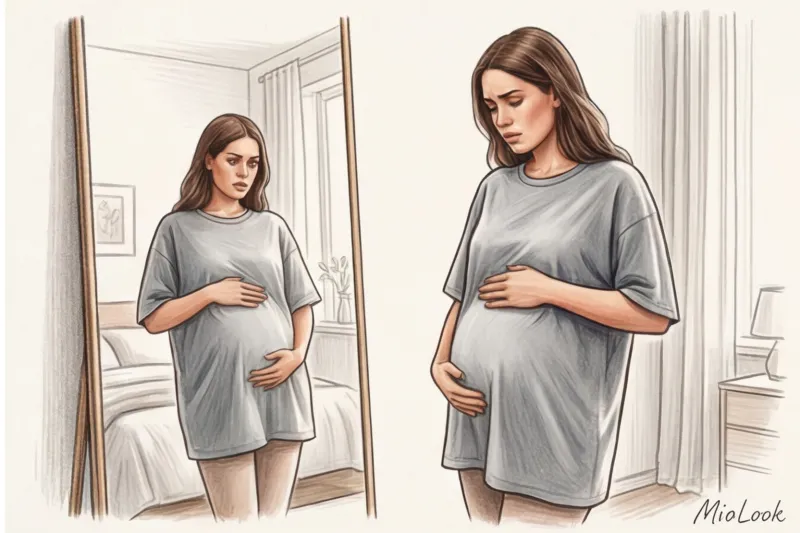
Let's be honest: the moment you return from the hospital isn't just euphoria, it's also incredibly stressful. You're exhausted, your body is experiencing a hormonal storm, and the first thing many of us do upon entering the apartment is pull on an old, stretched-out men's T-shirt or faded sweatpants. The logic is simple: "I'm sitting at home anyway, no one will see me, and I don't mind getting dirty." As a personal stylist with twelve years of experience, I can tell you: this is your biggest mistake. When you search for home clothes for pregnant women Brands often offer us childish teddy bear pajamas or shapeless robes. But you deserve more.
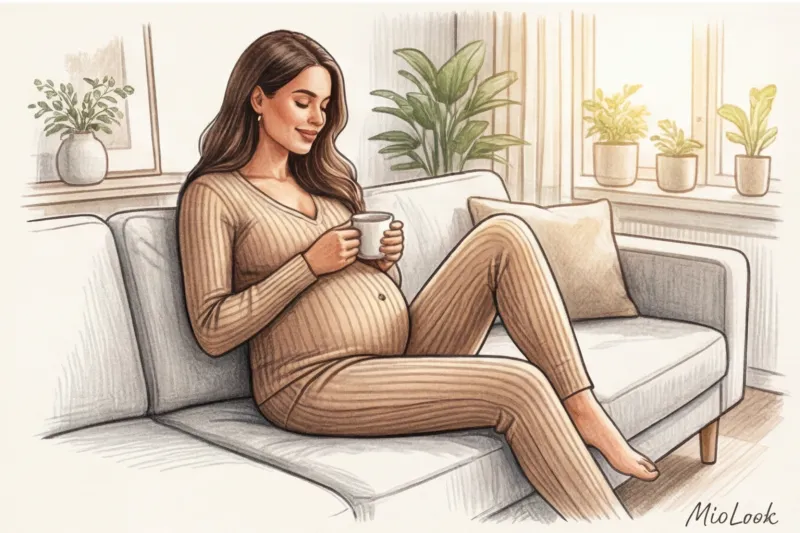
We talked about the basics of database formation in more detail in our The complete guide to creating a stylish home capsule , but maternity leave is a whole different story. Today, we'll explore the math behind a smart wardrobe, dispel the myth of having to buy everything in specialized departments, and learn how to choose clothes you won't be embarrassed to wear when you open the door to the delivery guy.
The Psychology of Maternity Leave: Why the "Husband's T-Shirt" Is Your Main Enemy
Did you know that a woman spends up to 85% of her time at home during the first year of maternity leave? Your home becomes your office, restaurant, and vacation spot all at once. Therefore, your capsule wardrobe is the most worn and most important part of your wardrobe for the coming year.
Researchers from Northwestern University (USA) Hadjo Adam and Adam Galinsky introduced the term back in 2012 Enclothed Cognition (embodied cognition). Their data proves that what we wear directly influences our psychological processes. By putting on shapeless, old clothes, you physically signal to your brain vulnerability, fatigue, and loss of control.
"I had a client, Anna, who literally burst into tears in front of the mirror during our first consultation. She was wearing a washed-out fleece sweatshirt three sizes too big. We completely threw out this 'home archive' and put together a simple capsule of viscose and soft cotton. A month later, she admitted that just looking in the mirror in the morning reduced her postpartum anxiety. She felt like a woman again, not just a function."
Access to MioLook for €0.99 — one-time payment
A smart AI stylist will select the perfect look and help you organize your wardrobe.
Get access — €0.99 onceComfortable maternity homewear: the smart 70/30 formula
The biggest myth in marketing to expectant mothers is the belief that you need to completely change your wardrobe, spending thousands of dollars at specialty stores (which, let's be honest, often overcharge). I suggest the 70/30 formula to my clients.
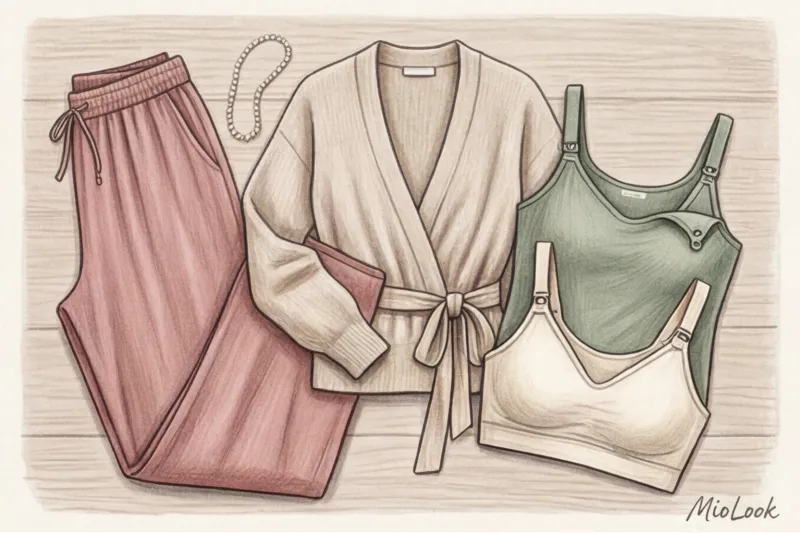
70% of your home capsule Your wardrobe should consist of high-quality basics from regular mass-market or mid-range brands. These include ribbed knitwear, oversized wrap cardigans, and shirt dresses. You'll still be wearing them three years after giving birth.
30% capsules — is a solid investment in functionality: nursing tops with clips, support leggings, and the right seamless underwear.
Let's calculate the cost-per-wear (CPW). Many people shy away from spending €100 on a quality modal lounge suit, preferring to buy three synthetic pajamas for €15 each. But synthetics will pill and start to smell after five washes. Its CPW is €3 per day of wear. A €100 suit will be worn at least 200 times during a year of maternity leave, and its cost will be only €0.50 per day. The mathematics of style always favor quality.
Base (70%): What to look for in regular mass-market departments
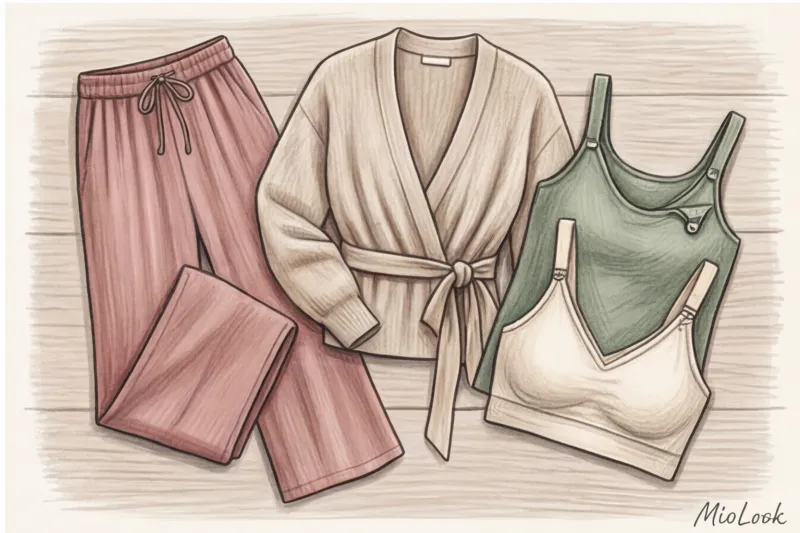
- Ribbed knit suits (noodles): An ideal investment. The fabric's texture stretches over your growing belly, and after childbirth and washing, it returns to its original shape without sagging.
- Cotton shirt dresses and kimonos: Loose fit, easy access to the chest (buttons or wrap). Indispensable for getting ready for the maternity hospital.
- Wrap cardigans: They don't have a rigid button closure. You simply adjust the waistband to suit any waist size.
Workwear (30%): What you shouldn't skimp on
- Nursing tops and bras: Look for models with secure but easy-to-release plastic clips.
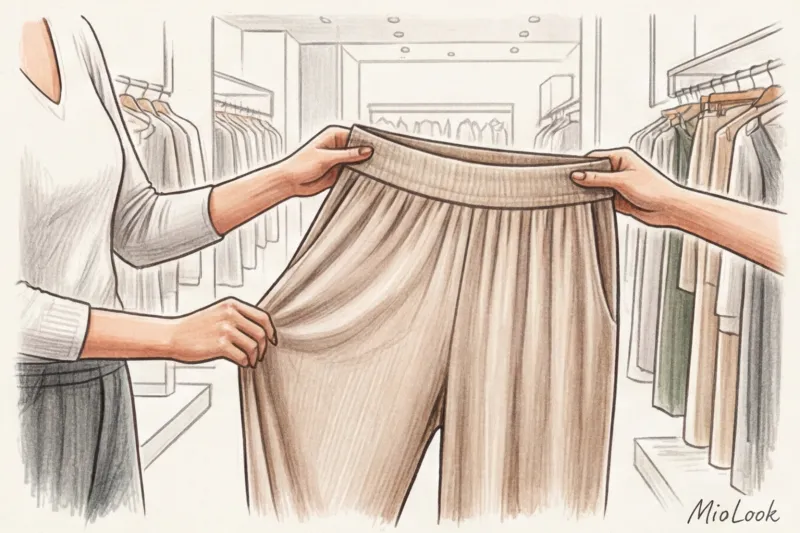
- Home trousers with insert: Choose between under-bump (soft cushion under the belly) or over-bump (high elastic panel over the entire belly).
- Supportive Seamless Sleep Tops: Night lactation requires gentle but firm support without underwires.
Fair Limit: Of course, the 70/30 formula doesn't work for everyone. If you have strict bed rest for medical reasons or severe swelling in your later months, the ratio may shift toward 100% specialized seamless medical underwear.
Fabrics that will survive: baby-safe and easy-care
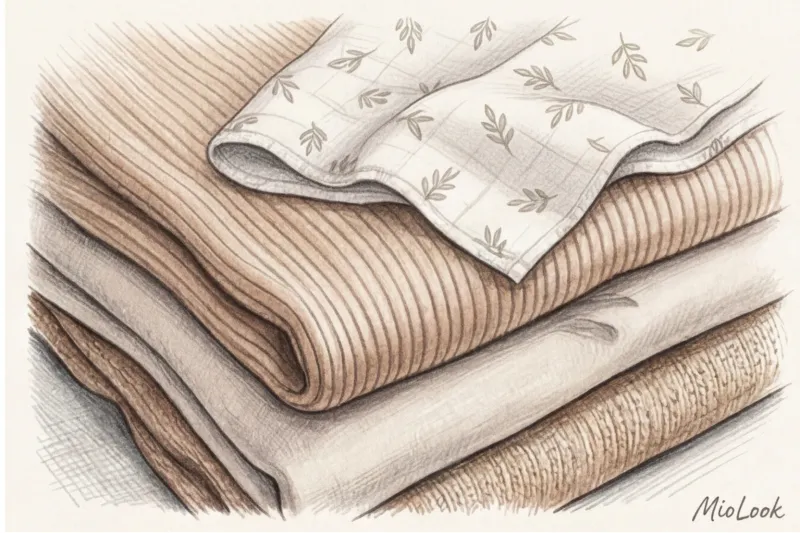
"Buy only 100% cotton!" shouts mommy forums. As a stylist, I strongly disagree when it comes to pants or leggings. Pure cotton has no shape memory. After just two hours of sitting on the couch with your baby, you'll end up with stretched-out "bubbles" at the knees. The ideal composition for lounge pants is 90-95% heavyweight cotton or viscose and 5-10% elastane.
Modern artificial fabrics made from natural raw materials deserve special attention: modal, viscose and lyocell (Tensel) According to textile research, Tencel absorbs moisture 50% more effectively than cotton. For women experiencing night sweats after childbirth, it's a real lifesaver. These fabrics also feel pleasantly cool on the skin.
Pay attention to the certificate OEKO-TEX Standard 100 What does this mean? This European standard guarantees that textiles are free of harmful dyes, heavy metals, and formaldehyde. Remember: during the first few months, your baby literally lives on your chest, burying their face in your T-shirt. Dye safety here isn't a marketing ploy, but a necessity.
And finally, the wash crash test. Your capsule must be machine washable at 40-60 degrees Celsius. Breast milk stains, spit-up, and lanolin-based creams—delicate silk, which requires hand washing, won't survive maternity leave.
Your perfect look starts here
Join thousands of users who look flawless every day with MioLook.
Get access — €0.99 oncePutting Together a Capsule: 8 Ideal Items for Combinatorics
To avoid racking your brain over what to wear in the morning when you've only had three hours of sleep, put together this wardrobe kit. Eight well-chosen items will give you up to 15 different combinations. If you have trouble visualizing the combinations, simply upload photos of the items to the Smart Wardrobe feature via MioLook app , and the algorithm will itself offer you images for the week.
- Two basic nursing tops (milky and graphite).
- Loose shirt made of softened linen or heavy cotton (worn unbuttoned over a top).
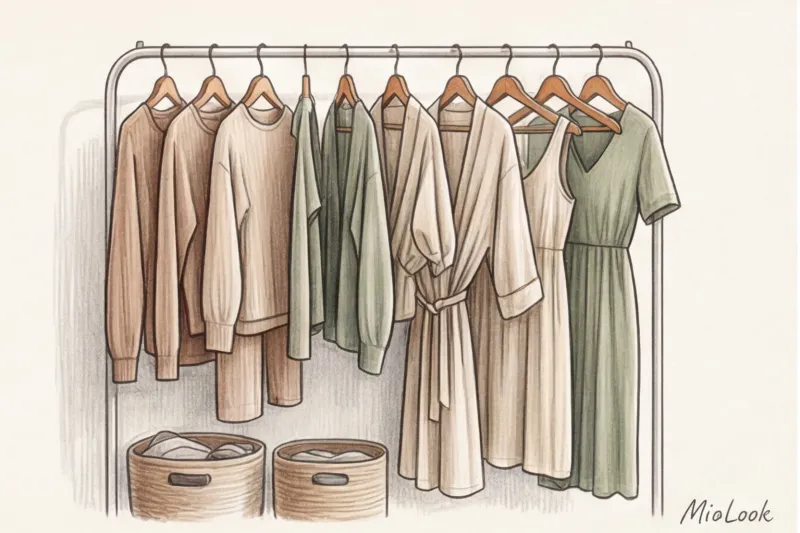
- Long soft cardigan smooth knit.
- Knitted palazzo pants on a soft wide drawstring under the belly.
- Joggers made of fleece with elastane for cool evenings or quick trips to the balcony.
- Robe-dress or long kimono made of viscose - a salvation when you need to quickly throw something beautiful over your underwear.
- Seamless knit midi dress (noodles) This is your heavy artillery for entertaining guests, visiting relatives, or a beautiful weekend at home with your husband.
Where to Shop: A Stylist's Guide to Brands (Oysho, COS, H&M, Zara Home)
Over the years as a personal shopper, I've tested hundreds of brands. There's no need to reinvent the wheel—the best solutions have already been found in a familiar price range.
Oysho — the absolute leader in the modal and seamless underwear category. Their fabrics flow, retain color, and look luxurious.
COS and Massimo Dutti — We come here for premium knitwear (that same cardigan or ribbed dress) that won't pill after a month. Yes, it's more expensive, but CPW makes it worth it.
H&M Mama — the perfect place to buy specialized essentials. I personally tested their nursing tops (multipacks) in the fitting rooms: the clips are easy to unclip with one hand, which is crucial when you're carrying a baby on your other arm.
Zara Home and Mango Home — here you should look for aesthetically pleasing linen and cotton kimonos and oversized shirts.
Uniqlo (Airism line) — their non-wired bra tops have long been an unspoken hit among pregnant women thanks to their phenomenal support and cooling effect.
5 Fatal Mistakes When Choosing Home Clothes While on Maternity Leave
Even with a good understanding of the theory, it's easy to give in to impulse and make a mistake. Here are the top 5 anti-patterns I regularly cleanse from my clients' closets:
- Buying ordinary things "just 3 sizes bigger." It's counterintuitive, but oversized clothes make a pregnant woman look bulky. If you wear a size M, buying an XXL will cause your shoulders to slip down, your armholes to sag, and you'll visually add 10 kg. Buy your size M, but with a tailored fit (wrap, high waist) Empire Line ) or made of super-elastic fabric.
- The bet is on black as the “most practical” color. Forget about it. Black loungewear instantly shows dust, cat hair, and, most importantly, light stains from spit-up and dried breast milk. The most practical colors for the home are marled gray, muted sage, beige, and taupe.
- Rigid seams and synthetic lace. During pregnancy and breastfeeding, a woman's skin becomes hypersensitive due to hormones. What once seemed like a cute, lacy decoration will now feel unbearably itchy.
- Complex fastenings on the back or small buttons. A nursing mother should be able to unbutton a garment with one hand, at three in the morning, in complete darkness. If her husband's help is needed, the garment is thrown out.
- Clothes that fit your figure, purchased in the third trimester. When choosing clothes before giving birth, women often forget that after giving birth, the belly doesn't go away right away, while breasts, on the contrary, increase by 1-2 cup sizes due to the influx of milk. Plus, you'll need space for nursing pads. Leave some extra room in the décolleté area.
Checklist: Checking Your Wardrobe Before the Maternity Hospital
Before you go shopping, take stock of what's already on your shelves. Ask yourself just one question—the "unexpected courier test." Imagine that right now a delivery courier rings your doorbell, or your mother-in-law pops in unannounced. Are you ready to open the door in what you're wearing? If you feel the urge to frantically change, throw it out.
- Ruthlessly dispose of anything with permanent stains, sprained knees, or holes. A home is not a dumping ground for damaged items.
- Leave only those items that are easily machine washed and absolutely do not require ironing.
- Collect 2-3 ready-made sets (bottom + top + cape), put them in a stack.
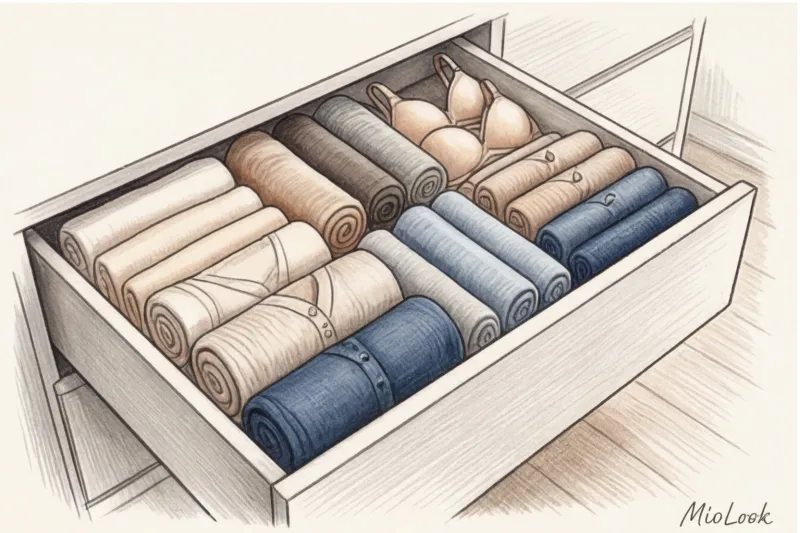
Remember the most important thing: maternity and nursing home clothes are not a temporary, necessary measure. They are your personal comfort armor. During this time when you're devoting all your resources to a new person, let the right clothes take care of you.