One day, a client of mine wrote me in a panic from her vacation in Dubai: "Olena, my 300-euro bottle of Baccarat Rouge has gone bad! It smells so strongly of burnt sugar and hospital iodine that it's giving me a headache." Spoiler alert: the perfume was perfectly fine. The 35°C (95°F) temperature in the shade and the 90% humidity of the Persian Gulf were to blame.
In 14 years of working as a stylist, I've learned one important thing: we can perfectly select the cut of a jacket and fine-tune the wardrobe palette, but the wrong fragrance will ruin the whole impression. How perfume unfolds depending on the weather , is not marketing magic, but pure physics and chemistry. We discussed the basic principles of seasonality in more detail in our the complete guide to choosing fragrances , and today let's look at how exactly temperature changes the molecules of your favorite perfume and how to pair it with the fabrics of your wardrobe.
The Physics of Fragrance: Why Perfume Changes Its "Face"
Any perfume is a mixture of ethyl alcohol, water, and aromatic substances (essential oils and synthetic molecules). According to the laws of thermodynamics, the rate of alcohol evaporation directly depends on the ambient temperature. But that's not all.
According to The Fragrance Foundation, each note in the olfactory pyramid has its own molecular weight. Citrus and green notes are the lightest. Floral and fruity notes are medium. Resins, oud, musk, and vanilla are the heavyweights. Under ideal conditions (room temperature 21°C and normal humidity), the pyramid unfolds gradually, as the perfumer intended. But step outside, and the rules change.
Temperature: Why do perfumes "fly off" in the heat and "hide" in the cold?
Imagine your skin as a radiator. On a hot day, it heats up, and light molecules (like bergamot or lemon) literally bounce off it, evaporating 2-3 times faster than usual. But the heavier base notes begin to melt and scream, filling the entire space.
In winter, the opposite happens. Perfume "freezes" on cold skin. The alcohol evaporates slowly, leaving the scent flat and monotonous, often revealing harsh, metallic, or soapy nuances. The base notes may not even awaken until you step into a warm room.
Humidity: The Invisible Loop Booster
Humidity acts like a magnifying glass for perfume. Water molecules in the air trap scent particles and prevent them from settling quickly. This is why, in the rain or in tropical climates, even a light eau de toilette leaves a dense, mile-long trail.
But dry air (thanks to office air conditioners in the summer and central heating in the winter) is the main enemy of longevity. In a dry environment, moisture evaporates from the skin instantly, taking the scent with it.
Summer heat and high humidity: saving your favorite bottles
Here I want to debunk one of the biggest perfume myths. For years, glossy magazines have been telling us, "Summer is here—buy fresh citrus scents." This is fundamentally untrue for extreme heat (28°C and above).
"Fresh citrus scents are the worst choice for hot weather. Due to their minimal molecular weight, they disappear on hot skin in exactly 15 minutes. You'll be dousing yourself with them every hour, risking irritation from the alcohol in the sun."
What to do? A counterintuitive tip I give my clients: in the summer, try microdoses of dry woods (sandalwood, cedar) or white florals (jasmine, tuberose). On hot skin, they become creamy, soft, and blend with your body odor.
Access to MioLook for €0.99 — one-time payment
A smart AI stylist will select the perfect look and suggest how to perfectly accentuate your style.
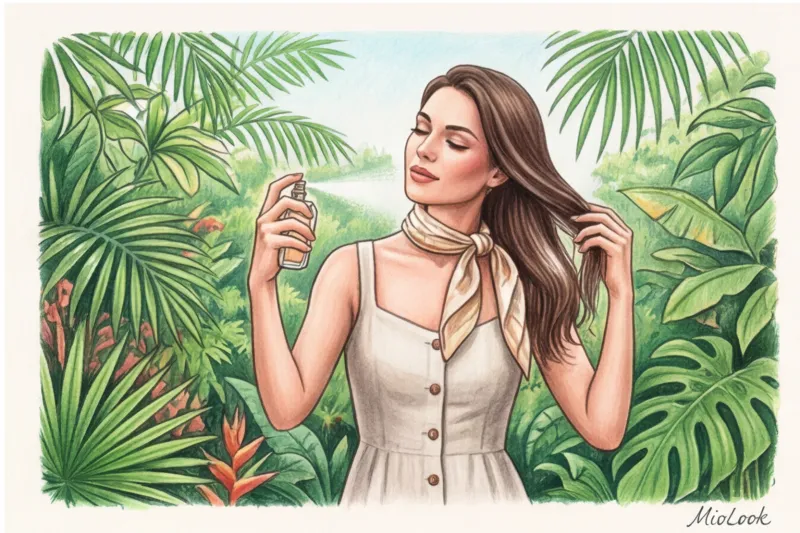
Get access — €0.99 onceLet me clarify right away: this does NOT work with heavy gourmands (vanilla, praline, caramel). In hot weather, such notes can be physically suffocating for you and those around you. If you can't live without citrus, apply it not directly to your skin, but to the inside of a cotton T-shirt or your hair—the temperature is lower there, and the scent will last longer.
Frost and dry winter air: how to make perfume smell
Have you ever noticed how your favorite delicate floral perfume suddenly smells like cheap air freshener in the winter? There's a scientific explanation. In dry, frosty air, human olfactory receptors lose up to 30% of their sensitivity. We literally lose our sense of smell.
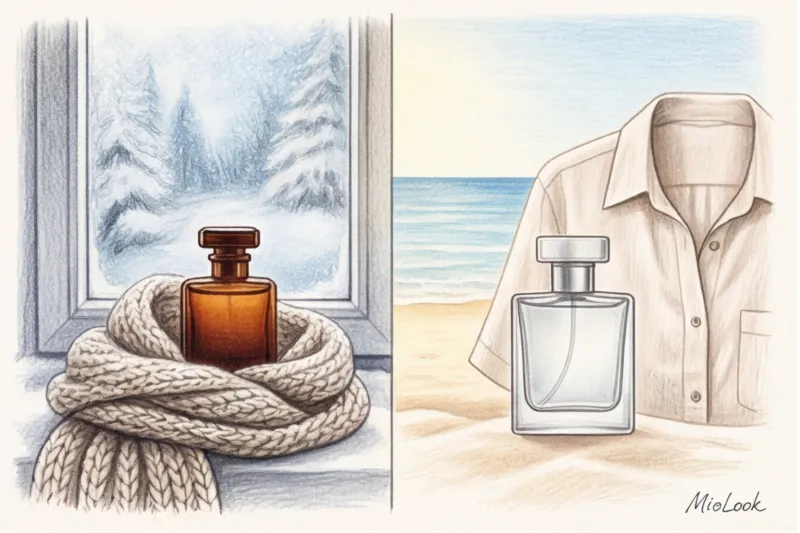
Winter is the season for heavy artillery. Amber, oud, rich vanilla, leather notes, hot spices (cinnamon, cardamom). What seemed vulgar in summer now smells like a cashmere blanket in the cold. The cold air cuts away their excess sweetness, leaving a noble, warming framework.
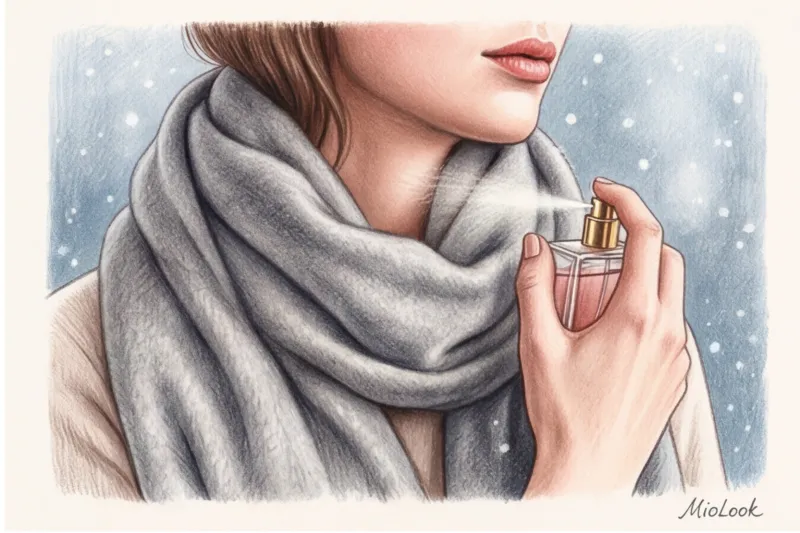
This is where our wardrobe comes in handy. Dense fabrics (merino wool, cashmere, heavy cotton over 200 g/m²) are excellent at trapping heavy molecules. Your scarf can retain its base notes for weeks. The main rule is to avoid mixing different perfumes on the same scarf, otherwise you'll end up with a confusing cacophony.
The off-season: the perfect time for complex compositions
Spring and early autumn (temperatures of 10–15°C and moderate humidity) are the golden age of perfumery. It is under these conditions that creators test fragrances in the laboratories of Grasse.
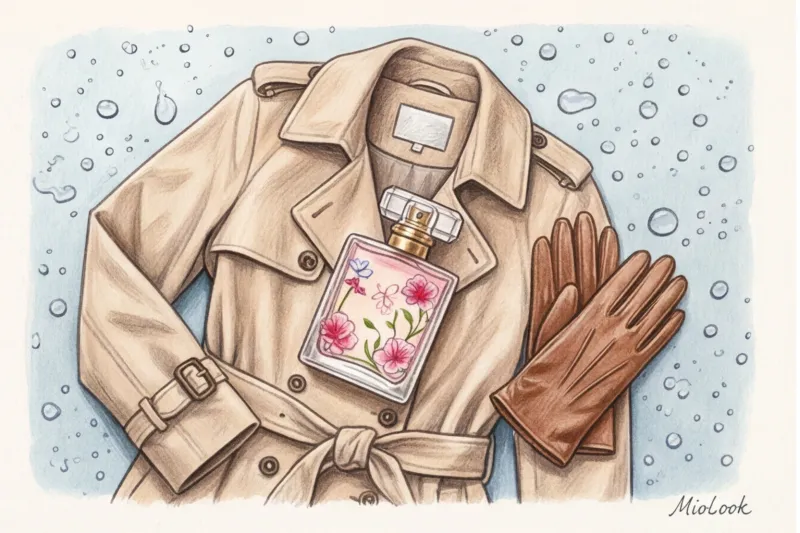
The off-season brings forth the most capricious fragrance families: chypres (aromas based on oakmoss, patchouli, and bergamot) and complex aldehydes. They require cool, yet humid air to reveal their full potential. A spring breeze acts as the perfect diffuser, creating a long, shimmering trail that's not stifling, but intriguing.
Your perfect look starts here
Join thousands of users who look flawless every day with MioLook. Create capsule looks for any season.
Get access — €0.99 oncePerfume Wardrobe: How a Stylist Matches Fragrance to Fabric
As a stylist, I always view perfume as an invisible element of clothing. In the appendix MioLook At , where we digitize wardrobes, I often recommend that clients match their scents not only to the weather but also to the texture of their fabrics. There's a golden rule of proportionality: the fragrance's density should match the fabric's density.
- Silk, chiffon, thin viscose: They call for watercolor-like, translucent compositions. Green tea, freesia, peony, light white musk. A heavy oud scent will overpower the lightness of a silk slip dress—it creates a visual and olfactory dissonance.
- Linen and poplin: Pairs well with dried herbs, vetiver, fig and unsweetened citrus.
- Tweed, heavy denim, cashmere: Structure is essential here. Woody notes (sandalwood, cedar), patchouli, tobacco, and rich resins. A Chanel-style tweed jacket is perfectly complemented by classic aldehydes or iris powder.
- Smooth leather (jackets, trench coats): An ideal base for leather perfumes, suede notes, saffron and strong black tea.
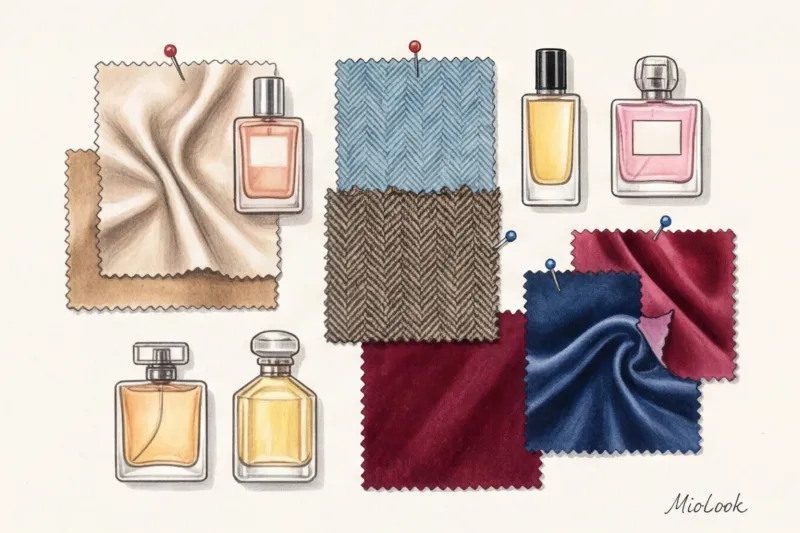
Try this experiment: put on a tailored, heavy wool suit (for example, from Massimo Dutti or COS) and spray on a light, fruity scent. You'll immediately notice how the scent "cheapens" the look. Conversely, a complex, woody fragrance will make basic jeans and a white shirt look more classy.
Checklist: 5 Rules for Applying Perfume During Sudden Weather Changes
Theory is great, but let's move on to practice. Here are 5 steps I recommend taking when the weather outside changes drastically:
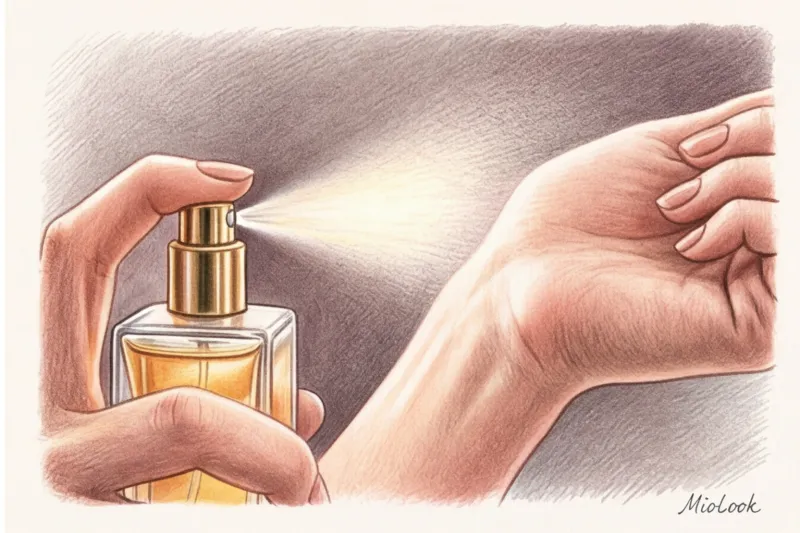
- Moisturizing is the basis of longevity. In dry weather (hot summer or frosty winter), apply perfume only to damp skin. Use an unscented base lotion (such as CeraVe). Fragrance fades quickly on dry skin.
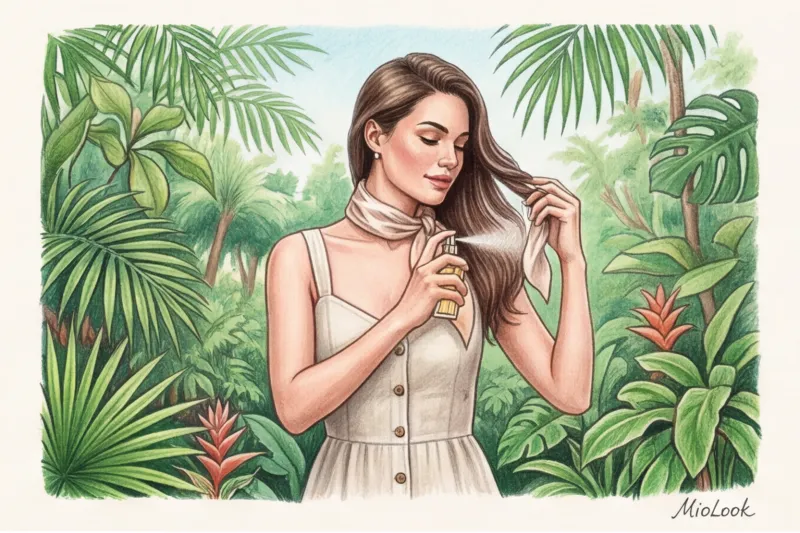
- The "cloud" rule for heat. If you don't want to give up your favorite, yet strong, perfume this summer, don't spray it directly. Spray it once into the air in front of you and step into the mist. The micro-droplets will settle on your hair and clothes, giving a subtle hint of the scent.
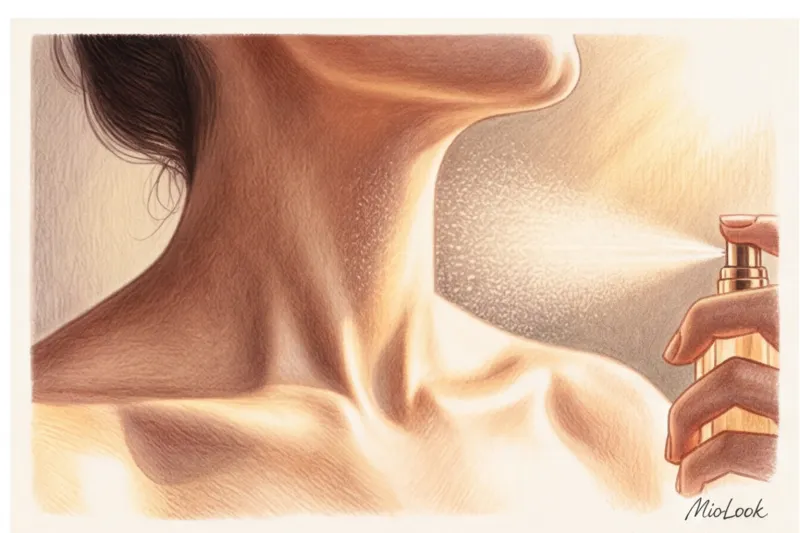
- Changing pulsation zones. In cold weather, apply perfume to the hottest spots: the sternal notch (between the collarbones) and the back of the neck under the hair. In hot weather, move to cooler areas: the outer forearm and the folds of the knees.
- Be careful with fabrics. I must warn you: never spray perfume (especially Eau de Parfum) on white silk, light-colored suede, or fine viscose. Essential oils will leave yellow stains that no dry cleaner will remove. Apply perfume before putting on a light-colored blouse.
- Play with concentration. The same fragrance often comes in different versions. Save Parfum and Eau de Parfum for winter and late fall, and for summer, buy the same fragrance as an Eau de Toilette or a special hair mist (Hair Mist)—they contain less alcohol and won't dry out your hair in the sun.
Ready to get started?
Try the free plan—no commitments required. Organize your wardrobe and find the perfect fragrance pairings.
Get access — €0.99 onceConclusion: Your fragrance is a smart accessory
Weather does dictate its own rules, but understanding the physics of scent puts control back in your hands. You'll no longer wonder why an expensive bottle suddenly smells flat, or why a light spray is suffocating your colleagues at the office.

Treat your perfume shelf the same way you treat your seasonal wardrobe. You wouldn't wear a linen sundress in a snowstorm or wrap yourself in cashmere in July, would you? Your perfume deserves the same thoughtful approach. Analyze your bottles tonight: sort them by density and match them to the current season. You'll be surprised how familiar compositions will sound new, expensive, and prestigious if you give them the right temperature and the right fabric.