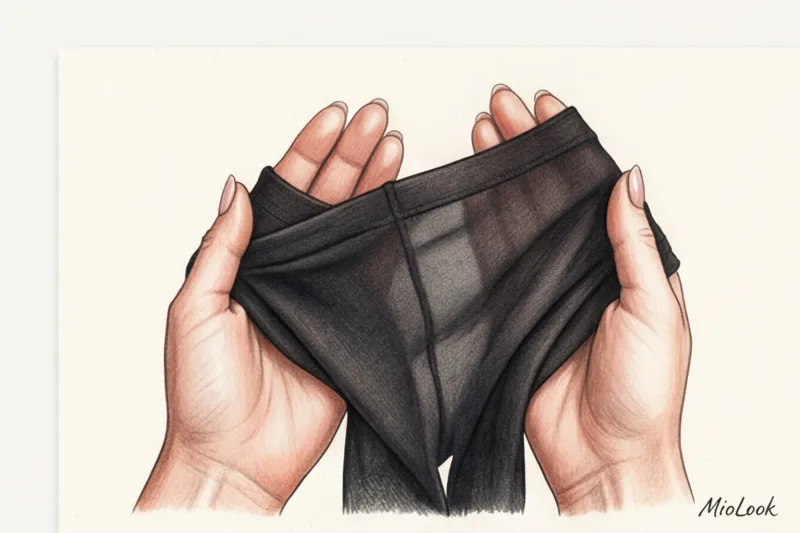
Recently, a client of mine, the CFO of a large company, came to me for a consultation completely disillusioned. She'd bought a pair of luxurious opaque Wolford tights for €60 specifically for an important presentation. She wore them once, washed them in the sink with soap as usual that evening, and in the morning, discovered that the premium matte texture had disappeared. In its place, a cheap, "plasticky" sheen had appeared, instantly ruining the entire look. The fault lay not in the quality of the product, but in the aggressive rubbing that had destroyed the structure of the polyamide.
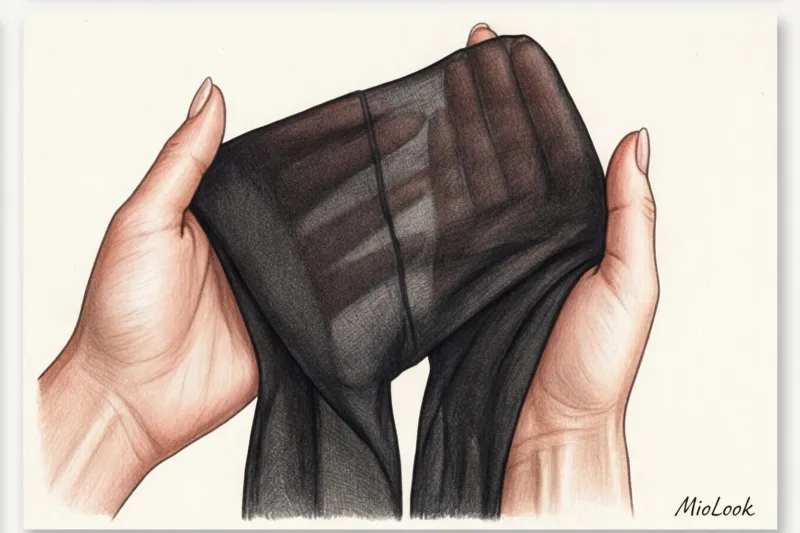
Most women don't think about it, How to wash nylon tights It's right to treat them as a consumable item that lasts two or three wears at most. But as a stylist, I'm absolutely certain: the problem isn't the fragility of nylon, but the complete lack of care. We've already discussed the intricacies of etiquette and choosing the right density in our The Complete Guide: How to Choose the Right Tights: Etiquette and Style And today I want to talk about how to make your favorite pairs last for months while maintaining their original aesthetics.
Why nylon loses its appearance: how washing affects the "status" of an image
Over 12 years of working with wardrobes, I've noticed a pattern: nothing cheapens even the most carefully crafted outfit like the wrong pair or washed-out tights. I was once putting together an outfit for a client: a €2,500 cashmere Loro Piana coat, a perfect wool sheath dress, leather pumps... and then tights that, after a couple of improper washes, had micro-pull marks and acquired a satin sheen where they should have been completely opaque. The entire veneer of "quiet luxury" vanished in an instant.
The thing is, premium matte tights have a special 3D knit and microstructure. When you rub them with your hands or wash them with harsh detergent, you literally micro-peel the polyamide. The smooth thread frays at a microscopic level, begins to refract light differently, and that cheap sheen appears.
I always encourage my clients to consider their cost per wear. Premium tights costing €40–€50, with proper care, will last 30–40 washes, costing you €1 per wear. Cheap €5 tights from the supermarket will rip on the second day. The mathematics of elegance always favor quality and proper care.
The Biggest Myth: Hand Wash vs. Machine Wash
Now I'm going to say something that mothers and grandmothers might judge me for: forget about hand washing nylon tights if you have a modern washing machine.
Yes, packaging often says "hand wash only." But let's be honest: how exactly do we hand wash? We rub the fabric together, and then—the worst part—we wring it out to squeeze out the water. It's this uneven hand wringing that breaks the elastane fibers. Pulling the tights too hard irreversibly deforms the fiber. The result? Tights that sag at the knees and bunch up at the ankles.
Six months ago, I conducted a personal experiment: I bought two identical pairs of Falke tights for €35. I washed one pair exclusively by hand using the classic "home" method, and the other in the washing machine using my own system. I tracked each wear in the app. MioLook For data integrity. Result: the hand-washed pair lost their fit and developed micro-pull after 14 washes. The machine-washed pair withstood 32 washes without losing their elasticity.
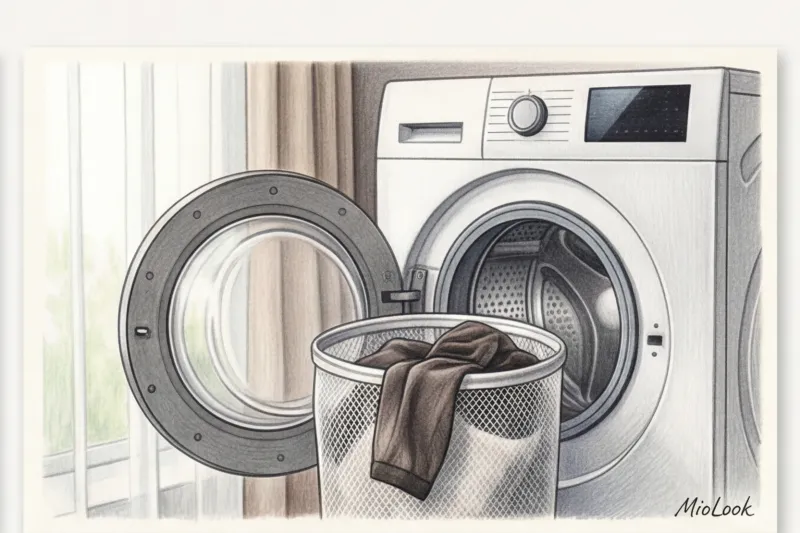
How to wash nylon tights in the washing machine without risk
To ensure your washing machine becomes your ally and not your elastane's killer, it's essential to follow strict protocol. Throwing nylon into the drum without a reason is guaranteed to ruin the product.
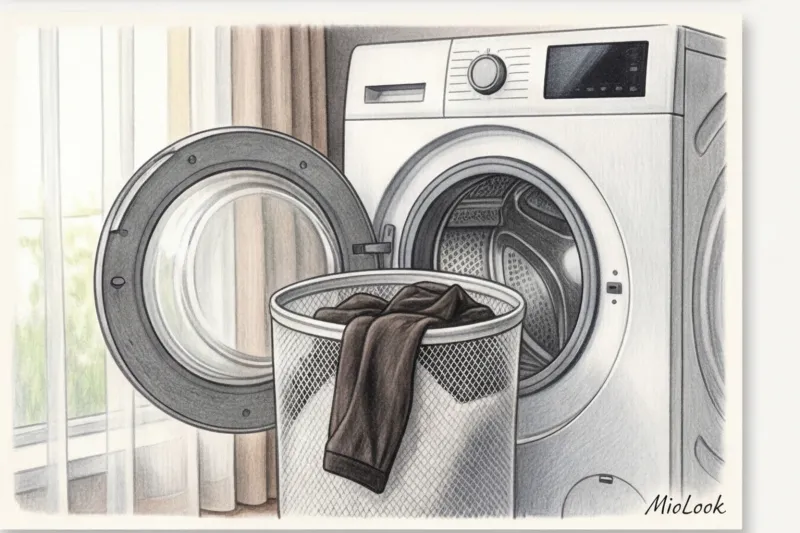
- Frame bag: Use only laundry bags with a rigid plastic frame (like those for bras) or very fine, dense mesh. Regular large-mesh bags won't protect against friction in the drum.
- Insulation: It's strictly forbidden to wash nylon in the same cycle as jeans (the stiff fabric acts like sandpaper), items with zippers, Velcro, or bras with hooks. One accidental touch of a hook and a run is guaranteed.
- Settings: Temperature: strict 30°C. Spin: turn off completely or set to minimum (no more than 400 rpm). Use "Silk" or "Delicate Wash" cycle.
Proper hand washing: when a machine is not available
If you are staying in a hotel or don't have a washing machine at hand, you should wash by hand using the "soak and squeeze" technique, not the "friction" technique.
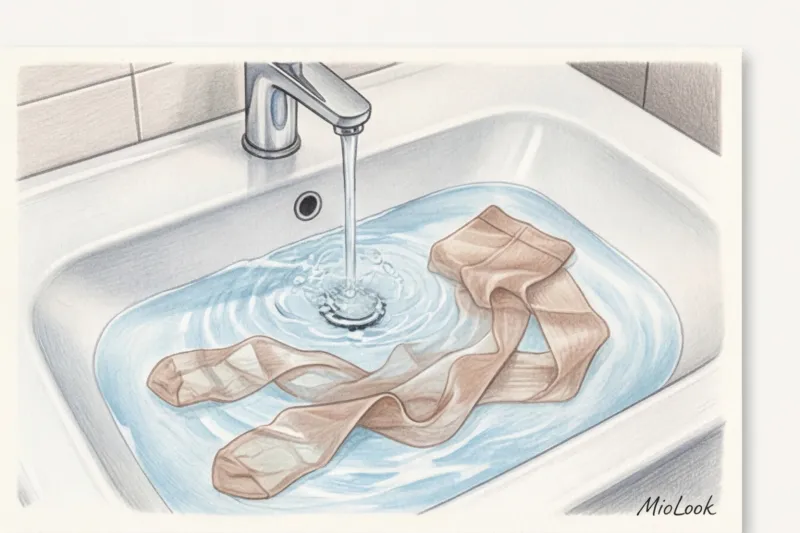
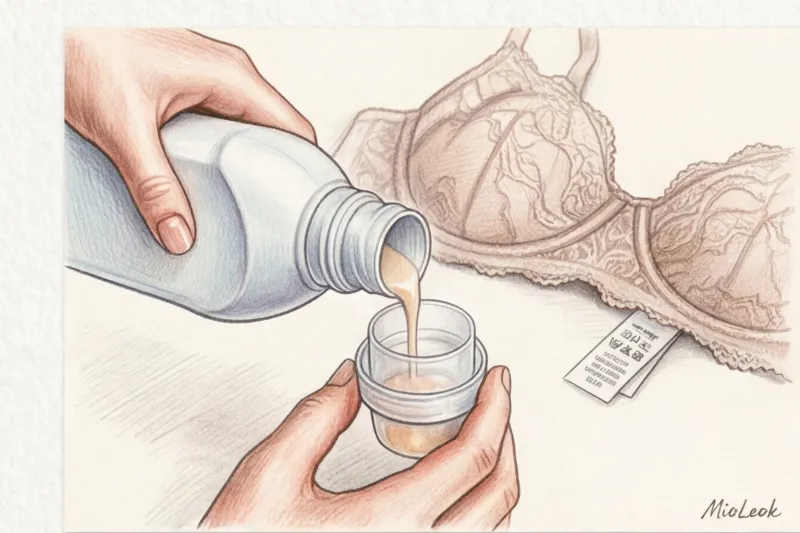
- Dilute liquid detergent for delicate fabrics in cool water. Lather the water BEFORE adding the tights.
- Immerse the product and leave for 10-15 minutes.
- Gently squeeze the tights in your palms, forcing the water through the fibers. No friction between your hands!
- Rinse thoroughly in two waters (residues of the product destroy the fibers).
- Towel trick: To wring out the water, lay the tights on a dry terry towel, roll the towel and the tights into a tight roll, and press gently. The towel will absorb excess moisture and prevent the elastane from stretching.
Your perfect look starts here
Join thousands of users who look flawless every day with MioLook. Digitize your wardrobe and create stylish combinations in just a few clicks.
Get access — €0.99 onceTemperature and means: the chemistry of preserving elastane
According to technologists at European hosiery brands, at water temperatures above 40°C, elastane loses up to 30% of its elasticity in just one wash cycle. High temperatures literally "cook" the synthetic fibers, making them brittle and losing their ability to return to their original shape.
The choice of detergent is no less critical:
- Dry washing powders are an absolute no-no. They contain micro-abrasives (insoluble granules) that remove the matte coating from the threads, like a micro-scrub.
- Ideal choice: Liquid gels for delicate fabrics, silk, or wool. They gently coat the fibers and rinse out without leaving any residue.
- Fabric softeners: Another invisible enemy. While fabric softener is soft for cotton towels, it's deadly for nylon. Silicones and softeners in fabric softener coat the elastane fibers with a film that blocks their ability to stretch and shrink. This causes tights to slip. Furthermore, fabric softener often leaves whitish stains on thick, dark tights.
How to dry tights so they don't lose their shape
One of the most painful moments in my practice is watching women dry washed, expensive tights on a hot radiator or by hanging them over a drying rack. The heat from the radiator destroys the elasticity of the nylon in 10 minutes. You're overdrying the thread, and the next time you wear it, it'll simply snap from the strain.

Hanging tights by the toe or waistband is also a no-no. Nylon, weighed down by water, will stretch under the influence of gravity. The only correct method is to dry them flat.
Lay a dry towel on a flat surface (table, bed, horizontal drying rack) away from direct sunlight. Spread the tights out without stretching them. Under the right conditions (room temperature around 22°C), they will dry in 2-3 hours. Avoid using any "emergency" methods such as a hair dryer.
Storage Architecture: How to Organize a Tights Drawer
Manufacturer statistics show that about 80% of snags and runs don't occur while you're wearing them, or even while washing them. They appear in your dresser drawer. That "common pool" where tights share space with bras, belts, and skirts is the perfect breeding ground for invisible snags.
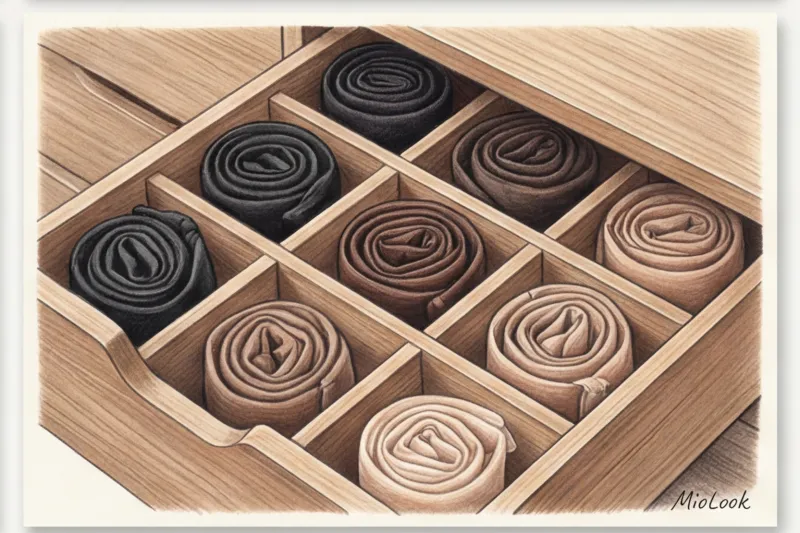
I teach my clients a storage system that not only saves things but also saves time in the morning:
- No knots or twisting: Many people fold their tights in half and pull the elastic band over the top to create a "ball." This is a fatal mistake—the elastic is constantly taut and quickly becomes deformed. The correct solution is to fold the tights in half lengthwise and roll them into a soft "roll" from the toe to the waistband.
- Individual zip-lock bags: This is my favorite life hack. Store each pair in an individual Ziploc bag. Firstly, it completely eliminates friction. Secondly, you can write the density and color right on the bag with a marker: "40 denier, matte, mocha." No more unwrapping five pairs in the morning to find the right one.
- Cellular organizers: If zip-lock bags seem inconvenient, try fabric honeycomb organizers. Each cell holds one pair.
If you want to go further in organizing, the virtual wardrobe feature in MioLook Allows you to track how many basic pairs you have on hand so you can replenish your stock in time and avoid being left with only one torn pair before an important meeting.
Ready to get started?
Try the MioLook plan for free—no commitments required. Digitize your wardrobe, plan your looks, and save time every morning.
Get access — €0.99 onceSOS situations: can nylon with a micro-hook be saved?
We've all been in that situation where we notice a tiny puff just before we go out. What should we do?
If a microscopic snag appears (the thread has come out, but the flick hasn't started yet), it can be fixed. The classic method with clear nail polish works, but it makes the area stiff. It's better to use a special fabric glue to stop flicks (it remains flexible after drying) or spray the snag with strong-hold hairspray.
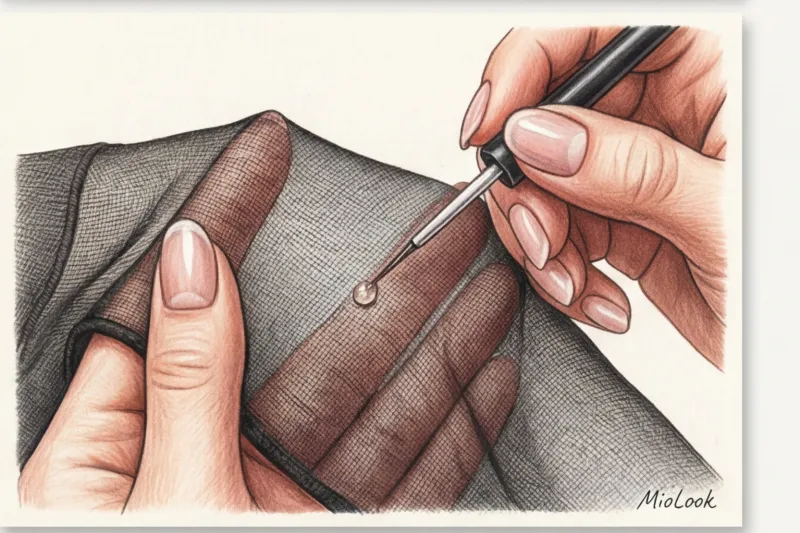
But here I have to make an honest stylist confession: This only works for invisible areas. (Under a skirt, on the toe, if closed-toe shoes). If a run or tear appears in a visible place—on the shin, knee, or thigh—the item goes in the trash. No nail polish can hide a texture defect. Your reputation and the status of your look are always worth more than the €10–€20 saved on a new pair.
Checklist: Routine Care for Statement Tights
To reinforce this lesson, let's create a habit. Caring for premium nylon should be as automatic as removing makeup in the evening.
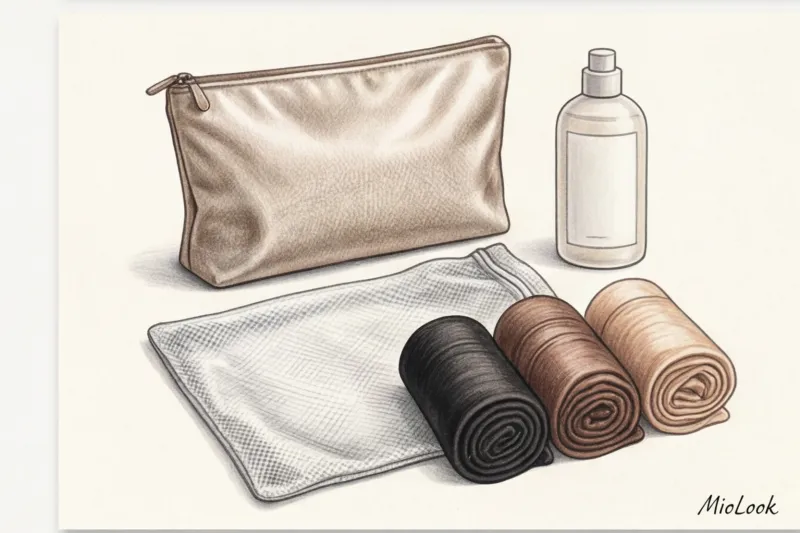
- Remove rings and bracelets. Before removing tights from the packaging or drawer, remove all jewelry. We put more than half of our own diamonds in our tights.
- Soften your hands. If you have dry cuticles or hangnails, apply a light hand lotion and let it soak in for a couple of minutes before putting on tights. Rough skin can easily snag thin nylon stockings.
- Remove carefully: Roll the tights down your legs, do not pull them by the toe or waistband.
- To the wash - straight away: Sebum breaks down elastane. Wash your tights (in a bag at 30°C) after each wear; don't let them sit in your hamper for weeks.
- Dry flat and label: Dry it on a towel, roll it up, and put it in a labeled zip-lock bag.
Changing your approach to basics changes the entire feel of your wardrobe. By stopping treating tights as disposable trash and implementing these simple washing rules, you'll discover that premium tights aren't a waste of money, but the most profitable investment in your personal perfection.