A client once came to me complaining about a stunning Jil Sander wool jacket for €1,500. The suit was baggy, bunched up at the chest, and visually added five kilograms to her figure. She'd been ignoring the brand's patterns. But as soon as she put on a new, securely fastened, smooth bra, the jacket fit perfectly, as if it had been tailored. The problem wasn't with the Jil Sander. It was the stretched, loose band of her old lace bra, which had long since ceased to function as a support structure.
For me, linen care isn't a boring household chore, but a direct way to protect your investment in your wardrobe. The fit of any item—from a basic white T-shirt to an evening dress—starts with what's underneath. We've covered the basic rules of working with fabrics in more detail in our a complete guide to caring for delicate laundry , but today I want to look at the most capricious category.
If you don't know how to wash lace lingerie properly, you're literally destroying the architecture of your silhouette with every wash.
The Physics of Delicate Fabrics: Why Lace and Elastane Age Quickly
To understand how to save your bra, you need to understand its anatomy. A modern bra is a complex engineering construct. While corded lace or fine mesh provides a beautiful visual effect, the functionality (breast support) is provided by the elastane in the band and straps, as well as metal or plastic underwire.
The main enemies of these materials are not time, but improper use.
- Hot water: According to the manufacturers of high-tech fibers (such as Lycra®), elastane begins to rapidly degrade when exposed to temperatures above 40°C. The polyurethane bonds in the yarns literally "melt," losing their ability to return to their original state.
- Enzymes in detergents: They are excellent at removing protein stains, but they slowly corrode natural fibers (especially silk).
- Mechanical friction: Leads to the appearance of micro-tears in the lace and deformation of the foam cups.
A high-quality mid-range bra, with proper care, can last 100–120 wears before the band loses 30% of its elasticity. However, a single wash in boiling water reduces this to 10–15 wears.
The Biggest Myth: Why Machine Washing Is Often Safer Than Hand Washing
Early in my career as a stylist, I made a costly mistake. Having bought a fantastic La Perla set for €250, I decided to hand-wash it exclusively, as the label instructed. I carefully washed it in a basin and then—carefully—wrung it out thoroughly, twisting the fabric to prevent water from dripping onto the floor. After three months, the boning had torn through the silk drawstring, and the lace had become unsightly.
I broke the set with my own hands.
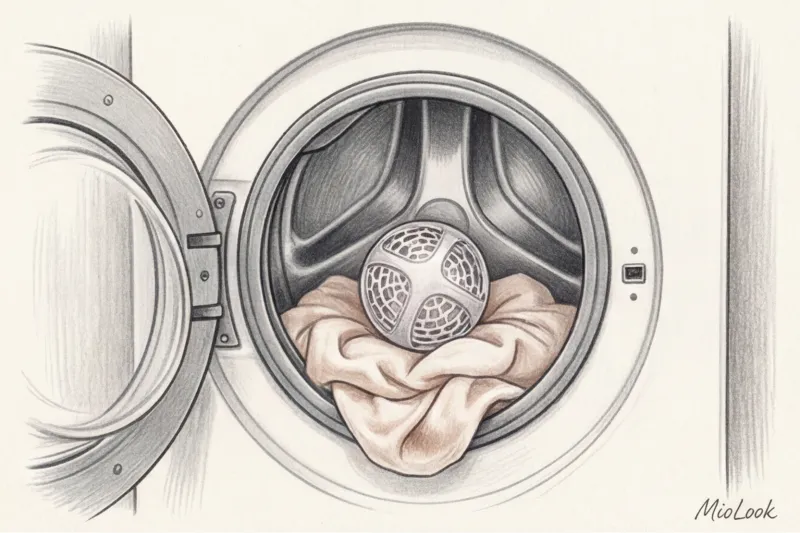
Aggressive hand-wringing tears spandex microfibers and deforms metal frames much faster than a gentle machine cycle. The "hand wash only" label on basic lace lingerie is often a simple precaution against lawsuits from consumers who wash their bras with jeans at 1000 rpm.
Machine washing at 30°C at 400 rpm using a hard protective sphere is mathematically safer than hand wringing.
When machine washing is really contraindicated:
- Sets made of 100% natural silk (it loses strength in water).
- The finest French Chantilly lace without any synthetic additives.
- An abundance of heavy rhinestones, pearls or intricate hand embroidery.
How to Machine Wash Lace Lingerie: A Step-by-Step Guide
If your underwear is made of polyamide, polyester, and elastane (which is 95% of the assortment of Zara, H&M, & Other Stories, and Intimissimi), feel free to entrust it to the washing machine, but follow strict protocol.
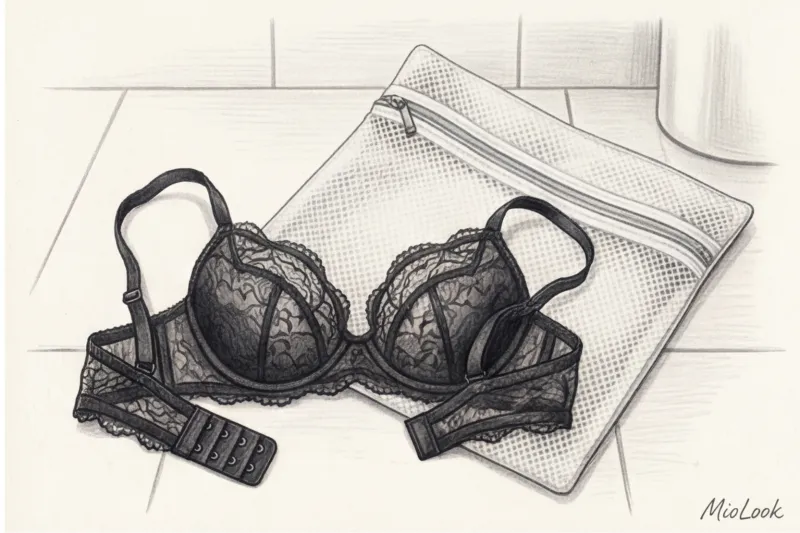
I conducted a personal test: I bought two identical sets of basic lace (priced around €40). I washed one in a simple bag, the other in a rigid sphere. After 15 washes, the difference was dramatic: the bag-washed cups had flattened and lost their shape, while the sphere-washed bra looked just like the day I bought it.
- Temperature conditions: Strictly 30°C. Cold water (20°C) simply won't remove sebum from the waistband, and water at 40°C or higher will begin to break down the elastane.
- Spin speed: Maximum 400–600 rpm. This is enough to remove excess water without deforming the pits.
- Loading rule: Wash only lightweight fabrics. No jeans, terry towels, bedding, or heavy hoodies with metal zippers. Ideally, load the drum with basic T-shirts or blouses.
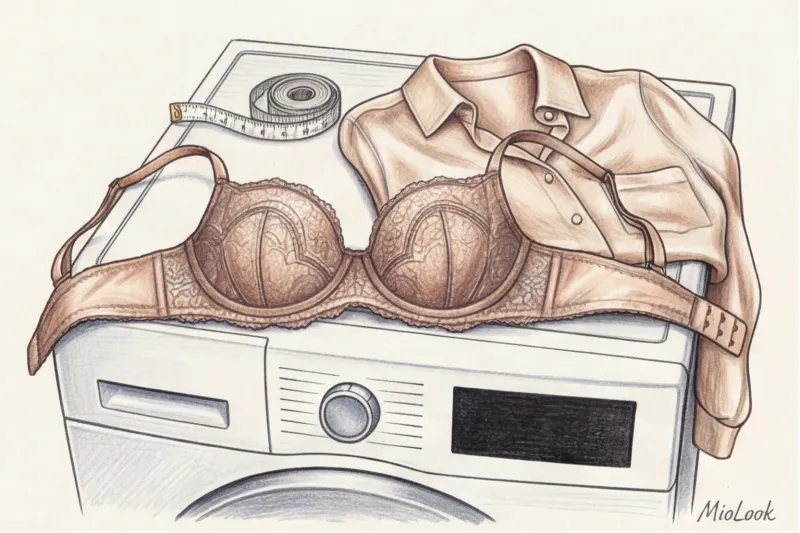
- Mandatory step: Always fasten your bra hooks before washing. An unfastened hook in the washing machine is like a harpoon, catching even the finest lace and leaving a snag.
Your ideal image
it begins Here
Join thousands of users who look flawless every day with MioLook.
Get access — €0.99 onceStylist's Toolkit: Chemicals, Bags, and Spheres
Powder is lace's main enemy. Dry powder granules don't wash out of the dense weave of the fabric even with short cycles at low temperatures. Remaining in the fibers, they act like micro-sandpaper with every movement of your body.
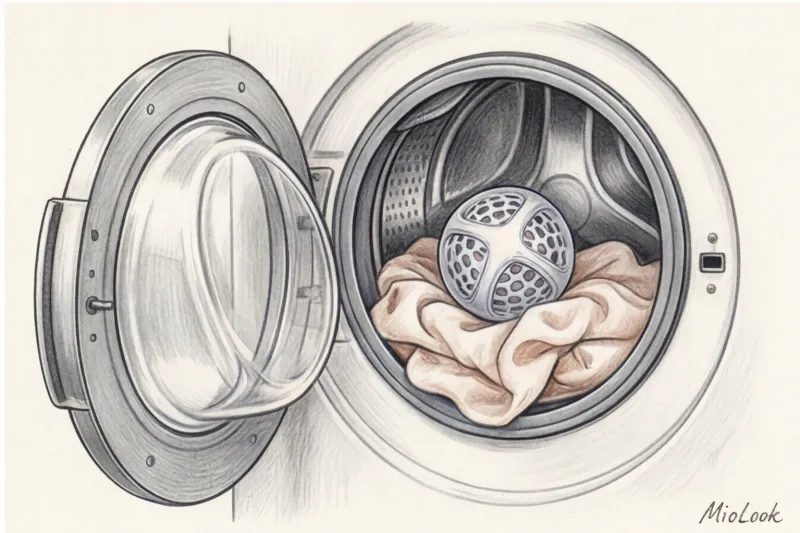
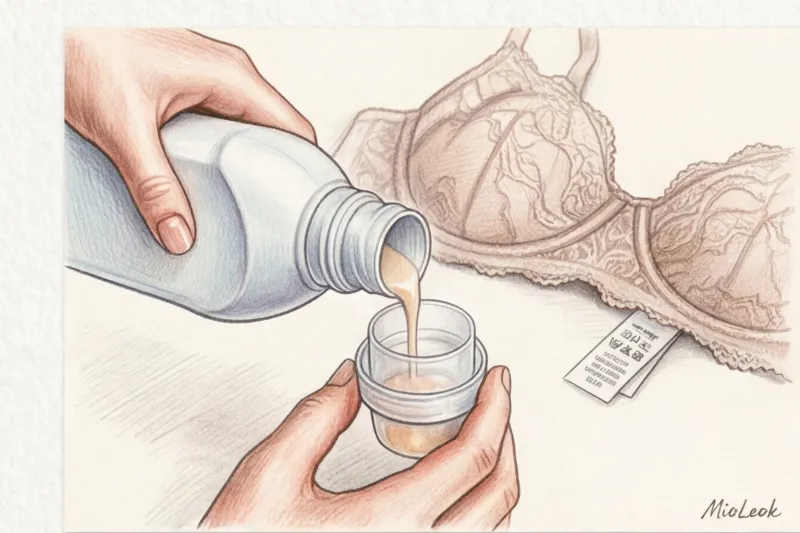
For delicate items, only liquid gels are needed. But there's a catch: the ingredients.
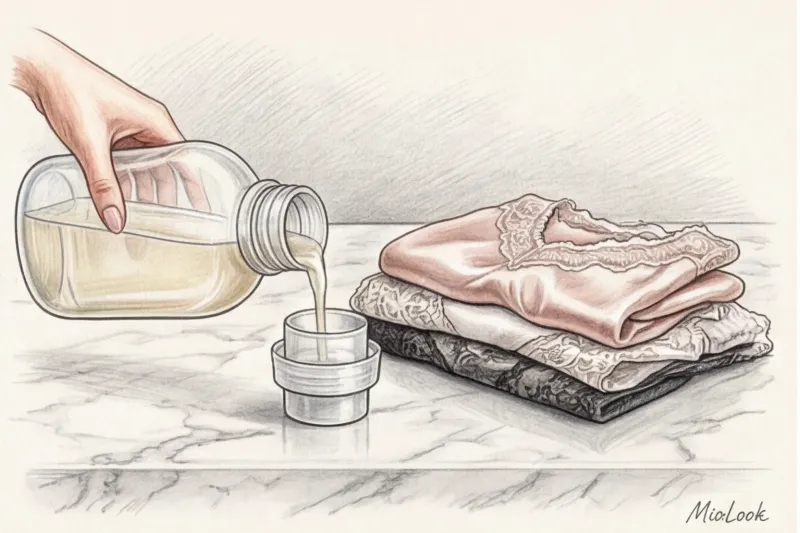
The European Textile Institute's recommendations for silk and delicate fibers state that enzyme-based products destroy protein structures. Enzymes in regular gels are designed to "eat" sweat and blood stains (proteins). If your lace set contains natural silk (also a protein), the enzymes will begin to digest the fabric itself. Look for pH-neutral gels or silk shampoos without optical brighteners.
When it comes to drum protection, separate the tasks:
- Laundry bags: Suitable only for soft, lace bralettes and panties without underwire. Choose bags with a fine mesh to prevent the hooks from slipping out.
- Rigid spheres (containers): Essential for underwire bras with molded (foam) cups. The sphere absorbs the pressure of the drum and other items, maintaining the bra's perfect geometry.
Hand wash for premium items: silk and French lace
If you're working with an Agent Provocateur set or the finest vintage lace, you'll have to rule out the machine. But hand washing also requires proper technique.
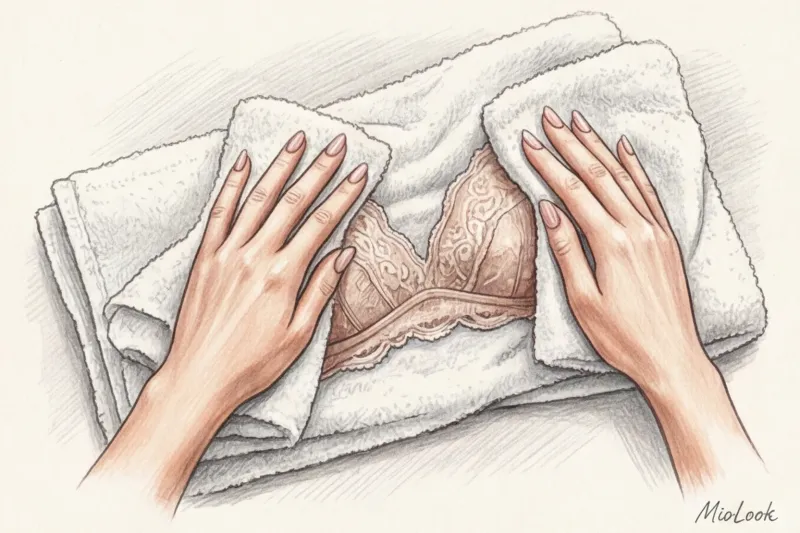
It's important to understand the physics of natural fibers: when wet, silk threads swell and lose up to 30% of their strength. They become as brittle as glass.
- Soak: Dilute the liquid gel in cool water (around 25°C) and soak the laundry. The maximum soaking time is 10 minutes. Any longer is not recommended, as it won't remove the dirt better and will cause the fibers to deteriorate.
- Washing technique: Avoid rubbing fabric against fabric. Use the "blotting" technique—gently squeezing and releasing the laundry in the water, creating a pumping effect.
- The secret of squeezing: Remove the laundry from the water and let it drain. Then lay the set on a clean, dry terry towel, roll the towel and the laundry together, and press gently. The terry towel will absorb 80% of the moisture without any loosening of the fibers.
Try MioLook
for free
Start creating perfect looks and managing your wardrobe with the help of artificial intelligence.
Get access — €0.99 onceDrying and storage: how to avoid ruining your set after washing
The most common mistake I see in my clients' bathrooms is bras hanging by the straps on the drying rack. Gravity works against you in this case.
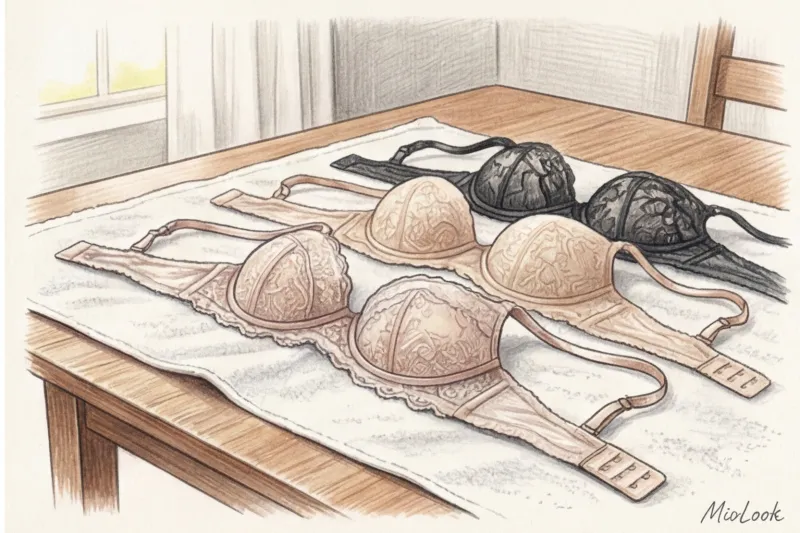
Wet fabric with foam weighs three times as much as dry fabric. By hanging a bra by the straps, you force this wet weight to stretch the elastic bands on your shoulders and back. After 10 such dryings, the straps will stretch so much that the length adjusters will no longer be effective.
Drying rules:
- Only horizontally on a flat surface (a dry towel will do).
- Keep away from radiators, coils and direct sunlight (ultraviolet light yellows white lace and destroys elastane).
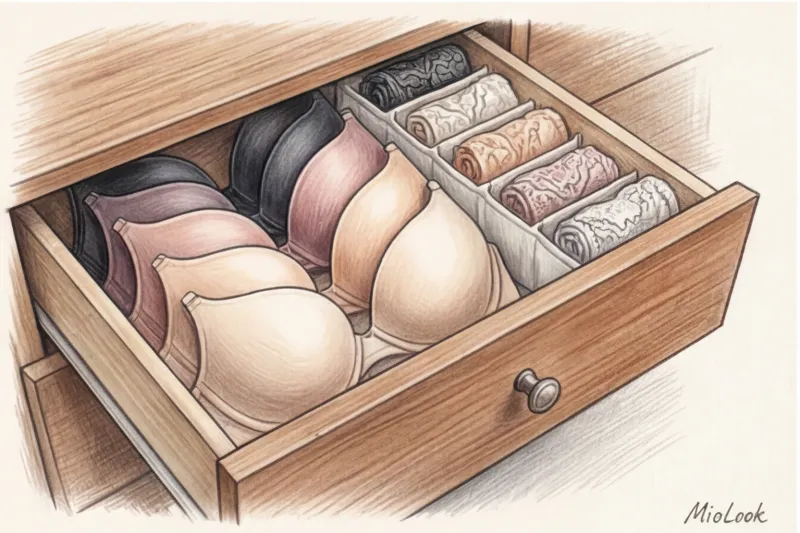
Organizing your bra drawer will extend the life of your bra set by months. For soft lace bras, nesting one cup inside the other and folding them in half is acceptable. But never Don't turn the molded foam cups inside out! This permanently breaks the material's matrix, creating creases that will show through thin blouses. Store them only unfolded, nesting one bra inside another like a train. By the way, to easily keep track of the condition of your base, I recommend filing all your basic sets in MioLook - this way you will always be able to see which wardrobe items require updating.
Checklist: 5 Signs It's Time to Throw Out Your Underwear (and Buy New)
I have a very pragmatic approach: if something doesn't perform its function, it has no place in the closet, no matter how much it cost on the day of purchase.
Here are 5 signs that even proper washing won't save the situation, and it's time to throw out your laundry:
- Tension test: You fasten your bra on the tightest (inner) row of hooks, but the band still slips up your back throughout the day. Elastane is dead, and there's no more breast support.
- Cup relief: The foam rubber developed permanent dents and creases that were visible even through thick knitwear.
- Protruding threads: Small white strings (called "fuzzies") have started to emerge from the lace or elastic of the waistband. This is a clear sign of mechanical wear and tear on the spandex.
- Unruly straps: Metal or plastic fittings constantly slide down under the weight of the breasts, without fixing the length.
- Color degradation: White lace has acquired a persistent gray or dirty yellow hue, and black has become ashen. Such lingerie visually cheapens any look, even the most inconspicuous, diminishing your inner confidence.
Washing lace lingerie isn't magic; it requires understanding the basic physics of fibers. Protect the fabric from high temperatures, ditch harsh detergents for gentle gels, and use hard spheres instead of hand-wringing. Remember: a beautiful, expensive look on the outside is always built on an invisible, yet high-quality and impeccably maintained structure on the inside.