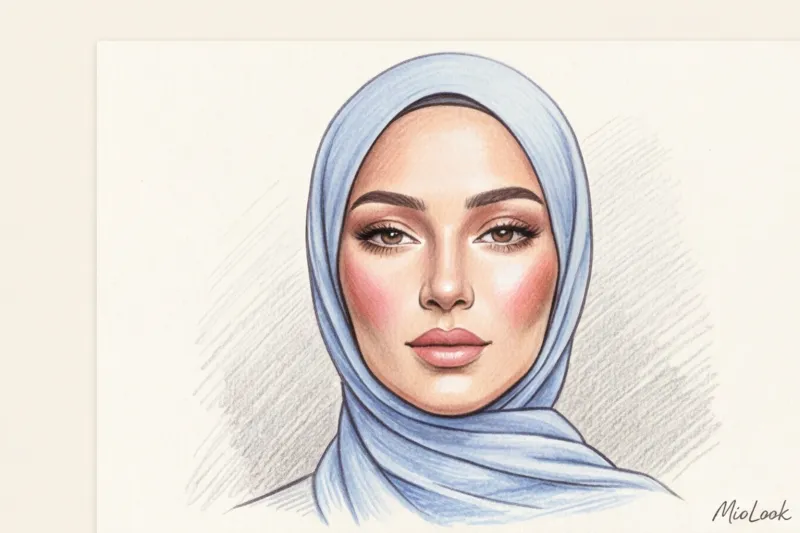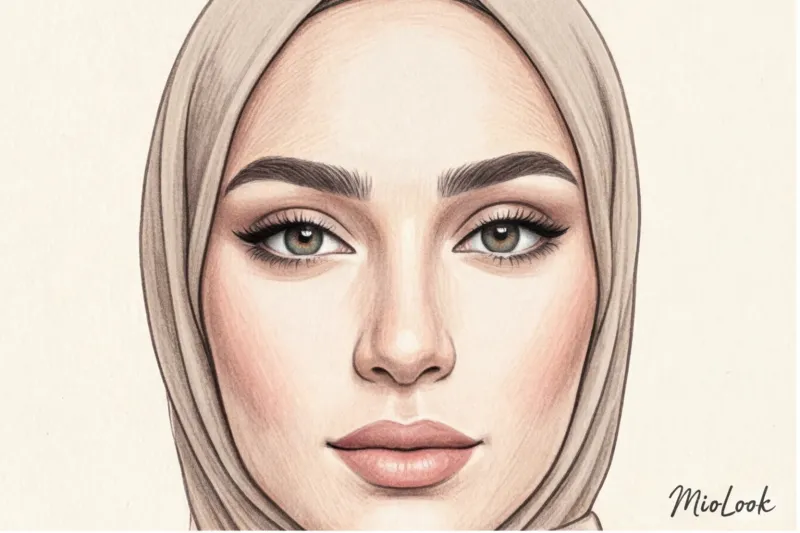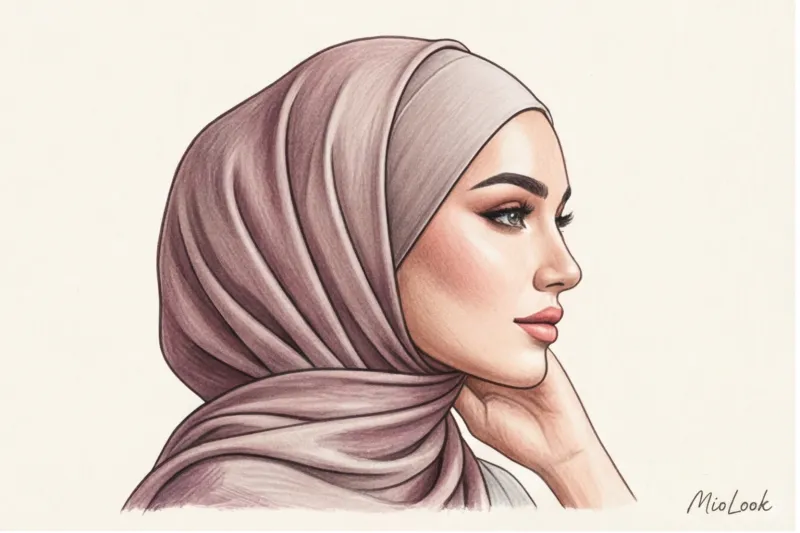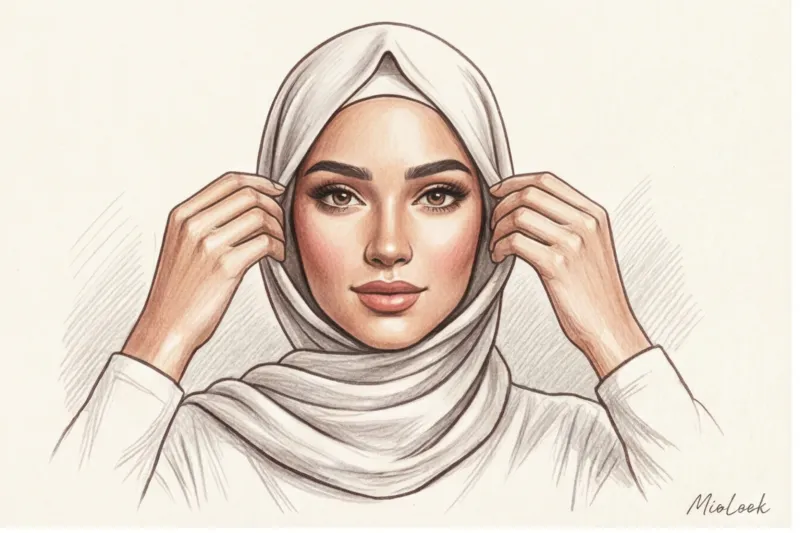
I remember Amina coming to see me for a consultation five years ago. She had stunning, expressive eyes and soft, rounded features. But the first thing that caught my eye was her headscarf. She wore a bonnet pulled tightly up to her eyebrows, and the hijab itself was wrapped tightly, like a bandage, around her cheeks and neck. "I'm trying to hide my cheeks," she sighed. The irony was that it was precisely this tight concealment that turned her face into a perfect sphere, highlighting every line she so desperately wanted to hide.
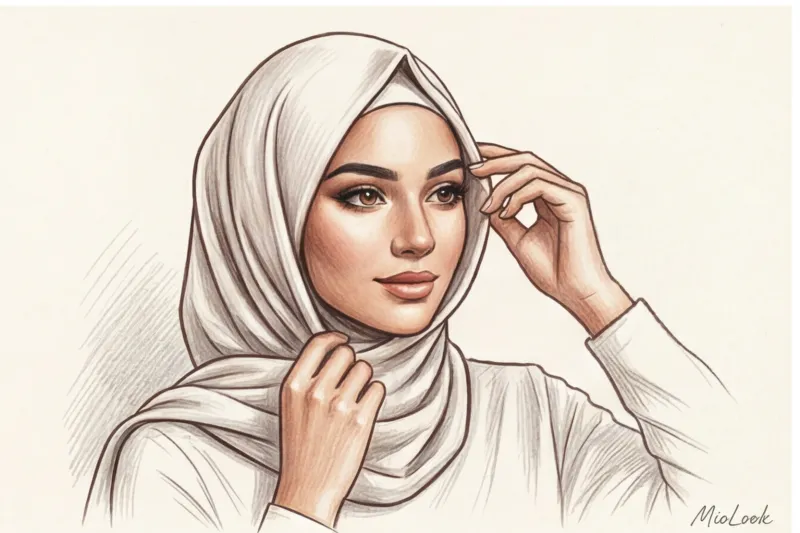
We moved the cap a couple of centimeters up toward the hairline, created a sharp corner of fabric on the forehead, and loosened the tension under the chin. Amina's face was visually elongated in just a minute. No magic—pure geometry. If you're looking for an answer to this question, How to tie a hijab for a round face Forget the clichéd advice to "hide your cheeks with fabric." I suggest an architectural approach: instead of masking shape, we create correct geometric lines—diagonals and sharp angles—using the scarf as a structural frame.
Of course, shape is only half the battle. Perfect styling won't save you if the fabric casts gray shadows on your face. We discussed this synergy in more detail in our The complete guide to choosing a hijab color Now let's look at the physics and geometry of proper drapery.
Architecture over Camouflage: Why Old Ways of Wearing the Hijab Don't Work
The main mistake I constantly see in women with round faces is trying to physically tighten their face. It seems logical: the tighter the fabric fits the skin, the less space the face takes up. In practice, the laws of optics work exactly the opposite.
When you tie a scarf tightly under your chin, you create a "balloon" (or "squeezed face") effect. The fabric cuts into your skin, and any natural plumpness of your cheeks or neck hangs over the line of the scarf, creating the illusion of a double chin, even if you're actually an XS. According to research by the Color and Form Institute (2023), the human eye perceives proportions by extreme points of contrast. If a scarf frames the face in a circular fashion, without a single angle, the brain perceives the entire object as a sphere.
A new style paradigm I instill in my clients: treat the hijab as an architectural cut inspired by couture techniques. We need air, volume, and verticals. The scarf should serve as a picture frame, not a vacuum-sealed package.
Access to MioLook for €0.99 — one-time payment
A smart AI stylist will select the perfect look based on your individual proportions.
Get access — €0.99 onceFace Geometry: How to Tie a Hijab for a Round Face Step by Step
Let's start with the foundation—the lower cap (bonnie). It sets the starting proportions. The rule for an open forehead is: never pull the bonnie down too low. By covering the forehead, you flatten the face vertically, making it appear even wider.
My personal stylistic standard: the perfect fit for a bonnet is exactly four finger widths (about 6-7 cm) from your brow line to the edge of the fabric. The cap should sit exactly at your natural hairline or just a millimeter below it.
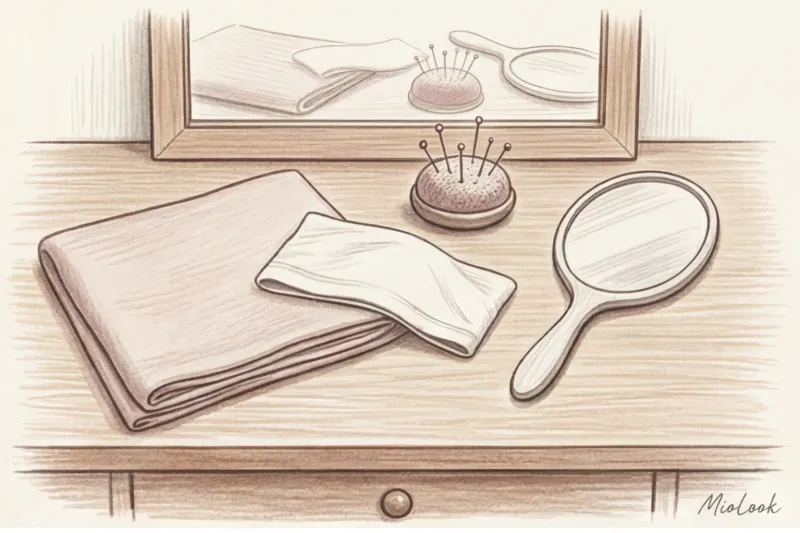
The Secret to a Pointed Visor (V-Shaped Line)
The most powerful visual elongation tool is a sharp angle (visor) in the center of the forehead. Forget about a round hairstyle that follows the shape of your head.
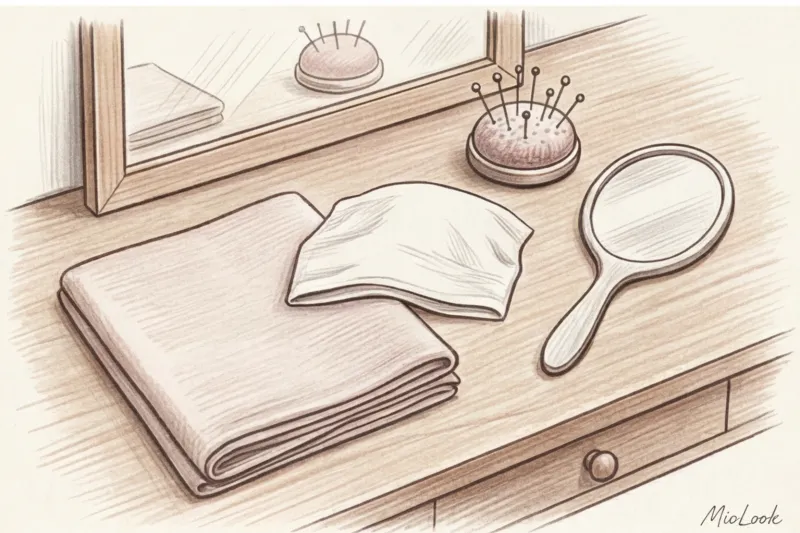
- Place the scarf on your head so that the center protrudes slightly forward above the bonnet.
- Using the index finger and thumb of both hands, form a slight crease (pinch) exactly along the center of the hairline.
- To keep this pointed cape from falling, secure the fabric with invisible pins or special pins on the sides (at temple level), but do not pull the fabric tight across the forehead.
This simple V-shaped contour on top instantly gives the illusion of an oval face.
Air under the chin: the 2-centimeter rule
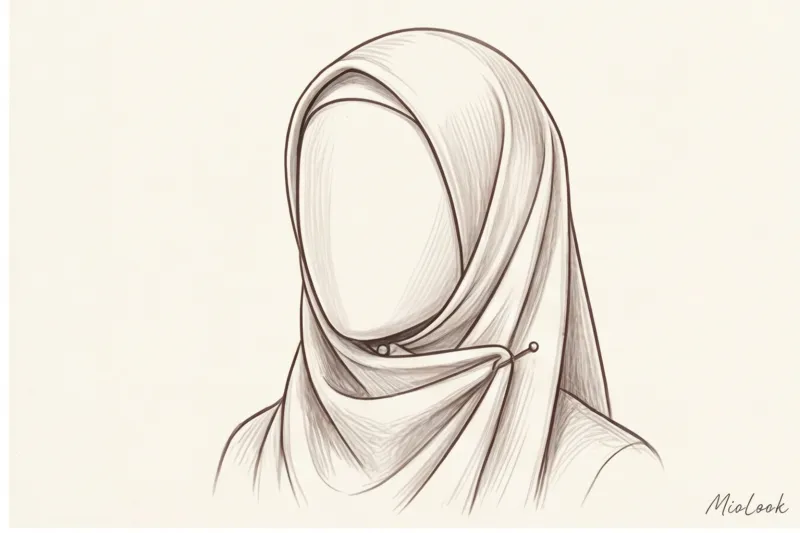
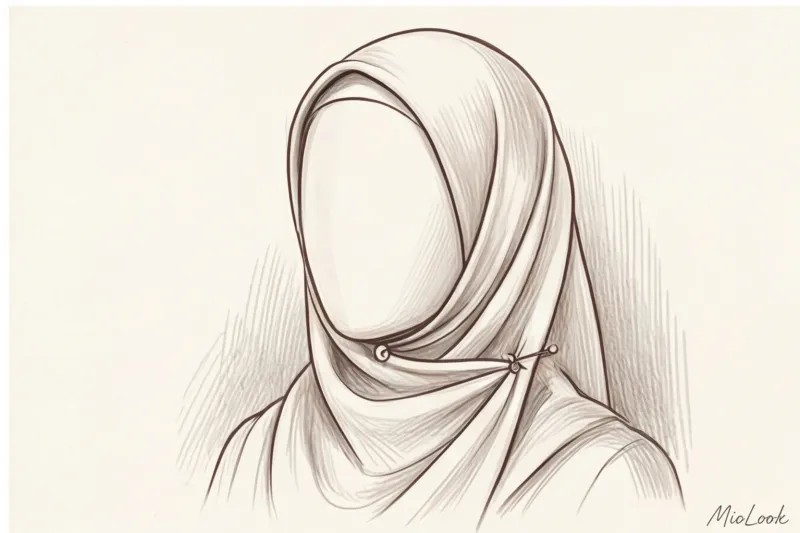
My favorite trick that changes everything is the "air loop." When you gather the ends of the scarf under your chin, don't press the pin right against your throat.
Leave a 1.5-2 cm gap between the fabric and your skin. Pin the pin just below your jawline. What does this do? First, it prevents the neck from looking constricted. Second, it allows the fabric to fall in straight vertical folds rather than clinging to your round cheeks. This creates a subtle V-shaped shadow under your chin, which works like a professional makeup artist, sharpening your jawline.
Your perfect look starts here
Join thousands of users who look flawless every day with the MioLook smart wardrobe.
Get access — €0.99 onceTissue Physics: Which Materials Create the Ideal Contour?
You can get every millimeter perfectly right, but if the fabric is wrong, the whole thing will collapse within five minutes. This is the real paradox: many women prefer soft, gliding silk or the finest sheer chiffon, considering them more feminine.
I have to be honest: these textures are the enemy of a round face. Smooth silk hugs the shape of the head, accentuating every curve, while thin chiffon can't maintain that architectural "visor" we mentioned above. They simply fall off.
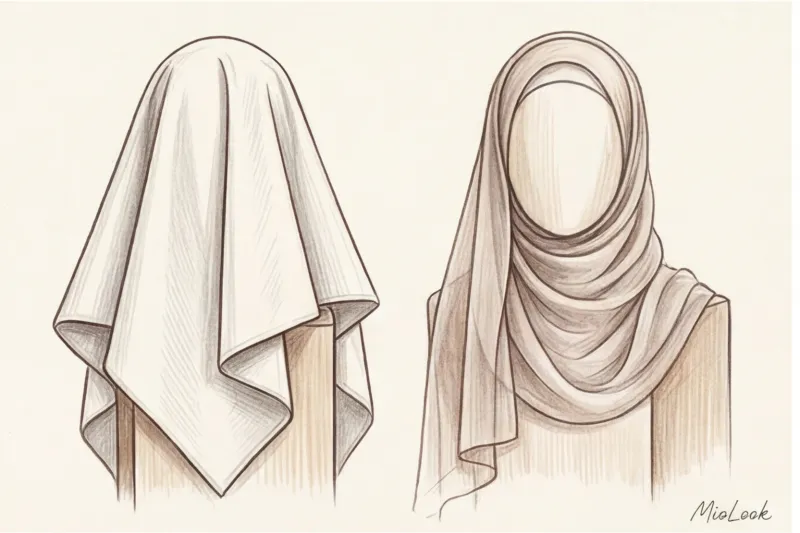
As the WGSN research agency notes in its report on structured modest fashion (2024), modern silhouettes require materials with an internal frame. You need fabrics with a sufficient weight (from 80 g/m²):
- Premium cotton and batiste: slightly dry, they perfectly hold the given angle on the forehead.
- Linen with viscose (70/30 ratio): Linen provides structure, and viscose allows the fabric to fall in heavy, beautiful vertical folds.
- Dense Crinkled Modal: Ideal for every day, it does not slip and creates excellent volume around the neck due to its texture.
3 Stylish Formulas: Styling Options for Different Occasions
As a stylist, I love formulas. In the app MioLook We often use combinatorics algorithms, but with the hijab everything works the same way: fabric + technique + chance = impeccable result.
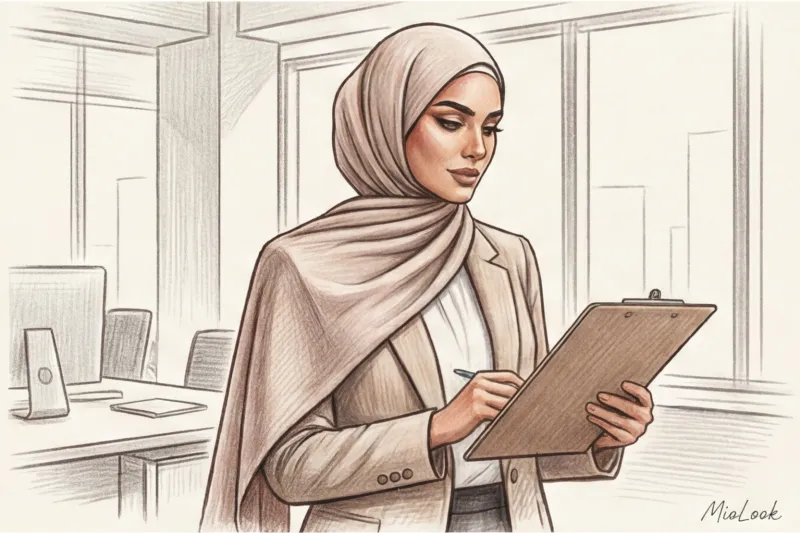
Formula 1: Business Casual (Asymmetrical Diagonal)
Jacket + thick cotton + one long end thrown over the back.
Asymmetry ruins the perfect symmetry of a round face. Leave one end of the scarf long and drape it loosely over one shoulder. This creates a powerful diagonal line that visually cuts off volume and elongates the silhouette. Ideal for the office and business meetings.
Formula 2: Effortless Everyday (Free Volume)
Oversized shirt + crushed modal + loose, pin-free throw.
Instead of pinning the scarf under your chin, simply wrap it around your neck in a loose loop. The resulting voluminous loop at the neck will create a striking contrast: against the voluminous drape below, your face will appear smaller and more graceful.
Formula 3: Structured Turban (Evening)
Closed dress with a high stand-up collar + silk satin + turban with a knot on the crown.
A limitation to be aware of: a turban completely reveals the oval of your face and neck. If you have a short neck, this option is not for you. But if your neck allows, tie the turban to create height at the crown (using a knot or folds). This extra height at the top compensates for the width of your cheeks, turning a round face into an oval.
Ready to get started?
Try the MioLook plan for free—no commitments required. Create your smart wardrobe today.
Get access — €0.99 onceOptical illusions: clothing and accessories in the portrait zone
The hijab doesn't exist in a vacuum. What lies beneath it can either enhance the correction or completely undermine it.
Never wear a high collar or a tight turtleneck under your hijab if you're wearing it the traditional way. This will flatten your neck and make your face appear wider. A V-neck shirt, jacket, or cardigan is your best friend. It replicates the same V-neck we created on the forehead, creating a double vertical line.
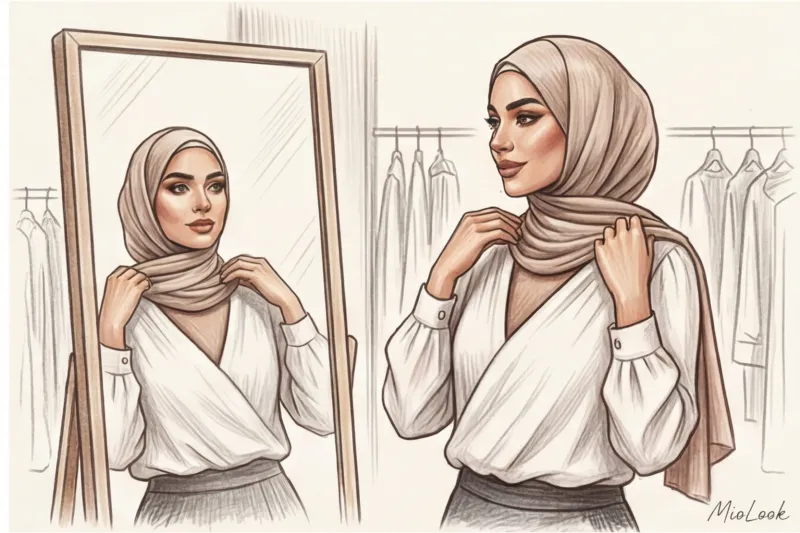
If you're wearing a turban or a style that exposes your earlobes, consider your jewelry. Avoid large, round hoops (like hoops) in favor of longer pendants, chains, or elongated teardrops. They'll add another vertical axis. If you're unsure about your choice, check out our guide on... How to choose earrings according to your face shape.
Glasses are a different story. Women wearing hijabs often find that the temples of their glasses disrupt the drape. Choose frames with pronounced geometric angles (square, cat-eye), avoiding round Lennons. Learn more. Styling tips for pairing glasses and earrings , so as not to overload the portrait area.
Checklist: 5 Rules for a Perfect Hijab for a Round Face
Let's recap. Save this list to check yourself in the mirror:
- Hairline: The lower bonnet sits high (4 fingers from the eyebrows), without covering the forehead.
- Peaky Blinder: A slight pinch (V-shaped cape) is formed in the center of the forehead, no rounded fit.
- Air: The pin under the chin is pinned with a gap of 1.5–2 cm from the skin, forming straight folds downwards.
- Asymmetry: one end of the scarf is longer than the other or thrown over the shoulder diagonally.
- Frame fabric: a material with sufficient weight (thick cotton, viscose with linen) was selected that was capable of holding the given angles.
Style isn't about hiding behind layers of fabric. It's about managing attention. By creating the right lines and angles, you don't remake your face; you give it a dignified, sophisticated frame.
Don't be afraid to experiment with fabric architecture. Leave some air, create diagonals, and you'll see how your natural features shine in a completely new way!