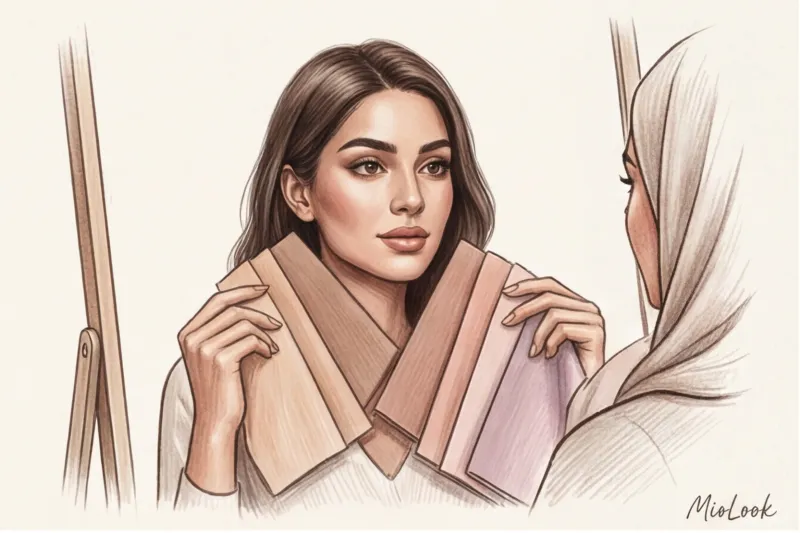
Style Essentials: How to Match Your Hijab Color to Your Skin Tone and Undertone
Have you ever noticed a strange pattern: you put on one headscarf and receive compliments on how fresh you look, as if you've just returned from a spa vacation. You put on another, and your colleagues sympathetically ask if you're feeling ill and suggest taking vitamins? The answer lies not in the amount of sleep you get or the quality of expensive cosmetics, but in the simple physics of light. That's why choosing the color of a hijab requires a completely different approach than choosing a dress, pants, or even a jacket.
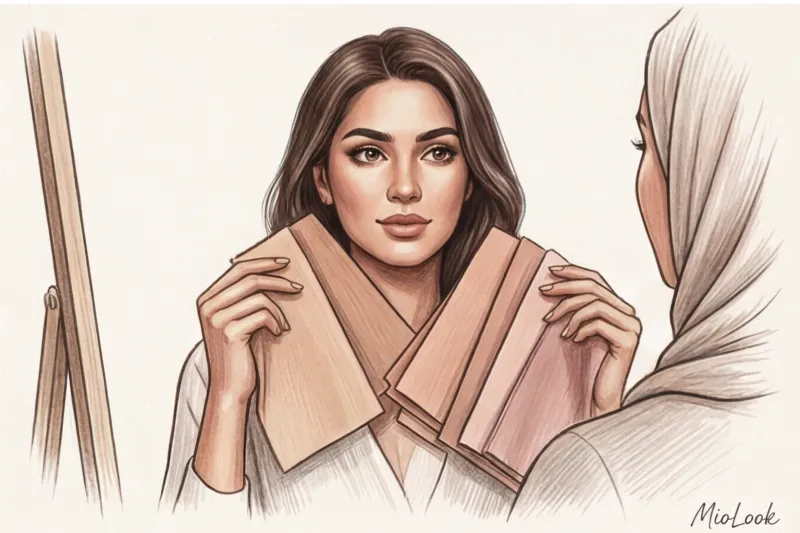
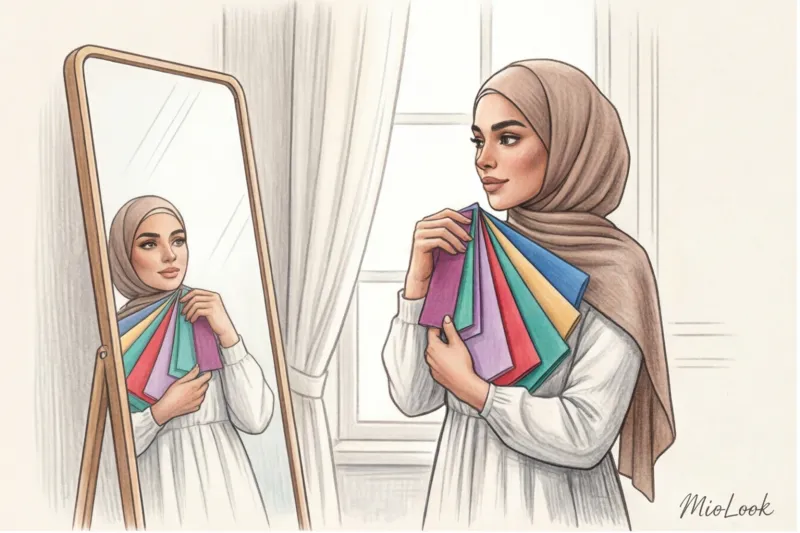
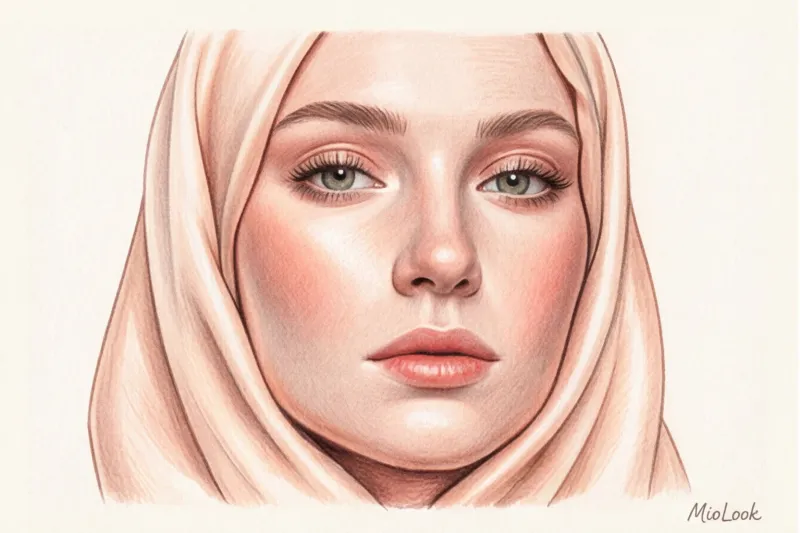
When it comes to fabric that frames the face 360 degrees, the "I just like this color in the store" rule ceases to apply. A hijab functions like a professional photographer's studio reflector. The fabric catches the light and casts its rays of color directly onto your skin. The right shade works like a smartphone filter: it illuminates the face, evens out skin tone, and brightens the eyes. The wrong one mercilessly highlights every shadow, wrinkle, pigmentation, and dark circles under the eyes. A dress is always separated from the face by a décolleté, neck, or shirt collar. A hijab, on the other hand, makes direct, close, and uncompromising eye contact with the skin.
Spending hundreds of dollars on premium foundation serums and concealers is pointless if the color of your face adds five to seven years to your age every day.
Over 14 years of styling, I've seen hundreds of mistakes in portraiture. One of the most telling stories involved a client of mine who had long studied the theory of 12 color types and was absolutely convinced she was a classic "autumn." Based on this classification, she bought an entire collection of hijabs in mustard, rust, and copper shades. In practice, these colors gave her face a downright unhealthy, yellowish cast. She complained that she always looked tired and tried to compensate with heavy makeup. When, during a wardrobe review, I removed her favorite mustard stole and draped a cool emerald scarf around her face, the effect was immediate. Pigmentation visibly smoothed, her facial contours became more defined, and her eyes sparkled. It turned out she had a pronounced cool undertone that simply "suffocated" in the warm autumn colors.
So how can you determine your skin temperature yourself to avoid making similar mistakes? Forget about checking your wrist veins in office lighting—this popular internet tip often leads to significant errors due to fluorescent lamps. We need to test in soft, natural light.
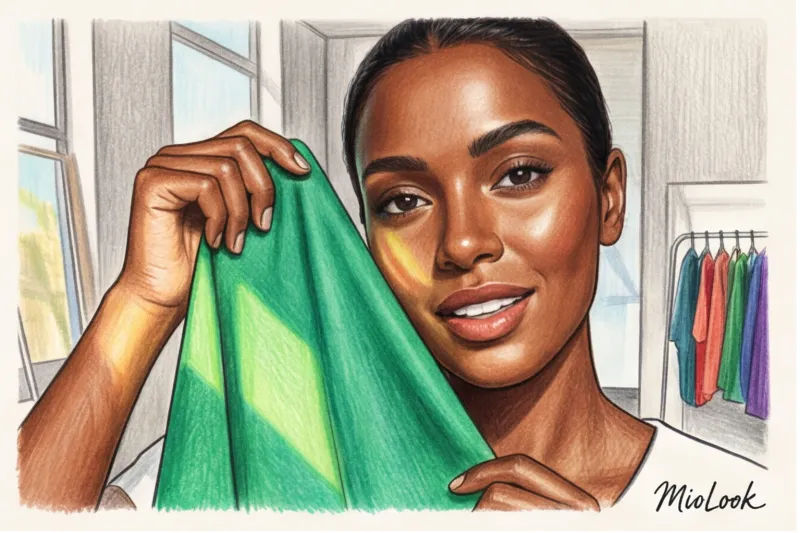
Sit in front of a window in daylight (ideally on a slightly overcast day without direct sunlight). Remove your makeup. Take two cloths: one decidedly warm (for example, orange, coral, or tomato), and the other decidedly cool (pure fuchsia or icy blue). Apply them alternately to your face and neck. Your goal is not to focus on the beauty of the cloth's color, but rather on the focal point of your face. The right shade will make your nasolabial folds appear less deep and your skin tone will be more even. The wrong shade will highlight redness on your cheeks and sallow shadows under your chin.
Incidentally, a similar test can be performed on jewelry. We discussed the mechanics of this method in more detail in the article Gold or silver: which metal suits your color type? And if you find it difficult to objectively assess yourself in the mirror, I always recommend that clients use Smart wardrobe in the MioLook app You can upload a photo of yourself in good daylight and virtually try on dozens of shades to visually see how your facial structure changes. This saves you from impulse scarf purchases that then end up sitting at the bottom of your closet for years.
However, temperature is only half the equation. The second, critically important variable is the level of contrast in your appearance. This is the difference in lightness between the color of your skin, eyebrows, eyes, and natural hair.
Striking brunettes with snow-white skin and expressive dark eyes (high contrast) often make the mistake of cloaking themselves in muted, dusty pastel tones—taupe, pale taupe, or washed-out mint. As a result, their strong natural contrast literally "eats up" the pale color, creating a washed-out and tired look. Conversely, delicate blondes or women with soft, light-brown features and light eyes (low contrast) are instantly "lost" in a dense, aggressive fuchsia, neon, or electric blue. In such cases, we first notice the bright splash of color of the hijab walking down the street and only then notice the woman herself.
Cool, warm, or olive: finding your perfect shades
Now that we've calibrated the basic appearance settings—temperature and contrast—let's put together a working shopping toolkit.
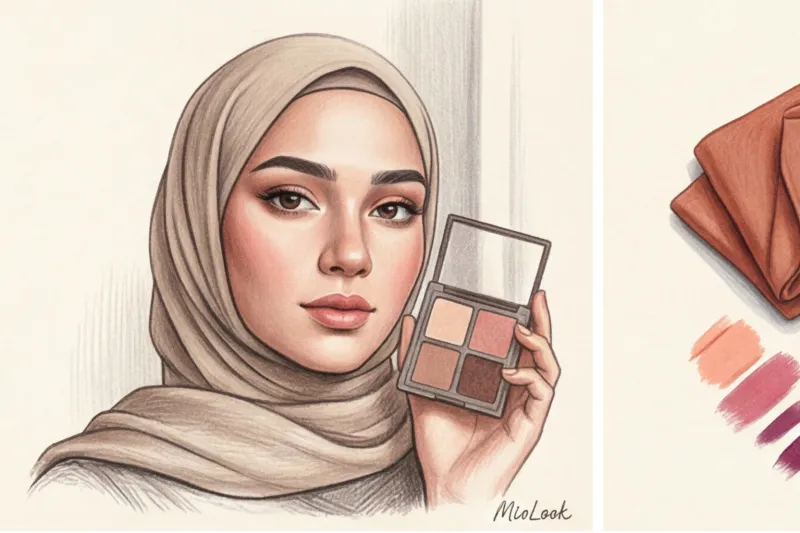
For owners cool undertone (skin with a slight pinkish, porcelain, or bluish glow that quickly reddens in the sun rather than bronzes) are best complemented by jewel-toned and berry shades. Look for rich emeralds, deep sapphires, ripe raspberries, classic blues, blackberries, and cool pinks. These colors complement the skin's natural pigmentation, bringing out a natural, healthy glow.
For girls with warm undertone (Peachy, golden skin that tans easily and evenly to a deep bronze) consider a natural, earthy, and spicy palette. Your ideal base is terracotta, rich, warm peach, warm olive, caramel, chocolate, and honey tones. With this setting, you'll look as if your skin is glowing from within. We've detailed the art of combining such complex tones with other wardrobe items in our article about mixing warm and cool colors in clothing.
But the most difficult and interesting challenge in coloristics is olive undertone This skin has a subtle greenish-yellow undertone. If the hijab is chosen incorrectly, olive skin can instantly appear gray, sallow, or sallow. The key rule here is to strictly avoid pale pastel shades with a yellow base (no lemon, pale green, or mustard). Your goal is to neutralize the green undertone.
Colors on the opposite side of the color wheel, specifically complex shades of pink and red: dusty rose, muted burgundy, deep wine, or Marsala, are brilliant at this. They create a soft, complementary contrast to the greenish undertone, restoring the complexion's exceptional freshness and restorative appearance, even if you've only slept four hours.
Fabric Makes All the Difference: How Texture Changes the Perception of Color
Color is a matter of physics. More precisely, it's light reflected from the surface of a material. Over my 14 years of styling experience, I've seen women spend hours searching for "their" shade, but forget about the texture of the fabric. Yet it's the texture that determines how color interacts with your complexion.
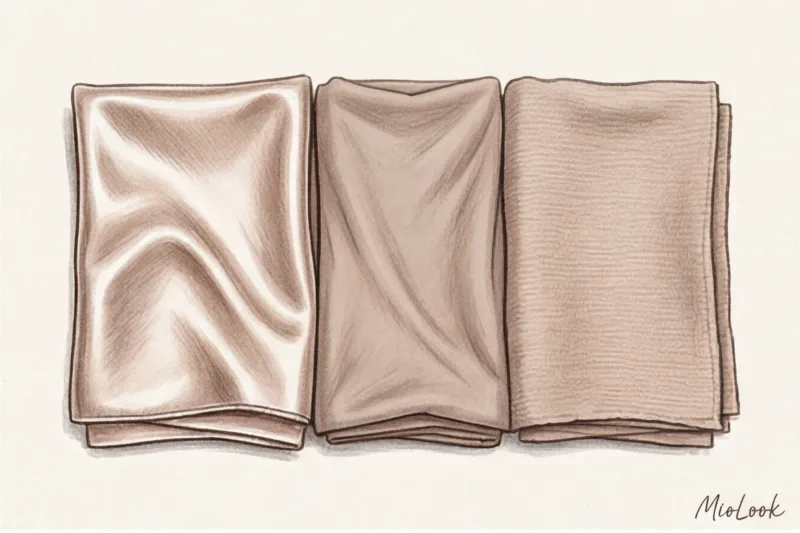
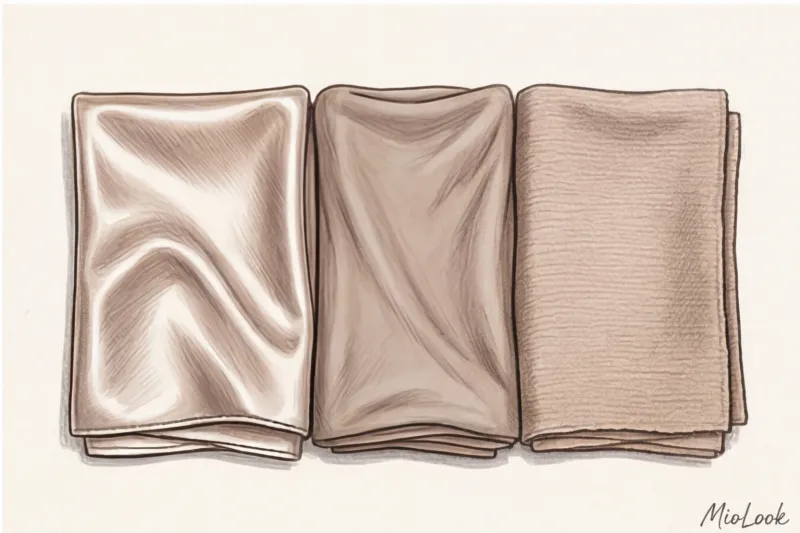
Consider a classic beige shade (for example, the popular PANTONE 14-1118 nude, a staple in basic wardrobes). If you dye the same pigment into a glossy silk thread and a matte cotton jersey, you'll get two visually different colors. Why is this?
Silk produces a directional (mirror) reflection. It reflects light rays in a single beam, making beige appear lighter, cooler, and more piercing. Jersey, on the other hand, produces a diffuse (scattered) reflection. Light penetrates the knit structure, is absorbed, and gently dispersed, making the same beige appear deeper, warmer, and more subdued.
The Treachery of Gloss: Silk, Satin, and Viscose
This is where the main danger of shiny textures lies. Shiny fabrics near the face act like a hard, upward-facing photographic reflector, casting harsh glare directly onto the skin.
According to the laws of optics, harsh, directional light accentuates any micro-relief. If your face has minimal texture—fine lines, nasolabial folds, enlarged pores, post-acne marks, or simply morning puffiness—a glossy hijab will act as a magnifying glass.
One of my clients once invested around $300 in stunning premium silk stoles in sophisticated emerald and wine shades. But she couldn't wear them: she said they made her look "five years tired." The problem wasn't the colors—they perfectly complemented her complexion—but that the satin sheen accentuated her undereye shadows. Once we swapped out the same shades for a matte crepe, her complexion instantly brightened.
Matte Fabrics: Why They're the Perfect Base
That's why I always insist: the foundation of your capsule wardrobe should be exclusively matte fabrics. Chiffon, crepe georgette, and high-quality jersey are your built-in "Photoshop filter" in real life.
- Chiffon and crepe: Their micro-grained, slightly rough surface breaks up the light rays, creating a soft, even illumination without harsh shadows.
- Jersey: Thick matte knitwear absorbs light beautifully and adds a relaxed feel. It's the perfect choice for casual style and layered outfits.
When deciding, How to choose the color of a hijab When trying a new shade, always start with a matte version. Matte textures are forgiving of sleep deprivation, conceal minor skin imperfections, and, importantly, don't slip through your hair or bonnet, holding your hair in place.
To avoid getting lost in your own collection, I recommend my clients digitize their wardrobes. In the app MioLook You can tag items not only by color but also by texture. This saves a ton of time in the morning: you can immediately see which are your basic matte stoles for everyday wear, and which are your statement silk ones for evening wear.
Access to MioLook for €0.99 — one-time payment
A smart AI stylist will select the perfect look based on your individual parameters, shades, and fabric textures.
Get access — €0.99 onceColor Myths: Why a Black Hijab Isn't the Best "Base"
Open any basic wardrobe checklist, and you'll almost certainly see black at the top. In the public consciousness, it's an unspoken standard, synonymous with elegance and absolute versatility. But when it comes to portraiture and accessories that cling closely to the face, this ironclad rule fails critically. According to statistics from the Pantone Color Institute, true black is unconditionally complimentary for only 15% of women—those with high-contrast, cool undertones. For everyone else, it acts as a merciless filter, squeezing out even the slightest imperfections.
The mechanics of this process lie in the physics of color. The rich black pigment completely absorbs light, leaving no glare. When applied close to the face, it casts harsh micro-shadows that visually deepen nasolabial folds, accentuate under-eye circles, and make even light pigmentation stand out. If you've slept less than eight hours or spent a long day on a plane, a black hijab will betray this to everyone around you, giving you a haggard appearance.
During one of my recent color masterclasses, I conducted a practical experiment with a participant. The woman complained that by the evening at the office, her face looked "gray and tired." We simply removed her usual solid black stole and draped it with a dark chocolate-colored scarf. The difference was phenomenal: the warm brown undertone instantly neutralized her sallow skin tone, deepened her gaze, and made her face appear softer and fresher. It worked better than a thick layer of concealer.
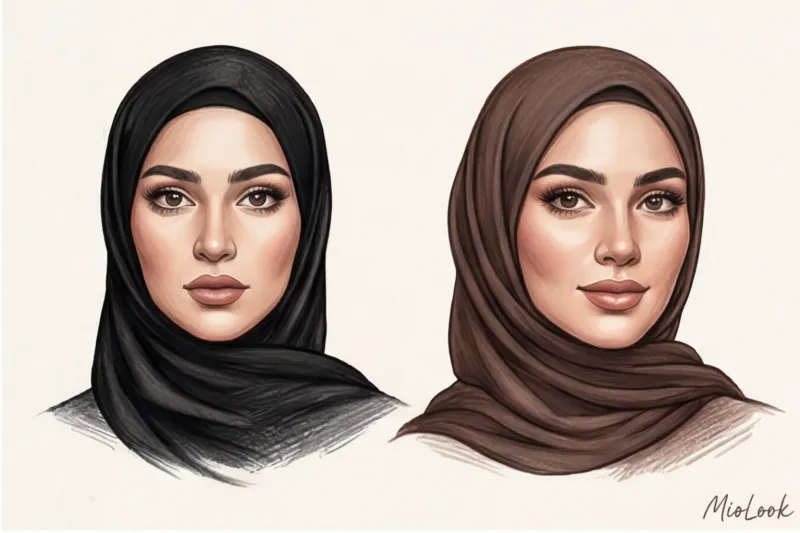
The second, no less insidious problem with the black hijab is its disruption of the silhouette's proportions. The sharp contrast between the black headscarf and lighter or brighter clothing (for example, a classic beige trench coat, a pastel jacket, or a white shirt) creates a harsh horizontal line at the neck. This visually "cuts off" the head from the torso, shortens the neck, and makes the figure appear squatter. You get the so-called "floating head" effect, which instantly ruins any color scheme, even the most carefully considered.
What if you truly need dark, low-staining, and classy shades? Turn to the "soft darks" palette. Your best, truly stylish alternatives to black are graphite, the aforementioned dark chocolate, deep maroon, and noble navy blue. Each one brilliantly fulfills its own stylistic needs. Navy works luxuriously with denim and gray business suits, graphite is ideal for minimalist monochrome looks, and deep burgundy stunningly sets off green and olive base clothing. They possess the same austerity as black, but contain a dose of color pigment that delicately interacts with the skin. If you're still having trouble deciding to completely ditch the black base, take photos of your everyday outfits and upload them to the "smart wardrobe" feature in MioLook Visualization tools will help you visually compare how much more harmonious and cohesive your favorite sand-colored cardigan will look with a graphite-colored scarf, rather than with a heavy charcoal block.
Integrating the Hijab into a Capsule Wardrobe: Combination Rules
Wardrobe mathematics does not tolerate accidents. If we consider style as architecture, then the hijab isn't just the finishing touch; it's the supporting structure of the entire look, capable of either bringing a silhouette together or mercilessly destroying its proportions. In my practice as a functional wardrobe architect, I always insist that a headscarf shouldn't be purchased based on the principle of "just a pretty color." It must work for you.
We discussed the fundamental principles of creating such a database in detail in the article Capsule Wardrobe: The Complete Guide , but the integration of the headdress requires a special approach and knowledge of optical illusions.
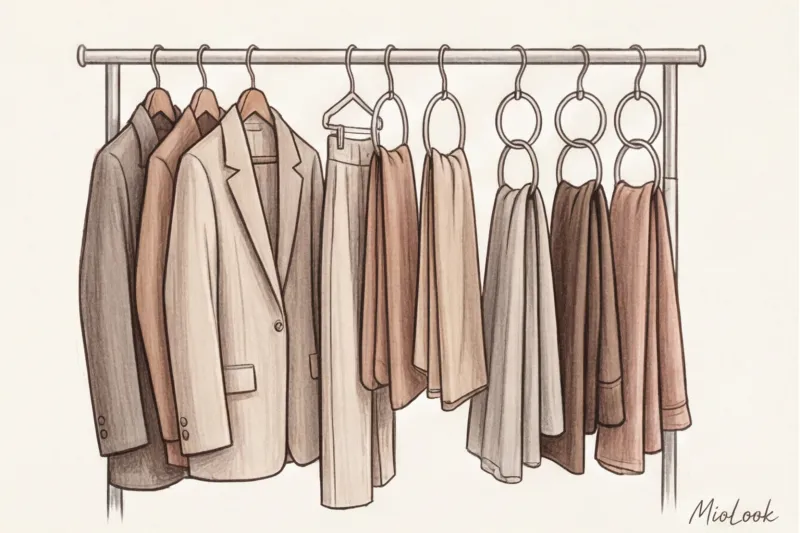
One of my favorite and most powerful body shaping tools is hijab as part of a color vertical The human eye is lazy: it reads silhouettes by continuous lines of color. If you wear loose-fitting sand-colored palazzo pants and pair them with a matching chiffon scarf (say, camel), you create a visual axis. Even if there's a contrasting white shirt or jumper between them, the brain completes this line. This visually elongates the silhouette and adds 3 to 5 centimeters of height, even without heels. This is how we visually lighten a heavy bottom with our clients, drawing attention to a single dominant color.
The following comes into force the rule of three colors in an image According to the PANTONE Color Institute, visual harmony is achieved when shades don't compete for attention but rather follow a strict hierarchy. To ensure your hijab doesn't clash with your clothing, I recommend using the classic 60/30/10 ratio.
- 60% - base color (for example, your suit or dress).
- 30% - additional color (coat, cardigan or jacket).
- 10% - accent (shoes, bag or scarf).
When deciding how to choose a hijab color in this formula, consider its area. If you're wearing a neat turban or a tightly tied silk square, it can easily take up 10% of the bright accent (for example, deep sapphire against a gray base). But if you prefer voluminous stoles draped across the chest, they automatically fall into the 30% category. In this case, the color should be more subdued, serving as a connecting link between the top and bottom.
The special risk zone is combination of prints Research in visual perception shows that an excess of patterns tires the viewer's eyes after just 15 seconds. A surefire rule of style: if the outfit features a bold pattern (for example, a Zimmermann-inspired floral midi dress), the hijab should be basic, without texture or pattern. Conversely, if you've chosen a simple, solid-color trench coat from Zara and basic jeans, a complex geometric print on the scarf will become a luxurious focal point.
Advice from a stylist: When choosing a solid hijab to pair with a printed dress, never choose the brightest color of the pattern. Instead, pull out the lightest, most muted shade from the print. This will instantly calm and harmonize the look. And if you're unsure how these colors will work together on the shelf, load your items into MioLook The smart wardrobe feature allows you to visualize your capsule wardrobe in advance and see if your prints clash before buying a new scarf.
Monochrome looks for a status look
There's nothing more luxurious and elegant than a well-chosen monochrome. It's a favorite technique among personal stylists for creating a "quiet luxury" effect that makes the pieces look like they cost a thousand dollars, even if they're mass-market items.
The biggest mistake I see all the time is trying to find items that are dyed exactly the same, tone on tone. This makes the look flat and uniform-like. On the contrary, Assembling an image in one color with a difference of 1-2 tones Provides the necessary depth. For example, if your pantsuit is a cool cappuccino shade, your hijab could be a shade lighter (closer to ecru) or a shade darker (mocha). This subtle gradient draws the eye along your figure.
But the true magic of monochrome lies in the play of textures. When we strip an outfit of color contrasts, the texture of the fabric takes center stage. Imagine a thick, completely matte wool suit in a men's cut paired with a hijab with a subtle satin sheen (for example, made of viscose or premium Tencel). Light reflects softly off the scarf, delicately illuminating the face, while the matte fabric of the suit absorbs the light, visually reducing the volume of the body. It's these nuances that distinguish casually worn pieces from a thoughtful, intelligent style.
Access to MioLook for €0.99 — one-time payment
Start creating perfect monochrome looks and capsule collections with the help of AI.
Get access — €0.99 onceBusiness dress code and hijab: conveying expertise
When a woman wearing a hijab enters a boardroom or important negotiations, her appearance is perceived before she even utters a word. In the context of business formality, style rules are uncompromising. Your goal is to ensure that your partners listen attentively to your financial strategies, not be distracted by a colorful pattern or the constantly slipping silk edge of your headscarf.
Last year, a client, a financial services executive at an international corporation, approached me. Her request was very specific: "My usual stoles make my look too casual and relaxed compared to her colleagues' formal suits." After analyzing her wardrobe, we completely eliminated the thin, flowing chiffon and assembled a business capsule collection of hijabs from premium matte crepe. This material is opaque, has a refined texture, and, most importantly, maintains its architectural shape from morning until late evening.
A business suit is your professional armor. A hijab in this context shouldn't look like a soft, shapeless detail. It should be a logical, architectural extension of your strict silhouette.
If you are faced with a question, How to choose the color of a hijab For a strict corporate dress code, forget about romantic pastels and bright accents. Your palette should consist of status-conscious, deep shades. The optimal colors for the office are:
- Deep navy blue — the absolute leader of business style, conveying reliability;
- Graphite and wet asphalt - an excellent, softer alternative to dull black;
- Cold taupe - the perfect neutral shade for daytime meetings;
- Ivory and ecru - to create a contrast with a strict dark suit.
Shape and draping are another critical factor. In the office, we strictly avoid excessive volume on the head and complex, multi-layered updos. A voluminous "turban" or a cascade of waist-length folds not only visually weigh down the upper body but also simply get in the way when working on a laptop or signing documents. The focus should be on maximum simplicity. The best option is a sleek style, with the ends of the scarf neatly tucked under the collar of a shirt or hidden under the lapels of a jacket.
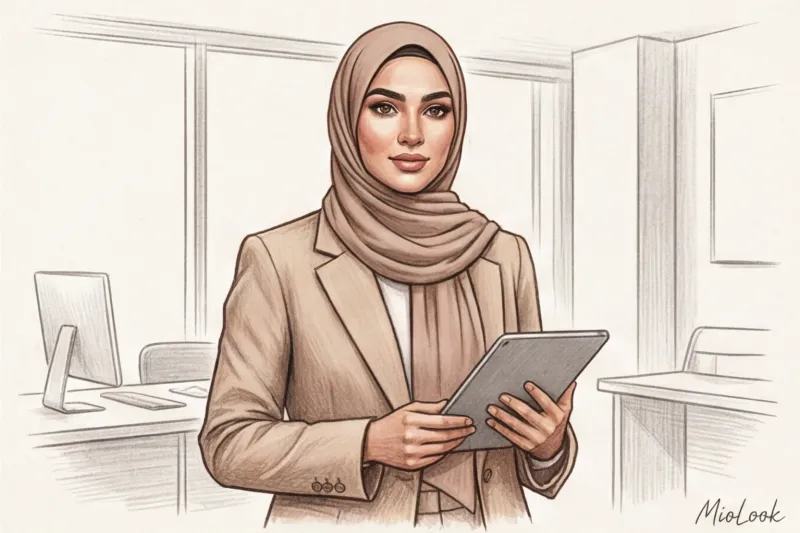
Rules for pairing with a classic two-piece suit
How to properly incorporate a hijab into an ensemble with a classic women's business suit? The main rule: the fabric weights should match. If you're wearing a jacket made of heavy suit wool (for example, Super 120s), the scarf shouldn't be translucent or weightless—this will create a cheap, clashing look. Choose a heavy georgette or crepe.
In terms of color, use the "solo base" approach. Pair a dark blue pinstripe suit with a solid hijab in a dusty blue shade (two shades lighter than the jacket). A scarf in cool steel or pearl ecru complements a gray suit perfectly. As experts note in numerous articles on the psychology of business style and executive image, a cohesive and restrained look directly translates into perceived competence.
To avoid wasting precious time in front of the mirror every morning, I advise my clients to digitize their office capsule in advance. By uploading their business suits and matching hijabs to MioLook smart wardrobe , you can put together ready-made formal outfits for the entire work week in just a couple of clicks.
Shape and drape: influence on facial proportions
Even if you have studied it thoroughly, How to choose the color of a hijab Depending on your skin tone, an incorrectly draped scarf can ruin all your efforts. Many women come to me for consultations convinced that a scarf makes their face look wider or accentuates their cheeks. In fact, it's not a matter of anatomy, but of geometry. Fabric against the face acts like a rigid mat for a painting: it can elongate the silhouette, hide sharp angles, or, conversely, transform a perfect oval into a sphere. Over the years, I've developed a clear principle: a well-placed drape can completely replace professional makeup and contouring.
If you have round face The main mistake I regularly see on the street is a scarf tied tightly just under the chin, with the edges hugging the cheeks. This visually "cuts off" the neck and creates a closed circle. Our goal is to create an optical vertical line. We strictly avoid scarves tied tightly under the chin and create straight vertical lines around the cheeks. To achieve this, I recommend creating a stiff corner (visor) above the forehead using starched cotton or thick crepe. The edges of the scarf should hang along the cheekbones in straight, loose lines, not pressed tightly against the skin. It's best to pin the scarf 1-2 centimeters below the natural jawline—this will instantly lengthen the neck.
WITH square and rectangular face shapes We're solving the exact opposite problem. Here, we need to balance out strict geometry and soften the active angles of the jaw. Symmetrical, tight, "trumpet"-style wraps (where the fabric clings tightly to the head and neck) are contraindicated here. When I was putting together a capsule wardrobe for one of my clients with a pronounced rectangular face shape, we completely avoided stiff fabrics like taffeta. Your best tool is asymmetrical draping and soft folds. Try wrapping the stole so that one end falls loosely over the shoulder, creating a pronounced diagonal. The fabric at the jawline should fall in light, fluid waves. Flowing chiffon, modal, or fine silk are ideal for this effect. This asymmetry draws the focus and visually "cuts" angularity, making the features smoother.
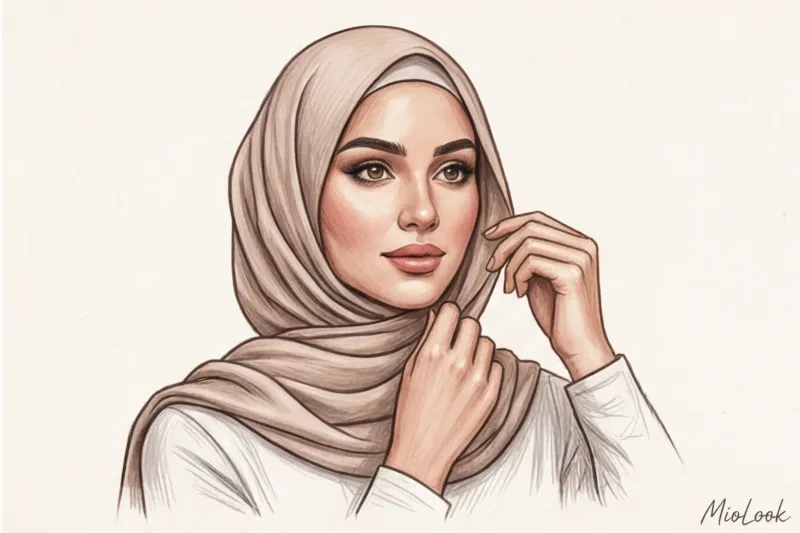
A completely different architecture is required elongated face The main rule is no excess volume at the crown or long, hanging ends of the scarf, which, according to the laws of optics, will only emphasize the vertical line. We need added volume at the sides. Create soft, slightly careless drapes around the ears and cheekbones. Voluminous turban wraps or layered hairstyles made from medium-weight stoles (such as crinkled viscose) are perfect here. However, the most powerful stylistic trick here lies not in the stole itself, but in its base.
Practical stylist tip: the bonnet/underscarf line can completely change the architecture of your face. The brain interprets the line of the fabric as a new hairline, allowing us to control proportions.
If you have a high forehead and an elongated face, move the basic hat down 1.5–2 centimeters, closer to the eyebrows. This will act as a horizontal fringe, visually shortening the forehead and creating a more harmonious face. Conversely, those with a low forehead or a round face should push the hat up as high as possible, tucking it under the edge of the main scarf. This will add airiness and height to the face. If you're unsure whether you've got the proportions right, take a selfie in daylight and upload it to MioLook smart wardrobe — Sometimes a sideways glance through a camera lens or an app analysis helps us see distortions that we simply don't notice in a regular mirror.
Your ideal image
it begins Here
Join thousands of users who look flawless every day with MioLook.
Get access — €0.99 onceA Stylist's Checklist: Putting Together a Basic Hijab Collection
According to a large-scale consumer behavior study (WRAP, 2023), most women regularly wear only 20% of their closet contents. But when it comes to accessories, the statistics are even more dramatic. During wardrobe reviews, I regularly find clients with drawers filled with dozens of scarves, impulse buys on sale. Yet, day after day, they wear the same three favorite stoles. Why waste your budget on visual clutter?
Right now, I suggest you take stock of your inventory and keep only the functional bare minimum. You don't need thirty random shades. For an ideal base that will cover 95% of life situations, it is enough to assemble a capsule according to the formula “2+1+1”.
- Two neutral shades (light and dark). Light is your ideal beige, milky white, taupe, or sand. Dark is deep graphite, bitter chocolate, or rich pine. These are the workhorses of your wardrobe, tying together any outfit, even the most complex.
- One shade of "biological marker". Here's a secret stylist trick: find a color that perfectly matches the shade of your irises or the natural pigment of your lips (for example, a muted dusty pink). This scarf will always look expensive and natural on you, even if you're completely makeup-free.
- One accent color. That perfect dopamine boost for monochrome looks. It could be trendy cobalt, deep burgundy, or a refreshing matcha shade—whatever reflects your mood this season.
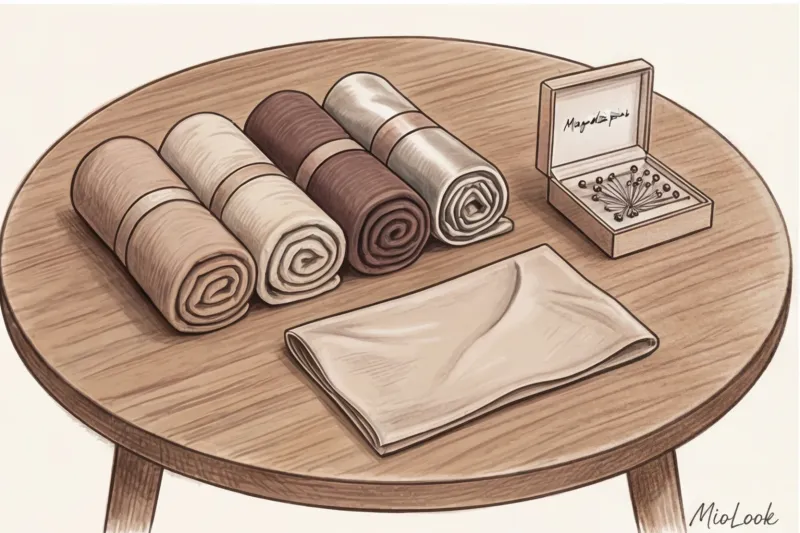
Before you go shopping for missing items, digitize what you already have. I always ask my clients to upload their current items to MioLook — this way, you can visually assess which color accents are missing from your virtual closet and try on new combinations in advance in the smart wardrobe section.
Accessories: How to Avoid Ruining Premium Fabric in a Week
The most common cause of a good scarf's ruin isn't washing, but cheap safety pins. A regular metal pin with a poorly polished eyelet leaves microscopic snags in the viscose and tears the delicate threads of the chiffon. After 5-7 uses, untidy fringe and holes form under the chin.
If you want your items to last for years, invest in the right hardware. Switch to neodymium hijab magnets—they have incredible adhesion strength and securely hold even thick layers of jersey in place, yet they don't damage the fibers at all. For intricate draping that requires pinning, use only snag-free pins made of medical-grade stainless steel.
An investment that pays off: premium nude
I often hear the question: why buy a basic beige stole for €60-80 when there are plenty of similar ones available at the mass market for €10? The answer lies in durability and light reflectivity.
A nude hijab is the item you'll wear most often. It sits closest to your face. Budget polyester not only attracts static and creates a greenhouse effect on your scalp, but also shimmers cheaply in the sun, revealing its synthetic origins. A high-quality stole made of premium modal, bamboo, or a silk-cotton blend has a refined matte texture with a subtle inner glow. It drapes softly, creating heavy folds, doesn't pill after the tenth wash, and retains its shape all day long.
To summarize our guide, I want to remind you of the most important rule of conscious style: a hijab isn't an attempt to hide, it's a frame for you. How you match the hijab's color to your complexion, its texture to your look, and its shape to your proportions directly impacts how others perceive you. Stop buying random items. Invest in quality, explore your contrasts, and build a wardrobe that will boost your confidence every minute.
Guide Chapters
The Perfect Hijab for an Evening Dress: How to Choose the Fabric
Learn how to choose the right scarf fabric for a formal look and avoid common mistakes. Stylists' secrets will make your outfit truly luxurious.
Business style, hijab: stylish looks for the office
Business attire and the hijab are complex affairs that don't tolerate fuss. We discuss with a professional stylist how to create a strict and authoritative look for the office.
What color hijab goes with a black dress: 5 options
A black dress absorbs light, so choosing the color and texture of your scarf is crucial. Discover 5 fail-safe ways to style a basic look.
How to Choose a Hijab Hat: A Stylist's Guide
A basic hat is the architectural foundation of your look. Learn how to choose the perfect style to ensure your hijab stays in place all day without causing discomfort.
The Perfect Hijab for an Oval Face: Styling Tips
A personal stylist's advice on choosing a hijab for oval and oblong faces. Learn how to highlight your beauty with the right drape.
How to tie a hijab for a round face without making mistakes
Forget the clichéd advice to "just hide your cheeks with fabric." Learn how to visually lengthen a round face with the right lines.
Hijab Color by Color Type: How to Find the Perfect Shade
The traditional color classification system breaks down when you cover your head. Learn how to correctly determine your ideal hijab base shade.
The Perfect Hijab Color for Dark Skin: A Guide and Tips
Tired of a dull complexion? Learn how to choose the right scarf shade for dark skin and avoid common color mistakes.
Winter Hijab Fabrics: Warmth Without the Greenhouse Effect
Tired of the greenhouse effect in the subway and the cold outside? Find out why the thickness of the material doesn't keep you warm and choose the perfect winter hijab.
The Perfect Hijab Color for Fair Skin: The Best Shades
A scarf worn near the face operates according to the strict laws of optics, acting as a personal light reflector. Let's explore which shades truly brighten porcelain skin.
Summer Hijab Fabric: What to Wear in 30+ Degrees
Natural fabrics aren't always the answer in extreme heat. We'll explore how to choose a summer hijab to maintain healthy skin and a chic look.
How to Match Your Hijab Color with Your Outfit: Styling Tips
A perfect tone match isn't the key to a stylish look. Find out why the texture and quality of the fabric are more important than the number of scarves in your wardrobe.